Our readers keep the lights on and my smoothie glass nicely filled. As an Amazon Associate, I earn from qualifying purchases.
When a birth certificate holds a blank space or a family story has a missing chapter, the search for biological parents becomes an emotional and logistical challenge. At-home DNA tests have transformed this journey, offering a direct genetic link to relatives you never knew existed. These kits use your unique genetic markers to connect you with a database of potential family members, building a bridge where traditional records fail.
I’m Mohammad Maruf — the founder and writer behind WellFizz. I’ve spent hundreds of hours analyzing the genetic databases, privacy policies, and matching algorithms of the leading DNA services to help you choose the right tool for this deeply personal search.
This guide breaks down the top options for an at-home DNA test, focusing on the database sizes, relative-finder features, and privacy controls that actually matter when you are searching for a biological parent or sibling. Read on to find the best dna test to find biological parents for your unique situation.
How To Choose The Best DNA Test To Find Biological Parents
Finding a biological parent through a DNA test is unlike tracing general ancestry. Your primary tool is the relative finder feature, and the single most important factor is the size of the company’s genetic database. The larger the database, the higher the probability that a close relative—a parent, half-sibling, or first cousin—has also tested. Beyond database size, you need to consider how the service displays DNA segment data, whether it allows you to contact matches, and the tools it offers to build a family tree around those matches. A test that excels at pinpointing your ethnic origins may be worthless for finding a biological parent if it has a small or inactive matching pool.
The Database Size Rule
AncestryDNA and 23andMe own the two largest consumer genetic databases in the world. AncestryDNA has a clear edge for finding biological relatives because its user base is heavily oriented toward genealogy and family tree building. Many users are actively researching their ancestry and will respond to messages. 23andMe also has a large database, but its user base is more split between ancestry and health insights. Services with smaller databases, while excellent in specific niches, drastically reduce your chance of a parent match. Always check the total number of tested users and the company’s privacy policy regarding data sharing for relative matching. A test is only as valuable as the network it connects you to.
Relative Finder and Contact Tools
Not all relative finder features are created equal. The best ones provide a list of matches ranked by the amount of shared DNA (measured in centimorgans). This metric is critical—a shared match of 3,500 cM indicates a parent relationship, while 1,750 cM indicates a full sibling. The service should also offer a straightforward way to view your matches’ public family trees and a built-in messaging system to contact them. Some services, like AncestryDNA, require a subscription to access advanced tree-building and record-matching tools, which are often necessary to confirm a relationship and build out a biological family line. Others offer these features for free once you have purchased the test.
Autosomal vs. Mitochondrial/Y-DNA Analysis
Standard autosomal DNA tests (used by AncestryDNA and 23andMe) analyze DNA inherited from both parents and are the best tool for finding close relatives, including parents and siblings. They can trace ancestry back roughly 5–7 generations. For deeper research into a specific paternal line (the father’s father’s father), you would need a Y-chromosome DNA (Y-DNA) test, which is only available to male testers. Similarly, a mitochondrial DNA (mtDNA) test traces the maternal line (the mother’s mother’s mother). These specialized tests are niche tools for advanced genealogy and genetic genealogy companies, but the most efficient path to finding a biological parent starts with a standard autosomal test from a major database. The goal is density of matches, not depth of lineage.
Privacy and Data Control
Before sending your saliva to any lab, understand how your genetic data will be stored and shared. Each service uses anonymized data to improve its algorithms and may share aggregate data with research partners. The best options allow you to opt out of research programs and delete your raw data and sample after processing. You also need to know if your profile is automatically included in the relative finder tool and whether you can control the amount of information visible to your DNA matches. Services like 23andMe offer granular controls, while others may default to a more open sharing model. For a sensitive search like finding a biological parent, having the ability to control your own visibility and data retention is non-negotiable.
Quick Comparison
On smaller screens, swipe sideways to see the full table.
| Model | Category | Best For | Key Spec | Amazon |
|---|---|---|---|---|
| AncestryDNA | Autosomal | Largest genealogy database | 3,600+ geographic regions | Amazon |
| 23andMe Ancestry Service | Autosomal | Data privacy and health upgrade | 4,500+ geographic regions | Amazon |
| 23andMe Health + Ancestry | Autosomal | Health insights alongside ancestry | 100+ health reports, FDA-authorized | Amazon |
| Choice DNA Sibling Test | Relationship Test | Sibling confirmation | Results in 2-6 days | Amazon |
| Wisdom Panel Essential Dog DNA | Canine DNA | Mixed breed identification | 430+ breeds, 30 health conditions | Amazon |
| Wisdom Panel Breed Discovery Dog DNA | Canine DNA | MDR1 medication sensitivity test | 3-generation family tree | Amazon |
| Embark Breed Identification Dog DNA | Canine DNA | High-accuracy breed breakdown | 400+ breeds, research-grade genotyping | Amazon |
| Embark Breed & Health Dog DNA | Canine DNA | Comprehensive health screening | 270+ health conditions, allergy risk | Amazon |
| Embark Purebred Dog DNA | Canine DNA | Purebred confirmation and COI | Coefficient of Inbreeding (COI) | Amazon |
In‑Depth Reviews
1. AncestryDNA
AncestryDNA is the gold standard for finding biological parents, purely by virtue of its massive, genealogy-focused user database. When you are searching for a parent, your chance of a match scales directly with the number of people in the pool, and Ancestry’s database dwarfs all other consumer services. Its SideView technology is particularly useful, as it separates your DNA matches into your maternal and paternal sides, effectively turning a standard autosomal test into a more targeted search tool. The test covers over 3,600 geographic regions and provides a detailed ethnicity estimate that can offer clues when you are building a case for a specific family line.
The process is simple: you activate the kit online, provide a saliva sample, and mail it back using the prepaid envelope. Results arrive in about four to six weeks. The online platform is intuitive, allowing you to filter relative matches by shared DNA in centimorgans (cM) and view deeper connections using family trees. The larger the family tree you build, the more Ancestry’s record-matching algorithms can suggest potential relatives. While a free account allows you to see matches and basic tree structures, a paid subscription is recommended to unlock the full power of their historical record database for confirming links.
Reviews consistently highlight its ability to find close relatives that other tests miss, making it the first choice for adoptees and those with unknown parentage. The primary trade-off is that AncestryDNA does not include any health reports. If you want FDA-authorized health insights alongside your ancestry search, you would need to purchase a separate test from 23andMe. For the sole goal of identifying a biological parent, AncestryDNA remains the most effective tool due to its unrivaled network and robust tree-building resources.
Why it’s great
- Largest consumer DNA database increases chance of a close relative match.
- SideView technology automatically sorts matches by paternal and maternal sides.
- Powerful family tree builder and record-matching tools with subscription.
Good to know
- Does not provide any health or wellness reports.
- Full tree features require an Ancestry subscription.
- Ethnicity estimates are estimates, not exact percentages—use them as clues, not facts.
2. 23andMe Ancestry Service
23andMe is a strong competitor for finding biological parents, offering a refined user experience and a database that, while smaller than Ancestry’s, is still substantial. Its DNA Relative Finder has successfully reunited numerous families, and its geographic breakdown is often more granular, sometimes pinpointing specific valleys or villages. The 23andMe platform is also known for its strict privacy controls, giving you full authority over how your data is used and who can see you in the relative finder. This is a significant consideration for those entering a sensitive search and wanting to maintain discretion.
The Ancestry Service kit uses the same simple saliva collection method, with results typically available in four to five weeks. One of its most practical features is the Ancestry Timeline, which estimates when your most recent ancestors from each population lived, offering chronological clues for your search. The test also includes over 30 trait reports, from cilantro aversion to sleep habits, which can add a fun layer of personal discovery to the process. However, the core value for a biological parent search remains the relative matching, and 23andMe provides a clear list of matches with shared DNA data.
A key differentiator of 23andMe is the easy upgrade path to its Health + Ancestry service. If you start with the Ancestry Service and later decide you want health reports, you can upgrade from your account without re-testing. Reviews confirm its accuracy in finding close relatives, with many users reporting that a 23andMe test was the key to unlocking a decades-old family mystery. The database is large enough that the probability of a parent-level match is high, and the combination of privacy features and upgrade flexibility makes it a top-tier choice for those who want control over their data and the option to explore health insights later.
Why it’s great
- Strong privacy controls let you opt out of research and delete your data.
- Detailed ancestry breakdown with specific regional and ancestral group data.
- Easy upgrade path to Health + Ancestry service later.
Good to know
- User database is smaller than AncestryDNA for genealogy-focused matching.
- No historical record library for building family trees.
- Some users report fewer close relative matches than Ancestry.
3. 23andMe Health + Ancestry Service
The 23andMe Health + Ancestry Service is the premium option for those who want the full picture—both a biological parent search and a comprehensive health risk assessment. It offers the same robust relative finder and detailed geographic ancestry as the Ancestry Service, but adds FDA-authorized reports on health predispositions (like type 2 diabetes, breast cancer markers), carrier status for inherited conditions (like cystic fibrosis), and wellness insights for diet, exercise, and sleep. This dual-purpose test is ideal for someone who wants to know their genetic health risks while also searching for family.
The test uses the same simple saliva collection and prepaid mailer, with results arriving in four to five weeks. The online dashboard is split into two clear sections: Ancestry and Health. Under Ancestry, you will find the DNA Relative Finder, maternal and paternal haplogroups, and Neanderthal ancestry. Under Health, you will find actionable reports that can be shared with your doctor. The health insights are scientifically robust, and the carrier status reports are particularly valuable for family planning. Reviews consistently note that the health information often provides unexpected but valuable data, such as confirming a genetic predisposition for celiac disease or lactose intolerance.
For the biological parent search, the core functionality remains identical to the standard Ancestry Service: the same database, same relative finder, same privacy controls. The premium price buys you the health data and the convenience of one test rather than two. If you are an adoptee or have an unknown parentage situation, the health reports can offer useful data points about your genetic predispositions that you cannot get from a family medical history. The Health + Ancestry Service is therefore the most comprehensive single purchase, providing the tools to find your roots and insights to manage your future health.
Why it’s great
- FDA-authorized health reports provide genetic risk and carrier status data.
- Combines ancestry, relative finder, and health insights in one kit.
- Eligible for FSA/HSA reimbursement.
Good to know
- More expensive than the Ancestry-only version.
- Health results can be emotionally confronting for some users.
- Direct-to-consumer health reports are not a substitute for clinical genetic counseling.
4. Choice DNA Full or Half Sibling DNA Test

Choice DNA provides a targeted relationship test rather than a broad ancestry service. This is a direct-to-home DNA test specifically designed to confirm whether two individuals are full siblings or half siblings. It is not a tool for a general search or for connecting with unknown relatives. Instead, it is a definitive confirmation test. If you have a specific person you believe is your biological sibling, this kit provides a clear, scientific answer without the complexities of a genealogical database. The turnaround time of two to six days is a major advantage when there is an immediate need for an answer.
The kit is straightforward: each participant uses four buccal swabs to collect a high-quality DNA sample, which is then sealed in secure envelopes and returned in the prepaid FedEx mailer. The lab uses autosomal DNA markers to calculate the probability of a full or half sibling relationship, returning a clear report that can be shared with family members. The process is private and discreet, with no third-party database exposure. Customer support is directly available by phone or email, which is helpful for those navigating a sensitive family situation.
User reviews highlight the speed and clarity of the results, with many expressing relief at the straightforward nature of the process. However, because this is a targeted test, it will not help you search for a parent whose identity you do not know. It is the right tool when you already have a suspect and need a legal-grade confirmation. It is a separate tool from the large database services and serves a different purpose in the biological parent search toolkit. For a targeted sibling confirmation, Choice DNA offers speed, clarity, and privacy.
Why it’s great
- Fast turnaround with results available in 2 to 6 days.
- Clear, definitive sibling relationship report without database complexity.
- Private and discreet process suitable for sensitive searches.
Good to know
- Only confirms a relationship between two specific individuals.
- Does not provide ancestry breakdown or relative database matching.
- Some users have reported delays in receiving results.
5. Wisdom Panel Essential Dog DNA Test
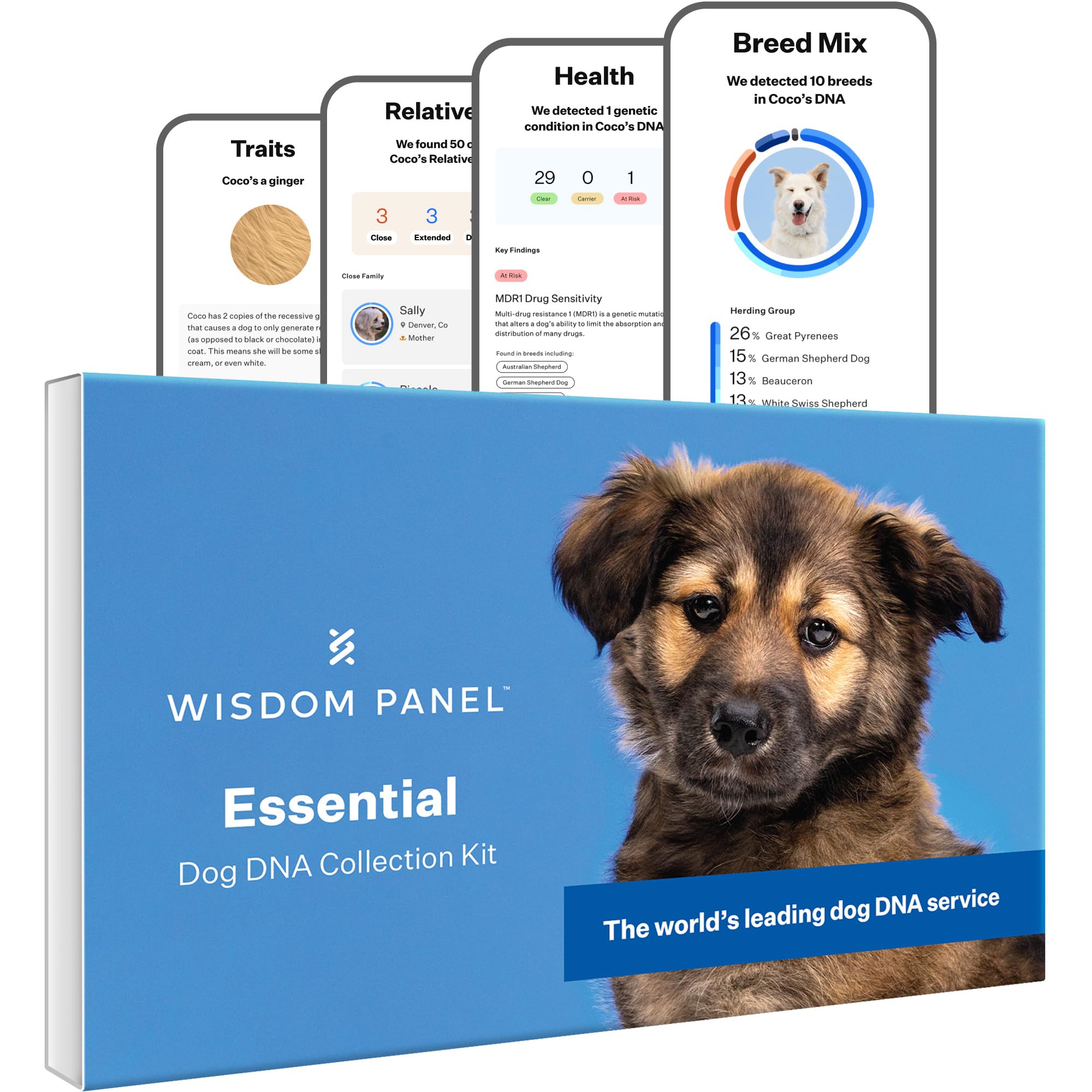
The Wisdom Panel Essential kit is a leading option for dog owners who want to understand their pet’s breed composition with high accuracy. It screens for over 430 breeds, providing a detailed breed breakdown down to 1%. For mixed-breed rescue dogs, this is the primary tool to answer the question “what is my dog?” The test also screens for 30 genetic health conditions, including MDR1, which indicates a sensitivity to certain common medications. This dual-purpose approach—breed plus health—makes it a comprehensive tool for any responsible dog owner.
The collection process uses a simple cheek swab that is painless for the dog. You swab the inside of the dog’s cheek, air-dry the swab, and return it using the prepaid mailer. Results typically arrive in two to three weeks. The online report is detailed, showing breed percentages, a family tree going back three generations, and behavioral trait predictions. A standout feature is the relative finder, which uses the world’s largest dog breed database to connect your dog with possible siblings or other relatives, allowing you to exchange photos and messages.
Customer reviews praise the Essential kit for its accuracy and the depth of the health screening. Many owners report that the test confirmed or corrected their vet’s initial breed guess. The health insights, particularly the MDR1 test, have been described as potentially life-saving for dogs that carry the mutation. The primary limitation is the lack of maternal or paternal line tracking that some specialized tests offer. For the vast majority of pet owners, the Wisdom Panel Essential kit delivers the most valuable balance of breed accuracy and health screening in a straightforward, affordable package.
Why it’s great
- Screens for 30 genetic health conditions including MDR1 drug sensitivity.
- World’s largest breed database with 4.5 million pet profiles for relative matching.
- Detailed family tree going back three generations.
Good to know
- Some users report lower confidence for extremely complex breed mixes.
- Does not offer the same depth of health screening as Embark.
- Relative finder lacks sorting features found in some competitors.
6. Wisdom Panel Breed Discovery Dog DNA Test
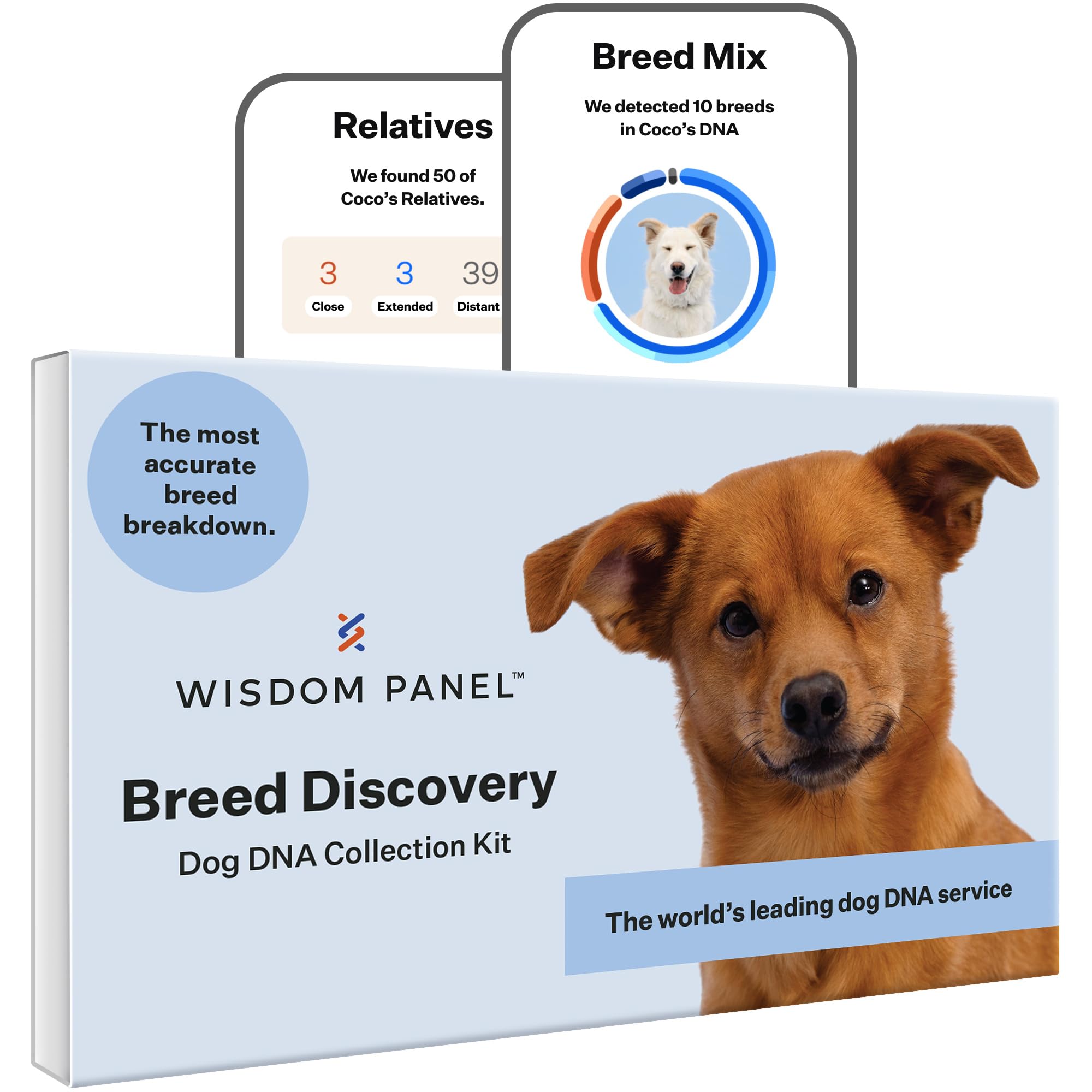
The Wisdom Panel Breed Discovery kit is a streamlined version focusing on breed identification and a single critical health test: MDR1. For owners who do not need the broader health panel of the Essential kit, this option provides the same powerful breed detection engine at a lower cost. It still screens for over 430 breeds and provides a detailed percentage breakdown. The breed discovery is often surprisingly accurate, with many owners finding that their rescued dog has a mix of breeds they never would have guessed, which can help tailor training and exercise plans.
The cheek swab process is identical to the Essential kit: a quick 30-second swab per cheek, an air-dry period, and a prepaid return mailer. Results take two to three weeks. The online dashboard is user-friendly and offers a clear breakdown of breed percentages, a three-generation family tree showing the ancestry mix, and a behavior insights section that predicts tendencies based on breed composition. The relative finder feature connects you with other dogs in the Wisdom Panel database, and over 99% of dogs tested find a relative match. This can be a fun and emotionally rewarding feature.
Reviews for the Breed Discovery kit are generally positive, with users appreciating its simplicity and speed. The biggest differentiator between this and the Essential kit is the number of health conditions tested; the Breed Discovery tests only for MDR1. For owners of mixed breeds where health history is unknown, the Essential kit provides better value due to its comprehensive health screening. The Breed Discovery kit is the ideal entry-level choice for someone who simply wants to know their dog’s breed breakdown and is not as concerned about a full health panel. It is a fast, accurate, and budget-friendly tool for canine breed identification.
Why it’s great
- Accurate breed breakdown for over 430 breeds down to 1%.
- Includes the critical MDR1 drug sensitivity test.
- Fast results, typically within 2-3 weeks.
Good to know
- Only tests for one health condition (MDR1) unlike the Essential kit.
- Swab design is disliked by some dogs who find the bristle texture uncomfortable.
- Behavioral trait predictions are general and should not replace professional training assessment.
7. Embark Breed Identification Dog DNA Test

Embark’s breed identification kit represents the pinnacle of accuracy for mixed-breed dogs, utilizing a research-grade genotyping platform developed in partnership with Cornell University College of Veterinary Medicine. This test screens for over 400 dog breeds, as well as wild canines like wolves, coyotes, and dingoes, offering the most thorough breed breakdown available. For owners of a rescue dog with a truly mysterious background, Embark provides the highest confidence in its breed analysis. The test reports show the precise percentage of each breed and can reveal the ancestral origin stories for each line.
The collection process is a simple cheek swab, and results generally arrive in two to four weeks. A standout feature is Embark’s Relative Finder, which uses patented technology to match your dog with its genetic relatives. Over 90% of tested dogs find a close relative, with 12% discovering a direct parent or sibling. The platform allows you to connect with your dog’s family via a built-in message system. The test also includes a new Personality Quiz that helps differentiate between instincts driven by breed and those that are uniquely your dog’s.
User reviews consistently highlight the surprising accuracy of the breed breakdown, with many owners commenting that the test revealed breeds they would never have guessed. The connection to Cornell University gives the test a high degree of scientific credibility. The primary drawback is the price point, which is higher than Wisdom Panel’s equivalent offering. Additionally, the base kit does not include the extensive health screening of the Embark Breed & Health version. For pure breed identification and relative finding with maximum scientific rigor, Embark is the top choice. It is the most reliable tool for the serious breeder or the owner of a truly enigmatic mutt.
Why it’s great
- Research-grade genotyping platform developed with Cornell University.
- Most accurate breed identification with 99% accuracy for mixed breeds.
- World’s first canine relative finder with high match rates across relatives.
Good to know
- More expensive than the Wisdom Panel breed-only tests.
- Health screening is limited in this base kit compared to the Embark Health version.
- Some users find the health and trait upgrade expensive.
8. Embark Breed & Health Dog DNA Test
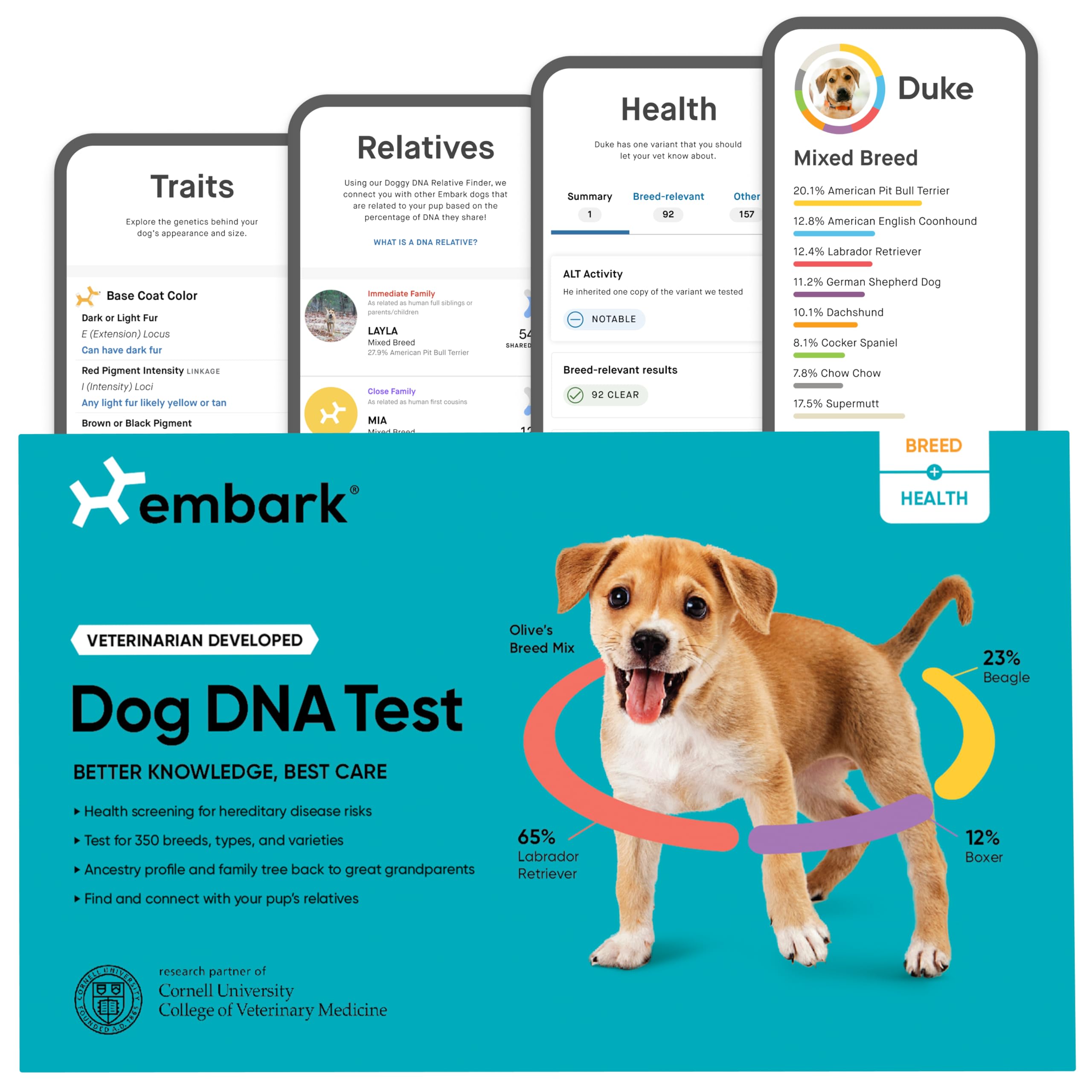
Embark Breed & Health is the most comprehensive canine DNA test available, combining the top-tier breed identification engine with a health screening panel that covers over 270 genetic health conditions. This is the definitive test for any owner who wants the fullest possible understanding of their dog’s physical makeup and health risks. The test includes an Allergy Risk Score, which is exclusive to Embark and assesses your dog’s risk for environmental, food, contact, and flea allergies. This proactive health data allows you to adjust diet and environment before symptoms develop.
The test also screens for 55 physical traits, from coat characteristics to the POMC gene (the ‘always-hungry’ gene), giving you predictions about your dog’s adult size, shedding levels, and grooming needs. For owners of a new puppy, this trait screening is particularly valuable for preparing for the dog’s future. The Cornell University partnership underpins the scientific validity of both the breed and health results. The relative finder is included, allowing you to connect with your dog’s siblings and ancestors.
Customer feedback is overwhelmingly positive, with many owners reporting that the health insights have led to concrete changes in their dog’s diet, exercise, and veterinary care. Reviews note that after receiving their results, 37% of owners changed how they care for their dog. The primary considerations are the cost, which is the highest on the market, and the longer processing time of up to four weeks. For the owner who wants the gold standard of canine genetic testing—from breed confirmation to deep health risk analysis—Embark Breed & Health provides the most actionable and comprehensive data available. It is a substantial investment in your dog’s long-term health management.
Why it’s great
- Tests for over 270 genetic health conditions and an exclusive Allergy Risk Score.
- Developed with Cornell University for high research-grade accuracy.
- Screens for 55 physical traits including the ‘always-hungry’ POMC gene.
Good to know
- The most expensive dog DNA test on the market.
- Results can take up to 4 weeks to process.
- Some health results may cause anxiety without immediate vet consultation.
9. Embark Purebred Dog DNA Test

Embark Purebred Dog DNA Test is a specialized version of the Embark platform, designed for owners of registered purebred dogs who want to confirm their dog’s genetic breed purity and assess inbreeding levels. The key feature here is the Coefficient of Inbreeding (COI), which measures genetic diversity within the breed. A high COI can indicate a higher risk for recessive genetic conditions, making this test a crucial tool for responsible breeders and owners who want to understand their dog’s genetic health risks at a deeper level. It tests for the same 270+ health conditions as the Breed & Health version.
The test screens for 55 physical traits and includes the relative finder, allowing you to connect your purebred dog with relatives across the Embark database. This is particularly useful for breeders tracking lineage or owners who want to find siblings from the same litter. The test also provides purebred confirmation, validating that your dog’s genetic profile matches its breed’s expected markers. The collection method is the same simple cheek swab, with results in two to four weeks.
Reviews from purebred owners and breeders are highly positive, highlighting the COI report as a key differentiator from other tests. Knowing the inbreeding level helps make informed breeding decisions to improve genetic diversity. The health screening component is also appreciated, with one user noting the test revealed MDR1 drug sensitivity that was previously unknown. The primary limitation is that this test is overkill for owners of mixed breed dogs who are better served by the standard Embark Breed Identification kit. For the serious purebred owner or breeder, the COI data combined with the full health panel makes this the most relevant test on the market. It is a precision tool for breed management.
Why it’s great
- Provides Coefficient of Inbreeding (COI) report for genetic diversity assessment.
- Confirms purebred status with high accuracy.
- Tests for 270+ health conditions and 55 physical traits.
Good to know
- Expensive compared to purebred confirmation alternatives.
- Not useful for owners with mixed breed dogs.
- Focus on COI may not be relevant for casual owners.
FAQ
Can a DNA test find my biological parent if they have not taken the test?
What is the difference between a DNA sibling test and a DNA ancestry test for finding a parent?
How long does it take to get results for a biological parent DNA test?
Is my DNA data safe and private when I use these services?
Final Thoughts: The Verdict
For most users, the dna test to find biological parents winner is the AncestryDNA because its massive genealogy-focused database provides the highest probability of finding a close relative match. If you want strong privacy controls and the option to upgrade to health insights later, grab the 23andMe Ancestry Service. And for a fast, definitive confirmation with a specific relative, nothing beats the Choice DNA Sibling Test.

Mo Maruf
I created WellFizz to bridge the gap between vague wellness advice and actionable solutions. My mission is simple: to decode the research and give you practical tools you can actually use.
Beyond the data, I am a passionate traveler. I believe that stepping away from the screen to explore new environments is essential for mental clarity and physical vitality.