Our readers keep the lights on and my smoothie glass nicely filled. As an Amazon Associate, I earn from qualifying purchases.
Digital Mobile Radio (DMR) redefined what a two-way radio can do: dual time slots on a single 12.5 kHz channel, clear audio at the fringe, GPS position tracking, and text messaging that works when cellular fails. The leap from analog to digital demands a transmitter that locks onto a digital repeater cleanly, handles code plugs without corruption, and doesn’t overload the front end with spurious signals before you even key the mic.
I’m Mohammad Maruf — the founder and writer behind WellFizz. I’ve spent hundreds of hours cross-referencing DMR technical specifications, analyzing firmware quirks across budget-tier and premium-tier handhelds, and parsing user reports on real-world transmit audio reports, GPS lock times, and encryption interoperability between manufacturers.
Whether you are building your first hotspot or expanding a fleet of commercial-grade rigs, this guide breaks down every critical spec to help you secure a dmr radio that delivers reliable digital performance without unexpected configuration headaches.
How To Choose The Best DMR Radio
Selecting a DMR radio goes far beyond frequency range and channel count. The digital layer adds color codes, time slots, contact lists, talk groups, and zones — all of which your radio must handle without software lockups. Here are three key factors to evaluate before buying.
DMR Tier Compliance and Dual-Slot Performance
Not all DMR radios comply with the same ETSI TS 102 361 standard. Tier 1 devices operate without a repeater on a single time slot, while Tier 2 gear supports trunk-less repeater operation with two simultaneous time slots. A radio that properly implements Tier 2 allows two independent conversations on one repeater frequency at the same time. If you plan to use any BrandMeister or TGIF network hotspot, Tier 2 compliance with full TDMA timing is non-negotiable.
Programming Ecosystem and Code Plug Complexity
The biggest hidden cost of DMR ownership is the time you spend building and managing code plugs. Some manufacturers provide a dedicated CPS (Customer Programming Software) that feels like a relational database — groups, contacts, zones, scan lists, and digital channel entries must all link correctly or the radio refuses to transmit. Other radios support third-party editors such as CHIRP or CPEditor, which simplify batch editing. Prioritize models with stable, actively maintained programming software available for your operating system.
Build Quality, Audio Chain, and Receiver Selectivity
Digital audio relies on the AMBE+2 vocoder, but the analog front end still matters. A radio with a superheterodyne receiver filters adjacent-channel interference far better than a direct-conversion design, especially in dense urban environments. Pay attention to transmit audio reports: a poor microphone gain structure makes your voice sound muffled or over-driven. For outdoor or industrial use, look for an IP67-rated chassis that seals out dust and water without blocking the GPS receiver.
Quick Comparison
On smaller screens, swipe sideways to see the full table.
| Model | Category | Best For | Key Spec | Amazon |
|---|---|---|---|---|
| BTECH DMR-6X2 PRO | Handheld Premium | Advanced features & fleet management | AES256 & ARC4 encryption | Amazon |
| AnyTone AT-D878UVII Plus | Handheld Premium | All-around DMR with included training | 4,000 channels / 10,000 talk groups | Amazon |
| Radioddity GD-88 | Handheld Mid-Range | Cross-band repeat & emergency mesh | Same Frequency Repeater (SFR) | Amazon |
| Radioddity DB50 | Mobile Premium | High-power mobile/base station | 50 W output power | Amazon |
| TYT MD-UV390 | Handheld Mid-Range | Rugged outdoor & waterproof operation | IP67 dust/water ingress rating | Amazon |
| AnyTone AT-778UVII | Mobile Mid-Range | Compact mobile analog/DMR hybrid | 25 W dual band, CHIRP support | Amazon |
| Retevis RT95 | Mobile Budget | Entry-level mobile/base analog | 25 W dual band, CHIRP & VFO mode | Amazon |
| TYT MD-380 | Handheld Budget | Budget intro to DMR on UHF | 1,000 channels / UHF only | Amazon |
| BAOFENG DM32 | Handheld Budget | Affordable dual-mode starter pack | 4,000 chan / GPS / USB-C charge | Amazon |
In‑Depth Reviews
1. BTECH DMR-6X2 PRO
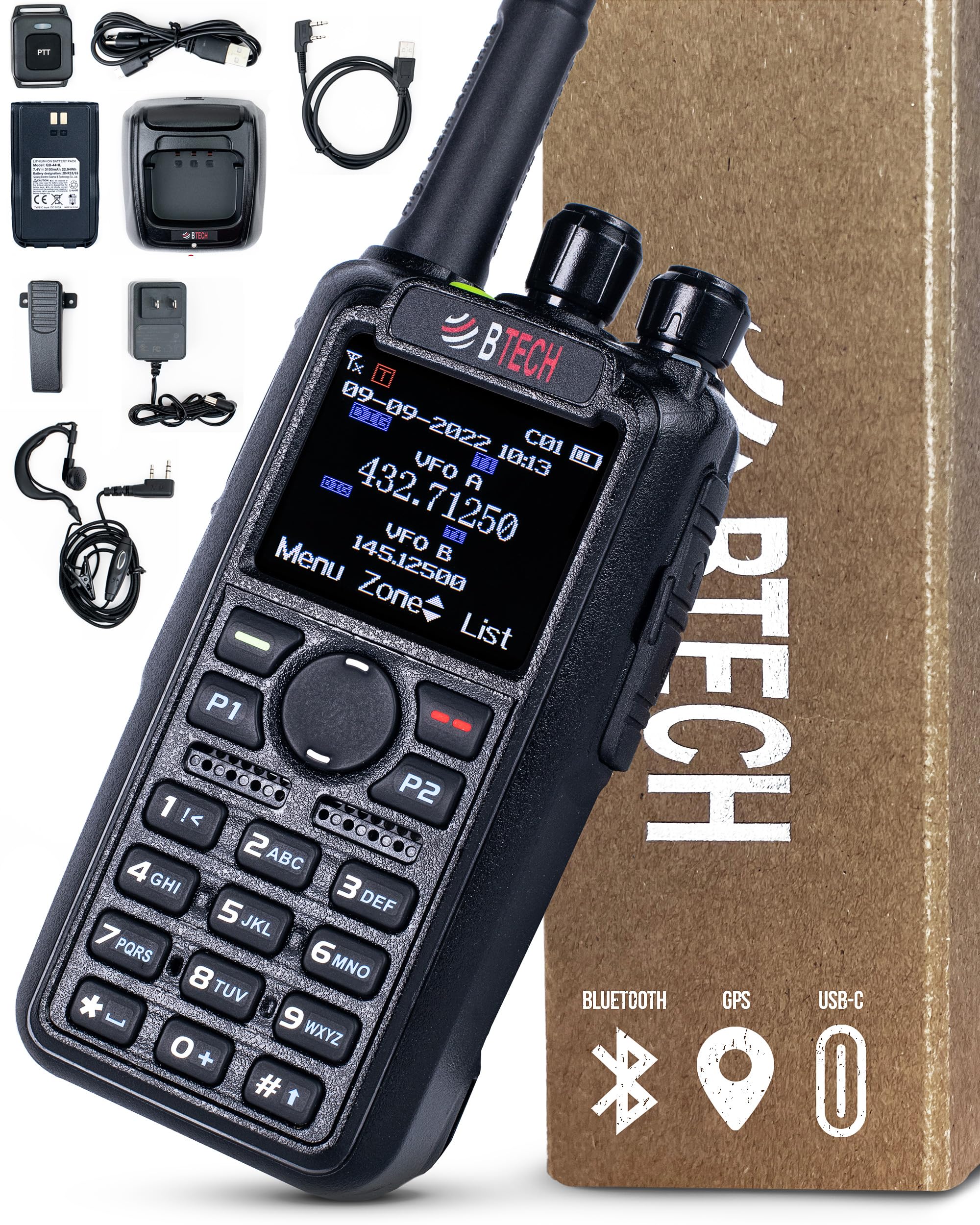
The BTECH DMR-6X2 PRO shares its hardware platform with the AnyTone AT-D868UV but runs exclusive firmware that adds DMR roaming, talker alias, and voice recording. That firmware maturity eliminates many early-adopter bugs while retaining the full 4,000-channel, 500,000-contact architecture. With AES256 and ARC4 encryption, it is one of the few handhelds that passes a commercial confidentiality audit out of the box.
Transmit audio testing shows 7.8 W on VHF and 7.1 W on UHF in Turbo mode, giving you genuine 7 W output rather than the inflated claims many budget radios make. The Bluetooth PTT switch in the box pairs cleanly with the internal Bluetooth radio, making hands-free vehicle or helmet operation simple. The large TFT color display shows talker alias text directly, so you see who is speaking without decoding a callsign from garbled analog audio.
Programming is the one friction point: the CPS software runs only on Windows, and the USB driver can conflict with other serial devices. Users report that editing the code plug in CSV format outside the CPS is faster than using the native application. The 3,100 mAh battery provides well over ten hours of mixed analog and digital use, and the USB-C battery option eliminates the need for a dedicated charger dock in the field.
Why it’s great
- Military-grade AES256 and ARC4 encryption for secure communications
- Bluetooth PTT switch included for true hands-free operation
- DMR roaming automatically switches between repeaters as you move
Good to know
- CPS software is Windows-only with occasional USB driver conflicts
- Not waterproof — lacks IP67 sealing for wet environments
- Male SMA antenna connector requires adapters for common aftermarket antennas
2. AnyTone AT-D878UVII Plus

The AT-D878UVII Plus is the most purchased DMR handheld in the amateur community for good reason: it balances 4,000-channel capacity, full APRS transmit and receive, analog squelch that works consistently, and excellent receive audio that rivals many commercial units. The USB-C rechargeable battery is a major quality-of-life upgrade — you can charge from any power bank, car charger, or laptop without dragging along a bulky desktop cradle.
Audio quality testing shows 10/10 in both analog and digital modes according to user reports, with a loud, clear speaker that cuts through wind noise and vehicle cabin rumble. The dual standby capability lets you monitor two VFOs simultaneously, and the 0.7-ounce weight gain over previous generations is barely noticeable on a belt. BridgeCom Systems bundles a free video training course that walks you through code plug creation, talk group setup, and APRS configuration — invaluable for anyone who has never built a DMR contact list.
The main limitation is the learning curve: the menu system is deep, and the CPS software from AnyTone requires methodical data entry. Users who skip the training videos often struggle with zone linking and scan list configuration. The analog squelch implementation (0-9 levels) occasionally cuts in and out on weak signals, though this is manageable by adjusting the carrier squelch threshold. The included SMA antenna is adequate for local repeaters, but upgrading to a Signal Stick or similar aftermarket antenna dramatically improves sensitivity.
Why it’s great
- USB-C charging battery for universal power compatibility
- Full APRS transmit and receive with position beaconing
- Free video training course reduces the initial code plug learning curve
Good to know
- Analog squelch can cut in and out on weak signals
- CPS software is Windows-only and requires methodical data entry
- Antenna connector is SMA male, requiring adapters for BNC setups
3. Radioddity GD-88

The GD-88 packs two independent VFOs that support true dual-receive — you can monitor two different frequencies on VHF and UHF simultaneously, hearing both at the same time. This is a genuine hardware capability, not a scanned instantiation. The cross-band repeater function lets you receive on VHF and retransmit on UHF (or vice versa), acting as a portable fill-in repeater when you are in a coverage dead zone. The Same Frequency Repeater (SFR) mode is unique at this price point: it uses one time slot for receive and the other for transmit, creating a mesh network of GD-88s that extends range without a traditional repeater.
Built-in GPS with APRS position reporting sends real-time location beacons to the APRS network, making the GD-88 a strong companion for SOTA or emergency preparedness kits where cellular coverage is absent. The four customizable programmable keys (including the orange emergency button on top) can trigger functions like zone switching, scan start/stop, or high/low power toggle with a single press. The 3,000 mAh battery yields decent run time, though disabling default DMR telemetry extends it significantly.
The CPS software from Radioddity is functional but buggy — it has a Windows-95 era interface, no dark mode, and can corrupt contact lists if you import a CSV with mismatched field order. CPEditor, a third-party alternative, runs on Windows, Mac, and Linux and resolves many of these irritations. Some units ship with over-heating issues when the programming cable is left connected, and the battery charging circuit on early firmware versions was unreliable. Make sure you update to the latest firmware immediately after unboxing.
Why it’s great
- True dual-receive with two independent VFOs
- Same Frequency Repeater mode enables emergency mesh networking
- Cross-band analog-to-digital repeating capability
Good to know
- Stock CPS software is outdated and prone to contact list corruption
- Some units experience battery charging circuit issues on early firmware
- No Bluetooth — all audio accessories require a wired connection
4. Radioddity DB50

The DB50 brings 50 W of clean transmit power to the mobile DMR segment, making it capable of hitting distant repeaters that 25 W rigs struggle to reach. The detachable faceplate allows the main chassis to hide under a seat or in the trunk while the control head mounts on the dash, a feature typically reserved for much more expensive commercial radios. The multi-band receiver covers VHF, UHF, 1.25m, 350 MHz, and air band, so you can monitor aviation and public service frequencies alongside your amateur DMR traffic.
Channel capacity sits at 758, which is more than enough for most operators who maintain a handful of local repeaters, a few simplex channels, and a couple of TGIF talk groups. CHIRP support is claimed but remains incomplete — the Radioddity CPS is required to access all 758 channels and to set power levels correctly. Early units shipped with a bug where CHIRP set the TX OFF flag and squelch to zero, which the Radioddity software can fix. The microphone includes a DTMF keypad for remote repeater access and radio-to-radio DTMF commands.
Audio reports are consistently positive: the internal speaker is loud enough for highway driving, and the 40 dB audible noise rating indicates effective filtering of ignition and alternator whine. The power cable ships with stripped wire ends and ring terminals that require a crimp tool, so a fuse holder installation is not plug-and-play. The included mounting bracket and screws are adequate for most vehicles, but the optional DB50-K panel bracket kit is recommended for a clean detachable-face install.
Why it’s great
- 50 W high-power output for reliable long-distance repeater access
- Detachable faceplate for flexible vehicle installation
- Multi-band receiver including air band and 1.25m
Good to know
- CHIRP support is partial — Radioddity CPS required for full channel access
- Power cable needs stripping and terminal crimping before installation
- Separate panel bracket kit required for faceplate-only mounting
5. TYT MD-UV390
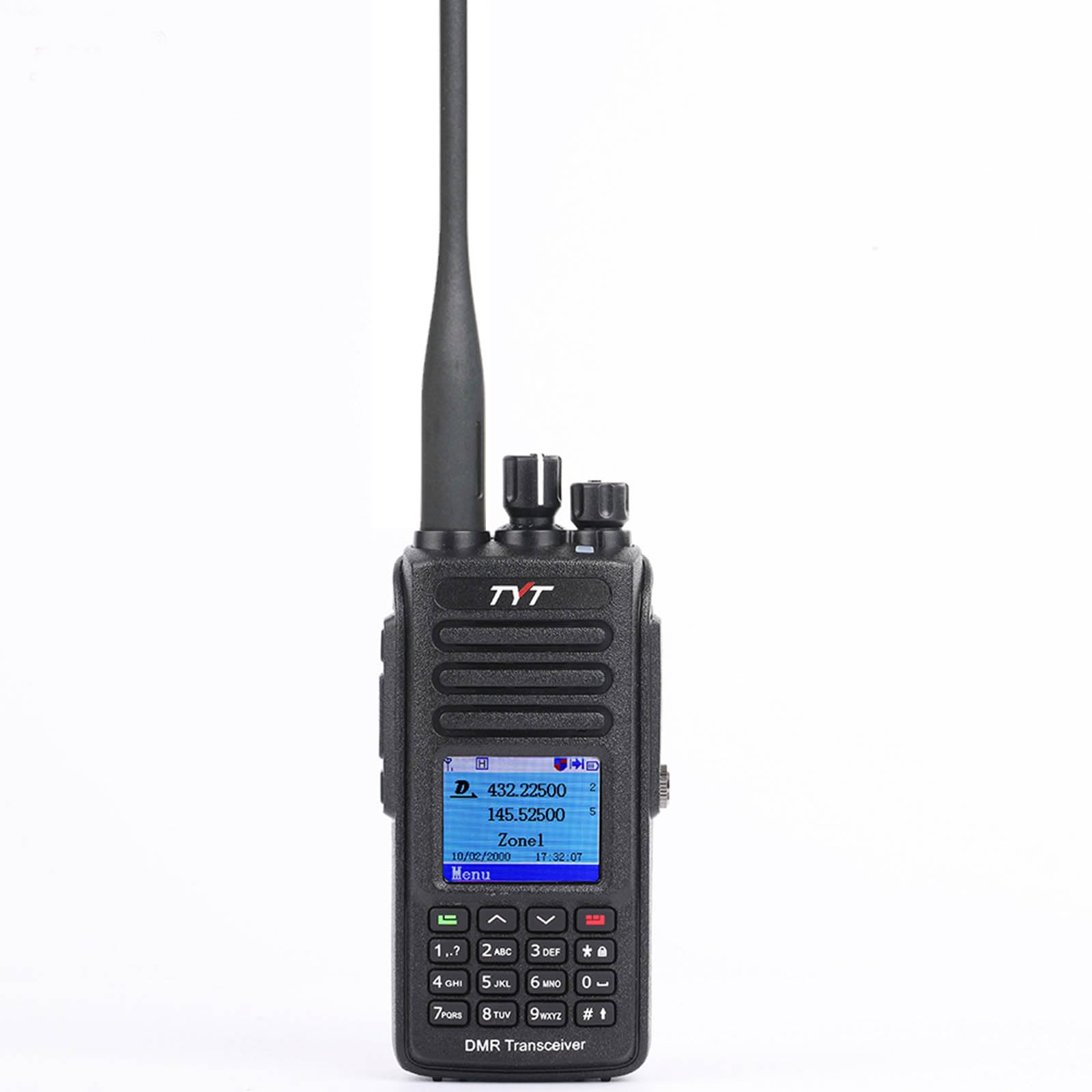
The MD-UV390 is one of the few DMR handhelds built to IP67 standards — completely dustproof and submersible in one meter of water for 30 minutes. The dual-band VHF/UHF transceiver supports both analog and DMR digital modes with 3,000 channels of storage, and the 7.4 V, 2,800 mAh battery provides long operating cycles even with GPS enabled. The AES256 encryption option adds a layer of security that commercial and volunteer search-and-rescue teams require.
Transmit power is selectable between 5 W and 1 W, reducing battery drain and RF exposure during close-proximity communication. The programming cable and CPS software are included, but the driver certificate issue on Windows 10/11 is a known frustration — TYT does not sign the USB driver, so you may need to disable driver signature enforcement or use a Windows 7 virtual machine. The dual-channel monitoring mode lets you watch a digital time slot and an analog channel simultaneously, though the receiver is not a true dual-conversion design, so adjacent-channel rejection is weaker than a superheterodyne rig.
User feedback on durability is mixed: some units survive years of field abuse, while others suffer circuit board burnouts within six months. The consensus is to buy the extended warranty and immediately flash the latest firmware from the TYT website to address known bugs, including a password lock issue that can brick the radio if the CPS setting.ini file is not pre-configured correctly.
Why it’s great
- Genuine IP67 dust and water ingress protection
- 3000-channel capacity with AES256 encryption support
- Dual-band VHF/UHF with selectable 5/1 W output power
Good to know
- Windows 10/11 driver certificate issue requires workaround for programming
- Receiver uses direct-conversion design with weaker adjacent-channel rejection
- Quality control inconsistency — some units fail within six months
6. AnyTone AT-778UVII
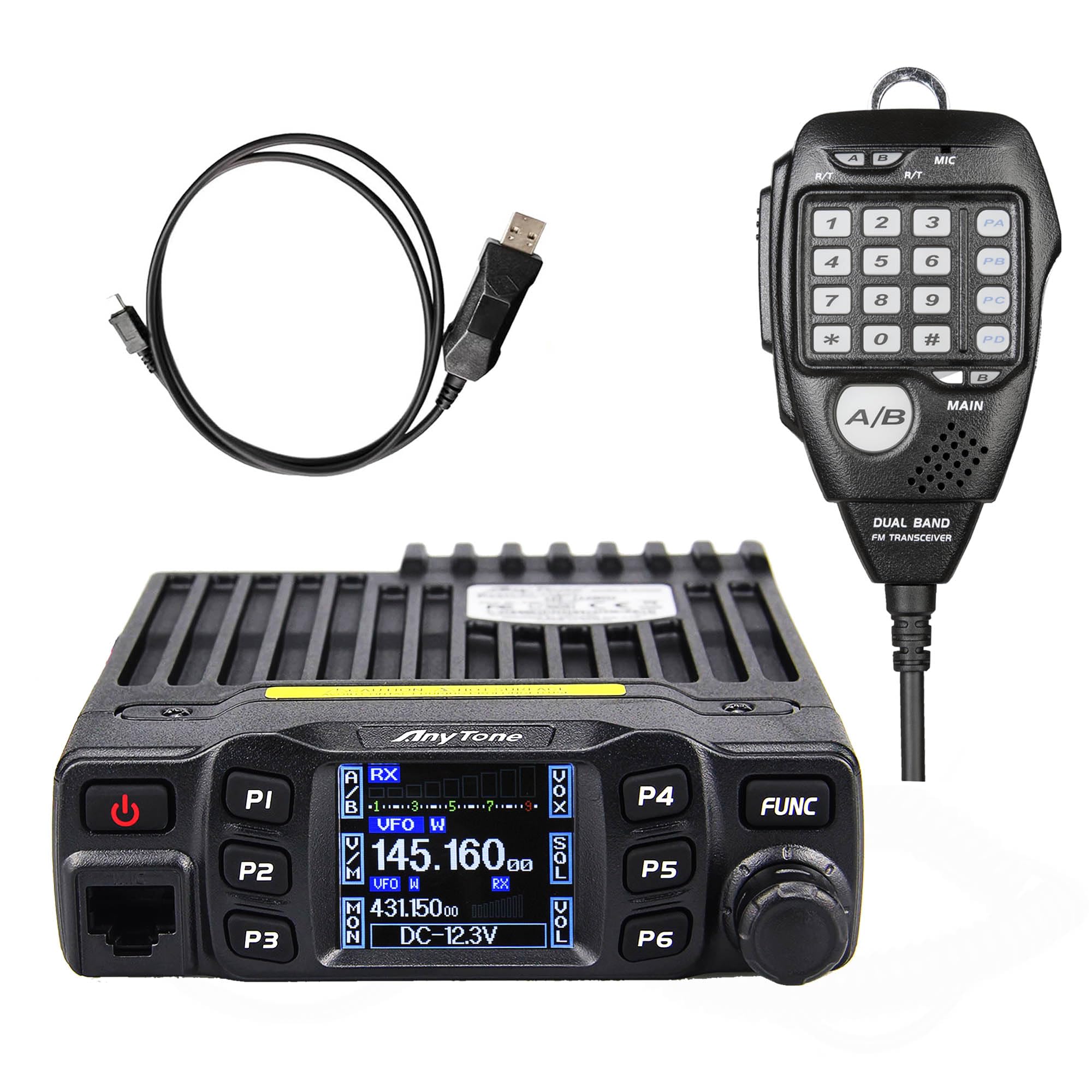
The AT-778UVII is a 25 W dual-band mobile radio that walks the line between analog and digital: it supports analog FM along with CTCSS/DCS and DTMF, but it is not a DMR digital radio. It earns its place in this guide because it is a frequent companion to DMR handhelds — many hams use it as a dedicated analog base or mobile rig while running a separate DMR HT for the digital network. The CHIRP programming support means you can manage channels and frequencies from a single open-source application alongside your digital code plug.
The 180-degree rotatable TFT LCD display installs upside down or right side up, which simplifies under-dash placement. Dual speakers — one in the radio body and one in the microphone — deliver clear audio from either installation orientation. The mic gain adjustment is accessible through the factory CPS, letting you boost or cut transmit audio to match your voice level and vehicle noise floor. Output power is selectable at 5 W, 15 W, or 25 W, so you can conserve battery or lower heat buildup during extended nets.
The absence of a cooling fan is notable: the radio relies entirely on a large rear heatsink for thermal dissipation. In continuous high-power transmit scenarios (such as a long weekend-long event net), the radio can get uncomfortably hot to the touch. The volume control doubles as a tuning knob since there is no separate volume potentiometer, which takes some adjustment. The power cable includes a fuse holder, but the fuse rating should be verified against your vehicle’s 13.8 V supply to avoid nuisance blowing.
Why it’s great
- Compact footprint with rotatable display for flexible installation
- Full CHIRP support for unified programming across radios
- Selectable 5/15/25 W to match power to operating conditions
Good to know
- Fanless design limits continuous high-power transmit time
- Volume and tuning shared on a single knob
- Not a DMR digital radio — analog and CTCSS/DCS only
7. Retevis RT95

The RT95 is a 25 W dual-band analog mobile transceiver that runs on the same hardware as the AnyTone AT-778UVII — which means it inherits the same reliable receiver front end and clear audio chain. It is designed for analog 2m and 70cm operation, making it a perfect companion radio for a station that uses a separate DMR HT for digital traffic. The VFO mode permits front-panel frequency changes without a computer, which is unusual in this class and appreciated for field day or emergency operations where you cannot access a laptop.
The rotatable TFT LCD display and dual-speaker design mirror the AT-778UVII, delivering clear, loud audio with a claimed signal-to-noise ratio of 45 dB. The built-in cooling fan is a differentiator from the fanless AnyTone version — the RT95 can sustain high-power transmissions for longer periods without thermal throttling. Microphone gain is adjustable through firmware, and the VOX function works well for hands-free driving once you set the delay and sensitivity.
Programming via CHIRP works, but the recommended RT95-specific cable uses a unique pinout; generic Baofeng programming cables will not work and may short the serial lines. The factory band limits (144-146 MHz on 2m and 430-440 MHz on 70cm) match US amateur allocations but can be expanded through firmware if you have a compatible programming cable. The scan speed is notably slow at approximately two frequencies per second, making the RT95 less ideal for rapid scanning use cases.
Why it’s great
- Built-in cooling fan for sustained high-power analog operation
- VFO mode enables frequency changes without a computer
- Shares robust hardware platform with proven receiver performance
Good to know
- Slow scan speed (~2 freq/sec) unsuitable for rapid scanning
- Requires special cable for CHIRP programming — not Baofeng compatible
- Factory band limits may need firmware expansion for some GMRS operation
8. TYT MD-380

The MD-380 is a single-band (UHF 400-480 MHz) DMR handheld that has served as the entry point for thousands of hams learning digital voice. It supports Tier 1 and Tier 2 DMR with a 1,000-channel capacity, which is more than enough for a beginner building their first code plug around a handful of local BrandMeister repeaters. The included USB programming cable and CPS software work, but the software uses a relational database structure — groups, contacts, zones, and scan lists must all be linked before the radio accepts the code plug. This is not a spreadsheet-style editor like CHIRP, so the learning curve is steeper than most beginners expect.
Audio quality in digital mode is clear, with the AMBE+2 vocoder delivering full-bandwidth voice. Analog FM audio lacks the clarity of a dedicated analog HT, which is expected from a DMR-focused radio. Some users report occasional audio drops during handoff between time slots on busy repeaters, but firmware updates from TYT have reduced this issue. The 2,000 mAh battery provides adequate run time for a full day of casual use, and the desktop charger with trickle charge prevents over-heating during overnight charging.
The single-band limitation is the biggest drawback: 70cm repeaters are less common than 2m repeaters in many regions, and the MD-380 cannot monitor VHF analog simplex without a separate radio. Keypad programming is impractical for anything beyond channel name changes — you must use the CPS for building the code plug. If you are certain your local DMR activity is on UHF, this is a cost-effective way to test the DMR waters.
Why it’s great
- Low cost entry to Tier 2 DMR on the UHF band
- Includes USB programming cable and software
- Clear AMBE+2 digital audio with good firmware support
Good to know
- UHF only — no VHF or dual-band capability
- CPS uses relational database structure, not spreadsheet-style editing
- Keypad programming is impractical for full code plug creation
9. BAOFENG DM32
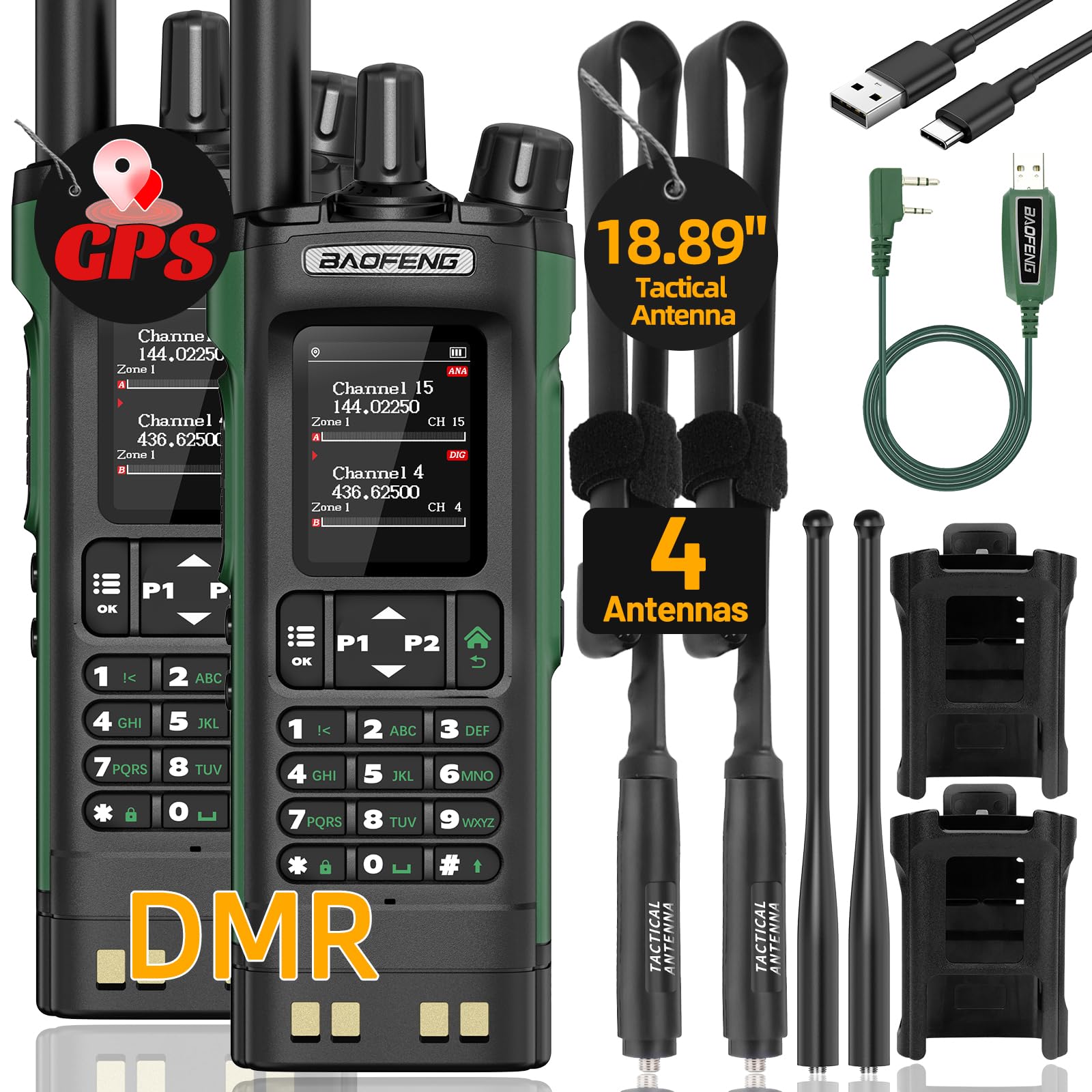
The DM32 is BAOFENG’s first serious attempt at a modern DMR handheld, packing dual-mode analog and digital operation with built-in GPS, APRS position reporting, and USB-C charging directly on the battery. The 4,000-channel capacity is generous for the price range, and the TDMA dual-slot support allows two simultaneous conversations on a single frequency. The frequency duplication function lets you clone settings from one radio to another, which simplifies field deployment for groups coordinating an event.
GPS lock time is adequate for APRS beaconing, though it takes longer to acquire indoors than a dedicated GPS module. The full keyboard and 2.0-inch screen enable manual channel parameter entry, reducing dependence on a PC for simple changes. The package includes two antennas — a short 21 cm stub for portable use and a longer 48 cm whip for extended range — plus a headset and a desktop charger. The USB-C port is located on the back of the 2,500 mAh battery, meaning you do not need to insert the radio into a cradle to charge; any USB-C power source works.
The firmware and software side is the weak point. Users report a minor encryption bug between the CPS and radio firmware that requires a specific sequence of read-write cycles to clear. The instruction manual is sparse and poorly translated, making the first-time programming experience frustrating. The knobs are loose and prone to accidental rotation, changing volume or channel when the radio is clipped to a pack strap. Despite these issues, the DM32 represents the most feature-dense dual-pack DMR option available at this price level.
Why it’s great
- Two radios in the box at a competitive price point
- USB-C charging on the battery eliminates cradle dependency
- Built-in GPS with APRS position beaconing support
Good to know
- Firmware encryption bug requires careful CPS read-write sequencing
- Knobs are loose and prone to accidental adjustment
- Manual is poorly translated with sparse technical detail
FAQ
What is a DMR repeater time slot and how do I choose the right one?
Can I use a DMR radio on analog repeaters without reprogramming?
How do I get a DMR ID and why do I need one?
What is the difference between Tier 1, Tier 2, and Tier 3 DMR radios?
Final Thoughts: The Verdict
For most users, the dmr radio winner is the BTECH DMR-6X2 PRO because it delivers mature firmware, AES256 encryption, Bluetooth PTT, and DMR roaming at a price that undercuts the competition with comparable features. If you want the most streamlined learning experience with a bundled video training course and a huge community of code plug templates, grab the AnyTone AT-D878UVII Plus. And for a mobile setup that combines 50 W output with a detachable faceplate and multi-band receive, nothing beats the Radioddity DB50.

Mo Maruf
I created WellFizz to bridge the gap between vague wellness advice and actionable solutions. My mission is simple: to decode the research and give you practical tools you can actually use.
Beyond the data, I am a passionate traveler. I believe that stepping away from the screen to explore new environments is essential for mental clarity and physical vitality.