Our readers keep the lights on and my smoothie glass nicely filled. As an Amazon Associate, I earn from qualifying purchases.
Dropping a few hundred watts on your roof or in your backyard no longer requires an electrician’s license or a second mortgage. The latest generation of DIY solar panels packs high-efficiency N-type cells, bifacial glass, and plug-and-play MPPT controllers into kits that a single person can mount in an afternoon. The real challenge isn’t installation anymore — it’s picking the right wattage, battery chemistry, and charge controller type to match your specific load without wasting capacity or burning through your budget.
I’m Mohammad Maruf — the founder and writer behind WellFizz. I’ve spent hundreds of hours analyzing solar panel specifications, charge controller efficiency curves, and real-world customer performance data to separate kits that genuinely deliver from those that just look good on paper.
Whether you’re powering a campervan fridge, keeping a home backup battery topped off, or running a small off-grid workshop, this guide cuts through the marketing to present the only best diy solar panels that earn their place based on real specs, proven durability, and verified buyer experiences.
How To Choose The Best DIY Solar Panels
The right DIY solar kit depends on three core factors: your daily energy consumption in watt-hours, the physical space you have for mounting panels, and whether you want an all-in-one power station or a modular panel-plus-controller setup. Beginners often overestimate their sunlight hours and underestimate the voltage drop from long cable runs.
Wattage and Daily Yield
A 200W panel in optimal conditions produces roughly 800Wh to 1kWh per day — enough to run a 12V fridge, charge phones and laptops, and power a few LED lights. For home backup covering a fridge, router, and fan, look at 400W kits or a power station with at least 1kWh of battery capacity. Panels rated with N-type cells (around 25% efficiency) produce more power per square foot than standard polycrystalline panels, making them the better choice for small roofs and van conversions.
Charge Controller Type: PWM vs. MPPT
PWM controllers are cheaper and work fine for small 100W kits where panel voltage is close to battery voltage. MPPT controllers track the panel’s maximum power point and convert excess voltage into additional charging current — they deliver 20-30% more energy from the same panel, especially in cold weather or partial shade. Every 200W-plus kit in this guide pairs with an MPPT controller for a reason: the extra efficiency pays for itself within a season.
Battery Chemistry and Cycle Life
LiFePO4 batteries now dominate the DIY solar space because they can handle 3,000 to 4,000 cycles before dropping to 80% capacity — roughly 10 years of daily use. Lead-acid batteries may cost half as much upfront but need replacement every 2-3 years, making LiFePO4 the cheaper option over any multi-year installation. If your kit includes a battery, confirm the BMS supports low-temperature charging and has adequate overcurrent protection for your inverter.
Quick Comparison
On smaller screens, swipe sideways to see the full table.
| Model | Category | Best For | Key Spec | Amazon |
|---|---|---|---|---|
| Callsun 400W Bifacial | Bifacial Panel Kit | High-efficiency rooftop / van | 25% N-type cells, 16BB busbars | Amazon |
| Renogy 400W Premium | Complete Panel Kit | Off-grid cabin / RV | 40A MPPT, Bluetooth module | Amazon |
| Jackery HomePower 3000 | Power Station + Panels | Whole-home backup | 3072Wh LFP, 3600W output | Amazon |
| EF ECOFLOW DELTA 3 Plus | Power Station + 220W Panel | Fast charging / camping | 1024Wh, 1000W solar input | Amazon |
| EF ECOFLOW DELTA 2 Max | Power Station + 400W Panel | Extended off-grid / emergency | 2048Wh, 2400W AC output | Amazon |
| BLAVOR S1600 | Power Station w/ Built-in Panel | Portable all-in-one backup | 1024Wh, built-in 40W panel | Amazon |
| ECO-WORTHY 200W Starter Kit | Complete Starter Kit | First-time DIY / small loads | 200W panel, 50Ah LiFePO4 | Amazon |
| Renogy 200W RV Kit | Panel + PWM Controller | RV / camper / boat | 200W, 30A PWM, Bluetooth | Amazon |
| EBL 1000W Power Station | Portable Power Station | Camping / CPAP / light backup | 999Wh, 1000W continuous | Amazon |
In‑Depth Reviews
1. Callsun 400W Bifacial Solar Panel (2x200W)
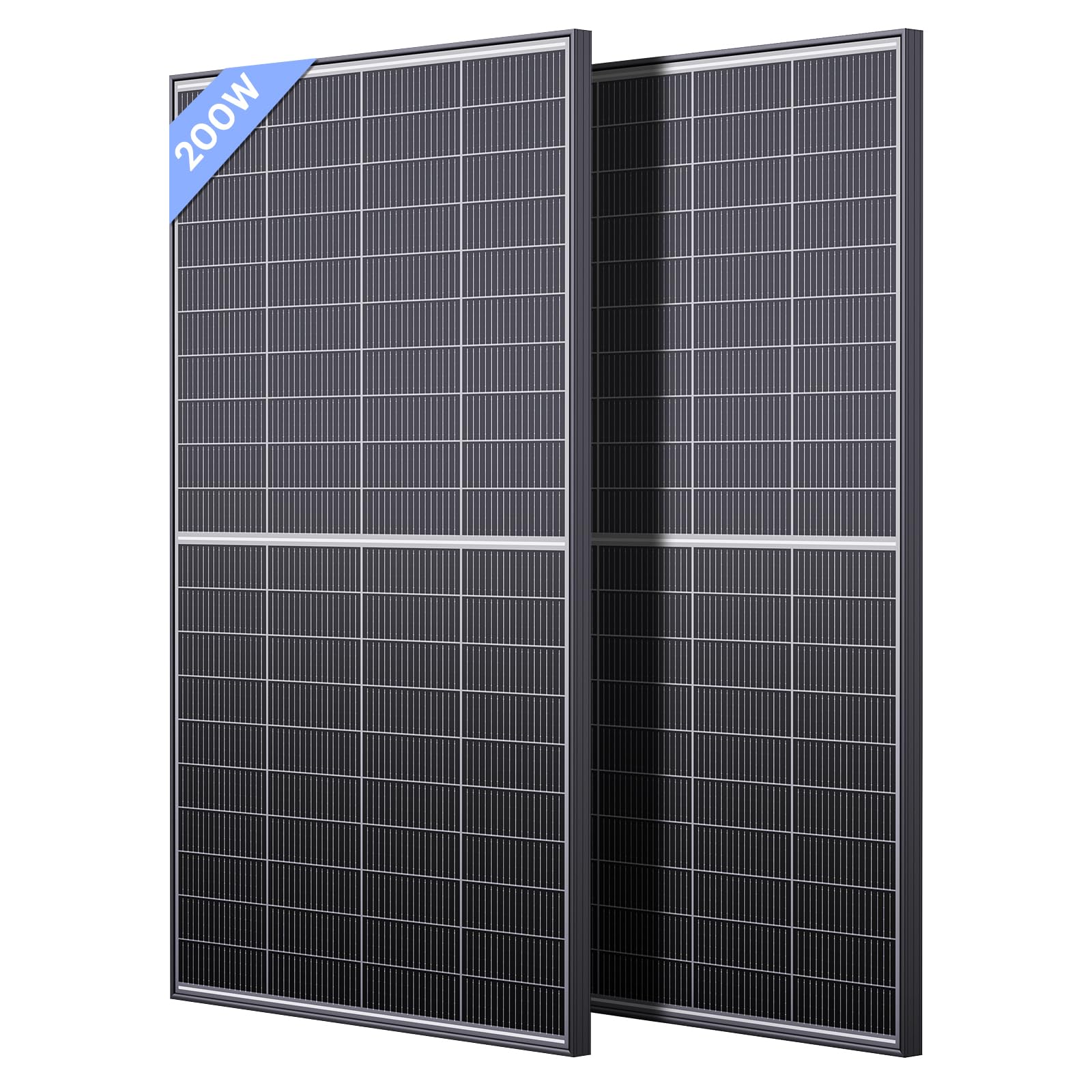
The Callsun bifacial kit uses N-type monocrystalline cells with 16 busbars to hit 25% conversion efficiency — noticeably above the industry average of 20-22%. The transparent backsheet lets the panel capture light reflected off rooftops, driveways, or snow, which reviewers report as 15-30% extra yield in real conditions. Each 200W panel measures 51.3 x 30.3 inches and weighs 23.8 lbs, making it a tight fit for Class B vans but manageable for one-person rooftop installation.
Its TwinCell design splits each panel into two independent halves. If a tree branch or vent casts shade over one section, the other half keeps producing at full voltage. The low temperature coefficient of -0.3%/K means power drops very little on hot summer afternoons — a meaningful advantage over standard panels that lose 0.4-0.5% per degree Celsius. IP68-rated junction boxes and 3.8mm tempered glass back the 25-year performance warranty.
Buyers consistently report peak output exceeding the 400W rating (one measured 420W in direct sun with light ground reflection). The panel ships as two separate 200W units with pre-drilled holes and solar connectors; you’ll need to supply your own MPPT charge controller and wiring for a complete system. For anyone building a permanent rooftop or ground-mount array where every watt counts, this is the most efficient panel-per-dollar option available.
Why it’s great
- 25% N-type cells outperform standard poly/mono panels
- Bifacial backsheet adds up to 30% more yield in reflective settings
- TwinCell shade tolerance prevents full-panel dropouts
- 30-year lifespan with 25-year performance commitment
Good to know
- No charge controller or wiring included — requires separate purchase
- Actual bifacial gain depends heavily on ground reflectivity
- Large panel size requires adequate roof or ground space
2. Renogy 400W Premium Kit (4x100W + 40A MPPT)

Renogy’s 400W premium kit bundles four 100W monocrystalline panels with a 40A Rover MPPT charge controller, Bluetooth module, Z-brackets, and pre-cut cables — everything except the battery and inverter. The panels use Grade A+ cells with 22.5% efficiency and 3.2mm low-iron glass, rated to withstand 2400Pa wind and 5400Pa snow loads. Daily output sits between 2-2.5kWh depending on your sun hours, which is enough to run a 12V fridge, LED lights, a laptop, and phone charging continuously.
The MPPT controller claims 99% tracking efficiency and 98% peak conversion, which translates to roughly 30% more charging current than a PWM controller would deliver from the same panels. Users can monitor voltage, current, battery state, and load draw through the Renogy DC Home app via the included BT-1 module — though several reviewers note the app can be unreliable for connecting to the controller at first setup. The kit also includes an inline fuse and an ANL fuse for overcurrent protection on both the solar and battery sides.
Owners with campervans and off-grid cabins report the system still performing flawlessly after three to five years of daily use. The 10-year panel warranty and 3-year controller warranty provide solid long-term coverage. The main complaint involves the app connectivity; some users swapped the Renogy controller for a Victron MPPT to get better monitoring. For anyone wanting a complete, pre-engineered solar kit with minimal guesswork, this is the most trusted choice in the mid-range tier.
Why it’s great
- Complete kit with MPPT controller, cables, and mounting brackets
- 40A MPPT delivers 30% more harvest than PWM
- Bluetooth module for real-time monitoring
- Proven long-term durability (3-5 year owner reports)
Good to know
- Bluetooth app connectivity can be finicky
- Panel wires may be too short for large motorhome roof layouts
- Four separate panels mean more wiring and roof penetrations
3. Jackery HomePower 3000 + 2x200W Solar Panels
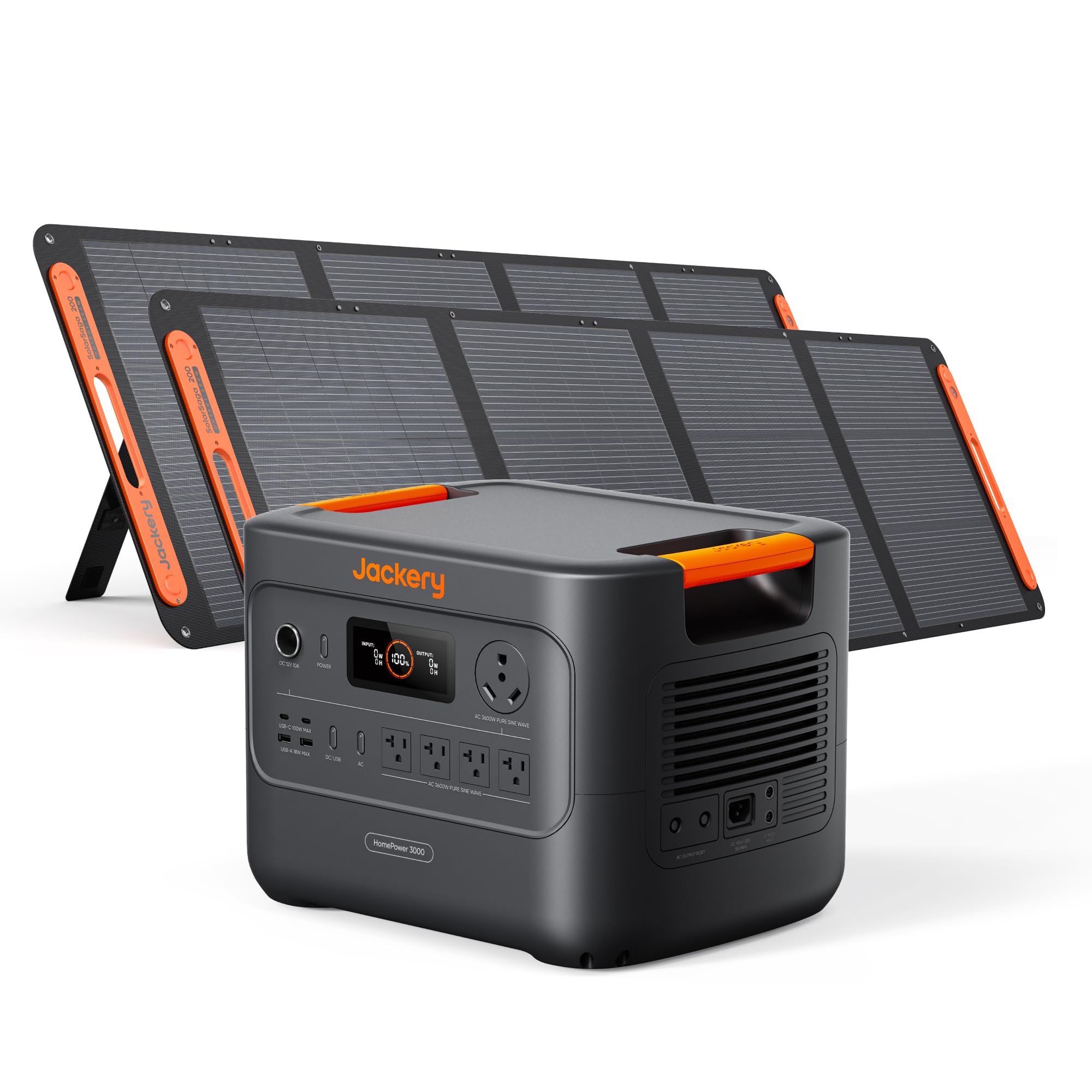
The Jackery HomePower 3000 is a proper home-scale backup solution: 3072Wh of LiFePO4 capacity with a 3600W continuous AC output (7200W surge). Two included SolarSaga 200W panels (400W total) can recharge the unit from 0-80% in about 9 hours of direct sun. The built-in ≤20ms UPS switchover keeps sensitive electronics — security cameras, medical refrigerators, network routers — running without interruption during grid flickers or full outages. Jackery claims the unit can power a full-size refrigerator for 1-2 days, and reviewers confirm running a fridge plus TV and internet during multi-day blackouts.
The CTB (cell-to-body) integration makes this 59.5 lb unit 43% lighter and 47% smaller than comparable 3kWh stations, though it’s still heavy enough to require a wheeled dolly for regular movement. Dual 100W PD USB-C ports allow fast charging of laptops and tablets directly. The TT-30 RV port provides plug-and-play power for campers. ChargeShield 2.0 AI algorithms optimise charging speed while extending the LFP battery’s 4,000-cycle lifespan.
Buyers praise its silent operation and ability to run high-draw appliances (1500W+ microwaves and blenders) without triggering overload. The main drawback is the solar charge time — 400W of panels will take two full sunny days to fully recharge the battery if you drain it completely. For those with grid-tied homes wanting outage protection, this pairs well with a larger roof-mounted array for faster replenishment.
Why it’s great
- Large 3kWh capacity runs fridge + essentials for 1-2 days
- 3600W continuous output handles high-wattage appliances
- ≤20ms UPS keeps sensitive gear online
- Lightest and most compact 3kWh station available
Good to know
- 59.5 lb — requires dolly for frequent moves
- 400W solar panels take 9+ hours for full recharge
- No expandable battery port for capacity upgrades
4. EF ECOFLOW DELTA 3 Plus + 220W Bifacial Solar Panel

The DELTA 3 Plus redefines charging speed in the portable solar generator category. Its 1500W AC input pushes the 1024Wh LFP battery from 0-80% in just 40 minutes, while solar charging at 1000W input (two MPPT controllers) reaches full charge in 70 minutes. The included 220W bifacial solar panel uses N-type cells with 25% efficiency and a 30-60° adjustable kickstand that aligns with the sun angle guide on the panel itself — a rare design detail that maximises daily yield without manual guesswork.
The 1800W AC output (3600W surge) with X-Boost mode handles resistive loads up to 2200W continuous. The station has 13 ports including USB-A, USB-C 100W, and multiple AC sockets. The IP65 battery pack adds splash and dust resistance that most power stations lack. LiFePO4 cells deliver 4,000 cycles to 80% capacity, roughly 10 years of daily use. The whole system ships in separate packages (station and panel arrive at different times), so plan for staggered delivery.
Reviewers highlight the built-in solar angle guide as genuinely useful — it helps you tilt the panel correctly without a separate app or compass. The large 220W panel (62 lbs total system weight) is heavier than standard portable panels but produces significantly more power in the same footprint. The main tradeoff is the 1024Wh capacity, which is sufficient for weekend camping or short outages but won’t carry a fridge through multiple overcast days.
Why it’s great
- Blazing-fast 1000W solar input recharges in 70 minutes
- Bifacial 220W panel captures 28% more energy
- Integrated 30-60° tilt stand with sun angle guide
- IP65 battery pack resists dust and water splashes
Good to know
- 1024Wh capacity limits run time for large appliances
- Station and panel ship separately
- Panel is larger and heavier than standard 200W units
5. EF ECOFLOW DELTA 2 Max + 400W Solar Panel

The DELTA 2 Max doubles the capacity of the DELTA 3 Plus while maintaining the same fast-charging DNA. Its 2048Wh LiFePO4 battery runs a 25 cu-ft fridge, a fan, and a TV for over 12 hours — one reviewer reported only 40-50% battery drain after a full day of Hurricane Beryl backup. The 2400W AC output (3400W with X-Boost) handles most home appliances including microwaves, blenders, and space heaters. Dual charging (AC + solar) at up to 2400W total input takes the battery from 0-80% in 43 minutes.
The included 400W mono solar panel uses 23% efficient cells and folds into a waterproof case. At 35.3 lbs, it’s light enough for one person to carry and deploy, though the case itself is somewhat flimsy for use as a stand — several owners built a simple PVC frame to hold the panel at the optimal angle. The panel is IP68 rated, meaning it survives rain and dust without damage. The EcoFlow app allows you to prioritise solar input over AC when both are connected, a useful feature for reducing grid consumption.
Buyers love the 3,000-cycle LFP battery (6x more than industry average) and the 5-year warranty. The 15 outlets cover everything from AC and USB-C to car and DC ports. Some users note that the stock 400W panel’s case is not the most durable stand solution and that they needed extra cables to connect roof-mounted panels. For anyone wanting a full-day home backup that recharges in under an hour from AC or in 2.6 hours with two solar panels, this is the sweet spot.
Why it’s great
- 2048Wh capacity runs a fridge for 12+ hours
- 2400W AC input charges 0-80% in 43 minutes
- IP68 waterproof 400W solar panel included
- 3,000-cycle LFP battery with 5-year warranty
Good to know
- Stock solar panel case is not a rugged stand
- Heavy at 50.7 lbs total for station + panel
- Requires extra cables for permanent roof mounting
6. BLAVOR S1600 Portable Power Station (Built-In 40W Solar Panel)
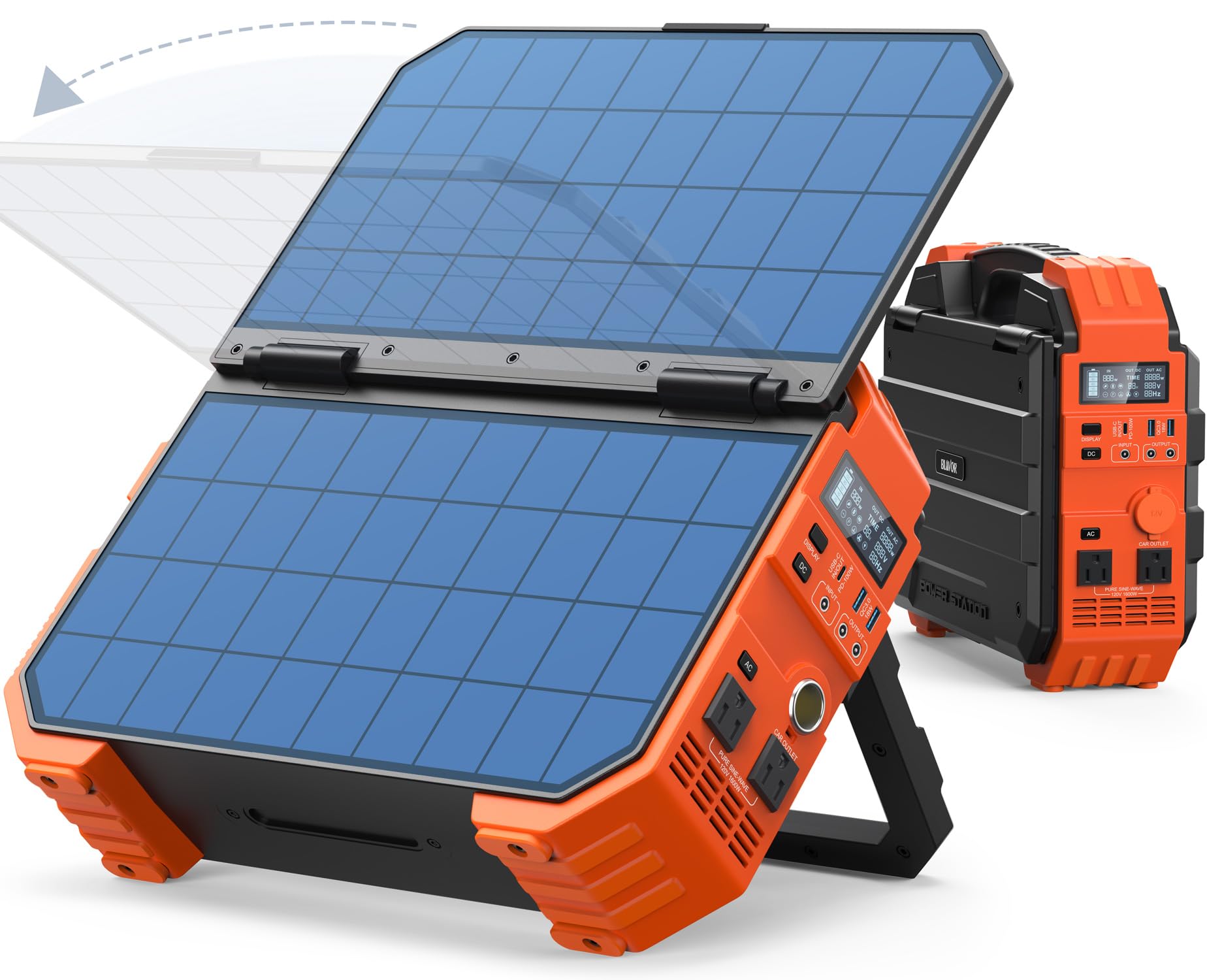
The BLAVOR S1600 stands alone in this list for one reason: a foldable 40W solar panel is built directly into the unit’s suitcase-style body. This means you can set it in the sun and start charging without unpacking any separate panel, cable, or controller. The 1024Wh LiFePO4 battery delivers 1600W continuous output (3200W surge), enough to run a deep freezer for about 20 hours or a mini-fridge overnight. The 2022 German IF Design Award reflects the clever integration — the panel folds flush into the top, and the handle doubles as a support leg for angling toward the sun.
Beyond the built-in panel, the S1600 supports external solar input via an MC4 adapter, plus AC and car charging. The 100W two-way USB-C port lets you fast-charge laptops or recharge the station itself from a USB-C power source. The 26-lb weight is manageable for carrying short distances, though the hard corners make it less backpack-friendly than soft-sided competitors. The LCD display shows real-time input/output wattage and remaining battery percentage.
Owners praise the convenience of not needing to pack a separate solar panel — just toss the unit in the car and you’re ready. The built-in 40W panel produces about 30W in December sun, enough for trickle-charging or topping off phones and radios. The main limitation is the 40W built-in panel’s slow recharge rate; fully replenishing the 1024Wh battery from the built-in panel alone would take multiple full-sun days. External panel support solves this, but then you lose the all-in-one advantage.
Why it’s great
- Built-in 40W solar panel — no separate panel packing needed
- 1024Wh LFP battery with 1600W continuous output
- 100W two-way USB-C for fast laptop charging
- Award-winning compact suitcase design
Good to know
- Built-in 40W panel is slow for full recharge
- 26 lbs with hard corners — not backpack-friendly
- Port labels can be hard to read in low light
7. ECO-WORTHY 200W Complete Solar Starter Kit
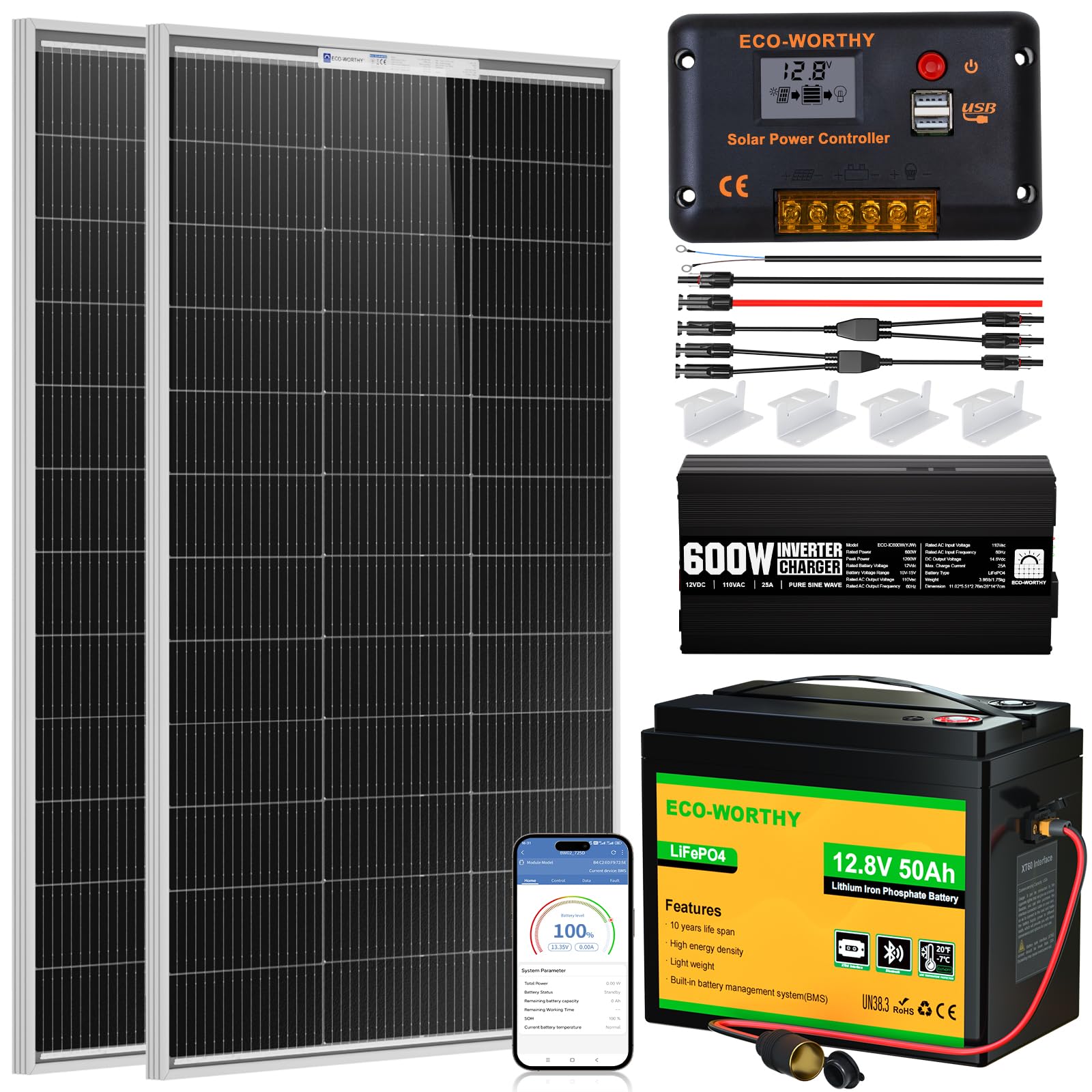
The ECO-WORTHY 200W kit is the only true plug-and-play system in this guide: it includes the solar panel, 30A charge controller, 50Ah LiFePO4 battery, and 600W pure sine wave inverter — everything you need to power small loads right out of the box. The N-type 100W panels deliver 25% efficiency with a bifacial design that captures reflected light for up to 15% extra output. The 50Ah battery (640Wh) provides enough stored energy for lights, phone charging, a coffee maker, and a small fan for an evening of camping or a backup window.
The 600W pure sine wave inverter runs sensitive electronics without noise, and the controller handles lithium batteries correctly with appropriate charge profiles. The XT60 port on the battery adds flexibility for connecting cigarette lighter adapters or car accessories. Assembly takes about 3-4 hours for a first-timer, including mounting the panels and crimping the MC4 connectors (the kit does require some basic wiring). The panels themselves proved durable through hail and storms, as reported by one buyer.
Several reviewers found the battery and controller undersized for their expectations — the 50Ah battery powered LED lights for only about 2 hours. This kit is best viewed as a learning platform for absolute beginners, not as a permanent power solution. The seller’s customer service received praise for issuing refunds on defective controllers. If you’re completely new to solar and want a low-risk way to understand the components without buying them separately, this is the most inclusive starter kit available.
Why it’s great
- Includes panel, controller, battery, and inverter — everything needed
- N-type bifacial panels for higher efficiency in low light
- 600W pure sine wave inverter runs sensitive electronics
- Good for learning solar fundamentals without risk
Good to know
- 50Ah battery has limited runtime for higher loads
- Requires crimping tools for MC4 connector assembly
- Some units shipped with defective inverters
8. Renogy 200W RV Solar Panel Kit

The Renogy 200W RV kit has been a bestseller for years, and for good reason: it’s the most straightforward way to add 200W of monocrystalline solar to a trailer, van, or boat. The two 100W panels deliver 22% efficiency with corrosion-resistant aluminum frames that handle 2400Pa wind and 5400Pa snow loads. The Adventurer-Li 30A PWM charge controller supports lithium, lead-acid, and gel batteries with protection against overcharging, overload, and reverse polarity. Daily output of roughly 800Wh (4 sunlight hours) keeps a 55-quart fridge running and a fan circulating all day.
Installation is beginner-friendly: pre-drilled panel holes, Plug-and-Play MC4 cables, and included Z-brackets and Y-branch connectors. The kit also includes a 30-foot 10AWG adaptor kit and a 16-foot tray cable for routing to the charge controller. The BT-1 Bluetooth module lets you monitor battery voltage and charging status through the Renogy DC Home app — though the app’s connection reliability drew complaints from some users, who ultimately swapped the controller for a Victron MPPT for better monitoring.
Owners consistently report the system keeping batteries fully charged during 10-day camping trips, even through partial cloud cover. The 5-year warranty and 24/7 technical support provide peace of mind for first-time buyers. The main limitation is the PWM controller, which wastes some panel voltage as heat compared to an MPPT — upgrading the controller later is a common path for users who add more panels. For RVers wanting a proven, no-fuss solar entry point with widespread community support, this remains the go-to choice.
Why it’s great
- Simple, reliable installation with pre-drilled panels and cables
- Proven track record — RV owners report years of trouble-free use
- Includes Bluetooth module for basic system monitoring
- Lightweight at 16.5 lbs total panel weight
Good to know
- PWM controller wastes some efficiency vs. MPPT
- Bluetooth app connection can be unreliable
- 200W may not be enough for larger RV loads like AC
9. EBL 1000W Portable Power Station 999Wh
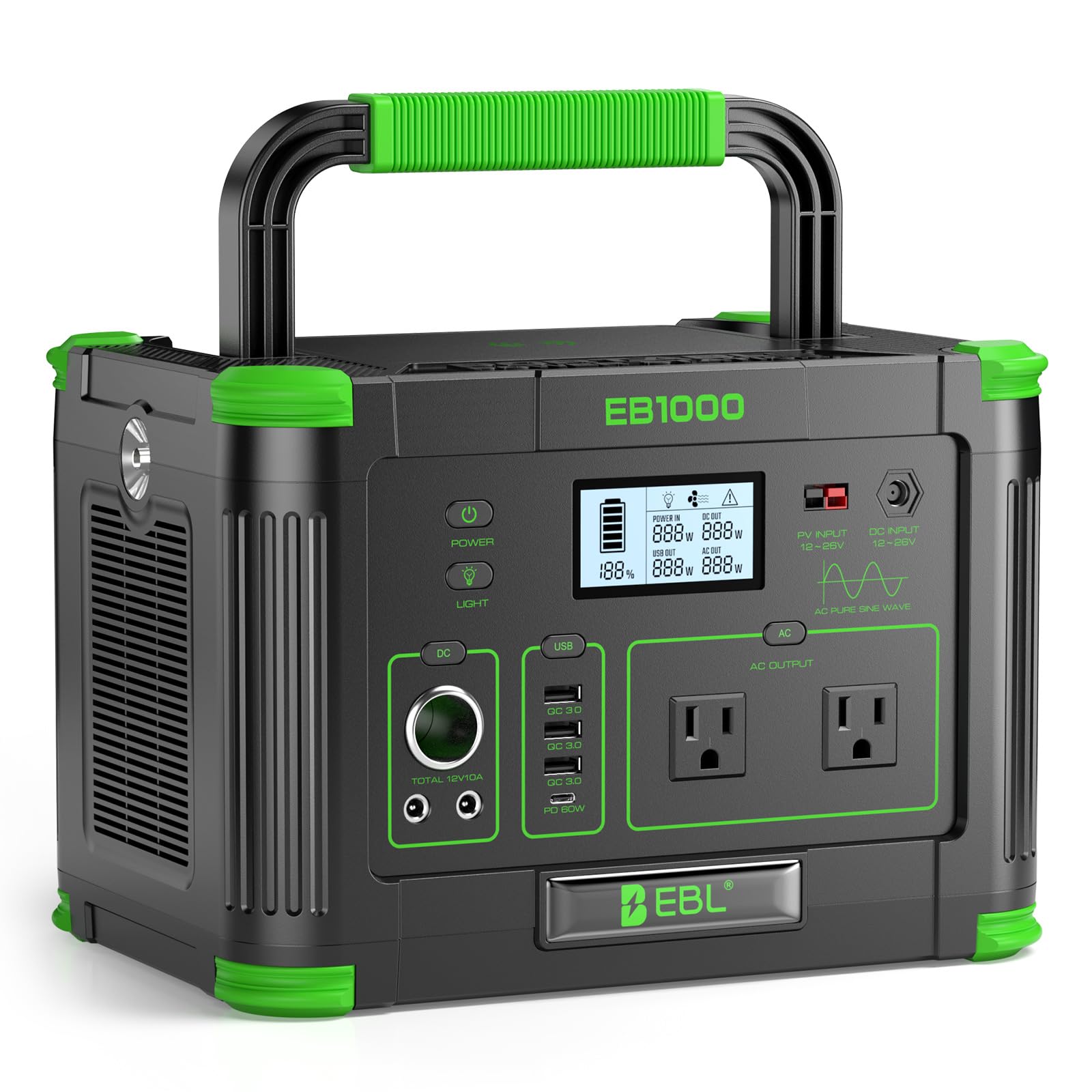
The EBL 1000W power station offers a budget-conscious entry point to portable solar power. Its 999Wh lithium-ion battery and 1000W pure sine wave inverter can run a CPAP machine all night, keep a TV on for 56 hours, or power floodlights for 212 hours — as claimed and verified by multiple buyers. Solar charging input accepts 12-26V at up to 8A (roughly 200W max), which means a single 200W panel can replenish the battery in a full sunny day. AC charging refills it in 7-8 hours, and car charging takes 9-11 hours.
Port selection is generous for its price bracket: one 120V AC outlet, 12V DC ports, 60W PD USB-C, multiple USB-A QC3.0 ports, a 10W wireless charger, and a 12V 10A car outlet. The LCD screen displays real-time input/output and battery percentage, with a 20-second auto-sleep to conserve energy. The SOS LED light doubles as a standard flashlight for emergencies. At 17.86 lbs with a folding handle, it’s easy to move between campsite, RV, and home.
Buyers appreciate the quiet fan operation and the pure sine wave output that runs sensitive electronics like laptops and CPAP machines without issue. Some users reported units bricking or showing inaccurate battery levels after their first discharge cycle — though the seller provided replacements. The 8A solar input limit means you can’t connect larger solar arrays for faster charging. For first-time power station buyers on a strict budget, the EBL delivers capable backup power at a price that leaves room for a separate solar panel.
Why it’s great
- Large 999Wh capacity at an affordable price point
- Pure sine wave inverter safe for CPAP and electronics
- Multiple ports including 60W PD USB-C and wireless charging
- Lightweight and portable at 17.86 lbs
Good to know
- Solar input limited to 8A — slower recharge with larger panels
- Quality control issues reported with battery management system
- LCD display can be difficult to read in bright sunlight
FAQ
Can I mix different wattages and brands of solar panels in one system?
How many sunlight hours do I actually get per day in the US?
Do I need a permit for DIY solar panel installation?
Final Thoughts: The Verdict
For most users, the best diy solar panels winner is the Callsun 400W Bifacial because you get 25% N-type cell efficiency and bifacial yield in a panel that fits standard mounting rails — all at a mid-range price that outperforms units costing significantly more per watt. If you want a true all-in-one system for home backup, grab the Jackery HomePower 3000. And for portable off-grid use where every charge minute counts, nothing beats the EF ECOFLOW DELTA 3 Plus with its 1000W solar input and bifacial panel.

Mo Maruf
I created WellFizz to bridge the gap between vague wellness advice and actionable solutions. My mission is simple: to decode the research and give you practical tools you can actually use.
Beyond the data, I am a passionate traveler. I believe that stepping away from the screen to explore new environments is essential for mental clarity and physical vitality.