Our readers keep the lights on and my smoothie glass nicely filled. As an Amazon Associate, I earn from qualifying purchases.
Getting off the utility grid isn’t a fantasy anymore, but it requires navigating a maze of watt ratings, charge controller types, and battery chemistries that can stall even an experienced DIYer. The difference between a system that keeps your fridge running through a storm and one that leaves you in the dark often comes down to a single spec choice made during the build.
I’m Mohammad Maruf — the founder and writer behind WellFizz. I’ve spent hundreds of hours analyzing component specs, cross-referencing real-world customer performance data, and tracing the efficiency curves of panels, inverters, and batteries to separate genuine power solutions from underbuilt kits.
Whether you’re outfitting a camper van or building a full home backup system, the best diy solar kits give you the freedom to install clean energy on your terms, with scalable hardware that matches your actual power needs and technical comfort level.
How To Choose The Best DIY Solar Kit
Selecting the right solar kit isn’t just about total wattage — it’s about matching the system architecture to your daily energy load and installation constraints. A 400W kit with an MPPT controller will outperform an 800W kit paired with a basic PWM controller under partial shade, so understanding these trade-offs is critical before you buy.
Charge Controller Type: MPPT vs. PWM
This is the single most important decision in any DIY kit. Maximum Power Point Tracking (MPPT) controllers convert excess voltage into additional amperage, delivering up to 30% more charging current in cold or overcast conditions compared to Pulse Width Modulation (PWM) controllers. If your panels are rated higher than 18V to charge a 12V battery bank, a PWM controller simply wastes that voltage headroom. Budget kits often include PWM to lower cost, but for any permanent installation, MPPT is the correct choice.
Battery Chemistry and Storage Capacity
LiFePO4 (Lithium Iron Phosphate) batteries have become the standard for modern solar setups. They tolerate deeper discharge cycles (80–100% depth of discharge vs. 50% for lead-acid) and last 3,000 to 6,000 cycles compared to roughly 500 for traditional AGM batteries. When evaluating a kit, check whether the included charge controller supports lithium battery profiles — some older PWM units are locked to lead-acid settings and will undercharge a LiFePO4 bank, reducing usable capacity by up to 30%.
Inverter Rating and Surge Capacity
Appliances with motors — refrigerators, pumps, and air conditioners — draw 2 to 3 times their rated running wattage during startup (surge). A 3000W pure sine wave inverter can handle a brief 6000W surge, which is essential for starting a 600W refrigerator compressor that might pull 1500W for two seconds. Kits that include inverters with a listed “peak” rating give you the headroom to avoid nuisance shutdowns. Pure sine wave output is required for sensitive electronics like CPAP machines and variable-speed tools.
Panel Type and Bifacial Efficiency
Monocrystalline panels dominate the market with 21-25% efficiency, while bifacial panels capture reflected light from the ground or roof surface for a potential 25% output boost. Bifacial panels shine on light-colored surfaces or open ground mounts but offer less advantage on dark asphalt roofs. For most DIY installations, standard monocrystalline panels paired with an MPPT controller deliver the best value per watt.
Quick Comparison
On smaller screens, swipe sideways to see the full table.
| Model | Category | Best For | Key Spec | Amazon |
|---|---|---|---|---|
| ECO-WORTHY 1200W 24V System | System Kit | Whole cabin backup | 3kW inverter + 5.52kWh daily | Amazon |
| Jackery HomePower 3000 | All-in-One | Home power outage | 3,072Wh LiFePO4 battery | Amazon |
| Jackery Explorer 2000 v2 | All-in-One | RV & camping backup | 2,042Wh + 400W solar input | Amazon |
| BLAVOR S1600 | Portable Station | Camping & emergencies | 1,024Wh + built-in 40W panel | Amazon |
| DOKIO 800W Panel Pair | Panel Only | Large solar array build | 800W total / 31V mono panels | Amazon |
| Renogy 400W Premium Kit | Mid-Range Kit | Off-grid cabin starter | 40A MPPT + Bluetooth monitor | Amazon |
| ECO-WORTHY 400W Premium Kit | Mid-Range Kit | Shed & small building power | 40A MPPT + BT-02 Bluetooth | Amazon |
| Renogy 200W RV Kit | Entry-Level Kit | Camper van essentials | 30A PWM / 200W total | Amazon |
| JJN Bifacial 425W Panel | Panel Only | High-efficiency array | 425W bifi / N-type cells | Amazon |
In‑Depth Reviews
1. ECO-WORTHY 1200W 24V Lithium Solar System
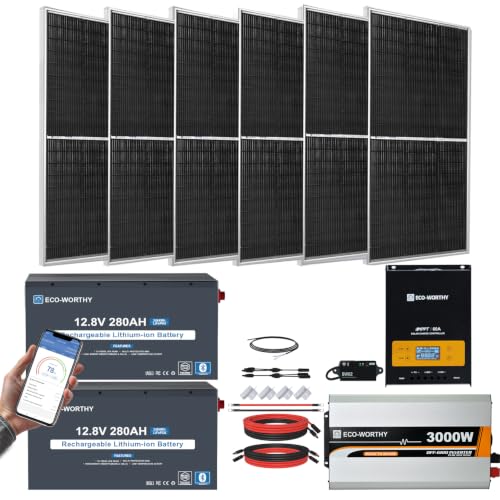
This complete off-grid system bundles six 195W bifacial panels, two 12.8V 280Ah LiFePO4 batteries totaling 7.168kWh of storage, a 60A MPPT charge controller, and a 3000W pure sine wave inverter. The 24V architecture reduces current draw and cable losses compared to 12V systems of similar capacity, making it suitable for running a 6000 BTU air conditioner, refrigerator, and lights simultaneously. Users report quick 30-minute assembly thanks to pre-terminated MC4 connectors and color-coded wiring, with real-world daily production around 4kWh under moderate sun.
The 60A MPPT controller achieves 99% tracking efficiency and includes Bluetooth monitoring for remote voltage and current readouts via smartphone. The inverter’s 6000W surge capacity handles motor startup loads without tripping, and the LiFePO4 batteries provide over 6000 cycles at 80% depth of discharge. One user noted a fan noise issue on the charge controller that was resolved through responsive customer support, and the controller’s initial temp probe required a quick Wago connector fix — minor assembly details for a system of this scope.
At this power level, the system covers most home baseline loads: TV, Starlink, multiple monitors, laptop charging, and a refrigerator for hours each day. Cloudy conditions extend recharge time beyond one day, so users in low-sun regions may need additional panels. The 25-year after-sales support from ECO-WORTHY adds long-term confidence for a permanent installation.
Why it’s great
- Full system kit with panels, batteries, MPPT controller, and inverter included
- LiFePO4 batteries with 7.168kWh usable capacity and 6000+ cycle life
- 3000W pure sine wave inverter handles 6000W surge for motor loads
Good to know
- Weighs over 100 lbs across all components; requires two people for installation
- Bifacial panels need open ground mount for best rear-side reflection gain
- Charge controller temp probe may arrive loose and need reseating
2. Jackery HomePower 3000 with 2x 200W Solar Panels
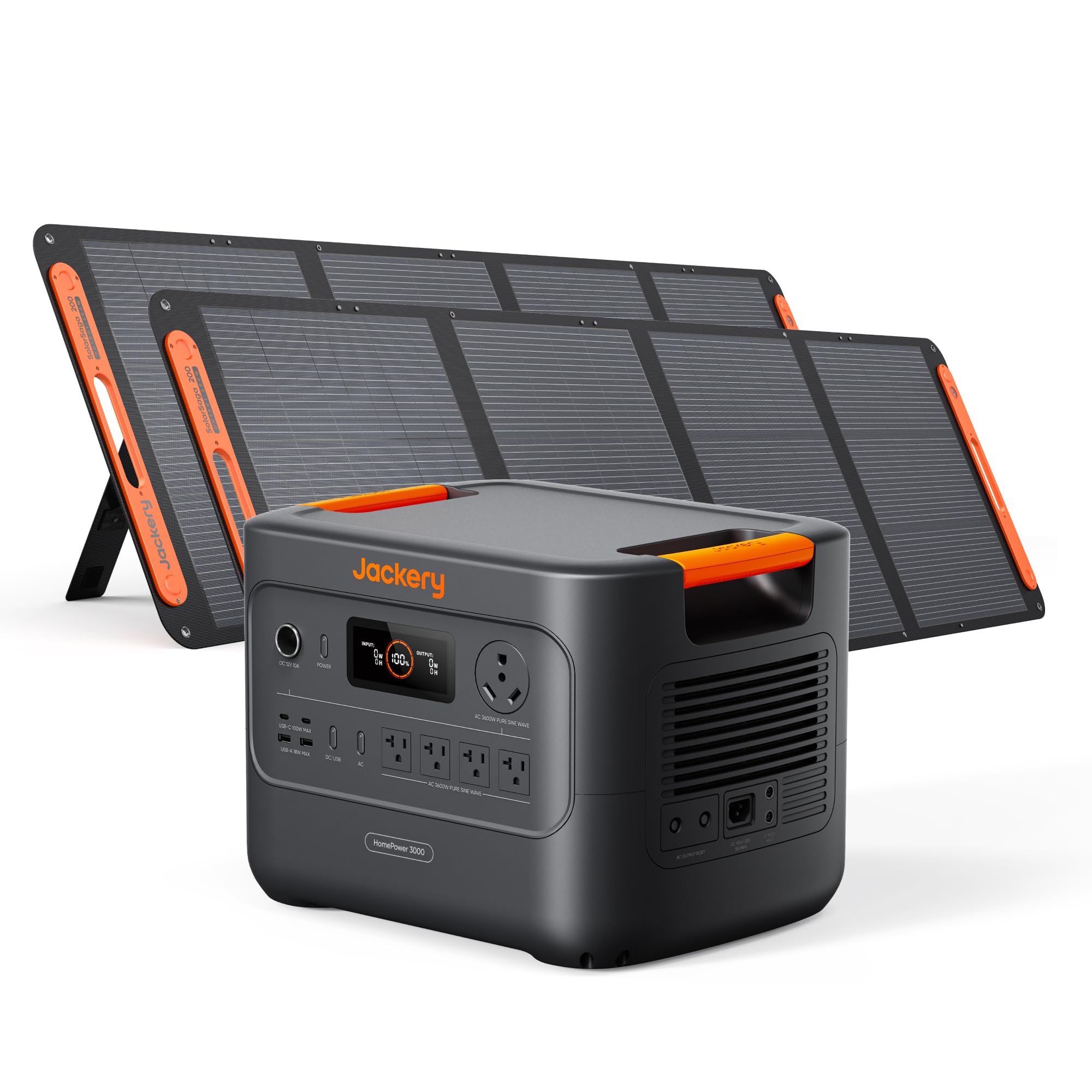
The HomePower 3000 packs 3,072 watt-hours of LiFePO4 storage into a chassis that is 43% lighter than comparable 3kWh units, thanks to Jackery’s CTB (Cell-to-Body) technology. The 3600W inverter (7200W surge) provides enough headroom to run a refrigerator, window AC unit, lights, and a router simultaneously for hours. The UL-certified 20ms UPS switching ensures connected devices never cut out during grid flickers — critical for desktop computers, medical refrigerators, and security systems.
Dual 200W SolarSaga panels recharge the battery from empty to 80% in approximately 9 hours of full sun, while AC charging fills the unit in 2.2 hours. The ChargeShield 2.0 AI algorithm intelligently adjusts charging speed to preserve battery life, delivering up to 4,000 cycles before dropping to 70% capacity. The integrated TT-30 RV port provides direct plug-and-play power for campers without adapters, and the dual 100W USB-C PD ports fast-charge laptops and tablets simultaneously.
At 59.5 lbs, the unit is heavy for one person to carry any distance, but many users pair it with a cheap dolly for rolling storage. Reviewers report running a full-size refrigerator for 1-2 days on a single charge, and solar recharge from zero to full in about 6 hours of strong sunlight. The unit’s honeycomb bottom shell adds structural rigidity, and the built-in handles make it relatively easy to slide into a closet or RV compartment.
Why it’s great
- 20ms UPS switching protects sensitive electronics during power interruptions
- TT-30 RV port eliminates extra adapters for camper hookup
- ChargeShield 2.0 AI extends battery lifespan to 4000 cycles
Good to know
- Unit is 59.5 lbs and may need a wheel kit for regular movement
- Solar recharge takes ~9 hours with included panels; cloud cover extends that
- Battery capacity is not expandable beyond internal 3072Wh
3. Renogy 400W Premium Kit with MPPT & Bluetooth

Renogy’s 400W Premium Kit delivers 2-2.5kWh daily output from four 100W Grade A+ monocrystalline panels with 22.5% cell efficiency. The included 40A MPPT Rover controller boasts 99% tracking efficiency, and the temperature sensor automatically adjusts charging voltage based on battery temperature — preventing undercharging in cold weather and overcharging in heat. The Bluetooth module connects to the Renogy DC Home app for real-time monitoring of panel output, battery state of charge, and load consumption up to 82 feet away.
The kit includes all necessary wiring: 30ft 10AWG adaptor kit, tray cables, Y-branch connectors, and Z-brackets for roof mounting. The 3.2mm low-iron glass and 35mm aluminum frame handle 2400Pa wind and 5400Pa snow loads, making it suitable for permanent installation on RVs, sheds, and cabins. Users report that the system charges a 200Ah battery bank from near-empty to full within 8 hours even on partly cloudy days, and powers gaming PCs, refrigerators, and small appliances without issue.
One common feedback point is that the wiring from panels to controller is too short for motorhome installations where the battery bank is far from the roof — adding extension cables is recommended. The included ANL and inline fuses protect against overcurrent, though some users found the 30A fuse block bulky for tight compartments. The app reliability varies; some users switched to a battery shunt monitor for more accurate state-of-charge readings than the BT-1 module provides.
Why it’s great
- 40A MPPT controller with temperature sensor for precise battery charging
- Grade A+ monocrystalline cells at 22.5% efficiency for higher real-world output
- Complete wiring kit with fuses, Z-brackets, and Bluetooth monitor included
Good to know
- Panel-to-controller wires are short; motorhome installations likely need extensions
- Bluetooth app has connectivity issues — consider a dedicated battery monitor
- Controller only has basic instructions; full system diagram not included
4. Jackery Explorer 2000 v2 with 2x 200W Solar Panels
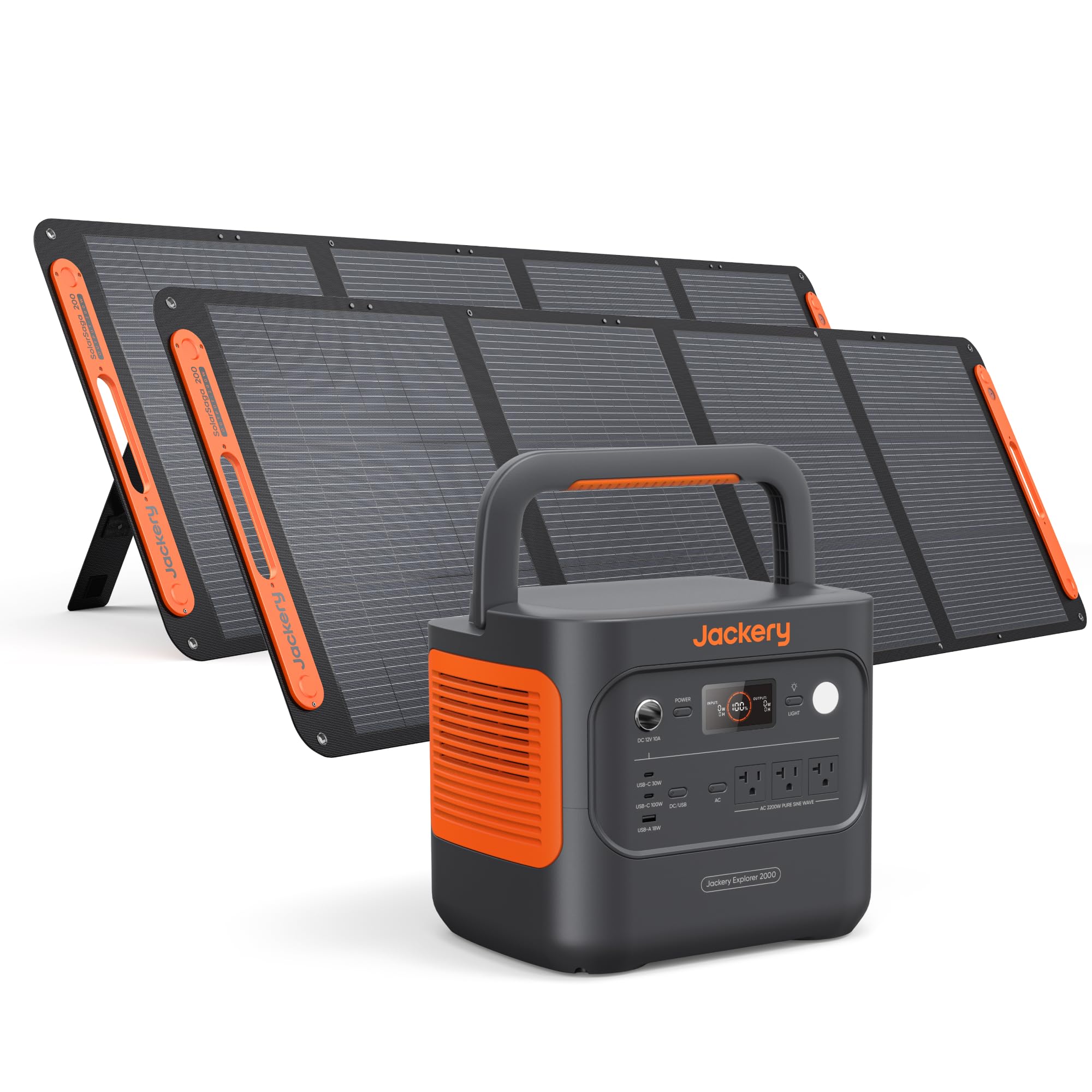
The Explorer 2000 v2 weighs 39.5 lbs — 41% lighter than conventional 2kWh stations — thanks to Jackery’s CTB technology that integrates battery cells directly into the chassis structure. The 2,042Wh LiFePO4 battery feeds a 2200W inverter (4400W surge) capable of running a window AC unit, large refrigerator, or multiple electronics simultaneously. AC charging hits 80% in just 66 minutes, and the Emergency Super Charging mode (activated via app) achieves a full charge in 102 minutes.
The two 200W SolarSaga panels provide a combined 400W input, refilling the battery from empty to full in about 6 hours of direct sunlight. A 20ms UPS switchover keeps connected devices running through grid blips, and the dual 100W USB-C PD ports charge laptops, tablets, and phones at full speed without needing separate bricks. The unit operates at just 30dB in Silent Charging mode, making it suitable for indoor use during overnight camping or power outages without disturbing sleep.
Reviewers consistently praise the build quality and intuitive interface. One user reported that the 2000v2 powered their entire home tech setup — desktop monitor, router, laptop, and phone chargers — for a full day with solar recharge topping it up each afternoon. The included AC charging cable and solar panel connectors are clearly labeled, and the LCD display shows remaining runtime under current load. The unit’s compact 13.2″ x 10.4″ x 11.5″ footprint slides easily under a camper bench or into a closet.
Why it’s great
- Lightest 2kWh station at 39.5 lbs with CTB structural integration
- Super-fast AC recharge: 80% in 66 minutes via Emergency mode
- 20ms UPS switching for seamless power during grid interruptions
Good to know
- Solar panels and power station ship separately in two boxes
- 6000-cycle battery lifespan depends on using app charge control features
- Panel cable connector uses tongue-and-groove design that needs proper alignment
5. BLAVOR S1600 Portable Power Station with Built-in Panel
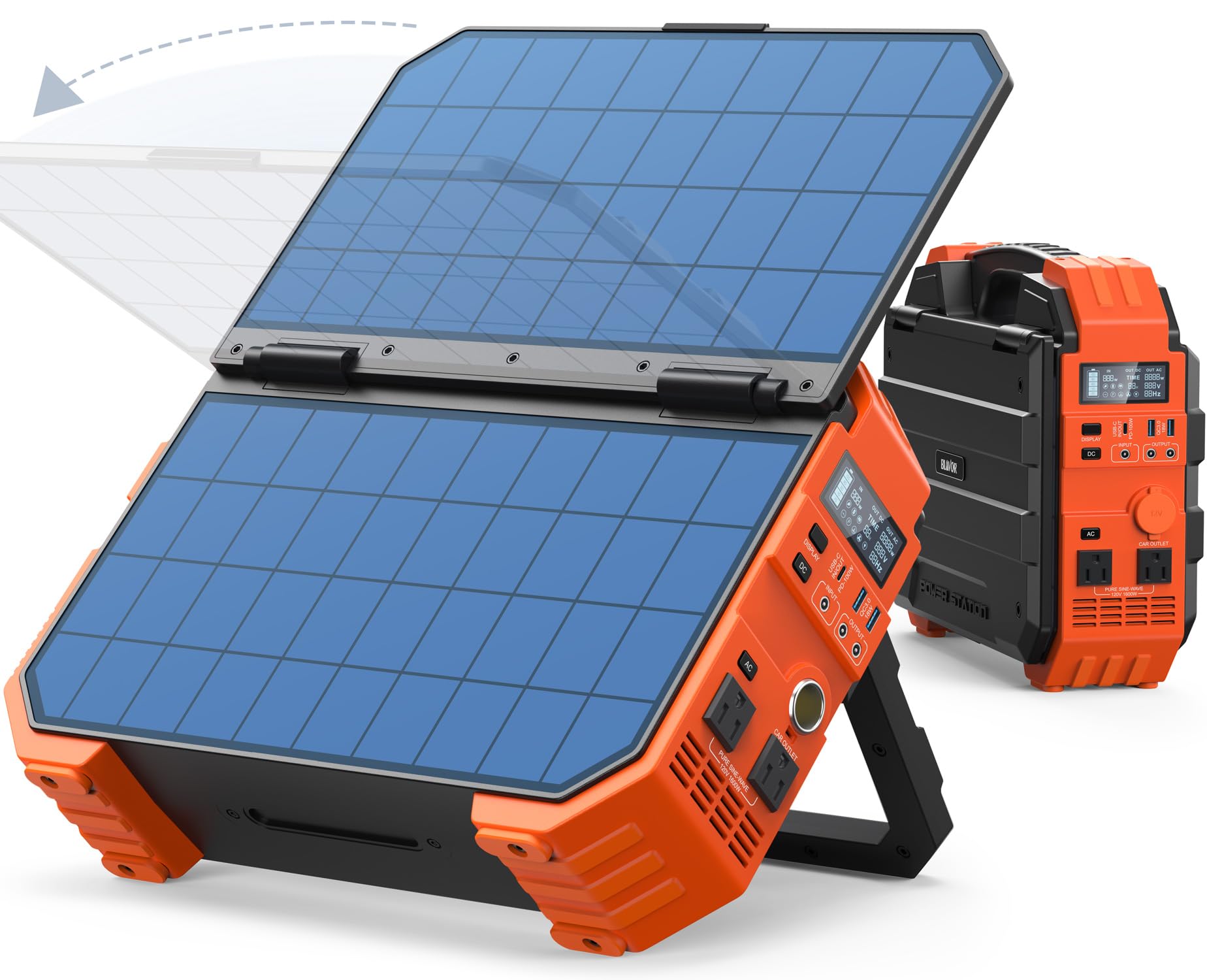
The BLAVOR S1600 stands apart with a foldable 40W solar panel integrated into the unit’s lid, allowing passive solar charging without external panels. The 1024Wh LiFePO4 battery feeds a 1600W inverter (3200W surge), enough to power a mini-fridge, CPAP machine, TV, and laptop simultaneously. Awarded the 2022 German IF Design Award, the orange suitcase design is rugged and portable at 26 lbs, with a fixed handle and foldout stand for positioning the integrated panel toward the sun.
Charging options include the built-in 40W panel (adds about 30W per hour in direct sun), external solar panels via MC4 input, wall AC charging, and car 12V input. The 100W USB-C PD port supports bidirectional charging — fast-charging the unit from a laptop charger or powering large USB-C devices at full speed. The LCD display shows real-time input wattage, output wattage, and remaining battery percentage, helping users gauge runtime at a glance.
Users report that a full charge runs a deep freezer for approximately 20 hours, and the built-in panel provides enough top-up during the day to extend runtime indefinitely in sunny conditions. Some noted that the port labels are difficult to read in low light, and the cooling fan air intake benefits from a filter cloth in dusty environments. For those who want one device that doesn’t require separate solar panels to self-charge, this is the most integrated option available.
Why it’s great
- Built-in 40W solar panel enables self-charging without external equipment
- Compact 26 lb suitcase design with award-winning industrial design
- Bidirectional 100W USB-C PD for fast device charging and unit top-up
Good to know
- Built-in panel outputs only ~30W in real conditions; full charge takes multiple days
- Port labels are small and hard to read in dim light
- Cooling intake may need a filter cloth to prevent dust buildup
6. DOKIO 800W (2x 400W) Monocrystalline Panel Pair

This panel-only kit gives you two 400W monocrystalline panels producing 800W total under STC, with 31V operating voltage suitable for both 12V and 24V battery banks when paired with the correct MPPT controller. Each panel comes with 9.84-foot MC4 leads, significantly longer than the typical 3-foot pigtails on smaller panels, reducing the number of extension connectors needed for ground-mount or rooftop arrays. The 2.4-inch aluminum frame and 3.2mm tempered glass handle wind loads up to 2400Pa and snow loads up to 5400Pa.
Users report real-world ground-level output of approximately 560W under partial shade, with expectations of higher production on rooftop mounts without obstruction. The panels are plug-and-play with MC4 connectors and work with most portable power stations like the EcoFlow Delta Pro via included adapters. The system requires a separate charge controller and inverter, but buyers appreciate the reduced wiring complexity compared to an eight-panel 100W array — fewer splitters, fewer failure points, and a cleaner overall layout.
At 44.45 kg (98 lbs) total for both panels, these are heavy units that require two people for safe handling and mounting. Buyers should measure available space carefully — each panel is 67.8 x 44.6 inches. Shipping is well-packaged with corner protectors, though inspection upon delivery is recommended as returns for glass damage are time-sensitive. For DIY builders who want a high-wattage array with minimal connection points, this panel set delivers excellent value per watt.
Why it’s great
- 9.84-foot MC4 leads reduce need for extension cables in large arrays
- 800W from just two panels means fewer connections and lower failure risk
- Compatible with 12V and 24V systems using appropriate MPPT controller
Good to know
- Panels are large (67.8″ x 44.6″) and heavy; measure mounting space before purchase
- Requires separate charge controller and inverter — not a complete kit
- Output drops significantly with any shading on the panel surface
7. ECO-WORTHY 400W Premium Kit with MPPT & Bluetooth

ECO-WORTHY’s 400W Premium Kit combines four 100W monocrystalline panels with a 40A MPPT charge controller and BT-02 Bluetooth module for remote monitoring. The panels feature 3.2mm low-iron glass and 35mm aluminum frames — 2-5mm wider than typical budget panels — for improved structural rigidity and heat dissipation. The MPPT controller achieves 99% tracking efficiency and 98% peak conversion, delivering up to 40% more charging current than PWM equivalents in cold or overcast conditions.
Installation is straightforward with pre-drilled mounting holes, 16-foot cables with Y-branch connectors, and detailed instructions. Users report peak output around 350W (25.5A) under optimal conditions, with the kit charging a 100Ah LiFePO4 battery from empty to full in about 3 hours of full sun. The BT-02 Bluetooth module provides real-time data on panel wattage, battery voltage, and load current within an 82-foot range. One reviewer noted the charge controller ran hot under sustained high load, and the included Bluetooth module’s app was non-functional, requiring a third-party app for connectivity.
The system is ideal for powering sheds, small cabins, and workshops without running grid power. Several users paired multiple kits together for larger arrays, noting that the panels match existing units from the same brand without cosmetic or performance differences. The 17-year industry presence of ECO-WORTHY and the 30-year warranty on the panels provide long-term assurance despite the controller’s minor heat management quirks.
Why it’s great
- 40A MPPT controller with 99% tracking efficiency outperforms PWM by 40%
- Panels have wider 35mm aluminum frames for better heat management
- Bluetooth monitoring and pre-wired cables simplify system setup
Good to know
- Charge controller can run hot under continuous high load
- Included Bluetooth app may be non-functional; third-party app needed
- Load function on controller may behave inconsistently without proper grounding
8. Renogy 200W 12V Monocrystalline RV Kit with PWM

Renogy’s 200W kit is the entry point for those new to solar, pairing two 100W monocrystalline panels with a 30A Adventurer-Li PWM charge controller. The system delivers approximately 800Wh per day under 4 hours of full sun, enough to keep a 55-quart DC fridge running continuously at 30°F, power an exhaust fan, and maintain battery charge for small electronics. The PWM controller supports lithium, lead-acid, and gel batteries but lacks the voltage conversion efficiency of MPPT controllers — expect about 20% less charging current in sub-optimal conditions compared to an MPPT equivalent.
The kit includes everything needed for a basic install: three pairs of Y-branch connectors, a 30-foot 10AWG adaptor kit, a 16-foot tray cable, mounting Z-brackets, and a BT-1 Bluetooth module for monitoring. The panels feature corrosion-resistant aluminum frames rated for 2400Pa wind and 5400Pa snow loads. Users report easy setup even without prior solar experience, and the system reliably keeps a 200Ah battery bank fully charged in sunny conditions, running a 2000W inverter for smaller appliances like a 7 cu ft freezer.
The primary limitation is the PWM controller — several users upgraded to a Victron MPPT controller for better performance in partial shade and colder weather. The included Renogy DC Home app has been criticized for unreliable Bluetooth connectivity, with some users unable to connect consistently or reporting an outdated firmware requirement. For the price point and intended use case (small camper, boat, or greenhouse), this kit delivers reliable power without complexity.
Why it’s great
- Truly plug-and-play setup with all wiring and mounts included in the box
- Compact 100W panels are lightweight and easy to mount on small roofs
- PWM controller is simple to operate with automatic battery type recognition
Good to know
- PWM controller loses 20-30% efficiency vs MPPT in cold or shade
- Bluetooth app has connectivity and stability issues
- Kit is limited to 200W; scaling requires buying additional equipment
9. JJN Bifacial 425W N-Type Monocrystalline Panel
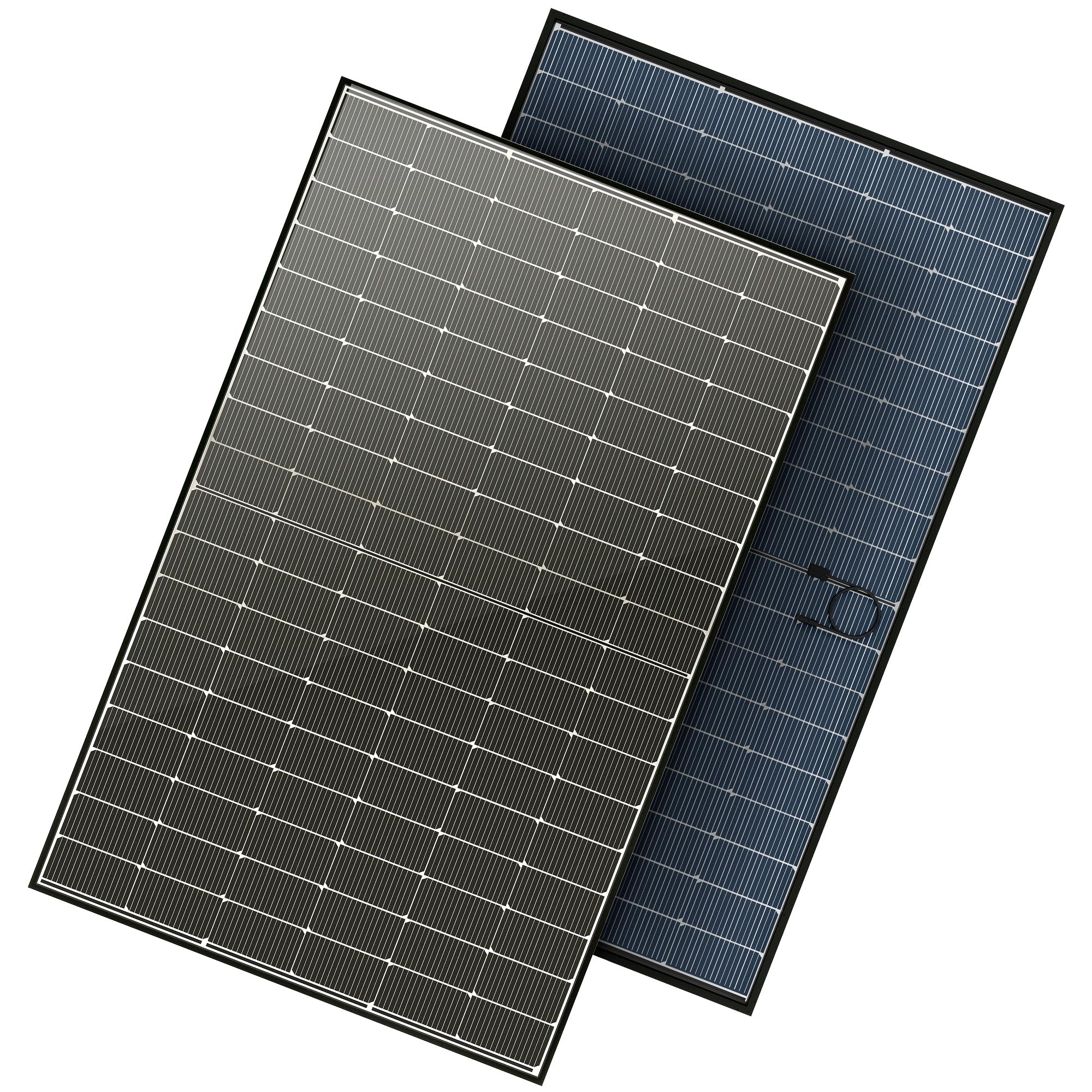
This single 425W panel from JJN uses N-type monocrystalline cells with 16 busbars and a transparent backsheet for bifacial power generation. The N-type cells offer superior low-light performance and lower degradation over time compared to standard P-type cells, with a 25% efficiency rating and an extra-long 30-year power output warranty. The hardened glass and black anodized aluminum frame handle 2400Pa wind and 5400Pa snow loads, making it suitable for ground-mount, rooftop, or carport installations where both sides can receive sunlight.
In real-world tests, users report 380+ watts from individual panels on ground mounts with reflected light, with two panels in parallel producing 1200-1500W total and 6000-10000 Wh per day — enough to cover most home baseline power needs. The 16BB cell design minimizes the impact of partial shading compared to traditional 9BB or 10BB cells, so a single leaf shadow causes less output drop. The panel operates at 31.05V output voltage, compatible with 12V, 24V, and 48V systems through appropriate MPPT charge controllers.
The panels are heavy at 51.6 lbs each and require sturdy mounting — one user noted their 67.8-inch length makes them prone to shipping damage if not properly braced in the box. Several cells on some units have been reported with tiny micro-damage dots that don’t affect output but are cosmetic. For DIY builders who prioritize maximum efficiency per square foot and are willing to invest in a high-quality charge controller, these panels offer long-term reliability with less performance degradation than conventional options.
Why it’s great
- Bifacial design harvests reflected light for up to 25% more total output
- N-type 16BB cells provide superior low-light performance and lower degradation
- 30-year power output warranty reflects high build quality confidence
Good to know
- Panel only — requires separate charge controller, inverter, and battery
- Heavy at 51.6 lbs; may be damaged during shipping without careful bracing
- Some units have cosmetic micro-dots on cells that do not affect output
FAQ
Can I mix different wattage solar panels in the same array?
How many solar panels do I need to run a refrigerator?
Is it better to wire panels in series or parallel for a 12V system?
Do I need a battery monitor for my solar system?
What size charge controller do I need for 800W of solar panels?
Final Thoughts: The Verdict
For most users, the best diy solar kits winner is the ECO-WORTHY 1200W 24V Lithium Solar System because it bundles a complete off-grid solution — panels, batteries, MPPT controller, and inverter — into a single purchase with enough capacity to run a cabin or home backup without needing to source components separately. If you want portable whole-home backup with silent operation, grab the Jackery HomePower 3000 for its 3kWh capacity, 20ms UPS, and integrated TT-30 RV port. And for a budget-friendly entry into solar without sacrificing quality, the Renogy 400W Premium Kit delivers reliable MPPT charging with Bluetooth monitoring at a price that won’t break your project budget.

Mo Maruf
I created WellFizz to bridge the gap between vague wellness advice and actionable solutions. My mission is simple: to decode the research and give you practical tools you can actually use.
Beyond the data, I am a passionate traveler. I believe that stepping away from the screen to explore new environments is essential for mental clarity and physical vitality.