Our readers keep the lights on and my smoothie glass nicely filled. As an Amazon Associate, I earn from qualifying purchases.
You’re tired of hauling gallon jugs from the store and want a permanent solution that puts purified water directly from your tap, on demand, with a system you can install and maintain yourself. But not all reverse osmosis systems are built the same, and the wrong choice can mean slow flow, wasted water, or a complicated installation that requires a plumber. This guide breaks down the top options so you can match the right system to your space, budget, and water quality needs without guesswork.
I’m Mohammad Maruf — the founder and writer behind WellFizz. I’ve spent countless hours analyzing membrane types, filtration stages, flow rates, and waste ratios across dozens of reverse osmosis systems to help you pick the one that actually fits your home setup.
Whether you are looking for a compact under-sink unit or a countertop model that needs zero plumbing, the right diy reverse osmosis system delivers clean, great-tasting water without the recurring cost of plastic bottles.
How To Choose The Best DIY Reverse Osmosis System
Reverse Osmosis (RO) systems vary widely in performance, but a few critical specs separate a great purchase from a frustrating one. Before you buy, consider the following factors to ensure the system matches your tap water profile and your daily usage pattern.
Filtration Stages and Remineralization
A standard 5-stage RO system removes sediment, chlorine, and dissolved solids through a semipermeable membrane. More stages (7, 8, or 9) typically add a UV light for killing microorganisms or a remineralization filter that adds back calcium, magnesium, and potassium for better taste and pH balance. If you are on well water or concerned about bacteria, prioritize UV. If you want spring-like flavor, look for an alkaline or mineral-adding stage.
Flow Rate and Capacity
Flow rate is measured in gallons per day (GPD) — higher GPD means faster filling. A 75 GPD membrane is acceptable for a couple, but a family of four filling bottles, cooking, and making coffee will want 400 to 800 GPD or more. Tankless systems provide continuous flow without a storage tank, but require electricity. Tank-based systems store purified water and can supply it without power, but they take up more under-sink space and may produce stale-tasting water if not used regularly.
Pure-to-Drain Ratio
Traditional RO systems waste between 3 and 4 gallons of water for every gallon of purified water. Modern systems achieve a 1:1, 2:1, or even 3:1 ratio, meaning they waste significantly less. If you live in a water-scarce region or pay high water bills, a higher efficiency ratio is a key advantage.
Quick Comparison
On smaller screens, swipe sideways to see the full table.
| Model | Category | Best For | Key Spec | Amazon |
|---|---|---|---|---|
| iSpring RO1200AK | Premium | High-flow whole kitchen | 1,200 GPD, 3:1 ratio | Amazon |
| iSpring RO500AK-BN | Mid-Range | Balanced flow and remineralization | 500 GPD, 2:1 ratio, NSF 58 | Amazon |
| Home Master TMHP-L | Premium | UV sterilization and mineral water | 75 GPD, 9-stage, UV | Amazon |
| AquaTru Glass Carafe | Premium | Countertop zero-install RO | 4-stage, 0.5 GPM | Amazon |
| Bluevua RO100ROPOT-Lite | Mid-Range | Compact countertop with fruit infuser | 7-stage, UV, 3:1 ratio | Amazon |
| SimPure T1-400UV | Mid-Range | Near-zero TDS and UV | 400 GPD, 1.5:1 ratio | Amazon |
| Express Water ROC001 | Mid-Range | Hot and cold countertop RO | 2-gallon tank, UV | Amazon |
| Waterdrop G5P500A | Mid-Range | Compact 8-stage with alkaline | 500 GPD, 2:1 ratio, tankless | Amazon |
| Waterdrop T3-T | Budget | Budget-friendly mineral RO | 220 GPD, 2:1 ratio, tank | Amazon |
In‑Depth Reviews
1. iSpring RO1200AK Dual-Flow
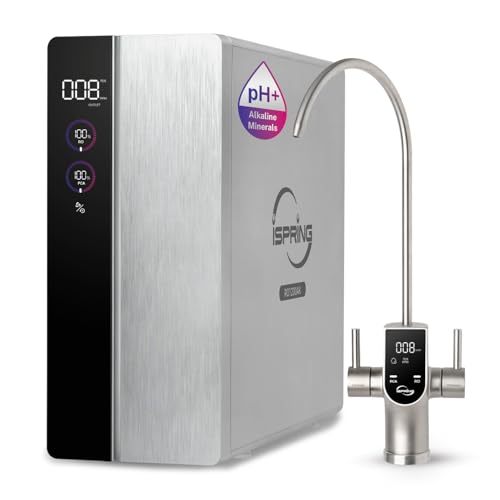
The iSpring RO1200AK is the highest capacity system on this list, producing 1,200 gallons per day with an industry-leading 3:1 pure-to-drain ratio. Its dual-flow faucet delivers fast carbon-filtered water on the left for rinsing and RO + alkaline water on the right for drinking, which extends membrane life by preventing unnecessary RO water use during everyday tasks. The pump is audible but quiet enough for under-sink installation, and the smart TDS monitor gives real-time inlet and outlet readings.
Installation is straightforward with push-fit connections, though the unit is larger than most tankless systems, so measure your under-sink space carefully. Users report measured flow rates of 0.60 GPM (close to its 0.83 GPM claim) and TDS reduction from 125 ppm to under 5 ppm. Filter replacements are affordable, costing roughly per week, and iSpring’s customer support is consistently praised for quick, helpful responses.
If you have a busy household that fills large pots, runs a refrigerator line, and wants near-zero wastewater, this is the most future-proof choice available. The price is premium, but the feature set — dual-flow, 3:1 efficiency, 1,200 GPD, and alkaline remineralization — justifies the investment for serious DIY users.
Why it’s great
- Dual-flow faucet extends membrane life by using carbon-filtered water for rinsing tasks.
- Exceptional 1,200 GPD flow rate fills a cup in about 5 seconds.
- 3:1 pure-to-drain ratio produces 50% less wastewater than typical 1.5:1 systems.
Good to know
- Larger footprint than most tankless systems; measure under-sink space.
- Pump is audible, though not disruptive under a cabinet.
2. iSpring RO500AK-BN

The iSpring RO500AK-BN brings many of the premium iSpring features to a mid-range price point, delivering 500 GPD with a 2:1 pure-to-drain ratio. It uses a 3-stage process — a composite sediment and carbon block filter, a 0.0001 micron RO membrane, and a carbon alkaline filter — that reduces over 1,000 contaminants while adding calcium, magnesium, and potassium for balanced pH. The brushed nickel faucet feels substantial and the tankless design frees up significant under-sink storage space.
Installation is a genuine DIY project, typically under one hour, and filter replacements are tool-free with quarter-turn caps. The automatic self-cleaning function flushes the membrane after 24 hours of inactivity, prolonging filter life. Users frequently mention that iSpring’s customer service team, especially representatives Nick and Myra, resolves issues quickly and often sends replacement parts even outside the standard warranty window.
The only trade-off is the faucet size — the standard unit may not cover a 1.5-inch counter hole, but iSpring sends a complimentary faceplate upon request. For a household seeking NSF 58 certification, alkaline water, and a reliable support team, this system delivers tremendous long-term value.
Why it’s great
- NSF 58 certified for TDS reduction; independent testing confirms performance.
- Tool-free quarter-turn filter changes simplify maintenance.
- Automatic self-cleaning extends RO membrane life between uses.
Good to know
- Faucet may be too small for 1.5-inch counter holes without the included faceplate.
- Requires electrical outlet for the built-in pump.
3. Home Master TMHP-L HydroPerfection

The Home Master TMHP-L HydroPerfection is a loaded under-sink system that uses a 9-stage process including a DOW Filmtec membrane with 99% rejection rate, a patented 2-pass remineralization system, and an EPA-registered UV sterilizer. It treats issues that plague other RO systems — it reduces storage tank degradation by adding minerals during purification rather than after, and the UV lamp eliminates bacteria and viruses. The brushed nickel Lux faucet and refrigerator connection kit come included in the box.
Installation is more involved than tankless models, typically taking 2 to 3 hours because of the tube routing to the storage tank, faucet, and refrigerator line. The system uses a standard 75 GPD membrane, but the storage tank provides a steady supply; users report filling a large pot in 2 to 3 minutes. Annual filter and membrane replacement costs are roughly equivalent to what you would spend on countertop filter cartridges in 6 months, making it cost-effective over time.
This is the best choice for anyone who wants true mineral water on tap, UV sterilization for well water or microbiological concerns, and a system that solves the common problems of tank degradation and slow flow. It does take significant under-sink space, so check your cabinet depth before purchasing.
Why it’s great
- Patented 2-pass remineralization adds calcium and magnesium during purification for better taste.
- EPA-registered UV sterilizer kills viruses, bacteria, and fungi.
- Includes Lux faucet, fridge kit, and disposal drain adapter right in the box.
Good to know
- Takes significant under-sink space; measure depth before installation.
- Standard 75 GPD membrane requires a storage tank; not tankless.
4. AquaTru Glass Carafe
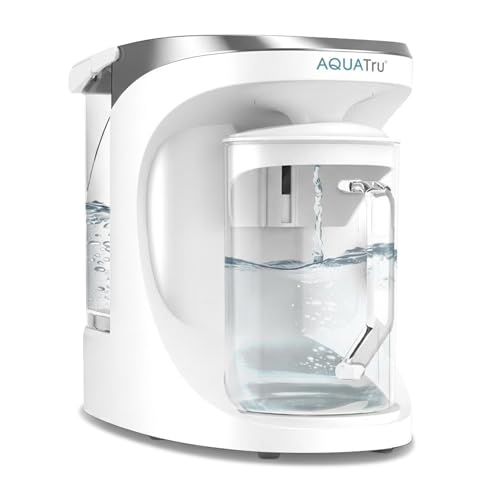
The AquaTru Glass Carafe is a countertop RO system that requires no plumbing — just plug it into a standard outlet. Its 4-stage filtration uses a pre/carbon filter, an RO membrane, and a VOC carbon filter to remove microplastics, fluoride, chromium-6, arsenic, PFOA/PFOS, and 84 other contaminants. The borosilicate glass carafe avoids plastic storage concerns and the system produces 30 ounces of purified water per cycle, with wastewater directed to a separate reservoir.
Setup is truly plug-and-play: fill the rear tank with tap water, press the button, and purified water dispenses into the carafe in roughly 8 minutes per full cycle. The filter life is reasonable — the pre/carbon filter lasts 300 gallons (about 6 months) and the RO membrane lasts 600 gallons (about 1 year). Users consistently praise the water taste, noting that it beats premium bottled water, though the intake tank is relatively small for large families and requires frequent refilling.
This model stands out for renters or anyone without under-sink access who still wants genuine RO filtration. The 1-year warranty and 30-day money-back guarantee add peace of mind. The main drawback is the higher per-filter cost if purchased on Amazon versus direct from the manufacturer.
Why it’s great
- Zero installation required — works on any counter near an outlet.
- Borosilicate glass carafe eliminates plastic leaching concerns.
- Certified to NSF standards for contaminant reduction.
Good to know
- Small intake tank requires frequent refilling for larger households.
- Replacement filters are less expensive when purchased directly from AquaTru.
5. Bluevua RO100ROPOT-Lite (UV)
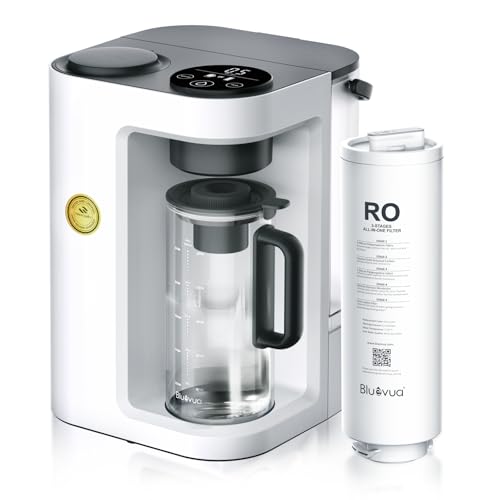
The Bluevua RO100ROPOT-Lite is a countertop RO system that combines 7-stage UV filtration with a borosilicate glass carafe and a built-in fruit infuser. It uses a 5-in-1 filter, UV light, and a remineralization filter to reduce TDS while adding essential minerals for balanced taste. The 3:1 pure-to-drain ratio is among the most efficient for a countertop model, and the annual filter replacement design keeps ongoing costs low at about per day.
The one-touch LED panel allows you to select water volume and monitor filter life, and the compact footprint (9.7 x 9.5 x 14.1 inches) fits on most kitchen counters. Users report TDS dropping from tap levels to 0 ppm without remineralization and 4 ppm with minerals enabled, and the water taste is described as crisp and clean. The infuser attachment adds a nice touch for flavored water without added sugars.
This is a great choice for individuals or couples who want premium countertop RO with UV and remineralization in a small package. The yearly filter is simple to swap, but the unit is designed for 1 to 2 people — larger households may find the production rate too slow for continuous demand.
Why it’s great
- Annual filter replacement reduces maintenance frequency and cost.
- Glass carafe with fruit infuser encourages healthy hydration.
- 3:1 pure-to-drain ratio minimizes wastewater.
Good to know
- Best suited for 1 to 2 person households; slower production than under-sink units.
- Replacement filters for UV models cost more than standard RO cartridges.
6. SimPure T1-400UV

The SimPure T1-400UV is a tankless under-sink RO system that uses 8-stage filtration and a UV light to achieve near-zero TDS levels. It produces 400 gallons per day with a 1.5:1 pure-to-drain ratio, and the built-in pump ensures consistent pressure even on lower municipal water supplies. The compact design (15.6 x 5.3 x 15.7 inches) saves under-sink space compared to tank-based alternatives.
Installation is straightforward for a DIY user, taking about 30 minutes with the included quick-connect fittings. Users report that tap water TDS of 200 to 500 ppm drops to below 25 ppm, often near zero for the first several months before stabilizing in the 10 to 14 ppm range. The UV module operates automatically based on flow pressure, providing an extra layer of protection against microorganisms.
A few users have noted damaged O-rings on pre-installed filters, but replacement rings are included, and the issue does not affect long-term performance. For anyone seeking the purest possible water with UV sterilization in a compact tankless form factor, the SimPure T1-400UV delivers excellent value without the premium price tag of larger systems.
Why it’s great
- UV sterilization provides reliable microorganism reduction without chemical additives.
- Near-zero TDS output satisfies those seeking maximum purity.
- Compact, tankless design fits easily in tight under-sink spaces.
Good to know
- Some units ship with damaged O-rings on filters; inspect before installation.
- Requires a brief flush after periods of inactivity to clear initial TDS spike.
7. Express Water ROC001 UV

The Express Water ROC001 UV is a countertop RO system that offers hot, warm, or ambient water through a smart temperature control panel. It uses a 5-stage filtration process with LED UV technology to reduce up to 99.99% of impurities, and the 2-gallon storage tank provides enough capacity to reduce frequent refills. The plug-in design requires zero installation, making it suitable for apartments, offices, or RVs.
Setup is genuinely simple — unbox, connect the quick-change filters, fill the tank, and plug it in. The unit delivers water at the selected temperature via a metal spout, though some users note the spout height is too low for larger jugs. TDS reduction is effective, with reports of tap water at 128 ppm dropping to 3 ppm. The ROM filter cap can sometimes leak, but Express Water’s support team is responsive and will send a replacement wrench or guide for tightening.
The main trade-offs are a slower fill rate (about 16 minutes per gallon) and a higher wastewater ratio (around 3:1 waste to pure). For those who prioritize temperature versatility and zero-install convenience over raw speed or efficiency, this is a solid choice.
Why it’s great
- Three temperature settings — hot, warm, ambient — for tea, coffee, or cold drinks.
- No installation needed; works anywhere with a standard outlet.
- 2-gallon tank reduces the need for constant refilling.
Good to know
- Wastewater ratio is approximately 3:1, higher than modern tankless systems.
- Metal spout height may be too low for large water jugs or pitchers.
8. Waterdrop G5P500A
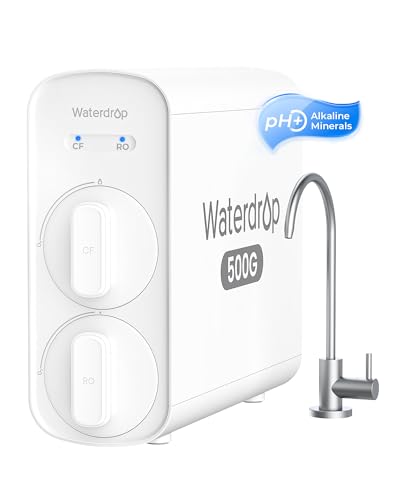
The Waterdrop G5P500A is a tankless under-sink RO system that packs 8 stages of filtration into a slim, space-saving cabinet. Its 0.0001 micron RO membrane is paired with an alkaline mineralization stage that adds Ca²⁺, Mg²⁺, Na⁺, and K⁺ while reducing PFOA, PFOS, chlorine, lead, fluoride, and heavy metals. The 500 GPD flow rate fills a 6-ounce cup in 8 seconds, and the 2:1 pure-to-drain ratio keeps wastewater minimal.
The tankless design frees up about 70% of under-sink space compared to traditional tank systems, and the smart faucet includes an LED display for filter life and water quality monitoring. Installation is straightforward with color-coded tubing and labeled ports, though some users have swapped the included fittings for John Guest push-connect fittings for added reliability. The pump runs quietly, and the compact dimensions (5.69 x 16.69 x 13.9 inches) fit under most sinks.
One quirk noted by users is the TDS reading on the smart faucet can get stuck at a specific value and not update with real-time changes, though the water quality itself remains excellent. For a mid-range price, this system offers a great balance of speed, efficiency, and mineral enhancement in a sleek package.
Why it’s great
- 8-stage filtration with alkaline mineralization for balanced pH and taste.
- Compact tankless design saves significant under-sink storage space.
- Smart faucet with LED display for filter life and water quality monitoring.
Good to know
- Smart faucet TDS reading can become inaccurate or static after several months.
- Some users prefer aftermarket John Guest fittings for more secure connections.
9. Waterdrop T3-T
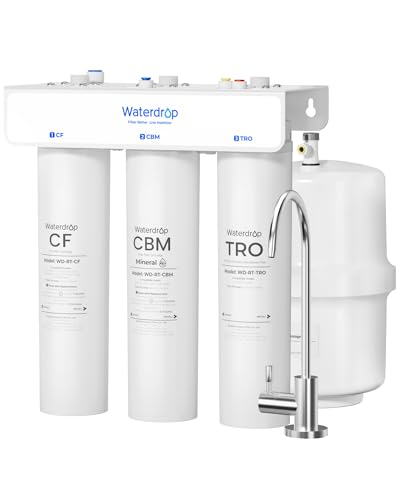
The Waterdrop T3-T is a compact tank-based RO system that delivers 220 GPD with a 2:1 pure-to-drain ratio, making it one of the most efficient budget-friendly options available. Its 7-stage filtration includes a CF filter, CBM filter (carbon block and mineral), and TRO filter that reduce TDS, chlorine, heavy metals, and sediment while remineralizing the water with potassium, calcium, sodium, and magnesium for improved taste. The all-in-one filter design allows a 3-second twist-and-replace change without any mess.
Installation is genuinely DIY-friendly, with simplified water lines that connect in about 30 minutes — users consistently report completing setup in under an hour with no leaks. The compact dimensions (12.6 x 6.1 x 14.69 inches) save 40% more under-sink space than traditional tank systems, and the NFC tap-to-phone feature reminds you when filters need replacement. The 2:1 waste ratio means a family of three can save roughly 225 gallons of water per month compared to conventional RO systems.
While the 220 GPD flow rate is slower than premium tankless options, filling five 16.9-ounce bottles takes about one minute, which is sufficient for most daily needs. The remineralization stage noticeably improves the flavor of coffee and tea. For buyers on a tighter budget who still want a well-rounded, mineral-enhanced RO system with easy maintenance, the Waterdrop T3-T punches above its price class.
Why it’s great
- All-in-one 3-second twist-and-replace filter design eliminates messy housing changes.
- NFC technology provides convenient smartphone filter reminders.
- Compact tank design saves under-sink space while maintaining a 2:1 waste ratio.
Good to know
- 220 GPD is slower than mid-range tankless options; plan for short wait times on larger fills.
- Faucet installation requires drilling a hole in the countertop.
FAQ
Can I install a DIY reverse osmosis system myself without a plumber?
What is the difference between tankless and tank-based RO systems?
Do I need a remineralization filter in my RO system?
What does the pure-to-drain ratio mean and why should I care?
Final Thoughts: The Verdict
For most users, the diy reverse osmosis system winner is the iSpring RO1200AK because it combines the fastest flow rate, the best waste ratio, dual-flow smart faucet, and alkaline remineralization in one package. If you want a moderate investment with NSF certification and rock-solid support, grab the iSpring RO500AK-BN. And for a no-install countertop option that delivers pure mineral water with UV protection, nothing beats the AquaTru Glass Carafe.

Mo Maruf
I created WellFizz to bridge the gap between vague wellness advice and actionable solutions. My mission is simple: to decode the research and give you practical tools you can actually use.
Beyond the data, I am a passionate traveler. I believe that stepping away from the screen to explore new environments is essential for mental clarity and physical vitality.