Our readers keep the lights on and my smoothie glass nicely filled. As an Amazon Associate, I earn from qualifying purchases.
The chlorine aftertaste, the metallic tang from old pipes, the sediment clouding your ice cubes — your tap water is drinking your home’s plumbing history. A DIY home water filtration system puts control back where it belongs: in your hands, without waiting for a plumber or spending a fortune on bottles.
I’m Mohammad Maruf — the founder and writer behind WellFizz. I’ve spent hundreds of hours cross-referencing membrane pore sizes, gallon-per-minute flow rates, filter replacement schedules, and third-party certifications to separate real performance from marketing fluff in the home water filtration space.
From countertop gravity units to whole-house three-stage setups, this guide breaks down the nine best options available today. My goal is to help you find the very best diy home water filtration system for your specific water quality issues and household needs.
How To Choose The Best DIY Home Water Filtration System
Before you buy anything, you need to know what is actually in your water. A municipal report or a simple home test kit will tell you whether you are fighting chlorine, sediment, lead, heavy metals, or biological contaminants. That single data point dictates whether a basic carbon block will suffice or if you need the full arsenal of reverse osmosis. The best system isn’t the most expensive one — it’s the one that targets your specific problem without adding unnecessary complexity or ongoing filter costs.
Filtration Media and Micron Rating
The filter media is the engine. Activated carbon blocks handle chlorine taste, odor, and volatile organic compounds (VOCs). KDF (Kinetic Degradation Fluxion) media targets heavy metals like lead and mercury. Ultrafiltration (UF) membranes with a 0.01-micron pore size can catch bacteria and cysts while retaining beneficial minerals. Reverse osmosis (RO) membranes go further, removing dissolved solids like fluoride, arsenic, and nitrates — but they also strip healthy minerals and produce wastewater. A lower micron number means finer filtration, but it also reduces flow rate, so balance coverage with how fast you need water flowing.
Installation Type and Space Requirements
Countertop gravity filters require zero plumbing and zero electricity — they sit on your counter and work by gravity alone, making them ideal for renters or emergency prep. Under-sink systems connect directly to your cold water line and require cabinet space below the sink; they deliver filtered water through your existing faucet or a dedicated tap. Whole-house systems install at the main water line and filter everything entering the home, protecting appliances and every tap simultaneously. Measure your available clearance — especially for whole-house units that need 28 inches of vertical space and room to spin the filter housings off for replacement.
Flow Rate and Filtration Speed
Flow rate is measured in gallons per minute (GPM). A gravity system might deliver 0.06 GPM — enough for drinking and cooking but not for filling a pot quickly. Under-sink units typically range 1.5 to 2.5 GPM. Whole-house systems can push 12 to 15 GPM, which is critical if you need to run a shower and a washing machine simultaneously. Faster flow usually means less filtration precision at each stage, so premium systems with larger filter cartridges (20×4.5 inches) maintain high flow while keeping micron ratings tight.
Filter Replacement Cost and Lifespan
The purchase price is only the entry fee. Every system has consumable filters that must be swapped on a schedule — typically every 6 to 12 months. A filter that costs and lasts a year is cheaper in the long run than one that costs but needs replacing every three months. Calculate your total annual operating cost by multiplying the replacement filter price by the number of stages divided by their respective lifespans. A system with individually replaceable cartridges (rather than combined all-in-one blocks) lets you swap only the stage that is exhausted, saving money over time.
Quick Comparison
On smaller screens, swipe sideways to see the full table.
| Model | Category | Best For | Key Spec | Amazon |
|---|---|---|---|---|
| iSpring WGB32B | Whole House | High-flow whole home filtration | 20″ x 4.5″ filters, 15 GPM | Amazon |
| iSpring WCB32C-KS | Whole House | Heavy metals + PFAS reduction | 30,000 gal capacity, GAC/KDF | Amazon |
| AquaTru Carafe | Countertop RO | Zero-install RO for renters | 4-stage RO, 0.5 GPM | Amazon |
| Waterdrop T3-T | Under Sink RO | Fast RO with remineralization | 220 GPD, 2:1 drain ratio | Amazon |
| 3M Aqua-Pure FF100 | Under Sink | NSF-certified high-flow drinking water | 2.5 GPM, NSF 42/53 | Amazon |
| Waterdrop TST-UF | Under Sink UF | Mineral-retaining UF filtration | 0.01μm membrane, 1.59 GPM | Amazon |
| Reverse Osmosis Revolution WHF-34F5 | Whole House | Budget whole-house with extra filters | 3-stage, includes 2 extra filter sets | Amazon |
| SimPure DB10C-2 | Whole House | Entry-level whole house for well water | 15 GPM, clear housings | Amazon |
| Purewell 2.25G | Countertop Gravity | No-power countertop filtration | 0.01μm UF, 2.25 gal capacity | Amazon |
In‑Depth Reviews
1. iSpring WGB32B Whole House Water Filter System

The iSpring WGB32B is the benchmark for whole-house filtration in the DIY space. Its three-stage design uses a 5-micron sediment filter followed by two coconut-shell CTO carbon block filters, each sized at 20 inches by 4.5 inches — the industrial standard that delivers up to 15 GPM without choking your home’s water pressure. The 1-inch NPT inlet and outlet ports ensure compatibility with standard main water lines, and the system’s 100,000-gallon capacity means you replace filters roughly once a year under normal family use.
What separates this unit from cheaper alternatives is the build quality of the housings and the availability of individual replacement cartridges. Each filter stage is separately replaceable, so you are not forced to swap a perfectly good sediment filter just because the carbon block is exhausted. The included wrench and mounting bracket make wall installation straightforward, though the 45-pound weight requires a sturdy mounting surface. Customer reviews consistently highlight the exceptional post-purchase support from iSpring’s US-based team, with several users reporting free replacement parts years after their original purchase.
This system does not reduce TDS — it retains healthy minerals like calcium and magnesium — so if your primary concern is dissolved solids, you would pair it with a separate RO unit at the kitchen sink. For every other common contaminant — chlorine, sediment, rust, herbicides, and odors — the WGB32B provides comprehensive, low-maintenance coverage for the entire home.
Why it’s great
- Industrial-size filters mean full-year replacement intervals for most households.
- Exceptional customer support with free replacement parts even out of warranty.
- High 15 GPM flow rate supports simultaneous shower, laundry, and tap use.
Good to know
- Heavy unit at 45 pounds requires a solid wall mount.
- O-ring seating can be fiddly during reinstallation and may cause minor leaks if not lubricated.
2. iSpring WCB32C-KS Whole House Water Filter System

The iSpring WCB32C-KS solves a specific problem that most whole-house filters ignore: heavy metals and PFAS (forever chemicals). Its three-stage configuration starts with a transparent 5-micron sediment housing — letting you visually inspect the filter without disassembly — followed by a GAC and KDF composite cartridge that targets lead, chloramine, hydrogen sulfide, and PFAS, and finishes with a CTO carbon block for residual chlorine and fine particles. The KDF media is the key differentiator here; it uses redox reactions to chemically convert heavy metals and chlorine into harmless byproducts that stay trapped in the filter bed.
The system’s 30,000-gallon capacity and six-month filter life fit well for a family of four with typical municipal water. Installation is DIY-friendly with the included wrench and thorough manual, but the 21.5-pound weight and 25-inch height require you to plan your mounting location carefully. Multiple customer reports confirm that iSpring’s support team proactively sends replacement head units or fittings when minor leaks occur, which speaks to the company’s confidence in its product.
A practical note: the system does not reduce TDS, as it is designed to preserve healthy minerals. If you need zero dissolved solids, you would still want a downstream RO system. For the vast majority of homes dealing with chlorine, lead, and PFAS concerns from municipal supplies, this is the most targeted whole-house solution in its class.
Why it’s great
- KDF media specifically targets heavy metals, PFAS, and hydrogen sulfide — not just chlorine.
- Transparent first-stage housing lets you monitor sediment build-up at a glance.
- Responsive customer support with free replacement parts for reported defects.
Good to know
- O-rings must be inspected carefully before installation to avoid pinhole leaks.
- Mounting bracket may require repositioning if studs are not at standard 16-inch spacing.
3. AquaTru Glass Carafe Countertop RO System
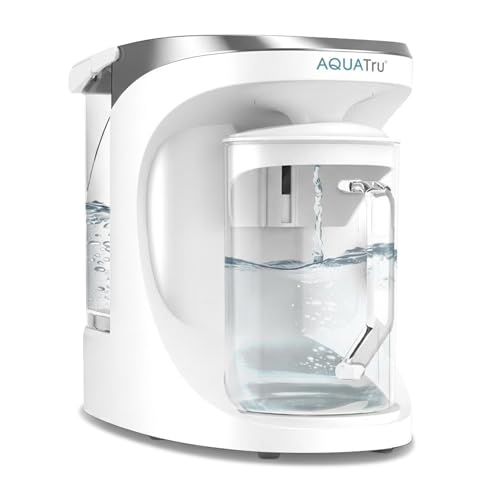
The AquaTru Carafe redefines convenience for the DIY filtration crowd by delivering real reverse osmosis without a single plumbing connection. You fill the top tank with tap water, plug the unit into a standard outlet, and it uses a built-in pump to push water through four stages — a pre/carbon filter, a reverse osmosis membrane, and a VOC carbon filter — before dispensing purified water into a borosilicate glass carafe. It removes 84 contaminants including microplastics, fluoride, chromium-6, arsenic, and PFOA/PFOS, certified by IAPMO to NSF standards.
The most compelling feature is the zero-installation footprint. At 14 inches wide and 13 inches tall, it occupies roughly the same counter space as a mid-sized coffee maker. The glass carafe eliminates the microplastic leaching concerns associated with plastic pitchers, and the magnetic shutoff mechanism automatically stops the purification cycle when the carafe is removed. Filter replacement intervals are clearly defined: the pre/carbon filter at 300 gallons or six months, the RO membrane at 600 gallons or 12 months, and the VOC filter at 300 gallons or 12 months.
The trade-off is throughput. At 0.5 GPM, it produces about 30 ounces of purified water per cycle, and the input tank cannot be topped up mid-cycle because the wastewater recirculates. You will need to dump the wastewater manually and refill the tank every one to two pitchers. This is not a high-volume solution for a large family, but for renters, small households, or anyone who wants RO-grade water without drilling into their countertop, it is the most practical option available.
Why it’s great
- True RO filtration with zero plumbing or drilling required.
- Borosilicate glass carafe avoids plastic microplastic contamination.
- NSF-certified removal of 84 contaminants including PFAS and heavy metals.
Good to know
- RO membrane may fail prematurely in some units before the 12-month mark.
- Input tank is relatively small and cannot be refilled during a purification cycle.
4. Waterdrop T3-T Reverse Osmosis System
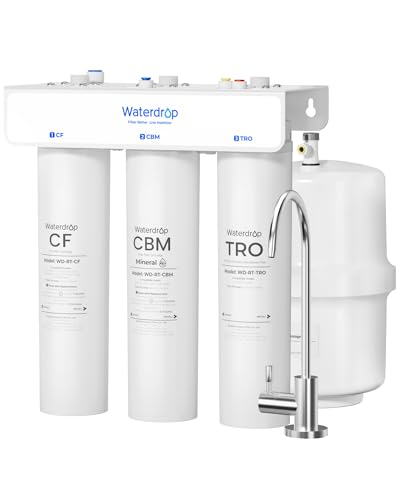
The Waterdrop T3-T attacks the two biggest complaints about traditional under-sink RO systems — slow production rate and mineral stripping. With a production capacity of 220 gallons per day, it fills a 16.9-ounce bottle in about 12 seconds, easily outpacing the standard 75 GPD units. The seven-stage filtration includes a sediment pre-filter, a carbon block, a reverse osmosis membrane, and a remineralization cartridge that adds back calcium, potassium, sodium, and magnesium for improved taste and pH balance.
The 2:1 pure-to-drain ratio is a significant environmental upgrade from conventional RO systems that waste three to four gallons for every gallon of purified water. A family of three can save up to 225 gallons of water per month compared to older RO technologies. The all-in-one filter design — a single twisting cartridge that consolidates multiple stages — replaces in three seconds without tools or housing disassembly. The compact unit measures 12.6 by 6.1 by 14.69 inches, saving about 40 percent of under-sink space versus tank-based systems.
Installation takes roughly 30 minutes for a competent DIYer, though the faucet does require a hole in the countertop. The NFC-enabled filter reminder lets you tap your phone to check remaining life, which removes the guesswork. If you want the speed of RO without the flat, acidic water that many systems produce, the T3-T delivers a noticeably better-tasting result.
Why it’s great
- 220 GPD output fills a bottle in seconds — much faster than entry-level RO units.
- 2:1 pure-to-drain ratio cuts wastewater by half compared to conventional RO.
- Remineralization stage restores healthy minerals for improved flavor and pH.
Good to know
- Faucet installation requires drilling a hole in the countertop.
- Requires a constantly powered outlet — cannot run on a switched circuit.
5. 3M Aqua-Pure FF100 Under Sink Filter System

The 3M Aqua-Pure FF100 is the under-sink filter that plumbers recommend when you want certified contaminant removal without the complexity of a dedicated faucet. It connects directly to your existing cold water line and delivers filtered water through your current faucet at up to 2.5 GPM — essentially full flow with minimal pressure drop. The system is certified under NSF Standards 42 and 53 to reduce microplastics, chlorine taste and odor, lead, parasitic protozoan cysts, and select volatile organic compounds including benzene.
The Sanitary Quick Change (SQC) design is a standout feature: the filter cartridge twists off and on without tools and without contacting the filter media. The head assembly includes a built-in shut-off valve so you can replace the cartridge without shutting off the water supply to the entire house. The FF101 cartridge lasts up to 6,000 gallons or roughly one year for an average family, though real-world users report that flow begins to decline around the six-month mark if the water is particularly dirty.
Installation requires basic plumbing skills — you need to connect 3/8-inch or 1/2-inch supply lines using the included push-fit fittings. Several experienced users recommend swapping the plastic push-tubing for braided stainless steel lines with compression fittings to avoid the risk of the tubing popping loose under pressure. This is a simple precaution that adds peace of mind to an otherwise excellent system.
Why it’s great
- NSF 42 and 53 certified for legitimate contaminant reduction — not just marketing claims.
- Maintains near-full faucet flow rate at 2.5 GPM.
- Built-in shut-off valve allows tool-free filter swaps without turning off the main water.
Good to know
- Replacement cartridges are relatively expensive compared to generic alternatives.
- Push-fit plastic tubing included with the kit has a known failure risk under continuous pressure.
6. Waterdrop TST-UF Under Sink Filter System

The Waterdrop TST-UF is the right choice when you want excellent filtration but want to keep the healthy minerals in your water. Its three-stage system uses a 5-micron PP sediment filter, a coconut-shell activated carbon block, and a 0.01-micron ultrafiltration membrane that captures bacteria, cysts, and particulate down to the sub-micron level while allowing dissolved minerals like calcium, magnesium, and potassium to pass through. The result is crisp, great-tasting water that still has the mouthfeel and mineralization of natural spring water.
The build quality is a step above most under-sink units in its range. The housing is constructed from 304 stainless steel rather than the plastic shells common at this price point, which eliminates concerns about cracking or leaching over time. The flow rate of 1.59 GPM fills an 8-ounce cup in roughly 2.3 seconds — fast enough for practical daily use without the wait of a gravity system. Installation connects directly to 3/8-inch or 1/2-inch cold water lines, and the compact dimensions fit easily in most under-sink cabinets.
This system is specifically designed for municipal tap water and is not recommended for well water. It does not reduce TDS — the whole point is to retain minerals — so if you have high dissolved solids or hard water, you would need a different approach. The replacement filter schedule is economical: the PP filter lasts 6-8 months, the UF membrane lasts 12 months, and the carbon block lasts 12-24 months, with each stage replaceable independently.
Why it’s great
- 0.01-micron UF membrane removes bacteria and cysts while preserving beneficial minerals.
- 304 stainless steel construction outlasts plastic housing alternatives.
- Individually replaceable filter stages reduce long-term operating costs.
Good to know
- Not compatible with well water — designed for municipal tap only.
- Does not reduce TDS, so it won’t help with hard water or dissolved solids issues.
7. Reverse Osmosis Revolution WHF-34F5 Whole House System
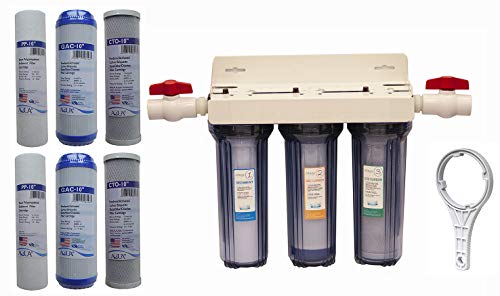
The Reverse Osmosis Revolution WHF-34F5 stands out for a simple reason: it ships with two extra sets of replacement filters (six cartridges total) included in the box, effectively giving you the first 12 to 18 months of operating cost covered. The three-stage configuration uses a 5-micron sediment pre-filter, a 10-inch GAC granular activated carbon filter for chlorine and VOC removal, and a 10-inch CTO carbon block for fine polishing and taste improvement. The system is built in the USA with 3/4-inch NPT brass ports.
The installation is straightforward for anyone comfortable with basic plumbing. The included shut-off valves and mounting brackets make the process cleaner, though the instructions for warranty registration are unnecessarily convoluted — expect to fill out multiple forms. Customer reports note that the system effectively eliminates sulfur smells from well water and significantly reduces the chlorine taste from municipal supplies. The 10,000-gallon capacity per filter set means you expect replacements every 4-6 months depending on usage and water quality.
This is not a premium build — the housings are standard blue polypropylene, and the included hardware is functional rather than heavy-duty. But for the price point, you are getting a complete whole-house filtration solution with two years of filters in the box. If you are on a tight budget but want three-stage protection for your whole home, this is the most cost-effective entry point.
Why it’s great
- Comes with two extra sets of replacement filters, covering operating costs for over a year.
- Effectively removes sulfur smell, chlorine, and sediment from both well and municipal water.
- Straightforward DIY installation with included shut-off valves.
Good to know
- Warranty registration process is frustratingly complex with redundant steps.
- Build quality is average — plastic housings may feel less substantial than premium options.
8. SimPure DB10C-2 Whole House Water Filter System
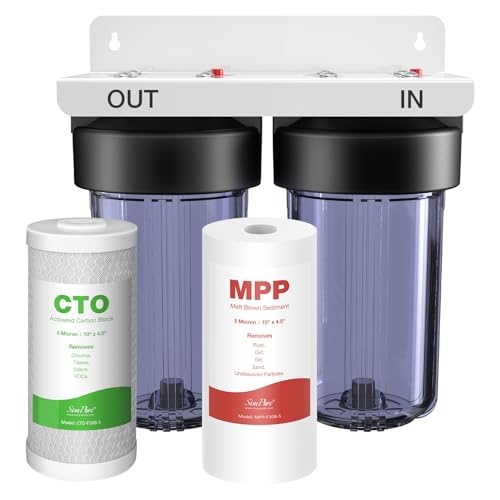
The SimPure DB10C-2 is a no-frills entry point for whole-house filtration that punches above its weight in two specific areas: visibility and flow. The clear polypropylene filter housings let you inspect the sediment and carbon cartridges at any time without disassembly — a feature usually reserved for more expensive systems. At 15 GPM, the flow rate is comparable to premium units, meaning you can run a shower and washing machine simultaneously without noticing a pressure drop.
The two-stage setup pairs a 5-micron MPP sediment filter with a high-performance CTO carbon block. The sediment stage captures sand, rust, and larger particulates that can clog appliances, while the carbon block targets residual chlorine, discoloration, and odors. The 80,000-gallon annual capacity is enough for most families, with the sediment filter lasting 6-12 months and the carbon filter needing replacement every 3-6 months. The brass 1-inch NPT ports provide a solid, leak-resistant connection point.
Installation is genuinely DIY-friendly — the kit includes all necessary fittings and clear instructions. The double O-ring seals on each housing reduce the leak risk that plagues cheaper systems. Customer feedback from well-water users is particularly positive, with many reporting crystal-clear results from previously red-clay-laden supplies. If you are looking for an affordable way to protect your home’s appliances and improve basic water quality, this is a solid starting point.
Why it’s great
- Clear filter housings let you see exactly when a cartridge needs replacement.
- High 15 GPM flow rate supports whole-home demand without pressure loss.
- Easy DIY installation with comprehensive kit and clear instructions.
Good to know
- Only two-stage filtration — less comprehensive than three-stage alternatives.
- Carbon filter section may not fully eliminate hydrogen sulfide smell from some well water sources.
9. Purewell 2.25G Gravity Water Filter System

The Purewell 2.25G is a countertop gravity system that delivers impressive filtration performance without any electricity or plumbing. Its three-stage composite filter uses a 0.01-micron hollow-fiber UF membrane — significantly tighter than the 0.2-micron membranes found in many competing gravity systems — combined with a silver-impregnated activated carbon block to reduce chlorine, rust, sediment, organic matter, and heavy metals. The stainless steel construction with a transparent water-level window eliminates the plastic taste and structural fragility of cheaper countertop units.
The gravity operation is straightforward: fill the top chamber with tap water, and it slowly passes through the filter into the lower collection chamber at roughly 4 gallons per hour. Each filter provides up to 3,000 gallons of treated water (6,000 gallons for the pair included in the box), with recommended replacement every six months. The absence of electrical requirements makes this system fully portable — equally at home on a kitchen counter, an RV galley, or an emergency preparedness kit.
Users report it holds roughly 1.5 gallons of usable filtered water at a time. The water quality improvement is immediate and noticeable — chlorine taste and smell disappear completely within the first few uses.
Why it’s great
- 0.01-micron UF membrane is tighter than most gravity-system competitors at 0.2 microns.
- Zero electricity required, making it ideal for off-grid use, camping, and emergency preparedness.
- Stainless steel housing with transparent window is durable and allows easy water-level monitoring.
Good to know
- Gravity flow is slower than pressurized systems — plan for 4 GPH output rate.
- Actual usable capacity is about 1.5 gallons, less than the full 2.25-gallon rating due to filter displacement.
FAQ
Can I install a DIY water filtration system without any plumbing experience?
How do I know if I need reverse osmosis or ultrafiltration?
What does it actually mean when a filter says it reduces chlorine?
Final Thoughts: The Verdict
For most users looking for a diy home water filtration system, the clear winner is the iSpring WCB32C-KS because it targets the broadest range of real-world municipal contaminants — including PFAS and lead — in a whole-house package that protects every tap and appliance. If you want zero-installation reverse osmosis with certified contaminant removal, grab the AquaTru Carafe. And for a portable, no-power solution that delivers excellent water quality anywhere, nothing beats the Purewell 2.25G.

Mo Maruf
I created WellFizz to bridge the gap between vague wellness advice and actionable solutions. My mission is simple: to decode the research and give you practical tools you can actually use.
Beyond the data, I am a passionate traveler. I believe that stepping away from the screen to explore new environments is essential for mental clarity and physical vitality.