Our readers keep the lights on and my smoothie glass nicely filled. As an Amazon Associate, I earn from qualifying purchases.
Setting up a garden watering network from scratch usually ends with a tangled mess of mismatched parts, frustrating leaks, and plants that still look thirsty. The promise of a simple DIY solution is appealing, but the gap between a cheap kit and a system that actually delivers consistent, root-level hydration is vast. Choosing the right components determines whether you spend your weekends fixing drips or watching your garden thrive.
I’m Mohammad Maruf — the founder and writer behind WellFizz. I’ve spent countless hours analyzing the build quality, connector standards, and real-world performance data of dozens of irrigation kits to separate the systems built for longevity from those destined for the compost bin.
This guide evaluates seven complete setups based on their tubing diameter, nozzle materials, and ease of expansion. After breaking down the specs and customer reports, I’ve identified which kit earns the title of the best diy drip irrigation system for different garden sizes and watering styles.
How To Choose The Best DIY Drip Irrigation System
The right kit balances tube diameter, nozzle material, and connector type against your garden’s specific layout and water pressure. Beginners often prioritize length, but a longer hose with narrow tubing won’t deliver water evenly to every plant.
Tubing Diameter & Material
The inner diameter of the main line dictates how much water can flow to the farthest emitter. A 1/4-inch tube is fine for a small raised bed, but anything longer than 50 feet benefits from a 5/16-inch or 1/2-inch main line to prevent pressure drop. Polyethylene (PE) tubing is standard, but its UV resistance and wall thickness vary between kits — thinner walls kink more easily under sun exposure.
Nozzle Adjustability & Material
Nozzles made from solid copper or brass resist corrosion and clogging far better than plastic alternatives. A 360-degree bendable rod lets you direct the spray pattern around plants without repositioning the entire line. Look for nozzles that offer a mist, stream, and drip mode so you can match the output to the plant’s root structure — mist for seedlings, stream for established vegetables.
Connector Design & Leak Prevention
Push-to-connect fittings (pneumatic tees) have largely replaced barbed connectors because they create a tighter seal without heating the tubing. A good quick-connect system allows you to disconnect and reconfigure sections without cutting new tube ends. Check whether the kit includes end plugs and replacement cores — missing plugs are the most common cause of terminal drips.
Quick Comparison
On smaller screens, swipe sideways to see the full table.
| Model | Category | Best For | Key Spec | Amazon |
|---|---|---|---|---|
| Bonviee 230FT | Complete Kit | Versatile layouts | 197ft 1/4″ + 33ft 5/16″ tubing | Amazon |
| Garden Grid 3×6 | Pre-Assembled Grid | Square foot gardens | 16 streams per sq ft | Amazon |
| GGAQHLK 230FT | Multi-Zone | High pressure zones | 1/2″ main line + 4-way connectors | Amazon |
| Thiswing 50FT | Quick Connect | Small raised beds | 5/16″ tubing, 16 copper nozzles | Amazon |
| MIXC 100FT | Bendable Rods | Custom nozzle angles | 1/4″ tubing, 16 brass nozzles | Amazon |
| BUIGNDG 120FT | Large Coverage | Large gardens | 26 copper nozzles, 120ft 1/4″ tube | Amazon |
| RAINPOINT Timer | Add-On Timer | Automation | Brass inlet/outlet, up to 116 PSI | Amazon |
In‑Depth Reviews
1. Bonviee Drip Irrigation System 230FT

Bonviee’s kit leads because it solves the two biggest failure points in DIY irrigation: pressure loss and leaky connections. The package combines 197 feet of 1/4-inch drip tubing with 33 feet of a 5/16-inch main line, giving you the backbone to run water across a large layout without starving the far end. The push-to-connect fittings create a tight seal that users consistently report holds up season after season.
The three adjustable stake sprayers — vortex, stream, and multi-stream — let you match output to each plant’s needs without swapping hardware. The kit includes 65 pieces total, covering connectors, emitters, and enough stakes to anchor the line in most soil types. Timer compatibility is straightforward: attach any standard hose timer to the 3/4-inch adapter, and you’ve got an automated system for vacations.
Customer feedback highlights the intuitive assembly process. One reviewer noted it cut their weekly watering from 8 hours to 15 minutes. The main consideration is that complex layouts with many turns may require additional stakes, which the base kit does not include in abundance.
Why it’s great
- Dual-diameter tubing prevents pressure drop at long distances
- Push-to-connect fittings eliminate leaks without tools
- Three sprayer types cover misting, stream, and vortex patterns
Good to know
- Extra stakes needed for intricate layouts
- 1/4-inch secondary line still limits flow compared to 5/16-inch
2. Garden Grid Watering System, 3×6
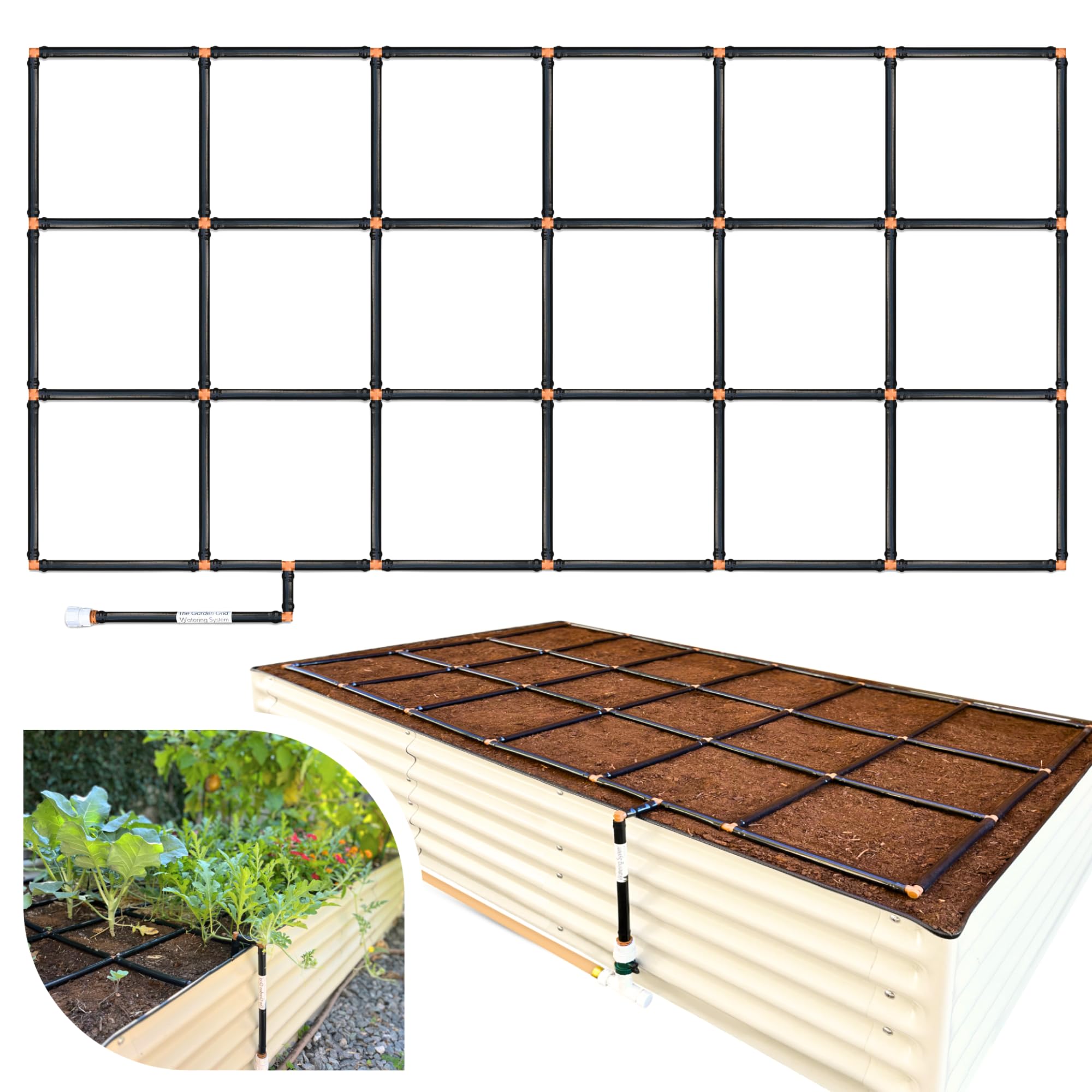
The Garden Grid abandons the traditional hose-and-emitter approach entirely. It arrives in pre-assembled sections that lock together to form a rigid grid sitting above your raised bed. Each square foot gets 16 gentle streams of water delivered directly to the soil line — no more guessing whether the soaker hose missed the tomatoes on the far side. Setup takes about two minutes with a standard garden hose connection.
The UV-resistant polypropylene construction has proven its durability: original units from 2013 are still in active use, according to the manufacturer. The built-in fine mesh filter screen catches debris before it reaches the watering paths, eliminating the clogged-emitter problem that plagues traditional drip systems. It also works with any standard hose timer for full automation.
The biggest trade-off is inflexibility. The 3×6 grid is designed specifically for a standard 33.5×66-inch raised bed. If your bed is an odd size or you need to weave around existing plants, this system won’t adapt. It is a premium choice for square-foot gardeners who value speed and even coverage over custom routing.
Why it’s great
- Two-minute tool-free setup with no cutting or measuring
- Every square foot gets equal water volume — no dry spots
- UV-resistant construction proven to last over a decade
Good to know
- Fixed size limits compatibility to specific bed dimensions
- Cannot reconfigure around irregular plant spacing
3. GGAQHLK 230FT Drip Irrigation System
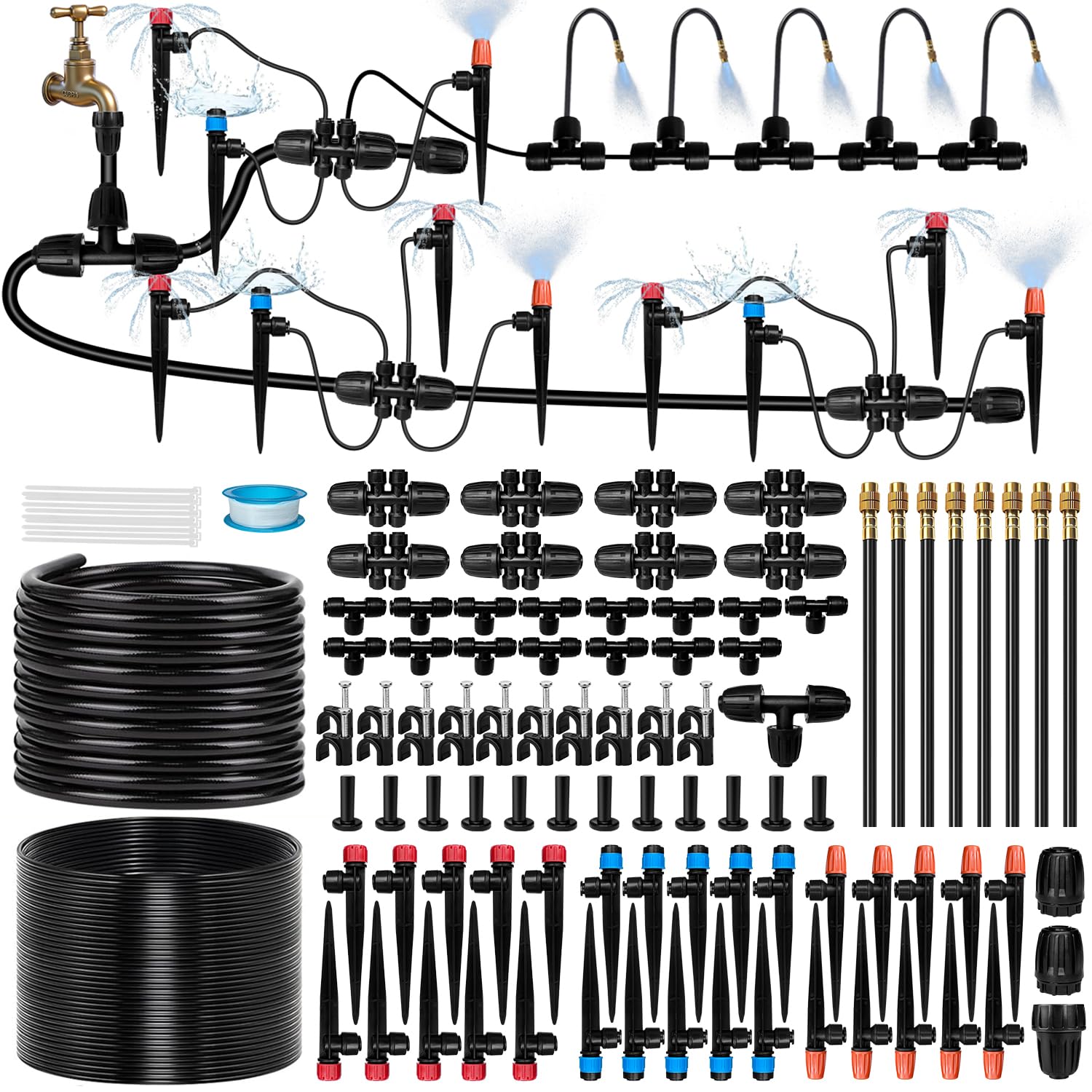
This kit upgrades the main line to a full 1/2-inch diameter, a significant step above the 5/16-inch or 1/4-inch found in most competitors. The wider bore handles higher water pressure without a steep drop-off, making it ideal for gardens that need two independent watering zones. The 1/2-inch to 1/4-inch 4-way connectors split the flow cleanly, allowing separate sections for vegetables and ornamentals.
You get 38 adjustable nozzles spread across three types: vortex emitters for broad coverage, stream emitters for targeted root watering, and misting nozzles for delicate seedlings or cooling. Eight copper nozzles offer 360-degree bendable rods for precise direction control around obstructions. The total tubing length hits 230 feet — 33 feet of 1/2-inch main line and 197 feet of 1/4-inch drip tubing.
Reviewers consistently praise the leak-free push-to-connect fittings. One customer reported it worked perfectly for their small backyard garden with zero drips. The primary caveat is that the 1/4-inch drip lines still use barbed-style connections at the emitter level, which can be slightly less secure than a full push-to-connect system on the secondary lines.
Why it’s great
- 1/2-inch main line supports high-pressure zones without pressure loss
- Three distinct nozzle types for different watering needs
- 8 copper 360-degree bendable rods for precise targeting
Good to know
- 1/4-inch drip section uses barbed connections at emitters
- Large kit may overwhelm first-time DIY users
4. Thiswing 360° Adjustable Drip Irrigation System 50FT

Thiswing takes a focused approach: a 50-foot 5/16-inch main line paired with 16 copper nozzles that deliver strong, even water flow. The larger inner diameter compared to standard 1/4-inch tubing ensures the far end of the run gets the same pressure as the start. The nozzles use a built-in metal tube that bends and locks at any 360-degree angle, so you can direct water precisely around plant bases without moving the line.
Installation uses a pneumatic tee connection that users compare to SharkBite plumbing fittings — push the tube in, and it locks without glue or heat. If you make a mistake, you can disconnect and reconnect without cutting the tubing. The kit includes a pipe cutter, replacement core, mounting nails, and cable ties, so you don’t need additional tools.
Customers note that the mister covers about 2 feet wide from 6 inches of height, making it ideal for a 3-foot-wide raised bed. One reviewer purchased three more kits after the first installation to replace all their previous systems. The only reported friction is that the terminal plug can be difficult to seat properly on the first try.
Why it’s great
- 5/16-inch tubing provides superior water flow over 1/4-inch
- Copper nozzles with 360-degree bendable rods for precision
- Plug-and-play pneumatic connectors allow easy reconfiguration
Good to know
- Only 50 feet of tubing limits reach for larger gardens
- Terminal plug may require heat-sealing for a perfect hold
5. MIXC 1/4″ 100FT Drip Irrigation System
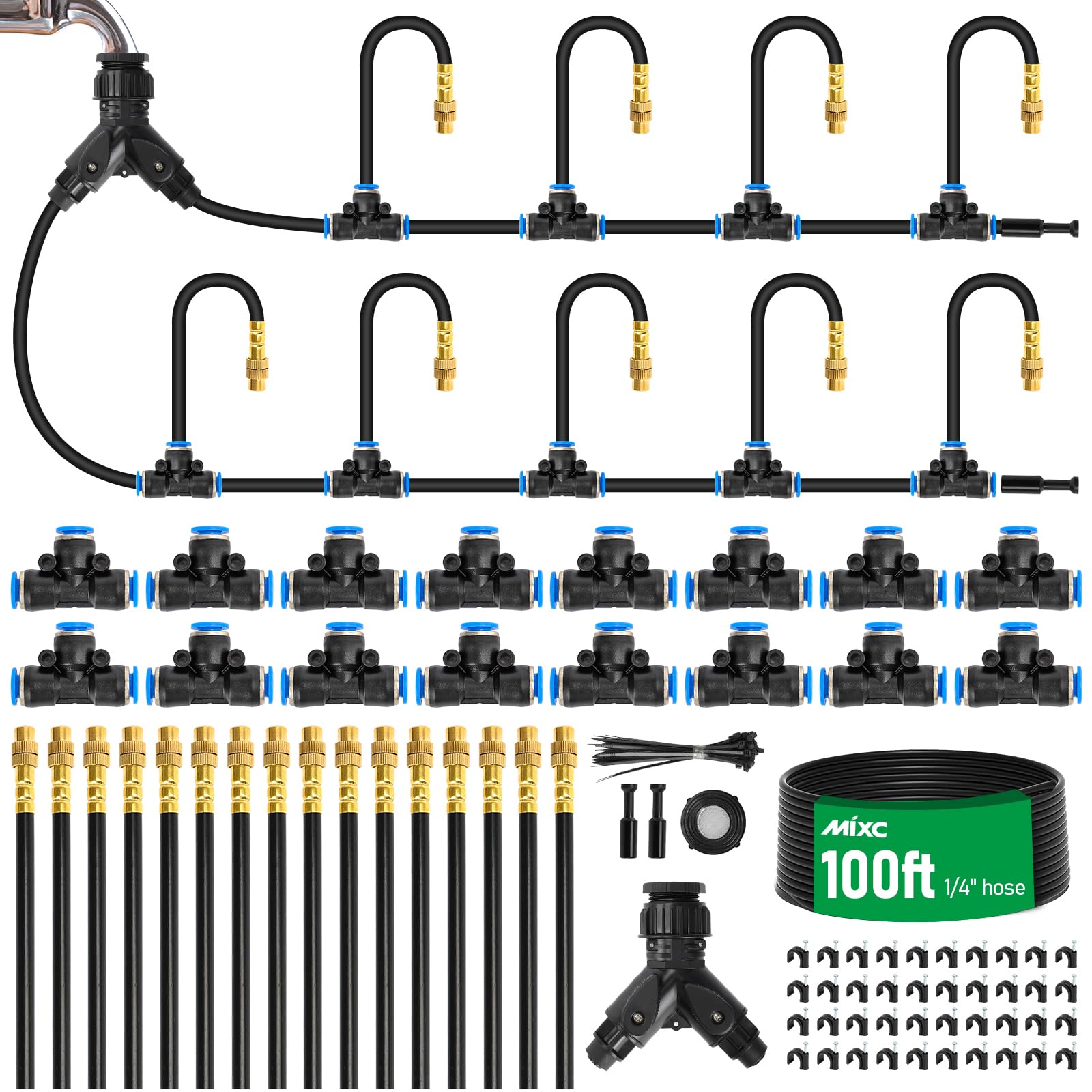
MIXC uses a universal 1/4-inch (6mm) sizing designed for easy compatibility with standard US garden hoses, avoiding the fitment issues that sometimes arise with 5/16-inch systems. The kit includes 100 feet of tubing and 16 brass nozzles that adjust from a thin stream to a heavy mist. The brass construction resists corrosion and holds its angle better than softer metals.
The aluminum-core bendable rods extend 20 centimeters, giving you enough reach to position the spray head exactly where needed — over a tomato cage or under a wide leaf. MIXC recommends connecting no more than 8 rods per 50 feet of tubing to maintain adequate pressure. The quick-connect design uses push-fit components that reviewers found seamless to integrate into existing sprinkler systems.
A few customers noted the kit does not include end plugs, so you will need to purchase those separately or crimp the tubing ends. The 1/4-inch diameter is also less forgiving for long runs; pressure drops noticeably when running the line uphill or over distances beyond 75 feet. It shines brightest in a medium-sized raised bed where precision outweighs brute flow.
Why it’s great
- Brass nozzles provide durable corrosion resistance
- Aluminum-core rods bend and hold position accurately
- 1/4-inch sizing matches standard US hose connections
Good to know
- End plugs not included in the kit
- 1/4-inch tubing loses pressure on long runs or uphill
6. BUIGNDG 120FT 1/4″ Drip Irrigation System
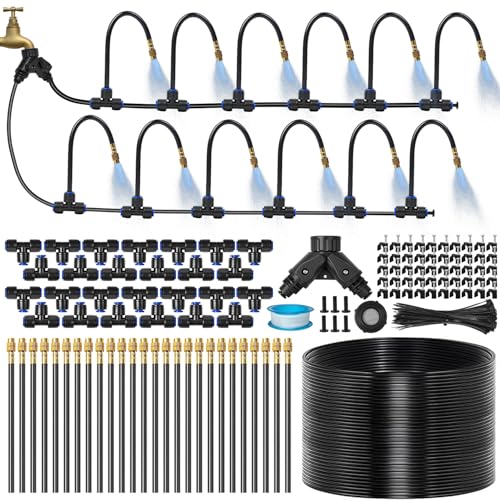
The BUIGNDG kit stretches 120 feet with 26 adjustable copper nozzles, giving you the most drip points in this tier. Each nozzle switches between a spray, drip, and misting mode by rotating the cap — no disassembly required. The manufacturer claims up to 70% water savings by delivering moisture directly to root zones, and the thickened PE tubing includes UV-resistant additives to prevent brittleness after a season in full sun.
Assembly uses the same pneumatic quick-connect design with upgraded rubber rings that create a leak-proof seal. The kit includes 50 stakes, 6 tube plugs, and 40 cable clips, far more anchoring hardware than most competitors. A full 120-foot run works well for a series of raised beds or a long vegetable row.
Customer reports confirm that the mist mode covers roughly 2×2 feet from an 8-inch elevation, while stream mode targets individual plants. One user irrigated three 4×8-foot beds using just 8 nozzles per bed. The 1/4-inch tube diameter limits the maximum number of nozzles you can run simultaneously — 26 is near the upper limit before pressure drops at the far end.
Why it’s great
- 26 copper nozzles offer the highest emitter count in this group
- Thickened UV-resistant PE tubing fights sun damage
- Three spray modes from each nozzle with no tool changes
Good to know
- 1/4-inch tubing limits flow when all 26 nozzles are active
- No 5/16-inch or 1/2-inch main line option included
7. RAINPOINT Sprinkler Timer

The RAINPOINT timer is not a full irrigation kit — it is the brain that turns any of the above systems into an automated setup. It features pure brass inlet and outlet threads rated to withstand up to 116 PSI, far exceeding the typical plastic body timers. The built-in metal filter gasket prevents sediment from clogging your drip system downstream.
Programming is straightforward with a large LCD screen. You set the start time, watering duration (1 minute to 3 hours 59 minutes), and frequency (hourly up to every 7 days). The rain delay mode pauses your schedule for 24, 48, or 72 hours and automatically resumes — a genuine water-saving feature if you live in an unpredictable climate. The manual mode lets you water on demand without disrupting the programmed schedule.
Users report the batteries last roughly two months, and the weatherproof shell handles rain, snow, and direct sun exposure. One reviewer relied on it during a Florida drought to save their pasture. The timer does not offer Bluetooth or app control, so program changes require walking to the spigot, but the dial-based menu is intuitive enough that most users find the app unnecessary.
Why it’s great
- Brass inlet/outlet threads withstand high PSI without cracking
- Rain delay mode saves water during wet weather automatically
- Simple dial-based programming with clear LCD display
Good to know
- No Bluetooth or smart home integration
- Screen can become hard to read in direct sunlight
FAQ
How many nozzles can I run on a single 1/4-inch drip line?
Can I use a drip irrigation kit with a rainwater collection system?
Why do my drip system connections leak even after pushing them in firmly?
Final Thoughts: The Verdict
For most users, the best diy drip irrigation system winner is the Bonviee 230FT because its dual-diameter tubing and push-to-connect fittings solve the pressure and leak problems that plague cheap kits. If you want a pre-assembled, no-measure solution for a standard raised bed, grab the Garden Grid 3×6. And for running multiple high-pressure zones across a large garden, nothing beats the GGAQHLK 230FT with its 1/2-inch main line.

Mo Maruf
I created WellFizz to bridge the gap between vague wellness advice and actionable solutions. My mission is simple: to decode the research and give you practical tools you can actually use.
Beyond the data, I am a passionate traveler. I believe that stepping away from the screen to explore new environments is essential for mental clarity and physical vitality.