Our readers keep the lights on and my smoothie glass nicely filled. As an Amazon Associate, I earn from qualifying purchases.
Air leakage through rim joists, attic kneewalls, and crawlspace band boards silently drains your HVAC budget year-round. Sealing those gaps with a rigid, expanding polyurethane foam that cures into a vapor-impermeable barrier is the only way to stop that thermal bleed for good, and doing it yourself with a canned kit cuts the installed cost by more than half compared to hiring a pro.
I’m Mohammad Maruf — the founder and writer behind WellFizz. I’ve spent hundreds of hours cross-referencing technical datasheets, ASTM fire-rating certifications, R-value per inch claims, and real-world coverage reports across the leading spray foam kits so you can pick the right one without burning a hole in your project budget.
From entry-level 12-can bundles to high-density 2-component tanks, this guide breaks down exactly what each kit delivers so you can confidently choose the best diy closed cell spray foam for your project scope and skill level.
How To Choose The Best DIY Closed Cell Spray Foam
Choosing a spray foam kit means balancing coverage volume, R-value per inch, application temperature range, and the quality of the included spray gun. The wrong pick will either leave you short on material or fighting clogged nozzles mid-project.
Coverage Volume And Board Feet
Kits are rated in board feet — one board foot equals one square foot at one inch thickness. A 12-can kit typically delivers around 200 to 240 board feet, while a 24-can kit pushes toward 480 board feet. Measure your cavity depth and square footage, then multiply to find your total board foot requirement. Always buy 10% extra to account for over-spray and learning curve waste.
R-Value Per Inch And Fire Rating
Closed-cell spray foam typically delivers between R-5.6 and R-7 per inch depending on density. Higher R-value per inch means thinner applications achieve the same thermal resistance. Look for Class A fire rating (ASTM E84) if the foam will be exposed in living spaces — this affects both safety and local building code compliance.
Application Temperature And Gun Quality
Most aerosol kits require can temperatures between 65°F and 85°F for proper expansion and adhesion. Applying foam below 50°F will cause poor cell structure and weak bonding. The included spray gun should have a metal barrel and adjustable flow control — plastic guns from budget kits tend to clog mid-job and are not worth the frustration.
Quick Comparison
On smaller screens, swipe sideways to see the full table.
| Model | Category | Best For | Key Spec | Amazon |
|---|---|---|---|---|
| BEEST FullStop 480 | Premium | Large attic or wall projects | R-8.24 at 2 in, 480 board ft | Amazon |
| Akfix Thermcoat 480 | Premium | High-R insulation with low thermal conductivity | R-11.32 at 2 in, 0.025 W/m·K | Amazon |
| Bigrizy Guard Quickcoat | Premium | Versatile bonding on multiple surfaces | R-8.52 at 2 in, 480 board ft | Amazon |
| Vega Bond V200 | Premium | High-density 2-lb foam for vapor barrier | R-7 per in, 200 board ft | Amazon |
| STANLEY Supercoat 480 | Mid-Range | Seamless monolithic insulation layer | R-11.32 at 2 in, 480 board ft | Amazon |
| Sprayman Spraycoat 480 | Mid-Range | Large coverage with dual-nozzle system | R-11.32 at 2 in, 480 board ft | Amazon |
| Kraken Bond Fastcoat 240 | Mid-Range | Fire-rated insulation for medium projects | R-11.32 at 2 in, 240 board ft | Amazon |
| BEEST FullStop 240 | Mid-Range | Small attic, crawl space or rim joist | R-8.24 at 2 in, 240 board ft | Amazon |
| ixirpro 18-Pack | Budget | Small DIY repairs and soundproofing | 414 board ft, fast-cure formula | Amazon |
In‑Depth Reviews
1. BEEST FullStop Spray Foam Insulation Kit 480
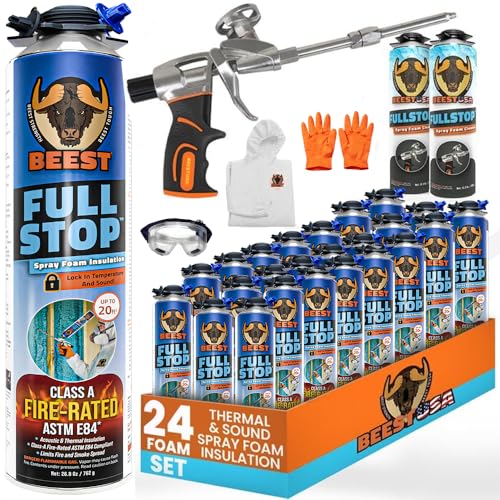
The BEEST FullStop 480 kit combines 24 cans of Class A fire-rated foam, a professional-grade Pro X gun, two cans of solvent cleaner, and a full set of PPE in one box. Its hybrid formulation uses a closed-cell outer skin for moisture resistance and an open-cell inner core that expands consistently within the 68-77°F sweet spot, giving you strong adhesion on wood, drywall, concrete, and metal surfaces.
Real-world users report that the included gun delivers fine control with half-trigger for small gaps and full fan spray for open cavities, making it suitable for both basement perimeters and full attic bays. At a 2-inch thickness the foam reaches R-8.24, which is enough to stop thermal bridging in standard 2×4 walls while still allowing trimming and painting after the 24-hour cure cycle.
Customer support from this American family-owned brand is notably responsive — multiple reports of a replacement gun or extra cans being shipped quickly when issues arose. The 480 board foot coverage handles most single-room or garage projects in one order, and the included Tyvek suit and goggles eliminate the need for separate safety purchases.
Why it’s great
- Class A fire rated with ASTM E84 compliance
- Hybrid closed-cell outer skin with open-cell core expansion
- Includes two solvent cleaners for proper gun maintenance
- U.S.-based customer support team
Good to know
- Gun can leak at the joint if overtightened
- Must tilt gun horizontally in crawl spaces to maintain flow
- Foam expands best in 68-77°F range
2. Akfix Thermcoat Fire Rated Spray Foam Insulation Kit 480
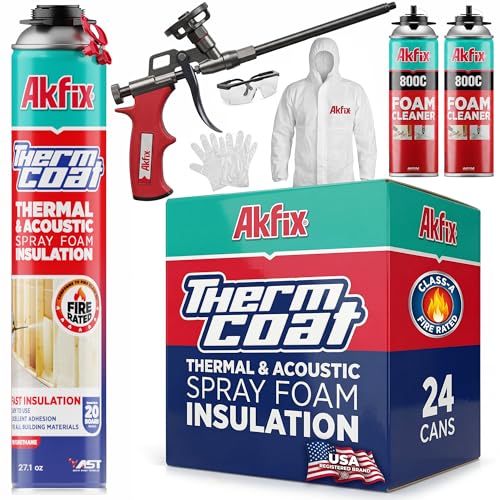
The Akfix Thermcoat kit delivers the highest R-value per inch in this lineup at R-11.32 at a 2-inch thickness, backed by a thermal conductivity rating of just 0.025 W/m·K. That means thinner applications achieve better insulation than most competitors, making it a top choice for spaces where cavity depth is limited.
Users consistently note the importance of warming cans to 65°F before spraying and shaking each can for at least 20 seconds to achieve consistent cell structure. The dual-nozzle system includes a vertical application tip for walls and an overhead tip for ceilings, though beginners should expect a learning curve — starting with a light tack coat prevents blow-through common with aggressive fan settings.
The Class A fire rating meets ASTM E84 standards, which matters for exposed applications in basements and garages where code enforcement is strict. Some users reported one defective can per case, so testing all cans immediately upon delivery is a practical precaution. The kit bonds to wood, drywall, concrete, metal, PVC, and even carbon fiber, giving it broad utility beyond standard insulation jobs.
Why it’s great
- Highest R-value per inch in the guide
- Very low thermal conductivity for superior energy efficiency
- Dual-nozzle system for vertical and ceiling applications
- Strong adhesion to almost all building materials
Good to know
- Occasional dud cans reported per case
- Requires finesse with trigger for consistent thickness
- Nozzle distance is critical to avoid splatter
3. Bigrizy Guard Quickcoat Spray Foam Insulation Kit 480
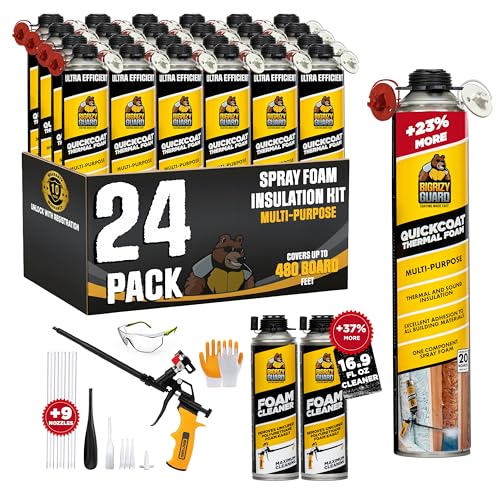
Bigrizy Guard’s Quickcoat kit builds its value proposition around a PTFE-coated spray gun that resists foam buildup, paired with 24 cans of closed-cell polyurethane foam rated at R-8.52 at the recommended 2-inch thickness. The advanced hybrid foam structure wraps a closed-cell outer layer around a flexible inner core, giving you the vapor barrier benefits of a true closed-cell system with a slightly more forgiving expansion profile.
Each 27.2-ounce net weight can includes a pair of nozzles, and the kit comes with two 16.9-ounce solvent cleaners — enough to flush the gun multiple times during a full day of spraying. Users who followed the recommended application distance of 12-18 inches for walls and 6-8 inches for ceilings reported consistent coverage without the blow-through that plagues cheaper kits.
The foam adheres securely to wood, concrete, metal, glass, brick, drywall, plaster, OSB, and PVC, making it suitable for garage doors, attic kneewalls, and even boat or trailer interiors. Storage stability is a strong point — the cans maintain pressure when kept between 41°F and 77°F in a dry environment, which matters if you are staging materials over several weekends.
Why it’s great
- PTFE-coated gun resists clogging during long sessions
- Hybrid cell structure balances strength and coverage
- Two full-sized solvent cleaners included
- Broad surface compatibility for multi-material projects
Good to know
- Some users report cans losing pressure before emptying
- Not Class A fire rated like some competitors
- 24-hour cure time before trimming or painting
4. Vega Bond V200 Closed Cell Spray Foam Insulation Kit 200

The Vega Bond V200 is a true two-component system that delivers professional-grade 2-pound density closed-cell foam with an impressive R-7 per inch. Unlike the single-component aerosol kits in this guide, the V200 uses separate A and B canisters that mix at the gun tip, producing a quick-curing rigid foam that becomes a vapor barrier in 20-30 minutes rather than 24 hours.
Users report that the foam bonds aggressively to metal and wood, adding measurable structural reinforcement to rim joists and wall cavities. The included 9.5-foot hose and gun assembly gives you more reach than aerosol gun setups, though the canisters need to be warmed to 75-85°F for optimal flow.
Some early units had gun assembly leaks, but Vega Bond’s customer service responded quickly with replacements. The low GWP formulation meets environmental standards, and the nationwide shipping availability removes a logistical barrier that some two-component kits face. This is the right choice for anyone who needs true vapor barrier performance in a single pass.
Why it’s great
- True 2-lb density closed-cell foam for vapor barrier
- R-7 per inch with 20-30 minute cure time
- Two-component system delivers professional-grade results
- Low GWP formula ships to all US states
Good to know
- Requires warming canisters to 75-85°F
- Coverage is 200 board feet — less than large aerosol kits
- Gun assembly may leak if not properly connected
5. STANLEY Supercoat Spray Foam Insulation Kit 480
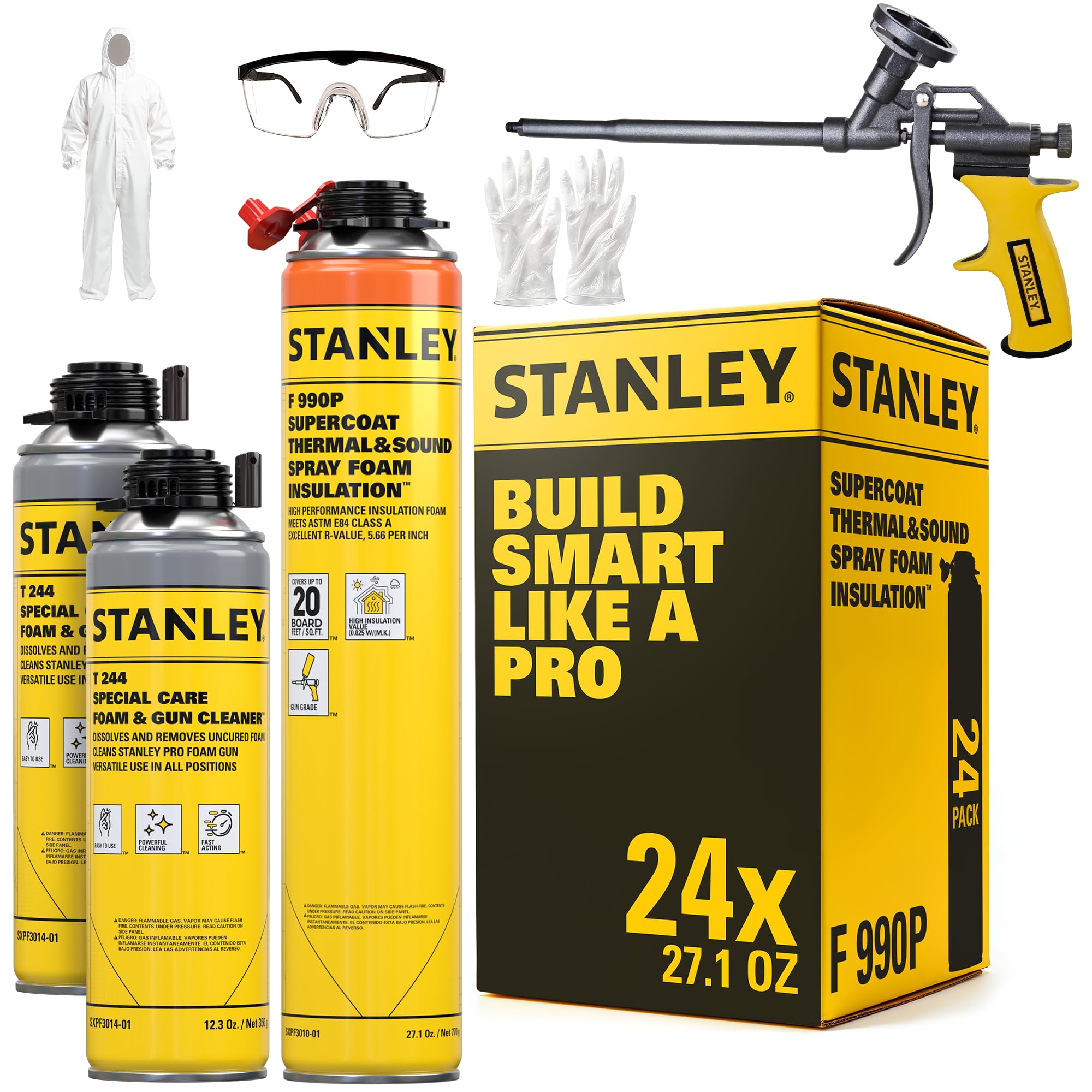
STANLEY brings its brand reputation to the spray foam category with the Supercoat kit, which delivers 480 board feet of coverage and an R-value of 11.32 at a 2-inch thickness. The polyurethane formulation creates a seamless monolithic layer that eliminates the joints, seams, and gaps inherent in EPS or XPS board installations, and the Class A fire rating meets ASTM E84 standards for safety.
Users report that the included PPE bundle — gloves, glasses, and coverall — is good enough for a full day of spraying, and the gun provides consistent fan control for both open wall cavities and tight gap filling. The foam’s low thermal conductivity of 0.025 W/m·K effectively prevents thermal bridges and dew point formation, which is critical for avoiding condensation issues in conditioned spaces.
A few users noted that pressure drops noticeably in the second half of each can, causing sputtering that requires careful trigger modulation. Others found that trimming the cured foam created enough dust and debris to warrant a full respirator beyond the included glasses. Despite these quirks, the coverage value and brand support make it a solid contender for medium-to-large DIY projects.
Why it’s great
- Seamless monolithic application outperforms board insulation
- Class A fire rated to ASTM E84
- High R-11.32 at 2-inch thickness
- Complete PPE included in the box
Good to know
- Pressure drops in second half of each can
- Trimming cured foam creates significant dust
- Not as cost-effective as batt insulation for large areas
6. Sprayman Spraycoat Fire Rated Spray Foam Insulation Kit 480
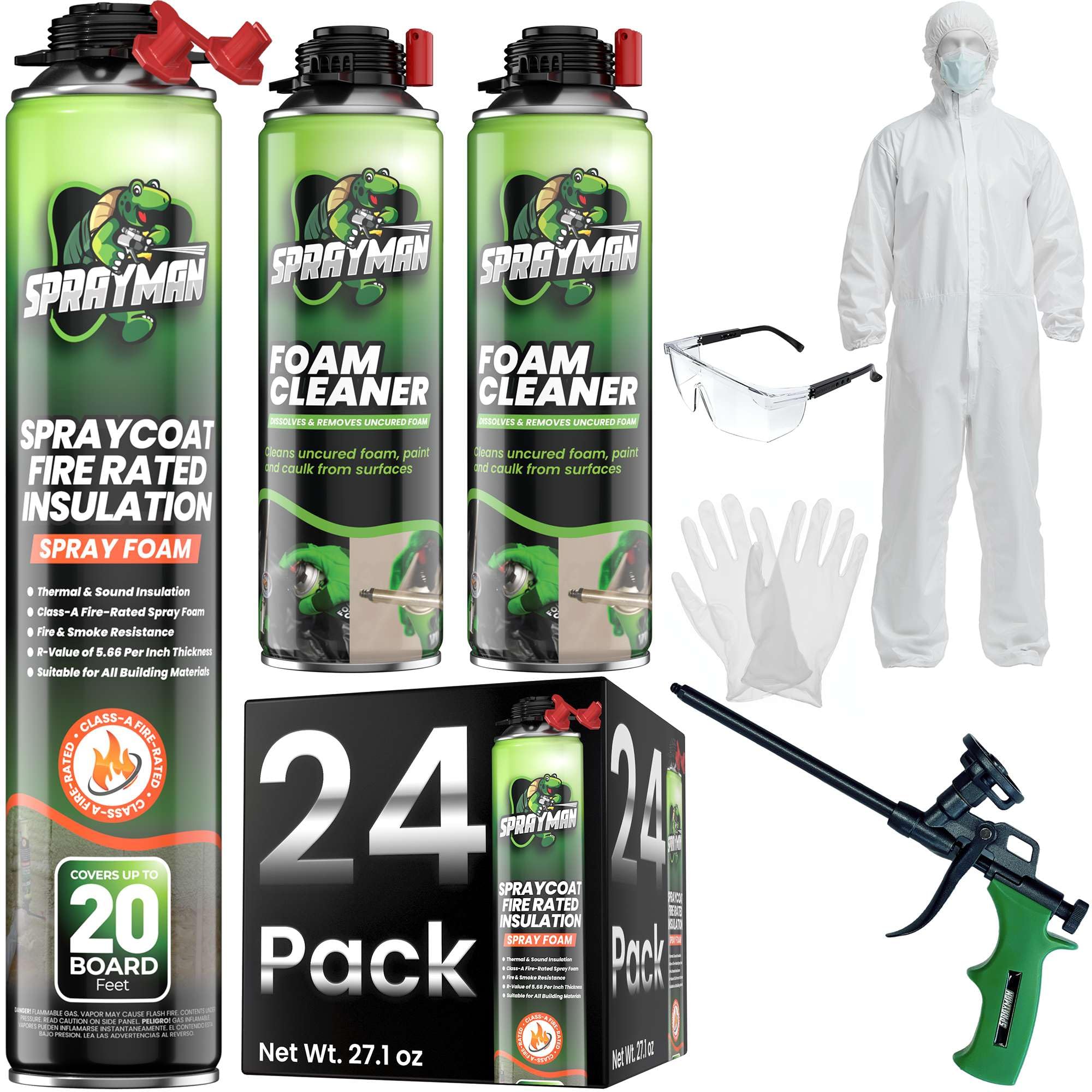
The Sprayman Spraycoat kit packs 24 cans of Class A fire-rated polyurethane foam into a single order, delivering 480 board feet of coverage at an R-value of 11.32 at 2-inch thickness. The smart dual-nozzle system uses Nozzle A for vertical wall surfaces and Nozzle B for ceiling and overhead applications, which eliminates the guesswork of tipping between orientations.
Users report that the foam cures quickly without dripping, forming a rigid structure that resists cracking and settling over time. The manufacturer claims heating and cooling cost reductions of 40-60%, though real-world savings depend heavily on application thickness and existing insulation levels. The formula maintains dimensional stability — important for avoiding warped window or door frames that can occur with aggressive expansion foams.
Some users experienced clogs on certain cans and found the identical-looking spray tips confusing despite their different intended orientations. The odor was strong enough in one case to trigger a gas leak detector, so proper ventilation is non-negotiable. When the cans work as intended, the coverage per can is consistent, though a few reviewers felt the actual yield fell short of the 480 board foot claim.
Why it’s great
- Class A fire rated with ASTM E84 certification
- Smart dual-nozzle system for walls and ceilings
- High R-value with dimensional stability
- Bonds to a wide range of surfaces including PVC and OSB
Good to know
- Clogging issues reported on some cans
- Strong odor requires full ventilation
- Actual coverage may be less than advertised
7. Kraken Bond Fastcoat Fire Rated Spray Foam Insulation Kit 240
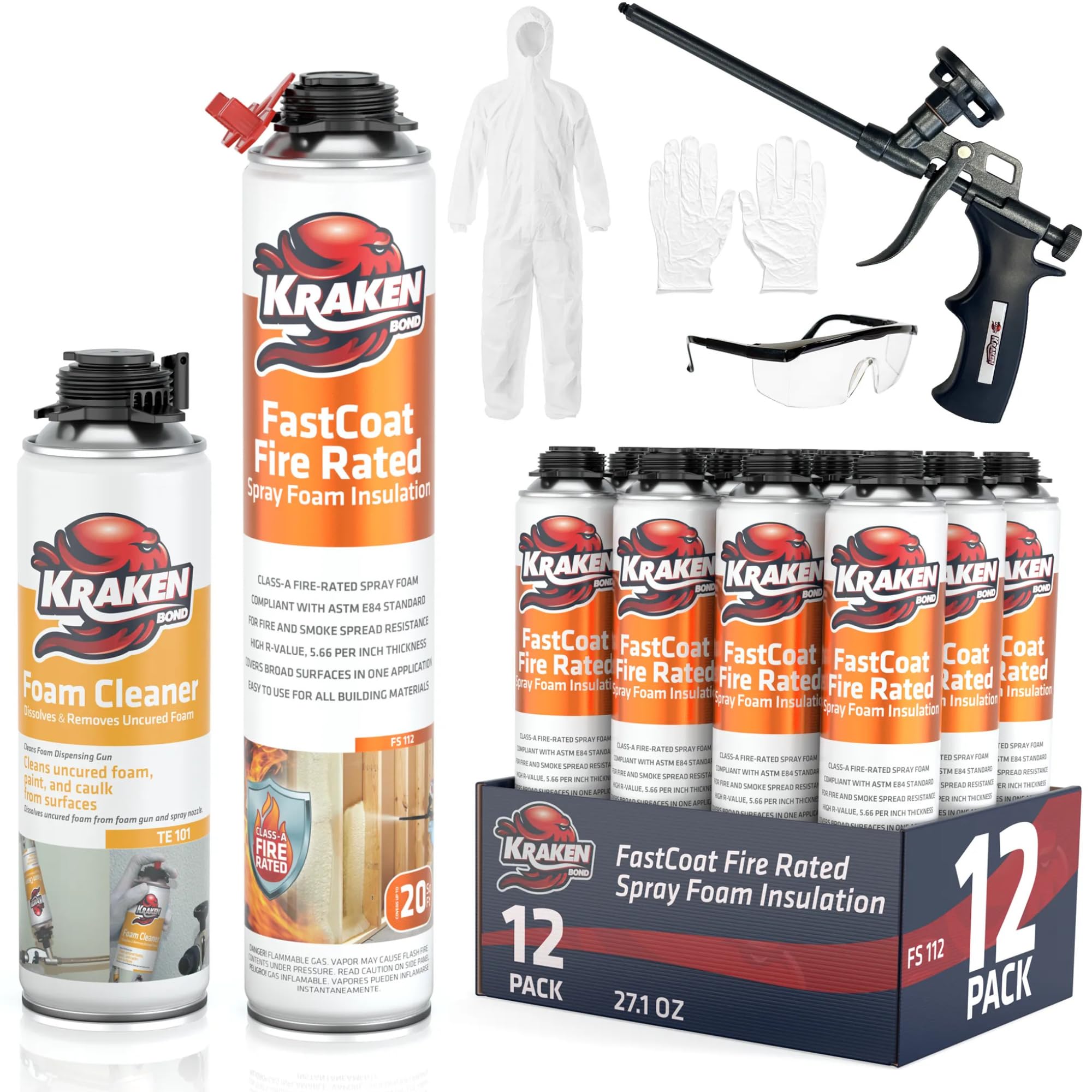
Kraken Bond’s Fastcoat kit serves up 12 cans of Class A fire-rated closed-cell foam with a strong R-5.66 per inch, hitting R-11.32 at the recommended 2-inch thickness. The ergonomic gun and cleaner set allow for immediate use, and the dual-nozzle system covers both vertical and ceiling applications without needing to swap hardware mid-job.
Users report that the 12-can kit covered roughly 300 board feet at 2 inches when applied in two coats, which suggests the 20-square-foot per can claim is optimistic under real-world conditions. The foam itself has minimal odor compared to some competitors, and overspray peels off surfaces easily when dry, making cleanup less punishing. Good results depend on acclimating cans to at least 68°F before use.
A significant number of users reported defective cans that were depressurized and would not dispense foam. Kraken Bond’s customer support initially responded but in some cases stopped replying after the 90-day window, leaving users with no recourse. Test every can immediately upon arrival to avoid finding out mid-project that your kit is short.
Why it’s great
- Class A fire rated with ASTM E84 compliance
- Low odor formulation during application
- Overspray peels off surfaces easily when dry
- Dual-nozzle system for ceiling and wall work
Good to know
- Defective depressurized cans reported frequently
- Customer support inconsistent after 90-day window
- Coverage falls short of 20 sq ft per can claim
8. BEEST FullStop Spray Foam Insulation Kit 240
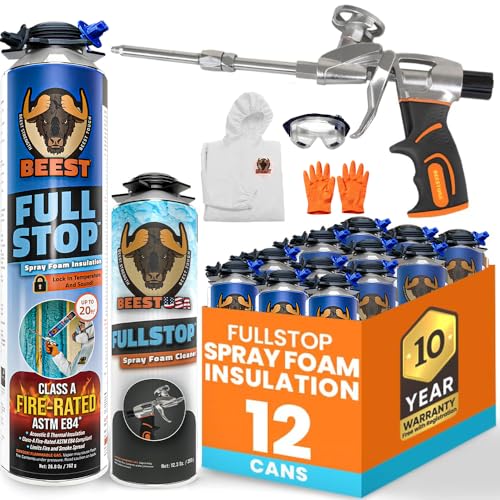
The smaller 12-can version of the BEEST FullStop kit delivers the same Class A fire-rated hybrid formulation, R-8.24 at 2-inch thickness, and the same Pro X gun as its 480-board-foot sibling. The difference is scale — this kit is sized for small attics, crawl spaces, single rim joist runs, or garage door headers where a full 24-can case would leave you with half-used cans that lose pressure over time.
Users consistently praise the included Tyvek suit, booties, gloves, and goggles as legitimate safety gear rather than disposable junk. The foam expands evenly without excessive splatter, and the half-trigger position on the gun allows precise bead control for gap sealing while the full trigger delivers a fan pattern for open cavities. The low-fume light blue formulation is easier on the senses than darker foams.
Some users experienced a leaking gun at the barrel joint, which ruined the first batch of cans. In every reported case, BEEST’s customer support responded by shipping a replacement gun plus a full case of foam at no charge. The seller’s responsiveness makes this the safest entry point for first-time DIY spray foam users who want fire protection without buying more than they need.
Why it’s great
- Same quality as the 480 kit at a lower volume
- Class A fire rated with ASTM E84
- Includes Tyvek suit, booties, and quality goggles
- Excellent customer support from U.S.-based team
Good to know
- Gun may leak at the joint if overtightened
- Only 240 board feet — not for large rooms
- Must tilt gun horizontally in crawl spaces
9. ixirpro Spray Foam Insulation Kit 18-Pack
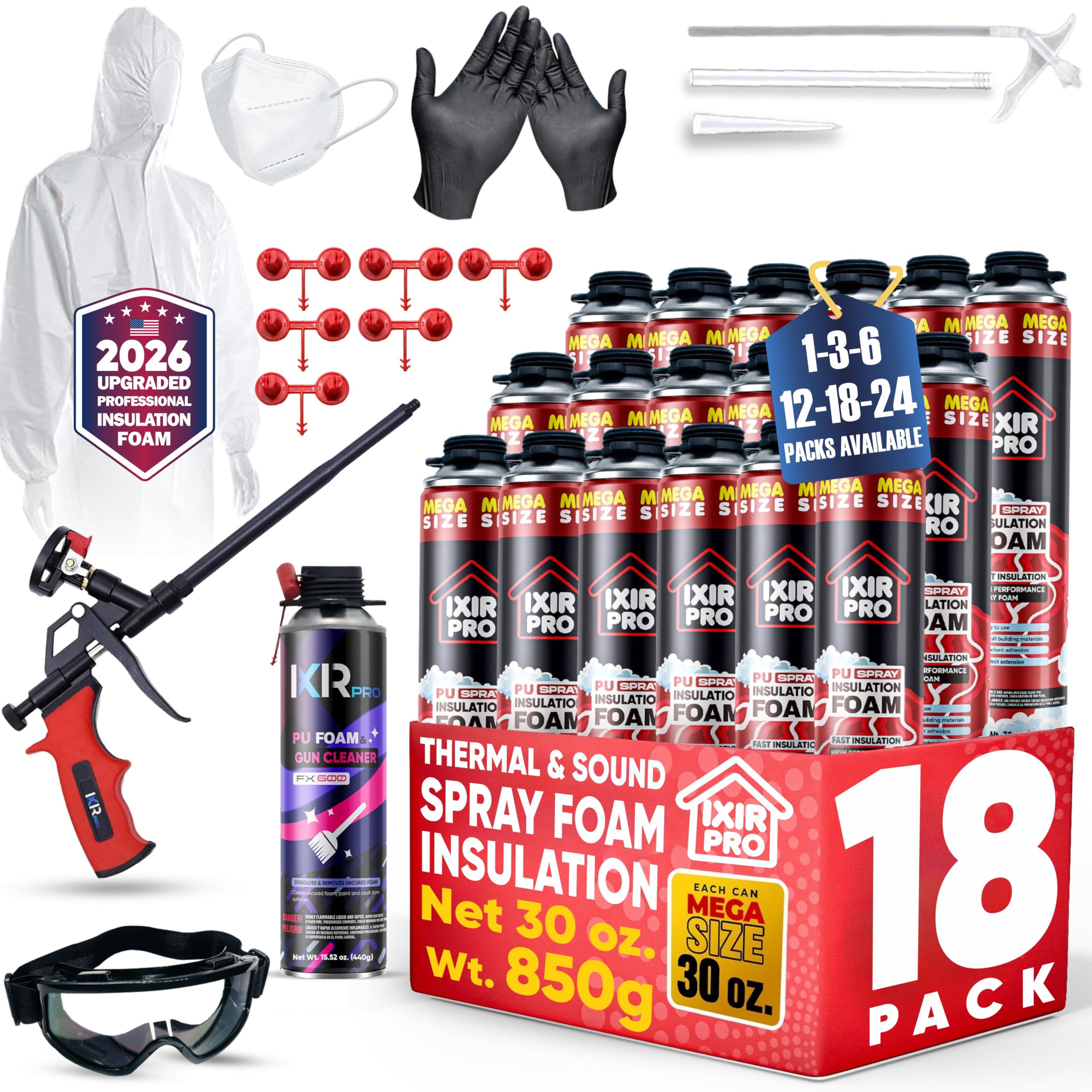
The ixirpro 18-pack offers the highest can count per dollar in this guide, with 18 cans of 30-ounce closed-cell polyurethane foam rated at 414 board feet of coverage. The kit includes a foam gun, two lengths of gun nozzles, 18 red nozzles for can-direct application, a can of cleaner, and full safety gear including a suit, goggles, and 18 pairs of gloves.
Users who followed the recommended 25-30cm spray distance and allowed 20-30 minutes between coats reported good adhesion to concrete, wood, metal, brick, and glass. The high-density foam cures in 24 hours and can be trimmed and painted for a finished appearance. For large projects where coverage volume is the priority, this kit delivers the most foam per box.
The trade-off is consistency. Several reviewers reported that the foam did not expand as aggressively as more expensive brands, and actual coverage fell short of the 414 board foot claim. Some cans required aggressive shaking to activate the propellant, and the included gun does not offer the same flow control as the BEEST or Akfix guns. For small soundproofing repairs, garage gap sealing, or workshops where absolute insulation performance is secondary to filling volume, this kit gets the job done on a tight budget.
Why it’s great
- Highest can count per box in the guide
- Includes full PPE with suit, goggles, and gloves for every can
- Adheres to multiple surfaces including glass and MDF
- Great for large-area coverage on a budget
Good to know
- Expansion performance inconsistent across cans
- Coverage falls short of 414 board foot claim
- Gun lacks precision flow control of premium kits
FAQ
What temperature do the cans need to be for proper expansion?
How do I clean the spray gun between cans and after finishing?
Can I paint over cured spray foam insulation?
How do I know if I need Class A fire rated foam?
What is the difference between 2-lb density foam and standard aerosol foam?
Final Thoughts: The Verdict
For most users, the best diy closed cell spray foam winner is the BEEST FullStop 480 because it balances Class A fire rating, reliable hybrid expansion, comprehensive PPE, responsive U.S.-based customer support, and enough coverage to tackle an average attic or basement in one order. If you need the highest R-value per inch for shallow wall cavities, grab the Akfix Thermcoat 480. And for true 2-lb density vapor barrier performance in a two-component system, nothing beats the Vega Bond V200.

Mo Maruf
I created WellFizz to bridge the gap between vague wellness advice and actionable solutions. My mission is simple: to decode the research and give you practical tools you can actually use.
Beyond the data, I am a passionate traveler. I believe that stepping away from the screen to explore new environments is essential for mental clarity and physical vitality.