Our readers keep the lights on and my smoothie glass nicely filled. As an Amazon Associate, I earn from qualifying purchases.
Cable railing delivers an unobstructed view, but the wrong hardware turns your deck into a sagging, rusting mess within one season. The difference between a pro-grade installation and a weekend frustration comes down to the metal grade, the turnbuckle design, and how much tension each component can hold without slipping.
I’m Mohammad Maruf — the founder and writer behind WellFizz. This guide is built from weeks of cross-referencing real customer install logs, metallurgy specs, and dimensional tolerances across nine leading DIY cable railing systems so you can match the right kit to your post layout and skill level.
After sorting through hundreds of verified installation reports, this roundup delivers the only best diy cable railing kit options that balance marine-grade corrosion resistance, smooth adjustability, and straightforward crimping requirements for a permanently taut result.
How To Choose The Best DIY Cable Railing Kit
Selecting a cable railing kit is not about picking the shiniest box. The real choices come down to metal composition, turnbuckle stroke range, the number of cable runs you need, and whether you have the tools to handle swage fittings. Below are the four specs that separate installations you will eventually redo from those you can set and forget.
Stainless Steel Grade: T304 vs T316 vs 316L
T304 stainless resists rust in covered indoor applications but will pit within months near salt air, chlorinated pools, or coastal decks. T316 (marine grade) contains molybdenum, which dramatically improves resistance to chloride corrosion. 316L is the low-carbon variant of T316, offering the same corrosion resistance with slightly better weldability — but for railing hardware, standard T316 or genuine 316L both stand up to decades of outdoor exposure. Any kit labeled simply “stainless steel” without a clear grade should be treated as T304 at best.
Turnbuckle Adjustability and Cable Tension Range
The turnbuckle is the component that takes up cable slack after installation. A turnbuckle that extends from 7 inches to 10 inches gives you roughly 3 inches of adjustable take-up per cable run. That range matters because cable will stretch slightly during initial tensioning and wood posts may shrink as they dry. Kits with a shorter adjustment window force you to cut cables to near-perfect length, leaving no room for error or future retightening. Look for a minimum expansion length of 9.5 to 10 inches when fully open.
Cable Diameter: 1/8″ vs 5/32″ vs 3/16″
Thicker cable is stiffer to pull but holds tension better over long spans and resists bending from accidental leaning. Standard residential decks commonly use 1/8″ cable because it is easy to thread through posts and acceptably strong for 4-foot post spacing. The 5/32″ size (often used by Atlantis Rail systems) offers a middle ground — thicker than 1/8″ without requiring a massive crimper. The 3/16″ cable is noticeably more rigid and requires a heavy-duty hydraulic crimper, but it delivers a beefier visual and higher breaking strength. Your local building code may specify a minimum diameter and maximum post spacing, so verify those before buying.
Swage vs Swageless Fittings
Swage fittings require a dedicated crimping tool (manual or hydraulic) that permanently deforms a metal sleeve around the cable end. These produce the most secure grip but leave zero room for error — cut wrong and you waste cable. Swageless systems (like Atlantis RailEasy) use a mechanical clamp that tightens with simple hand tools, allowing you to reposition or replace cables without a crimper. Swageless is easier for DIY beginners but typically costs more per fitting and may not meet every local code for tension holding under heavy load.
Quick Comparison
On smaller screens, swipe sideways to see the full table.
| Model | Category | Best For | Key Spec | Amazon |
|---|---|---|---|---|
| Deck Man T316 30 Pack | Swage Turnbuckle | First-time DIY with small decks | 10″ max turnbuckle length, 1/8″ cable | Amazon |
| Muzata CK07 100 Pack | Swage Turnbuckle | Large decks with many cable runs | 50 pairs, 10.1″ max length, 1/8″ cable | Amazon |
| BLIKA BL025 60 Pairs | Swage Turnbuckle | High-volume stair and deck projects | 60 pairs, 10″ max length, 1/8″ cable | Amazon |
| WAYSKA 36 Pairs | Swage Turnbuckle | Mid-size decks needing 180° angle heads | 36 pairs, 10″ max length, 1/8″ cable | Amazon |
| BLIKA BL059 30 Pairs 3/16″ | Swage Turnbuckle | Builds wanting a beefier 3/16″ cable look | 30 pairs, 10.3″ max length, 3/16″ cable | Amazon |
| Atlantis RailEasy C0981-1004 | Swageless Tensioner | DIY beginners wanting no-crimper install | 10-pack, 5/32″ cable, mechanical swage | Amazon |
| VEVOR 3/16″ 1000FT Coil | Bulk Cable | Large projects needing raw cable only | 1000 ft, 3/16″, 4200 lb breaking strength | Amazon |
| Atlantis RailEasy C0978-4500 | Bulk Cable | Premium 5/32″ cable in large spool | 500 ft, 5/32″, 1×19 strand construction | Amazon |
| Muzata HL10 Handrail Kit | Aluminum Handrail | Adding a black top rail to cable system | 4-pack, 8-ft sections, powder-coated aluminum | Amazon |
In‑Depth Reviews
1. Muzata CK07 100 Pack Swage Toggle Turnbuckle Kit
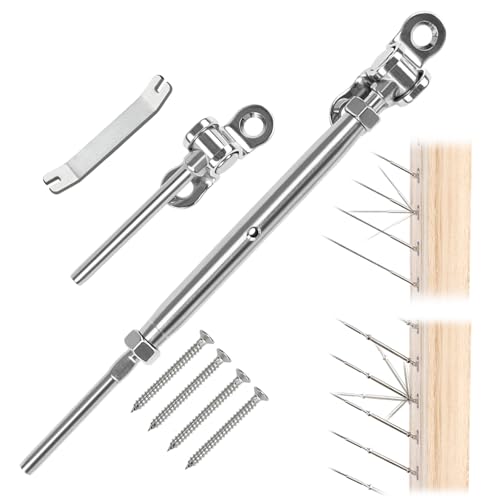
The Muzata CK07 kit delivers 50 pairs of T316 swage turnbuckles with a maximum expansion of 10.1 inches and a minimum of 6.8 inches — the widest adjustment range among comparably priced 1/8″ kits on this list. That 3.3-inch take-up window is the difference between a cable run you have to recut and one you can tension perfectly on the first pull. Each turnbuckle body rotates a full 360 degrees independently, meaning you never need to sort left and right hardware even on stair runs with compound angles.
Customers routinely report completing 45-foot deck spans with 10 horizontal strands using this single kit. The included bent wrench and the ability to use an Allen key (not supplied) to assist tightening make the process manageable even for first-timers. Multiple verified reviewers stated they saved thousands versus prefab cable panels, and the hardware held up through winter snow loads without any cable slackening after initial tensioning.
The one consistent complaint is the provided screws: they strip easily when driven into hardwood posts. Plan to buy a small pack of replacement stainless steel lag screws or use pilot holes slightly larger than the included fasteners. Otherwise, the Muzata CK07 is the volume-to-quality king for any DIY cable railing project spanning more than 20 feet of rail.
Why it’s great
- Wide 3.3″ turnbuckle adjustment range eliminates precise cable measuring
- T316 marine-grade steel resists pitting in coastal and poolside environments
- 360-degree rotating body simplifies angle changes on stair sections
Good to know
- Included screws tend to strip in dense wood; upgrade to aftermarket lag screws
- Requires a hydraulic crimper; not suitable for manual pliers-style tools
2. Atlantis RailEasy C0981-1004 Swageless Tensioner (10-Pack)
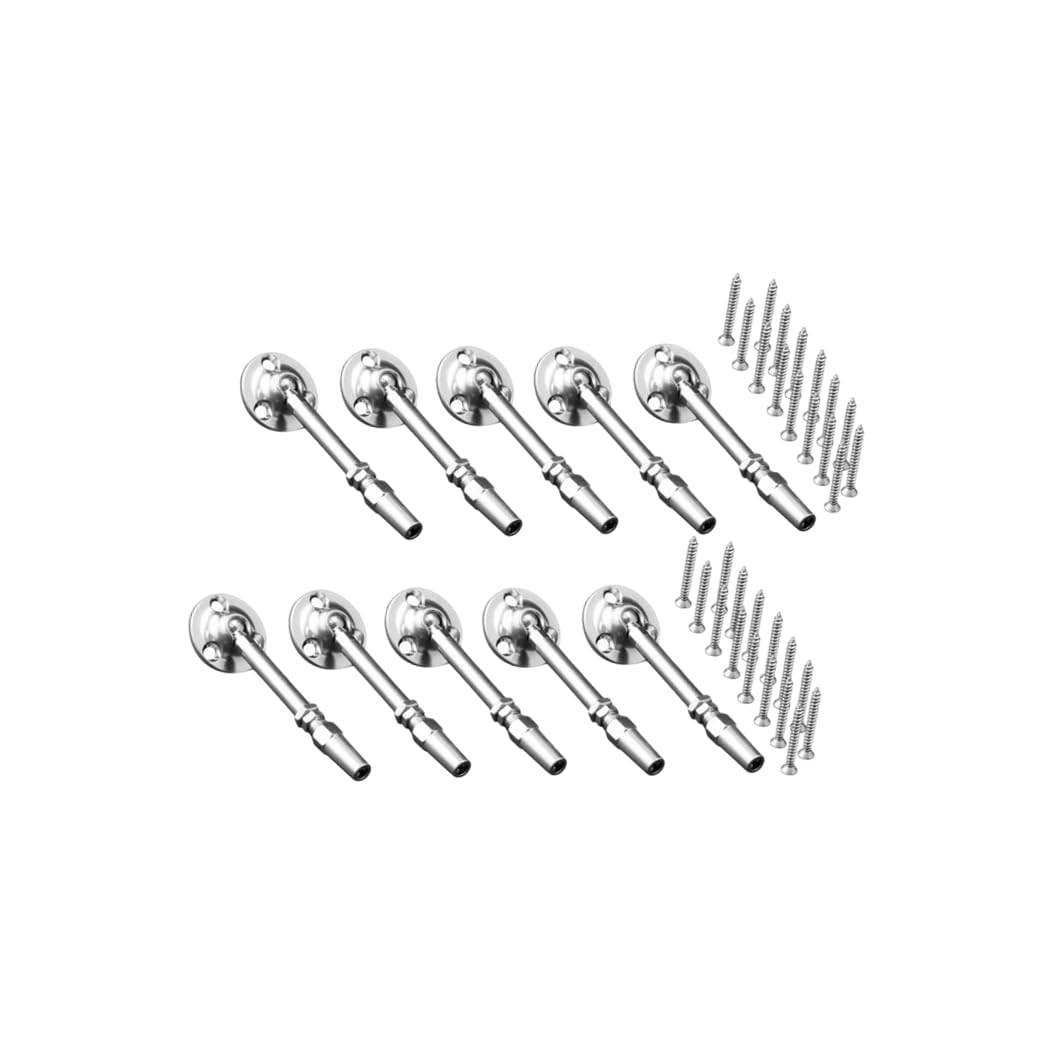
If you want the cleanest DIY experience without buying a crimping tool, the Atlantis RailEasy tensioner is the benchmark. It uses a patented mechanical swage that tightens with simple hand tools — no hydraulic press needed. Designed for 5/32″ cable, the tensioner body independently rotates 360 degrees and the base achieves up to 45 degrees on stair applications through a slotted mounting plate. This is the system for the homeowner who wants a professional result without investing in specialty crimping equipment.
Verified reviews highlight the durability in ocean-front environments: several users reported the hardware remained shiny and fully functional after eight years of salt spray exposure. The 316L stainless construction is the same metallurgy used in marine rigging. Because you work from a continuous cable spool, there is minimal waste — you cut each run to the exact length needed and clamp the tensioner at the post. This approach also simplifies future adjustments if wood posts shrink and cables loosen.
One catch: the 5/32″ cable is thicker than standard 1/8″ and requires a cutoff wheel or industrial-grade cable cutter to get a clean end. The tensioners are not compatible with 1/8″ cable because the gripping piece will not close tightly enough. Also, expect to pay a premium per tensioner versus swage-style fittings. For a small deck under 30 linear feet, the simplicity may justify the higher per-point cost.
Why it’s great
- No crimping tool required; install with basic hand tools only
- 316L marine-grade stainless proven for 8+ years in coastal exposure
- Adjustable up to 45 degrees for stair runs without special hardware
Good to know
- Only works with 5/32″ cable — will not grip 1/8″ wire
- Per-tensioner cost is higher than swage-style alternatives
3. BLIKA BL025 60 Pairs Swage Turnbuckle Kit
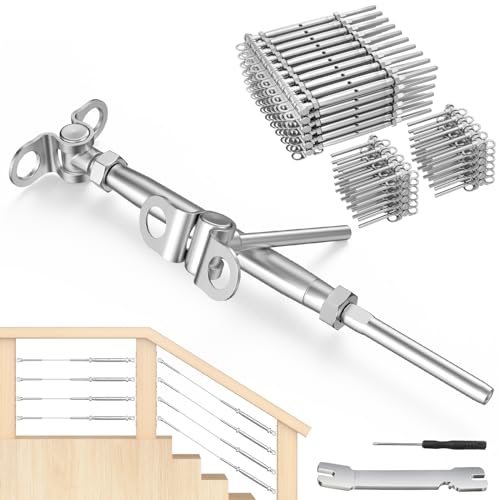
The BLIKA BL025 kit supplies 60 pairs of T316 swage turnbuckles and toggle ends — the highest count in this roundup. Each turnbuckle extends from 7.28 inches to a full 10 inches, giving you the same 2.7-inch adjustment window that makes tensioning forgiving. The kit is specifically designed for 1/8″ cable and works on both 2×2 and 4×4 wood posts. The included spanner multi-tool fits the turnbuckles directly, and a small screwdriver inserts into the center hole to assist final tightening.
Buyers consistently remark that these fittings cost roughly 20% of what custom marine hardware would run, and the stainless steel held up through winter snow without corrosion. Several reviewers used the kit for full deck railings and stair sections, noting that the clean lines and unobtrusive turnbuckle profile matched the look of expensive prefab panels. The kit works well for medium-to-large projects where you need 50 or more cable runs.
The main downside is similar to the Muzata kit: the included screws feel cheap and strip easily. Some customers also wished the turnbolts had a slightly beefier wall thickness, though no structural failures were reported. You will also need a hydraulic crimper rated for 1/8″ swage fittings. For the sheer volume of hardware at this price, the BLIKA BL025 is hard to beat.
Why it’s great
- 60 pairs provide enough hardware for large decks and stair sections
- 10-inch max turnbuckle length allows generous tension slack
- T316 construction tested through winter snow without rust
Good to know
- Screws included are soft and prone to stripping in hardwood
- Turnbolts are slightly less robust than premium cast alternatives
4. WAYSKA 36 Pairs Stainless Steel Cable Railing Kit

The WAYSKA kit offers 36 pairs of 1/8″ T316 swage fittings with the same 7-to-10-inch expansion range seen on higher-count kits. The standout feature is the 180-degree angle-adjustable base, which is especially useful for stair stringers where the cable run changes direction between treads. The hardware is integrated, meaning the turnbuckle body and toggle end come pre-assembled, saving you from having to thread small components on the job site.
Verified reviews praise the kit for its non-intrusive look and straight forward installation once you have the proper hydraulic crimper. Several users noted that the stainless steel fits flush against wood posts without large plate gaps. The 36-pair count suits a typical 30- to 40-foot deck with 4-foot post spacing, leaving a few spares for practice crimps. One reviewer specifically mentioned that using a power crimping tool made the 150+ attachment points quick to finish.
The hardware is slightly less robust than premium cast designs, though most buyers rated the strength as more than adequate for residential rail code. As with other swage kits in this tier, you must source a hydraulic crimper and cable cutter separately. Measure each cable run carefully because swage fittings are permanent — once crimped, there is no undoing a mistake.
Why it’s great
- 180-degree adjustable base suits complex stair layouts
- Pre-assembled turnbuckle bodies reduce on-site fiddling
- T316 grade resists corrosion in humid and coastal environments
Good to know
- Fittings are less heavy-duty than cast premium alternatives
- No spare hardware included; measure twice before crimping
5. BLIKA BL059 30 Pairs 3/16″ Cable Railing Kit
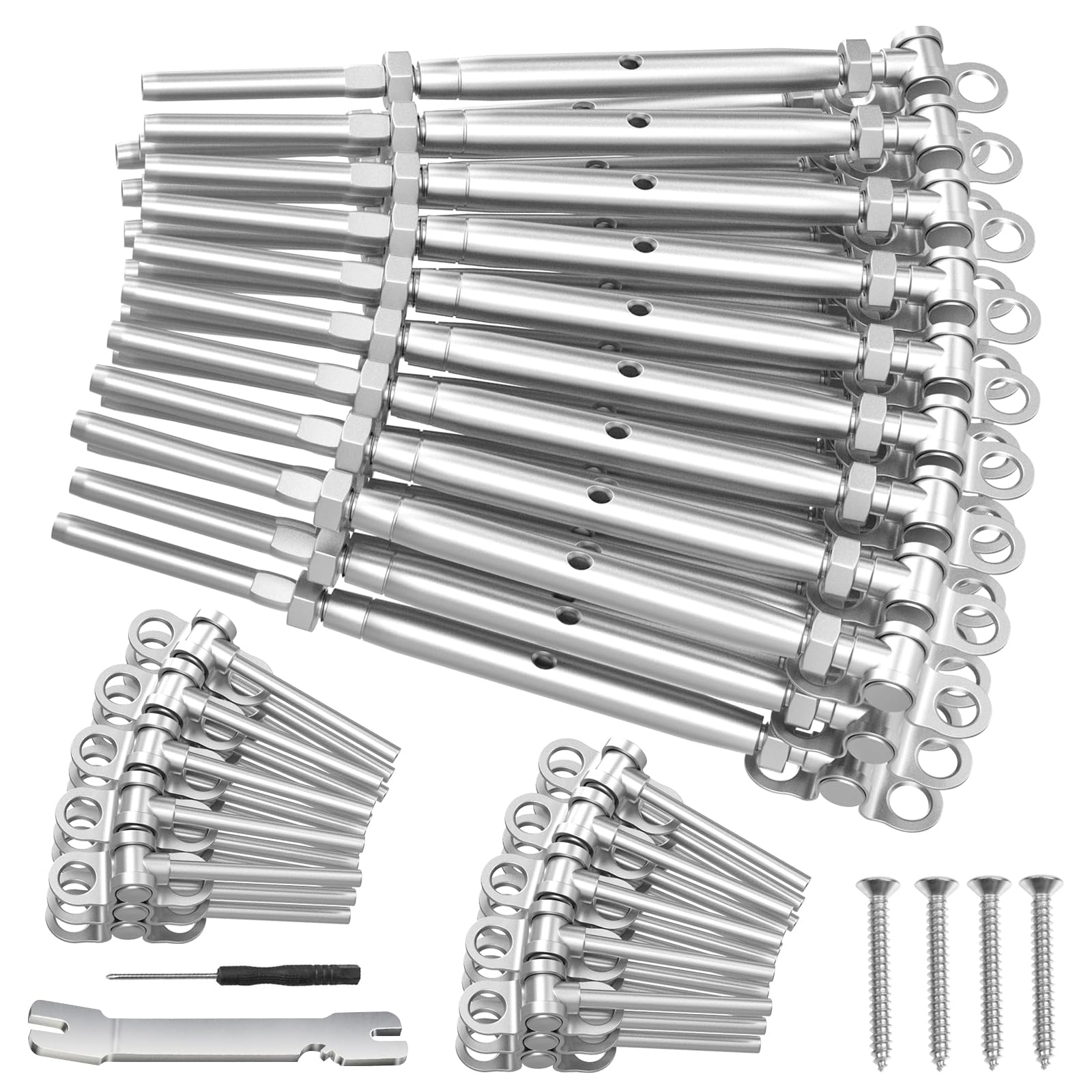
Most cable railing kits default to 1/8″ cable, but the BLIKA BL059 is purpose-built for 3/16″ wire. The thicker cable produces a more substantial visual appearance — less like a trip wire and more like a true railing infill. Each turnbuckle extends from 7.3 inches to 10.3 inches, offering the largest maximum expansion length in this comparison. The toggle ends measure 2.95 inches, and the kit includes 120 screws for mounting to wood posts.
Buyers who completed decks using this kit consistently mention that the 3/16″ cable looks far better than the “flimsy” 1/8″ they had previously installed. The weight and strength of the thicker cable also mean it holds tension more reliably over long spans. One reviewer noted that the system could be tightened very firmly without issue, and the consistent dimensions of the stainless components made alignment simple. This kit requires a heavy-duty hydraulic crimper and a good cable cutter — the thicker wire is significantly harder to cut cleanly than 1/8″.
The main trade-off is cost: 3/16″ cable and compatible hardware are pricier than their 1/8″ counterparts, and you will likely need to buy the cable and crimper separately. The 30-pair count covers a modest deck but may fall short for large layouts. If your building code allows 4-foot post spacing and you want a railing that feels substantial, the BL059 is the best option for 3/16″ compatibility.
Why it’s great
- 3/16″ cable creates a heavy-duty, high-end railing appearance
- 10.3-inch max turnbuckle length is the longest in this roundup
- T316 stainless resists corrosion in outdoor and marine environments
Good to know
- Requires a heavy-duty hydraulic crimper rated for 3/16″ swage fittings
- Higher total system cost when factoring in cable and tool purchase
6. Deck Man T316 Stainless Steel Adjustable Angle 30 Pack

The Deck Man kit offers the most accessible entry point for someone testing DIY cable railing for the first time. With 30 pairs of T316 turnbuckles and toggle ends plus 120 countersunk screws and a drill bit, the package includes almost everything except the cable and crimper. The turnbuckle expands from 7 inches to 10 inches, matching the same range as pricier kits. The 180-degree adjustable base handles stair runs and corner transitions.
Users consistently report that the kit is easy to install and produces a clean, professional result on decks up to 45 feet (using 10 strands). One reviewer specifically praised the discreet look of these turnbuckles compared to larger designs with exposed cable ends. The included drill bit is a thoughtful addition for wood posts, though several users wished installation instructions or a video were included in the package.
The biggest limitation is the 30-pair count — it suits smaller projects but requires a second purchase if you are building a large wraparound deck. Some users also found the anchoring screws were not long enough for thicker posts. For a modest balcony, stair run, or small deck, this kit provides everything you need at a manageable cost.
Why it’s great
- Includes a drill bit and 120 screws, reducing need for separate purchases
- 10-inch max turnbuckle length matches performance of higher-count kits
- T316 construction ensures long-term corrosion resistance
Good to know
- 30-pair count limits use to small to medium projects
- Anchoring screws may be too short for thick wood posts
7. VEVOR 3/16″ Stainless Steel Cable 1000FT Coil

This listing from VEVOR is not a complete railing kit — it is a 1,000-foot coil of T316 3/16″ stainless steel wire rope. If you already have turnbuckle hardware and a crimper, this bulk cable is an efficient way to complete a large deck railing without paying per-foot premiums. The cable uses 1×19 strand construction (19 individual wires braided into a single strand), producing a stiff rope that resists kinking and holds tension with minimal stretch during initial installation.
Carpenters and experienced DIYers praise this cable for its smooth surface finish and consistent diameter across the entire coil. The 4,200-pound breaking strength gives a wide safety margin over typical residential railing load requirements. Because it ships on a wooden spool, paying out cable is manageable without tangling. One reviewer who completed a 160-foot railing reported that the cable tightened without over-torquing and looked good after installation.
The catch is the 3/16″ diameter: you need a crimper and cable cutter capable of handling the thicker wire. VEVOR sells a compatible hydraulic crimper separately (ASIN B083Z5JQJ9). Also, 1,000 feet is excessive for a single deck — you will have leftover material unless you are building multiple sections. Consider splitting the cost with a neighbor or buying the 500-foot lengths available from other manufacturers.
Why it’s great
- Bulk 1,000-foot spool reduces per-foot cable cost significantly
- 4,200 lb breaking strength exceeds typical residential code requirements
- 1×19 strand construction stays stiff and resists sag during installation
Good to know
- Requires separate purchase of turnbuckle hardware and crimper
- 1,000 feet is excessive for most single-deck projects
8. Atlantis RailEasy C0978-4500 5/32″ Cable 500-Foot Spool
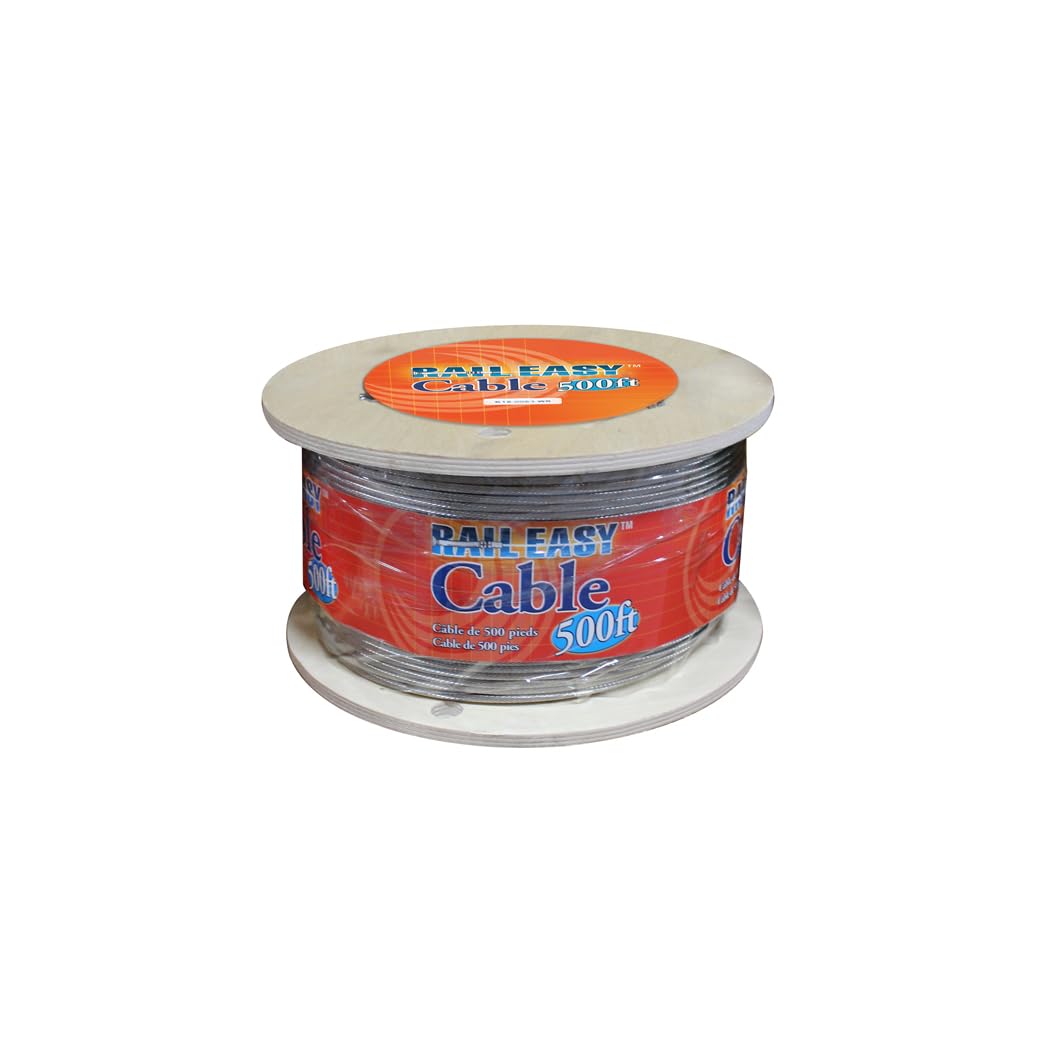
The Atlantis RailEasy 500-foot spool is the cable component for anyone building a railing system around the Atlantis swageless tensioners. It uses 316L marine-grade stainless steel in a 1×19 strand configuration at 5/32″ diameter — the exact size that pairs with the RailEasy C0981 tensioner. Working from a spool eliminates the waste of precut lengths and allows you to pull continuous cable across multiple posts for a cleaner result.
Verified owners highlight the professional look this cable produces when paired with the RailEasy hardware. The 5/32″ diameter strikes a practical balance between rigidity and flexibility: it is thick enough to resist bending when someone leans against it, yet flexible enough to handle stair angles without excessive force. The cable arrives on a wooden spool that keeps it tangle-free during payout, and the 316L grade provides the same corrosion resistance as T316 in coastal environments.
The 5/32″ cable does not work with standard 1/8″ swage fittings or turnbuckles — you must use compatible hardware. The cable ends also tend to swell slightly when cut, making insertion into turnbuckles tricky at first. Use an abrasive cutoff wheel or an industrial-grade cable cutter, then lightly file the cut end to reduce swelling. For a dedicated Atlantis system, this is the cable to buy.
Why it’s great
- 316L marine-grade stainless for maximum corrosion resistance in coastal areas
- 5/32″ diameter combines visual substance with manageable flexibility
- Continuous spool eliminates waste from precut cable lengths
Good to know
- Only compatible with 5/32″ hardware systems like Atlantis RailEasy
- Cable ends swell when cut; requires filing for smooth insertion
9. Muzata HL10 4-Pack 8FT Aluminum Black Cable Railing Handrail
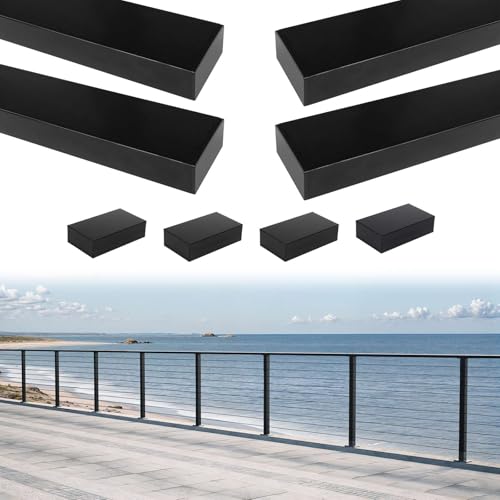
This Muzata handrail kit is not a cable railing hardware set — it is the top rail that finishes the system. Four 8-foot sections of flat-top aluminum rail with a matte black powder coating provide a clean, weldless appearance that matches the modern aesthetic of cable infill. Each section bolts directly to wood or metal posts with included screws, and extension connectors allow seamless joins between sections for runs longer than 8 feet.
Buyers consistently comment on how easy the aluminum rail is to cut with a standard hacksaw and how the matte black finish maintains its appearance through rain and direct sunlight without fading. The seam rings and end caps conceal connection points, creating a smooth, uninterrupted line that looks custom-fabricated. Several users paired this handrail with Muzata cable hardware for a coordinated system that required no painting or staining.
One quirk in the product description confused some users: the listing mentions 5-foot post spacing but the rail sections measure 8 feet, meaning you must cut the rail to match your post layout or adjust post positions accordingly. Also, the handrail does not include the posts themselves — you need to supply those separately. For a clean, low-maintenance top rail that ties your cable system together, the HL10 is the right finishing piece.
Why it’s great
- Matte black powder coating resists fading and corrosion without painting
- Weldless bolt-on design gives a clean, custom look with basic tools
- Includes seam rings and end caps for a seamless connection between sections
Good to know
- Posts are not included; must be sourced separately
- Product description phrasing on post spacing requires careful planning
FAQ
What is the maximum post spacing for 1/8″ cable railing?
Can I mix 1/8″ turnbuckles with 3/16″ cable?
Do I need a hydraulic crimper or will manual pliers work?
How often do I need to retension cable railing after installation?
Is T304 stainless steel good enough for a covered porch?
Final Thoughts: The Verdict
For most users, the best diy cable railing kit winner is the Muzata CK07 50-Pair because it combines a wide turnbuckle adjustment range, genuine T316 marine-grade steel, and a 360-degree rotating body that simplifies stair installations at a per-pair cost that undercuts premium systems while exceeding budget options in construction consistency. If you want a no-crimper installation with the cleanest possible look, grab the Atlantis RailEasy C0981 Tensioner — the swageless mechanical grip saves tool cost and allows future adjustments with hand tools. And for a heavy-duty cable system with a beefier visual and maximum breaking strength, nothing beats the BLIKA BL059 3/16″ Kit paired with a hydraulic crimper rated for thicker wire.

Mo Maruf
I created WellFizz to bridge the gap between vague wellness advice and actionable solutions. My mission is simple: to decode the research and give you practical tools you can actually use.
Beyond the data, I am a passionate traveler. I believe that stepping away from the screen to explore new environments is essential for mental clarity and physical vitality.