Our readers keep the lights on and my smoothie glass nicely filled. As an Amazon Associate, I earn from qualifying purchases.
Your car’s AC blowing warm air on a scorching summer day isn’t just uncomfortable—it’s a signal that your refrigerant level has dropped below the point where the compressor can do its job. A DIY AC recharge kit puts the diagnosis and the fix directly in your hands, letting you measure static and running pressures, add the correct refrigerant type, and get that ice-cold air back without booking a shop appointment.
I’m Mohammad Maruf — the founder and writer behind WellFizz. I’ve spent countless hours sorting through manifold gauge accuracy, vacuum pump CFM ratings, hose burst pressures, and coupler compatibility across the most popular recharge kits to find which setups actually deliver reliable results for the home mechanic.
Whether you’re servicing a car with R134a or a newer system with R1234yf, finding the best diy ac recharge kit comes down to matching the tool set to your specific refrigerant type and how often you plan to use it.
How To Choose The Best DIY AC Recharge Kit
Selecting the right recharge kit starts with knowing your vehicle’s refrigerant type and how much diagnostic control you want. A basic can-and-hose setup works for a simple top-off, but if you need to evacuate the system, measure vacuum depth, or switch between refrigerants, a manifold gauge set with a vacuum pump is the smarter investment.
Refrigerant Compatibility
R134a and R1234yf use different service port couplers—they are not interchangeable. R134a kits come with standard quick-disconnect couplers, while R1234yf requires locking-style couplers that are larger and threaded differently. Some premium kits include adapters for both, but if you buy a kit that only covers R134a, you won’t be able to connect to an R1234yf system at all.
Manifold Gauge vs. Single-Gauge Dispenser
A single-gauge trigger dispenser (like the A/C Pro can) lets you see only low-side pressure—it gives you a rough idea but no diagnostic picture. A 3-way or 4-way manifold gauge shows both low-side and high-side pressure simultaneously, which is essential for spotting restrictions, overcharges, or compressor inefficiencies that a single gauge would miss entirely.
Vacuum Pump Capability
If you’re opening an AC system for component replacement or the system has been open to air for more than a few minutes, you must pull a deep vacuum to boil off moisture before recharging. Entry-level recharge kits skip the vacuum pump entirely. Mid-range and premium kits include pumps rated between 3.6 CFM and 4.5 CFM—the higher the CFM, the faster the evacuation cycle completes.
Quick Comparison
On smaller screens, swipe sideways to see the full table.
| Model | Category | Best For | Key Spec | Amazon |
|---|---|---|---|---|
| VIVOHOME 4.5 CFM Kit | Premium All-in-One | Multi-refrigerant DIY with R1234yf support | 4.5 CFM / R32 R1234yf R454B compatible | Amazon |
| Orion Motor Tech 4.5 CFM Kit | Premium Complete Kit | Auto + home HVAC with leak detector | 4.5 CFM / 4-way manifold / 800 psi hoses | Amazon |
| VTG VOGTEN 4.5 CFM Kit | Premium Compact Set | Mini split and automotive use | 4.5 CFM / trifold case / leak detector | Amazon |
| BACOENG 3.6 CFM Kit | Mid-Range Starter | Beginner DIY with R134a and R410a | 3.6 CFM / 1/4 HP / 3-way manifold | Amazon |
| Lichamp R1234YF Gauge Set | Mid-Range Gauge Kit | R1234yf and R134a diagnostic & charge | 3-way gauge / 500 PSI max / 5 ft hoses | Amazon |
| Lichamp R410A Gauge Set | Mid-Range Gauge Kit | HVAC and auto with R410a support | 4-valve gauge / 800 PSI / 4 hoses | Amazon |
| A/C Pro Professional Formula | Budget Can Kit | Quick top-off with single-gauge dispenser | 20 oz can / trigger dispenser / R134a | Amazon |
In‑Depth Reviews
1. VIVOHOME 1/3 HP 4.5 CFM Vacuum Pump & Gauge Kit
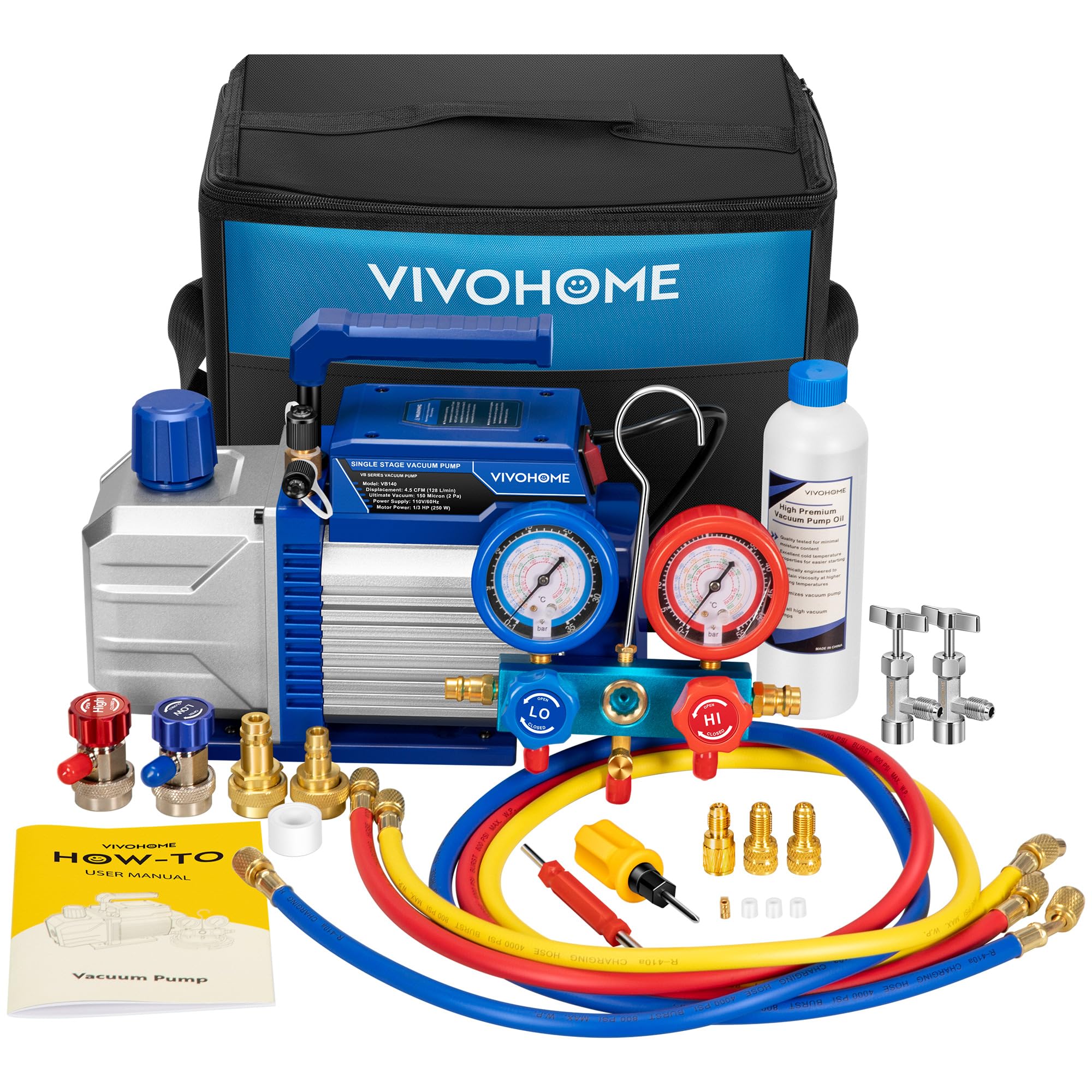
The VIVOHOME kit stands alone in this lineup for its sparkless motor design, which makes it safe for use with A2L mildly flammable refrigerants like R32, R1234yf, and R454B. That alone positions it as the most future-proof option for DIYers who may service newer vehicles or mini splits using next-generation refrigerants. The 4.5 CFM dual-stage evacuation pulls a deep vacuum fast, and the included pair of R1234yf self-sealing can taps means you don’t need to buy separate adapters for newer cars.
The 3-way manifold gauge delivers accurate pressure readings, though the low-pressure scale starts at zero instead of showing negative vacuum depth—so you’ll want a separate micron gauge if you’re chasing a deep evacuation number. The 4-foot color-coded hoses are rated for 800 PSI working pressure and 4000 PSI burst, giving you a solid safety margin even on high-side diagnostic work. The aluminum housing and integrated cooling fan keep the pump running cool during prolonged 30-minute evacuation cycles.
Some users noted that the included R134a self-sealing can tap doesn’t fully shut off after piercing, which can waste refrigerant if you need to disconnect mid-job. If you work exclusively with R1234yf, this is a non-issue. The carrying case keeps the pump, gauges, and all adapters organized for transport, making it the most complete premium kit in this roundup for anyone who services both old and new AC systems.
Why it’s great
- Sparkless motor is safe for A2L refrigerants like R32 and R1234yf
- Fast 4.5 CFM evacuation with oil sight glass and bottom drain valve
- Includes dedicated R1234yf can taps and quick couplers
Good to know
- Low-side gauge does not read negative vacuum depth
- R134a can tap may not seal fully after piercing
2. Orion Motor Tech 1/3 HP 4.5 CFM AC Vacuum Pump & Gauge Set
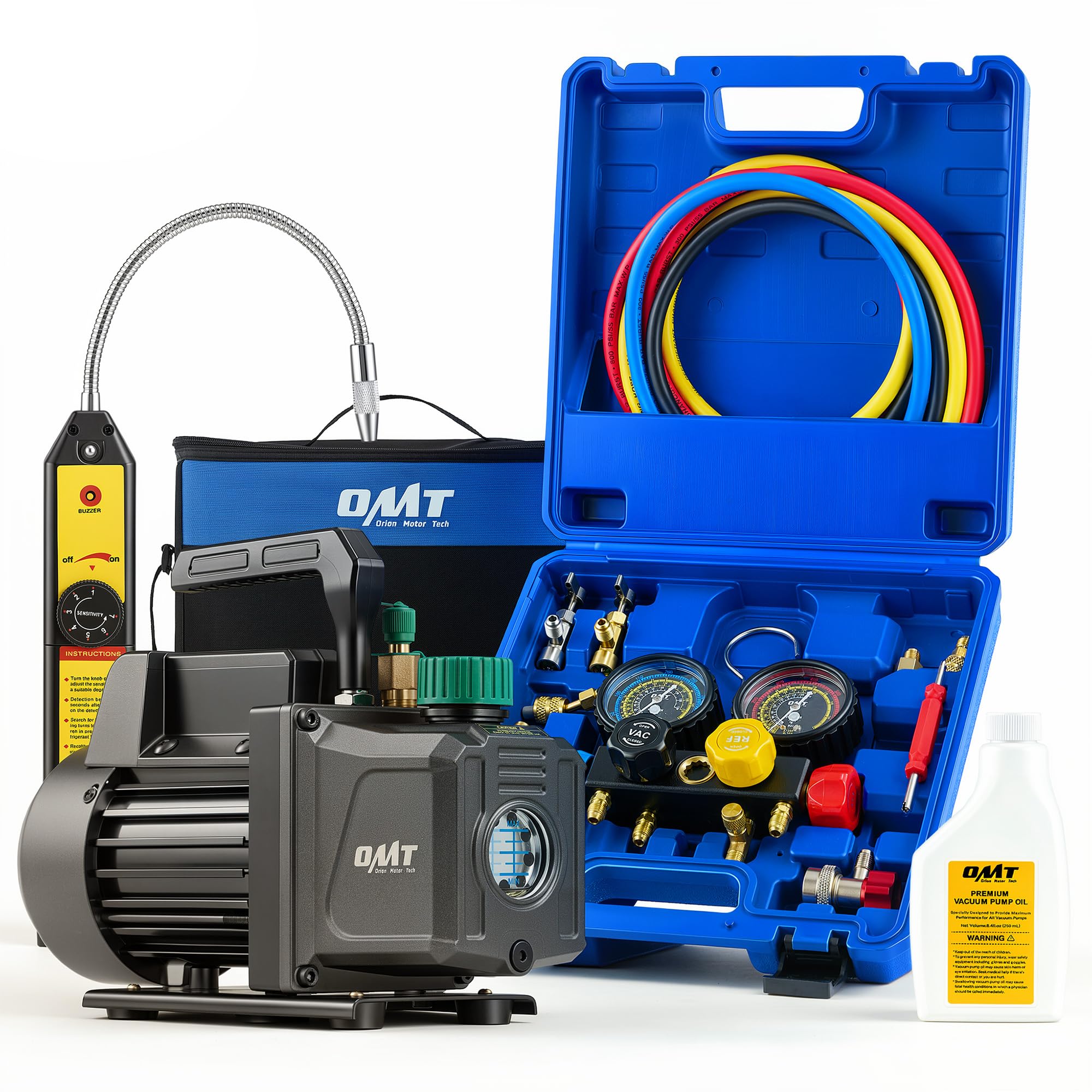
The Orion Motor Tech kit adds an electronic leak detector to the standard pump-and-gauge formula, which is a real time-saver when you’re trying to find a slow seep in an evaporator core or a hose O-ring. The 4-way manifold gauge gives you more connection ports than a standard 3-way, letting you hook up a recovery cylinder, vacuum pump, and refrigerant source simultaneously without swapping hoses. That extra valve simplifies the workflow for anyone doing regular AC service on multiple vehicles.
The 4.5 CFM all-copper motor pulls a vacuum quickly—most users report reaching 30 inches of mercury within 10 to 15 minutes on a standard car system. The aluminum alloy casing and built-in cooling fan keep the pump from overheating during extended runs, and the oil sight glass lets you check the level without stopping the pump. The hoses are rated at 800 PSI working pressure with a 4000 PSI burst rating, which is the same spec as professional-grade HVAC hoses from major brands.
A few users experienced a defective high-side connector that blew apart under pressure, though the seller replaced it quickly. The R134a adapter that comes pre-installed can cross-thread if you tighten too aggressively, so using Teflon tape on those fittings is recommended. The hard carrying case holds every component neatly, making this a strong choice for DIYers who want leak-detection capability built into their kit from the start.
Why it’s great
- Includes a functional electronic leak detector for finding system seeps
- 4-way manifold eliminates hose swapping during evacuation and charge
- Fast 4.5 CFM pump with reliable cooling fan and oil sight glass
Good to know
- Reported defective high-side connector on some units
- R134a adapter is prone to cross-threading if over-tightened
3. VTG VOGTEN 4.5 CFM AC Vacuum Pump & Gauge Set
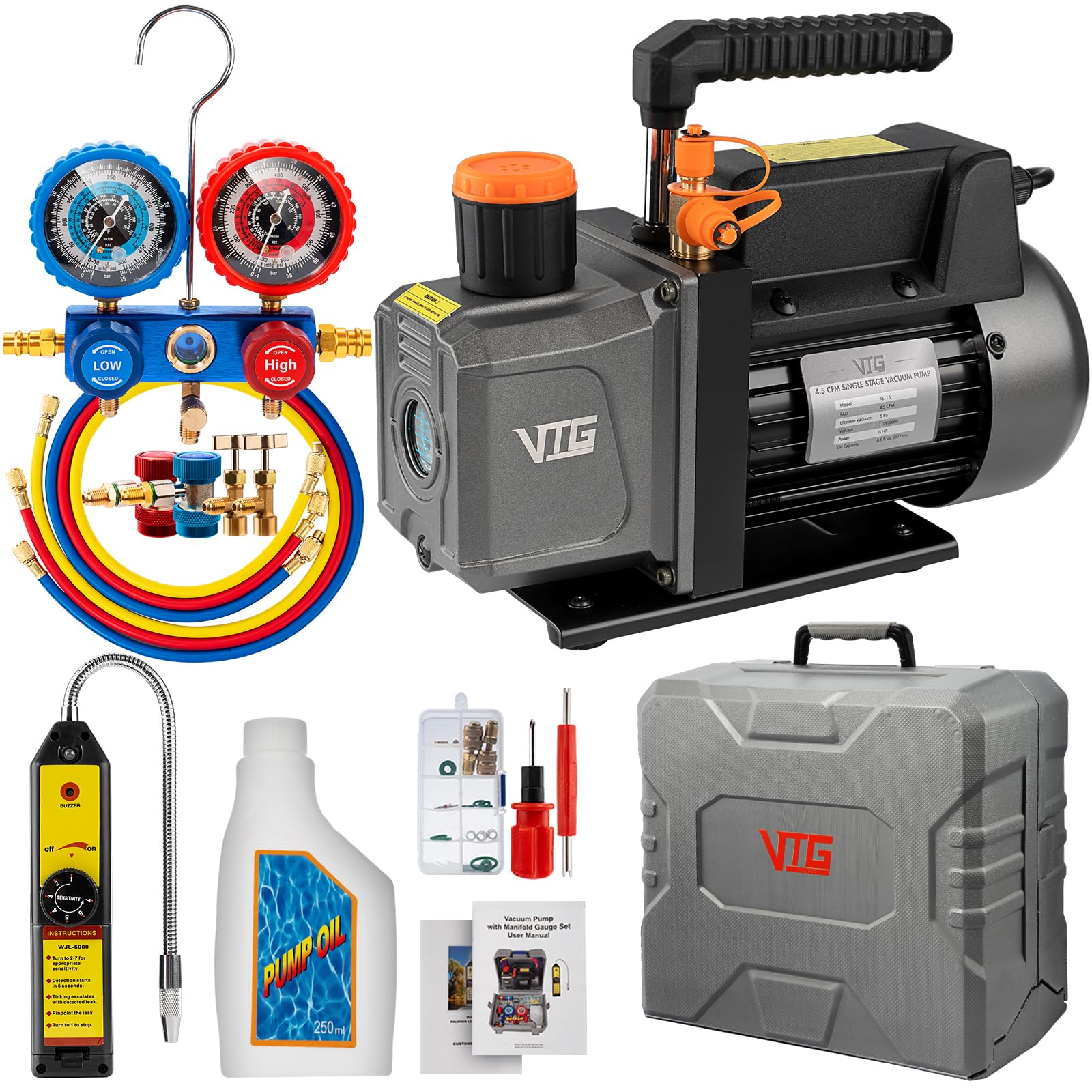
The VTG VOGTEN kit is built around a 4.5 CFM single-stage vacuum pump that handles automotive and mini split systems with equal ease. The pump itself is noticeably lighter than many competitors in this CFM class, which makes a difference when you’re carrying the kit from the garage to the driveway or up a ladder for a mini split install. The manifold gauge set provides direct temperature, pressure, and refrigerant flow readings, and the top hook lets you hang the gauge on the hood latch or a ladder rung to free up your hands.
The three 5-foot color-coded rubber hoses are rated for 600 PSI working pressure and 3000 PSI burst—slightly lower than the Orion or VIVOHOME hoses, but still more than adequate for standard automotive AC work. The included leak detector is a simple sniffer-style unit that works well for gross leaks but won’t pinpoint the tiniest micro-seeps. The trifold storage case is thicker than a typical soft bag and keeps everything organized without taking up as much floor space as a hard case.
The instructions are minimal—no detailed troubleshooting guide or step-by-step recharge procedure—so this kit is better suited for someone who has watched a few AC recharge tutorials and knows the basic sequence. The pump runs quietly and stays cool even during 40-minute continuous evacuation cycles, which is impressive at this price point. For the home mechanic who wants pump performance without the bulk, this kit delivers cleanly.
Why it’s great
- Lightweight pump body reduces fatigue during transport and setup
- Quiet operation with stable performance during long evacuation runs
- Compact trifold case stores neatly without consuming floor space
Good to know
- Included instructions are vague and lack diagnostic guidance
- Leak detector is suitable for large leaks only, not micro-seeps
4. BACOENG 3.6 CFM 1/4 HP AC Vacuum Pump & Gauge Set
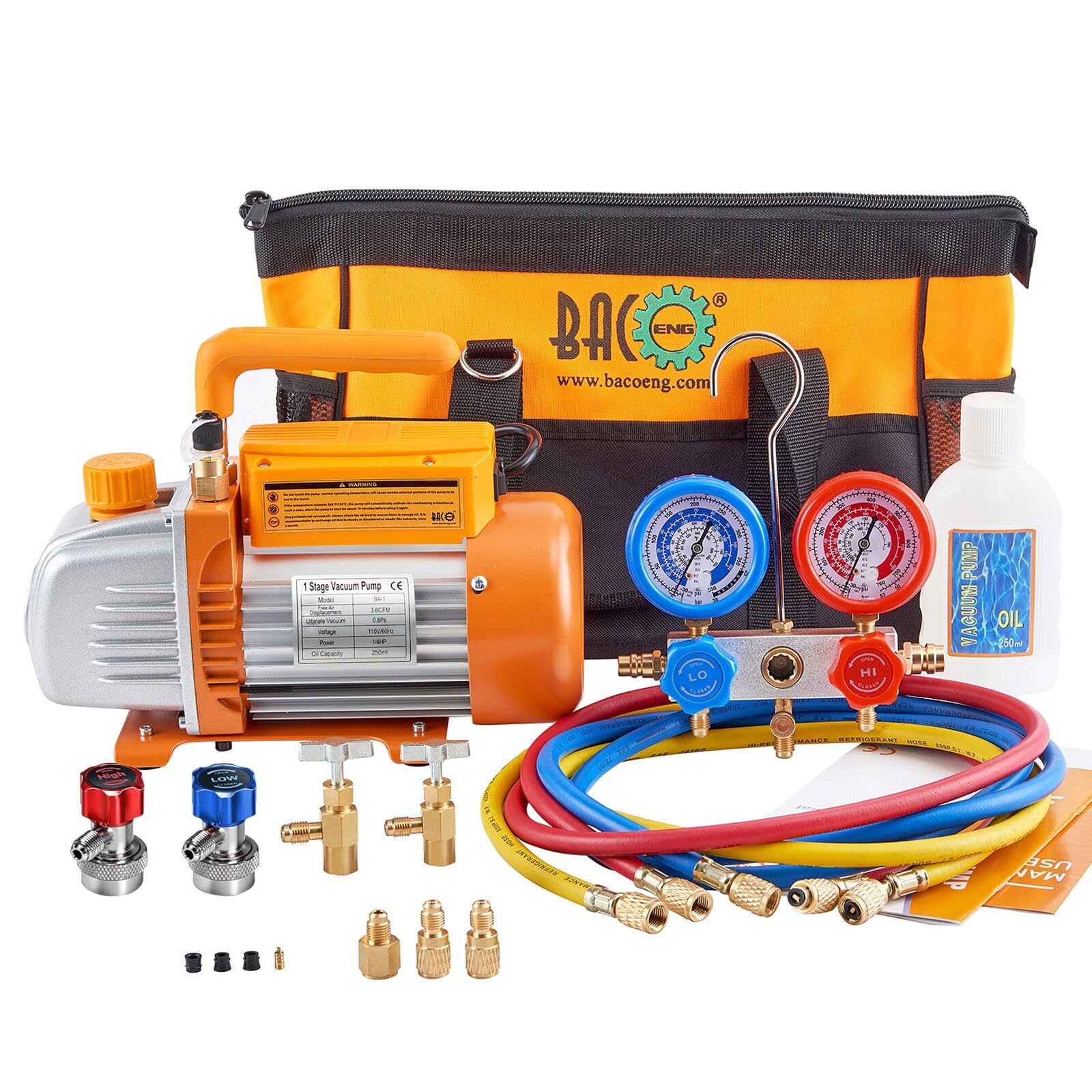
The BACOENG kit is the budget-friendly entry point into full evacuation-and-recharge capability. At 3.6 CFM, the 1/4 HP vacuum pump pulls a vacuum more slowly than the 4.5 CFM units—expect it to take 20 to 25 minutes to fully evacuate a standard car system—but it gets the job done reliably. The all-copper motor and aluminum alloy housing match the build quality of pumps costing more, and the integrated cooling fan prevents shutdown during long cycles.
The 3-way manifold gauge is color-coded clearly and comes with a hook for hands-free hanging. The three 5-foot hoses are rated at 600 PSI working pressure and 3000 PSI burst, which is sufficient for automotive AC and home mini splits. The kit includes both a puncture-style and a self-sealing R134a can tap, plus R134a quick couplers and R410a adapters, so you can start working on either system immediately without shopping for extra parts.
The most common complaint centers on the can tap—the pointed tip doesn’t always punch through the can completely, which can stall the fill process. If that happens, the self-sealing tap included in the kit is a reliable backup. The large tool bag holds everything but isn’t as protective as a hard case. For a first-time buyer who wants a functional setup without overspending, the BACOENG gives you the core tools you need to service R134a and R410a systems competently.
Why it’s great
- Complete kit with pump, gauges, hoses, and both tap styles included
- All-copper motor and aluminum housing for reliable long-term use
- Works with R134a, R410a, and R22 out of the box
Good to know
- 3.6 CFM pump is slower than premium 4.5 CFM alternatives
- Puncture-style can tap may fail to fully open the refrigerant can
5. Lichamp R1234YF R134A R404A Manifold Gauge Set

This Lichamp gauge set focuses purely on the diagnostic side of AC service—it gives you a professional-grade 3-way manifold with R1234yf compatibility at a price point that undercuts premium all-in-one kits. The gauges use extra-large colored dials that are easy to read at a glance, with the red high-side gauge rated to 500 PSI and the blue low-side to 350 PSI. A built-in sight glass lets you see when liquid refrigerant is flowing during the charge, which helps prevent overfilling.
The three 5-foot hoses are reinforced with a thickened rubber jacket and feature a 45-degree bend on one end for reaching tight service ports. The hose rating of 600 PSI working pressure with a 3000 PSI burst pressure is the same spec as many premium sets. All metal fittings are brass or aluminum, and the kit includes two adjustable R134a adapters, two R134a-to-R1234yf adapters, a can tap, a tank adapter, an ACME adapter, and even a valve core removal tool.
The critical catch is that the included R1234yf high-side coupler adapter may not lock securely on all vehicles—some users reported it wouldn’t latch, making it useless for newer R1234yf systems without buying a separate coupler. The build quality of the manifold body itself is excellent, and the kit works flawlessly with R134a. If you mainly service older R134a vehicles with occasional R1234yf work, this is a strong mid-range gauge set. For dedicated R1234yf service, budget for replacement couplers.
Why it’s great
- Extra-large colored gauge dials for easy pressure reading at a distance
- Sight glass allows visual confirmation of liquid refrigerant flow
- Comprehensive adapter set includes R1234yf, R134a, and tank fittings
Good to know
- R1234yf high-side coupler may fail to lock on some vehicles
- No vacuum pump included—diagnostic and charge only
6. Lichamp HVAC R410A R134A R22 Manifold Gauge Set

This Lichamp set uses a 4-valve manifold instead of the standard 3-valve design, giving you an extra port for connecting a vacuum pump or recovery tank without disconnecting your refrigerant source. That makes it a more efficient tool for users who do both evacuation and charging in a single session. The gauges are rated for higher pressures than the previous Lichamp model—800 PSI on the high side and 550 PSI on the low side—making this set suitable for R410a mini splits that operate at significantly higher pressures than automotive R134a systems.
The kit includes four 5-foot hoses (one extra service hose) with a 800 PSI working pressure and 4000 PSI burst rating, which is the toughest hose spec in this roundup. The manifold body is machined from brass and aluminum with a steel-reinforced shell that can handle drops without losing calibration. Included accessories cover R134a adjustable adapters, R410a liquid safety valves, tank adapters, a swivel adapter, a calibration screwdriver, and a valve core removal tool.
The low-pressure gauge uses 5 PSI increments, which makes precise readings difficult when you’re trying to hit a specific target like 75 PSI for R438A. The gauge faces are also relatively small—some users with older eyes found them harder to read than the larger dials on the previous model. For HVAC work where you’re charging by subcooling or superheat numbers, those 5 PSI increments add uncertainty. But for basic automotive AC work, the gauge resolution is adequate, and the 4-valve convenience is a genuine productivity boost.
Why it’s great
- 4-valve manifold streamlines evacuation and charging workflow
- 800 PSI working pressure hoses handle R410a mini split systems
- Comprehensive accessory kit covers R134a, R410a, and R22
Good to know
- Low-side gauge has 5 PSI increments, limiting precision
- Gauge faces are small and may be hard to read in poor light
7. A/C Pro Professional Formula R134a Recharging Kit (4-Pack)

The A/C Pro kit is the simplest tool in this lineup—a single 20-ounce can of R134a with a reusable trigger dispenser and built-in gauge. You screw the hose onto the low-side service port, read the gauge to confirm the system is low, and squeeze the trigger to add refrigerant. No manifold, no vacuum pump, no adapters. It’s designed for the driver who wants to top off a slightly warm AC system in under 30 minutes without learning the technical side of AC service.
The refrigerant formula includes a sealant that can fix small O-ring leaks over time, which some users reported as effective after multiple treatments. The trigger dispenser is re-usable, so the 4-pack gives you three additional cans for future top-offs or for use across multiple vehicles. The gauge reads only low-side pressure, so you won’t get a full system diagnostic—but for a simple top-off where you know the system was cooling well before, that’s often enough information.
The limitation is that this kit cannot evacuate moisture or air—it only adds refrigerant. If your system has been open to the atmosphere, has a major leak, or the compressor is cycling on and off rapidly, this kit won’t fix the problem. Some users found they needed three full cans to get cold air, which suggests the system may have had excess air that needed to be purged. For a quick seasonal top-off on a known-good system, the A/C Pro kit is the most convenient option. For any deeper repair, you need one of the manifold-and-pump kits above.
Why it’s great
- Fastest and simplest way to top off a low R134a system
- Re-usable trigger dispenser with integrated low-side pressure gauge
- Includes sealant that can address minor O-ring leaks
Good to know
- No vacuum evacuation capability—cannot remove moisture or air
- Single-gauge reading limits diagnostic information significantly
FAQ
Can I use an R134a recharge kit on a car that uses R1234yf?
Do I really need a vacuum pump for a simple top-off?
What does the sight glass on the manifold gauge tell me?
Why does my low-side gauge read zero when the system is off?
Is it safe to use a stop-leak additive in my AC system?
Final Thoughts: The Verdict
For most users, the best diy ac recharge kit winner is the VIVOHOME 4.5 CFM Kit because it combines a future-proof sparkless motor, full R1234yf support, and a fast 4.5 CFM evacuation pump in one organized package. If you want a built-in leak detector for troubleshooting seeps, grab the Orion Motor Tech Kit. And for a simple no-fuss top-off on a known-good system, nothing beats the convenience of the A/C Pro Kit.

Mo Maruf
I created WellFizz to bridge the gap between vague wellness advice and actionable solutions. My mission is simple: to decode the research and give you practical tools you can actually use.
Beyond the data, I am a passionate traveler. I believe that stepping away from the screen to explore new environments is essential for mental clarity and physical vitality.