Our readers keep the lights on and my smoothie glass nicely filled. As an Amazon Associate, I earn from qualifying purchases.
Poor visibility turns an exciting dive into a disorienting experience. The right light doesn’t just brighten the water; it cuts through suspended particles to reveal what’s hidden just feet away.
I’m Mohammad Maruf — the founder and writer behind WellFizz. I’ve spent countless hours analyzing beam angles, color temperatures, and lumen outputs specifically for the challenge of low-visibility diving conditions.
This guide focuses on lights that penetrate haze without scattering light back into your mask, bringing you the most critical specs for selecting a dive light for murky water that delivers real underwater clarity.
How To Choose The Best Dive Light For Murky Water
Selecting a dive light for low-visibility conditions requires a shift in thinking. While a wide floodlight works well in clear water, it backscatters light off suspended silt and plankton in murky environments, creating a blinding wall of white. You need a light that concentrates its energy on a narrow corridor ahead.
Prioritize Beam Angle Over Raw Lumens
A tight beam angle — typically between 6 and 15 degrees — punches through murk by minimizing the volume of illuminated water between you and your target. High lumen counts are secondary; a 3000-lumen narrow beam will out-perform a 20000-lumen floodlight in turbid conditions because it directs light where it’s needed rather than scattering it sideways.
Choose Cooler Color Temperatures
In murky water, cooler white light (5000K to 6500K) penetrates further and reduces scatter compared to warm or amber tones. While high CRI (90+) is excellent for photography in clear conditions, in low-viz environments, a slightly cooler, neutral-white beam provides superior target definition.
Magnetic Switching for Reliable Control
Murky water often means reduced visibility and bulky gloves. Mechanical twist switches can be hard to operate. A magnetic rotary or side-push switch offers positive, intuitive control even when you can’t see your hand. Look for a lock-out feature to prevent accidental activation in your BCD pocket.
Quick Comparison
On smaller screens, swipe sideways to see the full table.
| Model | Category | Best For | Key Spec | Amazon |
|---|---|---|---|---|
| ORCATORCH D710 | Premium | Ultimate murk penetration | 6° narrow beam | Amazon |
| Wurkkos DL46 | Premium | Maximum raw power | 20,000 lumens / 608m throw | Amazon |
| APLOS AP200 | Mid-Range | High-output all-rounder | 20,000 lumens / 380m throw | Amazon |
| Wurkkos DL06 | Mid-Range | Wide coverage + throw | 15,000 lumens / 555m throw / 100° beam | Amazon |
| Sofirn SD11 | Mid-Range | Compact versatility | 5,000 lumens / CRI 90 / 3K-6.5K CCT | Amazon |
| Wurkkos DL40 | Mid-Range | Balanced flood/throw | 5,000 lumens / 90 CRI / 5000K | Amazon |
| Wurkkos DL08 | Budget | Entry-level versatility | 3,600 lumens / 133° flood | Amazon |
In‑Depth Reviews
1. ORCATORCH D710 Scuba Diving Light

The ORCATORCH D710 was designed from the ground up for one purpose: cutting through murky water. Its ultra-narrow 6-degree beam focuses all 3000 lumens into a tight pencil of light that reaches 150 meters, minimizing backscatter better than any wide-angle light on this list. This is the defining spec for low-visibility environments.
Build quality matches the task. The machined aluminum alloy body with triple O-rings and 5mm thick tempered glass provides IP68 waterproofing to 150 meters. The side switch offers four brightness levels plus a momentary turbo mode, and its battery indicator shows green above 30% and red below, so you never get surprised mid-dive. The included hard case with foam holds two batteries and the charger, making travel simple.
Real-world feedback from night and wreck divers confirms the D710’s reliability after dozens of saltwater dives. The locking switch prevents accidental activation in a BCD pocket, and the available bright color options help you spot your light in a crowded gear bag. If tackling turbid conditions is your priority, this is the professional-grade tool.
Why it’s great
- 6-degree beam is unmatched for murky penetration
- Swappable batteries and fast Type-C charging
- Lockable side switch prevents pocket activation
Good to know
- Batteries sold separately
- Not suited for wide-angle video work
2. Wurkkos DL46 Dive Light
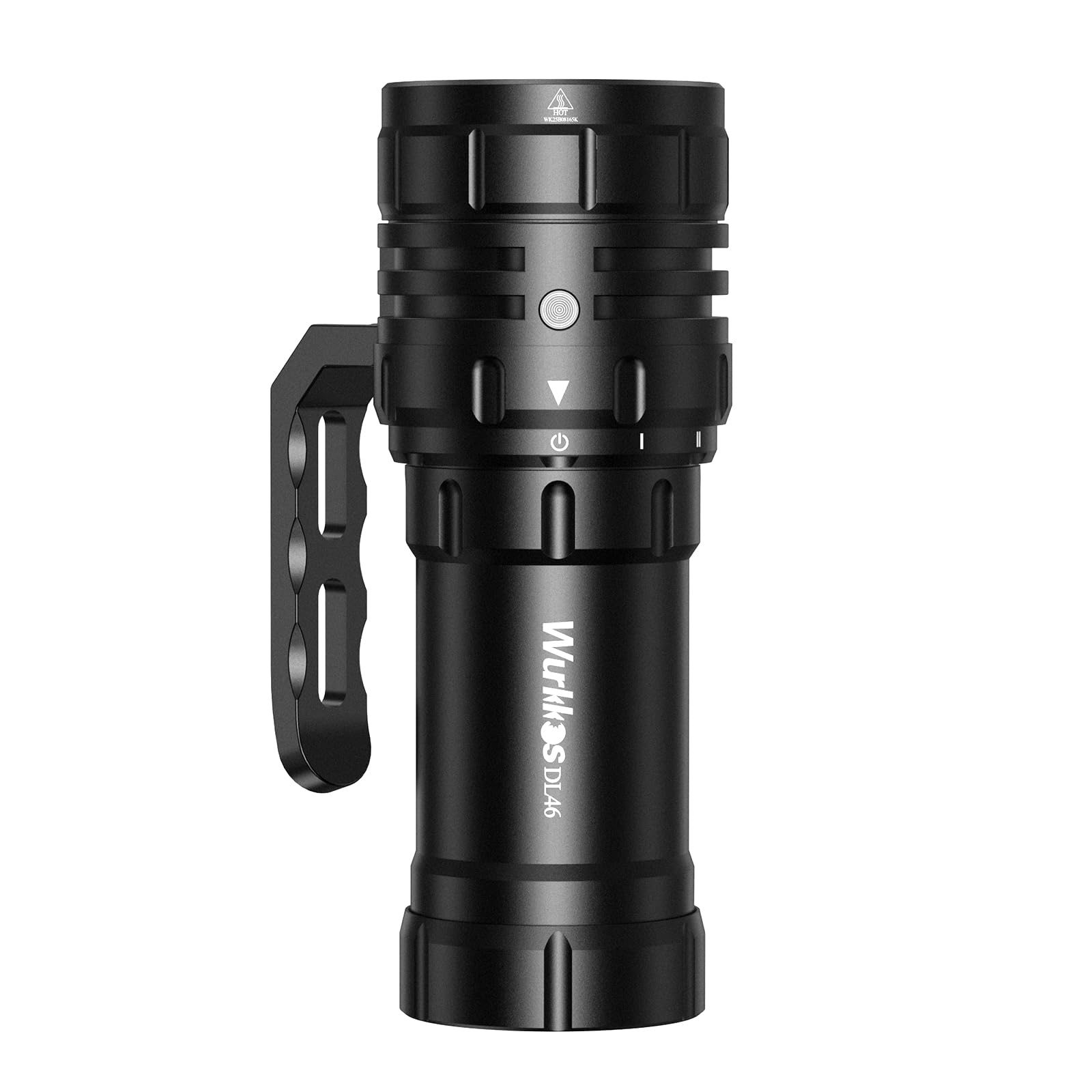
The Wurkkos DL46 answers the question: what happens when you put six XHP50.2 LEDs into a sealed aluminum tube? You get 20,000 lumens with a measured throw of 608 meters, making it the most powerful light on this list. The magnetic rotary ring switches between three modes — low (1,000 lumens), medium (5,000), and high (20,000) — and the hidden USB-C port keeps the seal intact.
Build details matter for murky conditions. The DL46 uses aerospace-grade 6061 aluminum with a hard anodized finish that resists seawater corrosion. The thick lens and double O-rings earn its IPX8 rating to 100 meters. A color indicator on the side shows battery status in real-time, and the battery pack can even reverse-charge a phone in an emergency, which is a thoughtful touch for extended trips.
Diver reviews highlight that this light outshone groups of eight other divers on night dives, revealing features others missed entirely. The downside is weight — at 1.24 kg, it requires a good wrist strap. But for sheer lumen-per-dollar performance with a beam that reaches through haze, the DL46 sets a new standard.
Why it’s great
- Class-leading 20,000 lumens with 608m throw
- Hidden USB-C charging preserves waterproof integrity
- Ergonomic handle and magnetic rotary UI
Good to know
- Built-in battery is non-replaceable
- Heavy feel may tire the wrist on long dives
3. APLOS AP200 Scuba Diving Flashlight

The APLOS AP200 delivers an astonishing 20,000 lumens with a beam that reaches 380 meters. It uses six robust O-rings to achieve IPX8 waterproofing down to 150 meters, and the aviation-grade aluminum body with tempered glass lens is built for the abuse of wreck and cave environments. Four lighting modes including an SOS signal make it adaptable above and below the surface.
Divers have confirmed the AP200’s performance at depths of 150 feet, noting it outperformed older LED lights that had seen 100+ dives. The magnetic switch is a standout feature — it avoids the mechanical failure points of twist-on designs, though some users recommend placing a spare O-ring over the switch to prevent accidental activation in a pocket. The light tucks neatly into a wetsuit pocket without adding bulk.
The complete kit includes a stylish toolbox, rechargeable 5000mAh batteries, and a charger. Customer reviews praise its performance in group diving scenarios where keeping track of buddy positions in low vis is critical. For a high-output light that bundles everything you need, this is a strong contender.
Why it’s great
- 20,000 lumens in a compact, EDC-friendly package
- Six O-rings for superior waterproof redundancy
- Complete kit with charger, batteries, and case
Good to know
- Magnetic switch can activate accidentally without lock ring
- Reported lumen output may vary from advertised spec
4. Wurkkos DL06 Dive Light
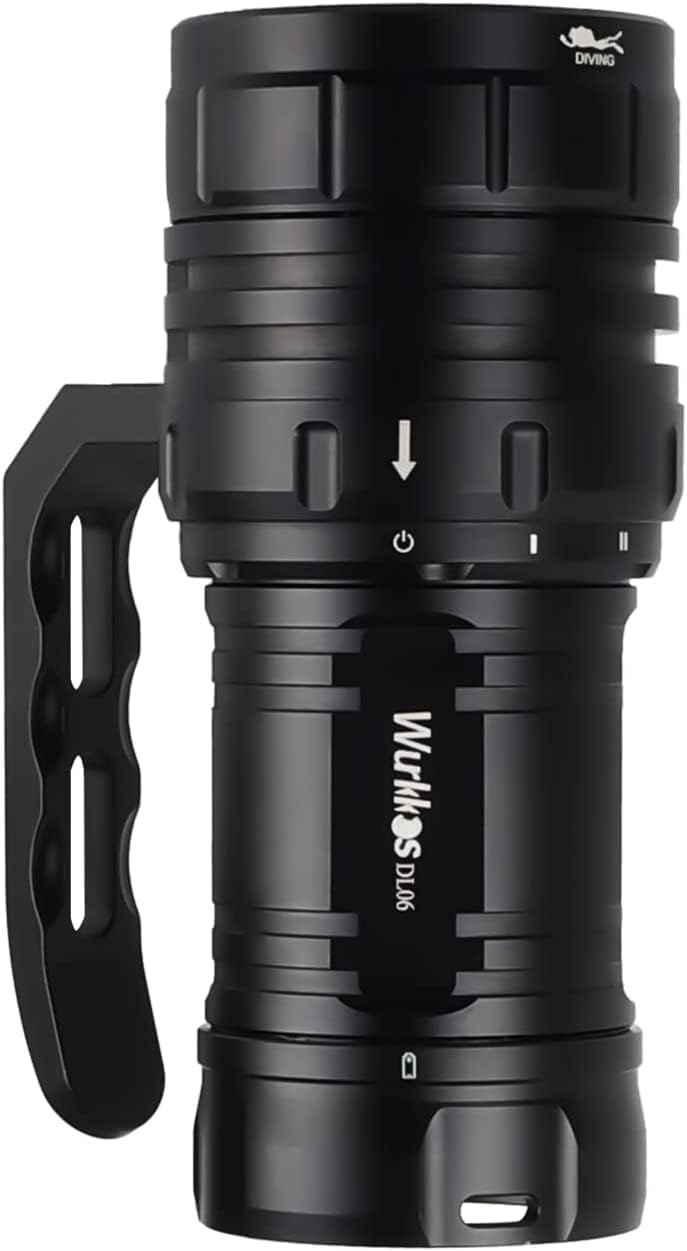
The DL06 from Wurkkos is built for divers who want wide-area illumination with serious reach. Six XHP50 LEDs crank out 15,000 lumens across a 100-degree beam that reaches 555 meters. That wide angle is excellent for night dives where you want to scan a large area without moving the light constantly, but it will produce more backscatter in heavy silt compared to a narrow-beam light.
A magnetic control ring makes mode selection intuitive even with thick gloves — rotate for high, medium, or low, with no fumbling for tiny buttons. The hidden Type-C charging port in the tail cap means you don’t need a proprietary charger. An Advanced Temperature Regulation system automatically drops brightness when the driver hits 60°C, protecting the LEDs if you run it on high out of water.
User reviews consistently praise the DL06’s build quality and the simple, reliable UI. The 2700K version offers a warm incandescent-like glow that some find pleasing, but for murky water, the cooler 5000-6000K option provides better penetration. This is a versatile, affordable workhorse for divers who split time between clear and moderately turbid conditions.
Why it’s great
- Wide 100-degree beam for excellent area scanning
- Magnetic rotary UI is simple and gloved-hand friendly
- Hidden USB-C charging port maintains seal
Good to know
- Wide beam causes significant backscatter in heavy murk
- Runs physically hot on brightest setting out of water
5. Sofirn SD11 Dive Light
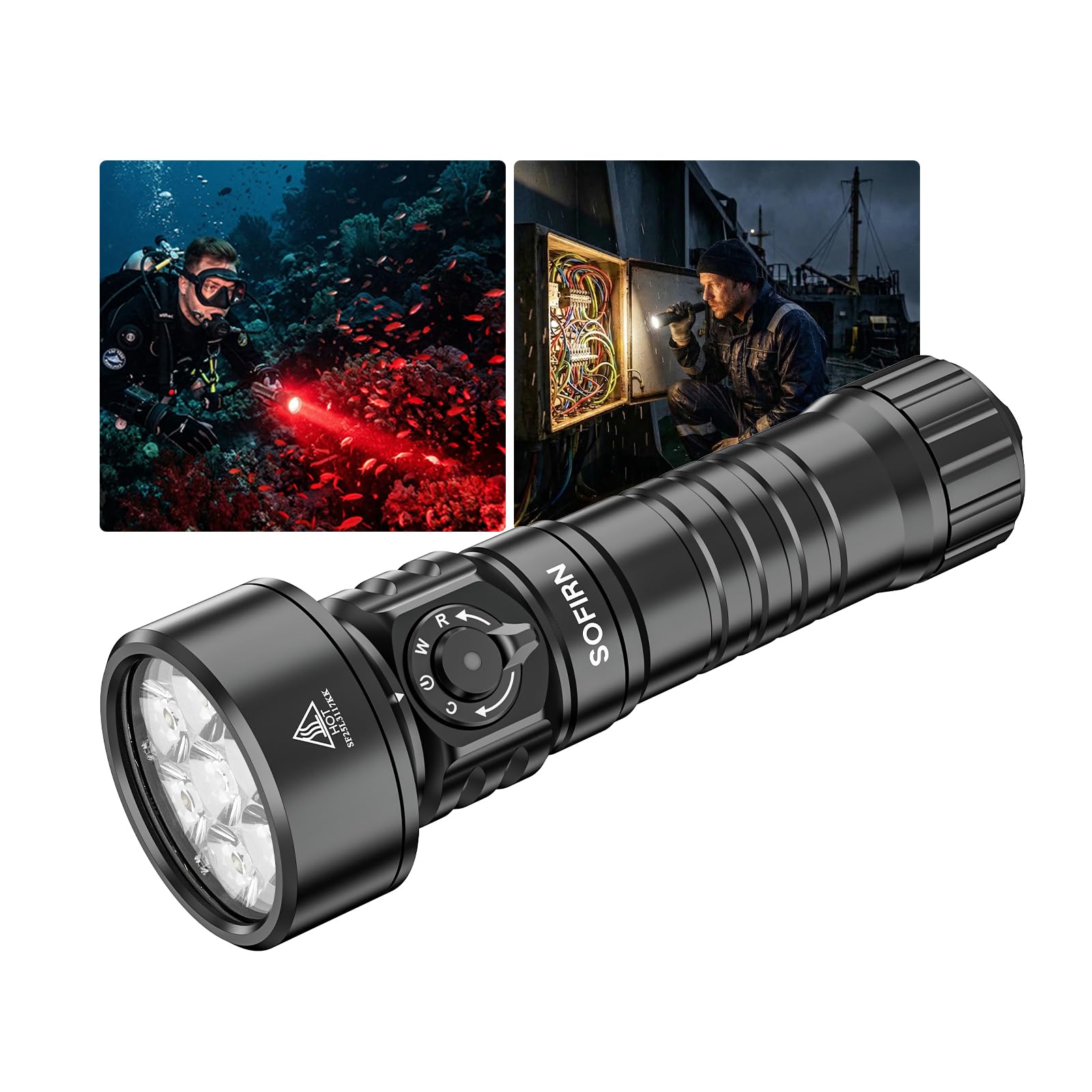
The Sofirn SD11 proves that compact lights can still be murky-water capable. It packs 5,000 lumens with a beam that reaches 244 meters, and its unique feature is four light sources: 3000K warm white at CRI 90 for color-accurate inspection, 6500K cool white for maximum penetration, a mixed mode, and a dedicated 660nm red light for preserving night vision. This makes it a versatile backup or primary light for photographers.
The magnetic rotary switch is easy to operate with gloves, and the lock mode prevents activation in your bag. USB-C charging means you can top up between dives without a dedicated charger, and the IPX8 rating to 100 meters gives you confidence at recreational depths. The body measures just 157mm long and weighs 196g, making it easy to pack as a secondary light.
Customer feedback highlights the SD11’s intuitive controls and the usefulness of the red light mode for signaling without blinding buddies. The main trade-off is runtime — on high, the battery drains faster than larger lights, so it’s best used as a spot-check light rather than a primary illumination source for long dives. For its size and feature set, it’s a fantastic companion light.
Why it’s great
- Ultra-compact at 157mm and 196g
- Four selectable light sources including red and 3000K/6500K
- High CRI 90 for accurate color rendering
Good to know
- Battery life on high is short (approx. 5 minutes)
- Beam distance modest compared to larger lights
6. Wurkkos DL40 Diving Flashlight

The DL40 uses four Samsung LH351D LEDs to produce 5,000 lumens at a true 5000K color temperature, offering a beam that balances flood and throw better than most lights in its tier. The 90 CRI rating means colors appear natural, which is useful for identifying marine life or inspecting gear. Four brightness levels — turbo (5000lm), high (2000lm), medium (820lm), and low (300lm) — give you precise control over battery consumption.
The magnetic side switch supports one-handed operation and includes a memory function that remembers the last brightness level used. The body is aerospace-grade 6061 aluminum with a hard anodized finish rated IPX8 to 150 meters. An extra pair of O-rings and a safety lanyard are included. The light runs on two 26650 batteries (included) or can use two 18650s with spacers, offering flexibility.
Diver reviews commend the simple UI (no strobe modes to cycle through) and the robust build. The beam pattern shows four overlapping circles which create a central hotspot with good spill — ideal for general diving in moderate vis. The main complaints are the weight (19.7oz with batteries) and that it heats up quickly on turbo when not submerged. For a mid-range light that does everything competently, this is a top choice.
Why it’s great
- High CRI 90 for accurate underwater color
- Balanced beam with good hotspot and spill
- Simple, memory-equipped magnetic switch UI
Good to know
- Heavy at nearly 20oz with batteries
- Included batteries may be unmatched, risking over-discharge
7. Wurkkos DL08 Dive Light

The DL08 is the most affordable entry into quality dive lighting, offering 3,600 lumens of floodlight with a 133-degree beam angle. It uses nine LED bulbs across four modes: a focused spotlight (up to 2000lm), a wide floodlight (3600lm), red light, and UV light. The dual brightness adjustment system — four preset levels or stepless dimming — gives you fine control over runtime, with a maximum possible endurance of 21 days on the lowest setting.
The IPX8 body uses thickened tempered glass and 6016 aluminum alloy with double-layer waterproof O-rings for corrosion resistance. The rotary switch and center button are intuitive. CRI is rated at 90, making the flood mode excellent for underwater photography in clear conditions. However, the ultra-wide beam angle is not ideal for murky conditions where backscatter becomes a problem.
Diver feedback is mixed: the flood white light is praised for its brightness and coverage, but the UV mode is reported as underpowered, and the focused spotlight shows a ringy beam pattern. Some users received defective units with switch issues. For clear-water night dives and photography, this is excellent value. For murky penetration, look to the narrower-beam options earlier in this list.
Why it’s great
- Budget-friendly entry into dive lighting
- 133-degree flood is excellent for video and photography
- Four modes including UV and red light
Good to know
- Wide beam creates severe backscatter in murky water
- UV mode is very weak; spotlight has visible rings
FAQ
Why does my wide-beam dive light create a wall of white in murky water?
Is higher lumens always better for low-visibility diving?
Should I get a warm or cool color temperature for murky conditions?
Final Thoughts: The Verdict
For most users, the dive light for murky water winner is the ORCATORCH D710 because its specialized 6-degree narrow beam is unmatched for cutting through suspended particles. If you want maximum raw brightness to penetrate dark wrecks, grab the Wurkkos DL46. And for a compact backup that offers multiple light sources including red and high-CRI white, nothing beats the Sofirn SD11.

Mo Maruf
I created WellFizz to bridge the gap between vague wellness advice and actionable solutions. My mission is simple: to decode the research and give you practical tools you can actually use.
Beyond the data, I am a passionate traveler. I believe that stepping away from the screen to explore new environments is essential for mental clarity and physical vitality.