Our readers keep the lights on and my smoothie glass nicely filled. As an Amazon Associate, I earn from qualifying purchases.
Tap water carries dissolved minerals that slowly build up in your soil, raising the pH and locking out nutrients until your plant’s leaves brown at the tips and growth stalls. Switching to a water that’s been stripped of those dissolved solids eliminates that invisible stress and lets your plant absorb fertilizer exactly as intended.
I’m Mohammad Maruf — the founder and writer behind WellFizz. I’ve spent hundreds of hours cross-referencing ASTM certification levels, deionization versus distillation processes, and total dissolved solids claims across commercial water suppliers to build this buying guide.
Whether you are nurturing carnivorous plants that die on tap water or trying to prevent white crust from forming on your potting mix, knowing which bottle delivers true purity matters. This is my curated list of the best distilled water for plants based on lab-grade purity standards and verified real-world results.
How To Choose The Best Distilled Water For Plants
Not all pure water is created equal. A bottle labeled “distilled” might still contain trace minerals if the distillation equipment isn’t maintained, while deionized water removes minerals through ion exchange rather than boiling. For plants, the goal is zero measurable total dissolved solids (TDS) that can alter soil chemistry over time.
Check for Laboratory-Grade Certification
Look for ASTM D1193 or ACS certification. These standards define maximum allowable impurity levels. Laboratory-grade water has been tested to meet those thresholds, meaning you can trust it won’t introduce calcium, magnesium, or chlorine into your watering routine.
Know Your Container Size
A single gallon can water a small collection of houseplants for weeks, but if you have multiple large pots or a whole tray of carnivorous plants, a 3.8-liter or 4-liter bottle reduces how often you need to reorder. Calculate your weekly consumption and choose a volume that fits your shelf space.
Quick Comparison
On smaller screens, swipe sideways to see the full table.
| Model | Category | Best For | Key Spec | Amazon |
|---|---|---|---|---|
| Carolina Distilled Water | Lab Grade Distilled | Venus flytraps and ironing | 3.8 L single distillation | Amazon |
| MAXTITE Type II DI Water | Deionized | Lab experiments and electronics cleaning | 4 gallon, ASTM/ACS certified | Amazon |
| Indco Deionized Water | Deionized | Steamers and chemical peels | 1 gallon, sterile | Amazon |
| HAVENLAB Deionized Water | Deionized | Aquariums and lab calibration | 1 gallon, odorless | Amazon |
| RPI Distilled Water | Lab Grade Distilled | Research and CPAP machines | 4 L, reagent grade | Amazon |
In‑Depth Reviews
1. Carolina Distilled Water

This 3.8-liter bottle from Carolina Biological Supply is singly distilled to laboratory grade, which means the water has been boiled into steam and condensed back into a separate container, leaving virtually all dissolved minerals behind. Users consistently report great results with sensitive specimens — one buyer noted it was “perfect for my Venus flytrap,” a plant that will die within weeks on tap water due to mineral burn.
The bottle is sturdy and well-sealed, and the 3.8-liter volume is large enough to sustain a small collection of carnivorous plants or a half-dozen calatheas for a month of weekly watering. Because it comes from a science supply company with decades of quality control, you can trust that each batch meets consistent purity standards.
Multiple verified reviews also mention using it for steam irons and steam cleaners without clogging, which confirms that the water is genuinely free of the calcium and magnesium particles that cause scale buildup. For plant owners who also want a multi-purpose pure water for household tools, this is the most practical option.
Why it’s great
- Verified single distillation removes minerals that harm sensitive plants
- Large 3.8 L volume reduces reorder frequency
- Sturdy container with zero reported leakage
Good to know
- Not certified for food or drug use
- Some users describe it as higher cost per liter than generic brands
2. MAXTITE Type II Deionized Water
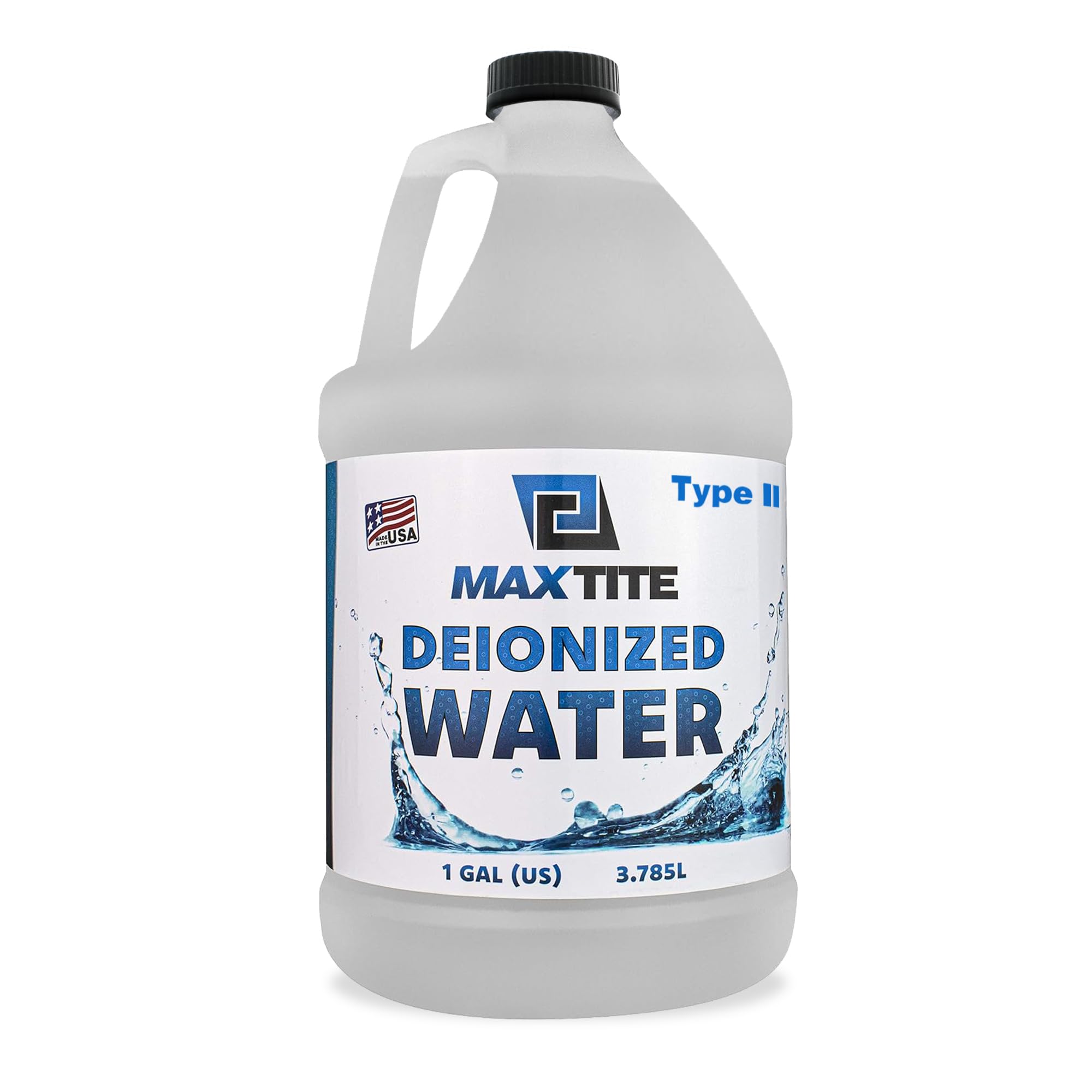
MAXTITE sells deionized water rather than distilled, which means minerals are removed through ion-exchange resins instead of boiling. The result is Type II purity that meets ASTM D1193-24 and ACS certification — a standard that many lab professionals rely on for sensitive experiments. The 4-gallon size gives you a large supply for frequent watering.
Plant owners will appreciate that deionized water is equally as mineral-free as distilled for soil use. The ions that cause hardness are stripped out, so your potting mix won’t develop the white crust that signals salt accumulation. One reviewer highlighted its use for fog juice and chemistry projects, underscoring its high purity level.
Beyond plants, users mention using it to clean computer screens and car windshields without streaks. The value proposition here is the large volume per purchase, which makes it a smart choice if you have a big collection of plants or multiple household needs for pure water.
Why it’s great
- Type II ASTM/ACS certification guarantees consistent purity
- 4 gallons is an economical volume for regular watering
- Multipurpose — plants, screens, fog machines
Good to know
- Deionized water can absorb CO2 from air, slightly lowering pH over time
- Jug is heavy to pour — consider a spigot or smaller containers
3. Indco Deionized Water

This one-gallon jug of deionized water from Indco (sold by Aqua Science) is certified laboratory grade and sterile. For plant owners who only need small volumes — a few succulents, a single peace lily, or a small terrarium — this entry-level size is practical. You are paying for only what you need without committing to a large container.
Sterilization means the water has been treated to kill microbes, which adds an extra layer of safety for hydroponic setups or for watering seedlings that are prone to damping-off disease. Users have reported using it for steamers and irons with no scale formation, which confirms the deionization process is effective.
One verified review from an esthetician noted the water does not alter pH balance during chemical peels, which suggests the TDS is genuinely near zero. For plant watering, that same stability means your soil pH won’t drift unexpectedly over time.
Why it’s great
- Sterile and lab-grade — ideal for sensitive seedlings or hydroponics
- Small one-gallon size minimizes storage footprint
- Proven zero-scale performance in steamers
Good to know
- Single gallon runs out quickly for large collections
- Price per fl. oz. is higher than multi-gallon options
4. HAVENLAB Deionized Water

HAVENLAB markets this one-gallon jug specifically for uses like aquariums, laboratory work, and plant watering. The water is demineralized and sterile, and the container is described by users as “durable” with no leakage during shipping. For plant owners running an Aerogarden or other small hydroponic unit, this is a strong match.
One verified review highlighted its effectiveness for an Aerogarden, which requires mineral-free water to prevent clogging of the pump system and to ensure the nutrient solution remains balanced. Another buyer used it for flooded lead-acid batteries and noted it may extend battery life — again confirming the low TDS level.
The bottle is also used by book conservators and soldering enthusiasts, suggesting that the purity is consistent across batches. For mid-range plant watering needs where you want a reliable, well-reviewed jug without overbuying volume, this hits a comfortable spot.
Why it’s great
- Durable container with zero reported leaks
- Verified for Aerogarden and hydroponic systems
- Multipurpose — aquariums, batteries, labs, plants
Good to know
- One-gallon size is small for heavy-use plant parents
- Not explicitly labeled as distilled — it’s deionized
5. RPI Distilled Water

RPI sells this 4-liter bottle as laboratory reagent grade distilled water. Reagent grade is a high purity classification used in analytical chemistry, meaning the water meets strict limits for dissolved solids and organic compounds. For a plant owner who wants the absolute cleanest water available without buying industrial-scale drums, this is a premium choice.
Users have applied this water for decanting acrylic paints for miniature painting, cleaning motors, and CPAP machines — all uses that demand zero mineral residue. The 4-liter volume is a good middle ground between the one-gallon jugs and the large 3.8-liter Carolina bottle, though the pricing reflects the reagent-grade label.
Some buyers noted the price per liter is higher than other options, and a few mentioned the bottle looked smaller than expected. But for those who want the peace of mind that comes with a product sold exclusively for research and manufacturing, this delivers on purity promise.
Why it’s great
- Reagent grade classification ensures high purity
- Compact 4-liter bottle fits easily in a cabinet
- Chemistry-grade water for the most sensitive applications
Good to know
- Higher cost per liter compared to other options
- Not labeled for food or drug use
FAQ
Can I use deionized water instead of distilled for my plants?
How much distilled water does a typical houseplant need per week?
Will distilled water harm my plants because it lacks minerals?
Final Thoughts: The Verdict
For most users, the best distilled water for plants winner is the Carolina Distilled Water because its 3.8-liter volume, single distillation process, and lab-grade backing from a trusted science supplier make it the most reliable choice for sensitive plants. If you want certification-level purity and a large economical buy, grab the MAXTITE Type II Deionized Water. And for small spaces or hydroponic units like an Aerogarden, nothing beats the HAVENLAB Deionized Water.

Mo Maruf
I created WellFizz to bridge the gap between vague wellness advice and actionable solutions. My mission is simple: to decode the research and give you practical tools you can actually use.
Beyond the data, I am a passionate traveler. I believe that stepping away from the screen to explore new environments is essential for mental clarity and physical vitality.