Our readers keep the lights on and my smoothie glass nicely filled. As an Amazon Associate, I earn from qualifying purchases.
Measuring dissolved oxygen in water is not a luxury—it is a necessity. Whether you manage a koi pond, run a hydroponic system, brew beer, or monitor wastewater, the difference between thriving aquatic life and mass die-off often comes down to a single number: the concentration of oxygen in your water. A reliable dissolved oxygen meter takes the guesswork out of water quality management, giving you actionable data in seconds.
I’m Mohammad Maruf — the founder and writer behind WellFizz. My research process for this guide involved cross-referencing technical spec sheets, analyzing customer durability reports, and mapping each meter’s feature set against the real-world demands of aquaculture, environmental testing, and laboratory work.
After comparing dozens of models on sensor accuracy, cable length, calibration complexity, and build ruggedness, I’ve narrowed the field to seven distinct options. This guide to the best dissolved oxygen meter will help you match the right instrument to your specific application without wasting money on features you do not need.
How To Choose The Best Dissolved Oxygen Meter
Buying a dissolved oxygen meter means navigating more than just price tiers. You need to match the instrument’s sensor technology, compensation features, and physical design to your specific water conditions and workflow.
Sensor Type and Maintenance
The electrode sits at the heart of every DO meter. Most affordable meters use a polarographic Clark-type sensor that requires a warm-up period and periodic membrane cap replacement. Higher-end models offer galvanic probes that are ready to measure instantly and demand less frequent maintenance. If you plan to take daily readings, factor in the cost and availability of replacement membrane caps and electrolyte solution.
Compensation Features
Oxygen solubility changes with temperature, barometric pressure, salinity, and altitude. A meter with automatic temperature compensation (ATC) is non-negotiable for any use case. Altitude and salinity compensation become critical if you work in saltwater aquariums, high-altitude lakes, or wastewater treatment facilities. Without these adjustments, your readings will drift and mislead your management decisions.
Cable Length and Portability
Short probes (under 4 feet) work fine for benchtop lab use or shallow aquariums. For deep ponds, river sampling, or tall hydroponic reservoirs, a meter with a 10-foot or longer cable saves you from having to submerge the entire instrument. Field users should prioritize lightweight, handheld designs with a backlit display and a protective carrying case.
Quick Comparison
On smaller screens, swipe sideways to see the full table.
| Model | Category | Best For | Key Spec | Amazon |
|---|---|---|---|---|
| Milwaukee MW600 | Premium | Educational & lab accuracy | ±1.5% accuracy, 3m probe cable | Amazon |
| Extech DO210 | Premium | Field & environmental testing | 13ft cable, altitude/salinity adj | Amazon |
| YSI Pro20 | Premium | Rugged lab/field pro | IP67, 3-second calibration | Amazon |
| GAIN EXPRESS 8403 | Mid-Range | Multi-parameter aquaculture | 11.48ft cable, 99 data memory | Amazon |
| Terronix DO9100L-US | Mid-Range | Hobbyist ponds & brewing | 3.77ft cable, Bluetooth APP | Amazon |
| Rowyet DO Meter | Budget | Basic aquarium monitoring | Range 0-40 mg/L, auto off | Amazon |
In‑Depth Reviews
1. Milwaukee MW600

The Milwaukee MW600 is a lab-grade portable DO meter built for users who need consistent, verifiable readings in educational and controlled aquaculture settings. Its polarographic probe delivers a resolution of 0.1 mg/L with a measurement accuracy of ±1.5%, which outperforms many entry-level meters in stability. The 3-meter cable gives you enough reach for standard tank depths without excessive slack.
Two-point manual calibration lets you set zero and span points precisely, while automatic temperature compensation from 0 to 30°C keeps readings stable as water conditions shift. The screw-on membrane cap design is common in professional instruments, reducing the risk of electrolyte leakage during probe maintenance. Users report that patience during initial membrane saturation pays off with reliable data.
On the downside, calibration solution is not included in the package, so you will need to purchase it separately for out-of-box use. The plastic housing feels durable but not rugged enough for repeated drops in the field. For stationary monitoring in a lab or classroom, this meter provides exceptional value at this performance tier.
Why it’s great
- Industry-leading ±1.5% accuracy for confident data
- Two-point manual calibration for precise zero and span settings
- ATC across 0-30°C range covers most aquaculture and lab conditions
Good to know
- Calibration solution not included in the box
- Plastic body is not impact-rated for field drops
- Membrane requires patience to saturate before first use
2. Extech DO210

The Extech DO210 is purpose-built for environmental fieldwork. Its 13-foot probe cable lets you sample from bridges, docks, and deep ponds without lowering the meter body into the water. The polarographic probe measures dissolved oxygen concentration from 0 to 20.0 mg/L and saturation from 0 to 100%, with automatic temperature compensation built into the sensor itself.
What sets the DO210 apart from mid-range competitors is its altitude compensation (0-3900 meters) and salinity compensation (0-39%). These adjustments are essential for accurate readings in mountain lakes, coastal estuaries, or saltwater aquaculture systems. The data hold and min/max capture functions are practical for documenting trends without manually writing down every number.
The kit comes with two spare replacement membranes, electrolyte solution, a 9V battery, and a soft carrying case. Some users report that readings can fluctuate in turbulent water, so allowing the probe to stabilize for 30-60 seconds is recommended. The build quality is solid for intermittent field use, though it is not IP-rated for submersion.
Why it’s great
- 13ft cable enables deep water sampling without submerging the meter
- Altitude and salinity compensation ensure accuracy in diverse environments
- Complete kit with spare membranes and carrying case
Good to know
- Readings can fluctuate in turbulent water without stabilization
- No IP rating for waterproof protection
- Polarographic probe requires warm-up time
3. YSI Pro20

The YSI Pro20 is a professional-grade handheld that straddles the line between laboratory precision and field durability. Its standout feature is the One Touch Cal capability, which calibrates the meter in roughly three seconds — a massive time saver for technicians who take dozens of readings daily. The graphical backlit display and glow-in-the-dark keypad make it usable in low-light conditions without a flashlight.
The meter is impact-resistant and IP67 rated, meaning it can survive dust ingress and temporary submersion in water. This makes it the most rugged option on this list for municipal wastewater operators, environmental consultants, and aquaculture facilities that operate in wet, muddy, and unpredictable conditions. It accepts both polarographic and galvanic probes, giving you flexibility in probe choice.
That said, the Pro20 is sold as a meter-only unit — cables and probes are purchased separately, which adds significantly to the total investment. Some users in humid climates have reported moisture intrusion issues inside the probe connector after extended use. For organizations that can absorb the upfront cost and need a meter that survives harsh environments, the Pro20 is the gold standard.
Why it’s great
- IP67 waterproof and impact-resistant for harsh field conditions
- 3-second One Touch Calibration saves time in the field
- Accepts both polarographic and galvanic probes for flexibility
Good to know
- Probes and cables sold separately, raising total cost
- Moisture intrusion reported in humid environments after extended use
- Overkill for simple home aquarium monitoring
4. GAIN EXPRESS 8403

The GAIN EXPRESS 8403 brings pro-level data logging and cable length to a mid-range price point. The Clark-type polarographic electrode has a typical sensor life exceeding 12 months with proper maintenance, and the meter can store up to 99 data points in its internal memory. This is a game-changer for aquaculture operators who need to track oxygen trends over time without manually transcribing each reading.
The 11.48-foot probe cable reaches deep into production ponds and tall tanks, and the meter measures DO in both mg/L and percent saturation. It also tracks temperature, barometric pressure (in mmHg or kPa), and salinity (0-50 ppt). The large LCD displays all key parameters simultaneously, and the auto power-off is adjustable from 20 to 120 minutes to prevent battery drain during extended monitoring sessions.
Users note that the probe takes a bit of time to settle to a final reading, so it is best used for stationary spot checks rather than quick dips. Calibration can be finicky for first-time users, and the instruction manual could be clearer. Despite these quirks, the combination of cable length, memory storage, and multi-parameter support makes this the strongest value proposition in the mid-range tier.
Why it’s great
- 99-point data memory for trend tracking without note taking
- 11.48ft cable reaches deep ponds and tall tanks
- Measures DO, temperature, barometric pressure, and salinity
Good to know
- Probe is slow to reach final reading; needs patience
- Calibration process is not intuitive for beginners
- Manual could include more detailed instructions
5. Terronix DO9100L-US
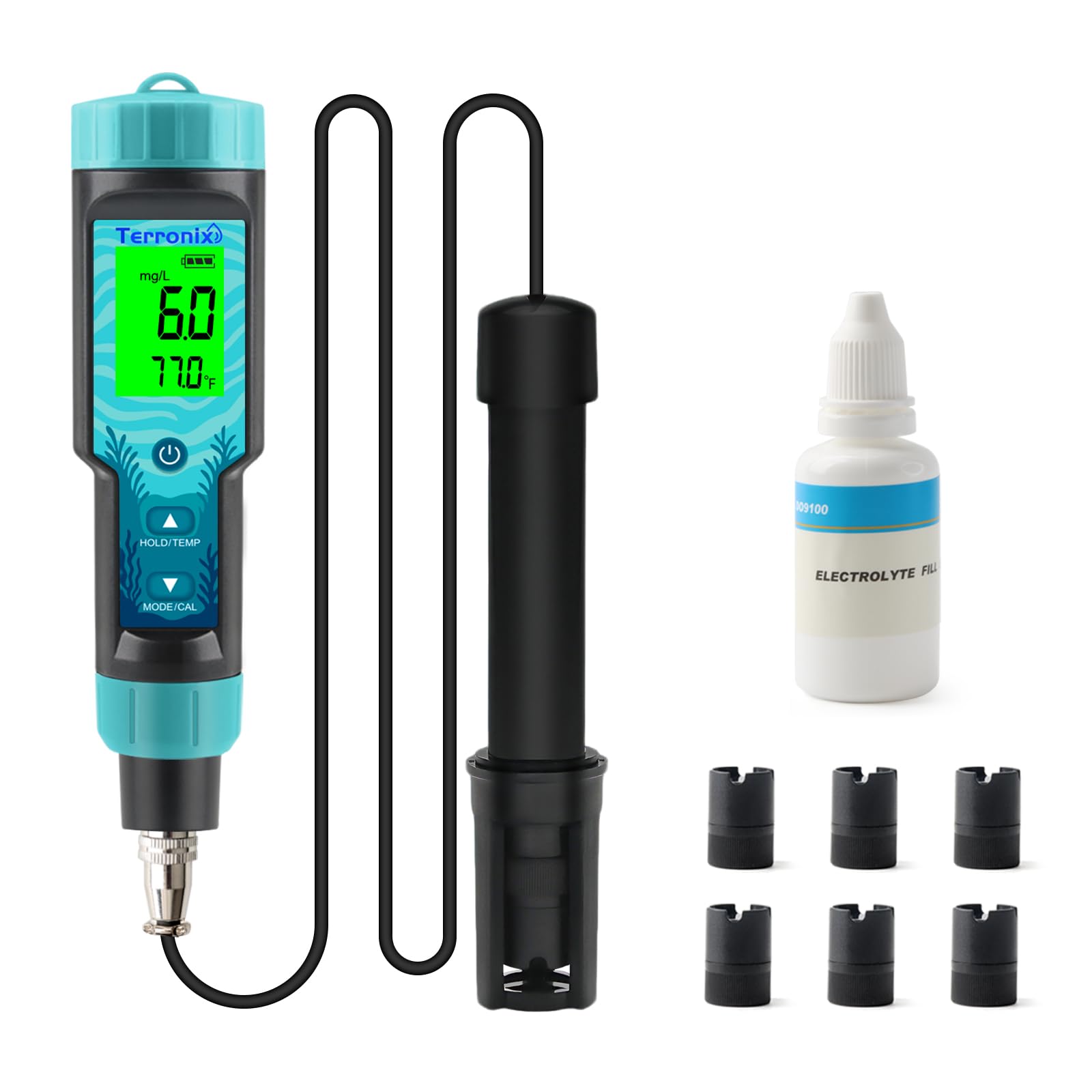
The Terronix DO9100L-US is the most tech-forward option in this lineup, pairing a portable DO meter with a Bluetooth app for data logging, storage, and export. This is ideal for hobbyists and semi-professional users who want to track oxygen levels on their phone without manually recording numbers. The dual display shows both mg/L and percent saturation modes simultaneously.
Automatic temperature compensation, manual salinity and altitude calibration, and the included calibration accessories (membrane cap, electrolyte, zero-oxygen water) make setup straightforward. The backlit LCD screen is readable in dim environments, and the data hold function lets you freeze a reading before writing it down. The 3.77-foot cable is adequate for shallow ponds and standard aquariums.
One major caveat: the product listing prominently states a 9.84-foot cable, but multiple verified buyers report receiving a cable that measures only about 3.7 feet. This discrepancy is a significant issue for anyone needing deep-water reach. If the cable length matches your needs, the Bluetooth integration and complete calibration kit make this a compelling mid-range option.
Why it’s great
- Bluetooth app for convenient data logging on your phone
- Complete calibration kit included out of box
- Backlit LCD with dual mg/L and % saturation display
Good to know
- Cable length inconsistency between listing and actual product
- 3.77ft cable limits deep water use
- Manual salinity/altitude calibration requires extra setup
6. Rowyet DO Meter

The Rowyet dissolved oxygen meter is a budget-friendly entry point for aquarium enthusiasts and small-pond owners who need basic DO monitoring without advanced features. Its measurement range spans 0.0 to 40 mg/L and 0.0 to 300% saturation, which covers the extreme ends of oxygen concentration you might encounter in poorly aerated systems or hyper-oxygenated environments.
Automatic temperature compensation helps stabilize readings across temperature variations typical in indoor tanks and small ponds. The digital backlit display is easy to read in ambient light, and the 8-minute auto-power-off function preserves battery life when you forget to turn it off. The low battery alarm is a practical touch for anyone who has been caught mid-calibration with dead batteries.
The trade-offs are clear: this meter lacks salinity and altitude compensation, so readings will drift in saltwater or high-altitude applications. Several users have noted that the reading stability is inconsistent, with the meter struggling to hold a steady value. For basic freshwater monitoring in a home aquarium or teaching lab, it gets the job done at the lowest entry cost.
Why it’s great
- Wide measurement range of 0-40 mg/L covers extreme conditions
- Backlit display and auto-off for convenient operation
- Low battery alarm prevents unexpected shutdowns
Good to know
- No altitude or salinity compensation limits accuracy in non-freshwater
- Reading stability reported as inconsistent by some users
- Probe cable length not specified for deep water use
FAQ
What is the difference between mg/L and percent saturation on a DO meter?
How often should I replace the membrane cap and electrolyte on my DO probe?
Can I use a dissolved oxygen meter in saltwater without damaging the probe?
Final Thoughts: The Verdict
For most users, the best dissolved oxygen meter winner is the Extech DO210 because it combines a generous 13-foot cable, altitude and salinity compensation, and a complete field kit at a price that serious aquaculturists and environmental technicians can justify. If you need laboratory-grade accuracy for teaching or research, grab the Milwaukee MW600 with its ±1.5% precision. And for rugged field work where the meter will get wet and knocked around, nothing beats the YSI Pro20 with its IP67 rating and three-second calibration.

Mo Maruf
I created WellFizz to bridge the gap between vague wellness advice and actionable solutions. My mission is simple: to decode the research and give you practical tools you can actually use.
Beyond the data, I am a passionate traveler. I believe that stepping away from the screen to explore new environments is essential for mental clarity and physical vitality.