Our readers keep the lights on and my smoothie glass nicely filled. As an Amazon Associate, I earn from qualifying purchases.
A design monitor that misrepresents a single hex value can mean the difference between a client sign-off and a costly reprint. The right display locks in color fidelity, pixel density, and panel consistency so your creative decisions on screen translate exactly to print, web, or video. Finding a display for graphic design means filtering through manufacturers who actually deliver Delta E < 2 out of the box versus those who just slap a wide-gamut sticker on the box.
I’m Mohammad Maruf — the founder and writer behind WellFizz. My approach to this guide involved cross-referencing factory calibration reports, gamut coverage percentages, and real-world user feedback across both mid-range and premium 4K options to separate hardware worth the investment from overpriced compromises.
The result of that deep spec analysis is this curated list of the best display for graphic design monitors available right now.
How To Choose The Best Display For Graphic Design
Selecting the right monitor for design work requires looking past glossy marketing claims. The three pillars — panel technology, color space coverage, and connectivity — determine whether your screen helps or hinders your creative output.
Panel Type: IPS vs IPS Black vs OLED
IPS panels dominate the design space because they deliver consistent color and brightness across wide viewing angles. IPS Black technology doubles the native contrast ratio to 2000:1, producing deeper blacks without the color shift issues of VA panels. QD-OLED offers infinite contrast and vibrant colors, but burn-in risk and subpixel text clarity remain real considerations for static UI-heavy workflows.
Color Gamut and Delta E
For print design, prioritize Adobe RGB coverage above 95%. For video and digital content, DCI-P3 is the standard. sRGB still rules web work, but a modern design monitor should cover at least 99% of sRGB alongside a wider gamut. Factory calibration to Delta E < 2 means you can start working confidently without a hardware calibrator, though periodic recalibration remains best practice.
Resolution and Scaling
4K UHD (3840 x 2160) at 27 or 32 inches hits the pixel density sweet spot for crisp text and fine detail work. Lower resolutions like QHD (2560 x 1440) can work for some design tasks but lack the sharpness needed for precise retouching and UI design. macOS users should specifically check HiDPI scaling support to avoid blurry fonts at non-native resolutions.
Connectivity and Ergonomics
USB-C with power delivery simplifies a single-cable laptop setup, carrying video and charging simultaneously. A fully adjustable stand — height, tilt, swivel, and pivot — is not a luxury but a necessity for long editing sessions. Built-in KVM or daisy-chain Thunderbolt support becomes valuable if you switch between multiple computers.
Quick Comparison
On smaller screens, swipe sideways to see the full table.
| Model | Category | Best For | Key Spec | Amazon |
|---|---|---|---|---|
| LG 27UP850K-W | Mid-Range | Single-cable Mac setup | 95% DCI-P3, 90W PD | Amazon |
| LG 32UN650-W | Mid-Range | Large 32-inch color work | 95% DCI-P3, IPS panel | Amazon |
| ViewSonic VP2756-4K | Mid-Range | Pantone-validated accuracy | Delta E<2, USB-C 60W | Amazon |
| Samsung ViewFinity S8 | Mid-Range | Ergonomic workflow | HDR10, tool-free stand | Amazon |
| ASUS ProArt PA279CV | Mid-Range | Calman-verified color | 99% sRGB, 65W PD | Amazon |
| ASUS ProArt PA279CRV | Mid-Range | Wide gamut workflows | 99% DCI-P3, 96W PD | Amazon |
| ViewSonic VP3256-4K | Premium | 32-inch pro content creation | 100% sRGB, USB-C 65W | Amazon |
| BenQ MA270U | Premium | Mac ecosystem integration | P3 gamut, 90W PD | Amazon |
| ASUS ROG Strix XG27AQDMG | Premium | Design + high-refresh gaming | 99% DCI-P3, OLED | Amazon |
| Dell UltraSharp U2725QE | Premium | Professional color-critical work | Delta E<1.5, TB4 140W | Amazon |
| MSI PRO MAX 271UPXW12G | Premium | QD-OLED budget flagship | Delta E<2, 98W PD | Amazon |
In‑Depth Reviews
1. Dell UltraSharp U2725QE
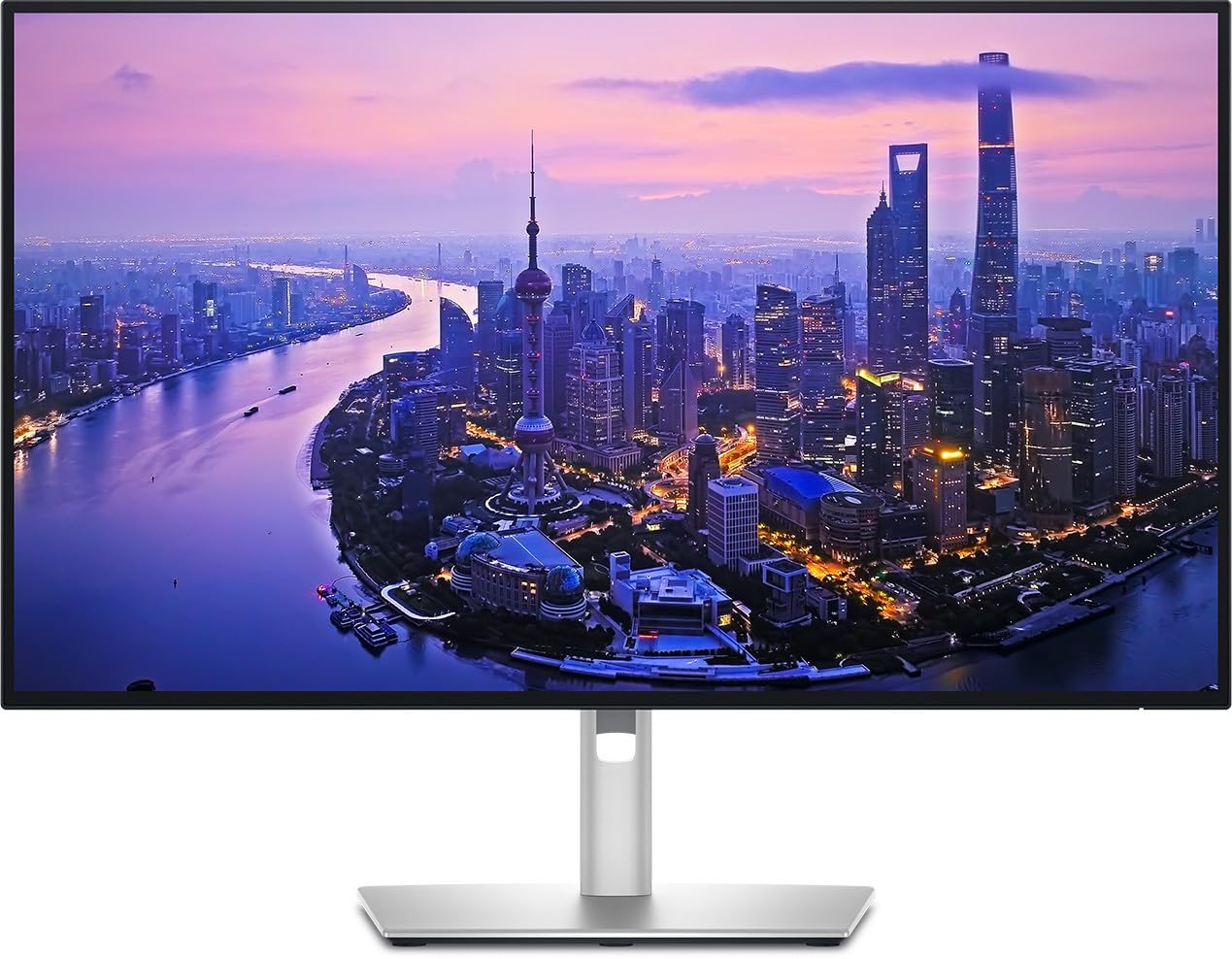
The Dell UltraSharp U2725QE represents the current ceiling for a professional 27-inch 4K monitor built around design work. The IPS Black panel delivers a 2000:1 contrast ratio — roughly double standard IPS — which makes shadows on dark-mode UIs and black-background photography actually look black rather than washed-out gray. Factory calibration to Delta E less than 1.5 is tighter than most competitors, and 99% DCI-P3 coverage ensures video editors and digital artists have the gamut width for HDR grading.
Connectivity is where this monitor separates itself from the mid-range pack. Thunderbolt 4 handles 140W power delivery, which can charge a 16-inch MacBook Pro at full speed while carrying a 4K 120Hz signal. The integrated KVM and daisy-chain support let you switch between a desktop PC and a laptop without reaching behind the panel. The 120Hz refresh rate is a meaningful upgrade over the standard 60Hz for cursor smoothness and timeline scrubbing — it does not transform this into a gaming monitor, but the fluidity lift is real for daily use.
Build quality matches the UltraSharp legacy: the stand is heavy, fully tool-less, and offers height, tilt, swivel, and pivot without any wobble. The matte anti-glare coating is notably grain-free, keeping text razor-sharp — a frequent complaint with aggressive matte finishes. The only real limitation is the price, which lands firmly in premium territory, but for design professionals who need out-of-box accuracy, Thunderbolt convenience, and future-proofed specs, this is the most complete package available.
Why it’s great
- Factory Delta E < 1.5 removes the need for immediate calibration
- IPS Black panel gives true 2000:1 contrast for deep shadows
- Thunderbolt 4 with 140W PD charges a MacBook Pro at full speed
- 120Hz refresh rate for fluid cursor and timeline performance
Good to know
- Premium pricing places it above most mid-range options
- Some Mac users report compatibility quirks that require firmware updates
2. BenQ MA270U

BenQ designed the MA270U specifically to eliminate the color mismatch headache MacBook users experience when plugging into generic 4K monitors. The proprietary color tuning aims to match the P3 gamut and white point of Apple’s built-in Retina displays, so a file dragged between laptop and external screen maintains visual consistency. The 27-inch IPS panel pushes 400 nits of brightness, which pairs well with MacOS’s HDR-capable UI elements.
Single-cable USB-C connectivity delivers a full 90W of power delivery, enough to sustain a 14-inch MacBook Pro under heavy render loads. The integrated USB hub accepts peripherals, and you can control brightness and volume directly from the MacBook keyboard — a small convenience that makes the monitor feel like a native Apple accessory. The stand offers full ergonomic adjustment including pivot, and the chassis is a clean silver that matches the Mac aesthetic.
Where this monitor stumbles is outside the Apple ecosystem. Windows users get no special tuning, and the 60Hz refresh rate is standard for the category but feels dated if you have used higher refresh panels. The built-in speakers are poor, and the warranty experience reported by early adopters has mixed results. For Mac-first designers who prioritize color harmony and single-cable simplicity, this remains one of the strongest options outside the Apple Studio Display price bracket.
Why it’s great
- Color tuning matches MacBook P3 gamut out of the box
- 90W USB-C PD keeps MacBook charged through one cable
- Mac keyboard brightness/volume controls work without extra software
- Full ergonomic stand with height, tilt, swivel, and pivot
Good to know
- Limited to 60Hz with no high-refresh option
- Built-in speakers are weak and tinny
3. ASUS ProArt PA279CRV

The ASUS ProArt PA279CRV is the updated version of the popular PA279CV and brings a significant gamut upgrade. Where the older model covered 100% sRGB and Rec. 709, the PA279CRV jumps to 99% DCI-P3 and 99% Adobe RGB, making it suitable for print designers who need Adobe RGB fidelity and video editors working in DCI-P3. Factory calibration targets Delta E < 2 and the monitor ships with a Calman Verified report inside the box.
The standout hardware feature is the 96W USB-C power delivery, one of the highest in its class. This is enough to fast-charge a MacBook Pro while carrying a 4K 60Hz signal. The PA279CRV also includes a DisplayPort-out for daisy-chaining a second 4K monitor, which is rare at this tier. The ergonomic stand is fully adjustable, and the OSD joystick makes menu navigation straightforward — though the buttons on the bottom edge are recessed and a bit fiddly.
Light uniformity is good but not perfect; some units show a slight warm cast on one side of the panel. The matte coating is moderate — it cuts reflections without introducing the grainy texture that cheap matte panels produce. The 60Hz refresh rate is expected here, and the built-in speakers are serviceable for system sounds but not for critical listening. For a designer needing Adobe RGB coverage combined with high-wattage USB-C, this is the best value proposition in the 27-inch category.
Why it’s great
- 99% Adobe RGB and DCI-P3 coverage for print and video workflows
- 96W USB-C PD charges demanding laptops at full speed
- DisplayPort-out allows daisy-chaining a second 4K monitor
- Factory Calman Verified report included in the box
Good to know
- Minor luminance uniformity variance reported on some panels
- 60Hz refresh, no high-refresh option for motion-critical tasks
4. ASUS ProArt PA279CV

The ASUS ProArt PA279CV has been a benchmark for budget-conscious designers since its release. It delivers 100% sRGB and Rec. 709 coverage with factory calibration to a Delta E < 2, confirmed by a Calman Verified report. While it lacks the Adobe RGB and DCI-P3 extension of its successor (PA279CRV), for digital-only design, web UI, and photography destined for screen, the sRGB gamut is perfectly adequate and actually prevents the oversaturation issues that wide-gamut monitors can cause in sRGB-locked applications.
Connectivity is generous for its position: USB-C with 65W power delivery, DisplayPort, HDMI, and a four-port USB 3.1 hub. The stand is fully adjustable with height, tilt, swivel, and pivot — a rarity at this price. One review noted a slight green tint out of the box (fixed by adjusting tint to -7), which confirms that factory calibration is good but not perfect across every unit. The 60Hz refresh and 5ms response time are fine for static design work.
Where you feel the cost savings is in the build materials — the chassis is mostly plastic, and the bezels are thicker than modern competitors. The OSD buttons on the bottom edge are cramped and require patience to navigate. For designers on a strict budget who need reliable sRGB accuracy and a fully adjustable stand, this remains the go-to option. It is also the smarter pick if you avoid wide gamut because you work exclusively in sRGB digital spaces.
Why it’s great
- 100% sRGB and Rec. 709 coverage with factory Delta E < 2
- USB-C 65W PD handles single-cable laptop connection
- Full ergonomic stand with pivot for portrait mode
- Calman Verified report included, confirming accuracy
Good to know
- Plastic chassis feels less premium than metal-bodied alternatives
- Some units benefit from manual tint adjustment out of box
5. ViewSonic VP2756-4K
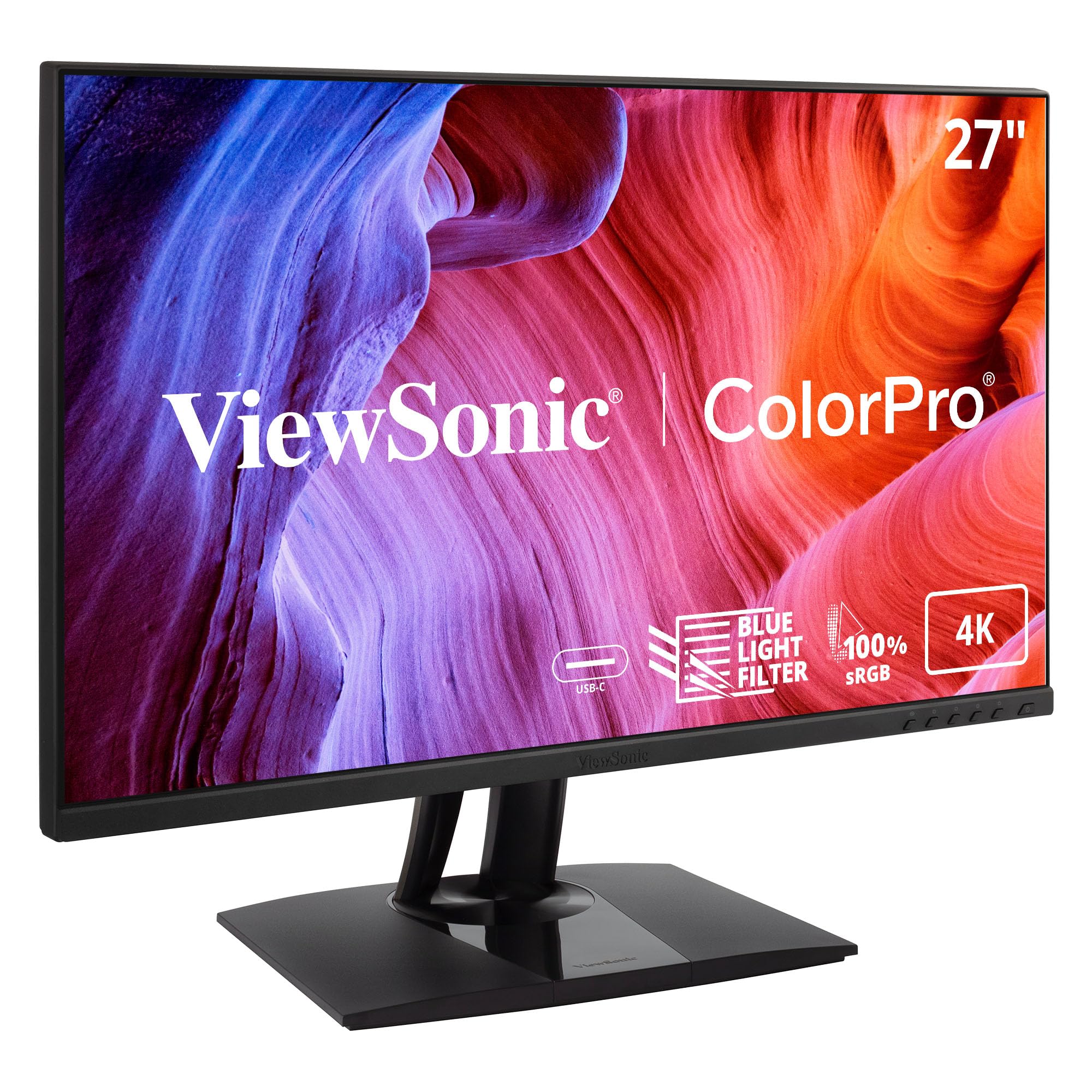
The ViewSonic VP2756-4K brings Pantone Validation and factory Delta E < 2 to the 27-inch 4K category, targeting designers who need guaranteed spot-color accuracy for packaging, branding, and print collateral. The IPS panel covers 100% sRGB, EBU, and SMPTE-C standards, and the color presets are well-tuned out of the box. Anecdotal reviews consistently report that the panel matches a MacBook screen closely enough for critical editing without immediate calibration.
USB-C connectivity provides 60W power delivery — sufficient for most ultrabooks and MacBook Air models, though a 16-inch MacBook Pro will drain slowly under full load. The built-in USB hub automatically follows the active input, effectively functioning as a basic KVM. The stand is fully articulated with height, tilt, swivel, and pivot. One point to verify before buying: some Mac users report that the pivot rotation to portrait mode is limited or non-functional depending on the macOS version, so check your specific setup.
The OSD joystick is well-positioned and responsive, but the accompanying software utility (vDisplay Manager) provides color and window controls from the desktop, reducing the need to reach for the monitor. Build quality is excellent for the tier — the chassis is dense, and the stand has no wobble. The speakers are thin but present. For designers who require Pantone validation for client proofing, the VP2756-4K offers a lower entry point than the larger VP3256-4K.
Why it’s great
- Pantone Validated for accurate spot color reproduction
- Factory Delta E < 2 with 100% sRGB coverage
- USB-C 60W PD with automatic input-switching USB hub
- Desktop software for OSD control without button navigation
Good to know
- Mac pivot rotation may be limited depending on OS version
- 60W PD not enough for full-power 16-inch MacBook Pro charging
6. LG 27UP850K-W
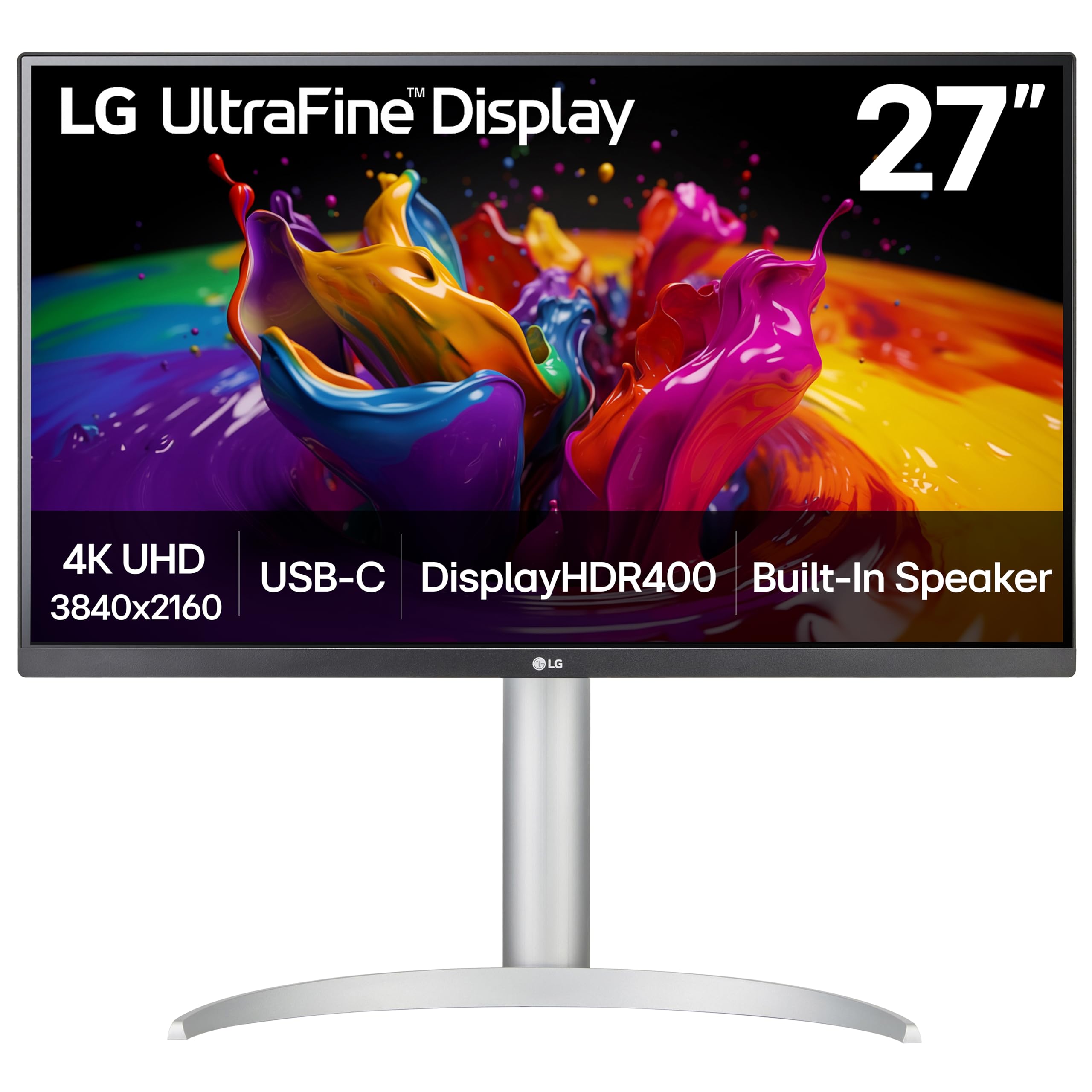
The LG 27UP850K-W is the white variant of the well-regarded UltraFine 4K series and offers a compelling blend of color performance and connectivity for designers. The 27-inch IPS panel covers 95% DCI-P3, which is enough for most digital design and video work, and the 400-nit brightness with DisplayHDR 400 support gives HDR content a noticeable punch over standard 350-nit panels. The matte display finish keeps reflections minimal in bright studio environments.
The headline feature is USB-C with 90W power delivery — more than enough to charge any MacBook or Windows laptop at full speed while transmitting 4K video. The monitor also includes two HDMI ports, DisplayPort, two USB 3.0 ports, and a headphone jack. The ergonomic stand supports height, tilt, and pivot adjustment, all tool-free. LG added built-in stereo speakers tuned with Waves MaxxAudio, and while they are not a replacement for dedicated monitors, they are louder and clearer than most built-in display speakers.
The 60Hz refresh rate is standard and expected at this tier. One subtle strength is the Switch app, which lets you split the screen into up to six sections and quickly switch between PC and webOS streaming. For a designer who uses the same desk for both production and media consumption, this adds genuine utility. The panel is well-reviewed for uniformity and backlight bleed control, and the white finish fits modern minimalist desk setups.
Why it’s great
- 90W USB-C PD provides full charging speed for any laptop
- 95% DCI-P3 and 400-nit brightness for vibrant HDR content
- Ergonomic stand with tool-free height, tilt, and pivot
- Built-in speakers with Waves MaxxAudio are better than average
Good to know
- 60Hz refresh limits motion clarity for fast animation work
- Not Pantone Validated or factory-calibrated to Delta E < 2
7. ViewSonic VP3256-4K

ViewSonic’s VP3256-4K scales the same pro-grade formula of the VP2756-4K to a 32-inch diagonal, giving designers more screen real estate for timeline-heavy editing, sprawling canvas work, and multi-window layouts. The IPS panel delivers 100% sRGB, Pantone Validation, and factory-calibrated Delta E < 2 accuracy. The 350-nit peak brightness is standard for the class, and HDR10 compatibility provides some dynamic range improvement for HDR previewing.
USB-C provides 65W power delivery — sufficient for most laptops, though a 16-inch MacBook Pro will need supplementary charging during sustained workloads. The built-in USB hub auto-switches with the active input, functioning as a basic KVM for two-computer setups. The stand is fully articulated with height, tilt, swivel, and pivot, and the 8mm bezels keep the multiple-screen experience relatively seamless if you run a dual setup.
Color consistency across the larger 32-inch panel is good, though some users report minor edge-to-edge uniformity variation that is typical for screens of this size. The OSD uses a joystick on the back, and the vDisplay Manager software is compatible with both Windows and macOS. One constraint: the VP3256-4K is a 60Hz monitor, so it is not suited for high-refresh motion work. This is a pure productivity monitor built for color-accurate static and video frame work at a larger scale.
Why it’s great
- 32-inch 4K panel gives extra workspace for complex layouts
- Pantone Validated with factory Delta E < 2 for print work
- 65W USB-C PD with auto-switching USB hub
- Fully adjustable ergonomic stand and thin bezels
Good to know
- 65W PD may not sustain a 16-inch MacBook Pro under load
- Limited to 60Hz with no high-refresh option
8. ASUS ROG Strix XG27AQDMG

The ASUS ROG Strix XG27AQDMG is a QHD (2560 x 1440) glossy WOLED monitor built around gaming, but it earns a place on this list through its exceptional color performance and unique value proposition for designers who also game. The panel covers 99% DCI-P3, and the glossy WOLED surface — paired with the third-generation WOLED technology — delivers deeper blacks, more vibrant color saturation, and noticeably better contrast than any IPS panel at this price. The QHD resolution at 27 inches provides a sharp 109 PPI, though not as fine as 4K UHD.
For design work, the uniform brightness setting is a critical feature: it prevents the automatic luminance reduction that OLED panels normally apply to static white windows, meaning your Photoshop interface stays consistently bright over long sessions. ASUS OLED Care functions, including pixel cleaning and screen shift, reduce burn-in risk for the UI elements that design applications leave static for hours. The 0.03ms response time and 240Hz refresh are extreme overkill for design tasks but make this the only monitor on this list that genuinely serves both creative and gaming workflows.
The trade-off is resolution: 1440p is not 4K, so designers working on high-res print layouts or 4K video will miss the extra pixel density for fine detail. The glossy finish, while gorgeous for color and contrast, reflects overhead lights and windows more aggressively than a matte panel. Text clarity on OLED is slightly less sharp than a high-end IPS due to the unique subpixel layout. This is a niche pick for designers who prioritize contrast ratio above all and want a single monitor for design and fast-paced gaming.
Why it’s great
- Glossy WOLED delivers infinite contrast and vibrant DCI-P3 color
- Uniform brightness mode prevents OLED dimming during static UI work
- 240Hz and 0.03ms response for fluid gaming performance
- ASUS OLED Care reduces burn-in risk for long design sessions
Good to know
- QHD resolution lacks the pixel density of 4K for fine detail
- Glossy screen reflects ambient light more than matte finishes
9. MSI PRO MAX 271UPXW12G
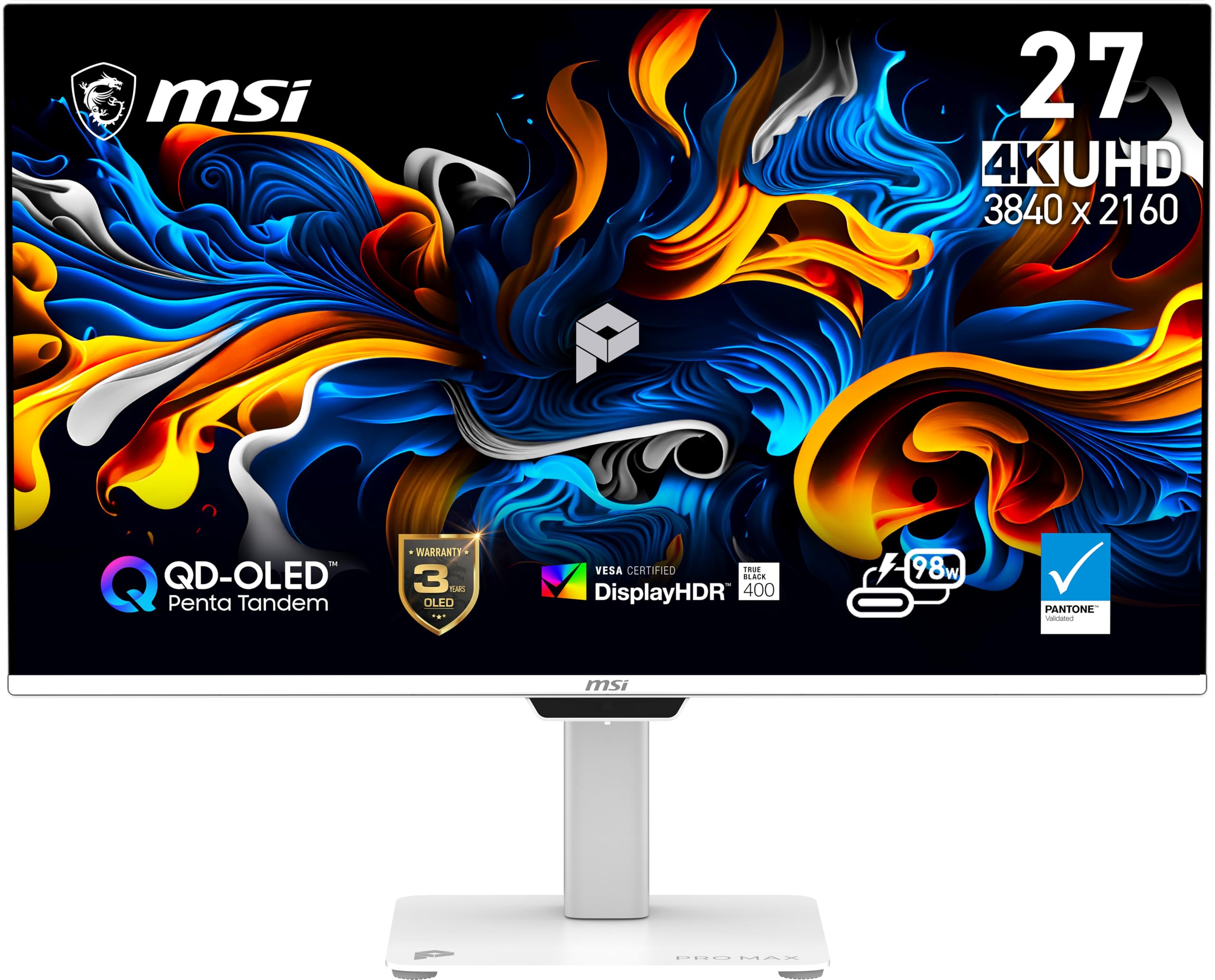
The MSI PRO MAX 271UPXW12G brings a 27-inch 4K QD-OLED panel to the professional design space at a price that undercuts most OLED competitors. The QD-OLED technology achieves true black levels (VESA DisplayHDR True Black 400 certified) while maintaining 99% DCI-P3 coverage and a factory-calibrated Delta E < 2. For designers working on high-contrast content, HDR video, or dark-mode UIs, the difference from traditional IPS is immediately visible in shadow detail and color pop.
Connectivity is generous for an OLED monitor at this tier: dual USB-C ports with one delivering 98W power delivery, plus HDMI and DisplayPort inputs. MSI’s Mac Optimization Software syncs color profiles with macOS and supports keyboard shortcuts for brightness and volume. The 120Hz refresh rate is a meaningful feature for timeline scrubbing and general desktop fluidity. The white chassis design is clean and would blend into a Mac-centric desk setup easily.
The downsides of QD-OLED for design work are the same across the category. Burn-in risk from static UI elements — toolbars, palettes, OS taskbars — requires active mitigation via pixel refresh and screen shift features. The panel structure can show a slight purple tint under direct bright light, and text rendering is marginally softer than a high-end IPS due to the triangular subpixel layout. For design professionals willing to manage OLED care and prioritize contrast and color saturation, this is the most accessible 4K QD-OLED option available.
Why it’s great
- 4K QD-OLED with true black and Delta E < 2 factory calibration
- 98W USB-C PD charges a MacBook Pro at high speed
- 120Hz refresh improves desktop and timeline fluidity
- Mac Optimization Software for seamless color and control integration
Good to know
- Burn-in risk from static design UI elements requires active OLED care
- Text sharpness slightly trails high-end IPS panels
10. LG 32UN650-W

The LG 32UN650-W is a straightforward 32-inch 4K IPS monitor that prioritizes screen size and color gamut over premium build features. The panel covers 95% DCI-P3 — matching the smaller LG 27UP850K-W — and delivers the wide viewing angles expected from IPS. It is HDR10 compatible, but the 350-nit peak brightness and lack of local dimming mean HDR performance is limited. For sRGB and standard dynamic range design work, the color is punchy and consistent.
Connectivity is where the cost savings become apparent: there is no USB-C port. You get two HDMI 2.0 inputs, a DisplayPort, and a headphone jack. This means no single-cable laptop setup and no power delivery — an important consideration if you switch between a laptop and desktop. The stand offers height adjustment but lacks swivel and pivot. The chassis is mostly plastic with a white silver finish, and the 3-side virtually borderless design looks more modern than the price suggests.
For the designer on a strict budget who needs a large 4K canvas, the 32UN650-W delivers the same panel quality as more expensive LG models but cuts costs on the stand, ports, and enclosure. The VA specification listed by some retailers is a mistake — the actual panel is IPS, confirmed by user reviews and third-party teardowns. If you do not need USB-C connectivity and can provide your own ergonomic arm or stand, this is the most affordable entry into a color-accurate 32-inch 4K display.
Why it’s great
- 32-inch 4K IPS with 95% DCI-P3 at a very accessible price point
- Thin bezels make it suitable for multi-monitor arrangements
- Height-adjustable stand included, VESA compatible for arm mounting
- Color gamut and brightness competitive with monitors twice the price
Good to know
- No USB-C port — requires HDMI or DisplayPort for video signal
- Stand lacks swivel and pivot rotation
11. Samsung ViewFinity S8 S80D
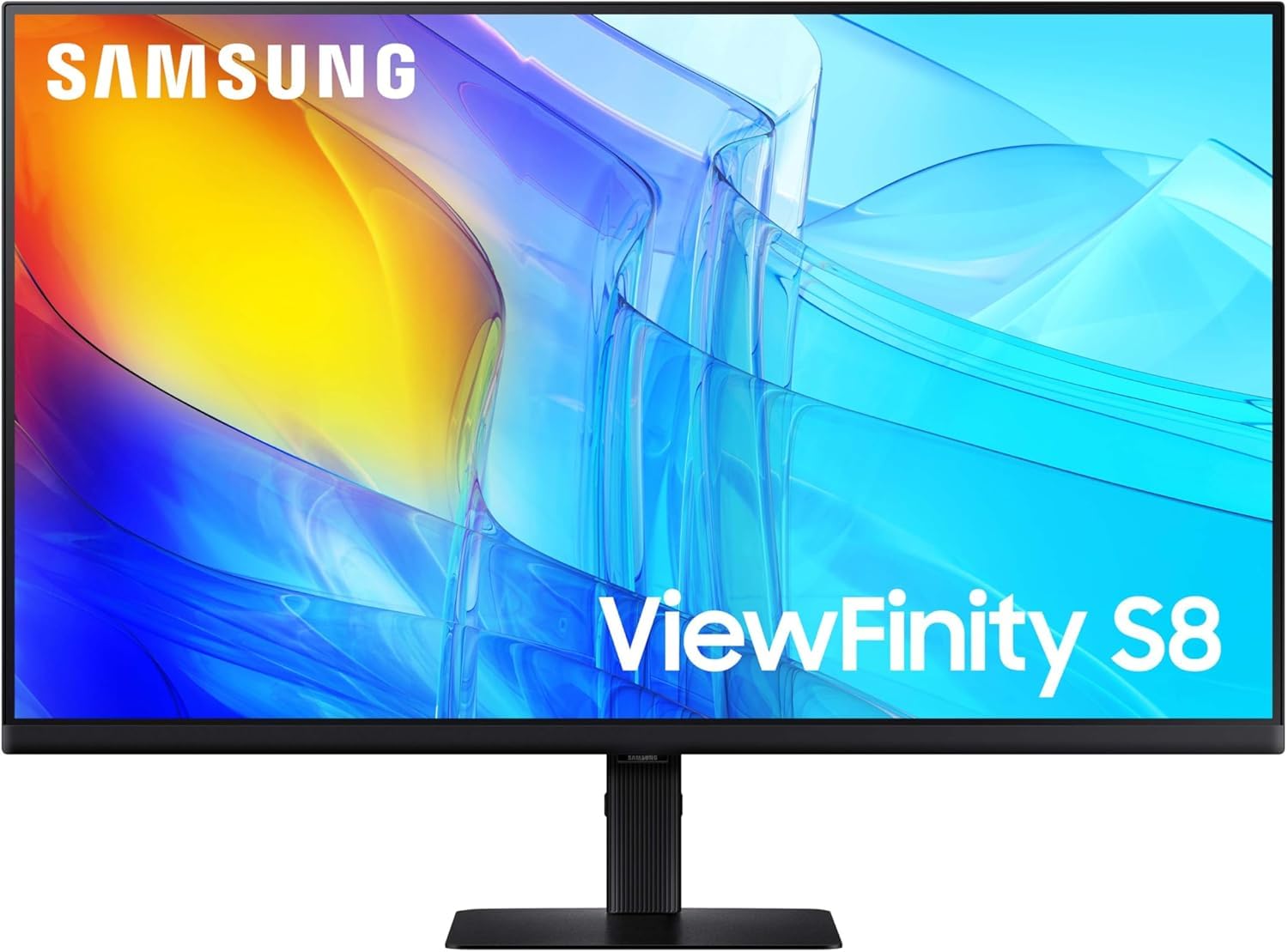
The Samsung ViewFinity S8 S80D is a 27-inch 4K monitor aimed at professionals who want a high-resolution workspace without the cost of pro-oriented brands. The IPS panel covers HDR10 and delivers a 350-nit brightness standard for the category. The matte screen finish is effective at controlling reflections without introducing visible grain — a common complaint on cheaper matte panels. Samsung does not publish specific gamut percentage claims for this model beyond HDR10 support, so color-critical buyers should factor in potential calibration.
The standout feature is the tool-free Easy Setup Stand, which snaps together without screws. The stand offers height, tilt, swivel, and 90-degree pivot adjustment. Port selection includes HDMI, DisplayPort, and USB-A ports, but notably lacks USB-C — the same limitation as the LG 32UN650-W. This means laptop users will need to use HDMI or DisplayPort and a separate power cable. Eye Saver Mode is TÜV-certified and automatically adjusts color temperature and brightness based on ambient light.
User reviews consistently praise the sharpness and clarity for Photoshop and Lightroom work. The HDR10 compatibility provides better contrast than standard SDR, but without local dimming, the effect is modest. The built-in speakers are absent — only a headphone jack is provided. The OSD controls are on the back and described as counterintuitive by multiple users. For a designer on a tight budget who needs 4K resolution and a fully adjustable stand and does not require USB-C connectivity, this monitor delivers solid fundamentals.
Why it’s great
- 4K UHD resolution with a high-quality matte, grain-free display finish
- Tool-free ergonomic stand with height, tilt, swivel, and pivot
- HDR10 support improves contrast over standard SDR panels
- Eye Saver Mode reduces blue light and adjusts to ambient lighting
Good to know
- No USB-C port — must use HDMI or DisplayPort for video
- No built-in speakers, only a headphone jack
FAQ
Is 4K resolution necessary for graphic design work?
Can an OLED monitor be used safely for graphic design without burn-in?
What does Pantone Validation mean for a design monitor?
Final Thoughts: The Verdict
For most users, the best display for graphic design winner is the Dell UltraSharp U2725QE because it combines IPS Black contrast, Thunderbolt 4 with 140W PD, a factory Delta E under 1.5, and a 120Hz refresh into the most complete professional package available. If you want Mac-native color matching and single-cable simplicity, grab the BenQ MA270U. And for the best balance of wide gamut and high-wattage USB-C at a mid-range price, nothing beats the ASUS ProArt PA279CRV.

Mo Maruf
I created WellFizz to bridge the gap between vague wellness advice and actionable solutions. My mission is simple: to decode the research and give you practical tools you can actually use.
Beyond the data, I am a passionate traveler. I believe that stepping away from the screen to explore new environments is essential for mental clarity and physical vitality.