Our readers keep the lights on and my smoothie glass nicely filled. As an Amazon Associate, I earn from qualifying purchases.
Watering, pruning, and sunlight get all the attention, but the single biggest factor determining whether a young tree flourishes or fails is the ground it sits in. The difference between a tree that struggles for years and one that puts on vigorous new growth in its first season comes down to one thing: the quality of the dirt you backfill into that planting hole.
I’m Mohammad Maruf — the founder and writer behind WellFizz. My research philosophy centers on reading between the lines of customer data, analyzing hundreds of verified reviews and technical specifications to separate what actually works from what just sounds good on the bag.
Whether you are planting a fruit tree, a shade tree, or an ornamental specimen for your front yard, you need soil that delivers the right balance of drainage, nutrition, and structure. This guide breaks down the best options to help you choose the right best dirt for trees.
How To Choose The Best Dirt For Trees
Not all bagged soil works for trees. The wrong mix can become a waterlogged tomb for roots or a nutrient-poor medium that stunts growth before it starts. Here is what to look for when shopping for tree soil.
Drainage and Aeration
Tree roots need oxygen to respire. Soil that stays soggy suffocates roots and invites root rot. Look for mixes that contain perlite, sand, or coarse bark to create pore space. A lightweight bag that feels fluffy when squeezed signals good aeration, while a dense, heavy bag may compact too much.
Organic Matter and Nutrient Source
Composted manure, worm castings, peat moss, and aged bark provide slow-release nutrients and improve soil structure. Avoid mixes that rely heavily on synthetic fertilizers — trees prefer steady, gradual feeding from organic sources that also support beneficial soil microbes.
pH Level for Specific Tree Types
Most trees tolerate a neutral pH (6.0 to 7.0), but acid-loving species like blueberries, azaleas, dogwoods, and conifers need lower pH soil in the 4.5 to 5.5 range. Select a specialized low-pH blend for those trees, or lower pH yourself with sulfur or peat moss additions.
Quick Comparison
On smaller screens, swipe sideways to see the full table.
| Model | Category | Best For | Key Spec | Amazon |
|---|---|---|---|---|
| Brut Organic Potting Soil | Premium Mix | Fruit & ornamental trees from day one | Filler-free, pH 6.3–6.5 | Amazon |
| Michigan Peat General All Purpose | All-Purpose | High-volume raised beds & large pots | 50 lbs, includes slow-release fertilizer | Amazon |
| Coast of Maine Acid-Loving Blend | Specialty pH | Blueberries, azaleas & dogwoods | Low pH, 20 quarts | Amazon |
| Coast of Maine Veg & Tomato | Organic Mix | Young trees in ground & containers | Composted manure, 20 quarts | Amazon |
| Back to the Roots Worm Castings | Soil Amendment | Boosting existing native soil | 5 lbs worm castings | Amazon |
In‑Depth Reviews
1. Brut Organic Potting Soil (1 CU FT)
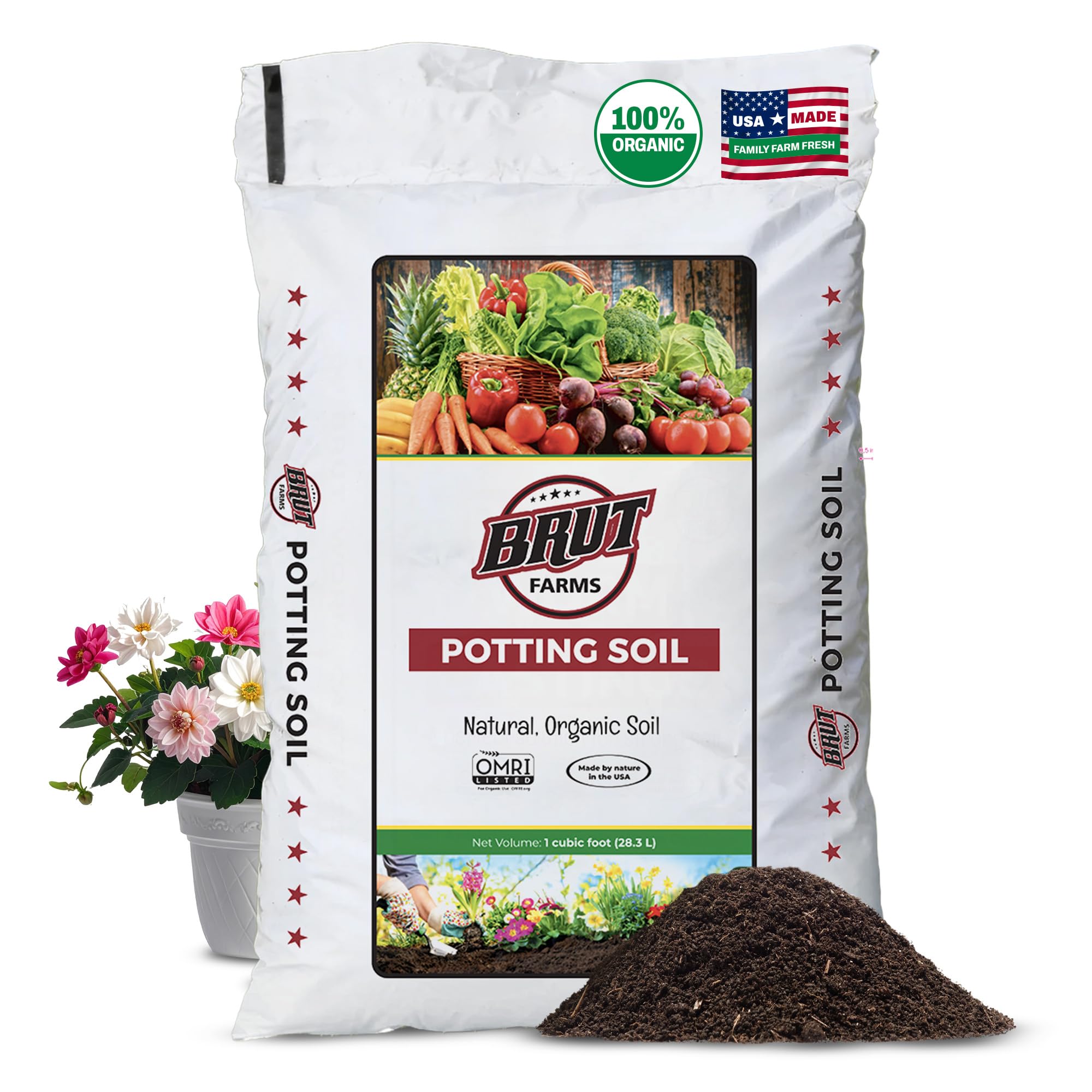
Brut stands out as the purest option in this roundup. It contains no wood chips, no filler bark, no synthetic chemicals — just organic worm castings, Azomite trace minerals, and kelp in a naturally balanced pH range. For a new tree planting where you want zero guesswork, this mix gives roots a clean, nutrient-dense start without the risk of unseen additives hindering early growth.
Customer reports confirm that trees like Cara Cara orange and Lapins cherry showed deep green leaves and new growth within two days of transplanting. The fine, uniform texture makes it easy to work into the hole or blend with native soil. The worm castings and minerals provide a steady feed directly at the root level, supporting strong top growth.
One drawback — the premium formulation comes at a higher per-volume cost than commodity mixes. Some users have reported that the fish and bone meal content can attract flies if the bag is left open or if the soil stays wet on the surface. Adding a thin top layer of coarse sand or gravel helps manage this, but it is something to factor into outdoor use.
Why it’s great
- Absolutely no filler or synthetic additives
- Microbe-rich worm castings feed roots directly
- pH 6.3–6.5 works for most fruit and ornamental trees
Good to know
- Higher cost per cubic foot than basic potting mixes
- Organic fish/bone meal can attract flies on the surface
2. Michigan Peat General All Purpose Premium Potting Soil (50 lbs)

When you are planting multiple trees or filling large raised beds around existing trees, the Michigan Peat General All Purpose mix delivers serious volume at a cost-effective pound-for-pound rate. The blend combines reed sedge peat, perlite, and sand — a classic lightweight formula that promotes drainage while retaining enough moisture for steady root growth.
The inclusion of both starter and slow-release fertilizers means this mix supports trees for weeks after planting without requiring immediate supplementation. Customers consistently note the “perfect consistency for potting” with a moist, ready-to-use texture straight from the bag. It works well in pots, planters, and raised beds where tree roots need room to spread.
Multiple reviews caution about fungus gnats emerging from the bag. This is common with peat-heavy soils that are stored moist. Letting the soil dry out slightly before use or mixing in a small amount of diatomaceous earth helps curb the issue. Also, the pH tends toward neutral-to-slightly-acid, so acid-loving trees may need an additional pH adjuster.
Why it’s great
- Large 50-pound bag offers excellent value per volume
- Includes slow-release fertilizer for sustained feeding
- Lightweight texture with good aeration from perlite and sand
Good to know
- Multiple users reported fungus gnats in the bag
- Not OMRI listed for certified organic use
3. Coast of Maine Organic & Natural Planting Soil for Acid Loving Plants (20 Qt)

If you are planting blueberries, azaleas, rhododendrons, dogwoods, or conifers, standard all-purpose soil will not cut it. These species demand a lower pH to properly absorb iron and other micronutrients. Coast of Maine formulates this blend with composted manure, sphagnum peat moss, and aged bark to achieve that naturally low pH while feeding the soil food web.
The 20-quart bag is a practical size for topping off planters or mixing into a single large tree hole. Customers growing strawberries and blueberries report strong results, noting the perlite helps retain moisture without waterlogging. The OMRI listing confirms no synthetic chemicals — a key consideration for edible landscapes where berries or fruit trees are involved.
A few users pointed out that the bag is heavy and the soil can arrive very moist, which makes handling a bit messy. The specific low-pH formulation also means you should not use it for trees that prefer neutral or alkaline soil — pairing it with a pH meter is a good practice until you know your native soil’s baseline.
Why it’s great
- Specialized low pH for acid-loving trees and shrubs
- OMRI listed for certified organic gardens
- Balances moisture retention and drainage effectively
Good to know
- Not suitable for neutral-alkaline soil trees
- Bag can arrive very moist, requiring careful handling
4. Coast of Maine Organic & Natural Planting Soil for Vegetables & Tomatoes (20 Qt)

Though marketed for vegetables and tomatoes, this Coast of Maine blend works surprisingly well for young ornamental and fruit trees, especially when planted in containers or raised beds. The base of composted manure and sphagnum peat moss provides a rich organic foundation, while the light fluffy texture prevents the compaction that kills tree roots in pots.
Customers consistently describe it as “the best soil they have tried” for growth. The mix holds moisture well yet drains excess quickly — exactly what a newly transplanted tree needs during its first critical weeks. The cedar and aromatic wood content acts as a natural insect deterrent in the root zone, a bonus for trees susceptible to soil-borne pests.
A recurring note in reviews is that the soil can harbor fungus gnats, likely because it stays moist. Users who pre-sterilize the soil by baking it or letting it dry in the sun have fewer issues. The 20-quart bag is priced at a mid-range point, but for large-scale projects you might find cheaper per-volume options.
Why it’s great
- Rich organic compost base with manure and peat moss
- Lightweight texture prevents container root compaction
- Cedar wood content naturally deters soil insects
Good to know
- Fungus gnats can appear in moist bags
- Small bag size may not be economical for large projects
5. Back to the Roots Organic Worm Castings (5 lbs)

Not every tree situation calls for a full bag of potting mix. When you are amending heavy clay or sandy native soil, pure worm castings provide a concentrated microbial and nutrient boost without changing your existing soil’s texture. Back to the Roots delivers 5 pounds of granulated castings that mix easily into any backfill hole.
Users report that the castings “hold a lot of moisture,” which is helpful in sandy soils but requires attention in clay-heavy ground. The product is OMRI-listed and made in the USA from vermicompost that carries no odor and will not burn roots — even tender tree seedlings. The resealable bag makes it easy to store for ongoing top-dressing around established trees each spring.
Because this is a pure amendment rather than a complete soil, you will need to combine it with a base planting mix or native soil. The 5-pound bag covers roughly one medium tree hole when mixed at a 1:4 ratio, so large projects may require multiple bags. For the price point, it is an efficient way to add organic firepower without buying an entire bag of soil.
Why it’s great
- Concentrated organic nutrients that won’t burn roots
- No odor and easy to store in resealable bag
- Loaded with beneficial microbes for soil biology
Good to know
- Not a standalone planting medium — must be mixed
- Holds significant moisture; use carefully in clay soil
FAQ
Can I use regular garden soil from my backyard for planting trees?
How do I prevent fungus gnats in my tree potting soil?
Should I add fertilizer to tree soil right after planting?
Final Thoughts: The Verdict
For most users, the best dirt for trees winner is the Brut Organic Potting Soil because it delivers pure filler-free nutrition with no synthetic additives, giving fruit and ornamental trees the cleanest possible start. If you want a high-volume soil for large raised beds or multiple containers, grab the Michigan Peat General All Purpose. And for acid-loving species like blueberries and dogwoods, nothing beats the Coast of Maine Acid-Loving Blend.

Mo Maruf
I created WellFizz to bridge the gap between vague wellness advice and actionable solutions. My mission is simple: to decode the research and give you practical tools you can actually use.
Beyond the data, I am a passionate traveler. I believe that stepping away from the screen to explore new environments is essential for mental clarity and physical vitality.