Our readers keep the lights on and my smoothie glass nicely filled. As an Amazon Associate, I earn from qualifying purchases.
A dirt bike chain that snaps or stretches mid-race doesn’t just ruin your day—it can strand you miles from the truck. Between mud-caked sprockets, hard-pack acceleration, and constant grit erosion, your drivetrain takes a beating that budget chains simply aren’t built to survive. The difference between a smooth, confident pull out of a corner and a sudden, sickening loss of power often comes down to the metallurgy and seal design of the links wrapped around your countershaft.
I’m Mohammad Maruf — the founder and writer behind WellFizz. I’ve combed through thousands of customer reports and spec sheets to pin down exactly what separates a chain that holds tight from one that forces you to reach for the adjuster wrenches every other ride.
Whether you ride a 250f on technical single-track or a 450 on wide-open motocross tracks, choosing a best dirt bike chain comes down to matching tensile strength, seal type, and link count to your specific machine and riding style.
How To Choose The Best Dirt Bike Chain
Selecting the right chain starts with matching pitch and link count to your sprockets, then weighing seal type against your riding environment. A chain that fits poorly or sheds lubrication after one muddy ride will cost you time and money no matter how strong the steel is.
Understand Pitch and Link Count
Pitch refers to the distance between the centers of two adjacent pins. Common dirt bike pitches are 428, 520, and 525. A 520 pitch chain is the standard for most modern off-road bikes from 125cc to 450cc, while 428 is common on smaller dual-sports and pit bikes, and 525 is used on larger-displacement street-legal enduros. Link count must match your bike’s specific wheelbase and sprocket combination.
Choose Between Sealed and Non-Sealed Chains
Sealed chains (O-Ring or X-Ring) trap grease between the pin and bushing, drastically reducing internal wear from grit intrusion. X-Ring chains, with their flatter cross-section, create less friction and run cooler than traditional O-Rings while maintaining superior seal life. Non-O-Ring chains are lighter and cheaper, making them popular for pure racing where you replace the chain frequently, but they require more frequent lubrication and adjustment in wet or dusty conditions.
Evaluate Tensile Strength for Your Engine Displacement
Every chain has a tensile strength rating measured in pounds-force. A 250cc bike needs at least 7,000 pounds of tensile strength. A 450cc bike with aggressive power delivery benefits from chains rated above 8,000 pounds. Using a chain with insufficient tensile strength leads to rapid stretching, poor power transfer, and increased risk of breakage under hard acceleration.
Quick Comparison
On smaller screens, swipe sideways to see the full table.
| Model | Category | Best For | Key Spec | Amazon |
|---|---|---|---|---|
| DID 525VX3 X-Ring | Premium Sealed | High-torque 450s & big-bore enduros | 9,220 lbf tensile | Amazon |
| DID 520ERT3 | Premium Non-Sealed | MX racing, frequent replacement | 25% better anti-shock | Amazon |
| Pro Taper 520 MX | Mid-Range Non-Sealed | Motocross & aggressive trail | 8,000 lbf tensile | Amazon |
| Renthal C125 R1 Works | Premium Non-Sealed | Race-ready durability | 7,643 lbf tensile | Amazon |
| DID 520DZ2 | Mid-Range Non-Sealed | MX track on a budget | 7,870 lbf tensile | Amazon |
| RK Racing M520HD | Mid-Range Non-Sealed | Dual-sport & 250cc off-road | 7,700 lbf tensile | Amazon |
| NICHE Gold 428 X-Ring | Budget Sealed | Small-displacement dual-sports | 5,665 lbf tensile | Amazon |
In‑Depth Reviews
1. DID 525VX3 X-Ring Chain

This is DID’s flagship sealed chain for high-displacement machines, built around a 9,220-pound tensile strength that can handle 1,000cc engines without breaking a sweat. The X-Ring seals are upgraded from the VX2 generation with better retention and reduced internal friction, meaning grease stays between the pin and bushing for twice as long as standard O-Rings. The gold-black finish resists corrosion better than bare steel when you’re pressure-washing after a sloppy ride.
Riders on 600cc-plus adventure bikes and 450cc dirt bikes report that the “Direct Energy Transfer” construction makes the chain feel noticeably stiffer laterally, which translates to more direct power delivery out of corners. The rivet-style master link requires a proper pressing tool, but once installed, it never loosens—no clip to lose in the woods. At 4.05 pounds per 100 links, it’s heavier than a non-sealed race chain, but that weight buys you consistent adjustment intervals measured in months rather than rides.
One common note from long-term users is that this chain fits about two links longer than stock on many bikes, so expect to cut it. Pair it with a quality rivet tool and a fresh set of sprockets for maximum life. It’s overkill for a 125cc or 250cc trail bike, but for anyone pushing a big-bore machine through technical terrain, the seal longevity alone justifies the premium.
Why it’s great
- Exceptional tensile strength for big-bore engines
- X-Ring seals dramatically extend service intervals
- Gold finish resists corrosion well
Good to know
- Requires a rivet press for installation
- Heavier than non-sealed alternatives
- Over-specified for small-displacement bikes
2. DID 520ERT3 Gold Racing Chain

The ERT3 is DID’s evolution of their non-sealed racing chain, offering 25 percent greater anti-shock performance and 5 percent higher tensile strength than the previous ERT2 without adding any weight. The stainless steel pins and bushings reduce corrosion from pressure-washing and wet motos, and the lack of O-Rings keeps rotational mass low for faster throttle response. This chain is built for riders who swap chains every couple of race weekends and want zero drag at the rear wheel.
Real-world feedback from 450cc motocross riders confirms that the gold plating holds up well against chain guide wear, and the clip-style master link makes swapping trackside quick. The chain arrives pre-lubed from the factory, but you’ll need to apply additional chain lube after every ride because there’s no seal to retain grease. Several CRF450R and RMZ-450 owners report getting ten to twelve hard practice days before noticeable stretch sets in, which is strong for a non-sealed chain.
Because this is a non-O-Ring chain, it will stretch faster than a sealed chain under continuous abuse. Plan to inspect slack before every ride and expect replacement every two to three months if you ride aggressively. It’s the right choice for racers who prioritize weight savings and low friction over long-term adjustment laziness.
Why it’s great
- Lightweight with excellent anti-shock properties
- Stainless steel resists corrosion
- Easy clip-link installation for track-side swaps
Good to know
- Non-sealed requires frequent lubrication
- Stretches faster than X-Ring chains
- Not ideal for long-term durability in mud
3. Pro Taper 520 MX Chain

Pro Taper’s 520 MX chain carries the same brand reputation as their handlebars and grips, and the build quality follows suit. This non-sealed chain uses alloy steel plates with a tensile strength around 8,000 pounds, making it suitable for 250cc to 450cc motocross bikes. The gold finish isn’t just cosmetic—it provides a corrosion-resistant layer that helps the chain survive pressure-washing after every practice day.
Multiple long-term users on KX450F and CRF450R machines note that after the initial break-in stretch during the first two rides, the chain settles into a stable state that requires only minimal adjustment over the next ten-plus hours. Compared to the stock chains that come on many bikes, the Pro Taper experiences significantly less lateral flex, which reduces the chance of derailment in deep, choppy ruts. The clip-style master link makes installation straightforward, but riders recommend safety-wiring the clip for extra security on high-horsepower bikes.
Because it’s a non-sealed chain, you must stay disciplined with lubrication. Riders who neglect lubing after wet rides report rust spots forming on the side plates within a week. If you’re willing to spray chain wax after every wash, this chain delivers a strong balance of affordability and race-ready performance without the weight penalty of a sealed chain.
Why it’s great
- Minimal lateral flex improves chain retention
- Corrosion-resistant gold plating
- Stable stretch pattern after break-in
Good to know
- Requires diligent lubrication schedule
- Clip link may need safety wire on high-power bikes
- Non-sealed design limits mud performance
4. Renthal C125 R1 Works Chain
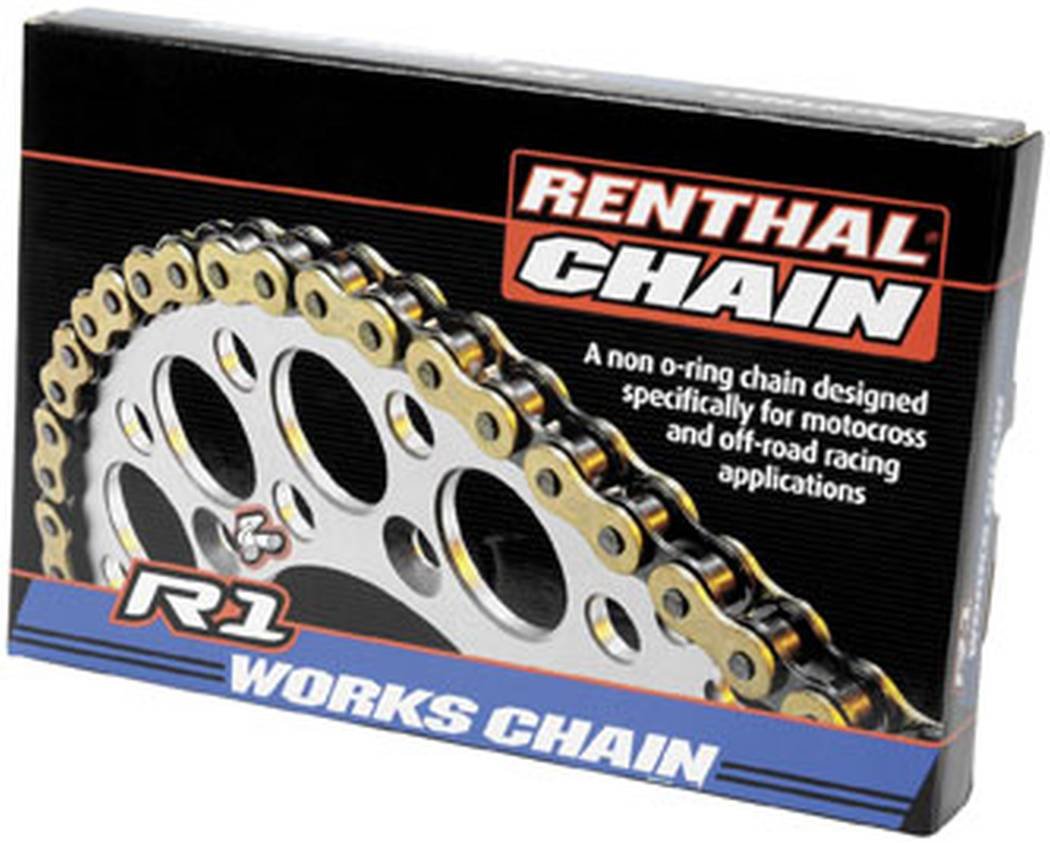
Renthal’s C125 R1 Works chain brings aerospace-influenced manufacturing to the dirt bike world, with shot-peened alloy steel side plates that resist fatigue fractures better than standard stamped plates. The chromised bearing pins undergo a surface hardening treatment that reduces wear at the critical pin-bushing interface, while the chamfered inner links help guide the chain onto sprockets even when the drivetrain is loaded laterally through rocky sections. Tensile strength is rated at 7,643 pounds, which comfortably covers 250cc to 450cc machines.
Owners running this chain on KTM 450 SX-F and Kawasaki KX250F models report that the chain exhibits virtually zero stretch in the first 200 miles, which is unusual for a non-sealed chain. The extended bushings between outer and inner link plates reduce friction, helping the chain run cooler and more efficiently under sustained high-RPM loads. The chain arrives heavily greased from the factory, so expect a messy initial installation. Two Renthal stickers and a pair of gloves are included in the box.
This chain comes as 114 links, which is standard for many KTM and Husqvarna models, but may need additional links for longer swingarm bikes. It’s a non-sealed chain, so it demands the same lubrication discipline as other race-oriented options. The gold side plates are more effective at preventing corrosion than cheaper gold coatings, holding up well through multiple wet rides without flaking.
Why it’s great
- Shot-peened plates resist fatigue cracking
- Chromised pins for extended wear life
- Chamfered links reduce derailment risk
Good to know
- Non-sealed requires frequent lube
- 114 links may be short for some bikes
- Messy factory grease upon arrival
5. DID 520DZ2 Gold Racing Chain

The DID 520DZ2 is the entry point into DID’s racing chain lineup, built with SDH technology specifically designed to handle grueling motocross track conditions. With a tensile strength of 7,870 pounds, it’s rated for motorcycles and ATVs up to 450cc displacement, making it a legitimate option for modern 250f and 450f race bikes. The gold outer plates and black inner links create a distinct two-tone look that stands out on the track.
Riders on RMZ-250 and KX450 machines report that this chain delivers the same DID quality as higher-tier models but without the cost of X-Ring seals or exotic steel treatments. The clip-style master link makes installation straightforward, and the chain accepts shortening easily with a standard chain breaker. Several long-term users mention that the chain maintains consistent tension for about 15 to 20 hours before requiring adjustment, which is solid performance for a non-sealed chain in the mid-range price bracket.
Being a non-O-Ring chain, the 520DZ2 does require more frequent lubrication than sealed alternatives. If you ride primarily in dry, dusty conditions, you’ll need to clean and re-lube after every ride to prevent accelerated pin wear. The gold plating is less corrosion-resistant than premium Renthal or DID ERT3 coatings, so expect some surface rust if you pressure-wash and store the bike without re-lubing immediately.
Why it’s great
- Affordable entry into DID racing chain quality
- Solid tensile strength for 250-450cc bikes
- Easy to cut and install with clip link
Good to know
- Non-sealed needs frequent lubrication
- Gold plating less corrosion-resistant than premium chains
- Not designed for extended off-road touring
6. RK Racing Chain M520HD-120

RK Racing Chain’s M520HD is made in Malaysia using Japanese steel, and it comes pre-stressed and pre-stretched to reduce the break-in period that typically requires constant adjustment. With a maximum tensile strength of 7,700 pounds, it’s rated for street bikes and off-road machines up to 400cc, making it an excellent match for dual-sport bikes like the Yamaha XT350 and Honda XR200R. The two-point riveted pins and curled bushings add durability at a weight of 3.65 pounds per 100 links.
Long-term owners on XT350 and XR200R platforms report consistently getting 7,000 miles or more of mixed on-road and off-road use before the chain reaches end of life. That kind of mileage from a non-sealed chain is impressive and points to the effectiveness of the Japanese steel metallurgy and pre-stressing process. The chain runs relatively quiet and smooth out of the box, and the clips-style master link makes installation easy even for first-time chain swappers.
Because this is a non-O-Ring chain, lubrication is still critical, but the pre-stretching helps maintain more consistent tension over the chain’s life compared to budget chains that stretch unevenly. The 120-link length fits many standard dual-sport applications, but you’ll likely need to remove several links for smaller bikes. The rust resistance is average, so don’t let the chain sit wet without riding it dry or applying a protective lube.
Why it’s great
- Pre-stretched for minimal break-in adjustment
- Exceptional longevity for a non-sealed chain
- Japanese steel provides consistent quality
Good to know
- Rust-prone if not lubricated after wet rides
- Non-sealed design limits mud performance
- Best suited for up to 400cc engines
7. NICHE Gold 428 X-Ring Chain
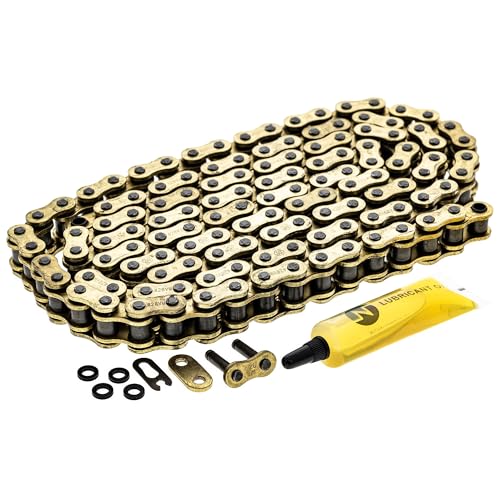
The NICHE Gold 428 X-Ring chain brings sealed-chain technology to the budget-friendly end of the market, with premium NBR X-Rings and quad-riveted pins housed in hardened steel bushings. The 428 pitch makes it compatible with smaller-displacement dual-sports and pit bikes like the Hawk 250 and Yamaha TW200. The tensile strength is rated at 5,665 pounds, which is adequate for 250cc and smaller engines but insufficient for larger-displacement machines.
Hawk 250 and dual-sport owners report that this chain significantly outperforms the stock chains these bikes ship with, maintaining tension much longer and resisting stretch through 600 miles of mixed dirt, dust, mud, and water exposure. The X-Rings keep grease sealed at the pins, reducing internal wear compared to the unsealed chains typically found on budget bikes. Some users note that the master link is very tight to install with the X-Rings in place, and a few choose to leave the rings off the master link for easier assembly.
At this price point, the NICHE chain offers remarkable value for anyone riding a small-displacement bike who wants the stretch resistance of a sealed chain without spending twice as much. The gold finish helps with corrosion resistance, but the primary value is in the X-Ring technology that keeps grit out of the pin-bushing interface. It won’t survive hard use on a 450cc bike, but for a 250cc trail machine or pit bike, it’s a smart upgrade that drastically reduces adjustment frequency.
Why it’s great
- X-Ring seals at budget-friendly price point
- Noticeable improvement over stock chains on small bikes
- Holds up well in wet and muddy conditions
Good to know
- Master link very tight with X-Rings installed
- Tensile strength too low for 450cc+ engines
- 428 pitch limits compatibility to smaller bikes
FAQ
How often should I replace my dirt bike chain?
Does gold chain color actually matter for performance?
Final Thoughts: The Verdict
For most riders, the best dirt bike chain winner is the DID 525VX3 X-Ring Chain because it combines exceptional tensile strength with X-Ring seals that dramatically extend maintenance intervals. If you want a lightweight race chain for frequent replacement, grab the DID 520ERT3. And for budget-conscious riders on small-displacement bikes, nothing beats the sealed-chain value of the NICHE Gold 428 X-Ring.

Mo Maruf
I created WellFizz to bridge the gap between vague wellness advice and actionable solutions. My mission is simple: to decode the research and give you practical tools you can actually use.
Beyond the data, I am a passionate traveler. I believe that stepping away from the screen to explore new environments is essential for mental clarity and physical vitality.