Our readers keep the lights on and my smoothie glass nicely filled. As an Amazon Associate, I earn from qualifying purchases.
The promise of a tour-caliber urethane cover without the -per-dozen retail penalty has reshaped the golf ball aisle. Direct-to-consumer brands have quietly proven that a three-piece construction, a soft cast urethane skin, and a dimple pattern tuned for spin and distance can live at half the price of the premium-shelf standard. The hard part is sorting which of these balls actually deliver on that promise versus which ones cut corners on compression consistency, cover durability, or flight stability. This guide isolates the five direct-to-consumer golf balls that have earned their place through actual spec sheets and real-player feedback—not just marketing budgets.
I’m Mohammad Maruf — the founder and writer behind WellFizz. I’ve spent hundreds of hours cross-referencing core compression data, urethane quality reports, dimple geometries, and verified user performance patterns to separate genuine value from retail hype.
Whether you’re chasing tighter approach spin, higher launch off the driver, or just a ball that doesn’t scuff after three wedge shots, the recommendations here cover the full performance arc. This is your data-backed cross-section of the best direct to consumer golf balls—ranked by what actually matters when the clubface meets cover.
How To Choose The Best Direct To Consumer Golf Balls
Direct-to-consumer golf balls eliminate the retail markup, but the selection still forces a trade-off between compression, construction layers, cover material, and dimple design. Understanding these four variables determines whether your ball helps your game or fights it.
Compression Rating and Swing Speed Matching
Compression measures how much the core deforms under impact, expressed on a scale from roughly 30 to 110. A lower compression (under 70) delivers more distance for swing speeds below 85 mph by compressing fully on slower swings. A higher compression (90-plus) rewards faster swings with controlled launch and greater energy return. Mismatching compression is the fastest way to lose yardage or feel—a low-compression ball spun out by a 100-mph swing will balloon, while a high-compression ball on a 75-mph swing will feel like a rock and lose carry.
Construction Layers: Two-Piece vs. Three-Piece vs. Multi-Layer
A two-piece ball provides distance and durability but minimal greenside spin. A three-piece ball adds a mantle layer between core and cover, creating a separation between driver energy transfer and wedge friction—allowing high launch off the tee and stopping power on the green. Multi-layer designs (four or five pieces) fine-tune spin across each club type but cost more and demand consistent ball-striking to realize the benefit. For most amateurs, a quality three-piece urethane ball delivers the optimal ratio of feel, control, and value.
Urethane Cover Quality and Thickness
Not all urethane covers are equal. Cast urethane—used in tour-level balls—provides the softest feel and highest friction for spin. Injection-molded urethane is cheaper but often thinner, leading to scuffing after a few wedge shots. A thicker cast urethane cover (typically 0.035 to 0.045 inches) balances durability with control. Lower-priced DTC balls sometimes use a thermoplastic polyurethane (TPU) blend, which improves durability at the cost of some greenside grip.
Dimple Pattern and Aerodynamic Stability
Dimple count, depth, and pattern design control drag reduction and lift generation. Fewer dimples (around 252–318) typically reduce drag for higher swing speeds. Denser patterns (338–392 dimples) improve lift and stability in wind. Shallow dimples lower spin for straighter flight, while deeper dimples increase spin for greater control on approach shots. The dimple pattern should align with your typical shot shape and the wind conditions you play in most often.
Quick Comparison
On smaller screens, swipe sideways to see the full table.
| Model | Category | Best For | Key Spec | Amazon |
|---|---|---|---|---|
| TaylorMade Tour Response Stripe | Premium Mid-Range | Alignment precision on every putt | 100% Cast Urethane Cover | Amazon |
| Srixon Z-Star Diamond | Premium Tour Ball | High launch with greenside spin | FastLayer DG Core, 338 Dimples | Amazon |
| Srixon Q-Star Tour Divide | Mid-Range Value | Visual tracking and alignment | Two-Tone Urethane Cover | Amazon |
| Kirkland Signature Performance Plus | Budget Value | Everyday play and bulk replacement | 3-Piece Urethane Construction | Amazon |
| Vice Pro Air | Mid-Range Distance | Slower swing speed distance | 318 Dimple Pattern, Low Compression | Amazon |
In‑Depth Reviews
1. TaylorMade Tour Response Golf Balls, Enhanced 360° ClearPath Alignment, Speed Wrapped Core for Distance and Feel, Pack of 12

The TaylorMade Tour Response Stripe delivers the strongest combination of premium construction and practical in-play feedback. Its 100% cast urethane cover matches the feel and friction you expect from a tour ball, while the Speed Wrapped Core creates a distinct energy transfer from driver to wedge. The 360-degree ClearPath Alignment isn’t a gimmick—it helps confirm putt direction and reveals the ball’s spin axis instantly on approach shots.
Players with driver swing speeds in the 85-95 mph range report that the ball achieves proper launch without feeling too firm or too mushy. The urethane cover holds up well across 18 holes, showing minimal scuffing on wedged shots from tight lies. The alignment stripe runs continuously around the ball, which means you get full-circle visual feedback rather than a single dot that disappears after a partial rotation.
One trade-off: the price sits slightly higher than other DTC options, and bulk-buy discounts from competitors can make the per-ball cost feel steeper if you lose several per round. But if you prioritize a premium urethane feel, responsive distance, and a clear alignment system that actually works on every putt, the Tour Response Stripe justifies its position at the top of this list.
Why it’s great
- Full-circle alignment stripe aids spin reading and putting
- Cast urethane cover delivers tour-level greenside control
- Speed Wrapped Core balances distance with soft feel
Good to know
- Premium pricing compared to other direct-to-consumer options
- Not ideal for high-swing-speed players seeking low launch
2. Srixon Z-Star Diamond Golf Balls

The Srixon Z-Star Diamond takes a distinct approach to the tour-ball formula by designing its FastLayer DG Core to produce a higher launch and optimized iron spin. The core softens at the center and hardens toward the edges, which encourages the ball to climb quickly off the driver face while still generating bite on wedge shots. The Spin Skin+ coating adds surface friction without a spongy cover feel, helping the ball check up fast on firm greens.
Players who regularly face crosswinds will appreciate the 338 Speed Dimple pattern, which reduces drag and stabilizes the ball’s flight path. The urethane cover feels distinctly crisp at impact—less marshmallowy than some competitors—but still provides ample stopping power on full wedges and partial swings around the green. Durability holds up better than some premium urethane options, showing less cover wear over multiple rounds.
The Z-Star Diamond is tuned for the player who wants a higher ball flight with controlled spin, not a low-bore bullet. If your natural shot tends toward a mid or low launch, this ball will help you hold greens with longer irons. The per-dozen price reflects a genuine DTC value relative to Pro V1 or TP5, though it sits above the entry-level DTC tier.
Why it’s great
- Higher launch optimizes carry distance for mid-swing speeds
- Spin Skin+ coating adds greenside grip without sacrificing feel
- 338 dimple pattern improves wind stability
Good to know
- Higher compression suits moderate to fast swing speeds better
- White-only cover limits visual variety for some players
3. Srixon Q-Star Tour Divide Golf Balls

The Srixon Q-Star Tour Divide flips the script on the conventional white-or-yellow golf ball by splitting the cover into two vibrant halves. The red/yellow version creates a strobe-like visual effect when the ball spins, letting you read shot curvature, wedge spin, and putt roll almost immediately after impact. This isn’t just cosmetic—the two-tone construction uses a full urethane cover with the DIVIDE Seam Line that acts as a 360-degree alignment guide.
The FastLayer Core reformulation delivers a slightly higher compression than earlier Q-Star iterations, which improves energy return for mid-swing-speed players (85-95 mph). The ultra-thin urethane cover provides a soft, responsive feel on short game shots, making this ball feel more premium than its price bracket suggests. The 338 Speed Dimples maintain stable flight in moderate wind, though the ball does produce slightly less spin on approach shots compared to the all-white Q-Star Tour version.
Low-spin tendency on greenside full shots is the main trade-off. If you rely on stopping power from 100 yards and in, the Divide will check up less aggressively than a Z-Star or Tour Response. But for a golfer who values visual feedback—seeing spin axis, launch direction, and putting roll instantly—and wants a premium urethane feel without a premium markup, the Divide delivers a genuinely unique experience.
Why it’s great
- Two-tone cover reveals spin and shot shape instantly
- Ultra-thin urethane cover provides soft, responsive feel
- DIVIDE Seam Line assists putting alignment
Good to know
- Greenside spin is lower than the white Q-Star Tour version
- Best for lower to moderate swing speed players
4. Kirkland Signature Three-Piece Golf Ball Urethane Cover Performance Plus

The Kirkland Signature Performance Plus occupies a unique position in the DTC market—it offers a three-piece urethane construction at a price that undercuts almost every alternative. The ball conforms to USGA and R&A rules and delivers a solid feel at impact, with controlled iron spin and consistent flight. For a mid-handicap golfer who loses a couple balls per round and doesn’t want to wince at the financial loss, this is the most forgiving option on the list.
The urethane cover gets the job done for everyday play, providing enough greenside friction to hold approach shots on most green firmness levels. Players who often play fast-rolling municipal greens will appreciate that this ball doesn’t over-spin and roll back excessively. The compression sits in the mid-range sweet spot, making it playable for swing speeds from 80 to 95 mph without feeling boardy or overly lively.
The compromise comes in cover durability and spin consistency. The urethane layer is thinner than premium DTC options, and some users note cover scuffing after a few wedge shots from tight lies. If you’re a single-digit player who needs precise spin control on every chip and pitch, the Kirkland may leave you wanting. But for recreational rounds and bulk replacement, the price-to-performance ratio is unmatched in the DTC space.
Why it’s great
- Three-piece urethane at a fraction of premium DTC pricing
- USGA-conforming for tournament legal play
- Solid distance and adequate iron spin for mid-handicaps
Good to know
- Urethane cover shows scuffing faster than premium DTC balls
- Greenside control not as precise as cast urethane options
5. Vice Pro Air Golf Balls
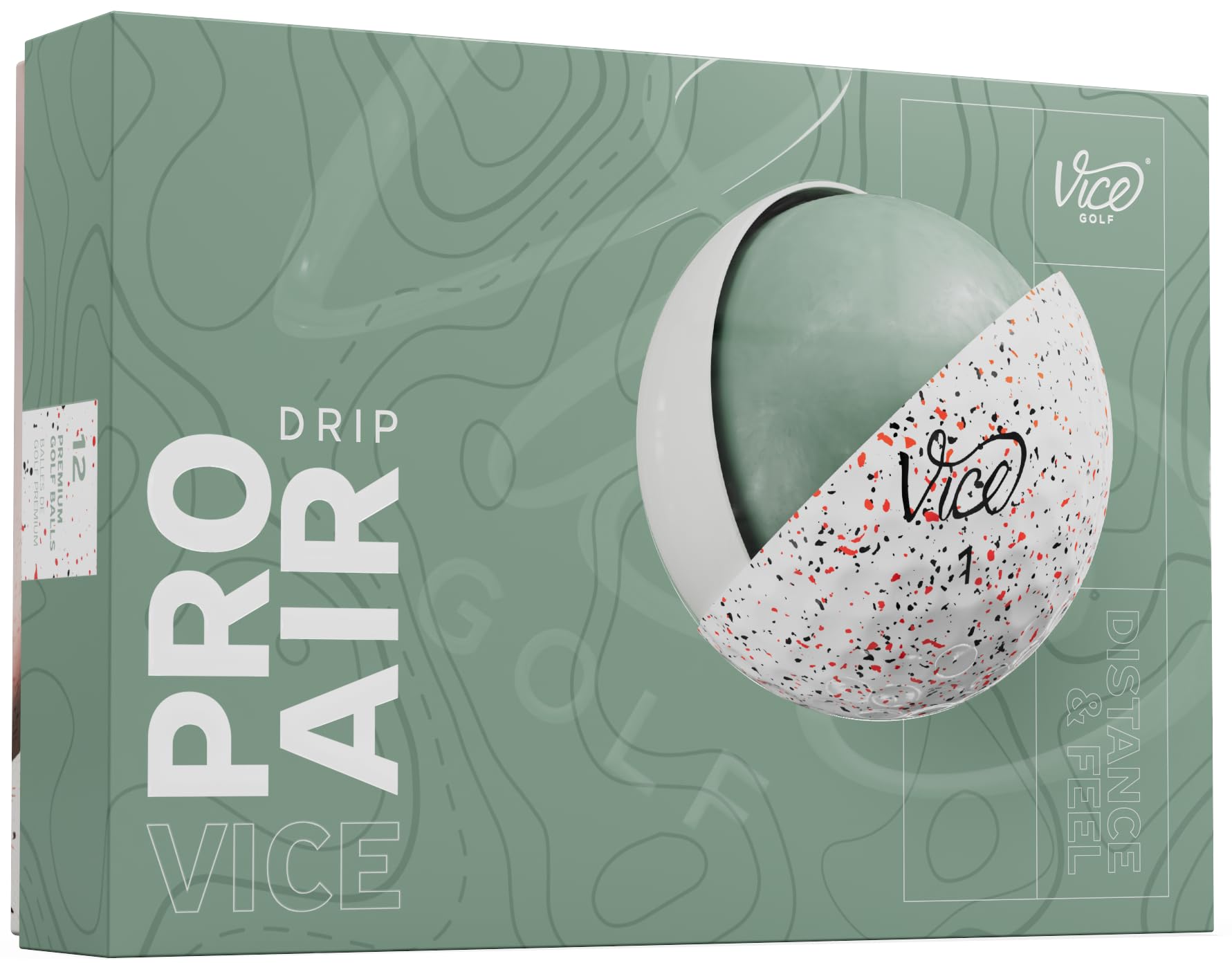
The Vice Pro Air is engineered specifically for golfers with lower to moderate swing speeds—exactly the player segment that often gets overlooked by premium tour-ball marketing. Its three-layer construction pairs a lower-compression core with a cast urethane cover and a 318 dimple pattern designed to increase ball flight trajectory while reducing spin for pure distance. Players who swing around 75-85 mph will find that this ball launches higher and carries farther than a standard tour ball designed for 95-mph-plus swings.
The cast urethane cover provides genuine greenside stopping power, contradicting the assumption that a lower-compression ball can’t hold a green. The alignment aid, with crisp edges that taper toward the target, feels intuitive for tee shots and putting. The neon color options (like the red/black drip) also make ball retrieval noticeably faster in rough or leaf cover. Vice’s DTC model means buying multi-dozen packs through their website unlocks significant per-ball savings.
The Pro Air’s 75 compression rating means it can feel slightly lively for faster swing speeds, and the spin rate on full wedge shots is lower than stiffer tour alternatives. If your driver speed stays consistently above 95 mph, a higher-compression ball will deliver more controlled launch and stopping power. But for the golfer who has lost yardage with age or who has never had a fast swing, the Pro Air restores distance without sacrificing the urethane feel that makes scoring possible.
Why it’s great
- Low compression maximizes distance for slower swing speeds
- Cast urethane cover provides real greenside control
- Neon color options improve visibility and retrieval speed
Good to know
- Not suited for players with swing speeds above 95 mph
- Lower wedge spin compared to higher-compression tour balls
FAQ
Will direct-to-consumer golf balls perform as well as premium brands like Pro V1 or TP5?
How do I know which compression level fits my swing speed?
Is a urethane cover always better than a Surlyn or ionomer cover?
Final Thoughts: The Verdict
For most players, the best direct to consumer golf balls winner is the TaylorMade Tour Response Stripe because it combines a premium cast urethane cover, a responsive core, and a full-circle alignment system that genuinely improves putting and spin reading. If you want higher launch with optimized iron spin and excellent wind stability, grab the Srixon Z-Star Diamond. And for a budget-friendly three-piece urethane option that performs well for recreational play, nothing beats the Kirkland Signature Performance Plus.

Mo Maruf
I created WellFizz to bridge the gap between vague wellness advice and actionable solutions. My mission is simple: to decode the research and give you practical tools you can actually use.
Beyond the data, I am a passionate traveler. I believe that stepping away from the screen to explore new environments is essential for mental clarity and physical vitality.