Our readers keep the lights on and my smoothie glass nicely filled. As an Amazon Associate, I earn from qualifying purchases.
The leap from a wheel-on trainer to a direct-drive unit is the single most meaningful upgrade an indoor cyclist can make. By removing the rear wheel and locking the frame directly onto the drivetrain, you eliminate tire wear, slippage, and the phantom power spikes that plague friction-based systems. The result is a rock-solid platform where every watt you push translates directly into controlled resistance, realistic gradient simulation, and accurate data you can actually trust for structured training.
I’m Mohammad Maruf — the founder and writer behind WellFizz. I’ve spent hundreds of hours analyzing drivetrain compatibility specs, power accuracy claims, noise decibel ratings, and flywheel inertia data across dozens of units to understand what separates a durable training tool from a frustrating gadget.
This guide compares the top models on the market today, from mid-range workhorses to premium flywheel giants, helping you pick the best direct drive bike trainer for your specific indoor riding goals, space constraints, and budget.
How To Choose The Best Direct Drive Bike Trainer
Not all direct-drive trainers feel the same, and a poor match can turn structured training into a frustrating experience. Before looking at specific models, anchor your decision around three non-negotiable factors: power accuracy, maximum resistance, and app compatibility. These specs define whether a trainer will grow with your fitness or hold you back within months.
Power Accuracy and Consistency
This is the single most important spec for any cyclist who follows structured workouts. Trainers with ±1% accuracy (like the Wahoo KICKR V6) allow you to precisely target power zones during interval sessions, while ±3% units (Tacx Flux S) introduce enough drift that a 200-watt effort could actually be anywhere from 194 to 206 watts. For general fitness riding, ±2% is perfectly acceptable, but for racing preparation, prioritize ±1% models.
Maximum Gradient and Wattage
Gradient simulation determines how steep the climbs feel. A unit that maxes out at 10% (Tacx Flux S) is fine for flat-to-rolling terrain training, but if you live for mountain stage simulations or heavy over-gear sprints, look for 18-24% maximum incline and at least 2,000 watts of peak resistance. Models like the Elite Direto XR (24%) and XPLOVA NOZA V (18%) handle these demands without hitting a resistance ceiling mid-effort.
Connectivity and Ecosystem Lock-In
Every modern smart trainer uses ANT+ FE-C and Bluetooth FTMS, but WiFi connectivity (Wahoo KICKR V6, KICKR CORE 2) offers the most reliable data streaming without latency or dropouts during races. Also check whether virtual shifting (Zwift Click, CYCPLUS BC2) requires proprietary accessories sold separately — some units bundle the shifter, others make it an extra purchase that adds hidden cost.
Quick Comparison
On smaller screens, swipe sideways to see the full table.
| Model | Category | Best For | Key Spec | Amazon |
|---|---|---|---|---|
| Wahoo KICKR V6 | Premium | Competitive racing prep | ±1% power accuracy, 2200W max | Amazon |
| Garmin Tacx Neo 2T | Premium | Realistic road feel | Virtual flywheel, 32 neodymium magnets | Amazon |
| Wahoo KICKR CORE 2 | Mid-Range | Zwift integration | WiFi connection, Zwift Cog bundle | Amazon |
| Elite Direto XR | Mid-Range | Mountain gradient training | ±1.5% accuracy, 24% max gradient | Amazon |
| Elite Direto XR-T | Mid-Range | Foldable high-inertia feel | 18% gradient, robust metal build | Amazon |
| Saris H3 | Mid-Range | Ultra-quiet operation | 59 dB noise, 12-speed compatible | Amazon |
| XPLOVA NOZA V | Mid-Range | Vibration-dampened structure | 2200W max, 4 rubber stabilizers | Amazon |
| Tacx Flux S | Entry-Level | Budget-friendly smart training | ±3% accuracy, 10% max gradient | Amazon |
| CYCPLUS T2 | Entry-Level | Portable compact design | Foldable 11.8″ footprint, 85Nm torque | Amazon |
| CYCPLUS R200 | Budget | Entry-level interactive ride | 19% gradient, 80Nm brushless motor | Amazon |
In‑Depth Reviews
1. Wahoo KICKR V6 Smart Indoor Trainer

The KICKR V6 represents the current pinnacle of consumer smart trainer engineering. Its high-inertia flywheel combined with the KICKR AXIS feet creates a side-to-side rock that mimics real-road body english, making sustained seated climbing and aggressive sprinting feel natural rather than robotic. The WiFi connectivity (2.4 GHz) eliminates Bluetooth dropout anxiety during Zwift races, and the automatic calibration keeps power output consistently within ±1% without requiring manual spin-downs before every session.
At 22 kilograms, this is not a trainer you casually move between rooms, but the chassis rigidity pays dividends when you’re out of the saddle cranking 1,200 watts. The integrated AXIS feet add about 2 inches of width but dramatically reduce the harsh lateral stiffness that plagues lesser designs. Riders coming from a KICKR CORE will immediately notice how much more road feedback transmits through the frame.
Setup takes under 20 minutes with the included adapters for 130/135mm quick release and 12×142/148 thru-axle. The disc brake spacer prevents caliper rub, and the 1.8mm cassette spacer accommodates 11-speed cassettes easily. The only real friction point is the initial WiFi pairing, which occasionally requires disconnecting your phone from the home network to complete the handshake.
Why it’s great
- WiFi connectivity provides the most stable data streaming available
- AXIS feet deliver genuine side-to-side road feel out of the saddle
- Automatic calibration eliminates pre-ride spin-down chores
Good to know
- Very heavy and not portable for frequent relocation
- WiFi setup may require phone network disconnect initially
- Premium price positions it above mid-range alternatives
2. Garmin Tacx Neo 2T Smart Trainer

The Neo 2T uses 32 neodymium magnets arranged in a unique radial configuration that generates resistance without a physical flywheel, relying instead on electromagnetic inertia simulation. This virtual flywheel algorithm adjusts the resistance curve based on your speed and gear selection, producing a coasting sensation that feels closer to outdoor deceleration than any belt- or gear-driven competitor. It also eliminates the need for calibration entirely — power is accurate out of the box within ±1%.
Road surface simulation is a signature Neo 2T feature: cobblestone, gravel, and wooden bridge textures vibrate through the frame during Zwift rides, adding immersion that other trainers can’t match. The unit is whisper-quiet at realistic riding speeds, with only tire and drivetrain noise audible. It folds relatively compact for a premium trainer, and the integrated handle makes moving it manageable despite the 47-pound weight.
Cassette installation requires careful attention to spacer placement — the wrong stack causes excessive chain noise that buyers sometimes mistake for a defective unit. Once properly set up, derailleur adjustment is straightforward with the included Shimano/SRAM freehub. The Neo 2T pairs instantly with Zwift, TrainerRoad, and Tacx Premium (1-month trial included), never dropping connection during multi-hour sessions.
Why it’s great
- Virtual flywheel provides the most realistic coasting feel available
- Road surface vibration simulation adds immersive feedback
- Calibration-free design maintains consistent ±1% accuracy
Good to know
- Cassette spacer alignment is critical for quiet operation
- App ecosystem integration is slightly less polished than Wahoo’s
- Premium price bracket does not include a cassette or Zwift Cog
3. Wahoo Fitness KICKR CORE 2 ZWIFT COG and Click
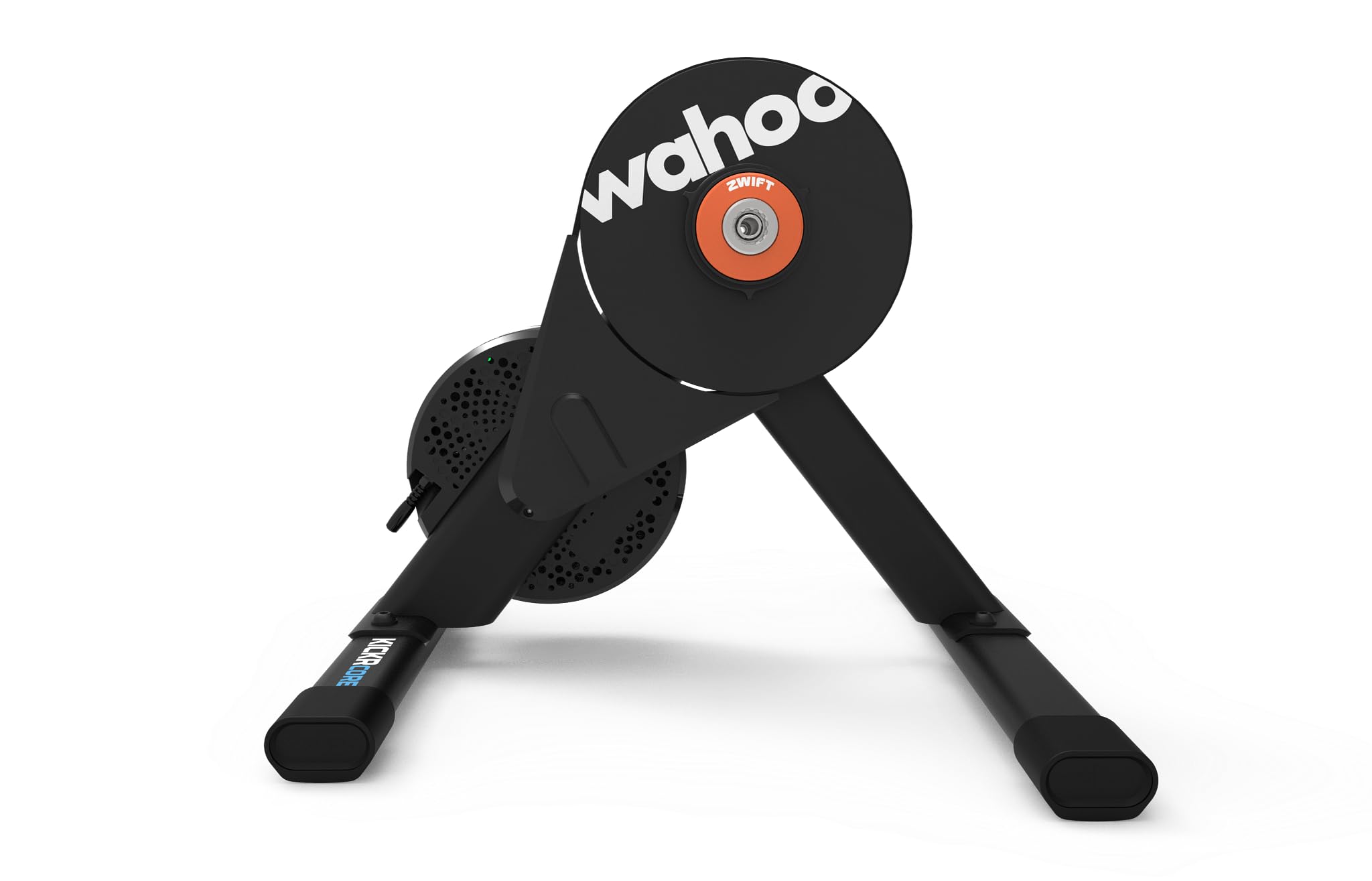
The KICKR CORE 2 builds on the legacy of the original CORE by adding integrated WiFi, faster pairing, and the Zwift Cog and Click bundle right in the box. The Cog replaces your cassette with a single narrow-wide gear that, paired with the Click remote, enables virtual shifting within Zwift — no rear derailleur noise, no chain drop, no cassette swapping between bikes. This is the easiest onboarding path for a rider who wants to open the box, attach their bike, and be riding in Zwift within 10 minutes.
Resistance feels consistent up to 1,800 watts, though serious sprint specialists will hit the ceiling earlier than on the KICKR V6. The flywheel provides adequate inertia for smooth pedaling at moderate cadences, but the lack of AXIS feet means the platform feels laterally stiff during hard out-of-saddle efforts. Build quality is excellent, with alloy steel legs that stay planted even on hardwood floors without a mat.
The Zwift Click has known quirks — pairing on iOS sometimes requires a credit card entry before it activates, and virtual shifting occasionally desyncs mid-ride. Buyers intending to use Rouvy or TrainerRoad should consider the standard cassette version instead, as the Click’s shifting logic is exclusively tuned for Zwift’s virtual gear system.
Why it’s great
- Zwift Cog and Click bundle eliminates cassette installation entirely
- WiFi connectivity ensures stable data streaming during races
- Extremely quiet operation — rider breathing is louder than the unit
Good to know
- Zwift Click pairing may require credit card entry on iOS
- Virtual shifting is incompatible with non-Zwift apps like Rouvy
- No free Zwift subscription is included at this price point
4. Elite Direto XR Interactive Smart Trainer
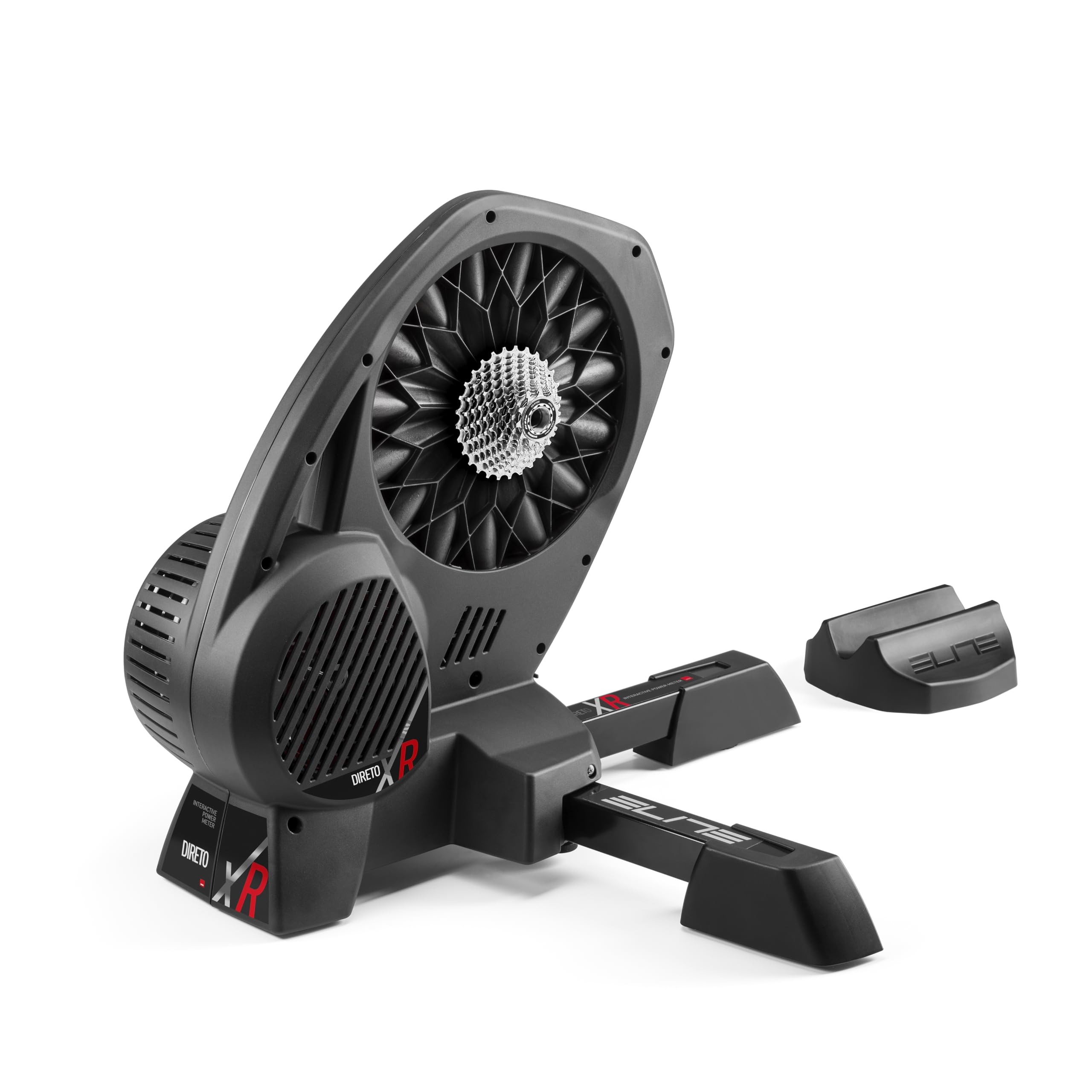
The Direto XR uses an optical torque sensor built directly into the axle to measure power with ±1.5% accuracy, a design that avoids the drift common in belt-driven sensor systems. This optical sensor combined with the carbon steel frame creates a responsive resistance feel that updates gradient changes within half a pedal revolution. The 24% maximum gradient simulation is the highest in this comparison, making it the first choice for riders who train specifically for alpine passes or steep criterium climbs.
Compatibility spans nearly every modern standard: it ships with a freehub for Shimano/SRAM 9-11 speed, Shimano 12-speed road, and SRAM NX/SX Eagle 12-speed. Thru-axle adapters for 142x12mm are included, and the quick-release adapters cover 130-135mm spacing. The unit measures 34 inches long with the legs deployed, requiring a dedicated floor space that’s slightly larger than compact competitors.
Noise output is moderate — not silent like the Neo 2T, but quiet enough that a TV at normal volume easily overpowers it. The 12-month free subscription to Elite’s My E-Training app adds structured workout plans and scenic videos, though the video resolution caps at 1080p. Some users report that electronic board failures can occur within the warranty window, so purchasing through a retailer with a solid return policy is advisable.
Why it’s great
- Optical torque sensor delivers reliable ±1.5% power accuracy
- 24% gradient simulation handles the steepest virtual climbs
- Broad drivetrain compatibility with included SRAM Eagle freehub
Good to know
- Occasional electronic board failures reported within warranty period
- Moderate noise output requires raised TV volume
- Campagnolo freehub requires separate purchase
5. Elite Direto XR-T One Color
The Direto XR-T shares Elite’s optical torque sensor DNA with the standard Direto XR but packages it with a heavier flywheel and a foldable leg design that collapses for easier storage. The increased flywheel mass produces a smoother pedaling feel at low cadences, which matters during sustained seated climbing where lighter flywheels tend to pulse. Power accuracy stays within ±2%, a slight step down from the standard XR’s ±1.5% but still well within acceptable range for most structured training.
The composite and metal frame feels robust during high-torque sprints, and the built-in handle simplifies moving the unit between rooms. At 16.3 kilograms, it’s lighter than the KICKR V6 while still delivering up to 18% gradient simulation — enough to replicate most real-world climbs except the steepest Alpine pitches. The unit arrives without a cassette, so factor in the cost and installation time of buying and mounting your preferred gear set.
Setup is straightforward: screw on the four folding legs, mount the cassette, and attach your bike using the included quick-release and thru-axle adapters. Bluetooth pairing with Zwift and TrainerRoad is immediate, though some riders report that cadence readings are more reliable with an external sensor attached to the crank arm. Storage footprint is noticeably smaller than the standard Direto XR thanks to the folding leg mechanism.
Why it’s great
- Heavy flywheel delivers smooth low-cadence pedaling feel
- Foldable legs reduce storage footprint significantly
- Optical torque sensor resists drift over long sessions
Good to know
- No cassette included — requires separate purchase and tools
- Cadence readings are inconsistent without an external sensor
- Power accuracy (±2%) is slightly looser than the standard XR
6. Saris H3 Series Smart Indoor Bike Trainer

The H3 earns its reputation as the quietest mid-range direct-drive trainer, operating at 59 decibels — roughly the level of a quiet conversation. Saris achieved this through a precision-crafted internal drivetrain that minimizes gear whine and bearing noise, making it the ideal choice for apartment dwellers or riders who train while others sleep. The steel frame and integrated front stabilizing block provide a rock-solid platform that doesn’t transmit vibration into the floor.
Power accuracy is rated at ±2%, and in practice the H3 matches that claim consistently across the power curve, from 100-watt recovery spins to 1,200-watt sprint efforts. The 12-speed drivetrain compatibility is seamless, and the pre-installed 8-11 speed Shimano/SRAM freehub means most riders can mount their cassette immediately without adapter hunting. The unit pairs via dual ANT+ FE-C and Bluetooth FTMS, maintaining stable connections even in signal-dense environments.
The main trade-off is weight — at 52 pounds, the H3 is one of the heaviest trainers in this class. Moving it requires deliberate effort, and the lack of folding legs means it commands a permanent floor footprint. Customer support responsiveness has been inconsistent, with some users reporting difficulty getting timely assistance for adapter compatibility questions.
Why it’s great
- 59 dB noise output is genuinely quiet enough for shared living spaces
- Steel frame construction provides zero flex during sprint efforts
- Pre-installed 8-11 speed freehub simplifies setup
Good to know
- Very heavy (52 lbs) and difficult to relocate
- Customer service responsiveness has drawn complaints
- Non-folding design requires dedicated floor space
7. XPLOVA NOZA V Smart Trainer

The NOZA V prioritizes rider and frame comfort through a four-rubber-foot vibration suppression system combined with stabilizers on both the front and rear legs. This design absorbs road buzz that would otherwise transmit through the frame, reducing fatigue during long trainer sessions and protecting the bike from unnecessary stress. The folding front leg collapses for compact storage, and the unit delivers up to 2,200 watts at 18% gradient, accommodating everything from steady-state threshold work to explosive sprint intervals.
Power measurement uses an electromagnetic motor that reads load fluctuations smoothly, avoiding the stepped resistance changes that cheaper magnetic trainers exhibit. The variance is rated within ±2%, and the integrated cadence sensor eliminates the need for an external pickup. Connectivity uses standard ANT+ and Bluetooth, pairing reliably with Zwift, TrainerRoad, and the XPLOVA companion app.
Long-term reliability concerns surface in user reports: some units develop intermittent load drop after 12-18 months of regular use, particularly in warm environments where the internal cooling struggles. The companion app’s workout builder only offers 5% load adjustment increments, which feels coarse for riders who prefer precision interval programming. Despite these caveats, the NOZA V’s vibration damping makes it a standout choice for riders who log multiple hours per session and want to minimize fatigue transfer.
Why it’s great
- Rubber foot vibration suppression reduces long-session fatigue
- Folding front leg enables compact storage between rides
- Electromagnetic motor provides smooth load fluctuations
Good to know
- Some units develop load drops after extended use in warm conditions
- App workout builder limits load adjustments to 5% increments
- Customer service responsiveness is inconsistent internationally
8. Tacx Flux S Smart Bike Trainer

The Flux S is Garmin’s entry-level direct-drive offering, and its value proposition is straightforward: you trade top-end power accuracy and gradient simulation for a reliable, nearly silent training experience at a digestible price point. Power accuracy is ±3%, which means a targeted 200-watt interval could actually be anywhere from 194 to 206 watts — noticeable for structured training but perfectly acceptable for general fitness and base-mile building. The 10% maximum gradient limits you to flat-to-rolling terrain simulation, making it less suitable for mountain stage training.
Build quality is solid, with a metal frame that supports up to 300 pounds and feels stable during standing efforts. The unit is genuinely quiet — chain noise is louder than the internal resistance mechanism — allowing normal TV conversations without volume adjustment. Setup is straightforward for 11-speed Shimano/SRAM drivetrains, and the trainer pairs quickly with Zwift and the Tacx app via ANT+ or Bluetooth.
The Flux S lacks an on/off switch, requiring you to unplug the power cord after every session — a minor annoyance that becomes tiresome over time. The included instructions are sparse, and first-time smart trainer users may need to consult online guides for proper pairing and setup. Despite these quirks, the Flux S delivers dependable direct-drive functionality at an entry-level cost.
Why it’s great
- Very quiet operation — drivetrain noise is the loudest component
- Sturdy metal frame supports heavy efforts without flex
- Reliable ANT+ and Bluetooth connectivity with major apps
Good to know
- 10% gradient cap limits mountain terrain simulation
- No on/off switch requires manual unplugging after each ride
- ±3% power accuracy is too loose for precision structured training
9. CYCPLUS T2 Smart Bike Trainer
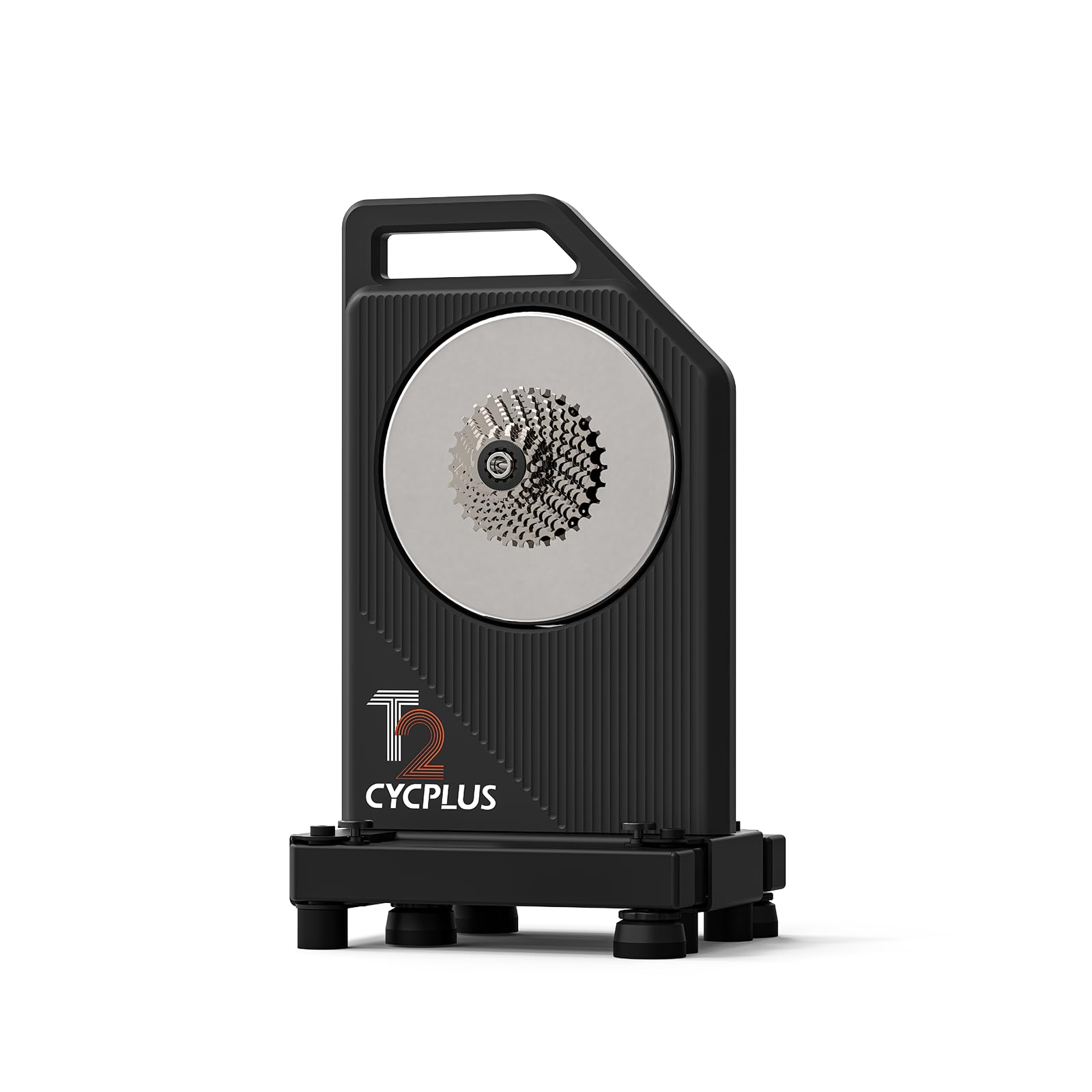
The CYCPLUS T2 is designed around portability without sacrificing the core smart trainer features. Its folded footprint measures just 11.8 by 10.1 inches with a slim 2.1-inch profile, and the oversized handle makes it easy to carry — it fits inside a standard suitcase for athletes who travel with their training gear. The 85 Nm brushless motor delivers up to 2,200 watts with ±1% power accuracy, matching premium trainers on paper while occupying a fraction of the space.
Triple-layer noise reduction keeps operation under 60 decibels, and the dual-fan cooling system prevents overheating during sustained high-output efforts. The unit supports virtual shifting via the CYCPLUS BC2 shifter (sold separately), but the standard mode works with gradient simulation up to 20%, syncing automatically with Zwift and other apps. Setup takes minutes with the included adapters, and the CYCPLUS companion app allows granular parameter customization for weight, bike weight, and rolling resistance coefficients.
The trade-off for portability is stability — the compact chassis is more prone to lateral wobble during max-effort sprints than the Saris H3 or KICKR CORE 2. The power cord is shorter than ideal, requiring proximity to an outlet or an extension cable. Despite these constraints, the T2 represents an excellent value for riders who need a high-power trainer that disappears into a closet between sessions.
Why it’s great
- Ultra-compact folded footprint fits in a suitcase
- ±1% power accuracy rivals units costing twice as much
- Dual-fan cooling system prevents thermal throttling
Good to know
- Compact design is less stable during explosive sprint efforts
- Power cord length is shorter than ideal for room layout flexibility
- Virtual shifting requires separate BC2 shifter purchase
10. CYCPLUS R200 Smart Indoor Bike Trainer
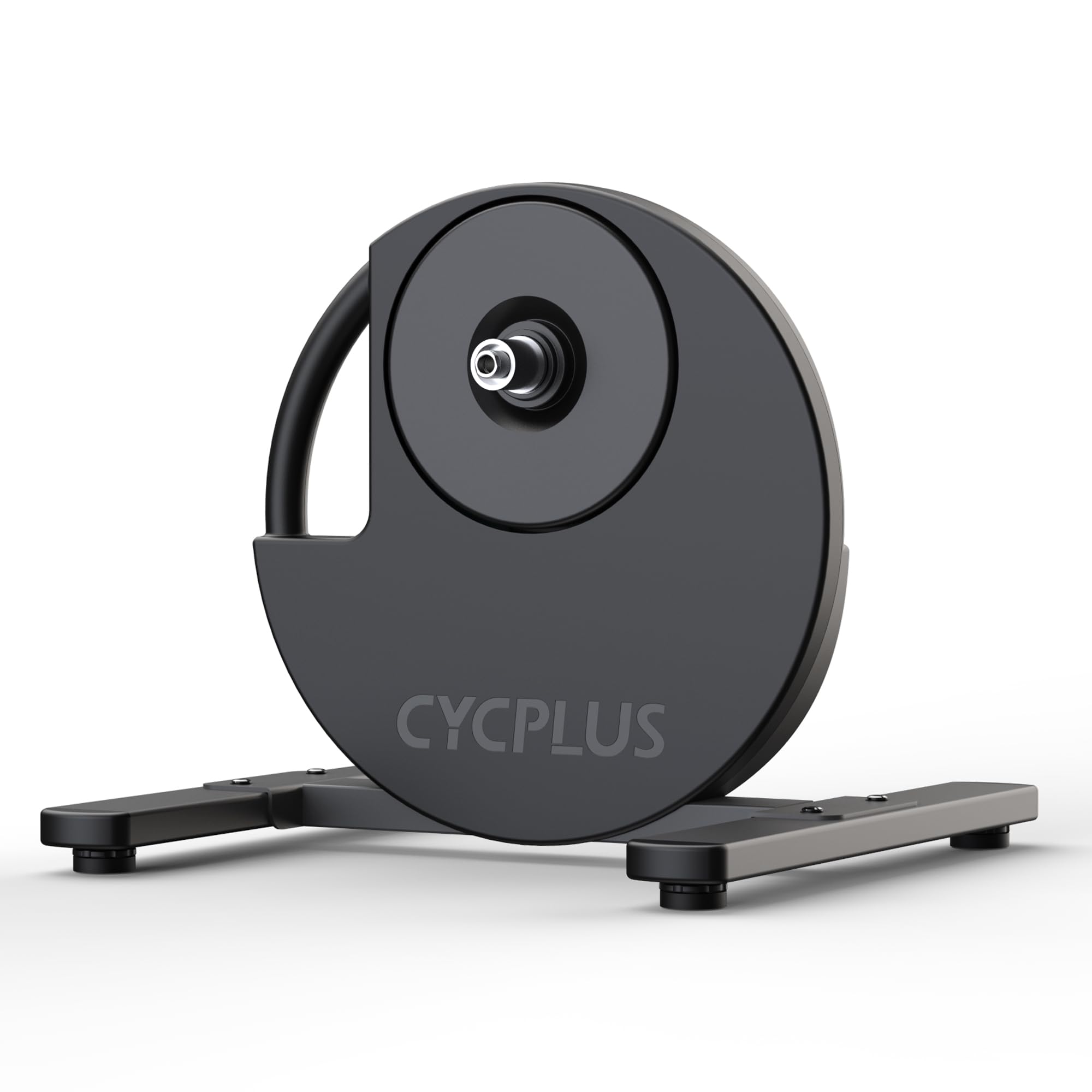
The CYCPLUS R200 is the most affordable direct-drive trainer in this list, yet it delivers a 19% gradient simulation and 2,200 watts of peak power — figures that comfortably exceed what the Tacx Flux S manages. The brushless motor produces 80 Nm of torque and maintains ±1% power accuracy, matching the spec sheet of units that cost substantially more. A built-in cooling fan with optimized airflow channels keeps the motor from overheating during extended sweet-spot sessions.
Virtual shifting is supported via the BC2 shifter (sold separately), and the dual-mode BLE/ANT+ connectivity pairs instantly with Zwift, MyWhoosh, and Rouvy. The alloy steel and stainless steel frame supports up to 250 pounds, and the 20.47-inch length provides adequate stability for most riders. Assembly is simple with the included Allen key and wrench, though buyers should note that neither a cassette nor a BC2 shifter is included in the box.
Quality control is the R200’s biggest variable — a small percentage of units arrive with power block failures or heat-related brake drag after short use. Customer support from CYCPLUS appears responsive, with replacement units shipped quickly after inspection, but the inconsistency means this trainer is best suited for budget-conscious riders who are comfortable troubleshooting initial setup issues or returning a defective unit.
Why it’s great
- Exceptional specs for the price — 19% gradient, 2200W, ±1% accuracy
- Built-in cooling fan prevents power fade during long sessions
- Simple assembly with included basic tools
Good to know
- Quality control issues affect a small percentage of units
- No cassette or virtual shifter included in the box
- Some units experience heat-related drag after extended rides
FAQ
Do I need a separate cassette for my direct-drive trainer?
Can I use a direct-drive trainer with a thru-axle bike?
How loud is a direct-drive trainer compared to a wheel-on trainer?
Is WiFi connectivity worth the extra cost?
Do I need a power meter on my bike if I use a smart trainer?
Final Thoughts: The Verdict
For most users, the best direct drive bike trainer winner is the Wahoo KICKR V6 because it combines WiFi reliability, ±1% power accuracy, and the AXIS feet side-to-side realism that makes indoor training feel less like a stationary chore. If you want the most realistic road feel and surface simulation, grab the Garmin Tacx Neo 2T. And for those who need a Zwift-ready plug-and-play setup with virtual shifting right out of the box, nothing beats the Wahoo KICKR CORE 2 Zwift Cog and Click.

Mo Maruf
I created WellFizz to bridge the gap between vague wellness advice and actionable solutions. My mission is simple: to decode the research and give you practical tools you can actually use.
Beyond the data, I am a passionate traveler. I believe that stepping away from the screen to explore new environments is essential for mental clarity and physical vitality.