Our readers keep the lights on and my smoothie glass nicely filled. As an Amazon Associate, I earn from qualifying purchases.
The biggest trap in the digital camcorder market is the gap between marketing resolution and real-world video quality. A camera that claims 8K but shoots at 15 frames per second delivers unusable footage, while a true 4K sensor paired with optical zoom and mechanical stabilization produces professional results you can actually edit and share. The choice isn’t about the highest number on the box — it’s about which internal components and stabilization systems will hold up when you’re actually recording.
I’m Mohammad Maruf — the founder and writer behind WellFizz. My research process for this guide involved cross-referencing sensor specifications, stabilization technologies, optical zoom ranges, and real customer footage across dozens of camcorder models to identify which units deliver genuine performance for their price tier.
Whether you are documenting family milestones, starting a YouTube channel, or need a reliable tool for event videography, this guide breaks down the top options to help you find the best digital video camcorder that matches your specific needs and budget without falling for inflated specs.
How To Choose The Best Digital Video Camcorder
Selecting a camcorder requires looking past the headline resolution to the components that determine real-world footage quality. The three pillars that define a camcorder’s value are its stabilization system, optical zoom capability, and sensor size — these specs directly control whether your video looks smooth, detailed, and usable in varied lighting.
Stabilization: Gimbal vs. Electronic
A 3-axis mechanical gimbal physically counteracts your hand movements, producing smooth footage even when walking or panning quickly. Electronic image stabilization (EIS) crops into the sensor to simulate steadiness, which reduces field of view and can introduce a jelly-like wobble. For active shooting scenarios like travel vlogging or sports events, a camcorder with a built-in gimbal is worth the premium. If you are shooting primarily from a tripod or steady surfaces, EIS may be sufficient.
Optical Zoom vs. Digital Zoom
Optical zoom uses the lens to magnify the image without losing detail. Digital zoom simply enlarges the pixels, producing a grainy result. A camcorder with 20x optical zoom will capture a distant subject with clarity, while a model relying on digital zoom will look soft and noisy past 2x or 3x. Always prioritize optical zoom range when you need to shoot from a distance.
Sensor Size and Low-Light Performance
A 1-inch CMOS sensor captures significantly more light than the 1/2.3-inch or 1/2.5-inch sensors found in budget camcorders. The larger sensor yields cleaner footage in dim environments, better color depth, and more natural background blur. If you plan to shoot indoors, at dusk, or in any non-ideal lighting, a 1-inch sensor is the single most impactful upgrade you can make.
Quick Comparison
On smaller screens, swipe sideways to see the full table.
| Model | Category | Best For | Key Spec | Amazon |
|---|---|---|---|---|
| DJI Osmo Pocket 3 Creator Combo | Premium | Professional Vlogging & Travel | 1″ CMOS / 3-Axis Gimbal | Amazon |
| Sony FDR-AX43 Handycam | Premium | Family Events & Long Zoom | 20x Optical Zoom / Balanced OIS | Amazon |
| Canon VIXIA HF G70 | Premium | Professional Recording & Streaming | 20x Optical Zoom / Dual SD Slots | Amazon |
| Xtra Muse Pocket Gimbal | Mid-Range | Active Vlogging & 4K/120fps | 1″ CMOS / 3-Axis Gimbal | Amazon |
| Canon PowerShot V10 | Mid-Range | Compact Vlogging & Portability | 1″ CMOS / Built-in Stand | Amazon |
| ORDRO M5 (3-Axis Gimbal) | Mid-Range | Budget Gimbal Stabilization | 5K / 3-Axis Gimbal | Amazon |
| ORDRO M5 (WiFi & 64GB) | Mid-Range | Portable Vlogging with WiFi | 5K / 3-Axis Gimbal | Amazon |
| FJFJOPK 5K Camcorder | Mid-Range | Live Streaming & Optical Zoom | 8x Optical Zoom / 5K Video | Amazon |
| FlyFrost 8K Camcorder | Budget | Beginners & Basic Recording | 8K (15fps) / 18x Digital Zoom | Amazon |
In‑Depth Reviews
1. DJI Osmo Pocket 3 Creator Combo

The DJI Osmo Pocket 3 sets the benchmark for pocket-sized camcorders with its 1-inch CMOS sensor and true 3-axis mechanical gimbal. It records 4K video at 120fps, producing smooth slow-motion footage without sacrificing resolution. The 2-inch rotatable touchscreen allows seamless switching between horizontal and vertical framing, which is critical for creators who publish across YouTube, Instagram, and TikTok without cropping.
ActiveTrack 6.0 locks onto a subject and keeps them centered in the frame automatically, even during movement. The Creator Combo bundle includes the DJI Mic 2 transmitter, a wide-angle lens, a battery handle, and a mini tripod — turning the Pocket 3 into a complete production kit. Battery life averages about 166 minutes, and the USB-C PD charging means you can extend recording time with a standard power bank.
D-Log M and 10-bit color depth give editors significant latitude in post-production for color grading. The stabilization in active scenarios like hiking or running is industry-leading, and the included wireless microphone solves the audio quality problem that plagues most compact camcorders. The only downside is the premium price and the delicate gimbal mechanism, which requires careful handling.
Why it’s great
- True 3-axis mechanical gimbal delivers professional-grade smooth footage during movement
- 1-inch CMOS sensor provides excellent low-light performance and dynamic range
- Creator Combo includes wireless mic, extra battery handle, and wide-angle lens for complete workflow
Good to know
- Premium price point places it beyond budget-conscious buyers
- Gimbal is mechanically delicate — requires a protective case during transport
- Limited to 2x digital zoom; no optical zoom capability
2. Sony FDR-AX43 UHD 4K Handycam

The Sony FDR-AX43 is a traditional camcorder designed for users who need long reach without image degradation. Its 20x optical zoom combined with Clear Image Zoom extends to 30x in 4K and 40x in HD, making it ideal for school plays, sporting events, and wildlife recording where you cannot physically get closer. The Balanced Optical SteadyShot acts like a built-in gimbal using a lens-shift mechanism
The 1/2.5-inch Exmor R CMOS sensor and BIONZ X processor work together to produce true 4K video with accurate color reproduction. Fast Intelligent AF locks onto subjects quickly, which is useful when filming moving targets like running children or athletes. The camcorder also includes a built-in projector for instant playback on a wall — a niche feature that families appreciate.
Wi-Fi and NFC connectivity allow remote control via smartphone, and the microphone input lets you upgrade audio for interviews or narration. The battery life is strong for a camcorder in this class, though the battery pack protrudes from the rear, making it less ergonomic for selfie-style shooting. No internal memory is included, so a high-speed SD card is required from day one.
Why it’s great
- 20x optical zoom with Clear Image Zoom delivers sharp distant subjects without pixelation
- Balanced Optical SteadyShot provides effective stabilization without cropping the image
- Built-in projector adds unique value for family playback
Good to know
- Date and time reset quickly after battery removal due to internal capacitor limitation
- Protruding battery design makes one-handed use and selfie stick mounting awkward
- No internal storage — requires purchasing a separate memory card
3. Canon VIXIA HF G70

The Canon VIXIA HF G70 is a purpose-built camcorder for serious videographers who need professional features in a traditional form factor. It records 4K UHD video at 30fps using a 1/2.3-inch CMOS sensor paired with the DIGIC DV 6 image processor, which delivers sharp footage with natural color science. The 20x optical zoom lens with an 8-blade aperture produces cinema-style bokeh in out-of-focus highlights.
The Hybrid AF system combines phase-detection and contrast-detection for fast, accurate focusing with face detection. Two SD card slots allow relay recording or simultaneous backup, which is essential for event coverage where a card failure would be catastrophic. UVC livestreaming outputs HD video directly to a computer via USB for webinars or live events without additional capture hardware.
The on-screen display (OSD) time stamp function embeds date, time, and timecode into the original file, which is valuable for legal, educational, and archival recording. Low-light performance is a known limitation — gain becomes noticeably noisy above +4 dB. The lack of a built-in gimbal means you will need a tripod or external stabilizer for moving shots.
Why it’s great
- 20x optical zoom with 8-blade aperture creates professional background separation
- Dual SD card slots provide relay and backup recording for critical events
- UVC livestreaming simplifies live broadcasting without extra hardware
Good to know
- Low-light performance degrades significantly above +4 dB gain
- HDMI and USB live output are limited to 1080p, not 4K
- No built-in gimbal — external stabilization needed for smooth motion shots
4. Xtra Muse Pocket Gimbal Camera

The Xtra Muse competes directly with the DJI Pocket 3 by offering a 1-inch CMOS sensor and 3-axis gimbal stabilization in a compact body at a lower price point. It records 4K video at 120fps, enabling silky smooth slow-motion playback. The Master Follow feature keeps the subject centered in the frame, similar to ActiveTrack, making solo vlogging much easier.
The 2-inch touchscreen supports both horizontal and vertical shooting modes, and the 10-bit X-Log color profile provides a flat picture profile for advanced color grading in post-production. Footage from this sensor is sharp and vibrant in good light, and low-light performance — while not quite matching the DJI — is impressive for the price tier. Battery life runs just over 160 minutes, and USB-C power bank charging keeps you recording all day.
The build quality feels solid, and the standard bundle includes a carrying bag, wrist strap, and threaded handle. Several users report that DJI Pocket 3 accessories are compatible, and a recent firmware update enabled connectivity with certain wireless microphones. The autofocus is quick but can hunt slightly in very low contrast scenes. Overall, this is the best budget-friendly alternative to the DJI Pocket 3.
Why it’s great
- 1-inch CMOS sensor combined with 3-axis gimbal delivers cinematic stabilization and clarity
- 10-bit X-Log color profile enables professional-grade color grading
- Compatible with DJI Pocket 3 accessories, expanding usability
Good to know
- Autofocus can struggle in very low contrast environments
- No optical zoom — relies on digital zoom which reduces quality
- Brand is less established, so long-term support is uncertain
5. Canon PowerShot V10

The Canon PowerShot V10 is designed for creators who prioritize pocketability above all else. It features a 15.2-megapixel 1-inch back-illuminated CMOS sensor that captures excellent 4K video with natural Canon color science. The retractable front-facing screen and built-in folding stand allow you to set it on a table and start recording immediately without a tripod, making it one of the most convenient vlogging cameras on the market.
The fixed 19mm wide-angle lens (35mm equivalent) ensures you and your background are both in frame, which is ideal for walk-and-talk vlogging. Stereo microphones with a third center mic for background noise reduction produce usable audio out of the box, though an external mic can be connected via the auxiliary port for higher quality. Image stabilization has three modes — Off, On, and Enhanced — offering flexibility depending on the shooting scenario.
The main trade-off is the total lack of zoom capability. You cannot zoom in or out during recording, so framing must be done with your feet. Battery life is modest, typically lasting 60-90 minutes of continuous recording, and the USB-C charging is relatively slow. For point-and-shoot vloggers who want the best image quality in a jacket-pocket size, the V10 is a unique and capable tool.
Why it’s great
- 1-inch sensor delivers superior video quality in a truly pocketable body
- Built-in stand and flip screen enable instant tabletop recording without accessories
- Wide-angle 19mm lens captures vlogger and background in a single frame
Good to know
- No zoom capability whatsoever — you must physically move to adjust framing
- Battery life is short compared to larger camcorders
- USB-C charging is slow; no included fast charger
6. ORDRO M5 3-Axis Gimbal Camcorder (Base)

The base ORDRO M5 brings 3-axis gimbal stabilization to an accessible price point. It records 5K video at 30fps and captures 48-megapixel photos, making it a versatile tool for YouTube beginners and travel vloggers. The 3.5-inch rotating touchscreen is larger than most pocket camcorders, providing a clear preview even in bright conditions.
The gimbal performance is genuinely impressive for the price — walking footage is noticeably smoother than any electronic stabilization alone could achieve. The 120-degree wide-angle lens captures a broad field of view suitable for selfie vlogging. IR night vision enables black-and-white recording in complete darkness, which is useful for nighttime outdoor shoots.
Battery life averages around 3 hours, and the removable batteries mean you can swap in spares for extended shoots. The main compromises are in audio quality — the internal microphone picks up handling noise, so an external wireless mic is strongly recommended. Some users report the gimbal can glitch after heavy trail use, and face tracking is not as reliable as premium competitors.
Why it’s great
- 3-axis mechanical gimbal at an entry-level price point
- Large 3.5-inch rotating touchscreen for easy framing
- IR night vision enables low-light black-and-white recording
Good to know
- Internal microphone captures handling noise — external mic is necessary for clean audio
- Gimbal can glitch or lose focus during heavy physical activity
- Face tracking accuracy lags behind DJI and Xtra Muse models
7. ORDRO M5 WiFi + 64GB Bundle
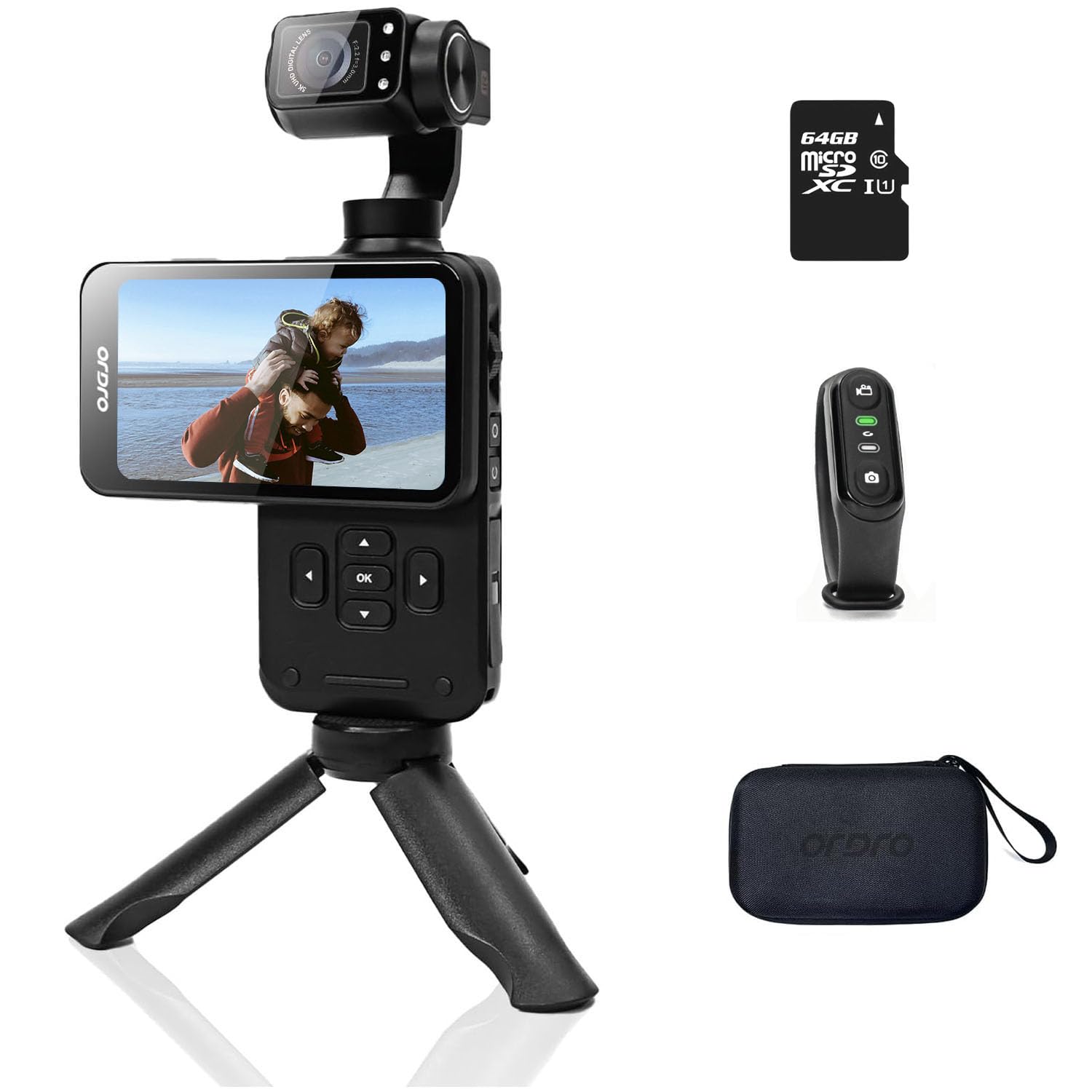
This version of the ORDRO M5 includes the same 3-axis gimbal and 5K sensor as the base model but adds WiFi connectivity for wireless file transfer and remote control via the OD Cam app. The package also includes a 64GB memory card, a mini tripod, and a remote control, making it a complete starter kit that requires no additional purchases to begin recording.
The WiFi feature allows you to preview the camera feed on your smartphone, control recording remotely, and transfer files without removing the SD card. This is especially useful for tripod-based recording where you want to check framing from a distance. The 64GB card provides approximately 4-5 hours of 5K footage before needing to offload.
The same caveats from the base model apply here — audio quality is mediocre, and the gimbal may struggle with aggressive movement. The tripod included is lightweight and best suited for stationary tabletop use. For beginners who want a gimbal-stabilized camera with all the accessories included, this bundle removes the guesswork of buying separate components.
Why it’s great
- WiFi connectivity enables wireless file transfer and remote camera control
- Includes 64GB card, mini tripod, and remote — ready to use out of the box
- 3-axis gimbal provides smooth footage at an affordable price
Good to know
- Audio quality remains a weak point — external mic upgrade recommended
- WiFi app stability varies across Android and iOS devices
- Gimbal performance degrades under heavy or rapid movement
8. FJFJOPK 5K Live Streaming Camcorder
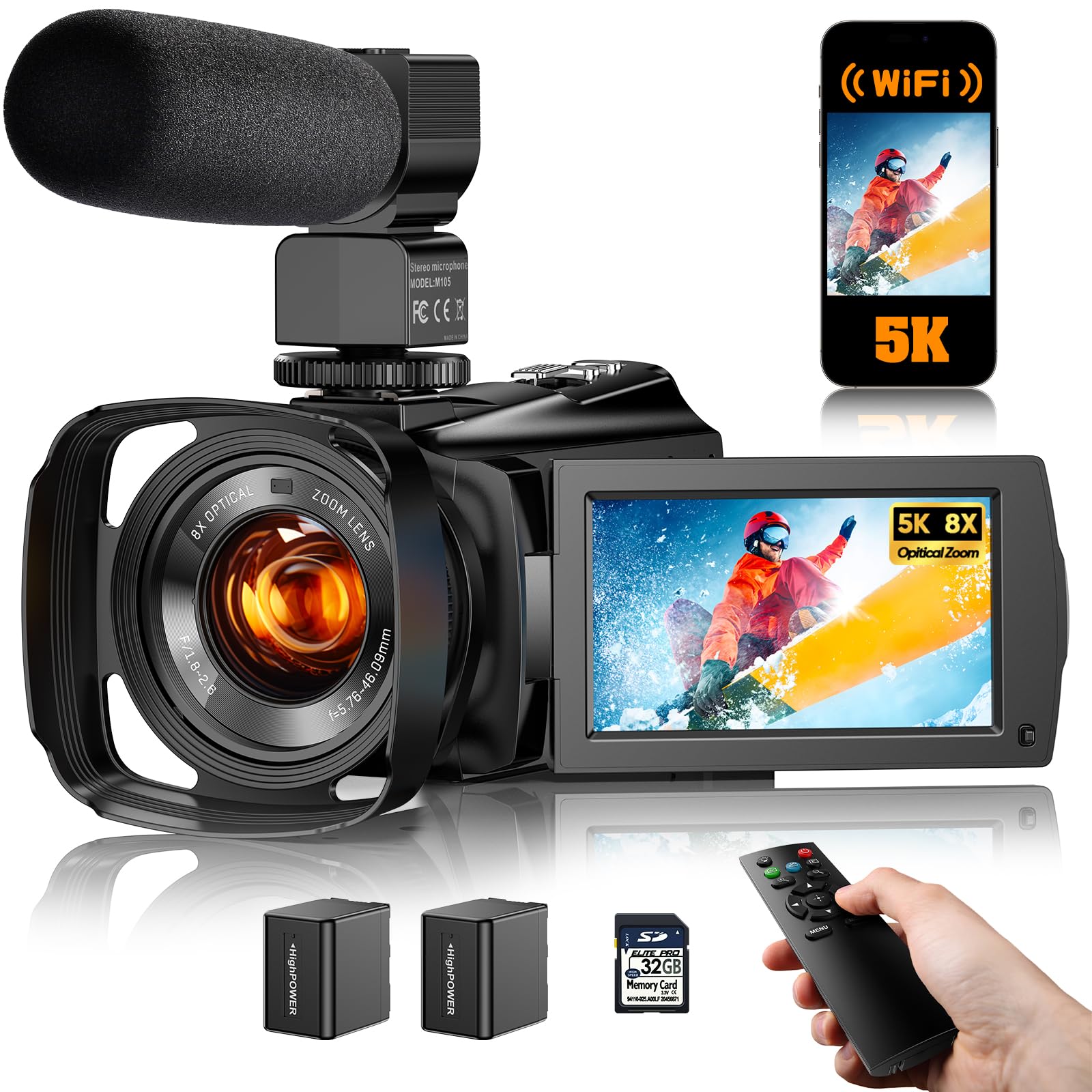
The FJFJOPK 5K camcorder differentiates itself with 8x optical zoom, which preserves image quality when zooming in — a rare feature at this price point. It records 5K video and 64-megapixel photos, and the customizable zone autofocus with TOF laser assist provides fast focusing even in dim conditions. The camcorder supports live streaming directly to platforms like YouTube and Facebook.
Full-color night vision is a standout feature — unlike IR night vision that produces black-and-white footage, this camcorder maintains color in low-light environments using a built-in LED light. The 3.6-inch IPS touchscreen rotates 270 degrees for selfie framing. Four scene modes (Default, Beauty, Jewelry, Clothing) are specifically tailored for product live streamers.
File transfer reliability is a concern — several users report difficulty offloading files to Windows 11 via USB-C, and the Viipulse companion app has mixed reviews. The touchscreen can be unresponsive at times. Audio quality from the internal microphone is average, but the included external mic improves it significantly. This camcorder is best suited for users who need optical zoom and live streaming features on a budget.
Why it’s great
- 8x optical zoom maintains detail at distance unlike digital-only competitors
- Full-color night vision preserves color in low light without IR washout
- Four scene modes optimized for product live streaming
Good to know
- USB-C file transfer can be unreliable on Windows systems
- Touchscreen responsiveness is inconsistent
- Internal audio is average — external microphone is essential for quality sound
9. FlyFrost 8K Camcorder

The FlyFrost 8K camcorder targets absolute beginners who want the maximum resolution number on the box. It claims 8K video but records at only 15fps, which produces footage that is essentially unusable for any motion content. The 88-megapixel still resolution is interpolated — real-world image quality is closer to what you would expect from a mid-range smartphone.
The package is generous for the price: it includes a 32GB SD card, external microphone, lens hood, handheld stabilizer, remote control, and two batteries. The 18x digital zoom is purely a crop, meaning image quality degrades immediately as you zoom in. The IR night vision works for black-and-white recording in complete darkness, and the WiFi function allows basic file transfer and remote control via the iSmart DV2 app.
The file transfer issue is a significant defect — the MSDC mode crashes File Explorer on some computers, and the companion app has overwhelmingly negative reviews for file retrieval. The lens hood and stabilizer are functional but basic. This camcorder can record usable 1080p footage in good lighting with the included accessories, but the 8K claim should be ignored entirely. It is a suitable learning tool for children or absolute beginners testing their interest in videography.
Why it’s great
- Extremely affordable entry point with many included accessories
- IR night vision enables black-and-white recording in total darkness
- Handheld stabilizer and external mic improve baseline recording quality
Good to know
- 8K video at 15fps is not usable for motion footage
- File transfer via USB and companion app is notoriously unreliable
- 18x digital zoom degrades image quality immediately — optical zoom is absent
FAQ
Why would I choose a dedicated camcorder over a smartphone for video?
What does the “8K” label on budget camcorders actually mean?
Is a 1-inch sensor worth the extra cost in a camcorder?
How important is a microphone input on a camcorder?
Final Thoughts: The Verdict
For most users, the best digital video camcorder winner is the DJI Osmo Pocket 3 Creator Combo because it combines a 1-inch sensor, professional 3-axis gimbal stabilization, and a complete accessory kit into a truly pocketable form factor. If you need long optical zoom for sports or events, grab the Sony FDR-AX43. And for an affordable entry into gimbal-stabilized video, nothing beats the ORDRO M5.

Mo Maruf
I created WellFizz to bridge the gap between vague wellness advice and actionable solutions. My mission is simple: to decode the research and give you practical tools you can actually use.
Beyond the data, I am a passionate traveler. I believe that stepping away from the screen to explore new environments is essential for mental clarity and physical vitality.