Our readers keep the lights on and my smoothie glass nicely filled. As an Amazon Associate, I earn from qualifying purchases.
That hollow, thin sound from your TV or gaming console isn’t a speaker problem — it’s a digital signal problem. Modern devices output pristine digital audio, but your older amplifier, powered speakers, or analog headphones can’t read ones and zeros. A dedicated bridge between these two worlds restores depth, warmth, and clarity to every track, movie, and game, turning lifeless playback into a genuinely involving experience.
I’m Mohammad Maruf — the founder and writer behind WellFizz. I have spent countless hours analyzing DAC chip performance, input/output compatibility, and real-world audio measurements to separate marketing claims from measurable improvement.
This guide breaks down the essential specs, connection types, and chipset differences to help you choose the right best digital to analog converter for your specific source devices and listening environment.
How To Choose The Best Digital To Analog Converter
Selecting the right converter depends on matching the inputs your source device offers with the outputs your amplifier or speakers require. Paying for a premium chipset that your TV cannot utilize is wasteful, while buying a budget unit for a high-resolution audio setup leaves performance on the table.
Input and Output Compatibility First
Check what digital output your TV, game console, or computer provides — optical (Toslink) and coaxial are the most common for home entertainment, while USB is standard for computers. The converter must also match your analog amplifier or powered speakers: RCA for standard stereo inputs, 3.5mm for aux, balanced XLR for professional gear, or headphone jacks for direct listening. A unit with multiple input options offers future flexibility if you change sources later.
DAC Chip and Sample Rate Performance
The DAC chip is the brain of the converter. Chips like the ESS ES9039Q2M, AK4493S, or Cirrus Logic CS43131 handle the actual conversion math and define the noise floor and dynamic range. Sample rates up to 192kHz are sufficient for 99% of streaming and Blu-ray content, while 768kHz and DSD support matter only for high-resolution music files. Do not overpay for sample rates your sources cannot produce — focus on signal-to-noise ratio (SNR) and total harmonic distortion (THD) for real quality metrics.
Quick Comparison
On smaller screens, swipe sideways to see the full table.
| Model | Category | Best For | Key Spec | Amazon |
|---|---|---|---|---|
| Fosi Audio ZD3 | Desktop DAC Preamp | Premium home stereo with HDMI ARC | ES9039Q2M chip, PCM 768kHz | Amazon |
| Fosi Audio K7 | DAC Headphone Amp | Desktop gaming and HiFi headphones | AK4493S, 2100mW output power | Amazon |
| SMSL DS100 | Mini DAC/Amp | Compact desktop with headphone amp | CS43131, 6.35mm + 4.4mm output | Amazon |
| SMSL D1 | Flagship DAC | Audiophile desktop listening | ROHM BD34352EKV, DSD512 | Amazon |
| SMSL PO100 | USB Bridge | Adding optical/coax output to PC/phone | XMOS XU316, USB-C input | Amazon |
| PROZOR DAC Converter | All-in-One | TV to analog sound system | 192kHz, Bluetooth 5.0, remote | Amazon |
| OREI DA34 | Dolby Decoder | Dolby/DTS 5.1 to stereo downmix | SPDIF/coaxial input, 2.0 output | Amazon |
In‑Depth Reviews
1. Fosi Audio ZD3 Desktop DAC Preamp

The ZD3 earns top marks by combining a flagship ES9039Q2M DAC chip with a fully balanced preamp stage and HDMI ARC input — a rare combination in this price tier. The XMOS XU316 processor handles PCM up to 768kHz and DSD512, while the QCC3031 Bluetooth chip adds wireless streaming convenience. The 1.5-inch OLED display and included remote make source switching effortless, and the 12V trigger allows synchronized power with other audio gear.
Reviewers consistently praise the airy, open soundstage and smooth midrange, with many noting a significant jump in clarity over previous budget DAC units. The preamp bypass switch is especially useful for users who want to integrate the ZD3 into an existing amplifier system without double-amplifying the signal. The included external power supply effectively isolates the analog stage from noisy USB power lines, a common pain point in PC-based setups.
One detail worth noting is that the stock LME49720 op-amps deliver excellent performance, but a handful of users upgrade to Sparkos or Burson op-amps for tighter bass control and slightly wider stereo separation. The case design makes op-amp swapping a bit fiddly, but the YouTube community has good guides. For anyone building a high-fidelity desktop or living room system, the ZD3 offers professional-grade versatility at a price that undercuts most competitors by a wide margin.
Why it’s great
- HDMI ARC input for TV audio integration
- Balanced XLR and RCA outputs for flexible system building
- External power supply eliminates USB noise artifacts
Good to know
- No standby mode; idle power draw is around 1 watt
- Op-amp swap requires disassembling the tight case
- HDMI is ARC, not eARC — limited to compressed 5.1
2. Fosi Audio K7 DAC Headphone Amp

The K7 is built for the demanding desktop user who needs both high-resolution headphone amplification and flexible connectivity for gaming, music, and work. At its core sits the AK4493S DAC chip from Asahi Kasei, paired with an XMOS XU208 USB processor that supports PCM up to 384kHz and DSD256. The TPA6120 headphone amp stage delivers up to 2100mW, easily driving high-impedance planars like the Hifiman Sundara or dynamic classics like the Sennheiser HD 650.
A standout feature is the dual large control knobs with five shortcut buttons and an angled chassis that improves ergonomics during long sessions. The 3.5mm microphone input is a rare inclusion that lets gamers use a single headset for both chat and high-fidelity audio, bypassing the noise floor of typical motherboard audio. Bluetooth aptX HD and LL support adds wireless convenience for music streaming from a phone without sacrificing audio quality.
Reviewers highlight the neutral, transparent sound signature that reveals details previously masked by lesser DACs. The all-metal aluminum chassis provides excellent EMI shielding, and the included 12V power supply ensures clean, consistent voltage. The volume knob clicks in steps of 3, which some find imprecise, and the on-screen EQ is limited to bass and treble adjustments. For a desktop hub that excels at both gaming positional audio and musical accuracy, the K7 is hard to beat.
Why it’s great
- Massive 2100mW output power for demanding headphones
- 3.5mm microphone input for gaming headset integration
- Bluetooth aptX HD/LL for low-latency wireless streaming
Good to know
- Volume knob step increments of 3 may feel coarse for fine adjustments
- No XLR output for balanced speakers
- Display viewing angles are narrow when desk is low
3. SMSL DS100 USB MQA DAC

The DS100 packs a surprising amount of performance into its 3.5-inch square aluminum chassis. The Cirrus Logic CS43131 DAC chip delivers a total harmonic distortion figure of just 0.00017%, which is genuinely exceptional at this level. MQA and MQA-CD decoding is built directly into the hardware, meaning Tidal Masters and MQA-encoded CDs unfold fully without requiring software rendering on the source device.
The dual headphone jack configuration — 6.35mm single-ended and 4.4mm balanced — covers the vast majority of aftermarket cables and headphone types. The balanced output delivers 7 Vrms into 600-ohm loads, enough to drive even the most power-hungry studio headphones. The CK-03 clock processing circuit reduces jitter significantly, and reviewers note a dead-quiet background with no hiss or interference even with sensitive IEMs.
Setting up on macOS and Linux is truly plug-and-play, while Windows requires a driver download from the SMSL website. The four LED indicators for volume level are a clever touch, showing HP, COAX, OPT, or USB depending on the active source. Some users wish the unit had Bluetooth, but the clean signal path and vanishingly low noise floor make the DS100 a focused tool for critical listening rather than a feature-packed lifestyle gadget.
Why it’s great
- Dual headphone outputs cover both 6.35mm and 4.4mm connections
- Hardware MQA decoding without software dependencies
- Ultra-low THD of 0.00017% for a transparent sound
Good to know
- Windows requires separate driver installation
- No Bluetooth connectivity for wireless sources
- No remote control included for volume adjustment
4. SMSL D1 Hi-Res Audio DAC
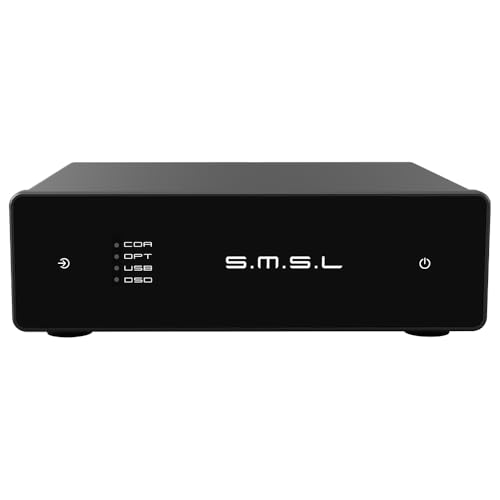
The SMSL D1 represents a genuine step up in DAC chip engineering, using ROHM Semiconductor’s BD34352EKV — a chip more commonly found in devices costing several times more. This chip delivers an SNR of 126dB and THD+N of 0.00038%, figures that place it firmly in the reference-class category. The XMOS XU-316 firmware supports USB, optical, and coaxial inputs with PCM up to 768kHz and DSD512, covering every high-resolution audio format available today.
The unibody CNC aluminum alloy chassis gives the D1 a rigid, vibration-dampened housing that also acts as a heat sink. Touch-sensitive controls on the front panel replace traditional buttons, giving the unit a clean, modern aesthetic. Reviewers describe the sound as slightly warm and musical rather than clinical, with excellent instrument separation and a wide, holographic soundstage that reveals layers in familiar recordings.
A key consideration is power sensitivity — the D1 is hyper-aware of USB power line noise. Using the optical or coaxial input with a separate cleaner power source yields the best results. One reviewer noted the unit died after a month of use, which appears to be an outlier given the broader positive consensus. For the listener who values resolving power and natural tonality over sheer feature count, the D1 is a benchmark performer.
Why it’s great
- ROHM flagship DAC chip with class-leading SNR of 126dB
- Touch-sensitive controls for a sleek, buttonless interface
- Supports DSD512 and 768kHz PCM for future-proof playback
Good to know
- Extremely sensitive to USB power noise — optical/coaxial preferred
- CNC aluminum chassis is premium but adds weight for portable use
- Some units have reported early failure; confirm warranty terms
5. SMSL PO100 USB Bridge
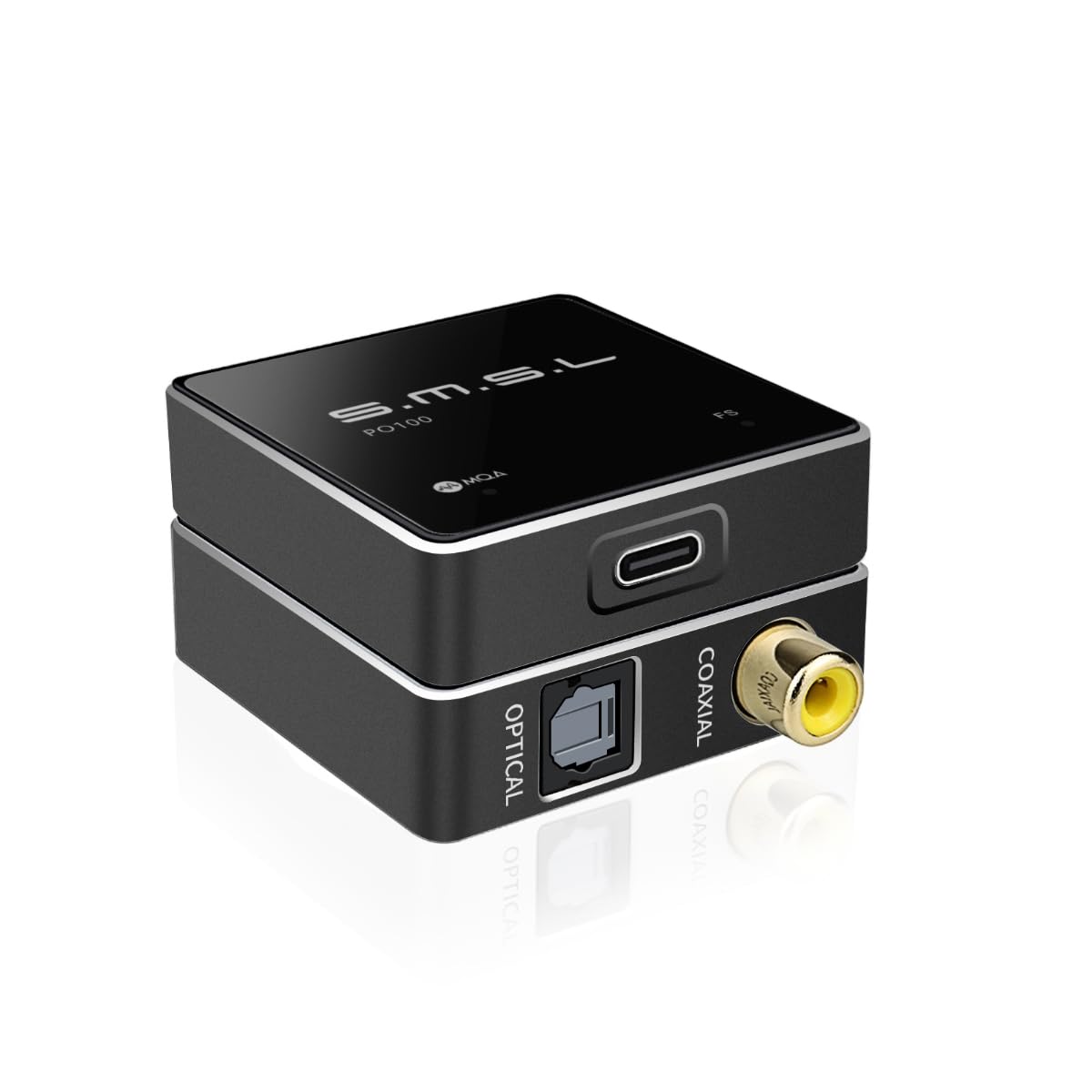
The PO100 is a tiny, lightweight USB-to-digital audio bridge that converts USB audio from a phone, PC, or streamer into optical (Toslink) and coaxial outputs simultaneously. Despite its minimal footprint, it uses the same XMOS XU316 chip found in many higher-end DACs, supporting PCM up to 192kHz and DOP64. MQA decoding is supported in hardware, which is remarkable given the size and price.
For anyone with an older standalone DAC that lacks USB input, the PO100 is the missing link. It acts as a re-clocker and USB ground isolator, cleaning up jitter and electrical noise from the source before passing the signal to the DAC via optical or coax. Reviewers consistently note a measurable improvement in detail retrieval and soundstage depth, even when the downstream DAC remains unchanged.
The unit is truly plug-and-play on macOS and Windows 10 and above, with no drivers required. A USB-C to C cable and a USB-A to C adapter are included, covering both modern laptops and older desktops. The only missing piece is a Toslink cable, which must be purchased separately if optical output is needed. At this price point, the PO100 is an essential tool for anyone who needs to add digital output to a device that only has USB.
Why it’s great
- XMOS XU316 chip delivers clean, jitter-free signal re-clocking
- Hardware MQA decoding without additional software
- Driverless on macOS and Windows 10+, same USB-C cable as modern phones
Good to know
- No Toslink cable included in the box
- No volume control on the device itself
- Plastic housing feels less robust than all-metal alternatives
6. PROZOR DAC Converter with Bluetooth
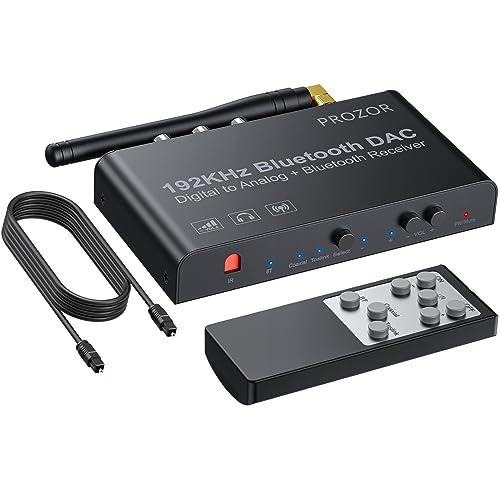
The PROZOR DAC Converter is the most versatile entry-level option in this guide, combining optical/coaxial input, RCA and 3.5mm analog output, and built-in Bluetooth 5.0 receiver into one compact aluminum unit. The 192kHz sampling rate is more than adequate for all streaming services, Blu-ray audio, and TV broadcasts. The included IR remote lets you adjust RCA and 3.5mm volume, switch between inputs, and mute — a rare convenience at this level.
The Bluetooth 5.0 implementation supports lossless transmission up to 50 feet, making it easy to stream from a phone to the converter while it is connected to an older amplifier or powered speakers. Reviewers frequently mention the clean build quality of the aluminum alloy case, which provides effective anti-interference shielding compared to plastic alternatives. The remote is functional but has a limited range, and the volume steps skip in increments of roughly 10%.
One important setup note is that the TV must be set to output PCM or LPCM format — the converter does not support 5.1-channel surround sound. This is standard for stereo-only converters, but buyers expecting Dolby Digital decoding will need the separate OREI DA34 instead. For connecting a modern TV to a vintage receiver or bookshelf speakers, the PROZOR delivers exactly what the name promises without any audiophile fuss.
Why it’s great
- Bluetooth 5.0 receiver for wireless phone streaming
- IR remote controls volume and input selection from the couch
- Aluminum alloy case minimizes electrical interference
Good to know
- Does not decode Dolby Digital 5.1 — PCM/LPCM only
- Remote has limited range and coarse volume steps
- Bluetooth cannot be turned off independently of other inputs
7. OREI Digital to Analog Audio Decoder DA34

The OREI DA34 stands apart from the other entries because it is not just a converter — it is a decoder. While most DACs require the source to already output PCM stereo, the DA34 accepts Dolby Digital and DTS 5.1-channel bitstreams via optical or coaxial input and downmixes them to analog 2.0-channel stereo via RCA L/R and 3.5mm headphone output. This makes it the right choice for TVs and streaming boxes that default to Dolby Digital output and cannot be switched to PCM.
The unit is housed in a compact plastic chassis measuring under three inches wide, with a physical switch on the side to select between optical and coaxial input. Many reviewers report success connecting the DA34 between a Samsung TV and an old soundbar, or between a Panasonic Viera and Sennheiser wireless headphones. The output is fixed level, meaning the amplifier handles volume control, which keeps signal path simple and avoids double-amplification.
A few setup gotchas are worth noting: the optical cable has a plastic cap that must be removed before insertion, and the optical cable must be pushed all the way in until it clicks. The default input is coax, so the side switch needs to be moved to optical if that is your source. The DA34 includes a power supply and optical cable in the box, so nothing extra is needed. For any setup where the source insists on outputting Dolby Digital, the DA34 is the specific tool for the job.
Why it’s great
- Decodes Dolby Digital and DTS 5.1 to stereo analog output
- Simultaneous RCA and 3.5mm outputs for shared use
- Includes power supply and optical cable out of the box
Good to know
- Fixed-level output — no volume control on the device
- Plastic build feels less premium than aluminum options
- Side input switch requires physical access to the unit
FAQ
Do I need a DAC with Bluetooth if my TV does not have it?
Why does my converter produce no sound from a Dolby Digital source?
What is the difference between optical and coaxial digital audio?
Final Thoughts: The Verdict
For most users, the best digital to analog converter winner is the Fosi Audio ZD3 because it combines HDMI ARC, balanced XLR outputs, Bluetooth, and a flagship ES9039Q2M chip at a price that undercuts traditional hi-fi brands by hundreds. If you need a powerful headphone amplifier for gaming and critical listening, grab the Fosi Audio K7. And for connecting a high-resolution USB source to an existing high-end DAC, nothing beats the value of the SMSL PO100 as a dedicated USB-to-digital bridge.

Mo Maruf
I created WellFizz to bridge the gap between vague wellness advice and actionable solutions. My mission is simple: to decode the research and give you practical tools you can actually use.
Beyond the data, I am a passionate traveler. I believe that stepping away from the screen to explore new environments is essential for mental clarity and physical vitality.