Our readers keep the lights on and my smoothie glass nicely filled. As an Amazon Associate, I earn from qualifying purchases.
Your home blood pressure monitor is only as useful as its accuracy—and a wrong reading can either frighten you into a false alarm or give you dangerous false reassurance. The arm cuff inflation method, the firmware logic for irregular heartbeat detection, and the display readability at dawn or dusk separate devices that earn their place in your medicine cabinet from those that frustrate you into giving up monitoring entirely.
I’m Mohammad Maruf — the founder and writer behind WellFizz. I’ve spent hundreds of hours analyzing clinical validation data, user error reports, and inflation technology across dozens of upper-arm blood pressure monitors to rank the models that deliver consistent, actionable readings.
This guide compares seven top-rated models across three value tiers, helping you choose a best digital sphygmomanometer that matches your arm size, your health needs, and your tolerance for smartphone integration.
How To Choose The Best Digital Sphygmomanometer
Blood pressure monitors vary in ways that aren’t obvious from a product photo. Three specifications—cuff compatibility, inflation algorithm, and memory segmentation—determine whether a unit serves you for years or ends up in a drawer after two weeks.
Cuff circumference is non-negotiable
If the cuff bladder does not encircle at least 80% of your bare upper arm, the reading will be falsely elevated (too small) or falsely depressed (too large). Standard cuffs cover 8.6–16.5 inches. Extra-large cuffs up to 21 inches exist for larger frames. Measure your mid-bicep circumference before selecting a model, and check whether the included cuff matches your arm.
Inflation technology drives comfort
Older monitors inflate to a preset pressure and then deflate. Newer units from Braun and OMRON measure as they inflate, stopping the cuff tightening the moment they capture the reading. This “measure during inflation” approach reduces arm squeeze duration and minimizes measurement anxiety, which can itself spike your pressure reading by 5–10 mmHg.
Memory and multi-user support
A monitor storing at least 60 readings per user is adequate for a single person tracking weekly trends. For couples monitoring together, look for dual-user memory (89–199 slots per user) and clear profile indicators. Shared monitors without profile separation mix data and make long-term trend graphs useless.
Clinical validation vs. marketing claims
Look for explicit mention of ESH 2010, AAMI, or BHS protocol validation. A device that passes these protocols offers readings within ±3 mmHg compared to a mercury sphygmomanometer. Avoid units that advertise “clinical accuracy” without citing a specific standard—this often indicates no third-party validation.
Quick Comparison
On smaller screens, swipe sideways to see the full table.
| Model | Category | Best For | Key Spec | Amazon |
|---|---|---|---|---|
| Microlife BPM2 | Premium | BIHS AA accuracy rating | Wide-range cuff 8.7–16.5 in | Amazon |
| OMRON Gold | Premium | AFib detection & app sync | Cuff fits 9–17 in arms | Amazon |
| Braun ExactFit 2 | Mid-Range | Measure-while-inflate comfort | Color-coded results on display | Amazon |
| iHealth Track | Mid-Range | Bluetooth logging to phone | Detects heart rhythm disturbances | Amazon |
| Medline MDS4001 | Mid-Range | Simple push-button operation | Stores 90 readings per user | Amazon |
| ALPHAGOMED U80BH | Budget | Two cuff sizes for family | XL cuff fits up to 21 in | Amazon |
| Urion U80A | Mid-Range | 4.5-inch bright LED display | Dual-user memory 199 each | Amazon |
In‑Depth Reviews
1. Microlife BPM2 Automatic Digital Upper Arm Blood Pressure Monitor
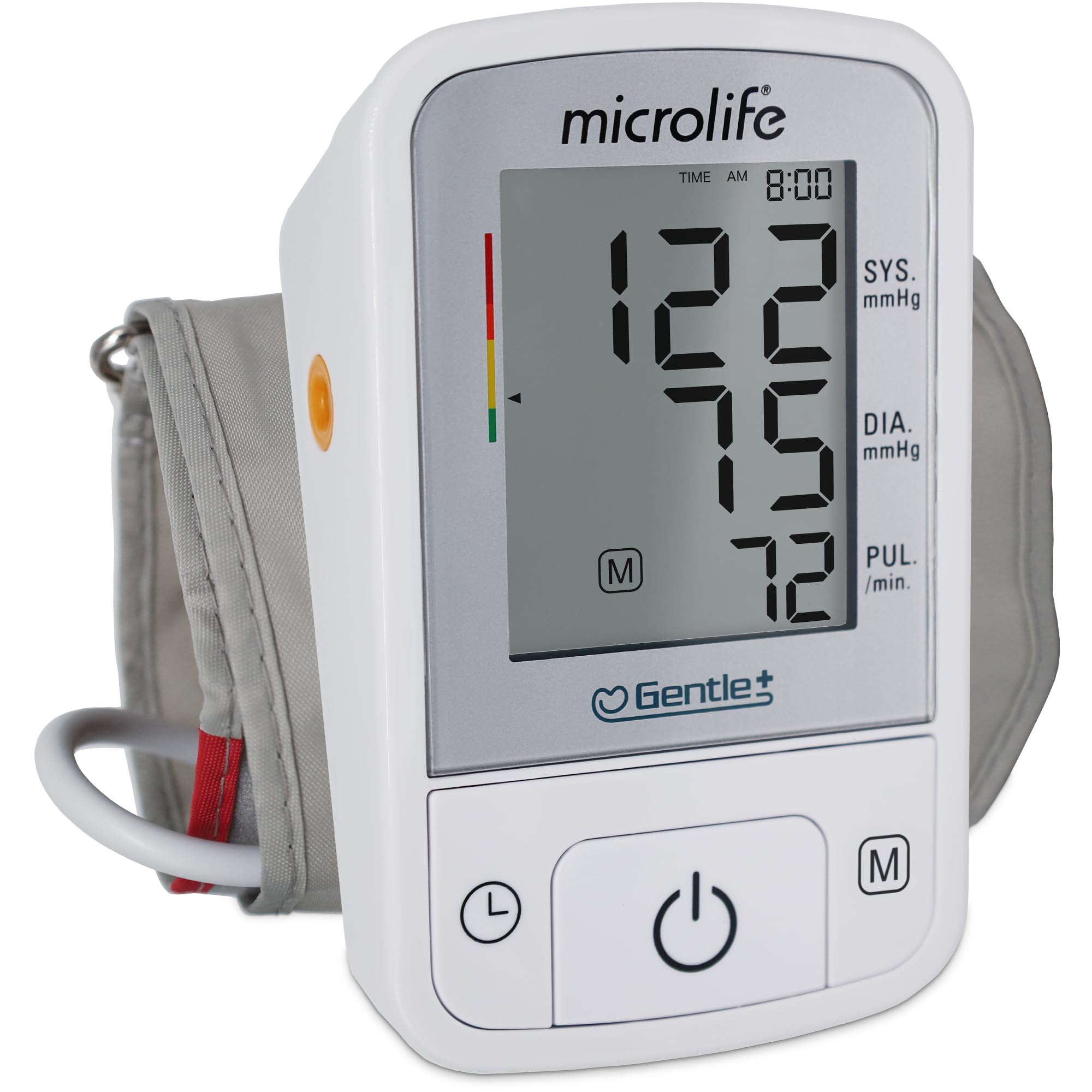
The Microlife BPM2 carries the British Hypertension Society’s AA rating—the highest grade for accuracy—which means its systolic and diastolic readings match mercury reference values within the tightest tolerance. The Gentle+ inflate algorithm applies lower pressure during measurement, making the process noticeably less uncomfortable for users who find standard cuffs painful during inflation.
The contoured wide-range cuff (8.7–16.5 inches) uses a softer outer fabric that makes self-application easier than many D-ring cuffs. It stores the last 60 readings and displays an average based on all stored memories, so you don’t need to manually calculate trends. An irregular heartbeat detector flags arrhythmias during each measurement.
Users report consistent readings that closely match their doctor’s office equipment over a full year of use. The unit does not offer Bluetooth or app connectivity—a potential downside if you want automatic digital logging, but a positive if you prefer a simple, reliable device without app-based bloat.
Why it’s great
- Highest BIHS AA accuracy rating available
- Gentle+ inflation reduces arm squeeze discomfort
- Contoured cuff easier to self-apply than standard cuffs
Good to know
- No Bluetooth or smartphone sync
- XL cuff sold separately for arms over 16.5 inches
- AC adapter not included
2. OMRON Gold Blood Pressure Monitor
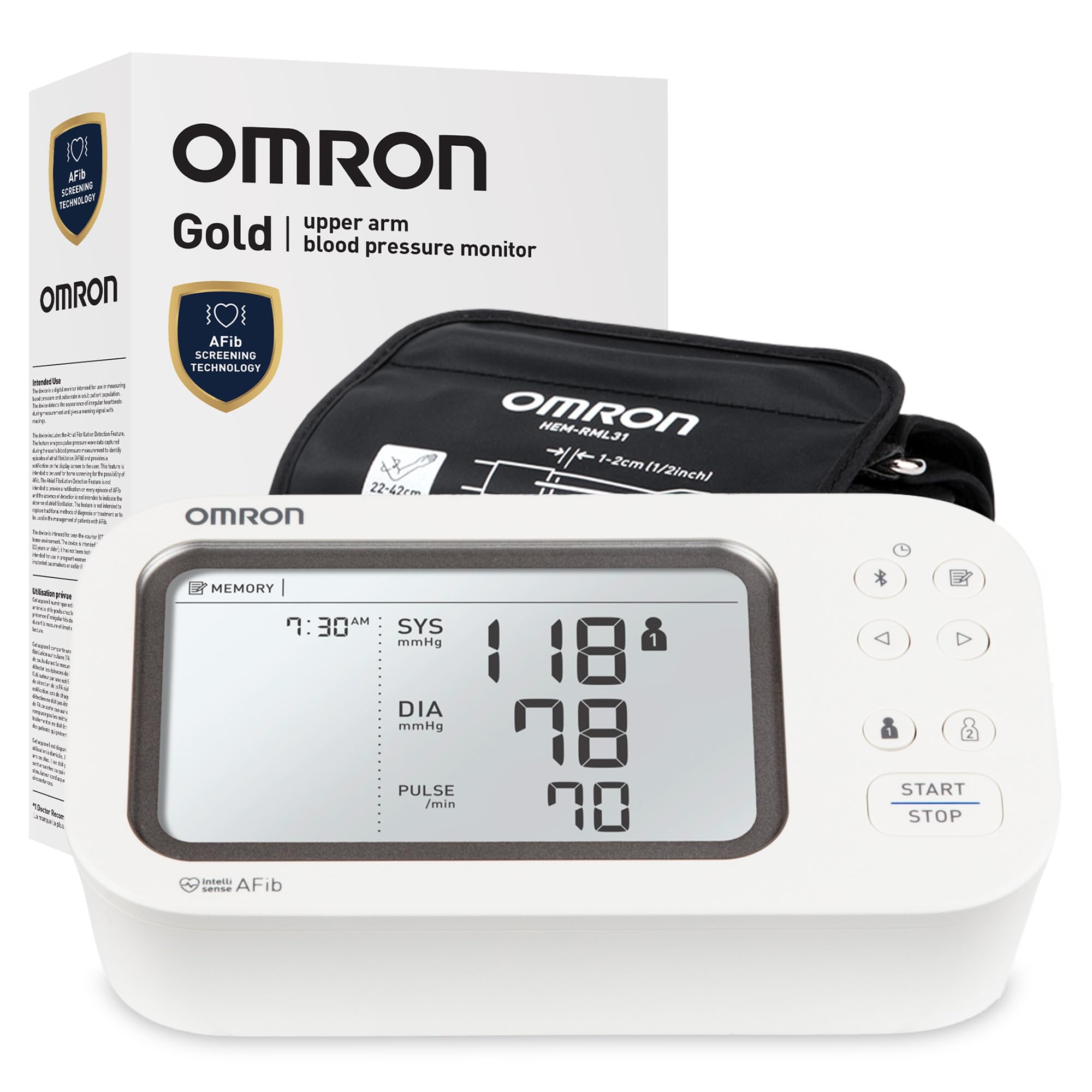
The OMRON Gold is the only monitor in this roundup that includes Atrial Fibrillation detection during every blood pressure reading, plus a High Morning Average indicator that flags early-morning spikes linked to stroke risk. The monitor syncs via Bluetooth to the OMRON Connect app, which stores unlimited readings, generates trend graphs, and exports reports compatible with Apple Health and Google Fit.
The wide-range D-ring cuff fits arms 9–17 inches and is pre-formed to reduce self-application errors. The device supports two user profiles with separate memory storage, making it practical for couples monitoring independently. Setup is truly out-of-box: four AA batteries included, Bluetooth pairing takes under two minutes, and no calibration is needed.
Note that the AFib detection algorithm prevents the monitor from displaying a reading if it detects an irregular rhythm that falls outside its acceptable measurement window. Users with diagnosed atrial fibrillation have reported that the device consistently refuses to show any blood pressure value—a design limitation worth considering before purchasing if you have a known arrhythmia.
Why it’s great
- Automatic AFib detection during each reading
- Syncs with Apple Health and Google Fit automatically
- High Morning Average indicator for cardiovascular risk
Good to know
- Will not display readings if AFib is detected
- Higher cost than other upper-arm monitors
- Some users report readings differ from doctor’s office
3. Braun ExactFit 2 Blood Pressure Monitor
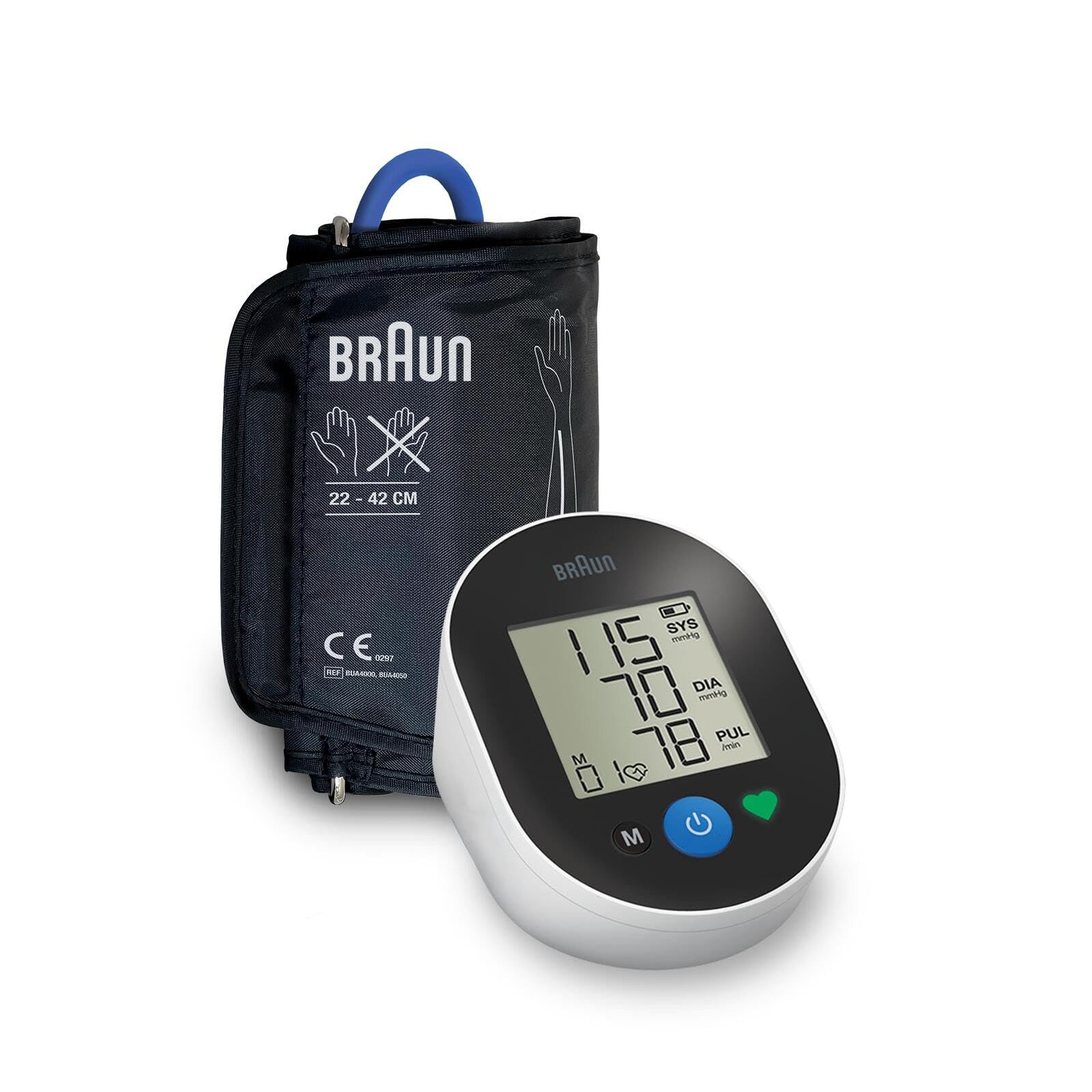
The Braun ExactFit 2 delivers clinically validated accuracy using a measure-while-inflating algorithm that stops the cuff the moment it captures a reading, then immediately deflates. This approach makes each measurement faster and less uncomfortable than conventional inflate-first monitors, which often squeeze the arm to a preset pressure before releasing.
The universally sized cuff fits arms 8.6–16.5 inches, and the large display shows systolic, diastolic, and pulse results alongside a color-coded indicator that maps to WHO hypertension stages—green for normal, yellow for borderline, red for high. The 30-memory storage is modest compared to some competitors, but sufficient for a single user tracking weekly trends.
Owner feedback emphasizes the unit’s consistency when compared against readings taken at a doctor’s office during follow-up visits. The four AA batteries are included, and the device does not rely on a smartphone app—making it a straightforward, high-accuracy choice for users who want no-fuss home monitoring without Bluetooth pairing complications.
Why it’s great
- Fast, comfortable measure-while-inflating design
- Color-coded display for instant result interpretation
- Clinically validated accuracy matching hospital-grade devices
Good to know
- Memory limited to 30 readings
- No Bluetooth or app integration
- Single-user profile, not ideal for couples
4. iHealth Track Smart Upper Arm Blood Pressure Monitor
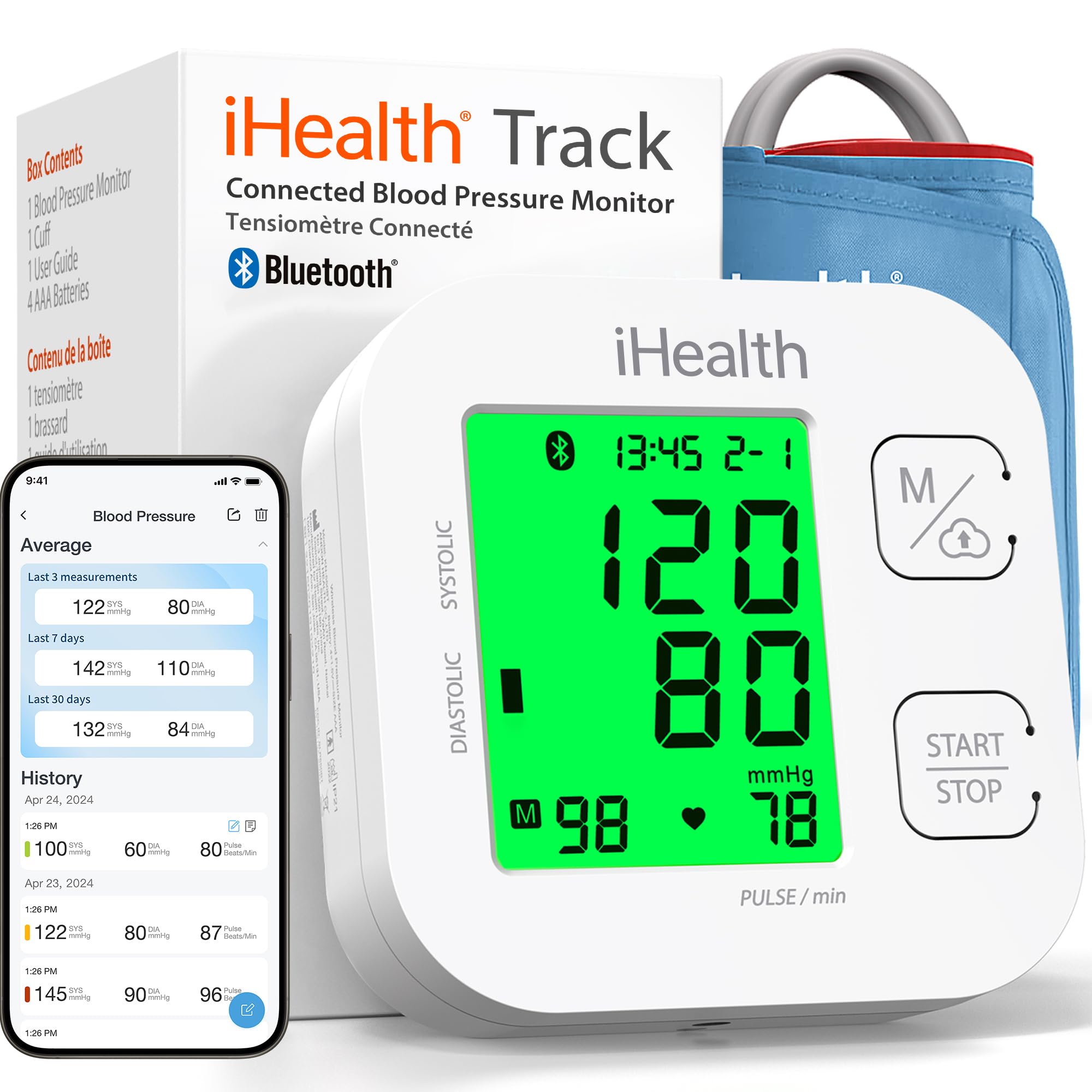
The iHealth Track combines Bluetooth connectivity with a wide-range cuff covering 8.7–16.5 inches and a large multi-color backlit display that highlights systolic, diastolic, and pulse readings in green, yellow, or red based on WHO categories. It meets ESH 2010 performance standards, so clinical accuracy is documented, not just claimed.
The accompanying free app (iOS and Android) logs unlimited readings over Bluetooth, supports Apple Health integration, and generates trend charts without requiring manual data entry. The monitor also detects heart rhythm disturbances during measurement and shows a warning symbol if irregularities are found—though the detection is not as advanced as OMRON’s AFib-specific algorithm.
Users consistently report easy one-button operation and very good accuracy against professional-grade equipment. The main drawback cited is the app’s persistent ad experience—some reviewers recommend manually recording readings rather than using the app. The device stores 99 readings onboard, so you can use it entirely without the phone if you prefer.
Why it’s great
- Bluetooth syncs readings to Apple Health automatically
- Large color-coded backlit display easy to read in low light
- Detects and flags heart rhythm disturbances
Good to know
- App contains advertisements that some users find intrusive
- Requires Bluetooth 4.0 or higher for reliable connection
- No dual-user profiles for two-person households
5. Medline Digital Blood Pressure Monitor MDS4001

The Medline Automatic Digital Blood Pressure Monitor is a no-app, no-Bluetooth device built around a single push-button start and a straightforward LCD display with a colored scale alongside the readout for quick interpretation. It stores up to 90 measurements per user across two separate user profiles, making it one of the most practical budget-tier options for couples monitoring together.
The adult cuff fits arms 8.6–11.8 inches—which is narrower than most competitors—so it is best suited for smaller to average adults. The inflation system adjusts to the individual’s arm size, and advanced error detection helps flag poor cuff placement or movement during the reading. Four AA batteries are included, and the device carries a one-year warranty.
Long-term owner reports highlight that the Medline provides consistent, trustworthy readings that match doctor’s office values closely over many months. The compact 6.85 x 4.38 x 4.38-inch footprint makes it easy to store in a nightstand drawer or pack for travel. The 90-reading memory per user is generous for a device at this level.
Why it’s great
- Dual-user memory with 90 slots per profile
- Advanced error detection prevents bad readings
- Compact design great for travel and small spaces
Good to know
- Cuff only fits arms up to 11.8 inches
- No Bluetooth or app connectivity
- Not suitable for larger arm sizes
6. ALPHAGOMED U80BH Blood Pressure Monitor

The ALPHAGOMED U80BH is the only monitor in this comparison that ships with two separate cuffs—a standard M/L cuff (9–17 inches) and an extra-large cuff (13–21 inches)—eliminating the need to buy a second unit for households with both average and larger arm sizes. The device uses advanced AI algorithms fed from thousands of clinical hypertension data points to produce readings that users consistently describe as accurate against doctor’s office measurements.
Large backlit LCD display with oversized operation buttons makes it accessible for older users with reduced vision or dexterity. The WHO color-coded indicator system (green/orange/red) appears on the upper right of the screen. The dual-user memory stores 99 readings per profile, and power can come from either 4 AAA batteries or the included USB-C cable.
While many owners praise the XL cuff’s fit for biceps up to 21 inches, a few have noted that the extra-large bladder can be difficult to self-tighten on the upper arm. Some users report using the XL cuff on the forearm as a workaround. The included nylon carry bag makes it easy to bring along for travel.
Why it’s great
- Two cuffs included cover 9–21 inch arms
- Oversized buttons and large backlit display
- Dual power via batteries or USB-C cable
Good to know
- XL cuff can be hard to self-tighten on the bicep
- No Bluetooth or app synchronization
- Some units reported faulty charger ports
7. FDA-Cleared Urion U80A Blood Pressure Monitor
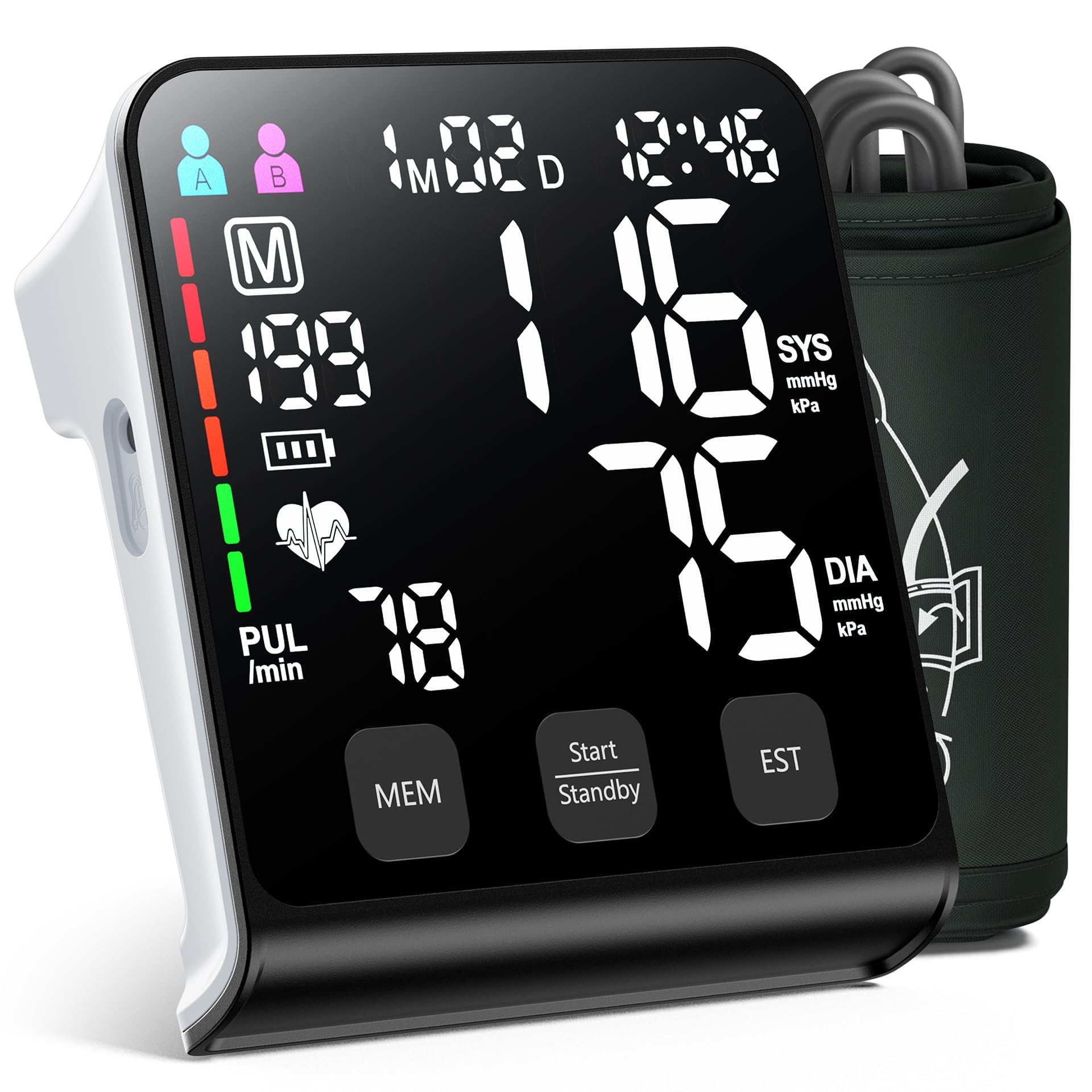
The Urion U80A features a 4.5-inch bright LED display that remains legible even in dim rooms or direct sunlight—a meaningful advantage for seniors who check blood pressure at dawn or during the night. The monitor is FDA-cleared and FSA/HSA eligible, with an error margin of ≤±3 mmHg and an intelligent pressure algorithm that adjusts automatically to the user’s arm.
Dual-user memory stores up to 199 readings per profile, making it one of the highest-capacity memory units available. The scratch-resistant acrylic front panel helps maintain screen clarity with frequent use, and the device powers via either 4 AAA batteries (included) or any USB-C cable. An irregular heartbeat alert provides additional peace of mind during each measurement session.
User feedback consistently praises the bright, oversized digits and the comfortable cuff design. The one-button start is genuinely simple, and several reviewers with arthritis or reduced grip strength found the cuff easier to secure than standard D-ring designs. The main trade-off is the absence of Bluetooth or app connectivity—all data logging is manual or relies on the built-in memory.
Why it’s great
- Bright 4.5-inch LED readable from across the room
- 199 readings per user with two separate profiles
- FDA-cleared with ≤±3 mmHg accuracy tolerance
Good to know
- No Bluetooth or digital export of data
- USB-C cable included but no wall adapter
- Price is higher than comparable non-connected monitors
FAQ
Does a digital sphygmomanometer need to be calibrated?
Can I use a digital monitor if I have atrial fibrillation?
How often should I take my blood pressure at home?
Final Thoughts: The Verdict
For most users, the best digital sphygmomanometer winner is the Braun ExactFit 2 because it combines clinically validated measure-while-inflate comfort, clear color-coded results, and a universally sized cuff at an accessible price point. If you want AFib detection and automatic app syncing for doctor reports, grab the OMRON Gold. And for households with both standard and extra-large arm sizes, nothing beats the ALPHAGOMED U80BH with its two included cuffs covering 9 to 21 inches.

Mo Maruf
I created WellFizz to bridge the gap between vague wellness advice and actionable solutions. My mission is simple: to decode the research and give you practical tools you can actually use.
Beyond the data, I am a passionate traveler. I believe that stepping away from the screen to explore new environments is essential for mental clarity and physical vitality.