Our readers keep the lights on and my smoothie glass nicely filled. As an Amazon Associate, I earn from qualifying purchases.
That muddy, lifeless sound from your factory car stereo isn’t a hardware limitation you have to live with. A digital sound processor strips away the factory equalization, applies time alignment to create a proper soundstage, and gives you per-channel control over crossovers and parametric EQ down to the exact frequency your speakers need.
I’m Mohammad Maruf — the founder and writer behind WellFizz. My research process here involved mapping the channel counts, bit depths, EQ bands, and signal routing flexibility across nine competing DSPs to identify which unit delivers measurable audio improvements without requiring a degree in acoustics to operate.
This guide breaks down the critical specs and real-world performance of today’s top models, helping you match the right processor to your system’s complexity and your tuning goals. Find the best digital sound processor for your build with the comparison table and in-depth reviews below.
How To Choose The Best Digital Sound Processor
Choosing a DSP isn’t about picking the most expensive unit. It’s about matching the right channel count, tuning depth, and integration features to your existing system and your tolerance for complexity. The wrong choice can leave you with a humming noise floor or a system you can’t properly tune.
Channel Count and System Architecture
The number of input and output channels defines what your DSP can do. A 2-input by 4-output unit like the Stetsom STX 2448 works for a basic front-stage plus subwoofer setup. An 8-output processor like the Dayton Audio DSP-408 allows an active 3-way front stage with subwoofer outputs. The AudioControl DM-810’s 8×10 matrix routing adds signal summing, essential for factory systems that combine multiple speaker wires into one signal path.
Equalizer Bands and Filter Precision
Graphic equalizers with fixed frequency bands are simpler but less precise. Parametric EQ lets you adjust center frequency, bandwidth (Q factor), and gain — critical for notching out a specific resonant peak in your vehicle. Look for at least 10-band parametric EQ per channel for serious tuning. The Behringer XR18’s 4-band PEQ per channel is impressive for a mixer, but a dedicated car DSP like the Rockford Fosgate DSR1 offers 31 bands per channel.
Input and Output Signal Handling
Factory head units often output speaker-level signals with built-in equalization that rolls off bass. A DSP with high-level (speaker-level) inputs and signal summing, such as the AudioControl DM-810’s AccuBASS, can restore lost low frequencies. Balanced differential inputs reject alternator whine better than single-ended RCA inputs, which matters in vehicles with noisy electrical systems.
Control Interface and Tuning Software
Some DSPs rely entirely on a Windows or macOS application for tuning, while others offer Bluetooth app control from your phone. The Dayton Audio DSP-408 has a capable PC GUI but a mobile app that lags in features. The Rockford Fosgate DSR1’s Perfect Tune app works on iOS and Android, but the Bluetooth setup process can be finicky. If you plan to make on-the-fly adjustments, prioritize a unit with a robust app or a wired remote.
Quick Comparison
On smaller screens, swipe sideways to see the full table.
| Model | Category | Best For | Key Spec | Amazon |
|---|---|---|---|---|
| AudioControl DM-810 | Premium | Factory system integration | 8×10 matrix with AccuBASS | Amazon |
| Rockford Fosgate DSR1 | Premium | iDatalink integration | 245 bands of EQ total | Amazon |
| Dayton Audio DSP-408 | Mid-Range | Active multi-way systems | 10-band PEQ per channel | Amazon |
| Banda Audiopart X8AiR | Mid-Range | Bluetooth app tuning | 79-band EQ per channel | Amazon |
| Audison bit Ten | Premium | OEM integration refinement | 31-band EQ per output | Amazon |
| PRV AUDIO DSP 2.8X | Entry-Level | Budget 8-channel control | 15-band graphic EQ | Amazon |
| Stetsom STX 2448 DSP PRO | Entry-Level | 2-way active with sequencer | 24 dB/octave crossover slope | Amazon |
| Behringer X AIR XR18 | Pro Audio | Live sound and studio mixing | 16 Midas preamps, 18 channels | Amazon |
| dbx DriveRack PA2 | Pro Audio | PA loudspeaker management | AutoEQ with RTA mic | Amazon |
In‑Depth Reviews
1. AudioControl DM-810
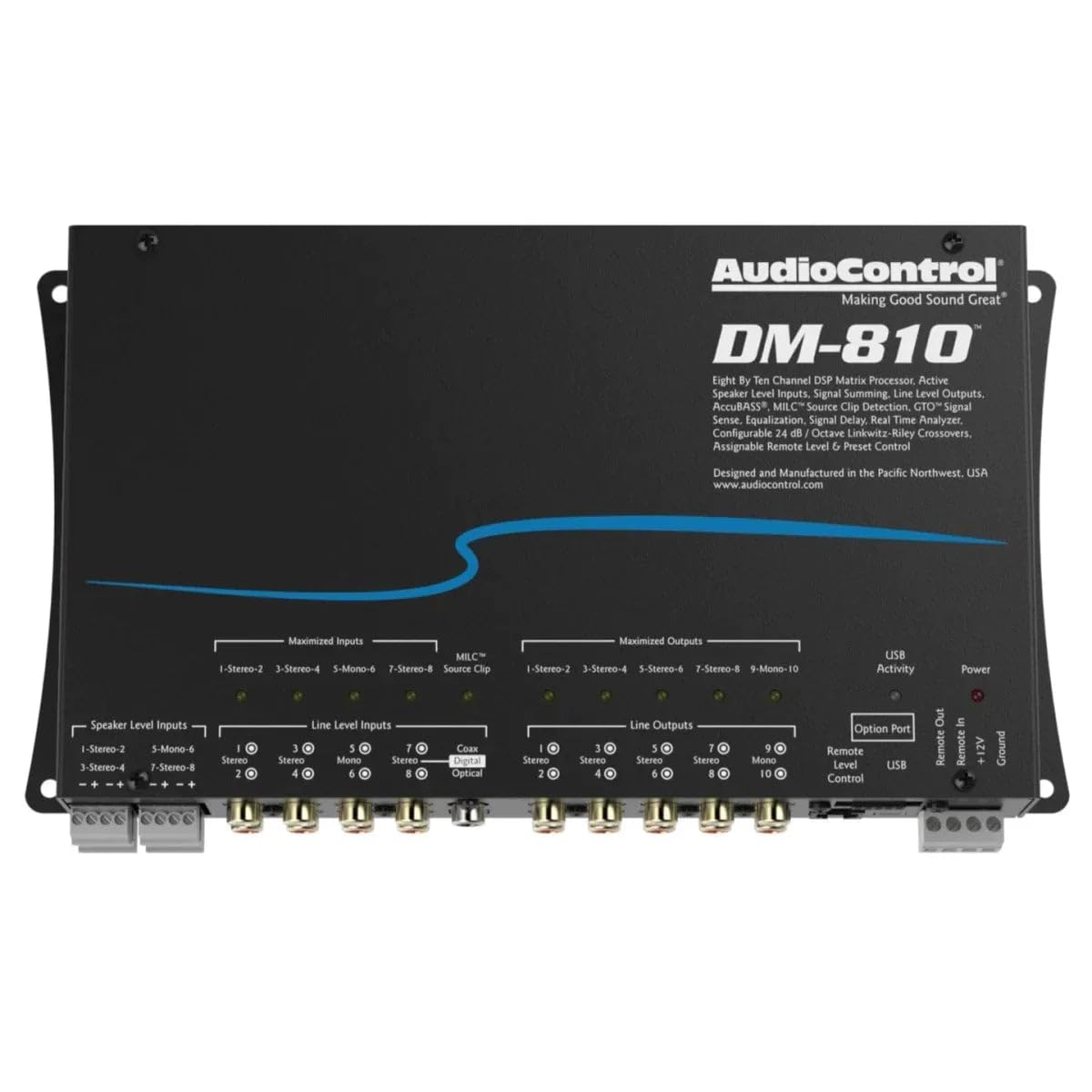
The AudioControl DM-810 sits at the top of the car audio DSP hierarchy because it solves the hardest problem: integrating with a factory radio that actively filters and equalizes its outputs. Its 8×10 matrix routing allows you to sum multiple input signals into a single full-range output, and the AccuBASS processing restores low-frequency content that modern factory head units deliberately roll off as volume increases. That 30-band auto-EQ with built-in RTA microphones makes room correction a guided process rather than guesswork.
Installation flexibility here is exceptional. The DM-810 accepts four sets of speaker-level inputs, four sets of RCA line-level inputs, plus S/PDIF and TOSLINK digital inputs. Its variable low-pass, bandpass, and high-pass crossovers are configurable per output pair. The MILC (Maximum Input Level Control) with clipping indicator prevents distortion before it reaches your amplifier. That said, the reliance on a laptop or PC for tuning via the DM Smart app is a workflow constraint — there is no native iPhone or iPad app for real-time adjustments on the go.
Customer feedback points to a learning curve for first-time DSP users, but those who invested the setup time report crystal-clear, extremely loud results with no static when wired correctly. The hissing noise mentioned in a minority of reviews typically traces back to ground loops or inadequate shielding on the input cables. For anyone running a complex factory-integrated system with multiple amplifiers, the DM-810 delivers the most complete set of signal correction tools in a single chassis.
Why it’s great
- AccuBASS recovers bass lost at higher volumes
- 8×10 matrix routing sums complex factory signals
- 30-band auto-EQ with RTA mic for precise tuning
- Multiple input types including digital TOSLINK
Good to know
- No native iOS app for mobile tuning
- Micro USB connection can become loose over time
- Premium price reflects pro-level features
2. Rockford Fosgate DSR1

The Rockford Fosgate DSR1 is the first DSP designed specifically to interface with Ford and Chrysler vehicles through the iDatalink Maestro module, allowing you to replace the factory amplifier while retaining factory knob controls, steering wheel buttons, and chime functions. Its processor architecture is derived from the Rockford 3Sixty.3, delivering 245 total bands of equalization across eight channels. Each output channel gets a 31-band graphic EQ, adjustable crossover with selectable slope up to 24 dB/octave, and up to 10ms of time alignment.
Signal input options include 4-channel high-level inputs with signal sense turn-on, 4-channel balanced differential inputs, auxiliary RCA, and SPDIF coaxial input. Bluetooth 4.0 connectivity enables wireless tuning through the Perfect Tune app on iOS or Android. The physical unit is compact at just over an inch tall, making it easy to hide under a seat or in the glove box. However, the initial setup process requires three firmware updates in a specific sequence, and the app’s Bluetooth pairing can be inconsistent — particularly on Android devices.
Owners consistently praise the dramatic improvement in sound quality when the DSR1 replaces a factory amplifier. The combination of high-level input processing and Maestro integration means you get a clean, low-level signal without losing any OEM functionality. The main trade-off is the steeper learning curve for the Perfect Tune software and the occasional need to reboot the unit by unplugging the harness if it locks up. For a direct OEM-replacement DSP that preserves every factory feature, this is the most targeted solution on the market.
Why it’s great
- Integrates with factory Ford/Chrysler systems via Maestro
- 245 total EQ bands for detailed tuning
- Compact form factor for flexible mounting
- Bluetooth wireless tuning via app
Good to know
- Setup requires specific firmware update sequence
- Android app is less reliable than iOS version
- Unit may need occasional power cycle to reboot
3. Dayton Audio DSP-408

The Dayton Audio DSP-408 occupies a unique sweet spot: eight output channels with a fully adjustable 10-band parametric EQ per channel, all at a price that competes with entry-level 4-channel units. Each of the eight output channels also gets independent level control, adjustable crossover filters (Butterworth, Linkwitz-Riley, Bessel) with selectable slopes, and delay adjustments up to 15 milliseconds. The channel routing matrix lets you mix any input to any output, which is critical for summing stereo signals into a mono subwoofer channel.
The PC-based graphical user interface is straightforward and responsive, giving you real-time visual feedback on EQ curves and crossover points. An optional Bluetooth dongle adds wireless streaming and basic app control, but the mobile app is notably less capable than the PC software — serious tuning should be done via laptop. The unit outputs approximately 2.5 to 3.5 volts RMS on its RCA outputs, which is sufficient for most aftermarket amplifiers. Some users report alternator whine when using RCA inputs, which can be resolved by using the high-level speaker input connections instead.
Customer experiences are overwhelmingly positive once the initial setup is dialed in. The DSP-408 is described as a “game changer” for hard-to-tune systems, allowing users to flatten frequency response and achieve concert-quality audio in vehicles with difficult acoustics. The sharp edges on the logo badge are a minor physical annoyance, and the turn-on noise — a brief pop — exists but is manageable with proper gain staging. For the channel count and parametric EQ depth, this is the strongest value proposition in the mid-range.
Why it’s great
- 10-band parametric EQ per output channel
- Flexible 4×8 matrix routing for complex systems
- PC software is responsive and feature-rich
- Excellent value for 8-channel active setups
Good to know
- Mobile app lags behind PC software in features
- RCA inputs can pick up alternator whine
- Sharp edges on the metal case
4. Banda Audiopart X8AiR
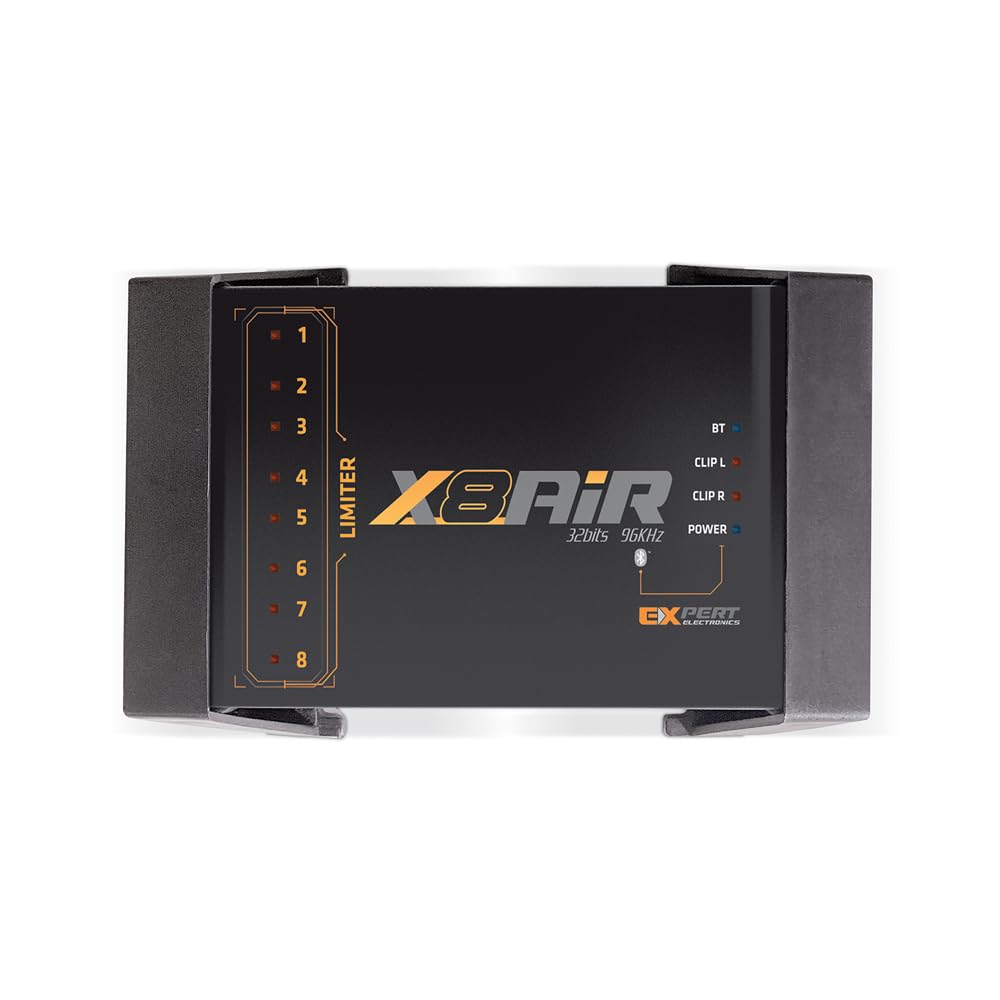
The Banda Audiopart X8AiR brings 32-bit/96kHz processing resolution to the mid-range price tier, offering 79 EQ bands per channel — significantly more than most competitors at this level. With 4 inputs and 8 outputs, it supports multi-amplifier configurations with component speakers and subwoofers. The on-board Bluetooth connects to a dedicated mobile app that allows real-time adjustment of EQ curves, crossover points, limiter settings, and channel gains from your smartphone, eliminating the need for a laptop during tuning sessions.
The user interface on the app is intuitive according to customer feedback, with a short learning curve for those who understand what a DSP does. The 79-band equalizer provides very fine frequency control, allowing you to target specific problem frequencies without affecting adjacent bands. However, there are no physical on-board controls — only clipping indicator lights — so tuning is entirely dependent on the app or a laptop connection.
Real-world performance reports from owners show dramatic improvements in sound quality, particularly in vehicles like Jeeps where acoustics are notoriously poor. The time alignment feature tightens bass response and creates a believable center image. The Bluetooth connection can take a few tries to pair initially, and some users note a low-level background hiss that disappears at normal listening volumes. For the processing power and EQ resolution, the X8AiR is a strong mid-range option for anyone who prefers app-based tuning over PC software.
Why it’s great
- 79-band EQ per channel for precision tuning
- 32-bit/96kHz high-resolution processing
- Bluetooth app control for on-the-fly adjustments
- Very compact and lightweight for easy mounting
Good to know
- No physical controls or display on the unit
- Bluetooth pairing can be finicky initially
- Low-level hiss may be present at very low gain
5. Audison bit Ten

The Audison bit Ten is a signal interface processor specifically engineered for OEM integration, accepting 4 high-level speaker inputs and outputting 5 channels with independent 31-band graphic equalizers per output. Each output channel also features a selectable crossover filter (Full, Hi-Pass, Low-Pass, Band-Pass) with Linkwitz-Riley slopes at 12 or 24 dB/octave. The processing architecture is designed to flatten and correct the signal from a factory head unit, removing built-in equalization curves that compromise aftermarket speaker performance.
Physical build quality is characteristic of Audison’s Italian design standards, with a compact aluminum chassis that weighs about 0.6 kilograms. The USB interface connects to a Windows-only software suite that provides deep customization of every parameter. Customers frequently mention that professional installation is advisable because tuning the bit Ten is a complex, time-consuming process — but the results are described as “amazing” and “a great improvement in overall sound.”
The bit Ten works well in systems where the factory head unit is retained but significant sound quality upgrades are desired. One owner reported using it with a JL Audio 5-channel amp and Focal speakers in a Toyota 4Runner, achieving clean, powerful sound. A notable limitation is that the software is restricted to Windows, and extreme cold temperatures (below -15°F) have been reported to cause the unit to emit a loud square wave, requiring a system reset. For a refined, purpose-built OEM interface with excellent equalization depth, the bit Ten commands its premium positioning.
Why it’s great
- 31-band graphic EQ per output for precise tuning
- Optimized for OEM head unit integration
- High-quality Audison build and components
- Linkwitz-Riley crossover slopes at 12 or 24 dB/oct
Good to know
- Windows-only tuning software
- Complex tuning requires professional installation
- May malfunction in extreme cold temperatures
6. PRV AUDIO DSP 2.8X

The PRV AUDIO DSP 2.8X is an entry-level 8-channel processor that focuses on accessibility. Its 16×2 character LCD display and physical button interface let you make adjustments without a phone, tablet, or laptop — a distinct advantage for users who prefer tactile control. The unit features 2 audio inputs (A and B) and 8 channel crossover independent outputs, and allows you to select audio source A, B, or A+B for each output individually. The integrated 15-band graphic equalizer includes 12 presets (Flat, Loudness, Bass Boost, Rock, Hip Hop, and more) plus manual tuning.
What sets the PRV apart at this price is its sequencer feature. The remote trigger connection (REM) allows sequential turn-on of multiple amplifiers or accessories, eliminating the “thump” that occurs when all amps power on simultaneously. Each input and output channel gets a parametric equalizer with gain control, specific frequency setting, and bandwidth adjustment — a surprising level of fine-tuning capability for a budget device. Owners report excellent results after a “break-in” period and initial tweaking, with time alignment dramatically improving subwoofer performance.
Customer reviews consistently highlight this DSP as an outstanding value for basic, effective signal processing. The intuitive interface and on-board controls reduce the intimidation factor for first-time DSP users. Some reviews note that patience is required during the setup process, and the unit runs warm when mounted in enclosed spaces — adequate ventilation is necessary. For a no-frills, hands-on DSP that gives you eight channels of control without requiring external software, the PRV 2.8X is the most cost-effective entry point in this lineup.
Why it’s great
- On-board LCD display and physical controls
- Sequencer remote prevents startup thump
- 12 EQ presets plus manual tuning
- Budget-friendly entry into 8-channel DSP
Good to know
- Requires patience and break-in period for best sound
- Runs warm, needs ventilation
- 15-band graphic EQ is less precise than parametric
7. Stetsom STX 2448 DSP PRO

The Stetsom STX 2448 DSP PRO is a 2-input, 4-output processor aimed at users building a 2-way active front stage with a subwoofer. Its 15-band graphic equalizer, variable crossover frequencies with selectable slopes (12, 18, 24, 36, and 48 dB/octave), and delay adjustments give you the tools to create a coherent soundstage without overwhelming complexity. The sequencer amp remote activation is a welcome feature, preventing the loud pop that can damage speakers during startup.
The intuitive LCD interface with screensaver and password lock provides local control, and the compact form factor (7.9 x 4 x 1.5 inches) makes installation straightforward. However, the signal routing is limited to mono pair processing — input L goes to channels 1 and 3, input R goes to channels 2 and 4. This routing restriction means the STX 2448 is not ideal for systems that require stereo signal routing to specific output pairs. Each output pair gets only one parametric EQ band, which limits notch filtering capability.
Customer reviews are strongly positive, with users praising the crystal-clear sound quality and powerful bass reproduction when the DSP is properly tuned. The consensus is that complaints about poor performance typically stem from user error rather than hardware limitations. The Stetsom works particularly well with JL Audio amplifiers and in systems where the user understands the mono-routing architecture. For a dedicated 2-way active setup with a sub, this DSP delivers excellent value and feature density at its price point.
Why it’s great
- Varied crossover slopes up to 48 dB/octave
- Sequencer for thump-free startup
- Compact size with clear LCD display
- Excellent performance in 2-way active setups
Good to know
- Signal routing is limited to mono pairs
- Only 1 parametric EQ band per output pair
- Not suitable for complex multi-way systems
8. Behringer X AIR XR18

The Behringer X AIR XR18 is an 18-input, 12-bus digital mixer controlled via iPad or Android tablet, making it a fundamentally different product from dedicated car audio DSPs. Its 16 MIDAS-designed programmable mic preamps deliver audiophile-quality input gain, while the built-in Tri-mode Wi-Fi router enables direct tablet control without external networking equipment. The XR18 functions as an 18×18 bidirectional USB audio interface for multitrack recording, and its rack effects suite — including compression, gating, and 4-band parametric EQ per channel — rivals outboard processing hardware.
For live sound reinforcement, the XR18’s channel count and bus routing provide complete control over monitor mixes, effects sends, and main outputs. The 8 XLR outputs can feed multiple amplifier zones or stage monitors independently. The built-in Wi-Fi, while convenient for small gigs, has been noted as potentially flaky for critical performances — wired Ethernet connection is recommended for high-stakes situations. The unit lacks dedicated time-alignment features found in car audio DSPs, though creative use of effects processing can approximate delay functions.
Customer reviews overwhelmingly praise the XR18 as the best value in digital mixers, with users calling it “unbelievable capability for an unparalleled price.” The iPad app is intuitive, and the unit supports the popular MixStation third-party app for expanded control. The rack-mountable 3U form factor and rugged housing make it stage-ready. For musicians, sound reinforcement engineers, and studio users who need a full digital mixing console in a small footprint, the XR18 is the obvious choice — but it is not a direct replacement for a car audio DSP.
Why it’s great
- 16 Midas mic preamps for exceptional input quality
- 18×18 USB audio interface for multitrack recording
- Full digital mixer with rack effects and 8 outputs
- Tablet-controlled with built-in Wi-Fi
Good to know
- Not optimized for dedicated car audio time alignment
- Built-in Wi-Fi can be unreliable for critical gigs
- Larger form factor than dedicated car DSPs
9. dbx DriveRack PA2

The dbx DriveRack PA2 is a 2×6 loudspeaker management system purpose-built for PA applications. Its core function is to protect speakers, eliminate feedback, and tune a venue’s acoustics automatically. The new AutoEQ algorithm uses an included RTA microphone to listen to the room, automatically set speaker levels, and apply equalization corrections in seconds. This automated process makes it significantly easier for non-engineers to achieve professional results in live sound environments.
Feedback elimination is handled by the updated Advanced Feedback Suppression (AFS) algorithm, which anticipates and suppresses feedback before it becomes audible without altering the system’s tonal character. The setup Wizard guides users through level balancing, AutoEQ, and AFS configuration, with access to speaker tunings from major manufacturers that update continuously. The unit outputs 6 XLR channels for stereo tri-amp or mono setups, giving you granular crossover control between subwoofers, mids, and highs.
Control is available via Android, iOS, Mac, or Windows devices through Ethernet connection, with a TP-Link nano router enabling wireless operation from a smartphone. The 1U rack-mount form factor is compact, though the display is small and navigation is menu-driven. Customers love the transformation in sound quality and the peace of mind provided by the limiter, which prevents amplifier clipping and speaker damage. The parametric EQ is less configurable than some competing processor units, but the automated tools and feedback suppression make the PA2 the best choice for live sound venues and touring setups.
Why it’s great
- Automated AutoEQ with RTA mic for fast tuning
- Advanced Feedback Suppression prevents howling
- Setup Wizard guides users step by step
- Multi-platform control via Ethernet or Wi-Fi
Good to know
- Small 1U display can be difficult to read
- Parametric EQ less powerful than competing processors
- Requires external router for wireless control
FAQ
Why do I need a DSP if I already have a good amplifier?
Can I use a Behringer XR18 as a car audio DSP?
What is AccuBASS and why does it matter?
How many output channels do I really need?
Final Thoughts: The Verdict
For most users, the best digital sound processor winner is the AudioControl DM-810 because its 8×10 matrix routing, AccuBASS processing, and 30-band auto-EQ with RTA mic solve the most common factory integration problems without compromise. If you want Bluetooth app-based tuning and high-resolution 32-bit/96kHz processing, grab the Banda Audiopart X8AiR. And for a pure value play with 10-band parametric EQ per channel on a budget, nothing beats the Dayton Audio DSP-408.

Mo Maruf
I created WellFizz to bridge the gap between vague wellness advice and actionable solutions. My mission is simple: to decode the research and give you practical tools you can actually use.
Beyond the data, I am a passionate traveler. I believe that stepping away from the screen to explore new environments is essential for mental clarity and physical vitality.