Our readers keep the lights on and my smoothie glass nicely filled. As an Amazon Associate, I earn from qualifying purchases.
Your factory rearview mirror is a hazard. Between towering headrests, dark window tints, cargo stacks, and the constant glare of headlights, the view behind you is a guessing game. Upgrading to a digital rear view mirror replaces that guesswork with a live, high-definition camera feed that shows you everything — regardless of what is piled in the back seat or how blinding the traffic is.
I’m Mohammad Maruf — the founder and writer behind WellFizz. I’ve spent countless hours analyzing the hardware specifications of dozens of digital rear view mirrors, comparing image sensor quality, display resolutions, connectivity protocols, and real-world installation compatibility to isolate the models that actually deliver on their promises.
Whether you drive a full-size truck, a minivan, or a sedan, finding the best digital rear view mirror means balancing video clarity, field of view, and smart features against the specific dimensions of your vehicle and your tolerance for wiring work.
How To Choose The Best Digital Rear View Mirror
Not all digital rear view mirrors are built alike. A mirror that looks crisp in a product video might wash out in direct sunlight or fail to resolve a license plate at 30 feet. Before you buy, you need to match the hardware to your specific driving environment — your typical light conditions, your vehicle’s mounting space, and your tolerance for semi-permanent wiring.
Front and Rear Camera Resolution
The front camera captures what you see through the windshield; the rear camera feeds the mirror display. The front should be at least 2K QHD — 4K gives you sharp license plate capture at higher speeds. The rear camera does not need to match the front: a 1080P rear is adequate for most passenger cars, but a 2.5K rear is noticeably sharper on the 12-inch screen, especially when zoomed in during parking or lane changes.
Image Sensor Generation (STARVIS vs STARVIS 2)
The Sony STARVIS series is the gold standard for automotive camera sensors. The first generation STARVIS handles low-light well; STARVIS 2 roughly doubles the sensitivity, reducing noise in near-dark conditions and preserving color instead of switching to grayscale. If you drive often after sunset or park in unlit lots, STARVIS 2 is worth the premium.
Installation Method — Straps vs OEM Brackets
Universal mirror models use rubber straps that stretch over your existing mirror. This works for most factory mirrors wider than 16cm but can wobble on rough roads. OEM replacement brackets bolt directly into your vehicle’s factory mounting points — they look cleaner and stay rock-solid. The trade-off is compatibility: bracket-based mirrors fit specific vehicle families and take 45–60 minutes to install.
Connectivity — CarPlay, Android Auto, and WiFi
Built-in CarPlay and Android Auto let the mirror double as a navigation and media hub, saving you from replacing your car’s stereo. Standalone WiFi models connect to an app for video transfer and settings but do not offer infotainment features. Decide whether you want a dedicated driving assistant or a silent recorder that only surfaces footage when needed.
Quick Comparison
On smaller screens, swipe sideways to see the full table.
| Model | Category | Best For | Key Spec | Amazon |
|---|---|---|---|---|
| Pelsee P12 Pro Max | Digital Mirror | Best Overall | 4K+2.5K, Dual STARVIS 2 | Amazon |
| Roadwitness Dual 4K | Digital Mirror | Premium Sensor Tech | Dual Sony STARVIS 2 IMX678 | Amazon |
| KOUENOM 4K | Digital Mirror | Best Value with CarPlay | 4K front / 1080P rear | Amazon |
| JOMISE K17 Pro | Digital Mirror | New Driver Safety | 2.5K with 3x Zoom | Amazon |
| LINGDU LD4K | Digital Mirror | ADAS & Blind Spot | 4K+2.5K, ADAS/BSD | Amazon |
| KBD OEM Bracket | Digital Mirror | Clean OEM Fit | 2K front / 1080P rear | Amazon |
| AZDOME PG17 Pro | Digital Mirror | Mid-Range STARVIS 2 | 4K+2.5K, STARVIS 2 | Amazon |
| Vantrue N4 Pro S | Digital Mirror | 3-Channel Coverage | 4K+2.5K+1080P triple | Amazon |
| WOLFBOX G900 PRO | Digital Mirror | STARVIS 2 Premium | 4K+2.5K, IMX678 | Amazon |
In‑Depth Reviews
1. Pelsee P12 Pro Max
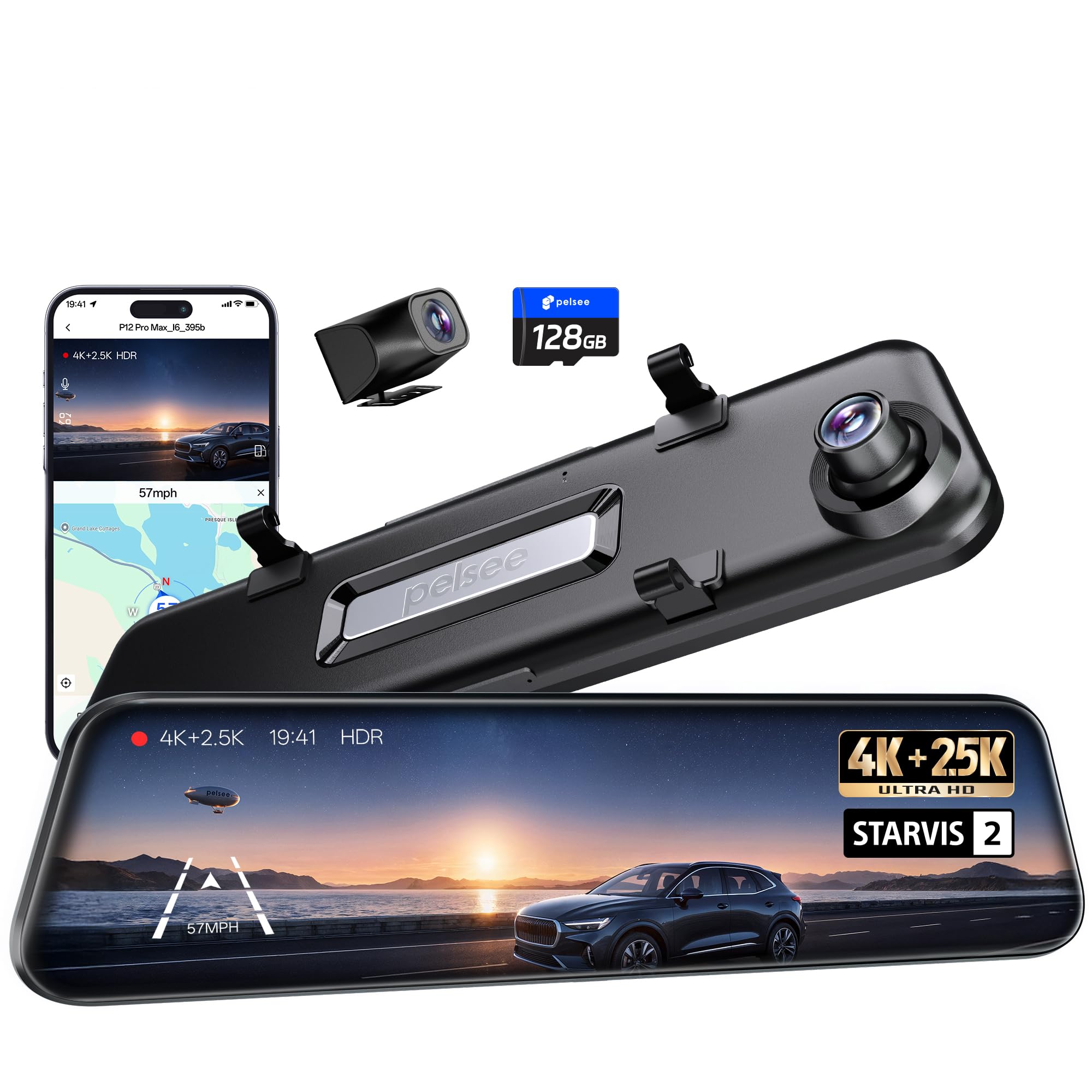
The Pelsee P12 Pro Max sets the benchmark for a fully-loaded digital rear view mirror by pairing a front STARVIS 2 IMX678 sensor (true 4K at 30fps) with a rear STARVIS IMX335 sensor (2.5K). This dual-sensor configuration captures roughly twice the light of standard sensors, producing usable footage in conditions where other mirrors descend into grainy silhouettes. The 12-inch IPS screen handles the 4K+2.5K feed without perceptible lag, and the included 128GB card means you are recording from the first start.
Beyond raw video, the P12 Pro Max integrates ADAS voice alerts for forward collisions, lane departures, and pedestrian detection, plus a dedicated BSD (Blind Spot Detection) algorithm that monitors zones your side mirrors miss. The included OBD hardwire kit simplifies parking mode installation — you plug into your car’s OBD-II port rather than splicing into the fuse box, and the low-voltage cutoff at 11.8V prevents battery drain.
The rear camera cable has been upgraded to 33 feet, which is generous enough for full-size SUVs, trucks, and even RVs with long wheelbases. Color night vision during time-lapse parking surveillance is a genuine differentiator — most competitors switch to black-and-white in low light. On the downside, some users report that the rear camera mirror setting resets after entering time-lapse mode, requiring a manual re-toggle; a firmware update may resolve this.
Why it’s great
- Dual STARVIS sensors deliver exceptional low-light clarity front and rear
- OBD hardwire kit included — no separate purchase needed for parking mode
- Full-color night vision during parking surveillance
- 33-foot rear cable fits large vehicles without extension adapters
Good to know
- Time-lapse parking mode can flip rear camera orientation — may require manual adjustment
- BSD and ADAS alerts can trigger false positives on winding roads
2. Roadwitness Dual 4K
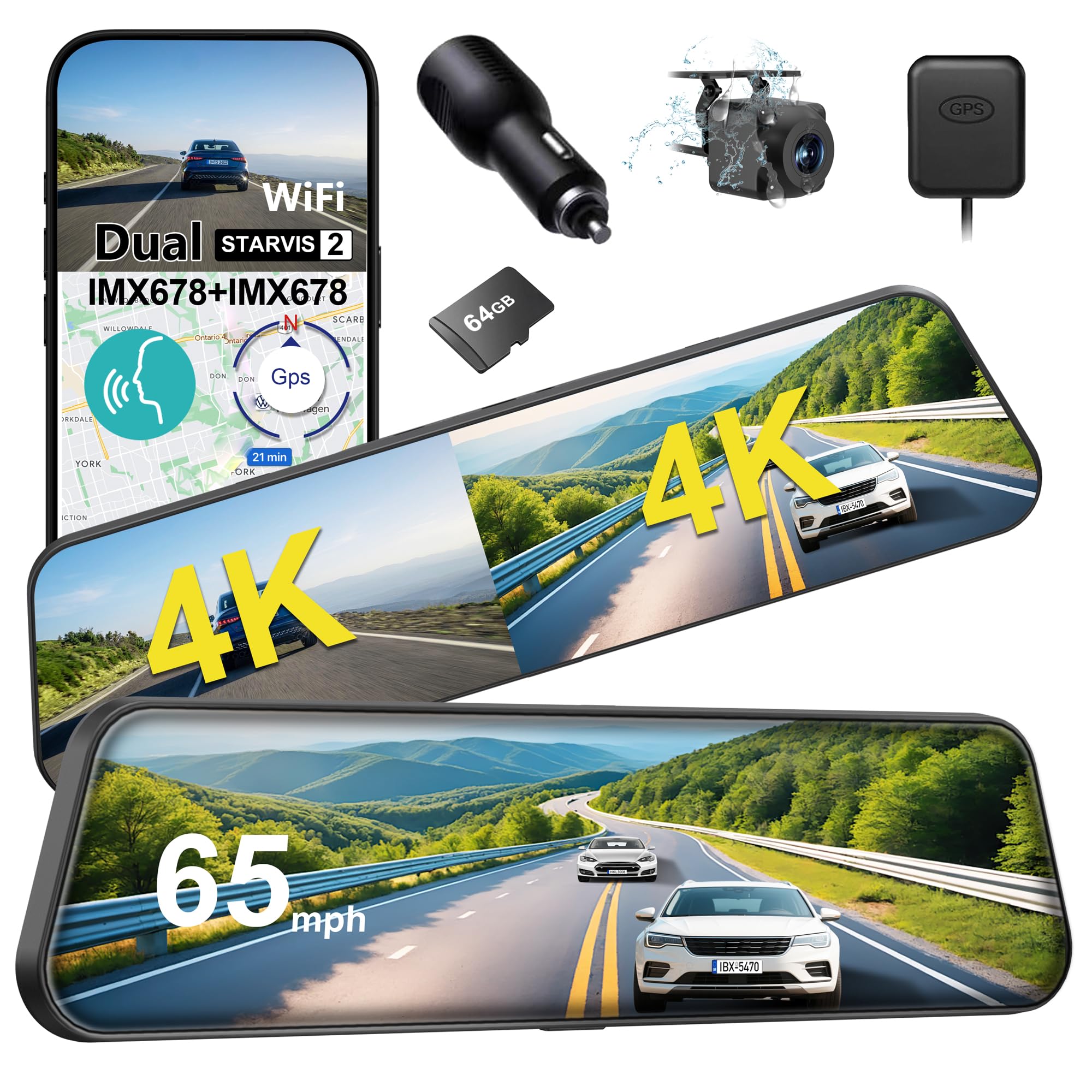
The Roadwitness earns its premium spot by putting a Sony STARVIS 2 IMX678 sensor behind both the front and rear lenses — true dual-4K recording at 30fps. Most mirrors in this price range downgrade the rear camera to 2.5K or 1080P, but the Roadwitness maintains identical resolution front and back, which matters if you rely on the digital mirror feed as your primary rear view rather than a backup assist. The 7-glass lens elements on each camera reduce chromatic aberration and flaring from direct headlights.
The 170-degree field of view covers six lanes of traffic, effectively eliminating blind spots on multi-lane highways. The STARVIS 2 HDR and WDR combination handles extreme transitions — think tunnels to bright sun or oncoming high beams — without washing out the license plates of vehicles directly behind you. The mirror body itself is relatively thin at 12 inches wide and just over half an inch thick, so it sits close to the windshield without blocking your sun visor range.
Parking mode requires a separately purchased hardwire kit, and the anti-glare coating on the screen gives the display a slightly dark tint when the unit is off, which some users find distracting. The touchscreen interface has a learning curve — the icons are small and the menu layout is not immediately intuitive. Still, for raw video fidelity, the dual-4K Roadwitness is the sharpest option in this lineup.
Why it’s great
- True 4K+4K recording — rear camera matches front camera resolution
- 170° ultra-wide lens covers six lanes with minimal barrel distortion
- STARVIS 2 HDR and WDR preserve plate readability in extreme lighting
- Thin profile fits tight windshield gaps
Good to know
- Hardwire kit for parking mode sold separately
- Touchscreen menu can feel cramped and unintuitive at first
3. KOUENOM 4K
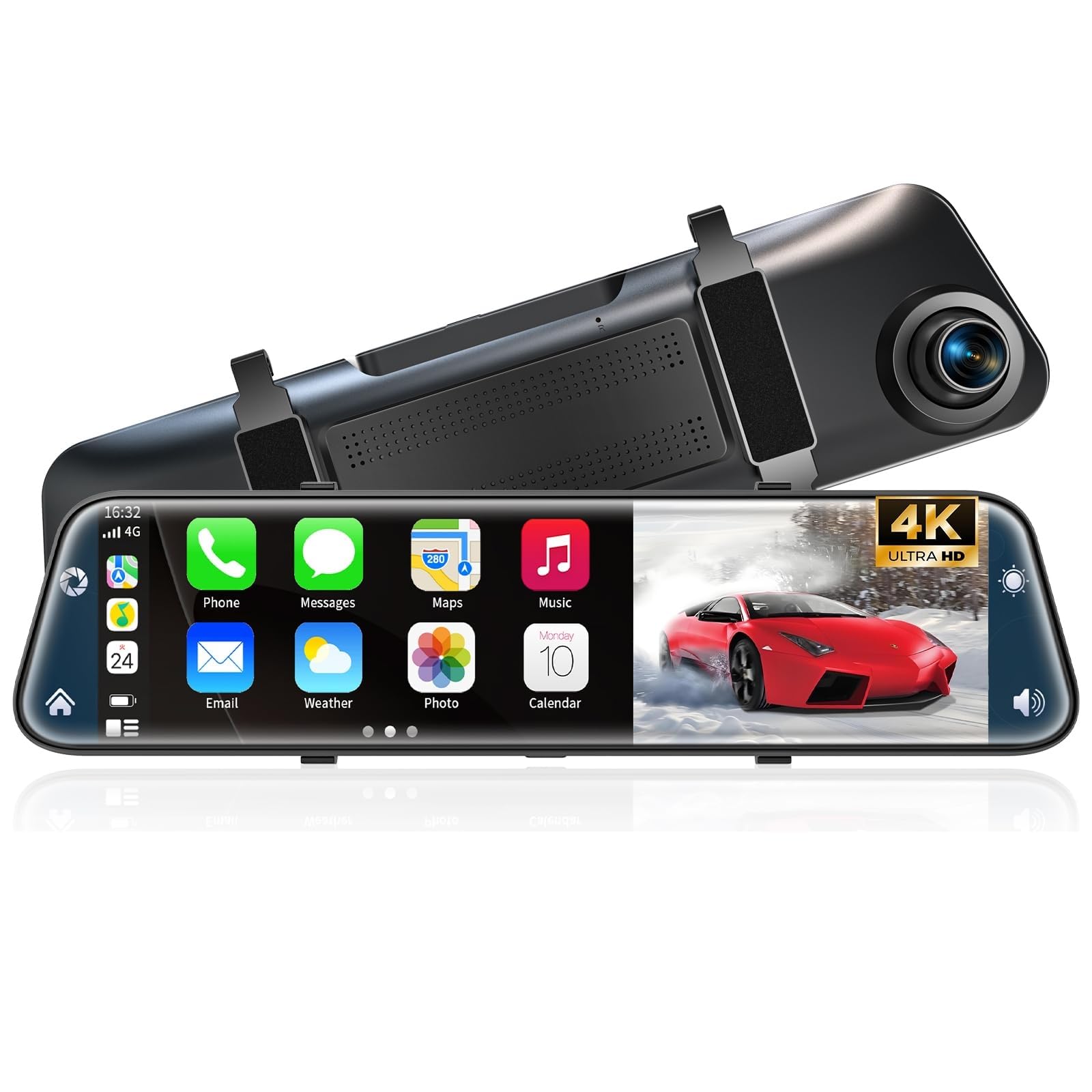
The KOUENOM 4K punches well above its price tier by bundling wireless CarPlay and Android Auto into a 12-inch mirror that records 4K front footage and 1080P rear footage. For drivers of older vehicles who want smartphone mirroring without replacing the entire dashboard head unit, this is the most cost-effective gateway. The Bluetooth connection to CarPlay takes about 15 seconds to sync on startup, and the split-screen mode lets you run a map on one half while keeping the rear camera feed visible on the other.
Video quality from the front 4K camera is surprisingly crisp for the price point, with a 170-degree front angle and a 140-degree rear angle that collectively reduce blind spots. The 64GB card is pre-installed and pre-formatted — you can start recording immediately without any extra setup. Voice control responds to commands like “show rear camera” and “take photo,” which keeps your hands on the wheel during operation.
Strap-based installation is straightforward but requires your factory mirror to be longer than 16cm — smaller mirrors may not hold the straps securely. The touchscreen is responsive but has a slight processing lag when switching between CarPlay apps. Reports of occasional freezes and GPS signal loss after extended use suggest that long-term reliability is not as consistent as higher-priced competitors.
Why it’s great
- Wireless CarPlay and Android Auto integration at an entry-level price
- 64GB card pre-installed, ready to record out of the box
- Split-screen mode keeps rear view visible alongside navigation
- Four audio output options: FM, AUX, Bluetooth, or built-in speaker
Good to know
- Factory mirror must be longer than 16cm for secure strap mounting
- Occasional GPS signal dropout and screen freezing reported
4. JOMISE K17 Pro

The JOMISE K17 Pro targets newer drivers with a 12-inch touchscreen that includes a 3x digital zoom on the rear camera — useful for reading license plates during parallel parking or when a car is tailgating. The 2.5K front recording (2560×1440 at 30fps) provides a step up from standard 1080P without demanding the storage space of 4K, making the included 64GB card last longer between overwrites. The rear camera also supports mirror-flip in the settings menu, which is critical for maintaining correct left-right orientation when the camera is mounted on a hatchback or trunk lid.
The CarPlay and Android Auto mirroring works across cars, trucks, and EVs, and the auto-start recording feature fires up the moment the ignition turns on — no manual button presses needed. The reversing assist triggers the rear camera feed automatically when you shift into reverse, overlaying optional grid lines to help with parking alignment. The G-sensor locks footage on impact, and the GPS module logs your route and speed.
A few users note that the power cord lacks an on/off switch, so the mirror continues drawing power from the cigarette lighter socket unless you physically unplug it. Additionally, the rear camera zoom is digital rather than optical, so image quality degrades noticeably at maximum magnification. For everyday use without zoom, the K17 Pro delivers smooth and reliable performance.
Why it’s great
- 3x digital zoom on rear camera helps identify plates and objects
- Auto-start recording with ignition — no manual action required
- Clean, lag-free CarPlay interface with split-screen support
- Retains OEM Bluetooth and steering wheel controls
Good to know
- No power switch — must unplug to prevent continuous draw
- Digital zoom degrades image sharpness at higher magnifications
5. LINGDU LD4K
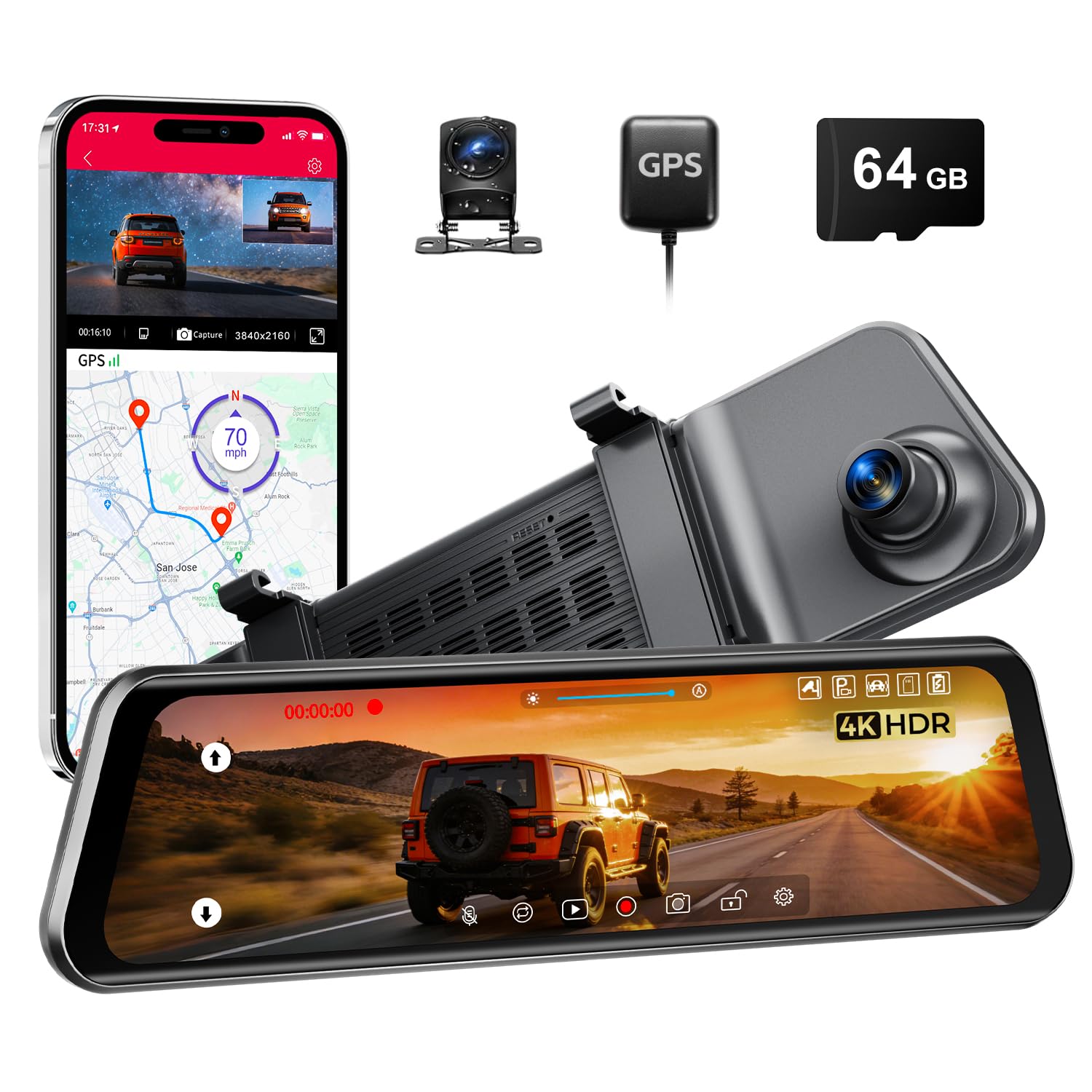
The LINGDU LD4K distinguishes itself with a full suite of driver-assistance features: ADAS (forward collision, lane departure, pedestrian, front vehicle movement, and safe distance alerts) plus BSD (Blind Spot Detection) and LCA (Lane Change Assist). The system uses audio and visual warnings to flag hazards before you register them, which is genuinely helpful in heavy traffic where glance durations are short. The front camera records at 4K UHD (3840×2160 at 30fps) using an 8MP sensor, while the rear records at QHD 2.5K (2560×1440 at 30fps) using a 3.7MP sensor.
The 5.8GHz WiFi module transfers footage to the LINGDU app at speeds up to 20MB/s, which makes downloading a three-minute clip a matter of seconds rather than minutes. The 64GB card is included and supports expansion up to 512GB for extended recording. Voice control recognizes ten commands including “Turn on WiFi,” “Take snapshot,” and “Lock video,” covering the most common actions without distracting menu navigation.
One limitation is the anti-glare protective film, which some users report makes the screen unusable as a standard reflective mirror when the display is off — you lose depth perception and objects appear farther than they are. The LINGDU relies entirely on the camera feed for rear visibility, so if the screen is off, you have no functional mirror. The parking monitor requires a separate hardwire kit. For drivers who prioritize active safety alerts over mirror versatility, this is a strong contender.
Why it’s great
- ADAS, BSD, and LCA provide real-time collision and lane-change warnings
- 5.8GHz WiFi enables fast app-based video downloads
- 10 intuitive voice commands cover essential functions
- Front 4K and rear 2.5K capture at 30fps with good detail
Good to know
- Anti-glare film kills reflective mirror function — camera feed is the only view
- Parking monitor requires separate hardwire kit purchase
6. KBD OEM Rearview Mirror Dash Cam
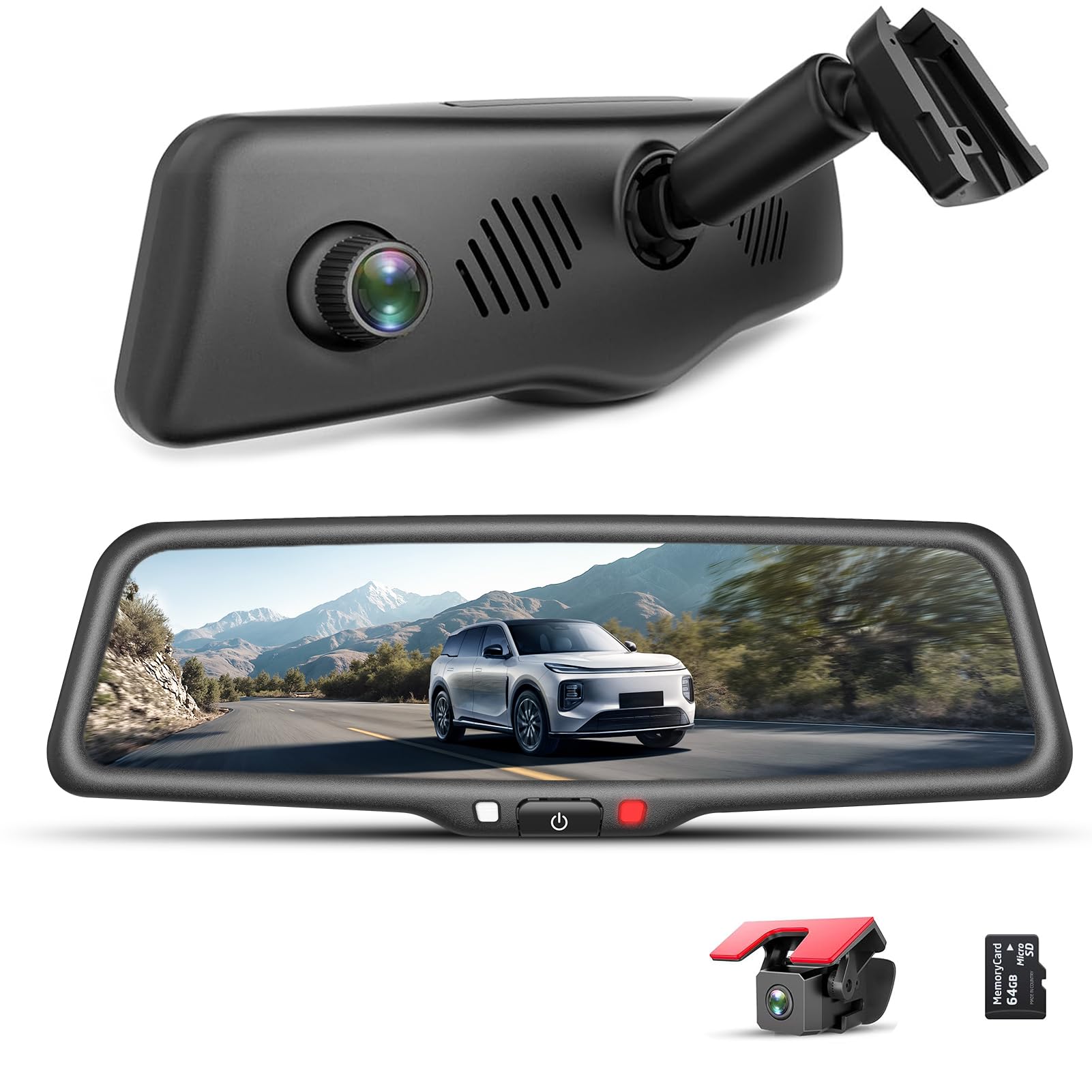
The KBD is the only mirror in this roundup that ships with a dedicated OEM bracket designed to bolt onto your factory mounting points rather than relying on rubber straps. This eliminates the sag and vibration that plague universal mounts on bumpy roads. It comes with four bracket adapters plus an extended mounting arm, covering 90% of vehicles including the Ford F-150, Chevy Silverado, RAM 1500, Toyota RAV4, and Honda CR-V. The 9.66-inch IPS touchscreen is smaller than the 12-inch competitors, but the trade-off is a unit that sits closer to the windshield and looks factory-installed.
The front camera uses a 2K QHD Sony IMX307 sensor with HDR and WDR to prevent headlight washout at night. The rear camera is 1080P with an IP68 waterproof rating — it survives rain, snow, and automatic car washes without fogging. The built-in WiFi app lets you view, download, and share recordings wirelessly without removing the SD card, though it does not include CarPlay or Android Auto. The parking monitor is hardwire-ready with an intelligent voltage cutoff at 11.8V to protect your starter battery.
Installation takes 45 to 60 minutes and requires basic hand tools plus running a single power cable and the rear camera wire. The 64GB card is pre-formatted and included. The KBD’s IMX307 sensor is one generation behind STARVIS 2, so low-light performance is adequate but not class-leading. The lack of CarPlay is a meaningful omission for drivers who wanted an all-in-one infotainment solution.
Why it’s great
- Vehicle-specific bracket eliminates vibration and sag — cleaner than strap mounts
- IP68 waterproof rear camera survives harsh weather and car washes
- HDR+WDR prevents headlight washout for usable night footage
- Intelligent voltage cutoff protects battery during parking monitoring
Good to know
- No CarPlay or Android Auto — app-only connectivity
- IMX307 sensor is less sensitive in low light than STARVIS 2 alternatives
7. AZDOME PG17 Pro
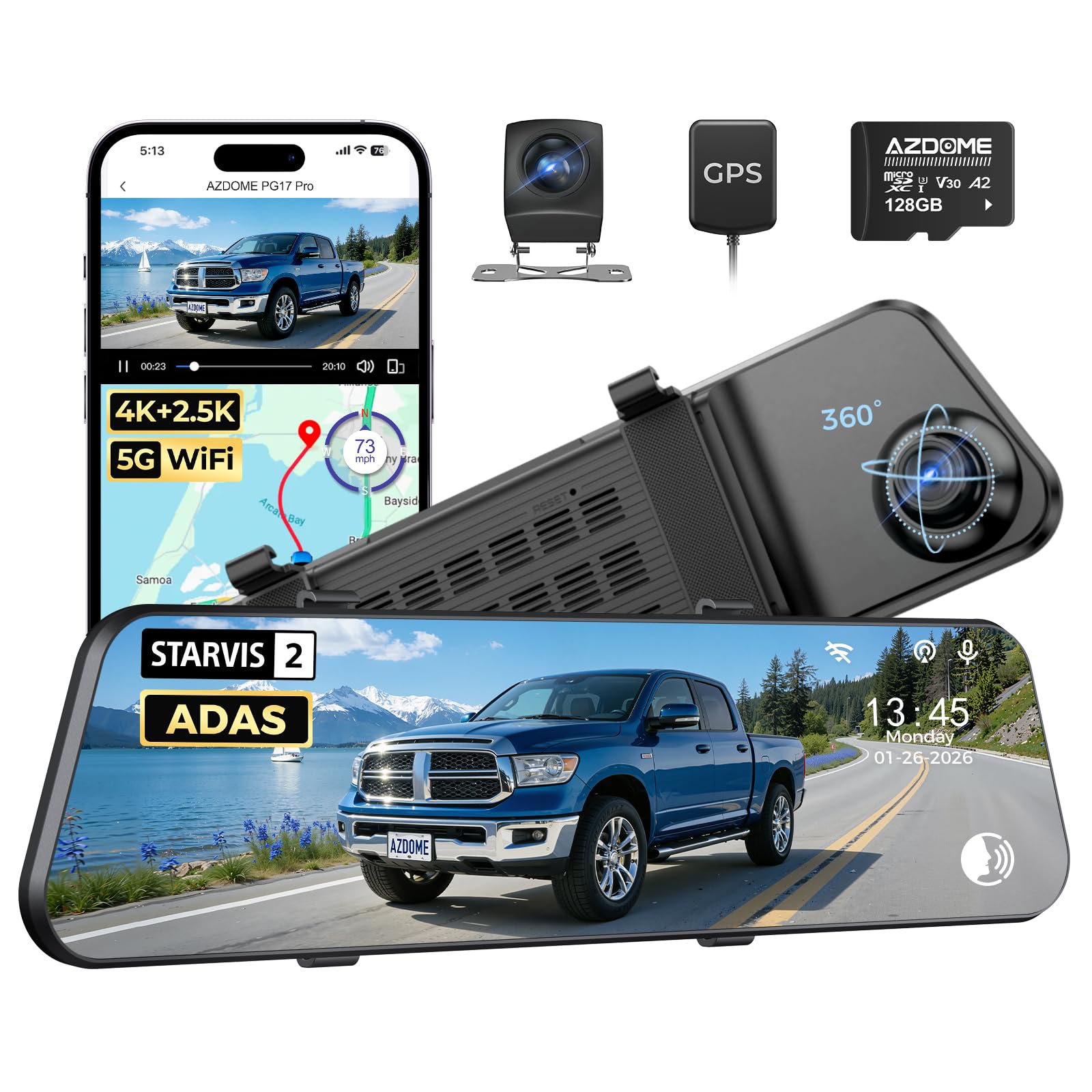
The AZDOME PG17 Pro brings a STARVIS 2 IMX678 front sensor and a 2.5K HDR rear camera into a 12-inch form factor at a mid-range price that undercuts most dual-STARVIS competitors. The front 4K UHD footage is bright and stable in low light, with the STARVIS 2 sensor pulling detail from shadows that first-gen sensors miss. The rear 2.5K HDR recording balances exposure when the sun is behind you, keeping license plates readable rather than turning them into black rectangles.
ADAS provides voice alerts for collision risk, lane departure, and following distance — though the tone is somewhat robotic and can be difficult to understand over road noise. The voice control system recognizes commands for recording, photo capture, and screen switching, and responds quickly enough to be useful without distraction. The 5.8GHz WiFi module pairs with the AZDOME app for quick downloads and settings adjustment.
The included 128GB card is double the capacity of most competitors at this price, and the 170-degree front field of view is wide without producing extreme fisheye distortion. The touchscreen interface has a slight lag — not enough to interfere with live video, but noticeable when swiping through menus. The G-sensor and loop recording work reliably, and the parking monitor (hardwire kit required) supports buffered recording.
Why it’s great
- STARVIS 2 IMX678 front sensor for strong low-light performance
- 128GB card included — double the capacity of most mid-range mirrors
- 5.8GHz WiFi for fast app-based transfers
- 170-degree wide-angle front view with minimal fisheye
Good to know
- Touchscreen has a slight processing lag when navigating menus
- ADAS voice alerts can be hard to understand over road noise
8. Vantrue N4 Pro S
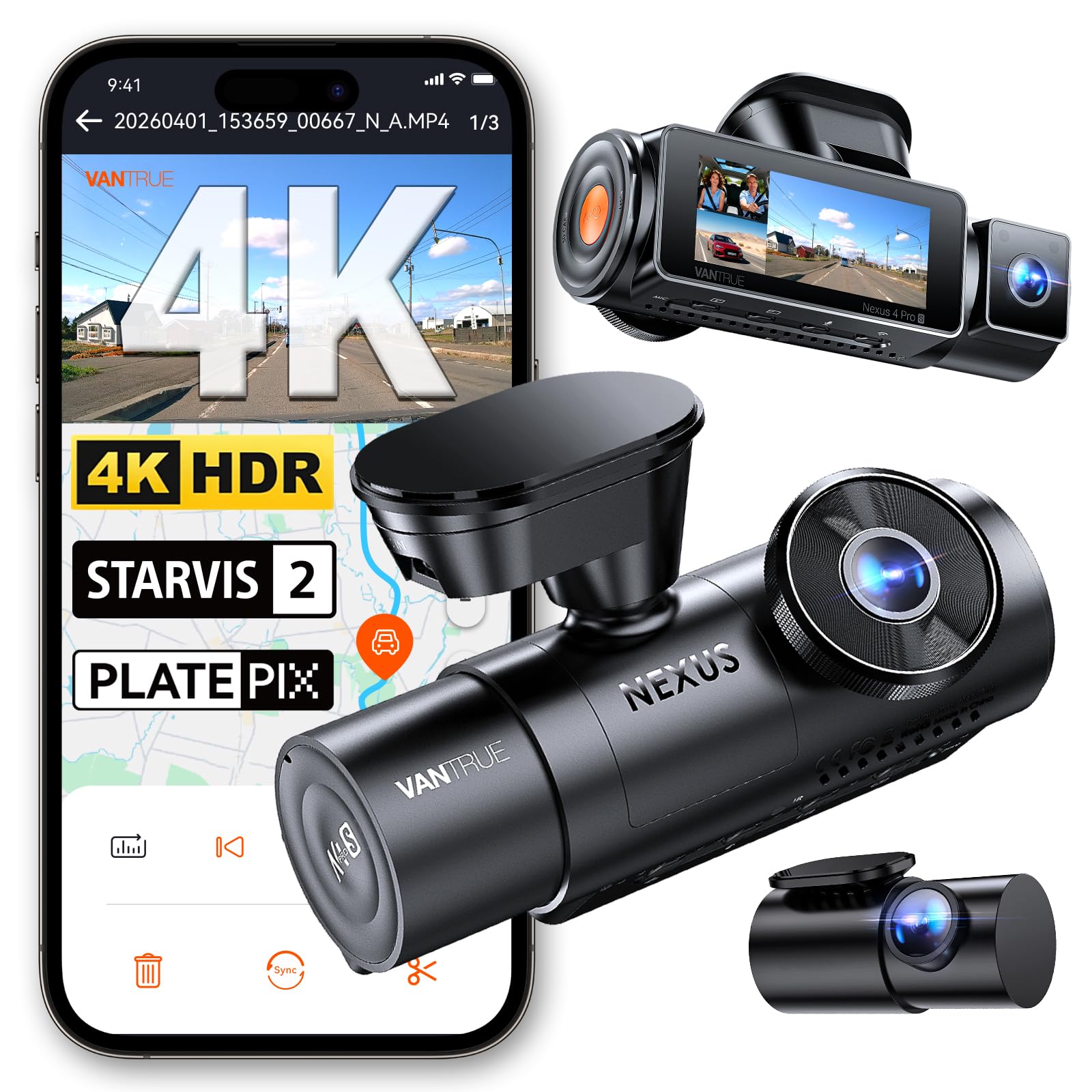
The Vantrue N4 Pro S is not a traditional digital rear view mirror with a 12-inch mirror display — it is a three-channel dash cam system (front 4K, interior 1080P IR, rear 2.5K) that records continuously in all directions. It earns a spot here because its rear camera feed can be displayed on the unit, and the triple-channel coverage is unmatched for rideshare drivers, taxi operators, or anyone who wants cabin monitoring alongside road recording. All three channels use Sony STARVIS 2 sensors, and the PlatePix technology identifies license plates at speeds up to 31mph in low-light conditions.
The rear camera itself rotates 360 degrees, allowing you to aim it at the rear window for traffic view or pivot it toward the trunk for cargo monitoring. The front and rear mode (4K+2.5K) reduces heat generation by 30 percent versus full triple-channel recording, which helps in summer heat. The buffered parking mode captures footage from 10 seconds before an impact event, activated by motion or G-sensor triggers. The system supports microSD cards up to 1TB, giving you up to 37 hours of continuous 4K triple-channel recording.
The main trade-off is that this unit does not function as a full-time digital rear view mirror in the same way a 12-inch mirror replacement does — you mount it to the windshield separately from your factory rearview mirror. The 5GHz WiFi enables fast transfers, but no memory card is included, and the hardwire kit for parking mode is sold separately. For drivers who prioritize forensic-grade recording over a seamless mirror replacement, the N4 Pro S is the most comprehensive option.
Why it’s great
- Triple STARVIS 2 sensors with 3-channel 4K+2.5K+1080P recording
- PlatePix technology captures readable plates at up to 31mph at night
- 360° rotatable rear camera for flexible positioning
- Supports microSD cards up to 1TB for maximum recording time
Good to know
- No memory card or hardwire kit included — both purchased separately
- Not a mirror replacement; mounts separately from factory rearview mirror
9. WOLFBOX G900 PRO

The WOLFBOX G900 PRO is a premium mirror replacement that centers on a front STARVIS 2 IMX678 sensor delivering 4K (3840×2160 at 30fps) with a 7-glass lens to reduce flaring and ghosting. The rear camera records at 2.5K (2560×1440 at 30fps) using a 4MP sensor, and the 12-inch LCD screen is one of the brightest in this class — roughly 90 percent as bright as a Toyota factory digital mirror, according to user comparisons. The anti-glare coating minimizes reflections, and the swipe gestures for screen navigation are smooth and responsive.
The 5.8GHz WiFi connects to the WOLFBOX app for quick video downloads, and the external GPS antenna logs speed and route data directly onto the video overlay. The voice control handles basic commands like “turn on screen” and “show rear camera” without the robotic delivery that plagues some competitors. The included 128GB card (upgradeable to 512GB) covers extended recording sessions at 4K without requiring immediate overwrites.
Installation follows the universal strap method over your existing mirror, which works on mirrors wider than the strap width but will not fit some European or compact vehicles with narrow factory mirrors. The rear camera is USB-C, and the 21.3-foot cable is long enough for most SUVs and trucks. The G-sensor is notably sensitive on rough roads, locking files unnecessarily, and a few users report that the rear camera feed occasionally disconnects and defaults to a split-screen view. Customer support from WOLFBOX is responsive, sending free replacement parts when needed.
Why it’s great
- STARVIS 2 IMX678 front sensor with 7-glass lens for low-light clarity
- Display brightness approaches factory OEM digital mirror levels
- 128GB card included with support for up to 512GB
- Smooth touchscreen swipe gestures and reliable voice control
Good to know
- Rear camera feed can intermittently disconnect, forcing split-screen mode
- G-sensor triggers false lockdowns on uneven road surfaces
FAQ
Can I use a digital rear view mirror as my regular mirror when the screen is off?
How do I prevent the rear camera feed from vibrating on rough roads?
Is a 4K rear camera worth the extra cost over 1080P?
Will CarPlay drain my car battery if I forget to unplug the mirror?
Why does my rear camera image look flipped horizontally?
Final Thoughts: The Verdict
For most users, the best digital rear view mirror winner is the Pelsee P12 Pro Max because it combines dual STARVIS sensors, true 4K+2.5K recording, full-color night vision, and a bundled OBD hardwire kit at a price that undercuts most premium alternatives. If you want dual-4K resolution front and rear with the most advanced sensor hardware available, grab the Roadwitness Dual 4K. And for a factory-integrated look with zero vibration and a waterproof rear camera, nothing beats the KBD OEM Bracket Mirror.

Mo Maruf
I created WellFizz to bridge the gap between vague wellness advice and actionable solutions. My mission is simple: to decode the research and give you practical tools you can actually use.
Beyond the data, I am a passionate traveler. I believe that stepping away from the screen to explore new environments is essential for mental clarity and physical vitality.