Our readers keep the lights on and my smoothie glass nicely filled. As an Amazon Associate, I earn from qualifying purchases.
When the trail turns to dust and your cell signal drops to zero, the only thing keeping your convoy connected is a radio that can handle the abuse. A digital radio for off roading isn’t a luxury—it’s the difference between a coordinated group ride and a solo search for a lost rig.
I’m Mohammad Maruf — the founder and writer behind WellFizz. I’ve spent hundreds of hours dissecting the communication needs of off-roaders, analyzing transmitter power, antenna efficiency, waterproofing standards, and battery endurance to separate the trail-ready gear from the weekend toys.
This guide walks through the rugged, weather-sealed, and long-range options that keep you in contact when the terrain gets rough. After comparing over a dozen models across GMRS, CB, and FRS bands, these picks represent the clearest path to reliable convoy communication in any environment. Welcome to my curated list of the best digital radio for off roading.
How To Choose The Best Digital Radio For Off Roading
Off-road radios are not the same as the family walkie-talkies you grab for a trip to the mall. The trail environment demands water resistance, shockproof builds, a communication protocol that matches your group, and enough battery or vehicle power to last a full day of driving. Nail these four factors and you will end up with a radio that clicks into place rather than one that frustrates you mid-trail.
Durability Standards: IP67 vs MIL-STD-810H
The two most common durability badges you will see are IP67 and MIL-STD-810H. IP67 means the radio is fully dust-tight and can survive immersion in one meter of water for 30 minutes — critical if your radio falls into a creek or gets caught in a sudden downpour. MIL-STD-810H is a military standard that tests against drops, vibration, extreme temperatures, and humidity. For buggy rides, vehicle mounting, and dusty trails, look for at least one of these certifications. A radio that lacks both is likely to fail when you need it most.
Band Selection: GMRS vs CB vs FRS
Each band serves a different off-road community. GMRS (General Mobile Radio Service) requires a license from the FCC, costs about for ten years, and covers the whole family. It offers repeater access for dramatically extended range. CB (Citizens Band) is license-free and popular among classic off-roaders and truckers but suffers from lower audio quality and limited channels. FRS (Family Radio Service) is license-free, low-power (2 watts max), and best for short-range communication between vehicles within visual sight. Most dedicated off-road groups prefer GMRS for its balance of range, power, and repeater support.
Power Output and Antenna
Transmit power is measured in watts. A 5-watt GMRS handheld can reach a few miles in dense woods, while a 20-watt mobile unit with an external antenna can push ten to twenty miles in open terrain. But power alone is nothing without a good antenna. The antenna is the single most impactful component for range — a cheap magnetic antenna will bottleneck your signal. For vehicle installations, consider upgrading to a quarter-wave or half-wave antenna tuned to your band for a measurable range boost.
Battery Life and Power Source
Handheld radios rely on internal batteries, while mobile units plug into your vehicle’s 12V system. For a full day of trail riding, a handheld should offer at least 14 to 20 hours of battery life on a single charge. USB-C charging is a modern convenience that lets you top off from a portable power bank. Mobile units eliminate battery anxiety altogether but require a clean installation with a proper mounting bracket and antenna cable routing. If you switch between vehicles frequently, a handheld with a long battery life is more practical.
Quick Comparison
On smaller screens, swipe sideways to see the full table.
| Model | Category | Best For | Key Spec | Amazon |
|---|---|---|---|---|
| Cobra 75 All Road | CB Radio | Wireless handset & dual-mode AM/FM | IP66 waterproof, 4W output | Amazon |
| BTECH GMRS-PRO | GMRS Handheld | GPS texting & app connectivity | IP67, 5W, GPS, Bluetooth | Amazon |
| Midland MXT105 | GMRS Mobile | Plug-and-play GMRS simplicity | 5W output, 15 channels | Amazon |
| Radioddity DB20-G | GMRS Mobile | High-power 20W mobile unit | 20W, 500 channels, VOX | Amazon |
| Retevis RB48 | FRS Handheld | Waterproof floating FRS set | IP67, MIL-STD-810H, 2-pack | Amazon |
| Sangean BB-100 | AM/FM Receiver | Rugged campsite Bluetooth radio | JIS4 rain resistant, Bluetooth | Amazon |
| Sangean TB-100 | AM/FM Receiver | Budget-friendly campsite audio | JIS4 rain resistant, AUX input | Amazon |
In‑Depth Reviews
1. Cobra 75 All Road Wireless CB Radio

The Cobra 75 All Road redefines what a CB radio can be in an off-road vehicle. Its two-piece wireless design separates the transceiver from the handset, so you can mount the main unit under a seat or in a glove box while the handset connects via USB or 12V power. The handset is fully waterproof to IP66, meaning it shrugs off rain, dust, and mud splashes without hesitation.
Dual-mode AM/FM operation gives you access to both CB bands — FM offers noticeably cleaner audio with less static, while AM keeps you compatible with legacy CB users. Built-in Bluetooth lets you connect a wireless headset, freeing your hands for driving. The Digital Noise Cancellation (DSP) cleans up transmitted and received audio, which is a lifesaver at highway speeds or when your rig is roaring through a rock garden.
Bench tests show AM transmit power averaging 3.69 watts with peaks above 15 watts, and FM output at a solid 3.5 watts. The included SWR meter helps you tune your antenna for maximum efficiency. The only caveat is that the USB port itself is not waterproof, so you will want to position the handset where it stays dry. For a clean, modern, trail-ready CB setup, this is the gold standard.
Why it’s great
- Wireless handset allows hidden transceiver mounting in any vehicle
- AM/FM dual-band delivers clear audio and broad compatibility
- IP66 waterproof rating handles rain, dust, and mud without failure
- Bluetooth connectivity for wireless headset use on rough terrain
Good to know
- USB port is not waterproof — position the handset away from direct splashes
- Requires pairing with a quality antenna for optimal range
2. BTECH GMRS-PRO Handheld

The BTECH GMRS-PRO is arguably the most feature-dense handheld GMRS radio on the market for off-road use. It combines a 5-watt transmitter with built-in GPS, a digital compass, and Bluetooth connectivity that tethers to your phone. The companion app allows you to program channels, sync contacts, and manage settings without diving through confusing menus — a significant quality-of-life upgrade on the trail.
IP67 dust and water protection means it survives full immersion and heavy rain without a second thought. In real-world testing in the Appalachian mountains, users report a solid one to two miles of range in dense, obstructed terrain, and up to twenty miles when hitting a repeater on a ridge line. The built-in texting and location-sharing features let your group share coordinates without needing cell service, which changes how you coordinate split groups on long trails.
The 2600mAh battery provides about 14 hours of typical use, and USB-C charging makes it easy to recharge from a vehicle or portable power bank. Some users note that the belt clip installation is unnecessarily difficult and that the operating system can feel a bit slow when scrolling through menus. But for the combination of GPS, Bluetooth, messaging, and waterproofing, nothing in the handheld GMRS category comes close at this level.
Why it’s great
- Built-in GPS and digital compass for location sharing without cell service
- Bluetooth app connectivity simplifies channel programming and contact syncing
- IP67 waterproof and dust-tight withstands creek crossings and mud
- Text messaging capability keeps your group coordinated in low-noise situations
Good to know
- Belt clip installation is finicky and may require a magnetic screwdriver
- USB-C charging only works with A-to-C cables, not C-to-C
- Proprietary accessories require a bulky adapter
3. Midland MXT105 MicroMobile
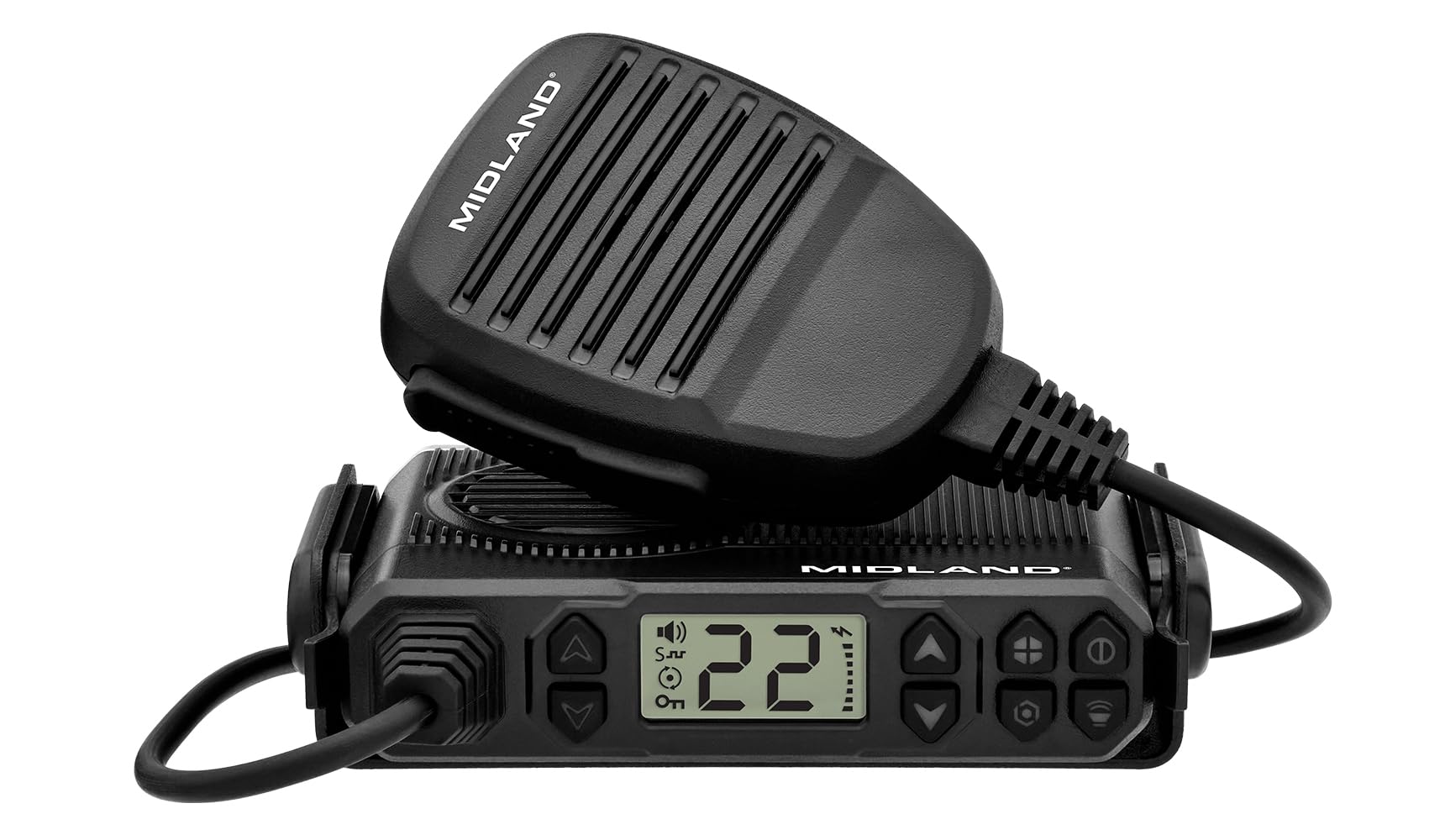
The Midland MXT105 is the definition of a no-hassle GMRS mobile radio. It ships with a magnetic mount antenna, a 12V power cord, and a flip-frame detachable mount — you literally plug it into your cigarette lighter, stick the antenna on your roof, and start talking. There is no programming, no software, no frustration. For off-roaders who want to spend their time driving rather than configuring radios, this is a breath of fresh air.
With 5 watts of transmit power and 15 high/low power GMRS channels, the MXT105 delivers clear communication over several miles on open trails. The included external magnetic antenna is decent, though some users replace it with a higher-gain unit for better range in hilly terrain. The 142 CTCSS/DCS privacy codes keep your conversations isolated from other groups on the same channel, which is handy on popular trail systems with lots of radio traffic.
NOAA Weather Scan and Alert are built in, automatically locking onto the strongest weather channel and sounding an alarm if severe weather is detected. The compact size means it tucks away easily in a center console or under a dash. A few owners report that the microphone cord is on the short side and that the unit can occasionally lock up, requiring a power cycle. But for pure ease of use and reliability, the MXT105 is hard to beat.
Why it’s great
- True plug-and-play operation — no programming or software needed
- Compact mobile form factor fits easily in small vehicles and buggies
- NOAA Weather Scan with audible alert keeps you aware of incoming storms
- 142 privacy codes prevent channel interference from other groups
Good to know
- Included magnetic antenna can feel cheap — upgrading improves range noticeably
- Occasional lockup requires disconnecting and reconnecting power
- Microphone cord is relatively short for large vehicles
4. Radioddity DB20-G GMRS Mobile

If you need serious range from a mobile GMRS unit, the Radioddity DB20-G brings 20 watts of transmit power to the table — four times the output of typical handhelds and compact mobiles. It reaches up to 20 miles in open air and about 10 miles on mountain trails, making it a strong choice for large convoys that spread out over long distances. The unit is surprisingly compact at 4.5 by 5 by 2 inches, fitting easily in tight vehicle cabins.
The DB20-G supports 500 channels, including 9 customizable repeater channels that let you program different CTCSS/DCS tones for accessing remote repeaters. The handset integrates all control buttons, so you can adjust volume, change channels, and activate VOX without taking your eyes off the trail for long. A programming cable is included, though the software is not CHIRP-compatible, which some advanced users find limiting.
Receive sensitivity is excellent at 0.25 µV for 20 dB quieting, and the unit runs cool even during extended use. The cigarette lighter plug makes installation trivial, but you will need to supply your own antenna. Pair it with a solid GMRS antenna like the Nagoya UT-72G and you will hit repeaters 25 to 30 miles away consistently. For the price per watt, this is one of the best values in mobile GMRS.
Why it’s great
- 20-watt output provides class-leading range for mobile GMRS setups
- Compact chassis fits in tight spaces where full-size radios won’t
- 9 programmable repeater channels dramatically extend usable range
- Excellent receive sensitivity pulls in weak signals from distant repeaters
Good to know
- Not CHIRP-compatible — programming requires the included proprietary software
- No antenna included; factor a quality GMRS antenna into your budget
- Manual is poorly written and can be confusing for first-time setup
5. Retevis RB48 FRS Walkie Talkies (2-Pack)
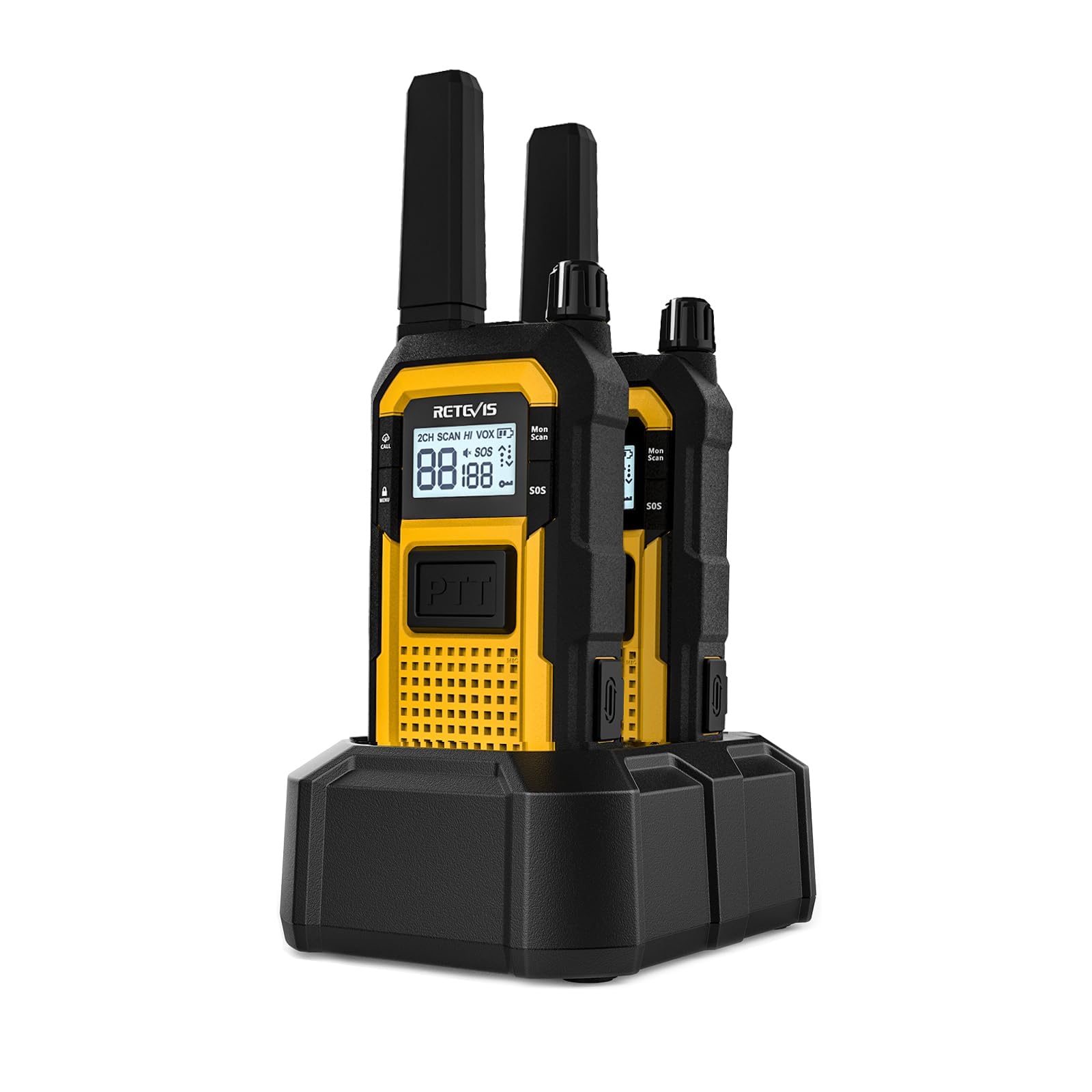
The Retevis RB48 proves that you do not need to spend a lot to get genuine durability. These FRS radios are tested to MIL-STD-810H for drops, vibration, and extreme temperatures, and they carry an IP67 rating that makes them fully dust-tight and waterproof — they even float if dropped in water. For off-roaders on a budget or those who need a spare set for passengers, this is a remarkably tough package for the price.
Each unit packs a 2000mAh battery that delivers up to 20 hours of use on a single charge. USB-C charging and a included charging dock give you flexibility topping off from a vehicle or power bank. The bright yellow design is easy to spot if dropped in brush, and the silicone button covers protect the controls in wet or dusty environments. Range is rated up to 300,000 square feet or 25 floors in a building, which translates to about a mile in open terrain.
The FRS band means no license is required, and the radios are compatible with most other license-free FRS units. Audio clarity is decent, and the roger beep confirms your transmission ended. The display can scratch relatively easily, so a screen protector is recommended for heavy trail use. For a rugged, waterproof, license-free radio that floats, the RB48 is an outstanding value for casual off-road groups.
Why it’s great
- MIL-STD-810H and IP67 certification means genuine field toughness
- Floats in water — recovers easily if dropped during a creek crossing
- 20-hour battery life with USB-C and dock charging options
- No license required for FRS operation — everyone in the group can use them
Good to know
- Display is prone to scratching — apply a screen protector early
- Range is shorter than GMRS options in dense or hilly terrain
- Menu navigation can be slightly unintuitive at first
6. Sangean BB-100 BlueBox Bluetooth Receiver

While not a two-way communication radio, the Sangean BB-100 is the perfect companion for campsite downtime after a long day on the trail. It is an ultra-rugged AM/FM receiver with built-in Bluetooth, housed in a roll-cage-protected chassis that meets JIS4 rain resistance standards. The 5.25-inch water-resistant speaker delivers surprisingly rich, bass-forward sound that fills a campsite without distortion at moderate volumes.
Bluetooth pairing is instant and stable, allowing you to stream music from your phone, podcasts, or audiobooks. The digital tuner with 5 presets per band locks onto stations cleanly, and the AM reception is notably good for a portable unit. The built-in battery charger works with rechargeable C cells, and a full charge lasts through multiple evenings of use. The green color and rugged roll cage give it a military-grade aesthetic that fits right into an overlanding setup.
The BlueBox is not cheap, but the build quality justifies the investment for those who want one radio that handles both job-site abuse and relaxing campfire listening. The bass-heavy tuning can wash out mids and highs at higher volumes, and the lack of stereo separation means it is monophonic. For a durable, all-weather, Bluetooth-enabled camp radio that keeps the mood alive after the sun goes down, the BB-100 is a clear winner.
Why it’s great
- JIS4 rain-resistant roll cage survives splashes and dust at camp
- Bluetooth streaming pairs instantly for music and podcasts off-grid
- Rich, powerful audio from a single 5.25-inch water-resistant speaker
- Built-in battery charger supports rechargeable C cells for long runtime
Good to know
- Monophonic output — no stereo separation for music enthusiasts
- Bass-heavy tuning can muddy mids and highs at higher volumes
- Relatively large and heavy at over 7 pounds for packing
7. Sangean TB-100 Toughbox Digital Receiver

The Sangean TB-100 Toughbox is the stripped-down, no-Bluetooth sibling of the BB-100, offering AM and FM reception in the same rugged roll-cage body. It is rain resistant to JIS4, shock resistant with rubber shock blocks, and built with a durable ABS plastic shell that shrugs off the bumps and vibrations of a truck bed or campsite table. For pure radio listening without the complexity of Bluetooth pairing, it gets the fundamentals right.
The digital PLL synthesized tuner is stable and drift-free, with 10 memory presets (5 AM, 5 FM) that store your favorite stations. The 5.25-inch magnetically shielded speaker delivers clear, loud audio with dynamic loudness compensation that boosts bass at lower volumes. Reception is surprisingly good — it can pull in AM stations from over 140 miles away during the day, and FM sensitivity is adequate with the included flexible antenna.
The built-in charger works with 4 C batteries, and the unit can run on AC power via the attached 9-foot cord. One notable quirk is that distortion creeps in above 75% volume when running on battery, though it remains clean on AC power. The antenna is on the short side, limiting FM range in deep valleys. If you need a rugged campsite radio purely for AM/FM listening and want to save some money over the Bluetooth version, the TB-100 Toughbox delivers the same core durability for less.
Why it’s great
- JIS4 rain-resistant roll cage withstands campsite weather and drops
- Excellent AM reception pulls in distant stations reliably
- Built-in battery charger works with rechargeable C cells for off-grid use
- Simple analog-style controls with digital tuning — no learning curve
Good to know
- No Bluetooth — streaming audio requires a separate AUX cable connection
- Distortion above 75% volume when running on battery power
- Short antennas limit FM reception in deep valleys or wooded areas
FAQ
Do I need a license to use GMRS on the trail?
What is the difference between a handheld and a mobile radio for off-roading?
Why do some off-roaders still use CB radio instead of GMRS?
How important is NOAA weather alert for off-road radios?
Final Thoughts: The Verdict
For most users, the best digital radio for off roading winner is the Cobra 75 All Road because its wireless handset, dual-mode AM/FM operation, and IP66 waterproofing deliver premium communication in a clean, modern package that integrates seamlessly into any rig. If you want GPS location sharing and texting without cell service, grab the BTECH GMRS-PRO. And for a straightforward, no-programming-needed mobile GMRS unit that works the moment you plug it in, nothing beats the Midland MXT105.

Mo Maruf
I created WellFizz to bridge the gap between vague wellness advice and actionable solutions. My mission is simple: to decode the research and give you practical tools you can actually use.
Beyond the data, I am a passionate traveler. I believe that stepping away from the screen to explore new environments is essential for mental clarity and physical vitality.