Our readers keep the lights on and my smoothie glass nicely filled. As an Amazon Associate, I earn from qualifying purchases.
The ritual of matching chemically stained squares on a plastic strip to a faded color chart feels ancient when you are staring at a cloudy pool on a hot Saturday. A fraction of a pH point or a few hundred parts per million of salt can throw your entire sanitizer system off balance, costing you time, chemicals, and frustration. A digital pool water tester removes the ambiguity by presenting precise numerical readouts for the parameters that matter most, allowing you to treat your backyard oasis like the closed-loop system it actually is.
I’m Mohammad Maruf — the founder and writer behind WellFizz. I’ve spent countless hours analyzing the specifications, real-world customer accounts, and engineering design trade-offs in digital water testing gear to help pool owners cut through the hype and find instruments that deliver repeatable, trustworthy data.
This guide compares seven of the most capable models currently available, covering salt, pH, free chlorine, TDS, ORP, EC, and temperature measurements. Whether you manage a saltwater pool, a freshwater chlorine system, a koi pond, or a hot tub, reading through the reviews below will help you identify the right digital pool water tester for your specific water chemistry needs.
How To Choose The Best Digital Pool Water Tester
Buying a digital tester for your pool means you are actively rejecting the guesswork of reagent drops and color wheels. To pick the right one, you need to think about which parameters your specific pool type demands, how often you test, and whether you prefer a single probe or a kit that combines a digital reader with backup test strips.
Parameter coverage matters more than the count
A 5-in-1 meter that reads pH, salt, TDS, EC, and temperature is perfectly adequate for a saltwater pool owner whose main concerns are salinity and pH. A freshwater chlorine pool, however, needs free chlorine values, and a hot tub user will want bromine and total alkalinity. Look for a meter that covers the three or four parameters your system actually demands rather than chasing a high number of features you will never use.
Calibration is not optional
Every digital probe drifts over time. The best models include calibration solutions or powder packets in the box and offer a simple one-button recalibration routine. Avoid any meter that asks you to trust factory settings indefinitely — even premium sensors require occasional zero-point or slope adjustment to stay within an acceptable error margin.
Probe design and durability
Titanium-alloy electrodes resist corrosion far better than brass or copper probes when used in saltwater environments. A replaceable probe extends the life of the meter significantly, while a sealed unit must be discarded when the sensor degrades. Also consider the probe’s response time: a stable reading within 3 to 5 seconds is ideal for quick dip-and-read sessions.
Quick Comparison
On smaller screens, swipe sideways to see the full table.
| Model | Category | Best For | Key Spec | Amazon |
|---|---|---|---|---|
| YINMIK 7-in-1 | Premium Multi-Parameter | Chlorine + pH + ORP monitoring | Measures free Cl and ORP | Amazon |
| YUZIIB 5-in-1 | Premium Value | Quick pH + salt checks | Titanium alloy probe | Amazon |
| AKSBTEC 11-in-1 Kit | Combo Kit | Full water balance snapshot | Includes 50 test strips | Amazon |
| Yewhick 7-in-1 | Mid-Range Multi | Saltwater pool + salt system | Free Cl range 1-3 ppm | Amazon |
| Rowyet 5-in-1 | Mid-Range Value | Drinking + pool water | 0.01 pH resolution | Amazon |
| T TESTRUST 5-in-1 | Budget-Efficient | Entry-level salt monitor | Three salinity display units | Amazon |
| AquaDoc Eagle Ray | Digital Strip Reader | Strip-based digital readout | Stores 100 results | Amazon |
In‑Depth Reviews
1. YINMIK 7-in-1 Pool Chlorine pH Meter
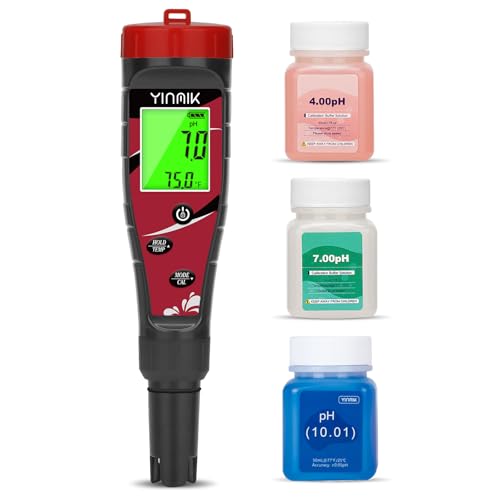
The YINMIK 7-in-1 stands out because it measures free chlorine, ORP, and pH simultaneously — a rare combination in a single handheld probe at this tier. Freshwater chlorine pool owners benefit from the free chlorine range targeting the ideal 1-3 ppm window, while ORP provides an additional oxidation-reduction potential reading that reveals how effectively your sanitizer is working. The pocket-sized design includes a digital backlit display that eliminates the need for color matching, and the included calibration kit makes recalibration straightforward.
Users consistently report that this meter holds calibration well over several months, even with regular use in both pool and home brewing applications. The temperature compensation is automatic, ensuring readings remain stable across the 32-140°F range. Transitioning between pH, chlorine, salt, TDS, and EC modes is quick, and the display updates in under five seconds when the probe is submerged.
One limitation is that the backlight does not stay on indefinitely — it times out to save battery, which can be slightly inconvenient in dim pump-house lighting. The reading also tends to jump momentarily when lifted out of the water before settling, but this is typical behavior for meters in this class and does not affect submerged accuracy.
Why it’s great
- Measures free chlorine and ORP — rare in one probe
- Holds calibration well over months of regular use
- Automatic temperature compensation for stable readings
Good to know
- Backlight times out quickly
- Reading jumps momentarily after removal from water
2. YUZIIB 5-in-1 Digital Pool Tester
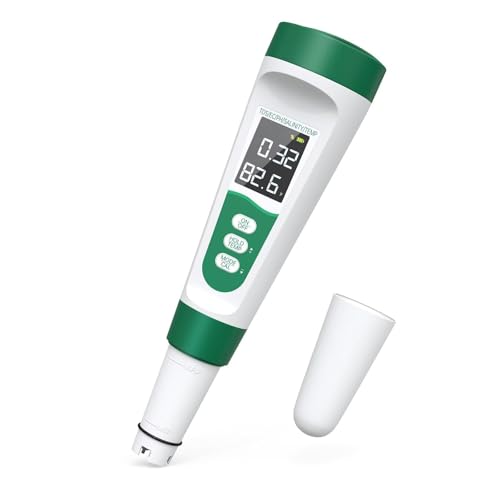
YUZIIB focuses on the core parameters a saltwater pool owner checks most frequently: pH, salinity, TDS, EC, and temperature. The titanium-alloy probe resists corrosion far better than standard brass sensors, giving this meter a longer useful life in chlorinated or saltwater environments. Measurement accuracy sits within ±2%, and the clear LCD updates within three seconds of immersion — faster than most competitors in the same price tier.
The hold button is a practical addition: press it to lock the current reading before lifting the probe out, which solves the common drift issue seen when the sensor leaves the water. Users switching from test strips notice the immediate improvement in repeatability — no more squinting at color gradients under different lighting angles. The compact body fits easily into a pocket for testing multiple pool stations or a hot tub.
Calibration instructions are minimal, and some users report needing to recalibrate more frequently during the first few weeks of use until the probe stabilizes. The included manual does not explain the calibration process in great depth, so a quick search for the meter’s factory reset sequence is recommended before first use.
Why it’s great
- Corrosion-resistant titanium alloy probe
- Under three-second reading stabilization
- Hold button locks value for easy reading
Good to know
- Calibration instructions are sparse
- Needs frequent recalibration during break-in period
3. AKSBTEC 11-in-1 Digital Pool Water Tester Kit
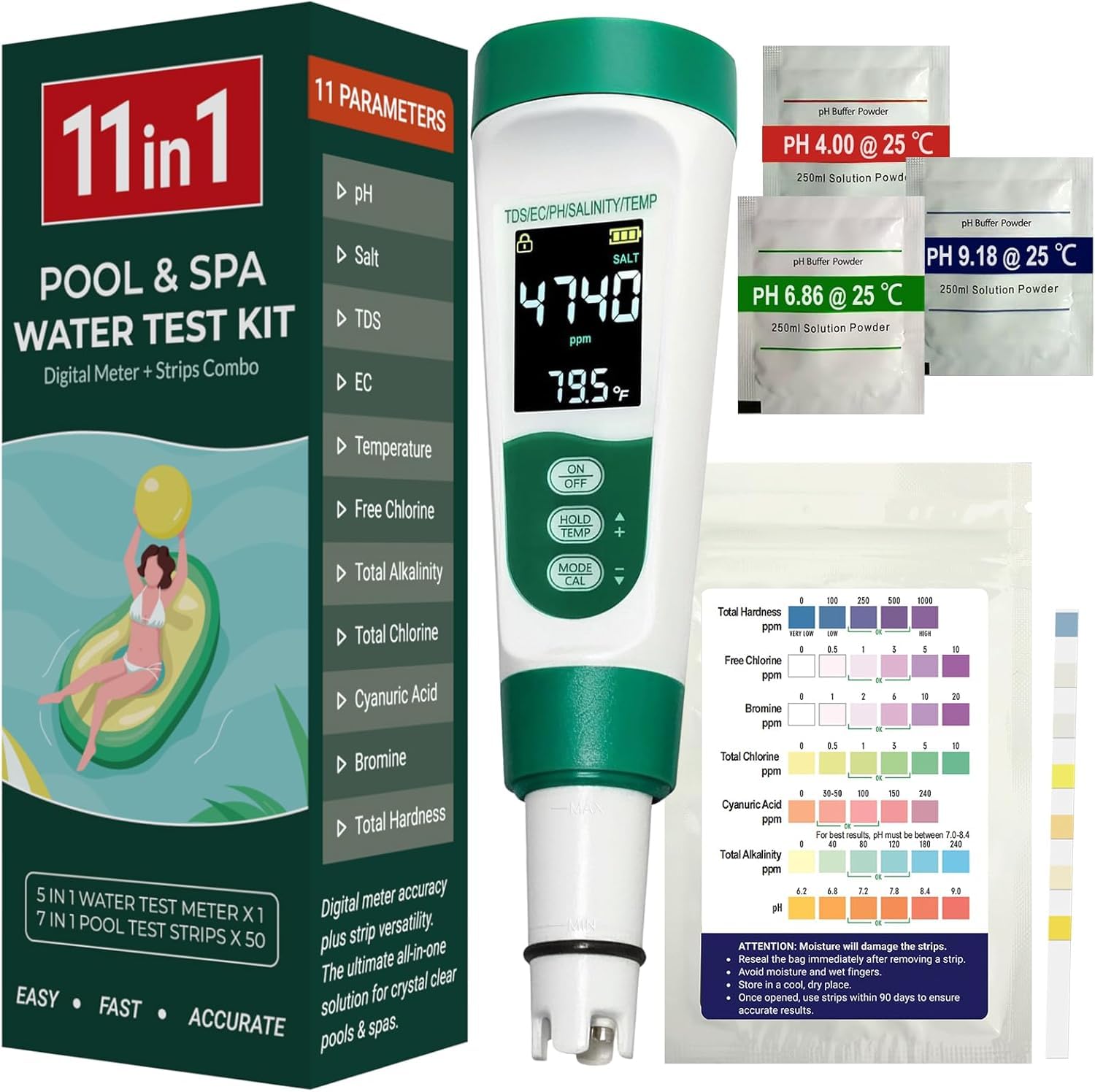
This kit pairs a 5-in-1 digital salinity and pH meter with 50 seven-parameter test strips, giving you a total of 11 measurable water parameters in a single package. The digital side handles salt, pH, TDS, EC, and temperature with push-button ease, while the strips cover free chlorine, total chlorine, bromine, cyanuric acid, total alkalinity, and total hardness. It is a practical solution for new pool owners who want both fast digital readings for routine checks and a full chemical panel for weekly balancing.
The digital meter is lightweight and pocket-friendly, with a clear LCD that switches between Celsius and Fahrenheit. The strips come in two sealed resealable bags, and the manufacturer claims a three-year shelf life when unopened — useful if you test infrequently during the off-season. Users testing aquariums and drinking water have reported consistent TDS readings that align with lab-grade reference meters.
Some buyers note that the digital meter occasionally retains a prior reading unless powered off and on again between tests. This requires a conscious reset habit to avoid cross-contamination of results. The meter is also not factory-calibrated for saltwater, so you may need to purchase a calibration solution if your primary use is a saltwater pool rather than freshwater.
Why it’s great
- Digital meter plus 50 strips for complete coverage
- Measures 11 parameters including CYA and bromine
- Long strip shelf life for seasonal pool owners
Good to know
- Digital meter sometimes holds prior reading between tests
- Not pre-calibrated for saltwater use
4. Yewhick 7-in-1 Digital Pool Water Tester

The Yewhick 7-in-1 specifically targets saltwater pool owners who need to verify that their salt chlorinator is operating in the ideal 2700-3400 ppm salinity window. The free chlorine channel monitors the residual level, typically keeping it between 1-3 ppm, while the pH channel covers the full 0-14 range with a sterile rating that meets basic pool standards. This combination makes it a strong dedicated instrument for salt system troubleshooting.
The interface is simple: press On, dip the probe, and read the PPM value instantly. Multiple users have confirmed that this meter replaces expensive salt test strips with repeatable digital accuracy. The inclusion of both pH and free chlorine in a single probe means you can diagnose whether a low sanitizer reading is caused by insufficient salt, incorrect pH, or a failing chlorinator cell.
There have been isolated reports of calibration failure, where the meter would not accept a recalibration attempt out of the box. This suggests some unit-to-unit variability in manufacturing quality. Buyers should test the meter against a known reference solution immediately upon arrival to ensure the sensor is functional before the return window closes.
Why it’s great
- Ideal salt range targeting 2700-3400 ppm for salt systems
- Free chlorine and pH in one portable probe
- Cost-effective alternative to single-use salt strips
Good to know
- Occasional calibration failure reported
- Unit variability requires immediate verification
5. Rowyet 5-in-1 PH & TDS Meter

The Rowyet 5-in-1 offers a high-resolution pH measurement of 0.01, making it suitable for applications beyond pool care — including wine making, hydroponics, and drinking water analysis. It displays salinity in PPM, PPT, and percent, automatically switching units when the reading exceeds 9999 PPM. The automatic temperature compensation covers 32-140°F, and the one-button hold function locks the value for convenient reading after testing.
Users appreciate the convenience of a single meter replacing vial-based chemical tests for pH and TDS. The backlit LCD is readable in bright outdoor conditions, and the included calibration packets allow for quick adjustment. Several water treatment professionals have confirmed that the TDS readings match their reference equipment within an acceptable margin after proper calibration.
The calibration process, however, is not clearly explained in the manual — some steps are implied rather than explicitly stated, and the meter requires patience during initial setup. A small number of units have arrived with stuck readings or dead pixels, indicating quality control inconsistencies. The probe is also non-replaceable, so the entire meter must be replaced once the sensor degrades.
Why it’s great
- High 0.01 pH resolution for precise adjustments
- Auto-switching salinity units for easy reading
- Calibration packets included for immediate setup
Good to know
- Calibration instructions are unclear
- Non-replaceable probe limits lifespan
- Occasional dead pixel or stuck reading on arrival
6. T TESTRUST 5-in-1 Pool Salt Tester

The T TESTRUST 5-in-1 is the entry-level gateway into digital pool testing, covering salinity, pH, TDS, EC, and temperature at a price that makes it easy to keep a backup unit on hand. It displays salinity in three units — PPM, PPT, and percent — and automatically transitions between scales when the concentration exceeds 9999 PPM. The operation is straightforward: dip the probe, wait for the reading, and rinse when done.
Users frequently highlight the accuracy improvement over test strips, particularly for saltwater pools where consistent salinity is critical for chlorinator performance. The clear LCD remains readable even in direct sunlight, and the unit runs on standard batteries that are widely available. Several pool owners have reported that keeping two units and comparing readings gives them confidence in the data.
The build quality feels less robust than premium options — the plastic housing is light and the probe cap can crack if dropped on concrete. Calibration is technically supported, but the manual is basic and may leave first-time users confused about the reset process. Over time, some units begin reading low on salt, especially after several months of regular use.
Why it’s great
- Affordable entry point for digital pool testing
- Three-unit salinity display with auto-switching
- Sunlight-readable LCD
Good to know
- Plastic housing is prone to cracking on impact
- Manual lacks calibration detail
- Tends to read low on salt after months of use
7. AquaDoc Eagle Ray Digital Water Test Kit
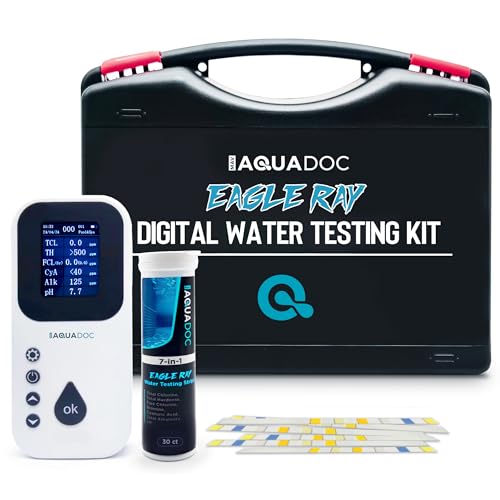
The AquaDoc Eagle Ray takes a different approach: instead of a probing electrode, it uses a small optical reader that analyzes a dipped test strip and displays the numerical result on its screen. This eliminates the subjective color-matching step while still using the chemistry of traditional strips. The reader measures total chlorine, free chlorine, bromine, total hardness, cyanuric acid, total alkalinity, and pH, and it stores up to 100 previous readings for trend tracking.
The kit includes 30 strips and is designed to simplify water analysis for new pool and hot tub owners who find standard liquid reagent kits intimidating. The user interface is minimal — dip the strip, insert it, and wait a few seconds for the digital readout. Built-in memory allows you to monitor how chemical levels change over consecutive days, which is useful for dialing in a new sanitizer schedule.
Accuracy complaints appear in a minority of units: some testers have reported wildly inconsistent pH readings between consecutive strips, suggesting that either the optical sensor or the strip lot was faulty. The reader is also completely dependent on proprietary strips, meaning you must keep a steady supply of AquaDoc strips on hand, and the unit has no connectivity or mobile app integration for deeper data analysis.
Why it’s great
- Eliminates color matching with numerical strip reading
- Stores 100 results for trend tracking
- Simple interface ideal for new pool owners
Good to know
- Requires proprietary strips; no generic strip compatibility
- Occasional inconsistent readings between strips
- No app or data export available
FAQ
How often should I calibrate my digital pool water tester?
Why does my digital tester give a different reading than my test strips?
Can I use a saltwater pool tester for a freshwater chlorine pool?
Final Thoughts: The Verdict
For most users, the digital pool water tester winner is the YINMIK 7-in-1 because it combines free chlorine, pH, and ORP in a single portable probe that holds calibration remarkably well over months of use. If you want titanium-alloy probe durability and instant stabilization, grab the YUZIIB 5-in-1. And for a complete water analysis kit that pairs a digital meter with 50 test strips, nothing beats the AKSBTEC 11-in-1.

Mo Maruf
I created WellFizz to bridge the gap between vague wellness advice and actionable solutions. My mission is simple: to decode the research and give you practical tools you can actually use.
Beyond the data, I am a passionate traveler. I believe that stepping away from the screen to explore new environments is essential for mental clarity and physical vitality.