Our readers keep the lights on and my smoothie glass nicely filled. As an Amazon Associate, I earn from qualifying purchases.
The crackle of a distant dispatch, the urgent tone of a fire ground channel—a digital police scanner pulls these signals from the air, but only if its receiver can handle the modern encoding that most agencies now use. Analog-only models fall silent in areas where public safety has moved to P25 trunking, leaving listeners with a dead speaker and growing frustration. A true digital police scanner must decode not just conventional frequencies but also the complex, multi-site trunked systems that define today’s emergency communications.
I’m Mohammad Maruf — the founder and writer behind WellFizz. I’ve spent hundreds of hours dissecting the technical datasheets, decoding protocols, and real-world reception reports that separate a worthwhile investment from a frustrating paperweight in this niche category.
Whether you are a storm spotter, an aviation enthusiast, or a concerned citizen wanting to stay informed, finding the best setup means matching receiver technology to your local radio infrastructure. This guide breaks down the critical specs and real-world trade-offs of every best digital police scanner worth your attention.
How To Choose The Best Digital Police Scanner
Selecting the right unit goes beyond brand loyalty. The first question is always the modulation standard used by your local agencies: are they still on analog, have they moved to P25 Phase I, Phase II, or adopted DMR/NXDN for commercial trunking? Every scanner on this list handles a different slice of that puzzle, and the wrong pick means silence where you expect chatter.
Trunking vs. Conventional Scanning
A conventional scanner simply tunes to a fixed frequency, but most modern public safety systems use trunking—a pool of frequencies assigned dynamically as calls come in. A scanner without trunking capability can only catch fragments of a conversation, missing the critical context of a dispatch and response. True trunk trackers follow the control channel and reassemble full transmissions, making them essential for metropolitan monitoring.
Simulcast Distortion and SDR Solutions
When a city deploys multiple transmitter sites on the same frequency, conventional receivers hear overlapping signals that cause garbled audio or missed packets. This is simulcast distortion, and it is the single biggest challenge for digital scanner owners in suburban and urban environments. Software Defined Radio (SDR) technology with True I/Q processing decodes these overlapping waveforms cleanly—a feature once reserved for the flagship tier that now defines the top-performing models.
Alpha Tagging and Memory Management
As channel counts climb past 500, remembering which frequency belongs to which agency becomes impossible without labeling. Alpha tagging assigns text names to each channel, and object-oriented memory systems let you organize talkgroups, frequencies, and search ranges without wasting storage. Look for models that allow dynamic memory allocation so you can add new systems without deleting old ones.
Quick Comparison
On smaller screens, swipe sideways to see the full table.
| Model | Category | Best For | Key Spec | Amazon |
|---|---|---|---|---|
| Uniden SDS200 | Base/Mobile SDR | Simulcast clarity | True I/Q SDR receiver | Amazon |
| Uniden SDS150 | Handheld SDR | Portable P25 decoding | Built-in GPS + IPX4 | Amazon |
| Uniden BCD536HP | Base/Mobile | Zip-code setup | Wi-Fi streaming | Amazon |
| Whistler TRX-1 | Handheld | DMR/NXDN/P25 Phase II | 50-hour recording | Amazon |
| Whistler WS1065 | Desktop Trunking | Phase I trunk tracking | 1800-channel memory | Amazon |
| Uniden BCD260DN | Base/Mobile | DMR/NXDN out of box | Band Scope display | Amazon |
| Uniden BCD160DN | Handheld | Digital search hobby | 1000 channels | Amazon |
| Uniden BC125AT | Handheld Analog | Aviation/rail listening | 500 alpha-tagged channels | Amazon |
| Whistler WS1025 | Desktop Analog | Budget home monitoring | 300 channel memory | Amazon |
In‑Depth Reviews
1. Uniden SDS200 True I/Q TrunkTracker X Base/Mobile

The SDS200 is the gold standard for simulcast environments. Its True I/Q Software Defined Radio architecture processes overlapping transmitter signals that cripple conventional receivers, delivering studio-clear audio where other scanners fall silent. The 3.5-inch fully customizable color display lets you color-code each field—system, talkgroup, department—so you can visually track activity at a glance without needing to decode squelch noise.
TrunkTracker X provides the deepest P25 Phase I and Phase II decoding available in a consumer base scanner, including X2-TDMA support. The built-in HomePatrol database covers all known radio systems in the US and Canada, updated weekly via the Sentinel software. Location-based scanning via zip code or GPS coordinates means you can install the unit at a vacation home and have it scanning local emergency channels in under two minutes.
The unit ships with AC and DC power cords, a mounting bracket, and a USB cable for firmware upgrades. Note that DMR, NXDN, and ProVoice digital modes require separate paid upgrades, so budget those in if your area uses those protocols. The front-panel USB-A port placement is awkward for programming, but the rear USB handles most connectivity once configured.
Why it’s great
- Best-in-class simulcast decoding eliminates garbled P25 Phase II voice
- Location-based scanning with weekly database updates keeps setup effortless
- Customizable color display for instant visual recognition of active systems
Good to know
- DMR/NXDN/ProVoice digital modes are extra each
- Front USB-A port placement blocks micro USB access during programming
- MicroSD card slot is difficult to reach and limited to 32GB cards
2. Uniden SDS150 Handheld Digital Scanner
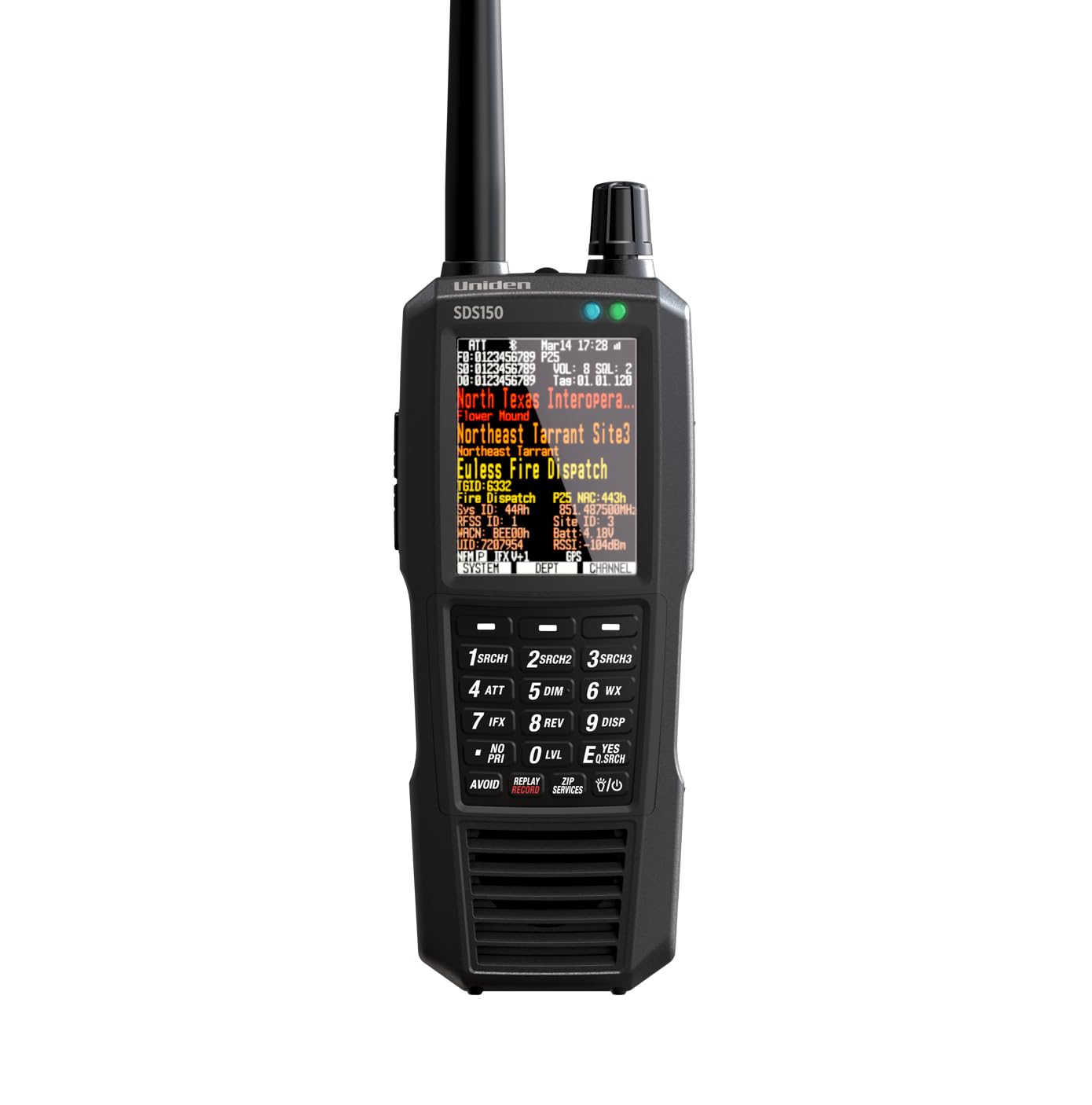
Uniden’s most advanced handheld takes the same True I/Q SDR foundation of the SDS200 and packs it into a portable, IPX4 water-resistant chassis with a built-in GPS receiver. The SDS150 automatically selects radio systems based on your physical location—no zip code entry, no manual database lookup—making it the ultimate choice for travelers, storm chasers, and field professionals who cross county lines hourly.
The included charge cradle comes with an extra battery charging slot, so you can hot-swap a fully charged lithium-ion pack without losing the current scan session. Bluetooth connectivity pairs with the u/Aware smartphone app for remote control and streaming, though the Bluetooth range is short and the connection can be finicky. Extended battery life reaches 7 to 10 hours under normal scanning loads, a major leap over earlier handheld models.
Enhanced sensitivity on the front end dramatically improves weak-signal reception, and the digital IF filtering rejects adjacent-channel interference that plagued earlier Uniden portables. The learning curve is real—the menu depth rivals the SDS200—but the payoff is a handheld that does not compromise on decoding quality. ProVoice is a paid add-on, but DMR and NXDN appear to be included at this tier.
Why it’s great
- True I/Q SDR in a water-resistant portable form factor
- Built-in GPS enables automatic system selection anywhere in North America
- Charge cradle with spare battery slot supports all-day field use
Good to know
- Bluetooth range to the u/Aware app is inconsistent
- Significant learning curve due to deep menu structure
- Bulky size makes pocket carry impractical without a belt clip
3. Uniden BCD536HP HomePatrol Series with Wi-Fi

Sit down, enter your zip code, set a radius—the BCD536HP starts scanning local police, fire, and EMS within two minutes of opening the box. This is the user-friendliest full-featured digital trunking scanner on the market, combining the HomePatrol database with TrunkTracker V for P25 Phase I and Phase II monitoring. The large backlit LCD and keypad make one-handed programming feasible without consulting a manual every time.
Built-in Wi-Fi allows remote streaming to a smartphone or tablet via the free app, so you can monitor your base station from anywhere in the house. The unit also records audio to an internal memory buffer, letting you replay missed calls or archive incidents. Frequency coverage stretches from 25 MHz through 1.3 GHz, capturing aviation, marine, federal, and military bands alongside public safety.
The Sentinel PC software handles all database updates and firmware upgrades with a single click. Some users report that the learning curve appears only when they need to manually enter custom frequencies or create favorite lists, but for the vast majority who just want to hear what is happening nearby, the zip code method is nearly foolproof. The lithium-ion battery in the handheld version is replaced here by a corded electric power source, so this is a dedicated base unit.
Why it’s great
- True plug-and-play setup via zip code and radius selection
- Wi-Fi streaming to smartphone or tablet for whole-home monitoring
- TrunkTracker V for P25 Phase I/II and X2-TDMA
Good to know
- Manual frequency entry requires Sentinel software or deep menu navigation
- No built-in rechargeable battery—corded operation only
- Wi-Fi streaming range depends on home network strength
4. Whistler TRX-1 Handheld Digital Scanner
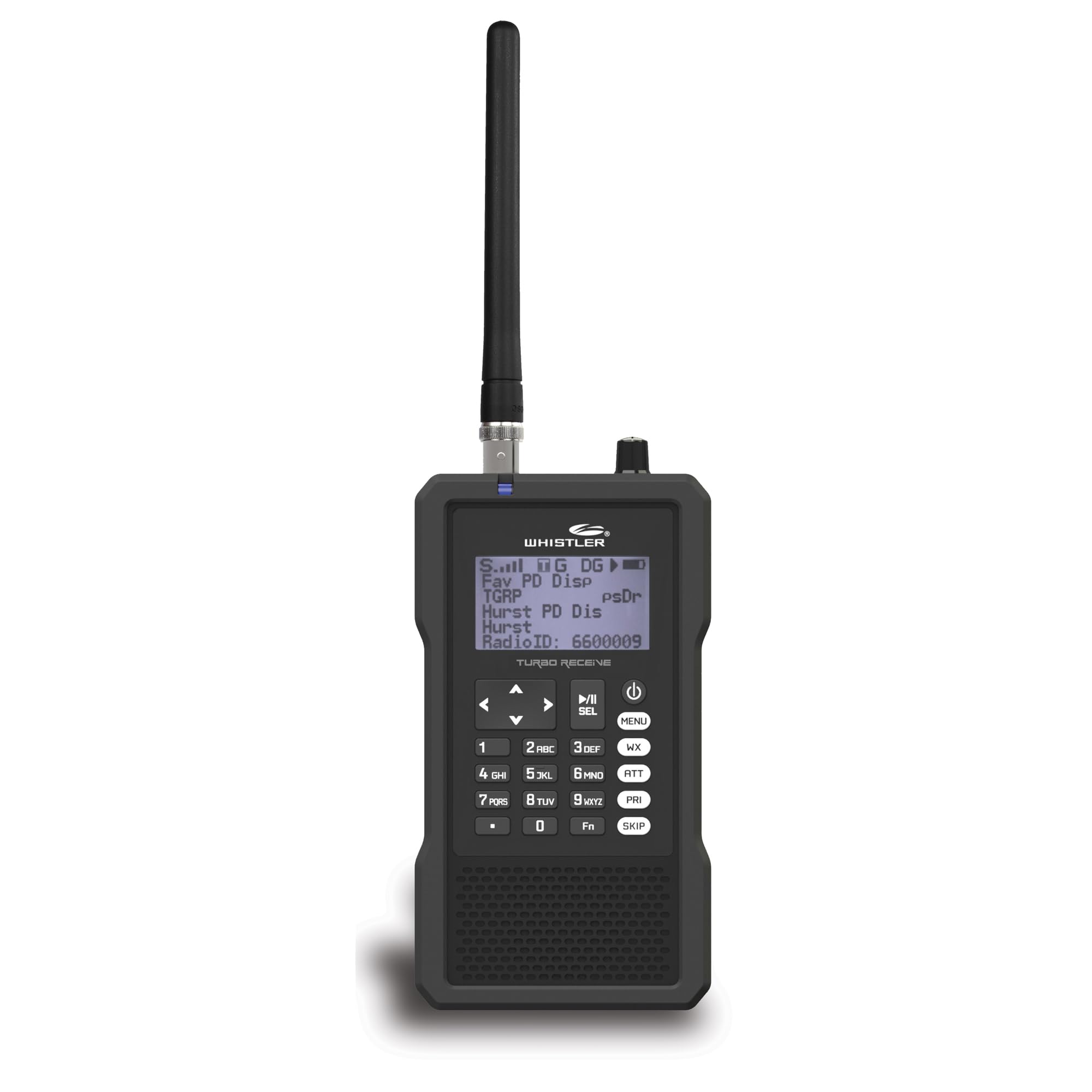
The TRX-1 stands out because it decodes DMR, NXDN, and P25 Phase I/II right out of the box—no paid upgrades, no additional key activation. This makes it the most versatile handheld for listeners in areas where commercial and public safety systems mix digital protocols. The object-oriented memory handles up to 200 customizable scan lists, and the included 2GB MicroSD card stores up to 50 hours of recorded audio for later review.
Tri-color LED alerts with strobe patterns mimic emergency vehicle lights, giving you visual confirmation of priority traffic even with the volume muted. The raw discriminator output lets you feed unprocessed data to third-party decoding software like DSD+ without voiding the warranty. V-Scanner II technology saves up to 200 full configuration snapshots, so you can instantly switch between a highway patrol profile and a local fire department profile.
The EZ-Scan PC software is powerful but notoriously non-intuitive—plan for several hours of manual reading before you can build your first scan list. Once programmed, however, the TRX-1 is a rugged, compact performer with excellent sensitivity across VHF, UHF, and 800 MHz bands. Battery life is adequate for a full day of scanning, and the USB port handles both programming and charging.
Why it’s great
- Decodes DMR, NXDN, and P25 Phase II without extra paid licenses
- 50 hours of recordable audio on the included MicroSD card
- Raw discriminator output for third-party signal analysis
Good to know
- EZ-Scan software has a steep learning curve
- No macOS support—PC required for programming
- 30-second boot time can be frustrating during quick power cycles
5. Whistler WS1065 Digital Trunking Desktop Scanner
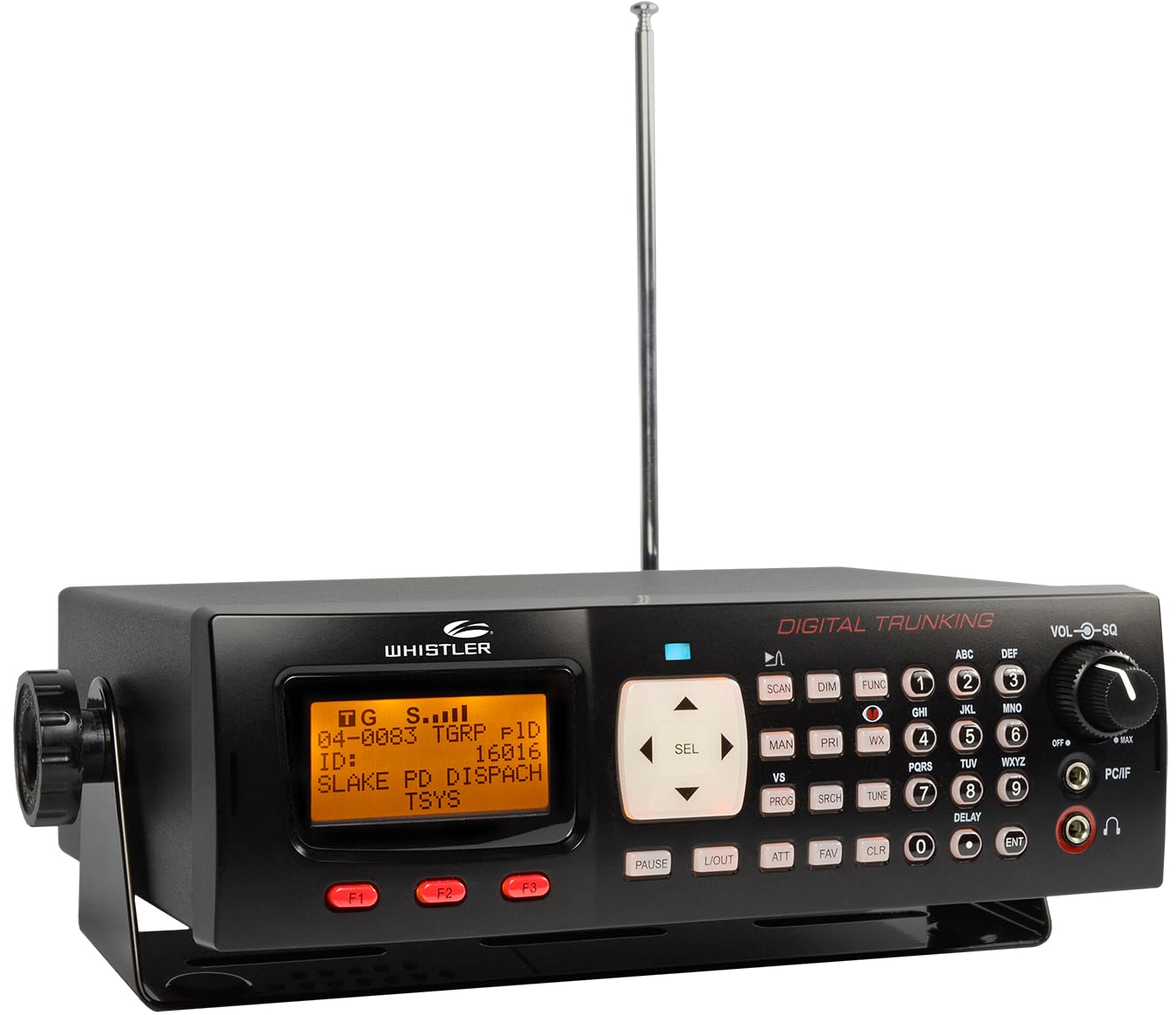
The WS1065 delivers desktop trunking at a price point that undercuts most Uniden equivalents. Its automatic adaptive digital tracking adjusts P25 decoding 50 times per second to compensate for multipath and fading, making it a solid performer in suburban environments with moderate signal overlap. The free-form memory structure stores over 37,800 objects without wasting capacity on fixed banks, giving you room for every talkgroup in your region.
Multi-system trunking support includes Motorola, EDACS, LTR, and P25 Phase I—but not Phase II, DMR, or NXDN. The multi-color Alert LED can be customized with thousands of color combinations and patterns, providing visual cues for priority systems. Real-time signal strength display helps you aim an external antenna for maximum reception on weak 800 MHz channels.
The biggest hurdle is programming: the manual assumes familiarity with trunking jargon, and the PC software (sold separately) plus a Radio Reference subscription add to the total cost. The USB programming cable is not included in the box, an omission that frustrates new users. Experienced scanner operators will find the WS1065 reliable and flexible, but beginners should budget extra time and money for setup.
Why it’s great
- Adaptive P25 Phase I decoding adjusts in real time for signal flutter
- Over 37,800 object memory with dynamic allocation
- Multi-color LED alerts with customizable patterns
Good to know
- No Phase II, DMR, or NXDN support
- USB programming cable not included
- Programming requires PC software and Radio Reference subscription
6. Uniden BCD260DN Base/Mobile Digital Scanner

The BCD260DN bridges the gap between analog and full trunking by offering preloaded DMR and NXDN digital decoding in a desktop/mobile form factor. It scans 10,000 pre-programmed frequencies covering emergency services, aviation, marine, railroad, and weather alerts. The Band Scope feature provides a real-time spectral display of activity across the tuned range, helping you spot hidden signals that might otherwise go unnoticed.
Narrowband reception and CTCSS/DCS rapid decode make it easier to identify sub-audible tones used by specific agencies. The unit shares the same chassis as the BCD996P2, so aftermarket mounting kits and external speaker accessories are widely available. The included whip antenna performs adequately for strong local signals, but an external antenna dramatically improves range, especially on the 700-900 MHz bands.
Critical to understand: the BCD260DN does not support trunk tracking or P25. If your local police department uses a P25 Phase I trunked system, the BCD260DN will hear individual frequency calls but will not follow the conversations through control channels. This makes it ideal for areas with conventional digital channels or ham repeater monitoring, but a poor fit for metro areas with trunked infrastructure.
Why it’s great
- Preloaded DMR and NXDN—no separate activation keys required
- Band Scope displays real-time spectrum activity for signal hunting
- Compatible with BCD996P2 mounting and speaker accessories
Good to know
- Does not support P25 trunk tracking or Phase II
- Stock whip antenna needs an upgrade for fringe reception
- Some units arrive as open-box returns with pre-programmed out-of-region data
7. Uniden BCD160DN Handheld Digital Scanner

The BCD160DN is purpose-built for the frequency search hobbyist who wants digital decode without the complexity of trunk tracking. It handles conventional DMR and NXDN signals—including color codes, system modes, and talkgroup IDs—and displays them on the alpha-tagged screen. The Band Scope Rapid System and Channel Number Tagging features accelerate the process of finding and labeling new discoveries.
Coverage spans 25-512 MHz, 758-824 MHz, 849-869 MHz, 894-960 MHz, and 1240-1300 MHz, so you can search everything from military air bands to 900 MHz ISM frequencies. The DCS/CTCSS rapid decode instantly detects sub-audible tones, saving you hours of manual tone scanning. PC programming via free Uniden software is available, but some users report that the software only loads one bank, making complex setups tedious.
A common complaint is low audio output—even at maximum volume, some users find it hard to hear in noisy environments. The included AA rechargeable batteries have no external charger, and the NXDN functionality may require a coupon activation depending on the batch. For dedicated search users who understand that this is not a trunk tracker, the BCD160DN offers impressive digital sensitivity in a compact handheld.
Why it’s great
- Decodes DMR and NXDN with color code and system ID display
- Band Scope shows spectral activity across wide frequency ranges
- Rapid CTCSS/DCS decode for instant tone identification
Good to know
- Audio output is quieter than competing handheld models
- No trunk tracking and no P25 support
- Some units may require coupon activation for NXDN
8. Uniden BC125AT Handheld Scanner

The BC125AT is the quintessential analog scanner for listeners in areas where public safety has not yet migrated to digital trunking. Its 500 alpha-tagged channels organize across 10 storage banks, and Close Call RF capture technology instantly locks onto nearby transmitters—ideal for finding the frequency of a fire scene or parade command channel. Pre-programmed search bands cover non-digital police/fire, aviation, marine, railroad, ham, CB, FRS/GMRS/MURS, and racing.
The orange backlit display is legible in direct sunlight and low-light conditions, and the compact form factor fits easily in a jacket pocket or center console. Battery life on the included NiMH cells averages about 10 hours of continuous scanning, though an upgrade to higher-capacity lithium-ion AA cells extends that significantly. The USB cable supports charging and PC programming via the free Uniden software.
This model is explicitly not a digital scanner—no P25, DMR, NXDN, or trunk tracking. If your local police department has switched to a P25 trunked system, the BC125AT will be silent. For aviation listeners, railroad enthusiasts, and those in rural areas with analog emergency services, however, the BC125AT delivers superb sensitivity and reliable audio at a budget-friendly price.
Why it’s great
- Excellent analog sensitivity with Close Call RF capture for nearby signal detection
- 500 alpha-tagged channels with 10 bank organization
- Pre-programmed search bands for aviation, marine, and rail
Good to know
- No digital decoding—P25, DMR, NXDN, and trunking are not supported
- Included NiMH batteries have limited capacity; upgrade recommended
- Manual programming is cumbersome without the PC software
9. Whistler WS1025 Analog Desktop Scanner
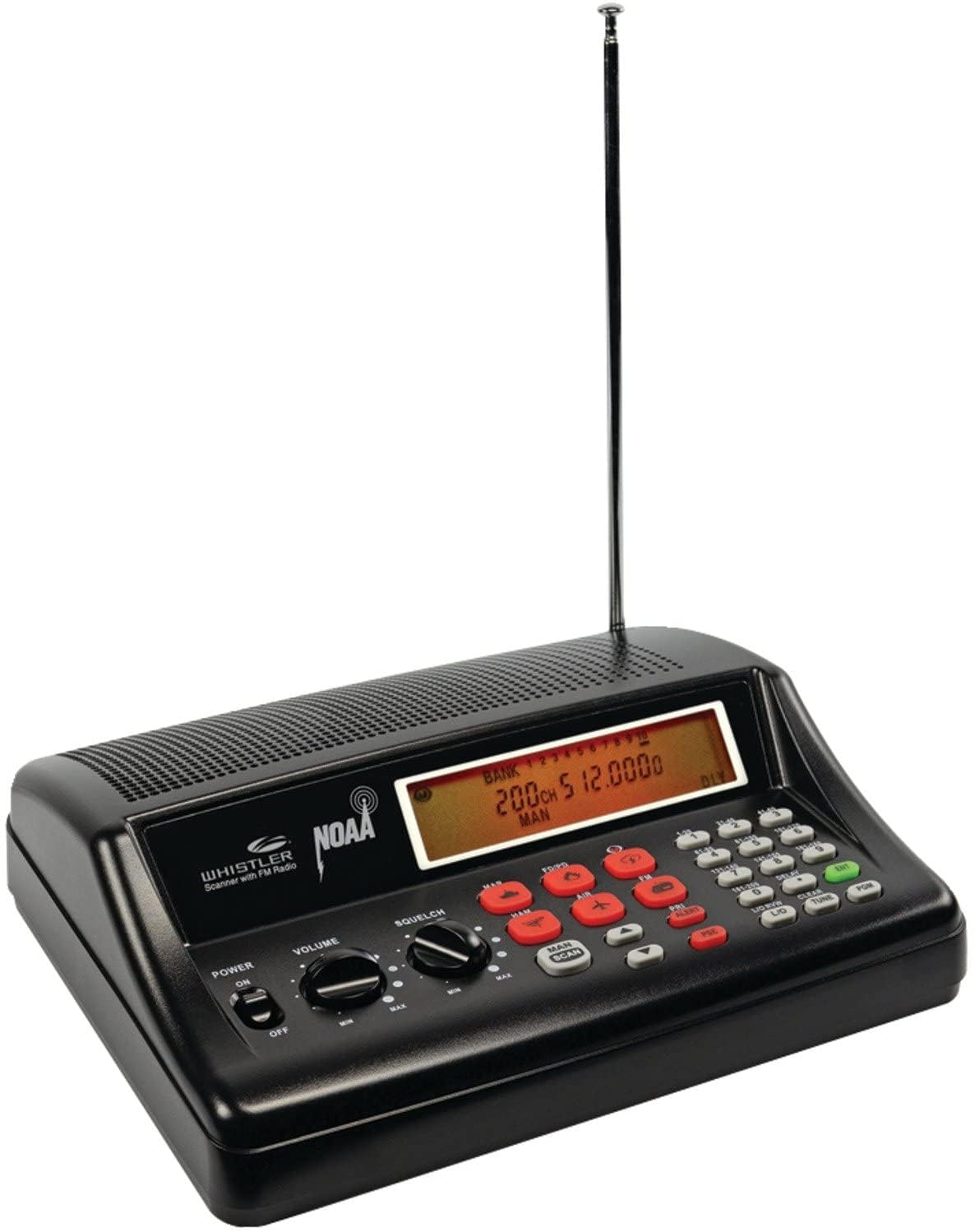
The WS1025 is an analog-only desktop scanner that serves as an affordable entry point for new listeners. It stores 300 channels across 10 banks, includes 153 pre-programmed frequencies for quick starts, and features a priority channel that the scanner checks every two seconds while scanning. The backlit LCD is readable across a room, and the built-in speaker delivers loud, clear audio with no external amplifier needed.
Scan delay pauses on active channels for two seconds before resuming, ensuring you hear replies without missing subsequent calls. The Tune function lets you search from a starting frequency to discover new or unlisted channels. The unit is compact—8.25 inches wide and 2.37 inches tall—so it fits on a crowded desk or shelf without dominating the space.
The WS1025 has no digital decoding whatsoever: no P25, DMR, NXDN, and no trunking support. It relies entirely on analog FM reception, which means it works well for legacy fire paging, weather broadcasts, and conventional VHF/UHF channels but will miss anything that uses digital modulation. Some user reports mention very poor reception with the stock antenna, so an external antenna is strongly recommended for usable performance.
Why it’s great
- Simple analog operation with no digital programming complexity
- Compact desktop footprint and loud built-in speaker
- Pre-programmed frequencies for instant out-of-box scanning
Good to know
- No digital or trunking capabilities—analog only
- Stock antenna provides poor reception; external antenna is essential
- May receive almost no signals in areas with weak RF or digital-only systems
FAQ
Will any digital police scanner work in my area?
What is the difference between trunking and conventional scanning?
Do I need an external antenna for a digital police scanner?
Can I listen to encrypted police communications?
What does DMR and NXDN support mean for a scanner?
Final Thoughts: The Verdict
For most users, the best digital police scanner winner is the Uniden SDS200 because its True I/Q SDR architecture solves the simulcast problem that renders competing units useless in modern metro systems. If you need handheld portability with built-in GPS, grab the Uniden SDS150. And for budget-conscious buyers who only need analog reception of conventional channels, nothing beats the Uniden BC125AT.

Mo Maruf
I created WellFizz to bridge the gap between vague wellness advice and actionable solutions. My mission is simple: to decode the research and give you practical tools you can actually use.
Beyond the data, I am a passionate traveler. I believe that stepping away from the screen to explore new environments is essential for mental clarity and physical vitality.