Our readers keep the lights on and my smoothie glass nicely filled. As an Amazon Associate, I earn from qualifying purchases.
Finding a digital police scanner that actually picks up modern P25 and DMR public safety channels without breaking the bank feels nearly impossible. Most entry-level radios under this cap are stuck in the analog era, leaving you with static where crucial communications used to be.
I’m Mohammad Maruf — the founder and writer behind WellFizz. I’ve spent hundreds of hours cross-referencing technical specifications, decoding radio standards, and analyzing user field reports to separate the few capable digital performers from the many analog placeholders.
This guide focuses strictly on models that operate on modern digital trunking and DMR modes at a price point most enthusiasts can justify. The best digital police scanner under 100 must balance digital decode ability, spectral coverage, and rugged build quality without requiring a second mortgage.
How To Choose The Best Digital Police Scanner Under 100
The biggest trap buyers fall into is assuming any radio labeled “police scanner” will still work on today’s encrypted and trunked public safety systems. Many departments have migrated to digital formats like Project 25 (P25) and DMR, rendering analog-only receivers useless for primary police monitoring. Your first job is confirming which digital standard your local agencies use. Phase 1 P25 is the most common for budget-friendly digital decoding, while Phase 2 and DMR require more advanced silicon that pushes prices higher.
Digital Modes and Modulation Compatibility
Not all digital is created equal. P25 Phase 1 uses a C4FM modulation that many entry-level digital handhelds can decode. DMR (Digital Mobile Radio) uses TDMA, splitting a single frequency into two time slots. If your target police department operates on a DMR conventional or trunked system, an analog-only scanner will deliver nothing but silence. Look for specifications that explicitly state “P25 Phase 1” and “DMR” support. The model must mention digital voice decoding in its feature list — vague terms like “digital display” or “digital tuning” do not count.
Frequency Coverage and Trunking Support
Police communications in most urban areas now occupy the 700-800 MHz UHF band on trunked systems. A scanner limited to VHF (136-174 MHz) will miss entire agencies. Ensure the radio covers 25-512 MHz at minimum, with extension into the 758-960 MHz range for modern public safety trunking. TrunkTracker capability is essential: it allows the scanner to follow frequency hops as the system switches channels automatically. Without trunking support, you will only catch fragments of conversations.
Build Quality and Battery Life in a Budget Package
Under the ceiling, you trade premium chassis materials for engineering compromises. A good budget digital handheld still needs a solid battery solution — either a high-capacity 2500mAh pack or standard AA compatibility for field swaps. Look for Type-C charging as a modern convenience in this price bracket, and confirm the antenna connector is standard SMA or BNC so you can upgrade to a rooftop or mag-mount antenna for better fringe reception. Avoid units with non-removable antennas, as they cap your ability to improve weak-signal performance.
Quick Comparison
On smaller screens, swipe sideways to see the full table.
| Model | Category | Best For | Key Spec | Amazon |
|---|---|---|---|---|
| BAOFENG DM32 | Digital DMR | DMR / Analog Dual-Mode Scanning | 10W TX, 4000 Channels, Type-C | Amazon |
In‑Depth Reviews
1. BAOFENG DM32 DM-32UV DMR Radio
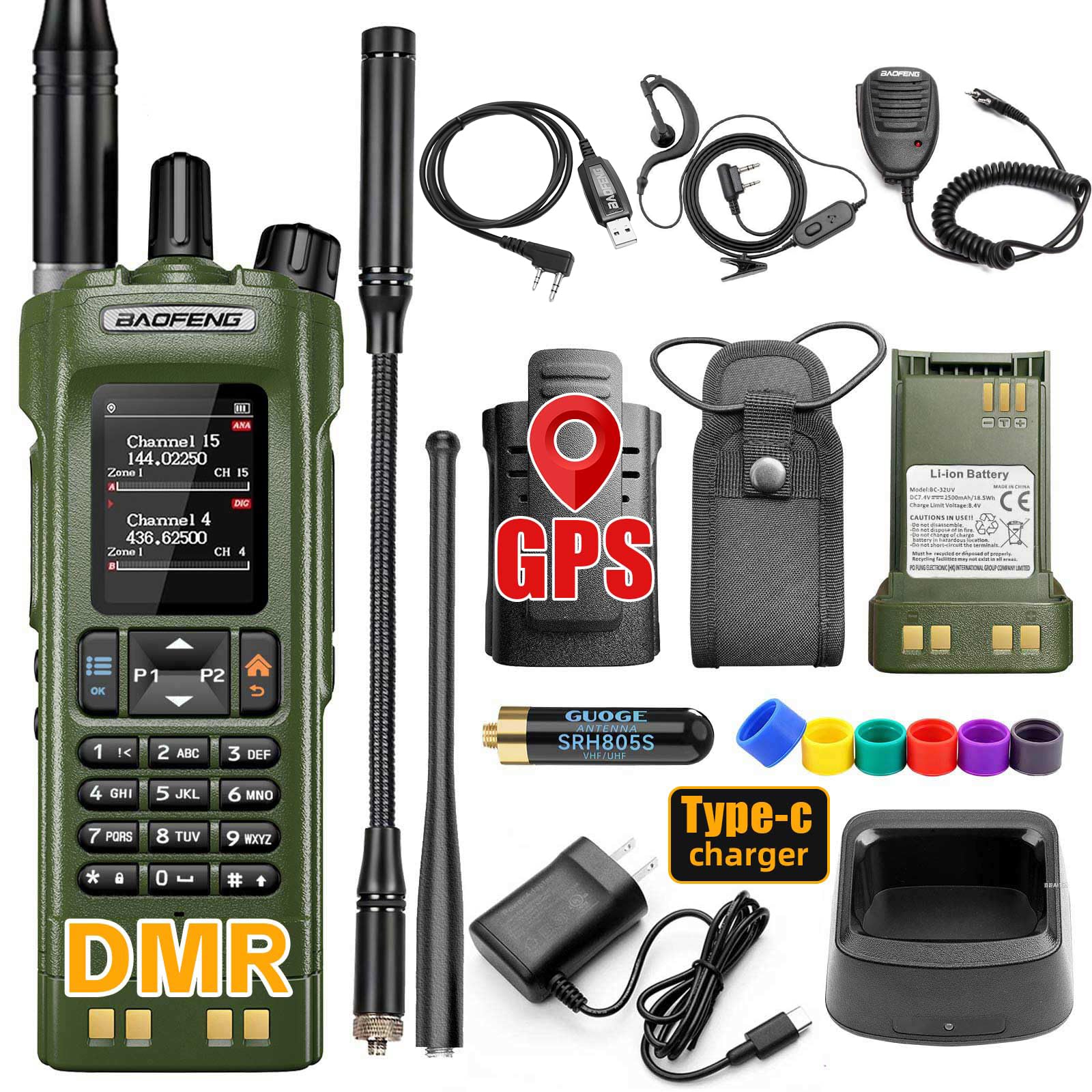
The BAOFENG DM32 delivers genuine digital DMR decoding and analog FM reception in a single handheld, making it the only model in this price range that can track both legacy analog police channels and modern digital public safety talkgroups. With a 10W maximum transmit power on analog and clear digital voice decoding, this unit punches far above its tier for a radio that fits under the cap. The 4000-channel memory and full keyboard allow manual frequency entry without needing a computer for basic operation.
Built-in GPS and APRS support add location-based utility often missing in budget handhelds, and the 2500mAh pack provides extended field time. The dual antenna setup — a standard 33cm whip and a gooseneck — gives you flexibility for portable versus vehicle use. The full-color 2.0-inch screen displays alpha tags, making it easy to identify which agency or channel you are monitoring at a glance. The TDMA digital decoding handles DMR Tier I and II systems commonly used in small-city police and fire networks.
The USB-C port covers charging, firmware updates, and frequency programming through a single cable, a major convenience at this price. While the stock antennas are adequate for local reception, upgrading to a dedicated external antenna noticeably improves weak-signal DMR frame synchronization. The programming software has a learning curve, but the manual programming option via the keypad works well for adding a handful of critical frequencies quickly. Analog audio is loud and clear, and the digital audio codec minimizes background hiss during DMR sessions.
Why it’s great
- True DMR and analog dual-mode reception in one affordable package
- 4000 channels with TDMA support for efficient frequency use
- USB-C connectivity simplifies charging and programming
- GPS and APRS add location features rare at this price tier
Good to know
- Stock antennas benefit from aftermarket upgrades for fringe reception
- Programming software has a moderate learning curve
- Color screen visibility drops under direct sunlight
2. Uniden BC355N 300-Channel Base/Mobile Scanner

The Uniden BC355N is an analog-only base/mobile scanner that excels at monitoring conventional analog police, fire, EMS, marine, aircraft, and NOAA weather channels. Its Close Call RF Capture technology instantly tunes to nearby active transmitters, making frequency discovery effortless. With 300 memory channels organized into 10 banks, you can dedicate separate banks to different service categories and quickly lock out unwanted chatter. The backlit display and included AC adapter with DC car power cable make it equally usable on a desk or a vehicle dashboard.
This scanner is pre-programmed with service banks for rapid deployment straight out of the box. The 8.33 kHz step tuning on the aircraft AM band covers civil aviation frequencies, and the 800 MHz range extends into UHF analog public safety bands still used in many suburban and rural areas. The unit scans at approximately 85 channels per second, which is fast enough to catch brief transmissions on busy analog systems. The telescopic antenna included in the box picks up strong local signals, but an external roof antenna dramatically widens reception range.
The BC355N is explicitly not a digital scanner — it will not decode P25, DMR, or NXDN. If your local police have migrated to a digital trunked system, this unit will produce only static or silence on those channels. It also lacks trunking support, so you will hear single-frequency analog conversations only, not the full traffic of a trunked system. The programming interface lacks numeric keypad buttons, requiring you to step through menu options for frequency entry, which can be tedious for large channel lists.
Why it’s great
- Close Call RF Capture makes finding active local frequencies simple
- 300 channels across 10 banks offer excellent organization
- AM aircraft band and 800 MHz coverage included
Good to know
- Analog-only — cannot decode P25, DMR, or NXDN digital signals
- No trunking support, limits monitoring to single-frequency analog
- Channel entry is menu-based without a numeric keypad
3. Whistler WS1025 Analog Desktop Scanner
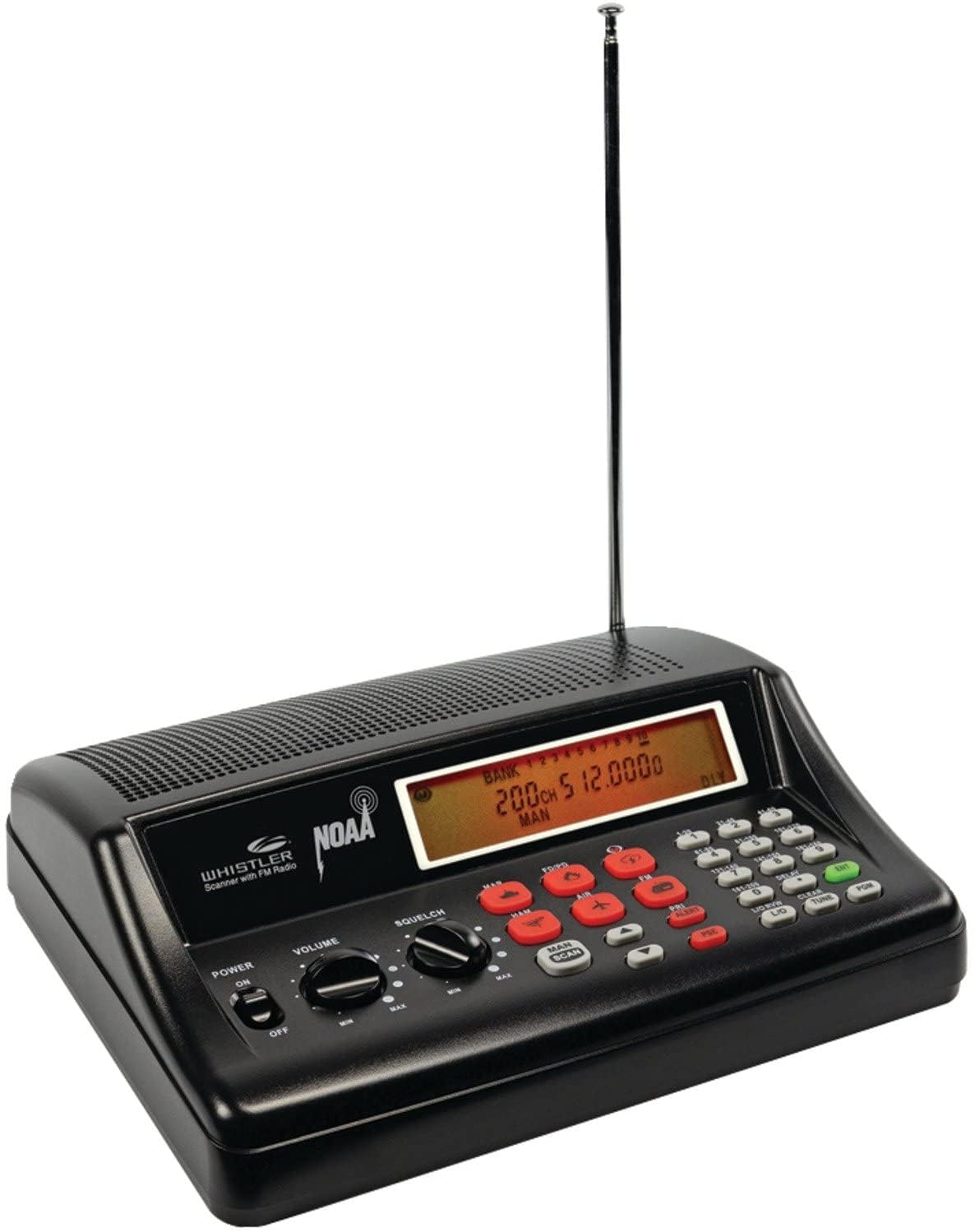
The Whistler WS1025 is a straightforward analog desktop scanner designed for users who want a dedicated base station without the complexity of handheld menus. It comes pre-programmed with 153 frequencies across public safety, weather, and marine bands, and offers 200 additional memory slots for user-added channels. The backlit LCD screen is easy to read across a room, and the large tuning knob makes manual frequency stepping intuitive. The built-in speaker delivers crisp audio with enough volume to fill a small office or kitchen.
The priority channel feature checks a designated frequency every two seconds, ensuring you never miss a call on your most important channel. The scan delay hold adds two seconds of pause after a transmission stops, so you can hear replies without the scanner racing away. The WS1025 also supports direct frequency entry via the keypad and lets you tune to unlisted frequencies using the Tune mode, which steps through the spectrum starting from a specified reference point. This makes frequency discovery feasible even without a computer.
The WS1025 is strictly analog with zero digital decoding capability, limiting its use in areas where public safety has moved to P25 or DMR networks. Some users report weaker reception compared to older Radio Shack models, particularly on the UHF band with the stock whip antenna. The desktop form factor also fixes the scanner in one location, meaning you lose portability. The programming manual is sparse, though the straightforward button layout compensates with intuitive operation after a short trial period.
Why it’s great
- Large backlit LCD and simple desktop controls for easy home use
- Priority channel and scan delay ensure you catch important traffic
- Tune mode allows manual frequency discovery without software
Good to know
- Analog-only — no P25, DMR, or NXDN digital support
- Fixed desktop form factor limits portability
- Reception may be weaker on UHF compared to legacy models
4. Racing Electronics RE3000 Scanner

The Racing Electronics RE3000 is a niche scanner purpose-built for motorsport fans who need to follow NASCAR, IndyCar, or ARCA driver communications at the track. It tunes the 450-470 MHz UHF racing band and stores up to 440 channels across 4 series banks, allowing you to sort drivers by series. Three one-touch favorite channel buttons give immediate access to your top drivers, while the last 30 seconds of audio replay captures transmissions you might have been distracted and missed during the action.
Over-the-air programming is supported at Racing Electronics service trailers found at most major tracks, so you can have frequencies loaded without a computer. The unit supports both user-programmable and trackside-programmable modes, and the user-selectable scan list means you can toggle between drivers on the fly. The lightweight form factor — just over 7 ounces — clips onto a belt or fits in a pocket, leaving your hands free for binoculars or a drink. Audio output is loud enough to be heard over roaring engines when paired with the included earbud connection.
The RE3000 is limited strictly to the 450-470 MHz UHF racing band and does not cover VHF police, fire, aircraft, or public safety frequencies. It cannot decode P25, DMR, or any digital mode, as it is an analog narrowband FM receiver. The battery life is adequate for a full race day but does not match the endurance of general-purpose handhelds. If you are a dedicated race fan, this unit is a laser-focused tool, but it has zero utility for general public safety scanning outside the track.
Why it’s great
- Purpose-built for NASCAR and IndyCar with over-the-air programming
- 440 channels across 4 series with 3 one-touch favorites
- Lightweight pocket design and 30-second audio replay
Good to know
- Limited to 450-470 MHz racing band — no public safety coverage
- Analog narrowband only, no digital mode decoding
- Battery life adequate for a day, not multi-day field use
5. Rapid Radios Nationwide LTE Walkie-Talkie

The Rapid Radios set is a Push-to-Talk over Cellular (POC) solution that uses the 4G LTE network to provide unlimited-range communication across the United States. It is not a radio scanner in the traditional sense — it operates as a two-way communication device rather than a receiver that monitors public safety frequencies. The set includes two radios with one year of nationwide service per unit, and the 256-bit AES encryption ensures your private group conversations stay secure from eavesdropping, including government interception.
Audio clarity on the Rapid Radios is exceptional, with active noise cancellation that filters wind and engine noise during outdoor use. The battery life extends up to 5 days on a single charge with typical daily use, and the USB-C charging port allows recharging from any standard phone charger, car adapter, or power bank. The talk groups support up to 200 people per group, making it viable for large event coordination, search and rescue operations, or multi-team work sites. The rugged, weather-resistant design can handle rain, dust, and drops.
The Rapid Radios does not function as a police scanner — it cannot scan or monitor P25, DMR, analog police, fire, or emergency service frequencies. It is a communication tool only, and it requires an active cellular subscription after the first year. Some users report difficulty with the battery removal process and inconsistent initial network registration on odd units. For team coordination across long distances, this system is robust, but it does not replace a digital police scanner for monitoring public safety channels.
Why it’s great
- Unlimited nationwide range via 4G LTE cellular network
- 256-bit AES encryption for completely private group communications
- Exceptional battery life and USB-C charging convenience
Good to know
- Cannot scan or monitor police, fire, or public safety frequencies
- Requires ongoing cellular subscription after first year
- Some units may have connectivity registration issues out of box
6. Uniden BCD436HP HomePatrol Series Digital Handheld Scanner

The Uniden BCD436HP is a reference-grade digital handheld scanner that combines the simplicity of the HomePatrol zip-code programming with the advanced features of a traditional handheld. You turn it on, enter your zip code, and the TrunkTracker V system automatically loads nearby local public safety, police, fire, EMS, aircraft, and weather frequencies from the Radio Reference database. It decodes P25 Phase 1 and Phase 2 digital signals, making it future-proof for most current municipal and state police radio systems across the USA and Canada.
The extra-large display shows system name, department, and channel alpha tags, giving you full context on every transmission. The Close Call RF Capture instantly tunes to nearby transmitters, and the Discover Mode helps you analyze unknown radio systems. Up to 240 seconds of instant replay buffers the most recent audio, so you can go back and catch a missed dispatch. The scanner scans at 85 channels per second, and the microSD card slot supports unlimited channel storage and recording to card for later playback.
The BCD436HP carries a premium price well beyond the ceiling, but its zip-code convenience and P25 Phase 2 support set the benchmark for digital police scanning. The battery life is moderate at around 8 hours, and some users report the plastic body feels less rugged than older Uniden metal chassis models. The programming depth can overwhelm new users, though the basic zip-code mode requires no technical knowledge. An external antenna dramatically boosts reception, and the optional GPS accessory enables full auto-switching of systems as you travel between jurisdictions.
Why it’s great
- Zip-code programming loads local police frequencies instantly
- P25 Phase 1 and Phase 2 digital decoding for modern systems
- 240-second instant replay and microSD recording for missed calls
Good to know
- Premium cost far exceeds the budget-friendly price tier
- Battery life averages 8 hours with moderate use
- Plastic build may feel less durable than older metal scanners
7. New Uniden SDS150 Digital Radio Scanner
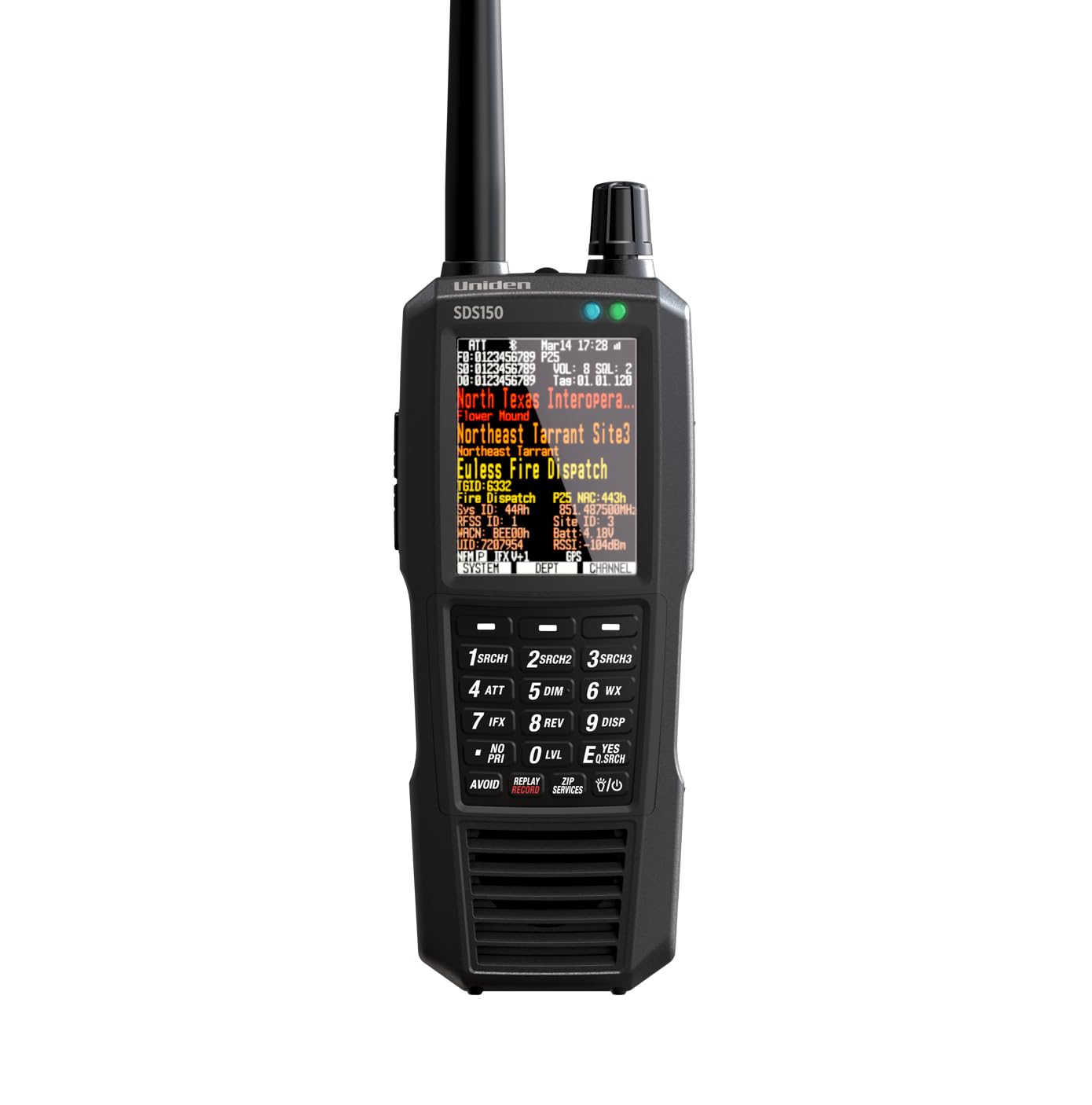
The Uniden SDS150 represents the most advanced digital scanner Uniden has ever produced, built on software-defined radio (SDR) architecture with a true I/Q receiver that eliminates simulcast distortion — the single biggest problem with consumer scanners in metro areas where multiple towers broadcast the same P25 channel on the same frequency. The SDR architecture processes the entire RF spectrum digitally, allowing adaptive filtering that locks onto weak signals while rejecting interference. It decodes P25 Phase 1 and Phase 2, DMR, and NXDN with complete fidelity.
The built-in GPS receiver automatically updates your location and loads the appropriate radio systems as you cross jurisdictional lines, making it the ultimate road-trip scanner. The charge cradle includes an extra battery charging slot, so you can rotate battery packs for continuous monitoring. The IPX4 water-resistant rating means it survives rain and splashes during outdoor use. Bluetooth connectivity pairs with the U/AWARE smartphone app for remote control and audio streaming to wireless earbuds. The color display is sharp and readable even in direct sunlight.
The SDS150 is the most expensive scanner in this guide, with a price that sits well above the budget cap by a wide margin. The learning curve for its full feature set is steep, and the Bluetooth range for the app connection is unreliable at distance. It is bulkier than previous Uniden handhelds, making pocket carry less practical. For enthusiasts who need perfect simulcast performance and future-proof digital support, the SDS150 is the ultimate tool, but for a buyer strictly under , it represents the aspirational reference point.
Why it’s great
- SDR I/Q receiver eliminates simulcast distortion on P25 systems
- Built-in GPS and zip-code programming for automatic travel scanning
- IPX4 water-resistant and Bluetooth app connectivity included
Good to know
- Very high cost places it far above the budget segment
- Bluetooth range to the U/AWARE app is limited and sometimes unstable
- Bulkier than previous Uniden handheld designs
FAQ
Can a digital police scanner under decode P25 Phase 2 systems?
What is the difference between analog and digital police scanners?
Will a ham radio like the BAOFENG DM32 work as a police scanner?
How do I know if my local police department uses encrypted communications?
What antenna do I need for better police scanner reception?
Final Thoughts: The Verdict
For most users, the best digital police scanner under 100 winner is the BAOFENG DM32 because it is the only radio in this price tier that offers genuine DMR digital decoding alongside analog FM reception, with enough channel capacity and battery life for serious monitoring. If you want a desktop base unit with Close Call capture for analog only, grab the Uniden BC355N. And for laser-focused race track communication with over-the-air programming, nothing beats the Racing Electronics RE3000.

Mo Maruf
I created WellFizz to bridge the gap between vague wellness advice and actionable solutions. My mission is simple: to decode the research and give you practical tools you can actually use.
Beyond the data, I am a passionate traveler. I believe that stepping away from the screen to explore new environments is essential for mental clarity and physical vitality.