Our readers keep the lights on and my smoothie glass nicely filled. As an Amazon Associate, I earn from qualifying purchases.
The moment you probe a live circuit, the difference between a usable scope and a frustrating one is measured in waveform update rate and vertical noise. A slow capture rate hides glitches, and insufficient vertical resolution buries small signal detail under quantization error. For anyone debugging embedded systems, power supply ripple, or automotive sensor outputs, the oscilloscope’s core specs—sampling rate, memory depth, bandwidth, and bits—determine whether you find the fault in minutes or miss it entirely. The shift from 8-bit to 12-bit resolution has redefined what entry-level hardware can reveal, while deep memory and high waveform capture rates separate serious diagnostic tools from basic signal viewers.
I’m Mohammad Maruf — the founder and writer behind WellFizz. My research approach for this guide involved cross-referencing datasheet specs with real-world user reports across repair forums, maker communities, and professional engineering evaluations to identify which oscilloscopes actually deliver on their published numbers when probing real signals.
This guide analyzes nine models ranging from pocket-sized USB designs to full-featured benchtop instruments, all evaluated for their specific strengths in different use cases. Whether you are diagnosing a no-start condition on a modern vehicle or decoding I2C traffic on a prototype board, the best digital oscilloscope for your bench is the one that matches your signal complexity, channel count, and measurement environment without wasting budget on specs you do not need.
How To Choose The Best Digital Oscilloscope
Choosing a digital oscilloscope is a balancing act between bandwidth, sampling rate, memory depth, channel count, and vertical resolution. Your specific application—whether audio repair, embedded debugging, or automotive diagnostics—dictates which of these specs matters most. Over-buying bandwidth wastes budget; under-buying memory depth makes intermittent faults invisible. The following criteria will help you match the scope to the signal.
Bandwidth and Sampling Rate: The Captured Signal Rule
Bandwidth determines the highest frequency sine wave the oscilloscope can accurately measure, typically defined by the -3 dB point. A useful rule of thumb is that the bandwidth should be at least five times the highest frequency of your signal to capture the fundamental and its significant harmonics. For a 20 MHz digital clock signal, a 100 MHz scope is the realistic minimum. Sampling rate, measured in GS/s (gigasamples per second), must be at least 2.5 to 5 times the bandwidth in real-time mode to avoid aliasing. A 100 MHz scope paired with 1 GS/s meets this margin comfortably.
Memory Depth: The Glitch Hunter’s True Ally
Memory depth dictates how long the oscilloscope can capture a waveform at its maximum sampling rate. A scope with 1 Mpts of memory can hold 1 million sample points; at its highest sample rate, this fills the screen with a short time window. Deeper memory (10 Mpts and above) allows you to zoom into captured data for fine detail without reducing the sample rate. For serial bus decoding (I2C, SPI, UART) or capturing a long sequence of pulses, shallow memory is a critical bottleneck. Models that offer 14 Mpts or 24 Mpts per channel give you the time context needed to correlate signal events.
Vertical Resolution: 8-bit vs 12-bit for Small Signal Fidelity
Most budget and mid-range oscilloscopes use an 8-bit ADC, providing 256 discrete voltage levels per division. This is sufficient for general-purpose probing of logic levels and amplitude-checking sine waves. A 12-bit scope, however, delivers 4096 levels—a fourfold improvement in vertical granularity. For applications like measuring power supply ripple in millivolts, checking the linearity of a sensor output, or observing the settling behavior of a low-voltage reference, 12-bit resolution reveals details that 8-bit quantization noise entirely masks. The RIGOL DHO814 and its siblings in the 12-bit category represent a meaningful threshold shift in what is available at mid-range pricing.
Quick Comparison
On smaller screens, swipe sideways to see the full table.
| Model | Category | Best For | Key Spec | Amazon |
|---|---|---|---|---|
| RIGOL DHO814 | Premium 12-bit | Power ripple, low-level signals | 12-bit / 1.25 GS/s / 25 Mpts | Amazon |
| Siglent SDS1204X-E | High-End 200 MHz | High-speed digital, advanced triggers | 200 MHz / 1 GS/s / 14 Mpts | Amazon |
| Siglent SDS1104X-E | Mid-Range 4-Ch | Embedded debug, serial decode | 100 MHz / 1 GS/s / 14 Mpts | Amazon |
| Rigol DS1054Z | Entry-Level 4-Ch | Education, general debug | 50 MHz / 1 GS/s / 24 Mpts | Amazon |
| Hantek DSO5102P | Budget Desktop | Home lab, DIY repair | 100 MHz / 1 GS/s / 40 Kpts | Amazon |
| HANMATEK DOS1102 | Budget Desktop | Field use, student projects | 110 MHz / 500 MS/s / 10 Kpts | Amazon |
| FNIRSI 1013D Plus | Budget Tablet | Portable touch, car repair | 100 MHz / 1 GS/s / 1 GB storage | Amazon |
| Korg Nu:Tekt NTS-2 | Specialty Audio | Synth, audio, CV monitoring | 4-Ch / Audio BW / Waveform Gen | Amazon |
| Pico 2204A | PC-Based Ultraportable | Travelling, education, beginner | 10 MHz / 100 MS/s / 8 kS | Amazon |
In‑Depth Reviews
1. RIGOL DHO814
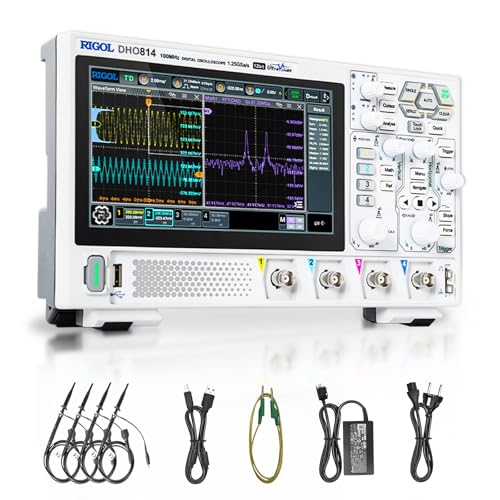
The RIGOL DHO814 sets a new baseline for mid-range oscilloscopes by integrating 12-bit vertical resolution across its four 100 MHz channels. The 1.25 GS/s sampling rate paired with up to 25 Mpts of memory depth means you can capture long sequences of 12-bit data without running out of buffer. The UltraAcquire mode at 1,000,000 wfms/s makes glitch hunting practical even for intermittent events—a capability previously exclusive to much more expensive instruments.
The 7-inch capacitive touch display with 1024×600 resolution responds accurately to gestures, and the Android-based OS runs the UI without noticeable lag. HDMI output and LAN-based web control allow remote monitoring from a laptop without installing software. Standard serial decode for CAN, RS232/UART, I2C, and SPI covers the most common embedded protocols, while the 41 auto measurements and FFT up to 1 Mpts give you enough analytical depth for power ripple and MCU bus debugging.
The USB-C power connector is the one polarizing design choice—it works well with a clean USB-C PD source, but any noise on the power line can couple into measurements. The fan is audible but not intrusive, and occasional UI lock-ups are resolved with a factory reset. For the combination of 12-bit resolution, deep memory, and fast capture rate at this bandwidth, the DHO814 delivers performance that outclasses traditional 8-bit scopes in the same bracket.
Why it’s great
- True 12-bit ADC reveals mV-level detail invisible on 8-bit scopes
- UltraAcquire captures 1,000,000 wfms/s for glitch hunting
- 25 Mpts memory across four channels at full sample rate
- Touch screen, LAN web control, and HDMI output are genuinely useful
Good to know
- USB-C power input can introduce noise from a dirty supply
- Occasional UI lock-up requires factory reset to clear
- 70 MHz probes bundled are adequate but not exceptional
2. Siglent SDS1204X-E
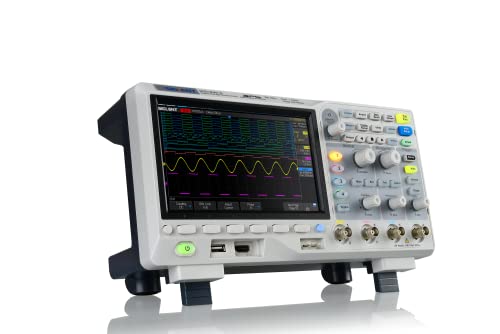
The Siglent SDS1204X-E brings 200 MHz bandwidth and 1 GS/s sampling rate across four channels, backed by 14 Mpts of memory depth that remains fully accessible to measurements and math operations. The Super Phosphor display technology provides an intensity-graded view that makes it easier to distinguish signal activity from noise, and the 500 µV/div vertical scale allows observation of extremely small signals without excessive pre-amplifier noise.
Intelligent trigger options—including Edge, Slope, Pulse Width, Window, Runt, Interval, Timeout, and Pattern—cover a wide range of debugging scenarios. The 14 Mpts FFT provides frequency-domain analysis that retains the full time-domain memory, unlike cheaper implementations that truncate the FFT length. Ethernet connectivity via the RJ45 port enables responsive remote control through the web interface, and an optional WiFi dongle and license unlock wireless operation.
The SDS1204X-E is new-old stock in some channels, so the calibration certificate date may be older than expected. The AWG and MSO capabilities require optional hardware and licenses, adding cost if you need them. For a pure four-channel 200 MHz scope with deep memory, reliable firmware, and low noise floor, this is a strong choice for serious hobbyists and professional techs who need headroom above 100 MHz.
Why it’s great
- 200 MHz bandwidth with 1 GS/s across all four channels
- 14 Mpts memory available for FFT and all measurements
- 500 µV/div low noise scale for tiny signals
- Responsive Ethernet web interface out of the box
Good to know
- AWG, WiFi, and MSO require separate hardware/licenses
- May ship as new old-stock with older calibration date
- Fan is on the louder side of acceptable
3. Siglent SDS1104X-E
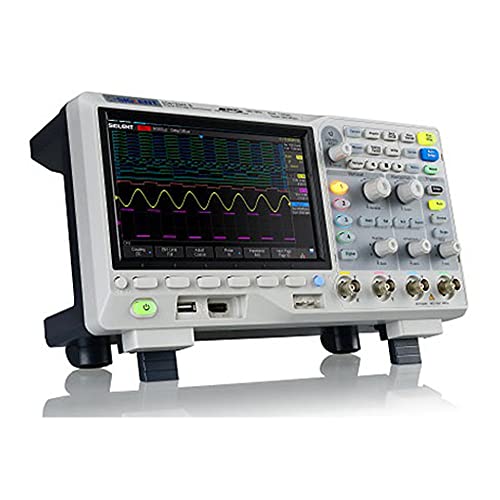
The Siglent SDS1104X-E offers a 100 MHz bandwidth with 1 GS/s sampling achievable on up to two channels simultaneously by routing one ADC per active channel pair. Its 14 Mpts memory depth is a standout feature at this price—deep enough to capture lengthy serial bus transactions without compression artifacts. The user interface presents 14 horizontal divisions without menu overlay, giving you a clean signal view that many competitor scopes obscure with persistent menu bars.
Standard serial decoders for I2C, SPI, UART/RS232, CAN, and LIN are included, and the Ethernet interface provides fast remote control that rivals a direct connection in responsiveness. The trigger stability down to 10 mV amplitude is excellent, making it suitable for low-level signal work. The external MSO add-on box exists but integrates less cleanly than Rigol’s solution, so if mixed-signal is critical, that context matters.
The 1X/10X switch on the bundled probes can feel loose, and the hook tips may not always clamp perfectly. There is no dedicated vertical position knob per channel, which users migrating from analog scopes may find inconvenient. The fan is slightly louder than silent, but for a 100 MHz four-channel scope with this memory depth and clean UI, the SDS1104X-E is a favorite among embedded engineers who prioritize display real estate and responsiveness.
Why it’s great
- 14 Mpts memory depth at 1 GS/s for long captures
- 14-division display with clean, unobstructed signal view
- Responsive LAN web control with low latency
- Low noise floor with stable triggering on small signals
Good to know
- 1 GS/s only on 2 channels at a time (one per ADC pair)
- MSO add-on is less integrated than Rigol’s option
- Probe switches feel loose; hook may slip off component leads
4. Rigol DS1054Z
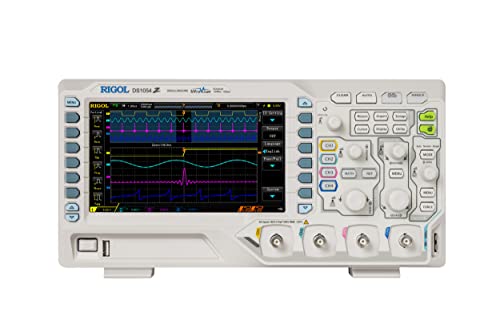
The Rigol DS1054Z remains a benchmark for entry-level four-channel oscilloscopes years after launch, thanks to its 24 Mpts of standard memory depth and the UltraVision architecture that delivers 30,000 wfms/s. The 50 MHz bandwidth covers the fundamentals for most audio, logic, and low-frequency power work, and the community-discovered firmware unlock that extends bandwidth beyond the base spec has kept it relevant against newer competitors.
Serial bus decoding for RS232/UART, I2C, and SPI is built in, making it viable for embedded debugging out of the box. The 60,000-frame waveform recording and playback is a powerful tool for capturing intermittent events over extended periods. The intensity-graded display helps distinguish signal activity from noise, and the hardware frequency counter provides reliable frequency measurement independent of the main acquisition path.
The front-panel rotary encoders feel mushy compared to higher-end scopes, and the fan produces a noticeable hum. The bundled passive probes are functional but require significant compensation tuning for flat frequency response. Single-channel bandwidth reaches the full 1 GS/s only on one channel; using all four drops the effective sample rate per channel. For education, general lab work, and budget-constrained builds, the DS1054Z still offers the best memory depth and feature set at its tier.
Why it’s great
- 24 Mpts memory depth is class-leading at entry level
- UltraVision engine delivers 30,000 wfms/s capture rate
- 60,000-frame record/playback for long-term monitoring
- Community firmware unlock extends bandwidth significantly
Good to know
- Rotary encoders feel loose and imprecise
- Fan noise is noticeable on a quiet bench
- Bundled probes require careful compensation adjustment
5. Hantek DSO5102P

The Hantek DSO5102P is a 100 MHz, two-channel digital storage oscilloscope with a real-time sampling rate of 1 GS/s and a 7-inch TFT LCD display. It is a desktop form factor with a folding handle for portability. The 40 Kpts memory depth is modest by current standards, but the scope includes 32 automatic measurement functions and FFT analysis covering the basic frequency domain needs for home electronics repair and hobbyist debugging.
The unit supports USB device connectivity for remote control and data transfer, and it can store over 1000 waveform reference data sets internally. The probes included are sufficient for general-purpose x1/x10 probing of signals up to 100 MHz, but users consistently note that the 1X/10X switch is stiff and the hook tips do not grip reliably. The scope is known to run warm because it lacks active internal cooling, and under sustained heavy use, overheating can cause measurement drift or shutdown.
Community users have documented firmware modifications that can unlock higher bandwidth, and the large user base means troubleshooting guides are easy to find. The USB remote control interface is slow—around 1 frame per second—making PC-based automation impractical. For a low-cost 100 MHz scope to keep on a home bench for quick signal check, the DSO5102P delivers reasonable functionality, but its thermal limitations and mediocre build quality limit reliability in extended diagnostic sessions.
Why it’s great
- 100 MHz bandwidth at a low cost for hobbyist use
- 1 GS/s sampling rate adequate for typical signals
- Large user community with documented firmware upgrades
Good to know
- No active cooling; overheating can cause shutdowns
- USB remote interface limited to ~1 fps
- Probe switches are stiff and hook tips unreliable
6. HANMATEK DOS1102
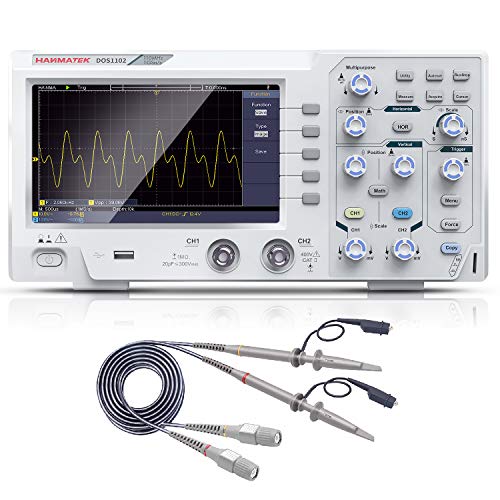
The HANMATEK DOS1102 offers 110 MHz bandwidth with a 500 MS/s real-time sampling rate on two channels, housed in a 7-inch TFT-LCD chassis. The 10 Kpts memory depth per channel is shallow, limiting the time window at maximum sample rate to capturing only a few microseconds of signal. It does include a built-in 6-digit hardware frequency counter measuring 2 Hz to 20 MHz, and it supports 30 automatic measurement functions that users can customize through the measurement menu.
The scope is compact and lightweight at 2.43 pounds, making it genuinely portable for field work and automotive diagnostics. Users report that the knob controls for timebase and vertical adjustment feel natural and responsive, and the large display with 800×480 resolution provides a clear signal view. The auto-range function works well for rapidly changing signals, and the four probe attenuation factors (1X, 10X, 100X, 1000X) give flexibility with different probe types.
The 20 mV/div minimum vertical scale exhibits roughly 2 mV rms of noise, making it less suitable for small signal measurement below a few hundred millivolts. The single-shot re-arm process is cumbersome, and the soft knob detents reduce precision during fine adjustments. For a first oscilloscope for student projects, simple automotive sensor checking, or any scenario where signals are in the volt-level range and bandwidth above 50 MHz is needed, the DOS1102 provides essential functionality at a low entry cost.
Why it’s great
- 110 MHz bandwidth covers most home/school signals
- Compact and lightweight for field transport
- Built-in hardware frequency counter is useful
Good to know
- 10 Kpts memory depth limits long capture windows
- ~2 mV rms noise floor at minimum vertical scale
- Cumbersome single-shot re-arm procedure
7. FNIRSI 1013D Plus

The FNIRSI 1013D Plus is a tablet-style handheld oscilloscope that combines two 100 MHz channels, 1 GS/s sampling rate, and a 7-inch 800×480 touchscreen display in a portable form factor. The 6000 mAh lithium battery provides up to 4 hours of use, making it genuinely untethered for mobile diagnostics. The built-in high-voltage protection module tolerates continuous voltage up to 400 V, and the 1 GB internal storage can hold 1000 screenshots and 1000 waveform data sets with thumbnail browsing and zoom.
The capacitive touch interface handles gesture operations for scaling and cursor placement, and the Lissajous graphic display function supports amplitude, frequency, and phase comparison between two signals. FFT viewing provides basic harmonic estimation. The complete trigger function includes single, normal, and automatic modes, covering both periodic analog signals and aperiodic digital signals. Users find it adequate for vintage computer troubleshooting, ESP32 debugging, and beginner automotive diagnostics.
Several limitations reduce its utility for precision work. The 8-bit ADC resolution is standard but the display lacks a voltage axis scale on the left edge—users must align cursors manually, which introduces inaccuracy. The DC coupling exhibits offset issues, and the interface at slow timebase settings (500 ms/div) can feel laggy with random spike artifacts. The manual is thin on high-voltage safety details. It is usable for AC and frequency measurement, but DC and small-signal work produces less reliable results.
Why it’s great
- Fully portable with 4-hour battery life
- Large 7-inch touchscreen for gesture control
- 400 V input protection and 1 GB internal storage
Good to know
- No voltage scale on screen; manual cursor alignment required
- DC coupling accuracy is unreliable for precision work
- Interface can lag at slow timebase divisions
8. Korg Nu:Tekt NTS-2

The Korg Nu:Tekt NTS-2 is a no-solder DIY oscilloscope kit specifically designed for monitoring audio signals and control voltages in modular synth and Eurorack environments. It offers four channels of input for CV and audio, a built-in waveform generator, a real-time spectrum analyzer, and a chromatic tuner—all in a palm-sized aluminum enclosure. Assembly requires no soldering, just screwdrivers and about an hour of careful work, making it accessible to musicians without electronics bench experience.
The dual stereo inputs and dual stereo THRU/OUT connections allow insertion into a signal chain without dedicated splitters. The waveform generator can produce LFO-rate modulation or audio-rate test signals, adding utility beyond passive monitoring. The display is bright and readable, and the interface supports simultaneous viewing of multiple channels for comparing signal phase and amplitude across different points in a patch. The integrated tuner is a nice bonus for quick pitch checks.
The NTS-2 is not a general-purpose oscilloscope—its frequency range is optimized for audio (roughly up to 20 kHz with useful visibility up to around 50 kHz), and it lacks the bandwidth for digital logic or RF work. Poor internal isolation can couple noise from the power input into the output channels, and the documentation is sparse regarding setup and troubleshooting. For musicians and synth enthusiasts who need a dedicated scope for CV, audio, and basic LFO analysis, the NTS-2 is a purpose-built tool that outperforms general-purpose scopes in its specific niche.
Why it’s great
- Four channels dedicated to audio and CV monitoring
- Built-in waveform generator and spectrum analyzer
- No-solder DIY assembly is rewarding and educational
- Includes a chromatic tuner for quick pitch checks
Good to know
- Limited to audio frequency range; not for digital/RF
- Power input noise can couple into output channels
- Documentation is sparse; interface can be fiddly
9. Pico Technology PicoScope 2204A

The PicoScope 2204A is a tiny USB-powered oscilloscope that uses your computer as its display and control interface. It delivers 10 MHz bandwidth with a 100 MS/s sampling rate across two channels, and the included PS7 software provides spectrum analysis, arbitrary waveform generation, and decoding for over 30 serial protocols straight out of the box. The entire device weighs 5 ounces and fits in a laptop bag, making it the most travel-friendly scope in this lineup.
The software runs on Windows, Linux, and Mac, with continuous free updates that improve functionality over time. The built-in function generator can produce sine, square, triangle, and arbitrary waveforms up to 1 MHz. The advanced digital triggering includes pulse width, window, and logic patterns. The 8 kS capture memory is very shallow, limiting the time window at maximum sample rate to only 80 microseconds—adequate for checking basic waveforms but impractical for capturing long serial sequences or intermittent glitches.
The maximum input voltage is 20 V, so automotive probing beyond 12 V requires an external 10:1 attenuator. The two-channel limit means stereo audio amplifier analysis requires a third probe input, which the hardware does not support. For a beginner learning scope fundamentals, an electronics student who needs occasional signal verification, or a traveling technician who prioritizes portability over performance, the PicoScope 2204A provides a complete software-defined scope experience in a pocket-sized package.
Why it’s great
- Ultraportable at 5 ounces; fits in a laptop bag
- PS7 software includes spectrum analyzer and function generator
- Free lifetime software updates across Windows, Linux, Mac
- Decodes 30+ serial protocols out of the box
Good to know
- 8 kS memory depth is extremely shallow
- 20 V max input; requires external attenuator for automotive
- Two channels insufficient for stereo amplifier signal analysis
FAQ
What is the real advantage of 12-bit resolution over 8-bit in an oscilloscope?
How do I choose between 50 MHz and 100 MHz bandwidth for my first oscilloscope?
Can a USB PC-based oscilloscope replace a standalone benchtop scope?
Final Thoughts: The Verdict
For most users, the best digital oscilloscope winner is the RIGOL DHO814 because its 12-bit vertical resolution, deep 25 Mpts memory, and 1,000,000 wfms/s capture rate provide diagnostic detail that no other scope in this price bracket can match. If you need 200 MHz headroom with reliable Ethernet control, grab the Siglent SDS1204X-E. And for the best value four-channel scope with deep memory, nothing beats the Rigol DS1054Z.

Mo Maruf
I created WellFizz to bridge the gap between vague wellness advice and actionable solutions. My mission is simple: to decode the research and give you practical tools you can actually use.
Beyond the data, I am a passionate traveler. I believe that stepping away from the screen to explore new environments is essential for mental clarity and physical vitality.