Our readers keep the lights on and my smoothie glass nicely filled. As an Amazon Associate, I earn from qualifying purchases.
A multimeter that gives you a false reading is worse than no multimeter at all — it sends you chasing phantom faults and replacing good parts. The real challenge in this category isn’t finding a meter that powers on; it’s finding one that delivers trusted, repeatable measurements on everything from a leaking capacitor to a live 480V busbar. The market is flooded with cheap meters that drift on the second test or skip essential safety certifications, leaving you exposed.
I’m Mohammad Maruf — the founder and writer behind WellFizz. I’ve spent hundreds of hours combing through datasheets, customer durability reports, and accuracy benchmarks to separate meters that merely look the part from those that earn their place on a pro’s bench.
Whether you are diagnosing a flickering receptacle or troubleshooting a variable-frequency drive, the best digital multimeter for your hand must balance real-world accuracy, input protection, and a feature set that actually matches the jobs you do every week. That balance is what this guide exists to deliver.
How To Choose The Best Digital Multimeter
Buying a multimeter is a safety decision before it is a convenience decision. The cheapest meters often share a visual design with reputable brands but lack the internal fuse ratings and transient protection that keep you alive. Start with your daily application — residential outlets, automotive circuits, or industrial panels — and work backward to the accuracy, count resolution, and measurement modes you actually need. A meter with 20 functions you never use is less valuable than one that nails your three core measurements with verified precision.
CAT Safety Ratings Are Not Optional
The Category (CAT) rating defines how much energy a meter can handle during a fault. CAT II covers plug-connected loads; CAT III is for distribution panels and fixed wiring; CAT IV is for utility-level service entrances. A meter rated CAT III 600V can survive a transient spike that would destroy an unrated meter — and potentially you along with it. Never use a meter in an environment above its stated CAT rating, and be deeply skeptical of meters that omit this spec entirely.
True RMS vs. Average-Responding
Average-responding meters assume a pure sine wave. When you measure the output of a variable-frequency drive, a dimmer switch, or any non-linear load, the average-responding meter under-reports voltage by a wide margin. True RMS meters calculate the heating equivalent of the waveform, giving you the correct reading regardless of waveform distortion. If you work with any equipment that isn’t a simple resistive load, True RMS is not a luxury — it is a requirement for trustworthy diagnostics.
Count Resolution and Accuracy
Counts describe how many discrete steps the analog-to-digital converter can display. A 2000-count meter shows a maximum of 1999 — enough for basic outlet checks. A 6000-count meter resolves down to a single millivolt on a 6V reference, which matters when you’re comparing supply rails or checking battery discharge curves. Pair count resolution with the stated accuracy percentage (typically ±0.5% or better for DC volts) to judge whether the meter can spot a 50 mV drift that signals a failing regulator.
Quick Comparison
On smaller screens, swipe sideways to see the full table.
| Model | Category | Best For | Key Spec | Amazon |
|---|---|---|---|---|
| Fluke 87V | Industrial | Advanced troubleshooting, VFDs | 20000 counts / Low-pass filter | Amazon |
| Fluke 17B+ | Professional | Electronics bench & HVAC | CAT III 600V / 1000V DC max | Amazon |
| Klein Tools MM420 | Mid-Range | Residential & light commercial | 6.6-foot drop rated | Amazon |
| Klein Tools ET270 | Specialty | Receptacle & GFCI testing | Built-in receptacle tester | Amazon |
| FKM Pro Touch | Modern | Quick one-handed measurements | 5-inch touch screen | Amazon |
| DEASOMIYE T28B | Value | Home use & beginners | Magnetic back mount | Amazon |
| Crenova 890Z | Budget | DIY & auto electrical | 6000 counts / TRMS | Amazon |
In‑Depth Reviews
1. Fluke 87V Industrial Digital Multimeter

The Fluke 87V is the gold standard for industrial troubleshooting for good reason. Its switchable resolution bumps from 6000 to 20000 counts, letting you see millivolt-level drift that cheaper meters average out. The built-in low-pass filter reads accurate frequency on variable-frequency drives — a measurement most meters in this price range cannot handle without severe error.
Peak Capture grabs transients as short as 250 microseconds, which is critical for catching intermittent faults on motor circuits and relay coils. The rubber holster and heavy-duty selector switch are built to survive years of daily use on factory floors and contractor trucks. Users consistently report that the 87V remains accurate and responsive a decade after purchase, with only battery changes as routine maintenance.
The included temperature probe and TL75 leads cover most field scenarios out of the box. The 87V is heavy relative to pocket meters, but that weight comes from genuine input protection and an overmolded case that absorbs drops from ladders and service trucks. For technicians who stake their diagnosis on a single reading, this meter justifies its investment on the first hard fault it catches that a budget meter would miss.
Why it’s great
- Low-pass filter reads VFD frequency accurately
- 250 µs Peak Capture for intermittent faults
- Switchable to 20000-count resolution
- CAT III 1000V / CAT IV 600V safety rating
Good to know
- Premium investment, not for casual home owners
- Heavier than pocket-sized alternatives
- Capacitance range limited compared to dedicated LCR meters
2. Fluke 17B+ Digital Multimeter
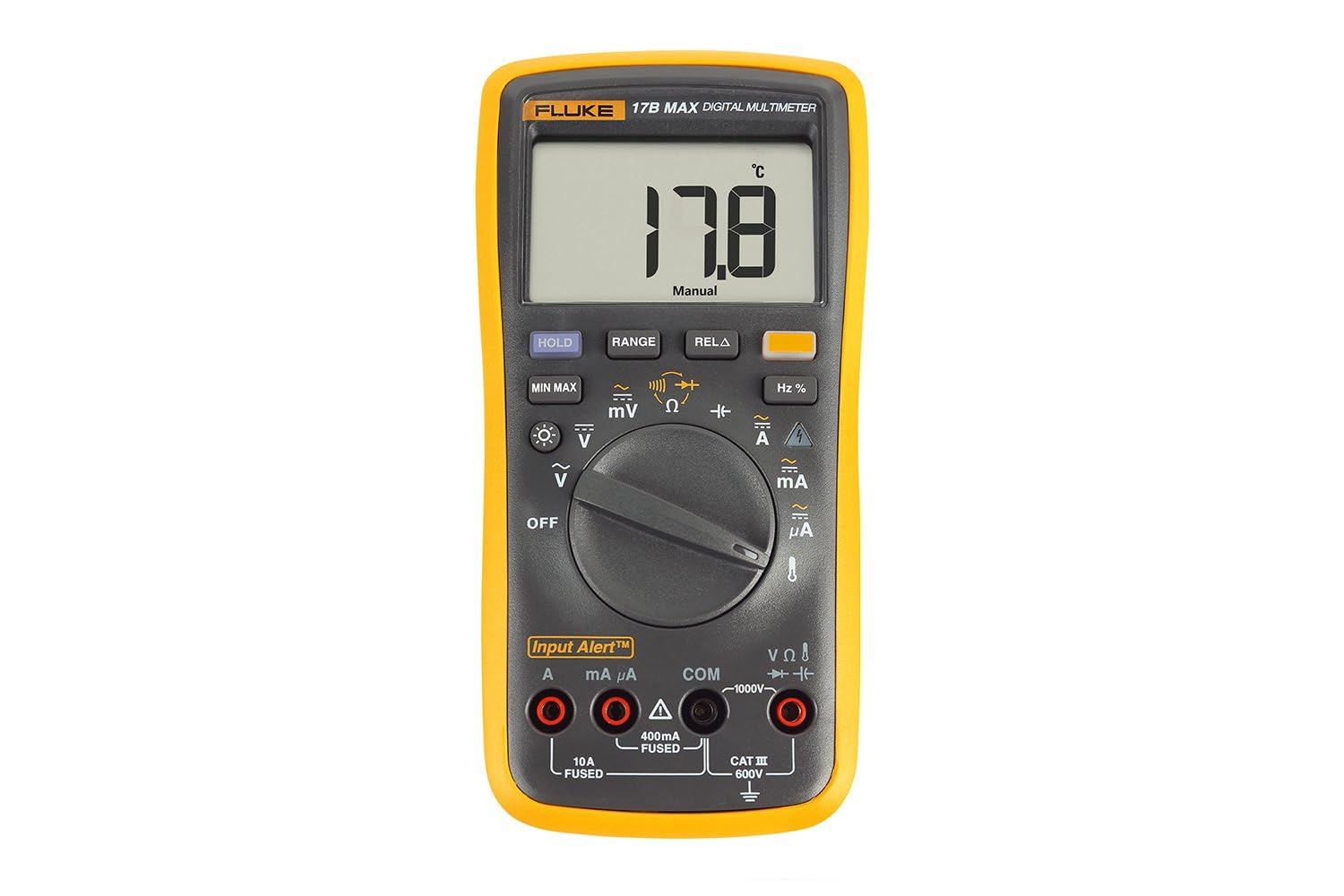
The Fluke 17B+ distills the brand’s reliability into a package that works beautifully on the electronics bench and for HVAC service calls. It measures AC/DC voltage up to 1000V and current to 10A, along with resistance, capacitance, frequency, and temperature up to 400°C via the included K-type thermocouple. That range covers the majority of residential and commercial diagnostic scenarios without forcing you into a specialty meter.
Users consistently praise the auto-ranging responsiveness and the large LCD, which is easy to read even when placed on a crowded workbench. The continuity beep is loud and immediate — a small detail that matters enormously when you are probing a harness with one hand while holding the meter. The built-in kickstand and magnetic strap accessory keep the meter visible and accessible during vehicle work.
For electronics hobbyists and field technicians who want Fluke accuracy without the full industrial price, the 17B+ hits a sweet spot. It lacks the low-pass filter and peak capture of the 87V, but if your work rarely involves adjustable-speed drives, those omissions are irrelevant. The durable leads and solid rotary switch inspire confidence that the meter will still be in your bag years from now.
Why it’s great
- Fluke build quality at a mid-range investment
- Includes temperature probe and sturdy leads
- Auto-ranging with fast continuity response
- Kickstand and magnetic strap compatible
Good to know
- No low-pass filter for VFD work
- Lower count resolution than the 87V
- Not as rugged as the fully industrial models
3. Klein Tools MM420 Auto-Ranging TRMS Multimeter
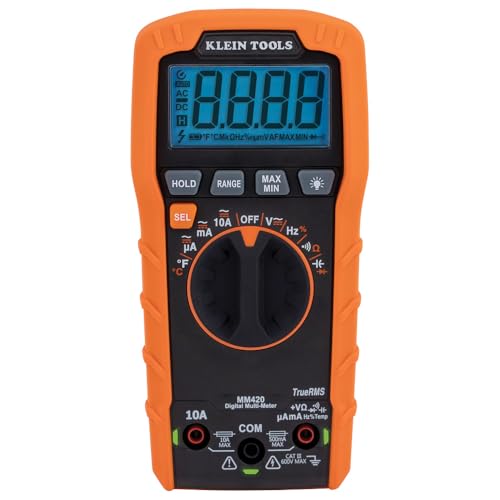
The Klein Tools MM420 delivers True RMS measurement and auto-ranging in a frame that Klein rates to survive a 6.6-foot drop. For electricians working on ladders or scaffolding, that durability translates directly to less downtime replacing broken meters. It measures AC/DC voltage up to 600V, 10A AC/DC current, and resistance up to 50 MOhms — sufficient for residential, commercial, and light industrial circuits.
A standout feature is the Lead-Alert system: LEDs on the meter face illuminate to confirm proper test lead placement before you take a measurement. This reduces the chance of blowing a fuse or getting a nonsense reading because your leads were in the wrong jacks. The backlit LCD and test lead holders on the back are thoughtful touches for working in dim panels or on crowded service calls.
The MM420 also measures capacitance, frequency, duty cycle, and temperature, making it a strong all-rounder for HVAC technicians who need to check capacitors and thermocouples alongside basic voltage work. The included thermocouple and CAT III/CAT IV safety caps on the leads reinforce that this meter is built for real field conditions, not just a garage drawer.
Why it’s great
- Certified 6.6-foot drop survival
- Lead-Alert LEDs prevent lead placement errors
- True RMS with auto-ranging
- Includes temperature probe and CAT IV caps
Good to know
- 600V max voltage — not for high-voltage industrial
- Magnetic hanger sold separately
- Display resolution maxes at 6000 counts
4. Klein Tools ET270 Auto-Ranging Digital Multi-Tester

The Klein ET270 is aimed squarely at electricians and serious homeowners who spend more time testing receptacles and GFCI outlets than chasing motor faults. It combines a standard auto-ranging multimeter with a built-in receptacle tester that can detect common wiring faults — open ground, reverse polarity, open neutral — and display GFCI trip time in milliseconds on the LCD. That integration saves you from carrying a separate outlet tester on every service call.
For voltage and resistance work, the ET270 measures up to 600V AC/DC and 40 MOhms with audible continuity. The receptacle test cord plugs directly into a standard 120VAC outlet, and the meter automatically routes the test signals. The find mode helps you identify which breaker corresponds to a given receptacle, a feature that dramatically reduces the back-and-forth trips that eat up a workday.
The ET270 also includes a battery test mode for checking 9V and 1.5V cells. The backlit display, kickstand, and optional magnetic hanger make it easy to read the meter while your hands are busy manipulating probes or resetting breakers. For professionals who primarily troubleshoot outlets and branch circuits, this specialized tool is faster and more intuitive than a general-purpose multimeter.
Why it’s great
- Integrated receptacle tester identifies wiring faults
- Displays GFCI trip time in milliseconds
- Breaker find mode saves trips to the panel
- Compact with backlit display and kickstand
Good to know
- Limited to 40 MOhms resistance
- No capacitance or frequency measurement
- Receptacle test works only with standard US 120V outlets
5. FKM Pro Digital Multimeter with 5-Inch Touch Screen
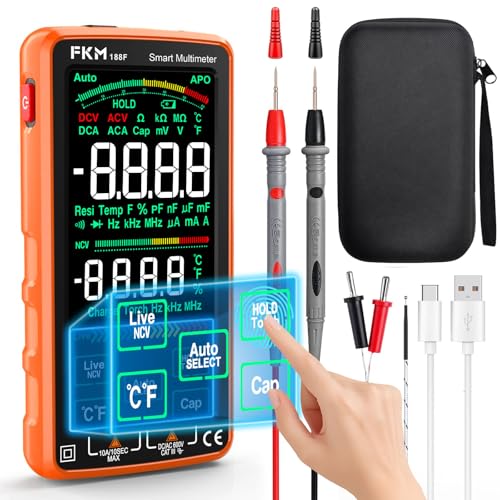
The FKM Pro takes a modern approach by replacing the traditional rotary switch with a 5-inch color touch screen. Swipe and tap to switch between AC/DC voltage, current, resistance, continuity, capacitance, diode, and temperature measurement modes. The auto-sense function detects whether you are probing voltage, resistance, or continuity and selects the correct mode without any dial manipulation — a genuine time-saver when you are switching between tests quickly.
The built-in rechargeable battery charges via USB-C, eliminating the need to keep a stash of 9V or AAA cells on your bench. Users report that the large, bright display is easy to read from a distance and in low-light environments, and the built-in flashlight helps illuminate dim junction boxes. The compact body — just 0.87 inches thick — slides into a tool pouch or laptop bag without hogging space.
While the touch interface is intuitive, some users note that the manual could be clearer for advanced functions, and the auto-sense may occasionally guess wrong on composite signals. For general troubleshooting and DIY work, the convenience of the touch screen and rechargeable battery outweighs those minor quirks. It is a strong option for anyone who values a clean, modern workflow over decades-old rotary-switch tradition.
Why it’s great
- 5-inch color touch screen replaces physical dial
- Rechargeable via USB-C, no batteries needed
- Auto-sense selects measurement mode automatically
- Slim and portable at 0.87 inches thick
Good to know
- Touch screen less glove-friendly than physical buttons
- Auto-sense can misinterpret composite signals
- Manual lacks depth on advanced measurements
6. DEASOMIYE T28B True RMS Multimeter

The DEASOMIYE T28B punches above its class by including strong rear magnets that let you stick the meter to any ferrous surface — fuse box covers, breaker panels, vehicle chassis — keeping both hands free for probing. That feature, common only on premium meters costing twice as much, makes this model a practical choice for electricians and auto mechanics who regularly work one-handed in tight spots. It measures up to 1000V AC/DC and 20A, with True RMS accuracy at 6000 counts for voltage, resistance, capacitance, frequency, duty cycle, and temperature.
The silicone protective case offers good grip and drop protection, and the built-in flashlight and large backlit LCD are genuinely useful in dark panel rooms. Auto-ranging simplifies the measurement process, and the NCV (non-contact voltage) detector adds an extra safety layer when checking for live wires before making contact. Users consistently mention that the magnetic back makes this meter feel purpose-built for field troubleshooting, not just bench testing.
For the investment, the T28B delivers performance that rivals mid-range meters on the most common diagnostic tasks. The included storage bag, thermocouple, and spare fuses round out a kit that is ready to go right out of the box. If you prioritize hands-free operation and solid True RMS accuracy without straying into professional-price territory, this meter deserves a close look.
Why it’s great
- Strong rear magnets for hands-free use on metal surfaces
- True RMS with 6000-count resolution
- Measures up to 1000V / 20A
- Includes storage bag, thermocouple, and spare fuses
Good to know
- Rotary switch can be stiff initially
- No low-pass filter for VFD signals
- Build feels light compared to industrial meters
7. Crenova 890Z TRMS Multimeter

The Crenova 890Z offers an impressive feature list at a budget-friendly entry point. For the DIYer, hobbyist, or mechanic who needs a capable backup meter, the 890Z delivers reliable basic functionality without a painful wallet impact.
The kit is notably generous: along with the meter and standard probe leads, you get a pair of alligator clip leads, a K-type thermocouple, batteries, and a hard carrying case. The alligator clips are a welcome addition for automotive work where you need to leave probes connected while you move around the engine bay. The NCV detector and backlit screen with built-in torch help in low-light scenarios, and auto power-off saves battery life when you inevitably forget to turn it off.
Users note that the case is not ruggedized for serious drops — it is best kept in a drawer or toolbox rather than strapped to a ladder. The auto-ranging is effective for most measurements, though you cannot manually lock a range for repeat readings. For home electrical checks, battery testing, and light automotive diagnostics, the 890Z provides excellent value and more functionality than most casual users will ever need.
Why it’s great
- True RMS and 6000-count resolution at a low entry point
- Includes alligator clips, thermocouple, and hard case
- NCV detection and built-in torch for dark spaces
- Covers transistor hFE measurement for component testing
Good to know
- Case is not ruggedized for drops
- Cannot lock auto-ranging for repeat measurements
- Build feel is consumer-grade, not professional-industrial
FAQ
Can I use a 2000-count meter for automotive diagnostics?
What does auto-ranging actually do inside the meter?
Is the FKM Pro touch screen reliable with sweaty or dirty fingers?
Why does my Klein ET270 not measure capacitance?
How often should I check the calibration of my multimeter?
What is the difference between a 6000-count and a 20000-count display?
Final Thoughts: The Verdict
For most users, the best digital multimeter winner is the Klein Tools MM420 because it balances True RMS accuracy, a certified 6.6-foot drop survival, and Lead-Alert safety at a mid-range investment that suits both electricians and serious DIYers. If you need industrial-grade diagnostics with low-pass filter and peak capture for variable-frequency drives, grab the Fluke 87V. And for quick one-handed measurements with a modern touch interface and rechargeable battery, nothing beats the FKM Pro Touch.

Mo Maruf
I created WellFizz to bridge the gap between vague wellness advice and actionable solutions. My mission is simple: to decode the research and give you practical tools you can actually use.
Beyond the data, I am a passionate traveler. I believe that stepping away from the screen to explore new environments is essential for mental clarity and physical vitality.