Our readers keep the lights on and my smoothie glass nicely filled. As an Amazon Associate, I earn from qualifying purchases.
A digital micrometer is the final word in precision measurement for any machinist, engineer, or serious hobbyist who needs to verify dimensions down to a fraction of a human hair. Unlike standard calipers, these instruments lock onto a workpiece with a consistent, repeatable force and deliver a resolution of 0.00005 inches — a level of accuracy that reveals even microscopic wear, material shrinkage, or out-of-tolerance parts before they cause a job failure. Whether you are measuring valve shims for an engine rebuild, filament diameter for a 3D printer, or critical features in a CNC lathe setup, the difference between a decent measurement and a wrong part often comes down to the tool in your hand.
I’m Mohammad Maruf — the founder and writer behind WellFizz. This guide is built on many hours of comparing the accuracy claims, build materials, and real-world user feedback across seven distinct digital micrometers to identify which models actually deliver repeatable, reliable reads in a shop environment.
Your measurement routine deserves a tool that eliminates the guesswork of analog vernier lines and mechanical zero drift. Here is my curated selection of the absolute best digital micrometer options spanning entry-level budget picks through premium shop-grade standards for 2025.
How To Choose The Best Digital Micrometer
Selecting the right digital micrometer goes far beyond just picking the cheapest LCD model with the best online rating. The three factors that define real-world utility — resolution and accuracy, anvil material and durability, and measuring force consistency — directly determine whether your part passes inspection or gets scrapped.
Resolution vs. Accuracy: Know the Difference
Resolution is what the display shows (typically 0.00005″ or 0.001 mm), while accuracy is the maximum deviation the tool is certified to deliver across its entire range. A micrometer may display five decimal places but only guarantee ±0.0001″ accuracy. For critical automotive or aerospace work, prioritize models with stated accuracy tighter than ±0.002 mm (±0.00008″) and a ratchet or friction stop that applies consistent force every time. Avoid the trap of assuming a higher-resolution display automatically means a more accurate instrument.
Carbide vs. Standard Steel Measuring Faces
The contact surfaces — the anvil and spindle faces — are the only points that touch your workpiece. Carbide-tipped faces resist wear far better than standard hardened steel, maintaining their flat and parallel surfaces through thousands of measurement cycles. If you measure hardened materials, abrasive ceramics, or simply demand long-term calibration stability, carbide is the only sensible choice. Budget micrometers often skip carbide, which leads to drifting zero readings after heavy use.
Digital Features That Actually Save Time
Not all digital bells and whistles are created equal. An Absolute Origin (ABS) function eliminates the need to re-zero every time you turn the tool on — a huge time-saver in a production environment. IP64 dust and splash protection allows the micrometer to survive the debris and coolant mist found on a real machine shop floor. A large, high-contrast LCD with auto-rotate or wide viewing angle prevents parallax errors. Prioritize features that solve a real workflow frustration rather than those that sound impressive on the box.
Quick Comparison
On smaller screens, swipe sideways to see the full table.
| Model | Category | Best For | Key Spec | Amazon |
|---|---|---|---|---|
| VINCA DMCA-0105 | Premium | Shop-floor durability & Absolute Origin | IP64 rated, carbide faces | Amazon |
| Mitutoyo 103-260 | Premium | Professional metrology & calibration | ±0.0001″ accuracy, ratchet stop | Amazon |
| SANDOR SR132 | Mid-Range | CNC & automotive bench work | ±0.002 mm accuracy, carbide tip | Amazon |
| iGaging 35-025-40 | Mid-Range | 3D printing & hobby-level precision | USB SPC output, ±0.00016″ | Amazon |
| WEN 10725 | Mid-Range | Budget-friendly valve shim measuring | ±0.0001″ accuracy, LCD readout | Amazon |
| Beslands WD1 | Budget | Occasional QC verification | ±0.003 mm accuracy, 2032 battery | Amazon |
| Mitutoyo 103-137 | Entry-Level | Watchmaking & fine mechanical work | 0.01mm graduation, carbide faces | Amazon |
In‑Depth Reviews
1. VINCA Absolute IP64 Origin Digital Micrometer DMCA-0105

The VINCA DMCA-0105 is the standout choice for anyone who needs a micrometer that performs reliably in a real workshop environment. Its IP64 rating means the internal electronics are sealed against the dust and coolant splashes that routinely kill lesser digital tools, while the carbide-tipped anvil and spindle faces maintain their flat geometry over thousands of cycles. The Absolute Origin function is a genuine productivity boost — you never need to re-zero the tool when you turn it on, which eliminates a common source of drift and frustration.
With a dual reading system that combines a large 1.25″ x 0.5″ LCD with a traditional drum sleeve, you get the best of both worlds: the speed of a digital readout and the fail-safe backup of an analog scale. The resolution hits 0.00005″ (0.001 mm), and multiple users in precision model railroading and hobby lathe work report that it consistently matches or beats readings from tools costing twice as much. The hold function lets you freeze a measurement for documentation without fumbling for paper.
Some users note that the instruction sheet could be clearer, but the controls are intuitive enough that most people are up and running within minutes. The auto on/off feature triggered by spindle movement is a welcome touch that extends battery life significantly. For a mid-range price, this micrometer delivers IP64 protection and Absolute Origin convenience that are rare at this level.
Why it’s great
- IP64 dust/splash protection for real shop durability
- Absolute Origin eliminates frequent re-zeroing
- Carbide measuring faces resist long-term wear
Good to know
- Instruction manual is sparse and could be more detailed
- Uses LR44 batteries instead of the more common CR2032
2. Mitutoyo 103-260 Outside Micrometer 0-1″
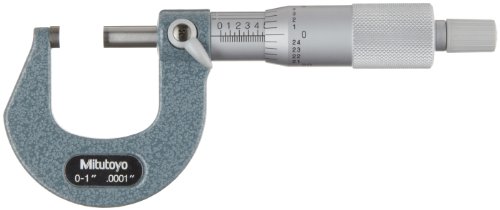
The Mitutoyo 103-260 is the analog reference standard that serious metrology professionals trust when a single tenth of a thousandth makes the difference between pass and reject. This is a mechanical micrometer with a ratchet stop mechanism that applies a consistent, repeatable measuring force — a critical detail that digital-only models often fail to replicate. The satin-chrome finish minimizes glare and fingerprint smudges, and the graduations are etched with a clarity that makes reading fast and error-free even under harsh shop lighting.
Carbide measuring faces are standard on this model, providing the wear resistance needed for frequent use against hardened steel and abrasive materials. The hammertone baked enamel frame is tough enough to survive being knocked around in a toolbox or on a bench. Every unit ships zeroed from the factory, and the overwhelming consensus among users is that this micrometer holds its calibration far longer than any budget alternative.
Be aware that Amazon’s packaging is sometimes inadequate — several buyers reported the tool rattling loose inside an oversized box without internal padding. Mitutoyo supplies a fitted plastic case, but the outer shipping box may not protect it during transit. If you order this, inspect the case carefully upon arrival. Despite that caveat, the 103-260 remains the micrometer against which all others in this class are measured.
Why it’s great
- Ratchet stop ensures repeatable measuring force every time
- Carbide faces provide exceptional long-term durability
- Satin chrome finish with clear, anti-glare graduations
Good to know
- Analog only — no digital readout for quick capture
- Amazon packaging may not protect the case during shipping
3. SANDOR Professional Digital Outside Micrometer SR132

The SANDOR SR132 targets the machinist who wants a digital micrometer with carbide-tipped measuring faces and a ratchet stop — features usually reserved for substantially more expensive tools. Its resolution of 0.00005″ (0.001 mm) and accuracy of ±0.002 mm make it more than capable for CNC setups, automotive engine work, and general fabrication. The auto on/off function triggered by spindle movement is a smart power-saving feature that extends the battery life to approximately one year under normal use.
Build quality is notably robust for the price tier: the hardened and ground stainless steel frame feels solid in the hand, and the large LCD screen offers good contrast from multiple viewing angles. The zero-set function and easy mm/in conversion work as expected, and the included hard carrying case provides decent protection for transport or storage. Multiple users praised its performance for reloading and hobbyist machining, noting that it holds zero well even after several weeks of intermittent use.
The main drawback is weight and bulk — this is a chunky micrometer that feels awkward for extended one-handed use, especially when trying to measure small alignment shims or tight clearance gaps. If you need a predominantly bench-mounted tool, the size is manageable, but it is not ideal for rapid, repeated handheld measurements on the shop floor. The warranty support from SANDOR is responsive, which adds peace of mind for a tool at this price.
Why it’s great
- Carbide tip and ratchet stop included at a reasonable price
- Large, easy-to-read LCD with good viewing angles
- Auto on/off extends battery life
Good to know
- Heavy and bulky for sustained handheld use
- Not ideal for extremely tight or recessed measuring positions
4. iGaging 0-1″ Digital Electronic Micrometer 35-025-40

The iGaging 35-025-40 stands out for its USB SPC data output, a feature typically seen on micrometers costing three times as much. This allows you to connect the tool to a computer or data logger for direct recording of measurements — a huge advantage for quality control documentation or statistical process control. The large LCD display is easy to read, and the unit switches seamlessly between inch and metric modes with the press of a button.
Accuracy is rated at ±0.00016″, which is respectable for a mid-range digital model and more than adequate for 3D printing filament measurement, sheet metal thickness checks, and general hobbyist work. The anvil and spindle are metal, though not carbide-tipped, so longevity under heavy use will not match the premium carbide models. Several users praised its repeatable results when checking against gauge blocks, and the ability to output data directly to a spreadsheet eliminates transcription errors.
The included carrying case feels a bit flimsy, and the ball adapter for the USB port can fall out of its storage slot. You also need to zero the tool before each use session — there is no Absolute Origin function — which adds a minor step to your routine. Overall, for anyone who values digital data capture and works primarily in a clean shop environment, this is an intelligent buy.
Why it’s great
- USB SPC data output for direct computer recording
- Large, high-contrast LCD display
- Good accuracy at ±0.00016″ for hobby work
Good to know
- No carbide tips — wear resistance is lower
- Case and USB adapter storage could be better designed
5. WEN 10725 Standard and Metric Digital Micrometer

The WEN 10725 is the gateway micrometer for anyone who needs reliable dimensional verification without spending a premium. With a measurement range of 0 to 1 inch and a resolution of 0.00005″, it offers the same digital precision as models costing twice as much, making it a go-to for budget-conscious machinists and DIY engine builders. The large LCD display is easy to read, and switching between inch and metric units is straightforward.
Numerous user reports confirm its accuracy when measuring valve shims and tappet buckets for ATV and motorcycle engines — a demanding application where a few ten-thousandths of an inch determine whether the valve train operates correctly. The stainless steel construction feels reasonably solid, and the included storage case keeps the micrometer safe when not in use. Many reviewers noted that it performs comparably to name-brand micrometers at a fraction of the price.
The primary trade-off is build refinement: the thimble rotation is not as buttery smooth as a Mitutoyo, and the ratchet stop is absent, so you must rely on feel to apply consistent measuring force. It also lacks carbide measuring faces, so the contact surfaces may wear sooner under heavy use. For occasional or medium-duty work, however, the WEN 10725 punches well above its weight class.
Why it’s great
- Excellent accuracy for the price point
- Large, clear LCD with inch/metric switching
- Well-rated for engine valve shim measurement
Good to know
- No ratchet stop — measuring force is operator-dependent
- Standard steel faces, not carbide
6. Beslands Digital Electronic Display Micrometer 0-1″
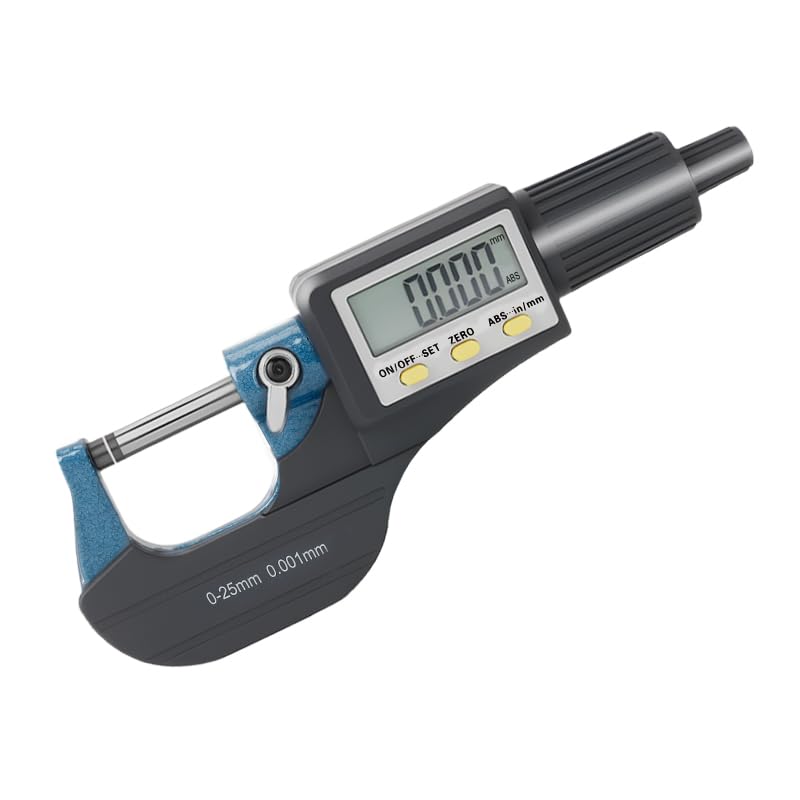
The Beslands WD1 is a genuinely budget-friendly digital micrometer that delivers functional precision for light to moderate shop use. Its 0-1″ measuring range and 0.001 mm (0.00005″) resolution match the headline specs of more expensive competitors, and the stainless steel spindle and lock nut provide adequate rigidity for basic measurement tasks. The large LCD screen is notably easy to read, with a wider viewing angle than many similarly priced models.
User reviews highlight its accuracy against gauge blocks — some report readings within 0.00001″ of a known standard — which is impressive given the entry-level price. The included CR2032 battery is a commonly available size, and the auto-off feature that retains zero when the tool powers down is a welcome convenience. The metric/inch conversion is easy to activate with a long button press.
Quality control is the main variable here. Some units arrive perfectly zeroed and remain stable, while others show initial zero drift of ±0.007 mm that takes a few measurement cycles to settle. The battery cap can have a burr that makes it difficult to remove, and the English instructions are poorly translated and confusing. For occasional QC verification or as a backup micrometer, the Beslands offers solid value, but it is not a tool to rely on for critical production work.
Why it’s great
- Large, wide-angle LCD display for easy reading
- Uses common CR2032 battery with auto-off
- Good accuracy potential for the price
Good to know
- Inconsistent QC — some units have zero drift
- Battery cap burr and poor instruction manual
7. Mitutoyo 103-137 Outside Micrometer 0-25mm
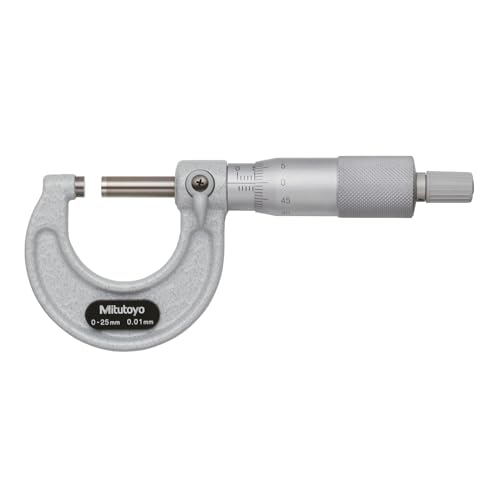
The Mitutoyo 103-137 is a mechanical outside micrometer built for metric-only applications where precise outside diameter measurement is critical. It features carbide-tipped spindle and anvil surfaces that resist wear through years of frequent use, and the ratchet-stop mechanism ensures consistent measuring force every time — a must for repeatable results in inspection and quality control environments. The satin-chrome finish and large thimble markings make for fast, clear readings even in low light.
With a 0-25 mm measuring range and 0.01 mm graduation, this is an entry-level Mitutoyo that still delivers the build quality and accuracy the brand is known for. Users in watchmaking and fine mechanical assembly praise its readability and the smooth, controlled movement of the spindle. The fitted carrying case is compact and protective, making it easy to keep the tool calibrated and clean.
The notable limitation is the lack of a vernier scale for estimating readings beyond 0.01 mm, which means you cannot interpolate to half-thousandths as you could on a more advanced mechanical micrometer. This limits its usefulness for extremely tight tolerance work unless you upgrade to a model with a vernier. It is also metric-only, with no inch conversion. For technicians working exclusively in metric with tolerances of ±0.01 mm, however, this is an excellent value.
Why it’s great
- Carbide-tipped faces for exceptional durability
- Ratchet stop provides consistent measuring force
- Excellent build quality at a reasonable price
Good to know
- No vernier scale — limited to 0.01 mm resolution
- Metric only; no inch mode available
FAQ
How do I calibrate a digital micrometer at home?
Is a ratchet stop necessary on a digital micrometer?
Final Thoughts: The Verdict
For most users, the best digital micrometer winner is the VINCA DMCA-0105 because it brings IP64 dust/water protection and Absolute Origin convenience into a mid-range package that outperforms its price tier. If you want traditional shop-standard accuracy with carbide faces and a ratchet stop, grab the Mitutoyo 103-260. And for budget-minded precision without sacrificing resolution, nothing beats the WEN 10725 for entry-level digital micrometer work.

Mo Maruf
I created WellFizz to bridge the gap between vague wellness advice and actionable solutions. My mission is simple: to decode the research and give you practical tools you can actually use.
Beyond the data, I am a passionate traveler. I believe that stepping away from the screen to explore new environments is essential for mental clarity and physical vitality.