Our readers keep the lights on and my smoothie glass nicely filled. As an Amazon Associate, I earn from qualifying purchases.
Distributing a single high-definition video source to every television in a house, sports bar, church, or RV park without running new cables is a specific engineering problem. HDMI over coax modulators solve it by converting an HDMI signal into a standard broadcast channel any TV can tune into, leveraging the coaxial wiring already in the walls.
I’m Mohammad Maruf — the founder and writer behind WellFizz. I’ve spent hundreds of hours cross-referencing encoder chipsets, modulation standards, and real-world user reports to separate the units that deliver a clean, stable 1080p RF signal from those that introduce jitter, audio drift, or compression artifacts over long coax runs.
Whether you are upgrading a legacy antenna system in a commercial building or sending a Roku feed to every bedroom, the best digital hdmi modulator must balance picture fidelity, latency, and ease of channel configuration.
How To Choose The Best Digital HDMI Modulator
A digital HDMI modulator is not a consumer convenience gadget — it is a signal distribution tool for environments where running a separate HDMI cable to every display is impractical. Choosing the wrong one can mean pixelated images, out-of-sync audio, or a channel that drops every time the furnace kicks on.
Modulation Standard: ATSC vs QAM
The modulation standard dictates which TVs can receive the signal. ATSC (Advanced Television Systems Committee) is the standard for over-the-air digital broadcasts in North America — any TV with an antenna input can tune an ATSC channel. QAM (Quadrature Amplitude Modulation) is used by cable providers and requires a cable-ready tuner. If you are injecting a signal into a house antenna system, an ATSC modulator is the straightforward path. For distribution through an existing cable TV infrastructure, QAM is often required. Many premium modulators support both, letting you select based on the connected TV fleet.
Video Encoding: MPEG-2 vs H.264 / H.265
Encoding compression directly impacts picture quality and bandwidth. MPEG-2 is the legacy broadcast standard — it is universally compatible but requires high bitrates to avoid artifacts. H.264 (AVC) delivers noticeably cleaner 1080p at the same bitrate, while H.265 (HEVC) cuts the bitrate nearly in half for the same quality. For a single-channel modulator feeding a handful of TVs, H.264 is the sweet spot. If you plan to combine multiple modulated channels on the same coax, H.265’s efficiency prevents the aggregate bitrate from overwhelming the cable plant.
Output Power and Signal Amplification
The output power of a modulator is measured in dBuV — typically ranging from 70 to 100 dBuV. A higher output power pushes the signal further down the coax run and through splitters without degradation. However, too much power injected into a system that already carries an OTA antenna signal can overload the front-end tuners, blocking weaker channels. The best modulators allow you to adjust the output power in 1-dB steps, giving you control to balance the modulated channel against the existing antenna signal
Quick Comparison
On smaller screens, swipe sideways to see the full table.
| Model | Category | Best For | Key Spec | Amazon |
|---|---|---|---|---|
| SatLink ST-7000 | HDMI to RF | ATSC/QAM distribution to multiple TVs | 1080p, 70-100 dBuV output | Amazon |
| PVI MINIMOD 2 | HDMI to Coax | RVs, churches, commercial buildings | 1080p, Dolby, color display | Amazon |
| Thor Broadcast H-HDMI-RF-PETIT | HDMI to RF | Compact, multi-standard modulation | 1080p, MPEG-2, Dolby AC3 | Amazon |
| OREI CO-UHD330-K | HDMI over Coax | Long-distance point-to-point extension | 4K@60Hz, 330 ft, IR control | Amazon |
| URayCoder UHE265-1L-4K | HDMI to IP | Live streaming to multiple platforms | 4K, H.265, RTMP/RTSP/SRT | Amazon |
| Lumantek SDI to HDMI | SDI to HDMI | Broadcast signal monitoring | Built-in display, scaler | Amazon |
| ez-HSV+ (M&HONG) | HDMI/SDI Conv | Frame rate conversion & display | 2.7″ TFT, audio meter | Amazon |
In‑Depth Reviews
1. SatLink ST-7000

The SatLink ST-7000 is a dedicated HDMI-to-RF modulator that takes a 1080p HDMI source and encodes it into an ATSC or QAM (J.83B) channel, which can then be distributed over any standard coax network. Its 70-100 dBuV adjustable output power gives you precise control over how the modulated channel sits alongside an existing antenna feed, and the picture quality at 1080p is consistently described as excellent across multiple user reports.
Setup is handled through an IP-based web interface, and reviewers note that the initial configuration is straightforward once you set the IP address. The unit includes an RF input for combining with an antenna signal, though some users report that the RF pass-through can attenuate the incoming OTA signal, requiring a preamplifier or careful gain staging to avoid losing lower-frequency channels.
The ST-7000 is best suited for fixed installations in houses, small commercial buildings, or anywhere you need to send a single HD source to multiple TVs without running new cables. It is not a portable unit — expect to rack-mount or shelf-mount it near the head-end coax junction. The main trade-off is the price, which sits in the premium tier, and a known limitation where the output does not handle overscan, meaning the image edges may be slightly cropped on some displays.
Why it’s great
- Adjustable 70-100 dBuV output power
- Clean 1080p picture quality on ATSC and QAM
- Web-based configuration is simple and reliable
Good to know
- RF pass-through can attenuate lower OTA channels
- No overscan handling — image edges may be cropped
- Premium price point reflects commercial-grade construction
2. PVI MINIMOD 2 Vecoax

The PVI MINIMOD 2 is a compact HDMI-to-coax modulator that includes a color display for channel naming and direct front-panel configuration — a rarity among digital modulators. It supports full 1080p with Dolby audio and can be combined with an antenna or cable feed so that users retain access to all existing channels while adding a new HD source to the lineup.
Real-world users in RVs and churches report that the unit delivers a dramatic picture improvement over older analog RF modulators, and its adjustable gain helps balance the modulated channel against OTA signals. Some users note that default settings may need to be switched from US Cable (QAM) to ATSC for standard antenna-based systems, and OTA reception may require attenuation to prevent channel loss.
The MINIMOD 2 is priced at the top end of the market, but the build quality, Dolby support, and integrated display justify the cost for professional installations. The main criticism is that compressed HD content over coax still shows some artifacts on large screens, though this is a limitation of the RF modulation path rather than the unit itself.
Why it’s great
- Color display for channel naming and on-device setup
- Full 1080p with Dolby audio support
- Adjustable gain for blending with OTA antenna signals
Good to know
- May require ATSC/QAM mode switch for proper detection
- OTA signal attenuation issues with strong antenna feeds
- Compression artifacts visible on large 4K displays
3. Thor Broadcast H-HDMI-RF-PETIT
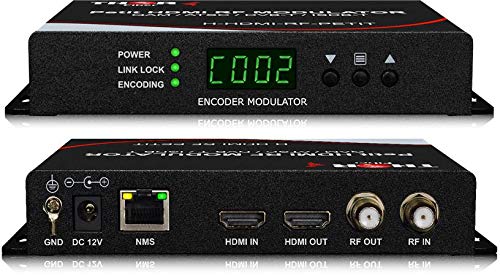
The Thor Broadcast H-HDMI-RF-PETIT is an ultra-compact HDMI-to-RF modulator that integrates HD MPEG-2 encoding with Dolby AC3 audio and a digital modulator in a chassis that fits in the palm of your hand. It supports multiple RF standards including DVB-C/T, ATSC, and ISDB-T, making it a flexible choice for international installations or mixed-use environments.
Users praise the unit for its excellent picture output and sturdy build quality, with many deploying it in RV setups to upgrade multiple TVs to smart functionality from a single HDMI source like a Roku or satellite receiver. The latency is reported at around 600ms, which is acceptable for broadcast viewing but noticeable for live camera feeds. Setup requires a PC or network connection via the proprietary GUI, which some users find less intuitive than a direct web interface.
The H-HDMI-RF-PETIT is a well-rounded mid-range option that delivers professional-grade output in a small footprint. The main trade-offs are the lack of a front-panel display and the slightly higher latency compared to dedicated low-latency models.
Why it’s great
- Very compact chassis for tight rack or shelf spaces
- Multi-standard RF support (ATSC, QAM, DVB-T)
- Sturdy metal build with clean MPEG-2 encoding
Good to know
- Around 600ms latency not ideal for live camera monitoring
- Setup requires PC software, not standalone web interface
- No integrated display for channel verification
4. OREI CO-UHD330-K

The OREI CO-UHD330-K is an HDMI-over-coax extender kit that transmits 4K@60Hz video up to 330 feet over a single RG-6 coaxial cable. Unlike an RF modulator, this is a point-to-point extender that preserves full 4:4:4 chroma subsampling and includes bidirectional IR control for remote source devices, making it ideal for sending a Blu-ray player or streaming stick signal to a distant TV without signal degradation.
Users consistently report that the unit works flawlessly out of the box, with one reviewer calling it a relief after dealing with unreliable alternatives. It is HDCP 2.2 compliant and works with existing coax runs in walls, meaning no new cable pulls are required for retrofits. The unit includes two IR kits for remote control extension, a practical addition for hidden source setups.
The CO-UHD330-K is not a multi-TV distribution solution — it is a single sender-receiver pair. For installations needing to feed one remote display with uncompressed 4K, it is a clean solution at a mid-range price. The push-type coax connector is a minor inconvenience for those accustomed to threaded F-connectors, and some users report device failure within six months, though OREI offers a one-year warranty.
Why it’s great
- Full 4K@60Hz 4:4:4 over existing RG-6 coax
- Bidirectional IR control for remote source devices
- Simple plug-and-play setup with no software required
Good to know
- Point-to-point only, not a multi-room distribution system
- Push-type coax connector, not screw-on F-type
- A few reports of early failure within the first year
5. URayCoder UHE265-1L-4K
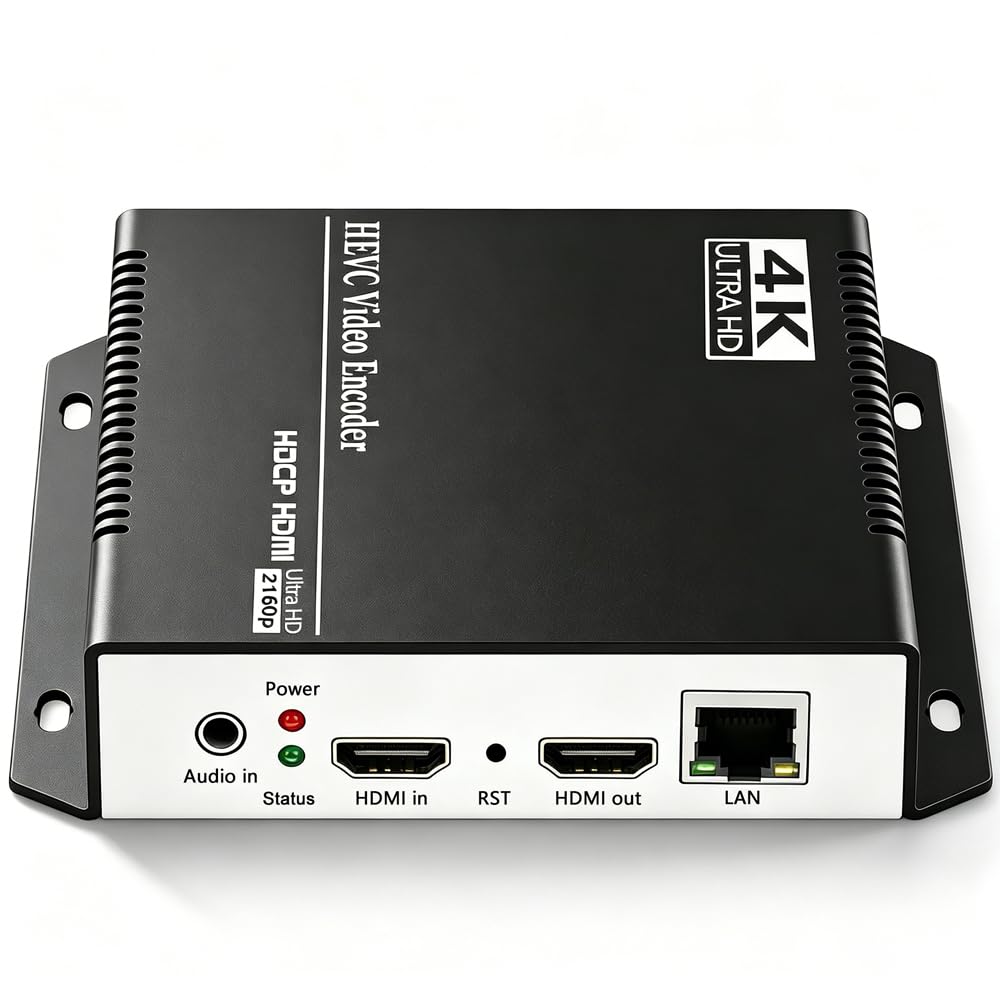
The URayCoder UHE265-1L-4K is an H.265/H.264 dual-encoding HDMI-to-IP streaming encoder that supports 4K UHD input and output at 30fps. It outputs simultaneous streams to multiple protocols including RTMP, RTSP, SRT, HLS, and UDP, making it a powerhouse for live streaming to platforms like YouTube, Facebook, and Twitch while also recording locally.
Users consistently highlight the responsive technical support and the ability to push to multiple endpoints simultaneously as the unit’s defining strengths. The aluminum shell construction and compact dimensions make it suitable for mobile streaming rigs. The unit also supports customizable on-screen overlays including text, scrolling captions, and logos — useful for branded live productions.
This unit is not a traditional RF modulator that sends a channel to cable-ready TVs. Instead, it is an IP streaming encoder that outputs over Ethernet. If your goal is to broadcast HDMI content over the internet or to networked displays, this is a solid mid-range option. The main drawbacks are the lack of a physical power switch on the unit and the occasional need for firmware updates to resolve initial compatibility issues.
Why it’s great
- H.265/H.264 dual encoding with 4K UHD support
- Multi-protocol output to YouTube, Facebook, and more
- Responsive technical support and firmware updates
Good to know
- No physical power switch for cooling downtime
- May need initial firmware patch for gray output
- Not a direct TV modulator — requires network setup
6. Lumantek SDI to HDMI Converter

The Lumantek SDI to HDMI Converter is a compact broadcast monitoring tool that includes a built-in LCD display and a scaler, allowing users to check incoming SDI signals for resolution, frame rate, and audio levels without needing a separate monitor. It can run on USB 5V power, making it portable enough to fit in a pocket and operate from a power bank.
Broadcast engineers praise it as a cost-effective alternative to + waveform monitors, providing quick signal verification for 1080p and 1080i feeds. The loop-through output allows the SDI signal to continue to the next device while the internal screen shows the status, which is particularly useful for troubleshooting feeds in live production environments.
Its primary function is SDI signal monitoring and conversion, not HDMI modulation. If your workflow involves verifying HD-SDI signals on a budget, this is a well-built mid-range tool. It does not encode or distribute channels over coax — it is a test instrument that happens to include HDMI output.
Why it’s great
- Built-in display for instant signal verification
- Runs on USB 5V power bank for portable use
- Scaler handles frame rate and resolution mismatches
Good to know
- Not a modulator — signal monitoring/conversion only
- LCD is small, not suitable as a confidence monitor
- Does not generate a test signal for cable testing
7. M&HONG ez-HSV+

The M&HONG ez-HSV+ (also branded as Lumantek ez-HSV+) is an HDMI-to-SDI and SDI-to-HDMI bidirectional converter with a built-in 2.7-inch TFT LCD screen that displays input/output resolution, frame rate, and audio metering. Its stainless steel housing and wall-mountable design make it suitable for fixed rack installations or field production rigs where signal conversion and verification are needed in one box.
Users highlight its accurate frame rate conversion — notably handling 59.94 fps signals from Blackmagic switchers where cheaper converters introduce jitter. The ability to scale HDMI down to SDI while simultaneously displaying the signal on the onboard screen makes it a versatile troubleshooting tool without requiring a separate monitor or waveform device.
The ez-HSV+ is a niche piece of kit aimed at broadcast and professional video workflows. It is not a consumer modulator or a long-distance extender. For its intended use — converting and scaling between HDMI and SDI while providing real-time signal feedback — it is a well-executed tool at a mid-range price point.
Why it’s great
- Bidirectional HDMI/SDI conversion with scaling
- Built-in TFT screen with audio level metering
- Accurate frame rate conversion for broadcast gear
Good to know
- No direct RF modulation or coax channel output
- Small touchscreen is for signal info, not preview
- Limited to SDI/HDMI formats, not IP streaming
FAQ
Will a digital HDMI modulator work with my existing antenna coax?
What is the difference between ATSC and QAM modulation?
Can I use an HDMI modulator to send 4K to multiple TVs?
Why does my modulated channel show compression artifacts?
Final Thoughts: The Verdict
For most users, the best digital hdmi modulator winner is the SatLink ST-7000 because it delivers a clean 1080p ATSC/QAM channel with adjustable output power and straightforward IP-based setup, making it the most reliable choice for distributing a single HD source to multiple TVs over existing coax. If you need a compact unit with a front-panel display and Dolby audio for an RV or church installation, go with the PVI MINIMOD 2. And for sending uncompressed 4K video to a single distant display, the OREI CO-UHD330-K is the straightforward point-to-point solution.

Mo Maruf
I created WellFizz to bridge the gap between vague wellness advice and actionable solutions. My mission is simple: to decode the research and give you practical tools you can actually use.
Beyond the data, I am a passionate traveler. I believe that stepping away from the screen to explore new environments is essential for mental clarity and physical vitality.