Our readers keep the lights on and my smoothie glass nicely filled. As an Amazon Associate, I earn from qualifying purchases.
The coax cables already running through your walls are essentially dead weight unless you have a device that can inject a high-definition signal into them. A Digital HD Modulator Box solves that exact problem, converting an HDMI source—like a satellite receiver, streaming stick, or security camera DVR—into a clean ATSC or QAM channel that any TV on that coax network can tune into.
I’m Mohammad Maruf — the founder and writer behind WellFizz. I’ve spent dozens of hours analyzing the modulation standards, output power specs, and latency figures that separate a useful modulator from a frustrating one.
This guide covers seven models that turn coax lines into distribution channels for HD video, and by the end you’ll know which digital hd modulator box matches your installation scenario.
How To Choose The Best Digital HD Modulator Box
A modulator that sends a clean, stable signal starts with matching the modulation standard your TV sets expect. Most North American households use ATSC for over-the-air channels, while cable systems rely on QAM (J.83B). Some pro-grade units output both, but budget models often lock into one standard, forcing you to pick before you buy.
Modulation Standard and RF Output Power
ATSC is the universal standard for antenna-based TV distribution; QAM is common in closed-circuit cable systems inside hotels, hospitals, and sports bars. The RF output power, measured in dBuV, determines how far the signal travels before degrading. A unit with adjustable output between 70 and 100 dBuV gives you flexibility to drive a single TV in the same room or a dozen TVs across a large building.
Latency, Audio Encoding, and Video Resolution
Not all modulators process video at the same speed. Some introduce up to 600ms of delay—fine for menu boards or background music, but unusable for live camera feeds or gaming. Audio encoding matters too; Dolby AC3 (Dolby Digital) support preserves surround sound, while basic MPEG-1 audio can sound thin. For video, 1080p at 60Hz is the ceiling for this category, but the bitrate and compression quality vary widely between units.
Quick Comparison
On smaller screens, swipe sideways to see the full table.
| Model | Category | Best For | Key Spec | Amazon |
|---|---|---|---|---|
| MINIMOD 2 Vecoax | Premium | Whole-home coax distribution | ATSC / QAM (J.83B) dual output | Amazon |
| Thor Broadcast H-HDMI-RF-PETIT | Premium | Multi-standard broadcasting | DVB-C/T/ATSC/ISDB-T support | Amazon |
| SatLink ST-7000 | Premium | Long-distance coax runs | Adjustable output power 70-100 dBuV | Amazon |
| OREI CO-UHD330-K | Mid-Range | 4K extension over existing coax | 4K@60Hz over RG-6 coax, 330 ft | Amazon |
| OREI EX-500IR | Mid-Range | Long-distance 1080p extension | 500 ft over Cat5e/6, PoC, IR | Amazon |
| Micca Speck 4K | Budget | Local media playback from USB | 4K H.265 decoding, USB+microSD | Amazon |
| TOP-ENERGY DTMB | Budget | Cuba / China DTMB regions | 6 MHz bandwidth, DTMB tuner | Amazon |
In‑Depth Reviews
7. MINIMOD 2 Vecoax

The MINIMOD 2 is the gold standard for distributing a single HDMI source—Dish, DirecTV, Roku, or a PC—to every TV on an existing coax network. It outputs full 1080p with Dolby Digital audio and lets you pick the channel number and name directly from the front-panel color display, so rescanning TVs shows your custom label rather than a cryptic number.
Users report excellent results in RVs, churches, and large homes where the coax is already wired. The adjustable RF gain helps balance the signal when combining the modulator output with an over-the-air antenna feed. Blu-ray sources show only minor compression artifacts on secondary TVs, and the unit is compact enough to tuck behind an entertainment center.
Some installers note that the default US cable setting didn’t scan on certain RV televisions; switching the modulation to ATSC resolved the issue. For a turnkey solution that works out of the box with professional support, this is the most reliable single-channel modulator on the market.
Why it’s great
- Full 1080p with Dolby audio over standard coax
- Channel naming via on-screen color display
- Adjustable RF gain for mixed antenna/modulator setups
Good to know
- Premium pricing puts it outside entry-level budgets
- Some older RV TVs require a manual mode switch to ATSC
6. Thor Broadcast H-HDMI-RF-PETIT
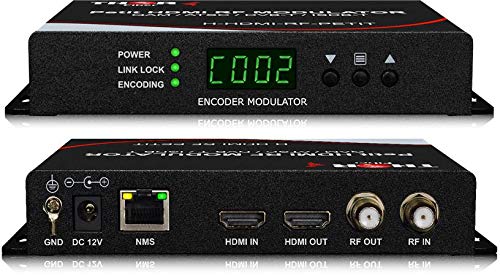
The Thor Broadcast modulator is an all-in-one encoding and modulation unit that supports ATSC, QAM, DVB-C, DVB-T, and ISDB-T. That makes it the only model on this list capable of working globally without a hardware swap. It encodes HDMI sources up to 1080p into MPEG-2 with AC3 (Dolby Digital) audio, then modulates the stream directly to an F-type coax output.
Setup requires a PC or tablet connected to the same network—the unit hosts a web-based GUI where you set the output channel, modulation standard, and video bitrate. Users who have installed it in motorhomes and commercial security systems praise the picture quality, noting that the video delay sits around 600ms, which is fine for distributed television but not ideal for live camera monitoring.
Build quality is solid, and the metal enclosure dissipates heat well even in enclosed AV racks. The front-panel OLED provides quick status checks. For installations that need multi-standard flexibility or advanced IP-based configuration, this unit delivers premium results at a lower price point than the MINIMOD 2.
Why it’s great
- Five modulation standards in one box (ATSC, QAM, DVB-C/T, ISDB-T)
- Browser-based GUI for remote configuration
- Excellent picture quality with Dolby Digital encoding
Good to know
- Requires a PC for initial setup—no front-panel channel selection
- Latency around 600ms may be noticeable for live camera feeds
5. SatLink ST-7000

The SatLink ST-7000 fills a niche for users who need to drive a modulated signal through long coax runs with multiple splitters. Its adjustable RF output power spans 70 to 100 dBuV, giving you the headroom to push a clean 1080p signal across an entire commercial building or a large residential home without adding an external line amplifier.
Setup is handled via an IP-based web interface, and users report that after assigning a static IP, the configuration process is straightforward. The encoder accepts HDMI and composite RCA inputs, making it backward-compatible with older analog cameras or DVD players. One notable limitation is the lack of overscan handling, which can clip the outer edges of the image on some TVs.
Some reviewers experienced the RF input attenuating the incoming antenna signal, causing lower OTA channels to drop out. The solution is to bypass the RF loop or add a signal combiner. If you need a modulator with adjustable output gain for complex coax topologies, the ST-7000 is a capable mid-premium choice.
Why it’s great
- Adjustable RF output from 70 to 100 dBuV for long cable runs
- Accepts HDMI and composite RCA sources
- IP-based web interface for configuration
Good to know
- No overscan control—image edges may be cut on some TVs
- RF IN port can attenuate OTA signals on lower channels
4. OREI CO-UHD330-K

The OREI CO-UHD330-K is an HDMI over coax extender rather than a traditional modulator. It uses a pair of transceivers to send a full 4K@60Hz signal over a single RG-6 coaxial cable up to 330 feet, making it ideal for homes or businesses where an existing coax run is already in place but no Ethernet or HDMI can be pulled.
The unit supports HDMI 2.0 and HDCP 2.2, so it works with 4K streaming devices, gaming consoles, and Blu-ray players without dropping the signal. Two-way IR pass-through lets you control the source device from the remote display location. The push-type F-connector is a minor limitation—if your coax ends in a screw-on connector, you’ll need a short adapter.
Customer feedback highlights its reliability for connecting a TV above a stone fireplace to a media cabinet below, using the existing coax in the wall. The main caveat is that both units require power, although the included adapters handle the load. For extending 4K over coax without re-modulating, this is a clean, low-latency solution.
Why it’s great
- Extends 4K@60Hz over standard RG-6 coax up to 330 feet
- HDMI 2.0 and HDCP 2.2 compliant
- Bi-directional IR control for remote source management
Good to know
- F-connector is push-type, not screw-on—adapter may be needed
- Both sender and receiver require individual power adapters
3. OREI EX-500IR

When you need HDMI extension beyond what a single coax run can handle, the OREI EX-500IR sends full 1080p@60Hz over a Cat5e or Cat6 cable up to 500 feet. It uses HDBaseT technology for lossless, lag-free transmission and includes a local HDMI loop-out so you can monitor the source at the transmitter location while sending the signal to a remote display.
The unit supports Power over Cable (PoC), meaning only one of the two units needs a power adapter. Bi-directional IR pass-through lets you control the source device from the far end. Users have deployed it in gyms, conference rooms, and houses of worship with runs over 200 feet, reporting zero signal degradation or dropouts.
Compatibility is broad—PS5, Xbox, Blu-ray players, Firestick, Apple TV, and PC all work without issues. The RS-232 port adds control options for commercial AV systems. If your cable plant uses Ethernet rather than coax, the EX-500IR is the most reliable HDBaseT extender at this price tier.
Why it’s great
- Transmits 1080p up to 500 feet over standard Cat5e/6
- Power over Cable—only one AC adapter needed
- Local HDMI loop-out for dual-monitor setups
Good to know
- Only extends HDMI—does not re-modulate to a TV channel
- Transmitter and receiver are paired; not interchangeable with other HDBaseT units
2. Micca Speck 4K Digital Media Player

The Micca Speck 4K is not a modulator—it is a digital media player that plays locally stored video files from a USB drive or microSD card directly to a TV via HDMI. Its primary use case is transforming an older TV into a capable media viewer without needing a smart platform or internet connection.
It decodes H.265 (HEVC) and H.264 (AVC) up to 4K resolution at 30fps, supports subtitle files, and includes composite AV output for older TVs or stereo systems. The device remembers the last playback position for each file, making it great for binge-watching series from a USB stick. Users consistently report that the tiny footprint and reliable performance make it perfect for vacation homes, workshops, and gym TVs.
The main limitation is that external hard drives must be formatted as MBR (not GPT) with a maximum of 2TB. Some OGG and FLAC audio files may cause issues, but for standard MP4 and MKV playback, it is near flawless. For local-only media consumption, this is the best entry-level option.
Why it’s great
- Decodes 4K H.265/HEVC from USB or microSD
- Resumes video from the last stop point
- Extremely compact and affordable
Good to know
- Only reads MBR-formatted drives, max 2TB
- No built-in streaming apps—local files only
1. TOP-ENERGY DTMB Decoder
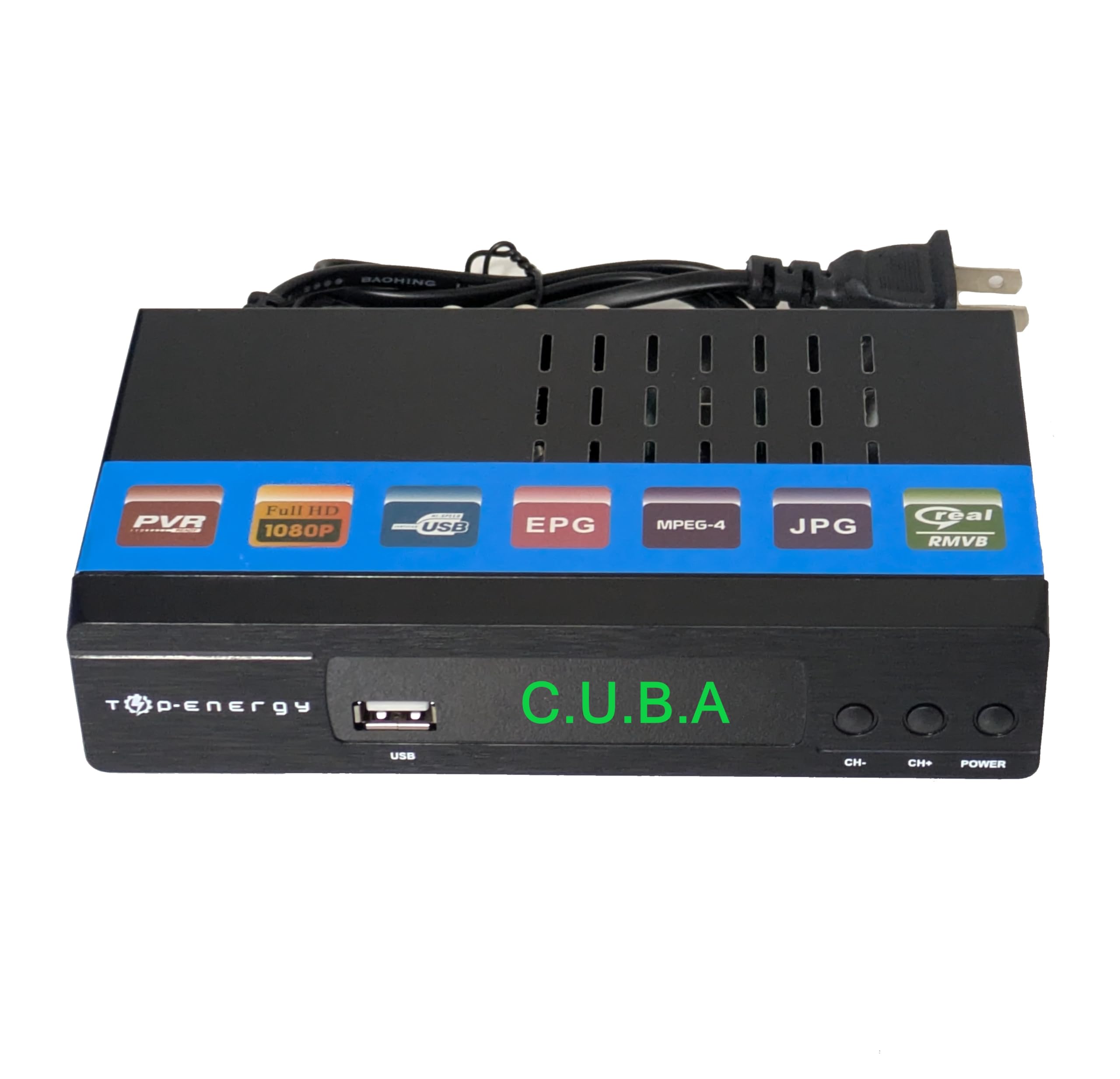
The TOP-ENERGY box is a DTMB digital decoder designed specifically for the broadcast standard used in Cuba, China, Hong Kong, and Macao. It is not a modulator that injects a signal into existing coax; instead, it receives over-the-air DTMB broadcasts and outputs them via HDMI for viewing on a modern television.
This unit features a USB port for recording live TV to a storage device, and its 6 MHz bandwidth matches the channel spacing used in those regions. Users who send this box to family members in Cuba consistently report that it picks up all available channels and works with standard NTSC analog inputs for older sets.
The package includes an HDMI cable, AV cable, and remote control, making the initial setup straightforward. If your requirement is receiving DTMB broadcasts rather than re-modulating an HDMI source, this is the correct device. For any other region or application, look at the modulators above.
Why it’s great
- Works with Cuba, China, Hong Kong DTMB broadcasts
- Records live TV via USB port
- Includes HDMI and AV cables in the package
Good to know
- Only receives DTMB—does not modulate an external HDMI source
- Not compatible with North American ATSC or QAM systems
FAQ
Can I use a Digital HD Modulator Box to distribute a streaming stick to multiple TVs?
What is the difference between a modulator and an HDMI over coax extender?
Why does my image look slightly compressed after modulation?
Final Thoughts: The Verdict
For most users, the digital hd modulator box winner is the MINIMOD 2 Vecoax because it delivers full 1080p with Dolby audio, supports both ATSC and QAM, and lets you name your channel directly on its color display. If you need multi-standard support for international installations, grab the Thor Broadcast H-HDMI-RF-PETIT. And for extending a 4K source over existing coax without re-modulating, nothing beats the OREI CO-UHD330-K.

Mo Maruf
I created WellFizz to bridge the gap between vague wellness advice and actionable solutions. My mission is simple: to decode the research and give you practical tools you can actually use.
Beyond the data, I am a passionate traveler. I believe that stepping away from the screen to explore new environments is essential for mental clarity and physical vitality.