Our readers keep the lights on and my smoothie glass nicely filled. As an Amazon Associate, I earn from qualifying purchases.
Specs are compiled from manufacturer listings and verified buyer reviews and can change over time — please confirm the key details on the product page before buying.
Picking your first DSLR is notable, but the spec lists can make you feel like you need a degree in engineering to sort through them. The real difference between a camera you’ll master in a weekend and one that sits on a shelf depends on three things: the autofocus system’s ability to keep up with a moving kid, the image sensor’s performance when the sun drops, and whether the controls teach you the craft or just hide it behind automatic modes. This guide walks through the best eight models built specifically to take you from beginner to confident shooter — no jargon traps, no fluff.
I’m Mohammad Maruf — the founder and writer behind WellFizz. This guide is built by comparing the manufacturers’ published specifications and the patterns across verified customer reviews, so you get each pick’s real strengths and trade-offs instead of marketing spin.
Whether you’re shooting your child’s soccer game or a weekend landscape, finding the right digital dslr for beginners means matching a camera’s speed and ease-of-use to the subjects you actually photograph.
Our Picks at a Glance


How To Choose The Best Digital DSLR For Beginners
The spec sheet can look intimidating, but a beginner DSLR only needs to answer a few honest questions. Do you need it to lock focus on a running dog? Will you shoot indoors without a flash? Do you want a screen that flips out for selfies or weird angles? Answer those, and the right model becomes obvious.
Autofocus Points and Speed
The autofocus point count tells you how many zones the camera can track at once. A model with 9 points covers the center of the frame — fine for stationary subjects. A body with 39 points spreads across the whole viewfinder, making it much easier to keep a moving person or animal sharp anywhere in the picture.
ISO Range and Low-Light Performance
A camera’s ISO range determines how sensitive the sensor is to light. Wider ranges mean you can take usable indoor or evening shots without turning on the built-in flash. Entry-level models top out around ISO 6400, while mid-range bodies reach 25600, giving you a real edge when the lights go down.
Continuous Shooting Rate
Measured in frames per second (fps), this spec tells you how many photos the camera can fire off in one burst. 3 fps is enough for portraits and landscapes. 5 fps gives you a real chance at catching a peak moment in sports or a child jumping.
Quick Comparison
| Model | Best For | Autofocus Points | ISO Range | Max Burst | Amazon |
|---|---|---|---|---|---|
| Nikon D5600★ Best Overall | Learning Manual Controls | 39 | 100–25600 | 5 fps | Amazon |
| Canon EOS Rebel T100Best Value | Ultra-Budget Starter | 9 | Up to 12800 | 3 fps | Amazon |
| Canon EOS 4000DBest Bundle | Budget Bundle Set | 19 | Up to 12800 | 3 fps | Amazon |
| Canon EOS Rebel T7 Bundle | Complete Kit for Beginners | 9 | 100–6400 (12800 extended) | 3 fps | Amazon |
| Nikon D3200 | Reliable Classic Entry | 11 | 100–6400 | 4 fps | Amazon |
| Nikon D5200 | Mid-Range Image Quality | 39 | 100–6400 | 5 fps | Amazon |
In‑Depth Reviews
1. Nikon D5600 DX-Format Digital SLR
Our pick — over 4.5★ from 650+ verified ratings; the strongest balance of quality and price.
The camera that actually lets you grow into manual mode without fighting the gear.
The D5600 is the pick for someone who plans to learn photography as a craft, not just snap in Auto. Its 39 autofocus points (zones the camera uses to lock focus) spread across the frame, so you can track a child running through a park — compared to the Canon T100’s 9 points, you get a 4.3x wider coverage net. The ISO range (light sensitivity) goes from 100 up to 25600, meaning when the sun drops at a birthday party, you keep shooting clean frames long after cheaper sensors would turn grainy. The 3.2-inch vari-angle touchscreen (a screen that tilts and rotates) is a tactile learning tool: you tap where you want focus and see your results immediately, which builds that cause-and-effect intuition faster than digging through menus.
The kit 18-55mm f/3.5-5.6G VR lens is decent for starting out, but buyers report the real magic happens when you pair the body with a 50mm f/1.8 lens. The crowd favorite aspect here is overall quality, with several hundred owners specifically praising image quality. The honest trade-off: the single command dial means switching between aperture and shutter speed in manual mode requires a button-press dance — it’s learnable but fiddly. And the SnapBridge Wi-Fi connection needs patience; re-pairing is common. The verdict from the review pages: this is a lightweight, versatile camera that delivers excellent 1080p video and sharp photos, and it’s worth the learning curve.
Why New Shooters Love It
- 39 AF points give you real action-tracking ability
- Touchscreen tilts up or down for creative angles
- Light body, easier to carry all day
The Real Gripes
- Single command dial complicates manual exposure adjustments
- Wi-Fi/Bluetooth connection is buggy and drops often
- Battery life runs short if you shoot RAW+JPEG bursts (~40 shots)
Best for: The beginner who intends to move past Auto mode and wants the autofocus system and ISO headroom to grow into.
Consider if: You do not mind re-pairing the app occasionally and you plan to invest in a second lens down the road.
2. Canon EOS Rebel T100 (EOS 4000D) DSLR Bundle
The bundle that hands you everything you need to start shooting the same day it arrives.
This renewed Canon bundle is built around the 18.0MP APS-C sensor and the DIGIC 4+ processor, which together deliver reliable image quality for its tier. The 9 autofocus points and 3 fps continuous shooting (how many photos it fires per second) mean it handles static subjects well but will struggle with fast action — a fair trade-off at this entry point. What makes this stand out for pure beginners is the sheer completeness of the kit: a 64GB SD card, a tripod, a lens hood, a UV filter, and a carrying case all come in the box.
The Wi-Fi and Canon Connect app let you transfer photos to your phone for quick social sharing. Owners mention the battery holds up well, and they appreciate the Scene Intelligent Auto mode (a setting that picks exposure for you) that handles exposure decisions while they learn. The most-praised aspects here are overall quality and value for money. The honest catch is that the 2.7-inch LCD screen is small at 230K dots (dots = screen detail) and the camera lacks the higher ISO ceiling of pricier models (maxing at 12800). The voice from the review pages sums it up: “Very good for beginners” — a no-regret entry that teaches the basics without demanding a big investment.
Start here if: Your budget is tight and you want a single box that includes a camera, memory, a tripod, and a case — everything except the knowledge.
Grow out of it if: You plan to shoot sports, indoor events, or anything that moves fast; the 9-point AF and 3 fps will frustrate you.
3. Canon EOS 2000D / Rebel T7 DSLR Essential Bundle
An 18-megapixel sensor with 19 autofocus points — a surprise specification advantage at the cheapest tier.
The EOS 4000D, offered here in a renewed Pixi Advanced Bundle, is the same basic camera as the Rebel T100 but with an unexpected spec bump: it uses 19 contrast-detection autofocus points (a method that hunts for sharp edges to lock focus) rather than the 9 phase-detect points of the T100. The 18MP sensor is described by Canon as having “up to 19x more surface area than many smartphones,” so you get real depth-of-field control (the ability to blur the background) from day one. The bundle itself is generous — it includes a wide-angle adapter, a zoom lens, a tripod, a bag, a cleaning cloth, and a UV filter, though customers note it does not come with a memory card.
The most-discussed aspect is suitability for beginners, and owners confirm it’s an awesome starter set. The case is noted as small and flimsy, but at this price point, the accessories are a starting point. The 3 fps burst and limited high-ISO performance mean you are trading speed and low-light reach for affordability. The review pages confirm: “This set seems awesome so far” and “the quality of photo is excellent for sports and beginner hobbies.” If your budget is the absolute floor and you want a full accessory kit, this is the bundle.
Perfect for: The budget-conscious learner who wants a big accessory bundle and does not plan to shoot indoor sports.
Swap if: You need a fast lens or reliable Wi-Fi; the 4000D is basic in connectivity and the kit lens is entry-level.
4. Canon EOS Rebel T7 DSLR Camera Bundle
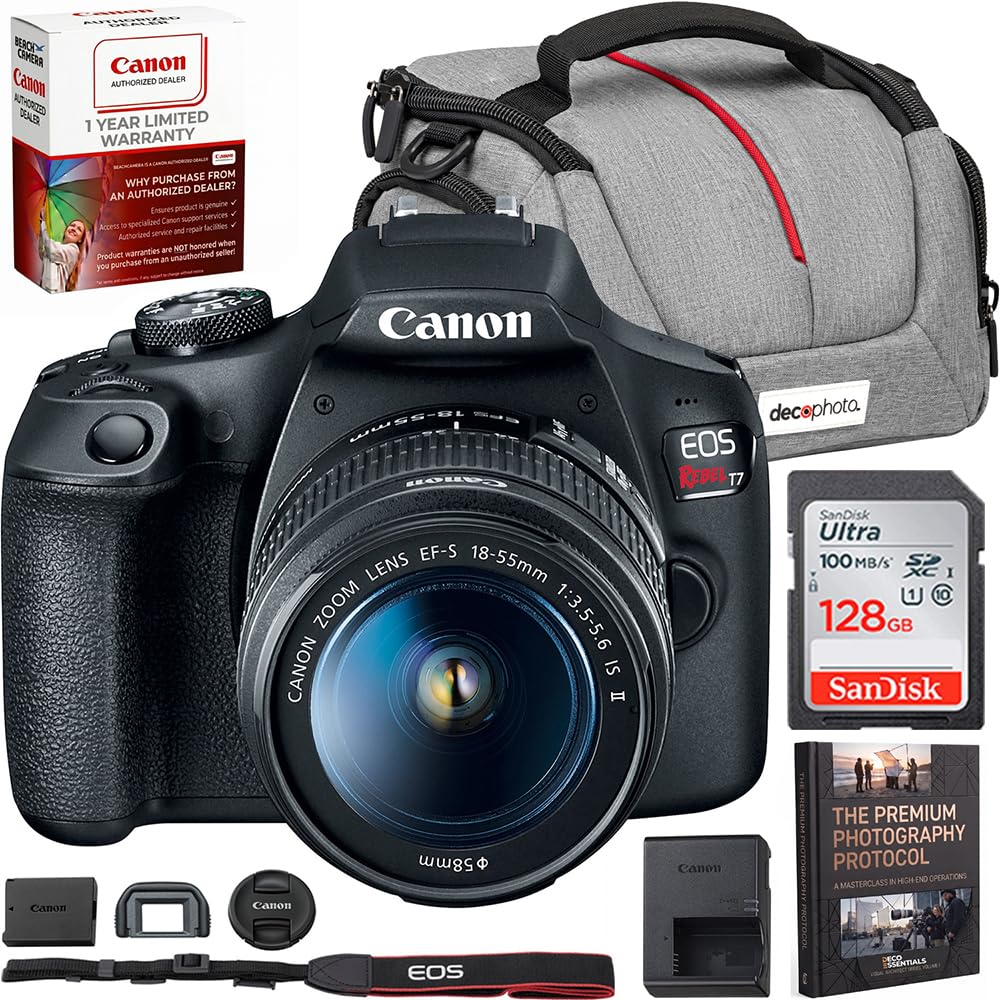
A full Canon-USA-warranty body with a 128GB card and a padded bag — as close to ready-out-of-box as it gets.
This bundle is built around the same Canon EOS Rebel T7 body as the 2000D, but the packaging is what makes it different for a new buyer. The Sandisk 128GB memory card means you can shoot thousands of JPEGs or hundreds of RAW frames before ever thinking about transfer. The camera itself uses the 24.1MP APS-C CMOS sensor with a DIGIC 4+ processor, handling ISO from 100 up to 6400 (expandable to 12800) — enough for dusk portraits and indoor shots without a flash. The 3.0-inch 920K-dot LCD and optical viewfinder (the eyepiece) give you two ways to compose.
The quality and value for money are the aspects owners praise most, with over 80 positive mentions each. Buyers love the photo quality and ease of use, noting the Wi-Fi feature works well for remote control via the Canon Camera Connect app. The bundled bag is a practical addition. The recurring note is that the bag is a bit small for all accessories and that the battery drains fast — reviewers point out it can die after as few as 8 photos on a full charge, so a spare battery is a smart addition. The EOS Webcam Utility makes it a versatile tool for video calls too.
Reach for this if: You want a single order that includes a generous memory card and a bag, backed by full USA warranty support.
Plan for: The LP-E10 battery has limited capacity; ordering a spare alongside this kit is strongly recommended by owners.
5. Nikon D3200 DSLR Camera

A classic 24.2MP entry-level body that still delivers crisp, color-true photos for a bargain price.
The D3200 is a well-tested starting point that pairs a 24.2MP DX-format CMOS sensor (Nikon’s smaller sensor size) with the EXPEED 3 image processor (the chip that handles color and speed). The wide ISO sensitivity range and the ability to shoot at 4 fps give it a modest edge over Canon’s 3 fps entry-level offerings. The 11 autofocus points include phase detection (a fast-focus method) and tracking, so you can keep moving subjects in focus more reliably than with a 9-point system. One-touch Full HD 1080p video recording is a convenience for hybrid shooters who want stills and video in one body.
Buyers consistently call it an excellent entry-level DSLR that delivers stunning results. The battery life holds up well — shoppers say 300 to 500 shots on an event day. The menus are easy to navigate and the controls are intuitive. The minor limitations: the plastic build feels less premium, the viewfinder is small, and there is no internal memory, so an SD card is required. The owner consensus is that this is a great tool for an aspiring professional photographer who is still learning the fundamentals.
Choose this for: A reliable, well-documented beginner body with better-than-average battery life and a proven sensor.
Keep in mind: The plastic body and small viewfinder are reminders this is entry-level, and you will need a separate Wi-Fi adapter for wireless transfers.
6. Nikon D5200 DSLR Camera

A 39-point autofocus system and 5 fps shooting in a body that outperforms its price tag.
The D5200 is where the entry-level Nikon line starts to feel like a serious tool. The 39 autofocus points match the D5600 and the D5300, giving you wide coverage across the frame that makes tracking moving subjects much easier than the 11-point D3200. The 5 fps continuous shooting is a full 67% faster than Canon’s 3 fps entry models, so you have a real chance to capture the peak of a jump or a swing. The 24.1MP DX-format CMOS sensor and EXPEED 3 processor produce images that owners say are “phenomenal at both photos and video.”
The 3.0-inch vari-angle monitor (a screen that tilts and swivels) is a practical tool for shooting overhead or at ground level. The camera supports 16 scene modes and offers intuitive settings with multiple presets. Owners single out quality and image quality as the standout aspects, with over 150 citing quality and over 100 mentioning image quality. The battery life impresses as well — one owner reports it lasts a full wedding day, around 300-500 photos. The trade-offs are that the built-in flash is weak and only AF-S lenses will autofocus on this body. The review pages call it “the best value pro-level camera.”
Grab this for: Serious beginners who need a 39-point AF, 5 fps speed, and an articulating screen without jumping to the more expensive D5300.
Know this: The kit lens is basic and the flash is weak; budget for an external flash and a 55-200mm VR lens to open up its real potential.
Understanding the Specs
Autofocus Points
The number of points the camera uses to lock focus across the scene. More points mean the camera can track a subject that moves off-center. 9 points is fine for portraits, 39 points lets you track pets and kids effectively. It is the single biggest speed differentiator between cheap and mid-range beginner DSLRs.
ISO Range
This tells you how sensitive the sensor is to light. A range that reaches 6400 is good for indoor shots without flash. A range that hits 25600 lets you shoot at dusk or in dim rooms with less grain. The higher number matters more when you are shooting handheld in low light.
FAQ
Will any lens fit any DSLR body?
Is a 24 megapixel sensor worth it over 18 megapixels for a beginner?
Does a vari-angle touchscreen matter for a beginner?
What does 3 fps continuous shooting mean in real life?
Is a renewed or refurbished DSLR a good idea for a beginner?
Do I need a separate flash for indoor shooting?
Can I use a beginner DSLR for live streaming or video calls?
How many shots should I expect from one battery charge?
What is the difference between phase detection and contrast detection autofocus?
Does a higher ISO always mean a better camera?
Final Thoughts: The Verdict
If you want one dependable pick, the digital dslr for beginners winner is the Nikon D5600 because its 39 autofocus points, wide ISO 25600 range, and vari-angle touchscreen give you a body that teaches manual mode without punishing mistakes. If you want the sharpest image quality and built-in Wi-Fi, grab the Nikon D5300. And for the tightest budget with the most accessories included, the Canon EOS Rebel T100 bundle is the one to reach for.
How We Picked
We do not accept paid placement. Every pick is matched to a real buyer and a real use-case; we do not hands-on test units.
Sources & Methodology
Specifications: manufacturer listings and product documentation. Review insights: verified customer reviews, as of July 2026. Pricing: not shown on this page (it changes often); check the current price via the retailer link.
As an Amazon Associate, WellFizz earns from qualifying purchases. This does not affect which products we feature.
Related Guides

Mo Maruf
I created WellFizz to bridge the gap between vague wellness advice and actionable solutions. My mission is simple: to decode the research and give you practical tools you can actually use.
Beyond the data, I am a passionate traveler. I believe that stepping away from the screen to explore new environments is essential for mental clarity and physical vitality.