Our readers keep the lights on and my smoothie glass nicely filled. As an Amazon Associate, I earn from qualifying purchases.
The chase for a sub- camera that delivers professional-grade image quality without the professional-grade price tag often leads to analysis paralysis. You are weighing sensor size against lens compatibility and video framerates against autofocus systems, trying to find the one body that doesn’t force you to compromise on the type of photography that actually matters to you.
I’m Mohammad Maruf — the founder and writer behind WellFizz. I’ve spent hundreds of hours cross-referencing lab tests, sensor specs, lens ecosystem costs, and real-world user feedback to build this guide.
Whether you are shooting portraits, vlogging on the move, or capturing everyday life, this guide breaks down the top mirrorless options to help you find your ideal best digital camera under 1000 by focusing on the specs that truly affect your final image.
How To Choose The Best Digital Camera Under 1000
The sub- mirrorless market is fiercely competitive. You must prioritize sensor size, autofocus capability, and video features because each model trades off these specs differently to hit the price cap.
Sensor Size: APS-C vs. Full-Frame
APS-C sensors (found in the R50, R100, and M50) offer a good balance of image quality and lens affordability. Full-Frame sensors (like the one in the RP) deliver superior low-light performance, shallower depth of field, and wider dynamic range, but the body and lenses cost more. The Canon RP is the only body in this guide that offers full-frame at a price that dips into the sub- range alongside a kit lens.
Autofocus Performance
The Dual Pixel CMOS AF system is a defining feature for Canon cameras. The R50 features the newer Dual Pixel CMOS AF II with advanced subject tracking (human, animal, vehicle) that covers a near-total sensor area. The R100 and M50 use the original Dual Pixel system, which is still very reliable for stills and video but has fewer coverage zones. Phase detection autofocus points are the number you want to look for—more points generally mean better tracking across the frame.
Video Capabilities and Crop Factors
Not all 4K is created equal in this tier. The Canon R50 delivers oversampled 4K from its 24.2MP sensor, which produces sharper, more detailed footage. The R100 and M50 record 4K but with a significant crop that narrows your field of view, making wide-angle shooting more difficult. The RP records 4K with a heavy crop and a 30-minute record limit, making it less ideal for video versus still photography.
Quick Comparison
On smaller screens, swipe sideways to see the full table.
| Model | Category | Best For | Key Spec | Amazon |
|---|---|---|---|---|
| Canon EOS R50 | APS-C Mirrorless | Best All-Around Hybrid | 24.2MP Oversampled 4K | Amazon |
| Canon EOS RP | Full-Frame Mirrorless | Portrait & Low-Light | 26.2MP Full-Frame Sensor | Amazon |
| Canon EOS R100 | Entry APS-C | Entry-Level Photography | 24.1MP 6.5fps Burst | Amazon |
| Canon EOS M50 | Renewed APS-C | Budget Vlogging | 24.1MP HD 120p Slow-Mo | Amazon |
| Canon EOS M100 | Compact APS-C | Ultra-Portable Snaps | 24.2MP Touchscreen LCD | Amazon |
In‑Depth Reviews
1. Canon EOS R50
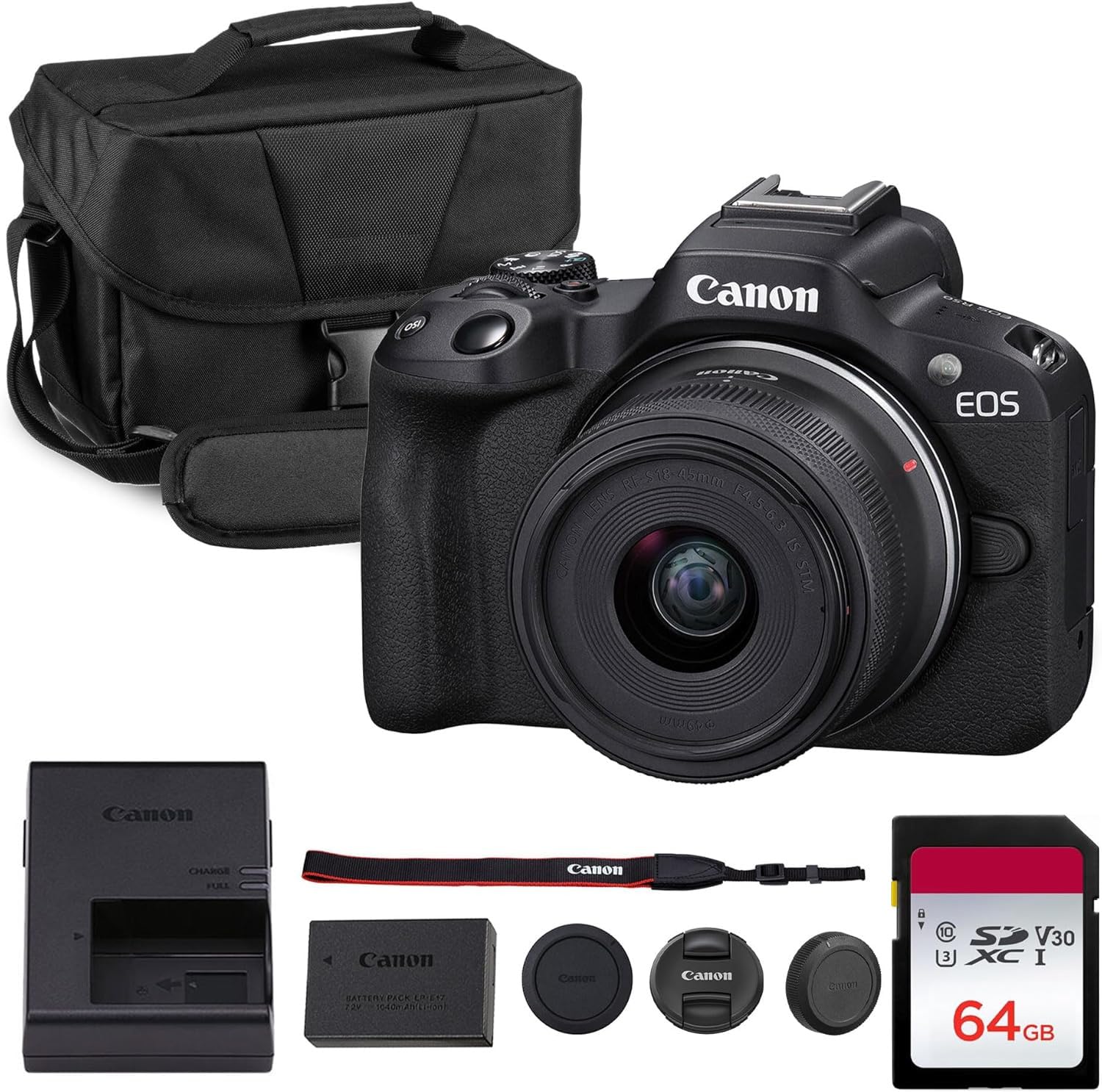
The Canon EOS R50 hits the sweet spot for this price tier by packing the newer Dual Pixel CMOS AF II system into a compact, lightweight body. This autofocus system provides near-total frame coverage with reliable eye and subject tracking for both stills and video, a significant upgrade over the older system used in the R100 and M50. The 24.2-megapixel APS-C sensor combined with the DIGIC X processor ensures fast operation and excellent image quality.
For video creators, the R50 is the strongest hybrid performer here. It shoots oversampled 4K video, which means the camera reads the full width of the sensor and downscales it, resulting in sharper footage with less moiré than cameras that simply crop the sensor for 4K. The vari-angle touchscreen and vertical video support make it easy to compose shots for social media platforms without needing extra rigging.
The included RF-S 18-45mm f/4.5-6.3 IS STM lens is a capable everyday zoom, and the RF lens mount offers a clear upgrade path to sharper glass. While the body lacks in-body image stabilization, the optical stabilizer in the kit lens is adequate for handheld walking shots. This is the camera that asks the fewest compromises from a buyer who wants to shoot both photos and high-quality video without exceeding a mid-range budget.
Why it’s great
- Dual Pixel CMOS AF II with advanced subject detection
- Oversampled 4K video with no crop
- Lightweight build with vari-angle touchscreen
Good to know
- No in-body image stabilization
- Kit lens aperture is slow for low light
- Rear control dial can feel cramped for large hands
2. Canon EOS RP

The Canon EOS RP is the only full-frame body within reach of the sub- cap, and it delivers a noticeable jump in image quality for still photographers. The larger 26.2-megapixel sensor provides superior dynamic range and cleaner images at higher ISOs compared to any APS-C sensor in this list. This makes it a strong option for portrait, event, and landscape photographers who prioritize image depth and low-light performance over video features.
The RP uses the original Dual Pixel CMOS AF system with 4,779 manually selectable AF points, providing fast and accurate phase detection for still subjects. Paired with the RF 24-105mm f/4-7.1 IS STM kit lens, you get a versatile zoom range with 5-stop optical image stabilization. The full-frame sensor also allows for shallower depth of field, delivering that creamy background blur that APS-C sensors struggle to replicate without fast, expensive prime lenses.
Video shooters should note the limitations: 4K recording has a 1.6x crop and a 30-minute record limit, making it less suitable for vlogging or long-form content. The body itself is compact and lightweight for a full-frame camera, weighing approximately 485 grams, and the flip-out touchscreen is useful for overhead or waist-level shots. If still photography is your primary goal and you want the best image quality per dollar, the RP is the strongest contender.
Why it’s great
- Full-frame sensor for superior low-light and dynamic range
- Lightweight and compact for a full-frame body
- Excellent still image quality and shallow depth of field
Good to know
- Heavy 4K crop and 30-min recording limit
- Battery life is moderate, recommend spare
- Kit lens aperture is slow compared to RF primes
3. Canon EOS R100

The Canon EOS R100 is the lightest and smallest body in the EOS R series, making it an excellent choice for photographers who prioritize portability above all else. At just 356 grams for the body, it slips into a small bag easily and is comfortable to hold for extended shooting sessions. The 24.1-megapixel APS-C CMOS sensor paired with the DIGIC 8 processor delivers good still image quality, with natural color reproduction and the ability to capture 4K video at up to 24 fps.
The autofocus system uses Dual Pixel CMOS AF with 143 zones and offers eye and face detection for both humans and animals. Continuous shooting reaches 6.5 frames per second with One-Shot AF, which is fast enough for capturing moving subjects like children or pets. The included RF-S 18-45mm f/4.5-6.3 IS STM kit lens provides optical stabilization, which helps keep handheld shots steady.
The main trade-off for the low price is video capability. The 4K recording comes with a significant crop factor that narrows the field of view, and the camera lacks the DIGIC X processor found in the R50, meaning more rolling shutter in fast-moving scenes. The screen is also fixed (not articulating), which limits vlogging and overhead shooting. For a budget-conscious buyer focused primarily on still photography and learning the RF system, the R100 is an affordable entry point.
Why it’s great
- Smallest and lightest EOS R body
- Reliable Dual Pixel CMOS AF with eye detection
- Very affordable way to enter the RF system
Good to know
- 4K video has a heavy crop factor
- Fixed LCD screen, not vari-angle
- No charger included in the box
4. Canon EOS M50 (Renewed)

The Canon EOS M50 is a familiar face in the budget mirrorless world, and this renewed model offers the same core hardware at a lower price point. It features a 24.1-megapixel APS-C CMOS sensor with DIGIC 8 processing and Dual Pixel CMOS AF with 143 phase-detection points. The built-in OLED electronic viewfinder and touch-and-drag autofocus make it a comfortable shooting experience, especially for those transitioning from a DSLR.
The M50’s video features remain competitive for vloggers on a tight budget. It records 4K UHD at 24 fps and HD at 120 fps for slow-motion playback. The ability to attach an external microphone via the shoe mount improves audio quality for vlogging, though the 4K crop factor is comparable to the R100’s. The vari-angle touchscreen folds out to the side, making it more convenient for self-recording than the fixed screen on the R100.
The biggest downside to the M50 is the EF-M lens mount, which is a discontinued system. New lens development has stopped, and while you can adapt EF/EF-S lenses, native EF-M lens choices are limited and generally less sharp than newer RF-S glass. The 4K crop and weak in-body stabilization mean you will likely need a gimbal for smooth walking footage. As a renewed product, condition may vary, but for the budget-conscious video creator, the features per dollar remain compelling.
Why it’s great
- Affordable entry point for vlogging with mic input
- Vari-angle touchscreen for self-recording
- HD 120p slow-motion recording
Good to know
- EF-M lens mount is a discontinued system
- 4K video has a heavy crop and tracking issues
- Renewed condition may have cosmetic wear
5. Canon EOS M100

The Canon EOS M100 is designed for maximum simplicity and portability. It is a 24.2-megapixel APS-C mirrorless camera that is nearly pocketable, especially when paired with the collapsed 15-45mm kit lens. The camera prioritizes point-and-shoot ease with a touchscreen interface that mimics smartphone gestures, making it an ideal step-up camera for smartphone photographers. It includes Dual Pixel CMOS AF for fast phase-detection autofocus in stills.
Connectivity is a strong point here, with built-in Wi-Fi, Bluetooth, and NFC for instant image transfer to a phone or tablet. The tilt-type 3.0-inch LCD screen is responsive, but it only tilts upward, which limits its use for video framing at low or high angles. The M100 supports 1080p video but does not offer 4K recording, a notable omission compared to the R100 and M50.
The EF-M lens mount is the same discontinued system as the M50, limiting future lens options. The body lacks a viewfinder and a hot shoe for external flash or microphone, which restricts its use for serious photography or vlogging. The M100 is best suited as a compact, high-quality travel camera for capturing everyday moments and family snapshots without diving into manual controls, but it is the most limited in terms of expandability and video features.
Why it’s great
- Extremely compact and light for travel
- Simple touchscreen operation like a smartphone
- Fast Wi-Fi and Bluetooth image transfer
Good to know
- No 4K video recording capability
- No viewfinder or hot shoe for accessories
- Discontinued EF-M lens mount system
FAQ
Is the Canon EOS R50 worth the extra cost over the R100 for beginners?
Can I use Canon EF lenses on the EOS R series cameras?
Is the Canon EOS RP still a good camera for photography under 1000?
Final Thoughts: The Verdict
For most users, the best digital camera under 1000 winner is the Canon EOS R50 because it delivers the best balance of modern autofocus, oversampled 4K video, and a growing native lens ecosystem without pushing past a mid-range budget. If you want full-frame image quality for portraits and landscapes, grab the Canon EOS RP. And for the tightest budget focused on still photography, nothing beats the light weight and low cost of the Canon EOS R100.

Mo Maruf
I created WellFizz to bridge the gap between vague wellness advice and actionable solutions. My mission is simple: to decode the research and give you practical tools you can actually use.
Beyond the data, I am a passionate traveler. I believe that stepping away from the screen to explore new environments is essential for mental clarity and physical vitality.