Our readers keep the lights on and my smoothie glass nicely filled. As an Amazon Associate, I earn from qualifying purchases.
The difference between a home movie and a cinematic short often comes down to one thing: the camera’s ability to handle motion, color, and light without compromise. Video capture demands higher bit rates, better in-body stabilization, and a sensor that works fast enough to avoid rolling shutter artifacts — details that still photography simply doesn’t stress.
I’m Mohammad Maruf — the founder and writer behind WellFizz. I’ve spent hundreds of hours cross-referencing sensor readout speeds, bit depths, codec support, and autofocus tracking performance across the current market to help you find the right tool for your video work.
After analyzing frame rate ceilings, log profiles, dynamic range claims, and real-world recording limits across eleven competing models, I’ve built this definitive guide to the best digital camera for video in every price tier and use case.
How To Choose The Best Digital Camera For Video
Video-centric buying requires prioritizing features that photographers often ignore. Your choice should balance codec quality, stabilization, autofocus reliability, and battery endurance — in that order for serious production work.
Codec Depth and Bit Rate
8-bit 4:2:0 footage limits color grading significantly. For professional results, look for 10-bit 4:2:2 internal recording or raw output over HDMI or USB-C. Higher bit rates (above 100 Mbps) preserve detail in motion-heavy scenes and reduce compression artifacts.
Sensor Readout Speed and Rolling Shutter
Cameras with slower sensor readouts produce noticeable skewing during pans or fast subject movement. Stacked CMOS or global shutter sensors virtually eliminate this. Check readout speeds in reviews — anything above 15ms starts to show wobble in handheld footage.
Autofocus and Stabilization
Continuous eye-tracking autofocus is non-negotiable for run-and-gun shooting. Phase-detection systems with on-sensor pixels (like Dual Pixel CMOS or Sony’s 4D Focus) deliver reliable tracking. In-body image stabilization (IBIS) saves gimbal weight for many walkaround scenarios.
Quick Comparison
On smaller screens, swipe sideways to see the full table.
| Model | Category | Best For | Key Spec | Amazon |
|---|---|---|---|---|
| Canon EOS 2000D / Rebel T7 Bundle | Entry DSLR | Beginner photo/video | Full HD 1080/30p | Amazon |
| Canon EOS Rebel T7 (Lens Kit) | Entry DSLR | First-time DSLR users | Full HD 1080/30p | Amazon |
| Canon EOS R100 Mirrorless | Mirrorless | Compact 4K beginner | 4K up to 24 fps | Amazon |
| Canon EOS Rebel T7 Bundle | Entry DSLR | Starter kit with extras | Full HD 1080/30p | Amazon |
| Panasonic LUMIX FZ80D | Bridge | Long zoom vlogging | 4K Photo extraction | Amazon |
| Canon EOS Rebel T7 Bundle (Renewed) | Entry DSLR | Budget full kit | Full HD 1080/30p | Amazon |
| Canon EOS R50 Mirrorless Kit | Mirrorless | Vlogging & content | Oversampled 4K 30p | Amazon |
| Sony Alpha ZV-E10 | Vlog Mirrorless | Creator vlogging | Oversampled 4K 30p | Amazon |
| Nikon D7000 DSLR | Mid DSLR | Enthusiast hybrid | Full HD 1080/24p | Amazon |
| Blackmagic Pocket Cinema 4K | Cinema Camera | Narrative & doc | 4K 60p RAW/ProRes | Amazon |
| Sony FX30 Cinema Line | Cinema Camcorder | Pro cinema indie | 4K 120p S-Cinetone | Amazon |
In‑Depth Reviews
1. Sony FX30 Cinema Line

The Sony FX30 delivers 6K oversampled 4K footage with S-Cinetone color science straight out of the box, eliminating the need for extensive grading to achieve a filmic look. Its dual base ISO (640 and 2500) produces clean shadows and low noise in dim environments, a feature usually reserved for full-frame cinema cameras. The active cooling system prevents overheating during long interviews or livestreams, so you never hit a recording time limit.
Autofocus performance is best-in-class for the cinema segment — reliable Eye-AF tracks subjects even when they turn profile or walk toward the lens. The Cine EI Quick mode lets you switch between exposure bases on the fly without clipping highlights. For narrative filmmakers and commercial creators who need professional latitude without the full-frame price, this sensor punches hard above its weight.
Battery life runs about 1-2 hours in 4K recording, which is manageable with a V-mount battery plate or USB-C power bank. The APS-C crop also turns full-frame telephoto lenses into super-telephoto reach, an advantage for documentary and nature work. Pair it with a Ninja V for ProRes RAW output if your post workflow demands maximum flexibility.
Why it’s great
- Dual base ISO for clean low-light footage
- S-Cinetone color requires minimal grading
- Active cooling eliminates recording limits
- Reliable Eye-AF for moving subjects
Good to know
- APS-C crop requires wider lenses for ultra-wide shots
- Battery life moderate — plan for external power
- No built-in ND filters
- Menu system complex for first-time cinema users
2. Blackmagic Pocket Cinema Camera 4K

The Blackmagic Pocket Cinema Camera 4K is built specifically for video — not a hybrid stills camera with video modes tacked on. Its 4/3 sensor offers 13 stops of dynamic range, which comfortably matches and often exceeds far more expensive cinema bodies. Recording internally to Blackmagic RAW or Apple ProRes at up to 4K 60fps gives editors serious grading latitude without transcoding.
The 5-inch touchscreen is bright enough for studio work and eliminates the need for an external monitor in most controlled setups. Dual native ISO up to 25,600 keeps noise manageable in poorly lit interiors, while the MFT lens mount opens access to affordable vintage glass and modern cine primes. The included DaVinci Resolve Studio license covers your entire post-production pipeline.
There is no continuous autofocus, no in-body stabilization, and the battery lasts roughly 30 minutes. This is a tool for tripod, gimbal, or shoulder-rig work — not for handheld vlogging. The fan is audible in quiet rooms. If your workflow is manual-focused, scripted, or interview-based, this camera delivers cinema quality at a price that competes with consumer hybrids.
Why it’s great
- 13 stops dynamic range matches pro cinema cameras
- Internal Blackmagic RAW at 4K 60fps
- DaVinci Resolve Studio included
- MFT mount works with wide range of lenses
Good to know
- No continuous autofocus — manual focus required
- Battery lasts about 30 minutes
- No in-body stabilization
- Fan noise audible in quiet environments
3. Sony Alpha ZV-E10
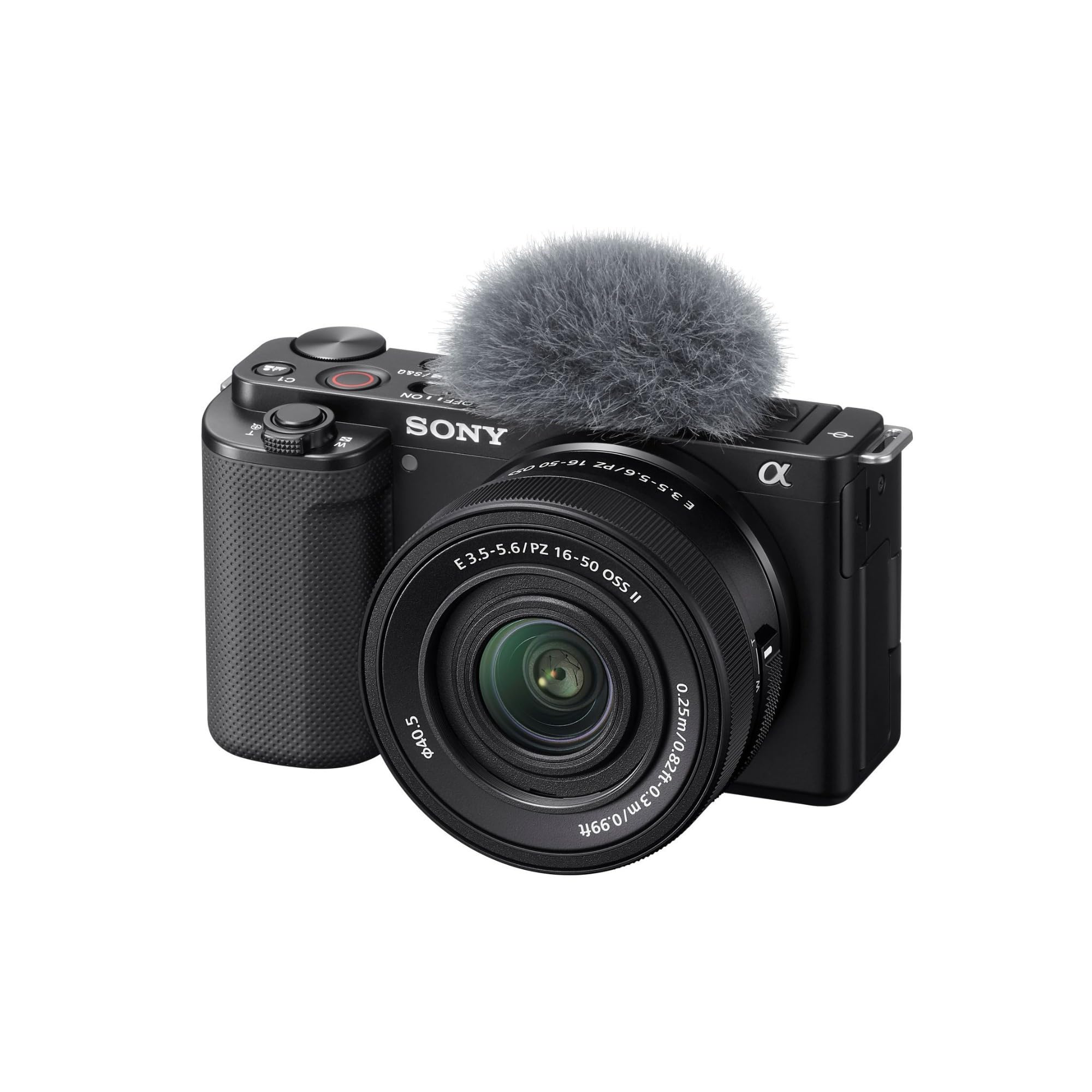
The Sony ZV-E10 packs the same 24.2MP APS-C sensor found in the a6400 but wraps it in a vlogging-first body with a side-flip screen and a dedicated Background Defocus button. The 4K footage is oversampled from a 6K readout, producing sharper detail and less aliasing than many larger cameras. The Product Showcase mode transitions focus from your face to an object held in front of the lens instantly — ideal for unboxing and review content.
Autofocus uses 425 phase-detection points with real-time Eye Tracking for both humans and animals, and the BIONZ X processor keeps it sticky even during rapid movement. The built-in three-capsule directional microphone captures clean audio in most indoor settings, and the hot shoe supports digital audio with Sony’s ECM-B1M shotgun for cleaner sound outdoors.
The kit lens (16-50mm f/3.5-5.6 OSS II) is compact but optically modest — upgrading to a Sigma 16mm f/1.4 or Sony 11mm f/1.8 significantly improves low-light performance. The ZV-E10 has no in-body stabilization, relying on lens-based OSS and electronic stabilization, which crops the frame slightly. For seated creators or handheld run-and-gun with stabilized lenses, this rig is light and fast.
Why it’s great
- 6K oversampled 4K produces sharp footage
- Product Showcase mode for content creators
- Excellent Eye AF tracking for vlogging
- Compact and lightweight for daily carry
Good to know
- No in-body image stabilization
- Kit lens is average in low light
- Rolling shutter noticeable during fast pans
- Limited to 4K 30fps (no 60p in 4K)
4. Canon EOS R50 Mirrorless Kit
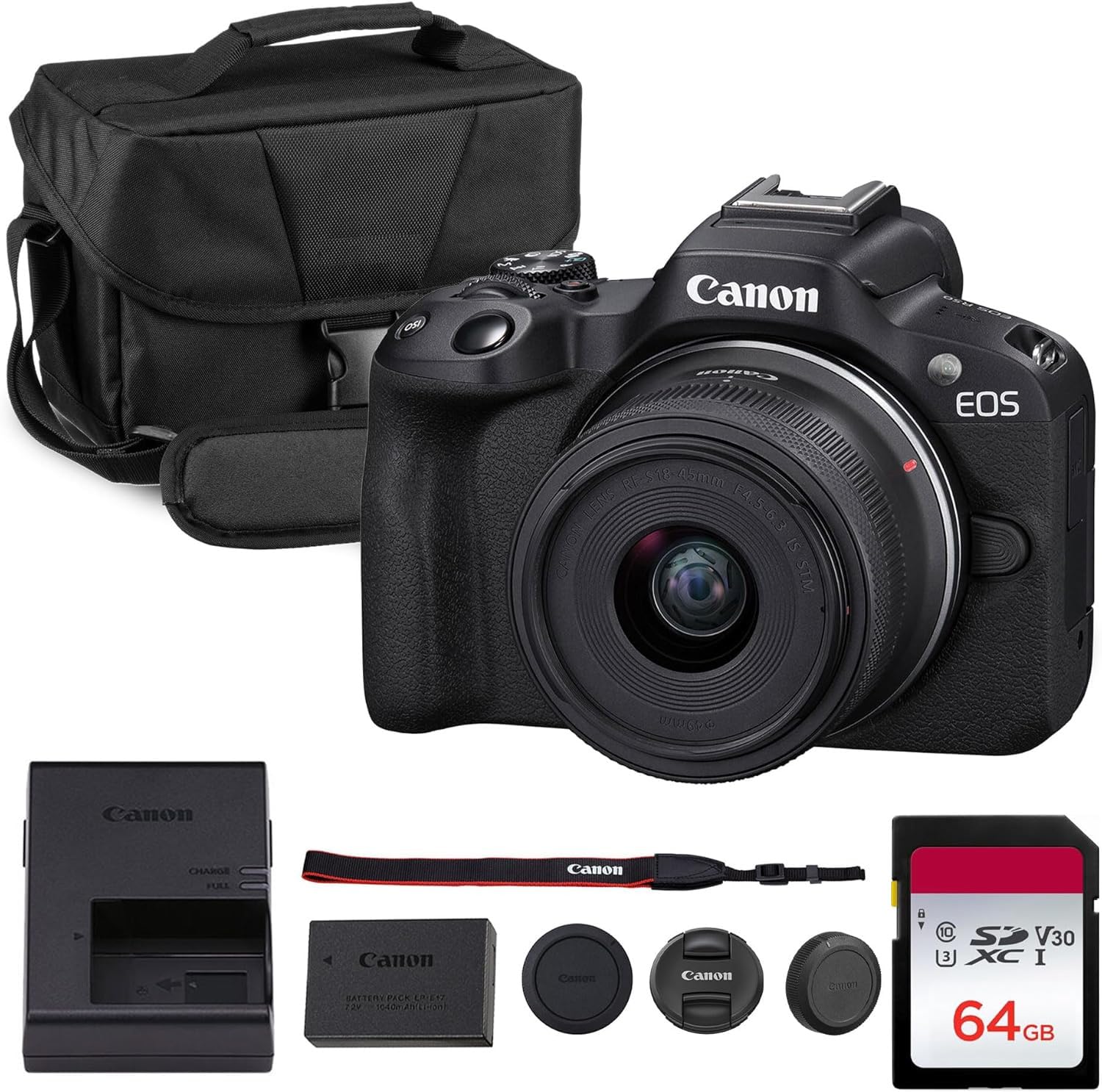
The Canon EOS R50 brings Dual Pixel CMOS AF II to an entry-level price point, offering 143 zone autofocus coverage with face and eye detection for both humans and animals. The oversampled 4K footage retains fine detail with minimal moiré, and the DIGIC X processor keeps rolling shutter relatively low for this class. The vari-angle touchscreen makes self-recording and low-angle shots straightforward — important for solo creators.
Creative Assist mode simplifies exposure adjustments for beginners who are still learning manual settings, while vertical video capture outputs ready-to-upload clips without cropping in post. The 18-45mm kit lens is compact and stabilized, delivering usable handheld footage in good light. Connectivity via Wi-Fi and Bluetooth allows wireless file transfer and remote control from a smartphone.
4K recording is capped at 30fps with no 60fps option, limiting slow-motion flexibility. The single UHS-I SD card slot is slow for high-bit-rate recording, and the buffer fills quickly during continuous shooting. The battery is rated for about 370 shots per charge, though video recording drains it faster. For aspiring YouTubers and travel documentarians on a strict budget, this is a formidable starter.
Why it’s great
- Dual Pixel AF II tracks faces and animals reliably
- Oversampled 4K with good detail retention
- Vari-angle touchscreen for vlogging
- Lightweight body easy to carry all day
Good to know
- No 4K 60fps — max 4K 30fps
- Single slow SD slot limits burst video
- Kit lens aperture modest for low light
- Battery life average for video work
5. Panasonic LUMIX FZ80D

The Panasonic FZ80D is a bridge camera with a 60x optical zoom lens (20-1200mm equivalent), giving you telephoto reach that would cost thousands in interchangeable lens glass. The 4K Photo mode captures 8MP stills from video bursts, while the Post Focus feature lets you touch to refocus after the shot — useful for nature and event videography where perfect focus is difficult in the moment.
The 2,360K-dot Live View Finder remains clear in bright sunlight, a big advantage over rear-screen-only cameras for outdoor shooting. The POWER O.I.S. stabilization effectively reduces hand shake at the telephoto end, making handheld recording at 1200mm feasible with steady technique. The built-in flash covers basic fill duties for close-range subjects.
The small 1/2.3-inch sensor limits dynamic range and low-light performance — footage above ISO 800 becomes noticeably grainy. The contrast-detect autofocus is slower than phase-detect systems, and there is no microphone input for external audio. Battery life drops quickly when using the zoom motor frequently. This camera suits hikers and wildlife watchers who prioritize reach over image purity.
Why it’s great
- 60x zoom captures subjects far away
- Post Focus reframes sharpness after capture
- Bright EVF works well in sunlight
- Very lightweight for its zoom range
Good to know
- Small sensor struggles in low light
- Contrast-detect AF is slow
- No external microphone input
- Battery drains fast with zoom use
6. Canon EOS R100 Mirrorless

The Canon EOS R100 is the smallest and lightest body in the EOS R series, designed for creators transitioning from smartphones to interchangeable-lens cameras. Its 24.1MP APS-C sensor paired with the DIGIC 8 processor delivers 4K video at 24fps, plus Full HD at 60fps and HD at 120fps for basic slow-motion. The Dual Pixel CMOS AF covers 143 zones with face and eye detection — a rare autofocus feature at this price tier.
The RF-S 18-45mm kit lens is stabilized with up to 4 stops of shake correction, producing usable handheld footage for casual travel and daily content. The in-camera Creative Assist mode simplifies exposure and color adjustments for beginners who are still learning manual controls. Wireless connectivity via Wi-Fi and Bluetooth allows easy photo and video transfer to a smartphone for quick sharing.
4K recording is limited to 24fps with no option for 30fps or 60fps, which restricts smooth motion for fast-moving subjects. The single SD UHS-I slot writes slowly, and the buffer fills quickly during continuous shooting. There is no headphone jack for audio monitoring. The battery lasts roughly a day of casual shooting. For budget-conscious learners who want 4K capability and modern AF, this is a sensible launch point.
Why it’s great
- Dual Pixel CMOS AF with face/eye detection
- Compact and light — smallest EOS R body
- 4K video at 24fps in entry-level package
- Stabilized kit lens helps handheld footage
Good to know
- 4K limited to 24fps — no 30 or 60
- No headphone jack for audio monitoring
- Single SD slot is slow
- No in-body stabilization
7. Canon EOS Rebel T7 (18-55mm Kit)

The Canon Rebel T7 remains a perennial entry-level DSLR, offering a 24.1MP APS-C CMOS sensor with DIGIC 4+ image processing at a price that leaves room for lens investment. The Full HD 1080/30p video recording is adequate for casual family movies, classroom projects, and basic YouTube uploads. The 9-point AF system with a central cross-type point provides reliable focus in good light for stationary subjects.
The optical viewfinder offers 95% coverage, which helps compose shots in bright conditions where LCD screens wash out. Built-in Wi-Fi and NFC enable wireless image transfer to a smartphone via the Canon Camera Connect app, and the EOS Utility Webcam Beta software turns the T7 into a decent webcam for Zoom calls and livestreaming. The included 18-55mm f/3.5-5.6 II lens covers standard focal lengths for everyday recording.
Video autofocus uses contrast detection in live view, which hunts and slows down during recording — manual focus or fixed-camera setups yield better results. The 3fps burst rate is slow for action sequences. The LCD is 2.7 inches at 230k dots, making critical focus checking difficult. This camera rewards users who learn manual exposure and focus control rather than relying on automation.
Why it’s great
- Very affordable entry to Canon EF lens system
- Optical viewfinder for bright-day composition
- Wi-Fi for quick smartphone transfer
- Webcam utility for livestreaming
Good to know
- Contrast-detect AF hunts in video mode
- 2.7-inch low-res LCD makes focus check hard
- No 4K video — Full HD only
- 9-point AF is dated by modern standards
8. Canon EOS 2000D / Rebel T7 Essential Bundle

The Canon EOS 2000D (Rebel T7 outside North America) is nearly identical to the standard T7 but often sold in bundled kits that include a 64GB memory card, LED video light, tripod, and carrying case — everything a first-time video creator needs to start filming immediately. The 24.1MP APS-C CMOS sensor captures Full HD 1080/30p footage, and the DIGIC 4+ processor keeps operations snappy for basic recording tasks.
The bundle includes an EF-S 18-55mm f/3.5-5.6 DC III zoom lens with Super Spectra coating, and the added LED video light helps compensate for the lens’s modest aperture in dim interiors. The EOS Webcam Utility allows plug-and-play streaming, making this kit functional for both content creation and live communication. The 9-point AF system with center cross-type point works well for still photography.
Video autofocus remains contrast-detect in live view, leading to slow rack-focus transitions. The 3fps burst rate is slow for capturing action. The optical viewfinder is usable for photos but irrelevant during video recording. The bag and tripod included in the bundle are basic — serious users will eventually upgrade them. For a complete starter kit under one purchase, this bundle removes accessory anxiety.
Why it’s great
- Complete bundle with bag, tripod, and LED light
- Large 24.1MP sensor for sharp stills
- Webcam software for live streaming
- Good value for first-time camera buyers
Good to know
- Contrast-detect AF for video is slow
- No 4K video capture
- 3fps burst too slow for action
- Bundle accessories are entry-level quality
9. Canon EOS Rebel T7 Bundle (Renewed)

This renewed Canon Rebel T7 bundle packs the camera body and 18-55mm II lens with two 32GB SD cards, a padded case, flash bracket, filter kit, extra battery, tripod, and both wide-angle and telephoto auxiliary lenses. For a budget-conscious buyer, this provides a full video starter kit in one box. The 24.1MP sensor captures Full HD 1080/30p video with decent color reproduction straight from the default Picture Style.
The auxiliary wide-angle (0.43x) and telephoto (2.2x) lenses attach to the front of the kit lens, extending the focal range without additional lens purchases. The included external flash bracket supports basic off-camera lighting for interviews. The DIGIC 4+ processor handles continuous shooting up to 3fps, which is sufficient for talking-head recording and stationary subjects.
As a renewed product, cosmetic condition varies between units, though most arrive in excellent shape. The auxiliary lenses add noticeable distortion and chromatic aberration at their extremes. The 9-point AF system is functional but far behind modern mirrorless tracking. The tripod is lightweight and prone to vibration in windy conditions. For an absolute beginner who wants maximum gear per dollar, this bundle delivers.
Why it’s great
- Massive accessory bundle for beginners
- Auxiliary lenses extend focal range cheaply
- Two memory cards for backup recording
- Renewed price saves money for lens upgrades
Good to know
- Renewed — cosmetic condition may vary
- Auxiliary lenses add optical distortion
- 9-point AF is dated
- Tripod and flash bracket are basic quality
10. Nikon D7000 DSLR

The Nikon D7000 is a veteran DSLR that still holds value for video users who prioritize manual control and lens compatibility over resolution. Its 16.2MP DX-format CMOS sensor records Full HD 1080p at 24fps, and the built-in microphone jack accepts external stereo mics for improved audio. The 39-point AF system with 3D Color Matrix metering provides reliable exposure for outdoor filming.
The dual SD card slots allow simultaneous recording to separate cards — one for backup or overflow during long events. The 18-105mm VR kit lens includes Vibration Reduction that smooths handheld footage noticeably, and the silent wave motor keeps autofocus quiet during video capture. The 6fps burst rate is twice as fast as the Rebel T7, useful for B-roll cutaways.
Video resolution tops out at 1080/24p with no 60fps slow-motion option. Live view autofocus hunts during recording, so manual focus is recommended. The 2010-era sensor shows more noise above ISO 1600 compared to modern sensors. The D7000 rewards videographers who are comfortable with manual exposure and focus workflows. For documentary shooters with a collection of older Nikon lenses, it remains a capable secondary body.
Why it’s great
- Dual SD card slots for backup recording
- VR kit lens improves handheld stability
- 6fps burst for action B-roll
- Compatible with decades of Nikon lenses
Good to know
- Only 1080p at 24fps — no 60fps
- Live view AF hunts in video mode
- ISO performance lags behind modern sensors
- Older design — no touchscreen or Wi-Fi
11. Canon EOS Rebel T7 DSLR with 64GB Bundle
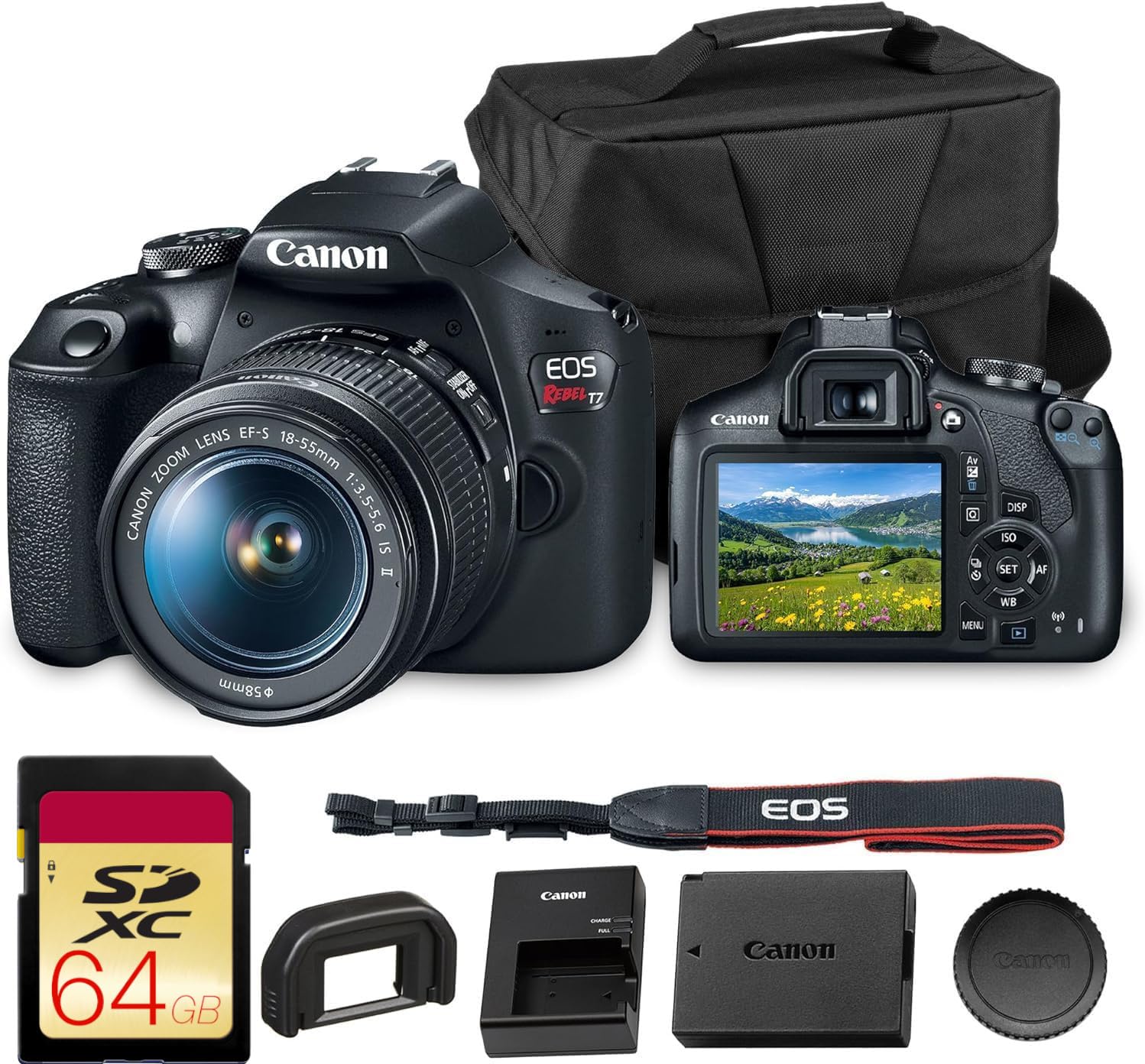
This Rebel T7 bundle includes the camera body with 18-55mm lens, a shoulder bag, and a 64GB memory card — everything a beginner needs to start recording without separate accessory purchases. The 24.1MP APS-C CMOS sensor and DIGIC 4+ processor deliver Full HD 1080/30p video with Canon’s characteristic color science. The 9-point AF system with center cross-type point works well for stationary subjects in good light.
Built-in Wi-Fi and NFC enable wireless transfers to a smartphone via the Canon Camera Connect app, and the EOS Webcam Utility turns the camera into a plug-and-play webcam for livestreaming. The included LP-E10 battery provides extended shooting sessions for day trips and events. The 3-inch 920k-dot LCD is sharp enough for menu navigation and basic playback review.
Video autofocus relies on contrast detection in live view, which struggles with continuous tracking and racks focus slowly. The 3fps burst rate is too slow for capturing fast action sequences. There is no 4K recording capability, limiting future-proofing as display resolutions increase. The bag included is adequate for basic protection but lacks padding for heavy gear. For the lowest total investment into the Canon ecosystem, this is the cleanest path.
Why it’s great
- Lowest entry price to Canon DSLR system
- Wi-Fi for quick smartphone uploads
- Webcam utility for streaming
- 64GB card and bag included in package
Good to know
- Contrast-detect AF hunts in video
- No 4K — Full HD only
- 3fps burst too slow for action
- Bundle bag is basic
FAQ
Does a higher megapixel sensor mean better video quality?
Why do some cameras overheat during 4K recording?
Final Thoughts: The Verdict
For most creators, the best digital camera for video overall is the Sony FX30 because it combines professional codecs, dual base ISO, and reliable autofocus in a compact body that doesn’t overheat. If you want maximum grading flexibility at a lower price, grab the Blackmagic Pocket Cinema 4K. And for handheld vlogging with the best autofocus in its class, nothing beats the Sony ZV-E10.

Mo Maruf
I created WellFizz to bridge the gap between vague wellness advice and actionable solutions. My mission is simple: to decode the research and give you practical tools you can actually use.
Beyond the data, I am a passionate traveler. I believe that stepping away from the screen to explore new environments is essential for mental clarity and physical vitality.