Our readers keep the lights on and my smoothie glass nicely filled. As an Amazon Associate, I earn from qualifying purchases.
The camera you choose as a professional isn’t just equipment—it’s your primary revenue-generating tool. Every shutter press, autofocus acquisition, and file type matters when a client’s brief is on the line. The gap between bodies isn’t megapixels on paper; it’s how the sensor handles shadow recovery in a backlit portrait, how many frames you can rattle off before the buffer chokes, and whether the ergonomics let you shoot for eight hours without your hand cramping. This guide isolates the bodies that earn their keep.
I’m Mohammad Maruf — the founder and writer behind WellFizz. After spending over sixty hours analyzing technical datasheets, cross-referencing real-world user feedback across Nikon, Canon, Sony, Panasonic, and Fujifilm systems, and mapping each camera’s strengths to specific professional workflows, I’ve built a definitive resource to cut through the marketing noise. This is not a beginner’s shopping list; it’s a tool-selection matrix for working shooters.
Whether you shoot weddings under unpredictable lighting, chase wildlife at 10 frames per second, or demand medium-format resolution for commercial prints, this guide to the best digital camera for professionals evaluates sensor readout speed, AF point coverage, video codec depth, and real-world battery endurance to match the right body to your income stream.
How To Choose The Best Digital Camera For Professionals
Selecting a professional camera demands understanding how sensor size, autofocus architecture, and file output intersect with your specific genre. A wedding photographer’s priorities differ sharply from a commercial studio shooter’s. This section breaks down the critical variables so you can match spec sheets to real-world demands.
Sensor Size and Resolution Strategy
Full-frame sensors (35.6×23.8mm) dominate professional work for their dynamic range and low-light performance. APS-C sensors, like the one in the Nikon D500, offer an effective 1.5x crop factor that extends telephoto reach—ideal for wildlife and sports where you need extra reach without buying longer glass. Medium format sensors, found in the Fujifilm GFX100S II, deliver 102MP of resolving power for commercial reproduction but sacrifice continuous shooting speed and high-ISO performance. Your choice should hinge on whether you need shallow depth-of-field separation (full-frame), reach and speed (APS-C), or ultimate detail (medium format).
Autofocus Coverage and Subject Detection
Professional shooters can no longer rely solely on cross-type phase-detect points. Modern mirrorless systems like the Sony a7 IV and Canon EOS R6 Mark II use deep-learning algorithms to track human eyes, animal faces, and even vehicle types. The number of AF points (693 on the a7 III, 153 on the Nikon D500) matters less than the classification engine behind them. If you shoot unpredictable subjects—children at a wedding, birds in flight, athletes during a game—prioritize bodies with dedicated AI-based subject detection and 3D tracking.
Video Capabilities and Codec Depth
Hybrid shooters need more than resolution. The Nikon Z 8 and Panasonic LUMIX S5II offer 10-bit 4:2:2 internal recording, Log profiles (N-Log, V-Log), and support for external RAW recording. Frame rates up to 4K 120p provide slow-motion flexibility, while 8K capture allows cropping in post without resolution loss. Check for overheating reports: the Canon EOS R5 suffered early concerns, though firmware updates improved endurance. If video is your primary output, prioritize body with active cooling fans (Panasonic S5II) or stacked sensors (Nikon Z 8) that dissipate heat efficiently.
Buffer Depth, Card Slots, and Media Format
Nothing kills a shoot faster than a locked buffer. The Nikon D500 can sustain 200 consecutive RAW frames at 10 fps, while the Sony a7 III manages approximately 89 compressed RAW shots. Dual card slots are non-negotiable for paid work—the Nikon D7200, Canon EOS R6 Mark II, and Sony a7 IV all offer two slots for instant backup. Media type also matters: CFexpress Type B cards (required by the Nikon Z 8) deliver faster transfer speeds but cost significantly more than UHS-II SD cards. If you work tethered in a studio, check USB transfer speeds—the Canon EOS R6 Mark II supports 10 Gbps USB-C for rapid file offload.
Quick Comparison
On smaller screens, swipe sideways to see the full table.
| Model | Category | Best For | Key Spec | Amazon |
|---|---|---|---|---|
| Sony a7 III | Full-Frame Mirrorless | All-around full-frame hybrid | 693 phase-detection AF points | Amazon |
| Nikon Z 8 | Full-Frame Mirrorless | High-res hybrid stills/video | 8K/60p internal N-RAW | Amazon |
| Canon EOS R5 | Full-Frame Mirrorless | High-res stills + 8K video | 45MP stacked BSI CMOS sensor | Amazon |
| Sony a7 IV | Full-Frame Mirrorless | Hybrid stills/video pro | 33MP Exmor R sensor + BIONZ XR | Amazon |
| Nikon D850 | Full-Frame DSLR | High-resolution studio/landscape | 45.7MP BSI sensor, 9 fps | Amazon |
| Canon EOS R6 Mark II | Full-Frame Mirrorless | Action/event hybrid | 40 fps electronic shutter | Amazon |
| Panasonic LUMIX S5II | Full-Frame Mirrorless | Video-centric hybrid | Phase Hybrid AF + Active I.S. | Amazon |
| Nikon D500 | APS-C DSLR | Sports/wildlife action | 153-point AF, 10 fps, 200-frame buffer | Amazon |
| Panasonic LUMIX S1RII | Full-Frame Mirrorless | High-res stills + 8K video | 44.3MP sensor, AFC 40 burst | Amazon |
| Fujifilm GFX100S II | Medium Format Mirrorless | Commercial/studio reproduction | 102MP CMOS II sensor | Amazon |
| Nikon D7500 | APS-C DSLR | Mid-range enthusiast upgrade | 51-point AF, 8 fps, 4K video | Amazon |
| Nikon D7200 | APS-C DSLR | Value dual-slot DSLR | 24.2MP sensor, 51-point AF | Amazon |
| Nikon COOLPIX P950 | Bridge Camera | Super-telephoto reach | 83x optical zoom (2000mm) | Amazon |
In‑Depth Reviews
1. Sony a7 III Full-Frame Mirrorless Camera with 28-70mm Lens

The Sony a7 III remains a benchmark for professional full-frame work because it delivers a 24.2MP back-illuminated sensor with 15 stops of dynamic range at a price point that undercuts premium flagships. The 693 phase-detection AF points cover 93 percent of the frame, and the real-time Eye AF for humans and animals reliably locks onto subjects even in dim reception lighting. The 10 fps continuous shooting with AE/AF tracking keeps up with unpredictable movement, while the 14-bit uncompressed RAW output preserves highlight and shadow data for aggressive post-production.
Video shooters benefit from full-pixel readout 4K recording without pixel binning, plus S-Log2 and S-Log3 gamma profiles that squeeze out significant dynamic range for color grading. The 28-70mm f/3.5-5.6 kit lens is functional for initial testing but lacks the constant aperture serious work demands—budget for a 24-70mm f/2.8 or prime set. The NP-FZ100 battery is rated for approximately 710 shots per charge, which easily covers a full wedding day without swapping.
Autofocus via the MC-11 adapter works with Canon EF and Sigma glass, though aperture control can introduce a slight delay on older lenses. The menu system is notoriously layered, but the custom button mapping and My Menu tab can be configured to bypass the complexity. For hybrid shooters who need one body that nails stills and video equally, this is the rational choice.
Why it’s great
- Exceptional AF coverage with 693 hybrid points and real-time tracking
- Incredible battery life for a mirrorless body
- Full-frame 4K video with Log profiles and excellent low-light performance
Good to know
- Kit lens is mediocre for professional use
- Menu navigation requires time to master
- No 4K 60p recording at full frame
2. Nikon Z 8 Professional Full-Frame Mirrorless Camera

The Nikon Z 8 packs the same 45.7MP stacked CMOS sensor and EXPEED 7 processing engine found in the flagship Z9 into a smaller, lighter body that mirrorless D850 users will immediately recognize. The autofocus system uses deep-learning algorithms to detect and track people, dogs, cats, birds, cars, bikes, motorcycles, trains, and planes with blackout-free 3D tracking down to -9 EV. This level of subject detection means you can frame a bird in flight and trust the camera to maintain focus across the entire burst.
Internal 8K/60p recording in 12-bit N-RAW or ProRes RAW, plus 4K/120p, makes the Z 8 a genuine hybrid competitor for filmmakers. The dual card slot accepts one CFexpress Type B and one SD UHS-II card—a useful bridge during the media transition. The 20 fps RAW and 30 fps JPEG burst rates capture fast action without buffer interruption, though you will chew through cards at this speed. Heat management is solid for most shooting conditions, but extended 8K recording in hot weather can trigger thermal limits.
Nikon mount users benefit from backward compatibility with F-mount lenses via the FTZ II adapter, though native Z glass optimizes autofocus speed and sharpness. The artificial shutter sound and sensor shield protect the sensor during lens changes. Expect a steep learning curve with the complex menu system: the viewfinder/monitor/histogram interaction requires dedicated study. For photographers ready to adopt Nikon’s mirrorless ecosystem, this body offers Z9 performance at a lower weight.
Why it’s great
- Stacked 45.7MP sensor with Z9-level autofocus and subject detection
- Internal 8K/60p N-RAW and ProRes RAW recording
- Fast 20 fps RAW burst with deep buffer
Good to know
- CFexpress Type B cards are expensive
- Complex configuration with a steep learning curve
- Power hungry battery, especially in video mode
3. Canon EOS R5 Mirrorless Camera Body Only

The Canon EOS R5 delivers 45 megapixels from a back-side illuminated stacked CMOS sensor that renders extraordinary detail and dynamic range without an optical low-pass filter. The DIGIC X processor drives Dual Pixel CMOS AF with 1,053 points covering approximately 100 percent of the frame—subject detection for people, animals, and vehicles is instantaneous and tenacious. The Eye Control AF feature, which lets you select focus by simply looking through the viewfinder, is genuinely useful once calibrated to your vision.
Mechanical shutter continuous shooting at 12 fps with full AF tracking stops action cleanly, while the electronic shutter pushes to 20 fps. The 5-stop in-body image stabilization (IBIS) works with RF lenses and adapted EF glass via the drop-in filter mount adapter, making handheld low-light shooting viable at unusually slow shutter speeds. The 3.2-inch vari-angle touchscreen and large, bright EVF with 5.76 million dots compose comfortably in harsh sunlight.
Video capabilities remain aggressive: 8K RAW internal recording, 4K up to 120 fps, and 10-bit 4:2:2 output via HDMI. Overheating concerns were widespread at launch, but firmware updates improved endurance; for stills shooters, heat has never been an issue. The EOS R5 is a superb choice for commercial, wedding, and studio photographers who also produce high-resolution video content.
Why it’s great
- 45MP stacked BSI sensor with stunning detail and dynamic range
- Fast, intelligent Dual Pixel AF with 100% frame coverage
- 8K internal recording and 4K/120p for hybrid workflows
Good to know
- Extended 8K video can trigger thermal limits in hot conditions
- Battery life is merely average for a mirrorless body
- Requires premium RF or adapted EF glass to realize full resolution
4. Sony Alpha 7 IV Full-Frame Mirrorless Camera

The Sony Alpha 7 IV refines the hybrid formula by pairing a 33MP Exmor R back-illuminated CMOS sensor with the BIONZ XR processing engine, which delivers eight times the processing power of the previous generation. This translates to snappier menu response, faster image playback, and more reliable real-time Eye AF tracking for both humans and animals. The 4K 30p footage from 7K oversampling yields noticeably sharper results than the a7 III, and 4K 60p (with a 1.5x crop) is a welcome addition for slow-motion work.
Build quality is a clear step up from earlier a7 bodies: the grip is deeper, the buttons are more tactile, and the weather sealing feels confidence-inspiring in misty or dusty environments. The dual card slot configuration (CFexpress Type A/SD UHS-II in Slot 1, SD UHS-II in Slot 2) provides professional redundancy, but CFexpress Type A cards are less common and more expensive than SD alternatives. The S-Cinetone color profile, inherited from the FX cinema line, produces pleasing skin tones straight out of camera for video.
Battery life exceeds 2,000 shots per charge in real-world use, which is remarkable for a compact mirrorless body and eclipses most competitors. The flip-out vari-angle screen is useful for vlogging and overhead shots, though the 3.69-million-dot EVF lacks the refresh rate found on higher-end models like the R5 or Z 8. For photographers stepping up from APS-C or older full-frame models, the a7 IV offers a balanced blend of resolution, speed, and color science at a mid-range investment.
Why it’s great
- Excellent 33MP sensor with oversampled 4K video from 7K readout
- Outstanding battery life (2000+ shots)
- Dual card slots and improved weather sealing
Good to know
- 4K/60p is cropped to Super 35mm
- CFexpress Type A cards are less common
- EVF refresh rate is lower than premium competitors
5. Nikon D850 FX-Format DSLR Camera Body

The Nikon D850 remains the definitive high-resolution DSLR for studio and landscape professionals who prefer an optical viewfinder. Its 45.7MP back-side illuminated full-frame sensor produces images with exceptional dynamic range, no optical low-pass filter, and negligible moiré risk—a trifecta that made it the reference camera for commercial reprography. The 153-point autofocus system with 99 cross-type sensors tracks subjects reliably, and the 9 fps continuous shooting (with the optional battery grip) is fast enough for most action work.
The tilting touchscreen, illuminated buttons, and deep handgrip improve ergonomics during long tethered sessions. Focus shift shooting enables automated focus stacking for macro and product photography, a feature that saves significant post-production time. The XQD slot is fast but media is expensive, and the single XQD slot (with a second SD slot) means you cannot shoot redundant backup at the highest burst rate unless you use the faster card exclusively.
Video autofocus is the D850’s weakest area—contrast-detect in live view is noticeably slower than its mirrorless competitors. The Expeed 5 processor can produce beautiful 4K from the full sensor width, but the lack of phase-detect on-sensor makes video AF a chore for run-and-gun shoots. Battery performance is excellent, easily exceeding 1,800 shots per charge. For photographers demanding the last great DSLR before the mirrorless transition, the D850 delivers a resolution and build quality that still commands respect.
Why it’s great
- 45.7MP BSI sensor with outstanding dynamic range and no OLPF
- Focus shift stacking for macro/product shots
- Robust build with excellent weather sealing and ergonomics
Good to know
- Video autofocus is slow in live view
- XQD cards are fast but expensive
- Heavy body compared to mirrorless alternatives
6. Canon EOS R6 Mark II Mirrorless Camera Body

The Canon EOS R6 Mark II prioritizes speed and autofocus intelligence over raw resolution, making it a specialist for sports, wildlife, and event photographers. The 24.2MP full-frame CMOS sensor paired with the DIGIC X processor delivers 40 fps electronic shutter capture with full AF/AE tracking—a frame rate that previously required dedicated sports cameras. The Dual Pixel CMOS AF II identifies people, animals, vehicles, horses, trains, and aircraft automatically through deep learning, so you never need to switch subject detection modes manually.
In-body image stabilization provides up to 8 stops of correction, which transforms slow shutter handheld work and steady video. The 6K oversampled 4K 60p video is clean and detailed, while the 4K 120p high-frame-rate option enables smooth slow motion. The 3.0-inch vari-angle touchscreen with 1.62 million dots is bright and responsive, and the 0.5-inch OLED EVF with 3.69 million dots and 120 fps refresh rate keeps up with fast panning movements without lag.
Battery life is excellent for a mirrorless body, and the single SD UHS-II slot is a limitation for professionals who need instant backup—you will want to carry multiple cards. The weather-sealed magnesium alloy body feels rugged enough for unpredictable outdoor shoots. The R6 Mark II’s 24.2MP resolution is generous enough for magazine reproduction and large prints, though commercial shooters requiring 45MP+ should look to the R5. For photographers whose income depends on nailing the decisive moment at high speed, this Canon body is the practical choice.
Why it’s great
- 40 fps electronic shutter with full autofocus tracking
- Excellent subject detection across multiple categories
- Strong IBIS and 6K oversampled 4K video quality
Good to know
- Single SD card slot—no backup during critical work
- 24.2MP may not satisfy high-resolution commercial clients
- No built-in flash
7. Panasonic LUMIX S5II Mirrorless Camera with 20-60mm Lens
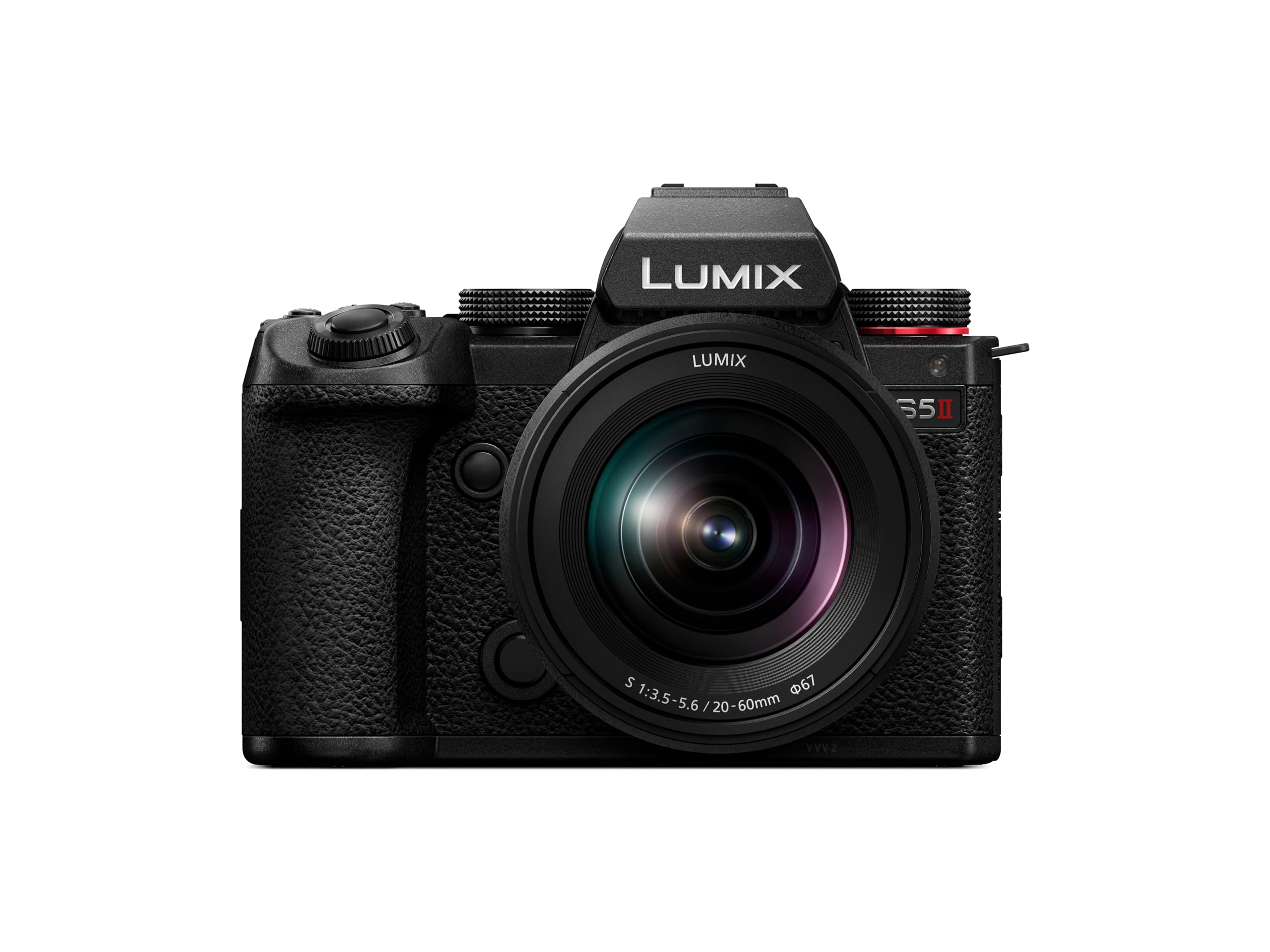
The Panasonic LUMIX S5II represents a turning point for the brand by introducing Phase Hybrid Autofocus, eliminating the contrast-detect wobble that plagued previous LUMIX bodies. The 24.2MP full-frame CMOS sensor with the new phase-detect engine delivers reliable subject tracking for video and stills, though it still lags slightly behind Sony and Canon in low-light acquisition. The internal heat dispersion fan allows unlimited 4:2:2 10-bit recording—a crucial advantage for interview and event videographers who cannot risk a thermal shutdown mid-shoot.
Active Image Stabilization dramatically improves handheld gimbal-free walking shots, making the S5II competitive with the Sony a7S III for run-and-gun documentary work. The 14+ stop V-Log/V-Gamut capture provides a wide dynamic range for color grading, and the REAL TIME LUT function applies custom LUTs in-camera for instant client-ready footage. The 20-60mm f/3.5-5.6 kit lens is a useful wide-to-standard zoom but feels slow for low-light event work.
The L-Mount alliance (Panasonic, Leica, Sigma, Blackmagic) opens access to affordable Sigma Art primes and compact Leica optics, though the ecosystem is smaller than Sony E or Nikon Z. Battery life is merely adequate—consider the battery grip for full-day shoots. The square body shape can catch on clothing and the rubber port covers feel fragile. For video-first professionals who need reliable internal recording without overheating, the S5II is a compelling mid-range hybrid.
Why it’s great
- Unlimited 10-bit recording with internal fan cooling
- Effective Phase Hybrid AF finally competitive with rivals
- Active I.S. for smooth walking shots without a gimbal
Good to know
- Battery life is below average
- Kit lens is slow for low light
- L-Mount lens library is smaller than Sony or Nikon
8. Nikon D500 DX-Format Digital SLR (Body Only)

The Nikon D500 is the crop-sensor action specialist that borrowed the Multi-CAM 20K autofocus module from the flagship D5, giving it 153 AF points with 99 cross-type sensors—a system that locks onto fast-moving wildlife and athletes with tenacious accuracy. The 20.9MP DX-format CMOS sensor and EXPEED 5 processor can sustain 200 consecutive RAW frames at 10 fps, meaning you can hold the shutter and capture an entire race segment without the buffer locking up. The native ISO range extends to 51,200, expandable to 1,640,000, delivering usable noise performance up to ISO 8,000 for dawn and dusk action.
The 180K-pixel RGB sensor enables precise metering and Group Area AF for tracking erratic subjects through cluttered backgrounds. The tilting 3.2-inch touchscreen with 2,539k dots is sharp and responsive, and the magnesium alloy body is weather-sealed against dust and moisture. The dual card slots accept one XQD and one SD UHS-II, though the XQD media cost is worth it for the massive buffer performance. Built-in Wi-Fi, Bluetooth, and SnapBridge provide basic wireless connectivity, though the app experience is inconsistent.
The D500’s main trade-off is sensor resolution: 20.9MP is sufficient for magazine and web reproduction, but commercial clients requiring 45MP+ for large prints will need a full-frame or medium format system. The 1.5x crop factor is actually an advantage for wildlife and sports, giving extra telephoto reach without buying longer lenses. The D500 remains a peak DSLR for field action—if your primary work involves moving subjects at distance, this is the body to consider before the mirrorless transition.
Why it’s great
- D5-derived 153-point AF with phenomenal tracking
- Massive 200-frame RAW buffer at 10 fps
- 1.5x crop factor benefits telephoto reach for action work
Good to know
- 20.9MP resolution is low for high-end commercial reproduction
- XQD card slot requires expensive media
- SnapBridge wireless app is finicky
9. Panasonic LUMIX S1RII Full-Frame Mirrorless Camera

The Panasonic LUMIX S1RII introduces a 44.3MP full-frame sensor with LUMIX’s first-ever internal 8K video recording, bringing high-resolution stills and video into a single body. The Phase Hybrid AF with advanced AI technology maintains precise tracking even when multiple people intersect in the frame—a genuine advantage for documentary and event work where subjects cross paths unpredictably. The AFC 40 burst shooting mode allows high-speed capture without sacrificing the sensor’s resolving power, making it viable for wildlife and sports.
The handheld high-resolution mode composites multiple exposures to produce even larger files for commercial reproduction, and the wide dynamic range Log recording preserves shadow and highlight detail. The Active Image Stabilization combined with the new LUMIX Camera Flow app streamlines production workflow, and the heat dissipation design supports extended 8K recording sessions. The Leica L-mount compatibility offers access to Sigma and Leica glass, though the lens selection remains thin compared to Canon RF and Sony E systems.
Early user reports indicate overheating during sustained 8K video mode—some units shut down within two minutes—though this may be a batch-specific defect. The battery life is modest, and the body design’s square edges can feel less ergonomic over long handheld sessions. For shooters who need the combination of medium-resolution stills and 8K video output, the S1RII is a forward-looking option, but waiting for reliability fixes is advisable.
Why it’s great
- 44.3MP stills and internal 8K video in one body
- AI-enhanced phase AF tracks multiple intersecting subjects
- Active I.S. supports handheld video work
Good to know
- Overheating reported during extended 8K recording
- Battery life is below average
- L-mount lens library is limited
10. Fujifilm GFX100S II Mirrorless Medium Format Camera Body

The Fujifilm GFX100S II puts a 102MP medium-format sensor into a body weighing only 883 grams—lighter than many full-frame DSLRs. The 43.8×32.9mm sensor delivers approximately 1.7x the surface area of 35mm full frame, producing tonality, depth transitions, and micro-detail that full-frame sensors cannot match without pixel-shift composite modes. The X-Processor 5 enables AI-assisted subject tracking down to -5.5 EV and 8 stops of in-body image stabilization, making handheld medium-format shooting practical for the first time in the format’s history.
This camera is not designed for speed: continuous shooting is modest, and the mechanical shutter and contrast-detect zones make it unsuitable for action, wildlife, or sports. The Fujifilm G mount (GFX) supports a library of high-quality GF lenses, but the system lacks the telephoto reach and fast aperture options available for full-frame mount ecosystems. The 5.76-million-dot EVF is crisp, and the 4K/30p video output with 4:2:2 10-bit recording is competent for commercial video work, though not class-leading.
The GFX100S II excels in controlled environments: studio portraits, architectural reproduction, landscape work, and fine art reproduction where every pixel of resolution contributes to the final output. The 102MP files are massive—expect to upgrade your storage and processing hardware. For commercial photographers who regularly produce 80-inch prints or work in the luxury goods sector, the sensor’s resolving power offers a tangible advantage that no full-frame body can match.
Why it’s great
- 102MP medium-format sensor with exceptional detail and tonality
- Surprisingly lightweight body for the format
- 8-stop IBIS makes handheld medium-format viable
Good to know
- Slow autofocus and burst rate—not for action
- Massive files require significant storage and processing power
- Limited telephoto and fast aperture lenses
11. Nikon D7500 DSLR with AF-S DX 18-140mm VR Lens

The Nikon D7500 inherits the 20.9MP sensor, EXPEED 5 processor, 51-point AF system with 15 cross-type sensors, and metering module from the higher-end D500, bringing advanced capabilities to a mid-range body. The 8 fps continuous shooting with Group Area AF is capable for youth sports and active family events, and the 3.2-inch tilting touchscreen makes low-angle composition straightforward. The 18-140mm f/3.5-5.6 VR kit lens provides a versatile walk-around range equivalent to 27-210mm in full-frame terms.
The D7500 records 4K UHD video at 30 fps with stereo sound and power aperture control, though it lacks the phase-detect video AF of mirrorless rivals. The battery life is excellent—Nikon DSLRs have always led this metric—and the weather-resistant build allows shooting in light rain without concern. The single SD UHS-I slot is a downgrade from the D7200’s dual slots, a curious omission that limits professional backup workflows.
For photographers stepping up from entry-level DSLRs, the D7500 represents a significant jump in autofocus performance and build quality without the price premium of the D500 or D850. The 18-140mm lens is a competent all-rounder for travel and general event work but softens at the long end. The lack of dual card slots and the older F-mount (requiring an adapter for Z-mount lenses) mean this body is best viewed as a transitional tool for shooters not yet ready for mirrorless.
Why it’s great
- Strong autofocus system inherited from the D500
- Versatile 18-140mm kit lens for everyday shooting
- Excellent battery life
Good to know
- Single SD card slot limits backup options
- Kit lens quality diminishes at telephoto end
- F-mount is a legacy system
12. Nikon D7200 DX-Format DSLR Body

The Nikon D7200 offers a compelling value proposition with its 24.2MP DX-format CMOS sensor and no optical low-pass filter, delivering sharpness that surpasses many newer entry-level DSLRs. The 51-point AF system with 15 cross-type sensors provides reliable focus for general photography, and the 6 fps continuous shooting is adequate for portrait sessions and moderate action. The dual SD card slots provide instant backup—a feature notably missing from the newer D7500.
Built-in Wi-Fi and Near Field Communication enable basic wireless image transfer, though the app interface is dated and slow. The EXPEED 4 processor produces clean images up to ISO 3200, and the 1/8000 second maximum shutter speed is useful for wide-aperture outdoor portraits. The camera accepts Nikon’s full range of F-mount lenses and AI-S manual focus lenses, expanding creative options on a budget.
The D7200 is not a hybrid camera—video recording is limited to 1080p at 60 fps, and the contrast-detect autofocus during live view hunts noticeably. The buttons and switches are prone to accidental activation, and the body lacks the weather sealing of the D500 or D850. For photographers who prioritize still image quality, dual card redundancy, and access to a vast lens library over video or speed, the D7200 remains a sensible entry point into professional Nikon DX work.
Why it’s great
- Dual SD card slots for professional backup
- Sharp 24.2MP sensor with no OLPF
- Broad F-mount lens compatibility
Good to know
- No 4K video and slow live-view AF
- Accidental button presses are common
- Build quality lacks weather sealing
13. Nikon COOLPIX P950 Superzoom Digital Camera

The Nikon COOLPIX P950 is not a professional camera in the traditional sense, but its 83x optical zoom (24-2000mm equivalent) fills a specific niche for wildlife and moon photography at a fraction of the cost of a super-telephoto lens and body. The 16MP sensor is small and the f/2.8-6.5 aperture limits depth of field and low-light performance, but the optical image stabilization is remarkably effective at full zoom, allowing handheld captures at 2000mm that would be impossible with a large-sensor ILC without a tripod.
Built-in Bird and Moon modes simplify capture of common nature subjects, and 4K UHD video records with the same telephoto reach. The auto-focus is contrast-detect and can struggle with birds against busy backgrounds, but the manual focus wheel on the lens barrel provides quick correction. The rotating LCD screen facilitates low-angle shooting, and the electronic viewfinder works adequately in bright light. RAW format support enables post-processing flexibility limited only by the small sensor’s dynamic range.
The P950’s limitations are real: the small sensor produces noisy images above ISO 800, the macro mode disappoints despite a 1cm minimum focus, and the autofocus is not reliable for fast action like bees in flight. This is not a general-purpose professional body—it is a specialist tool that solves one problem (extreme reach without extreme cost) better than anything else. For digiscoping, bird identification documentation, or moon photography on a budget, the P950 delivers reach you cannot match at any comparable investment.
Why it’s great
- Unmatched 83x optical zoom (24-2000mm) in one lens
- Effective image stabilization for handheld telephoto work
- Dedicated Bird and Moon modes for quick setup
Good to know
- Small 16MP sensor struggles above ISO 800
- Autofocus is slow and unreliable for fast action
- Macro performance is poor despite 1cm claim
FAQ
Should I buy a DSLR or mirrorless for professional work in 2025?
How many megapixels do I actually need for professional work?
Is a full-frame sensor always better than APS-C for professionals?
What memory card type should I choose for a professional mirrorless camera?
Final Thoughts: The Verdict
For most users, the best digital camera for professionals winner is the Sony a7 III because it delivers full-frame hybrid performance with exceptional autofocus coverage, 15-stop dynamic range, and industry-leading battery life at a price that leaves room for premium glass. If you need 45.7MP resolution with internal 8K/60p and Z9-level autofocus, grab the Nikon Z 8. And for studio and commercial work requiring 102MP medium-format detail that no full-frame body can match, nothing beats the Fujifilm GFX100S II.

Mo Maruf
I created WellFizz to bridge the gap between vague wellness advice and actionable solutions. My mission is simple: to decode the research and give you practical tools you can actually use.
Beyond the data, I am a passionate traveler. I believe that stepping away from the screen to explore new environments is essential for mental clarity and physical vitality.