Our readers keep the lights on and my smoothie glass nicely filled. As an Amazon Associate, I earn from qualifying purchases.
The moment you hit record on a camcorder, the story is already being written in pixels and motion. But for many, that story gets ruined by shaky hands, poor low-light capture, or audio that sounds like it was recorded in a wind tunnel. Choosing the right digital camcorder means navigating sensor sizes, stabilization types, and frame rate options that can make or break your final video.
I’m Mohammad Maruf — the founder and writer behind WellFizz. I’ve spent countless hours analyzing the specifications, real-world trade-offs, and build quality of modern digital camcorders to help you avoid expensive mistakes and find the tool that actually fits your shooting style.
Whether you’re documenting a family trip, starting a YouTube channel, or filming an event, finding the best digital camcorder means matching sensor resolution and stabilization to your specific needs without paying for features you’ll never use.
How To Choose The Best Digital Camcorder
Picking the right camcorder is about matching sensor technology, stabilization method, and zoom range to your real-world shooting environment. A camera that shines in a studio can look terrible at a sunny outdoor event, and a pocket camcorder built for run-and-gun vlogging lacks the lens range needed for wildlife or sports.
Sensor Size and Low-Light Performance
Larger sensors collect more light, which directly reduces grain and noise when shooting indoors or at dusk. A 1-inch CMOS sensor found in premium pocket camcorders dramatically outperforms the 1/2.3-inch sensors common in entry-level models. If you frequently film in living rooms, restaurants, or evening settings, prioritize sensor size over sheer resolution.
Stabilization Type: Optical vs. Electronic vs. Gimbal
Optical image stabilization uses moving lens elements to counteract hand shake without cropping the image. Electronic stabilization crops the frame and can introduce warping. A 3-axis gimbal stabilizer physically moves the camera head to keep footage smooth regardless of your movement. For walking shots or active filming, a gimbal-equipped camcorder delivers the smoothest video with no quality loss.
Optical Zoom vs. Digital Zoom
Optical zoom uses the lens to magnify the scene before the light hits the sensor, preserving full resolution at maximum zoom. Digital zoom simply crops and enlarges the image, quickly turning sharp footage into a pixelated mess. A 20x optical zoom lens is a powerful tool for weddings, sports, and wildlife, while 18x digital zoom should be treated as a preview feature rather than a primary shooting tool.
Quick Comparison
On smaller screens, swipe sideways to see the full table.
| Model | Category | Best For | Key Spec | Amazon |
|---|---|---|---|---|
| Canon VIXIA HF G70 (Pkg) | Premium Pro | Events & Sports | 20x Optical Zoom | Amazon |
| Canon VIXIA HF G70 (Body) | Premium Pro | Livestreaming & Interviews | UVC Livestreaming | Amazon |
| Xtra Muse Pocket Gimbal | Mid-Range | Active Vlogging | 1-inch CMOS Sensor | Amazon |
| ORDRO M5 | Mid-Range | Travel & Hiking | 3-Axis Gimbal Stabilizer | Amazon |
| OPRKQEE 6K Camcorder | Budget | Beginner Vlogging | 4500mAh Battery | Amazon |
| ABJURNJ 6K Camcorder | Budget | School Projects | 270° Rotatable Screen | Amazon |
| Canon VIXIA HF R600 (Renewed) | Budget | Classroom Use | 57x Advanced Zoom | Amazon |
In‑Depth Reviews
1. Canon VIXIA HF G70 (Package Bundle)
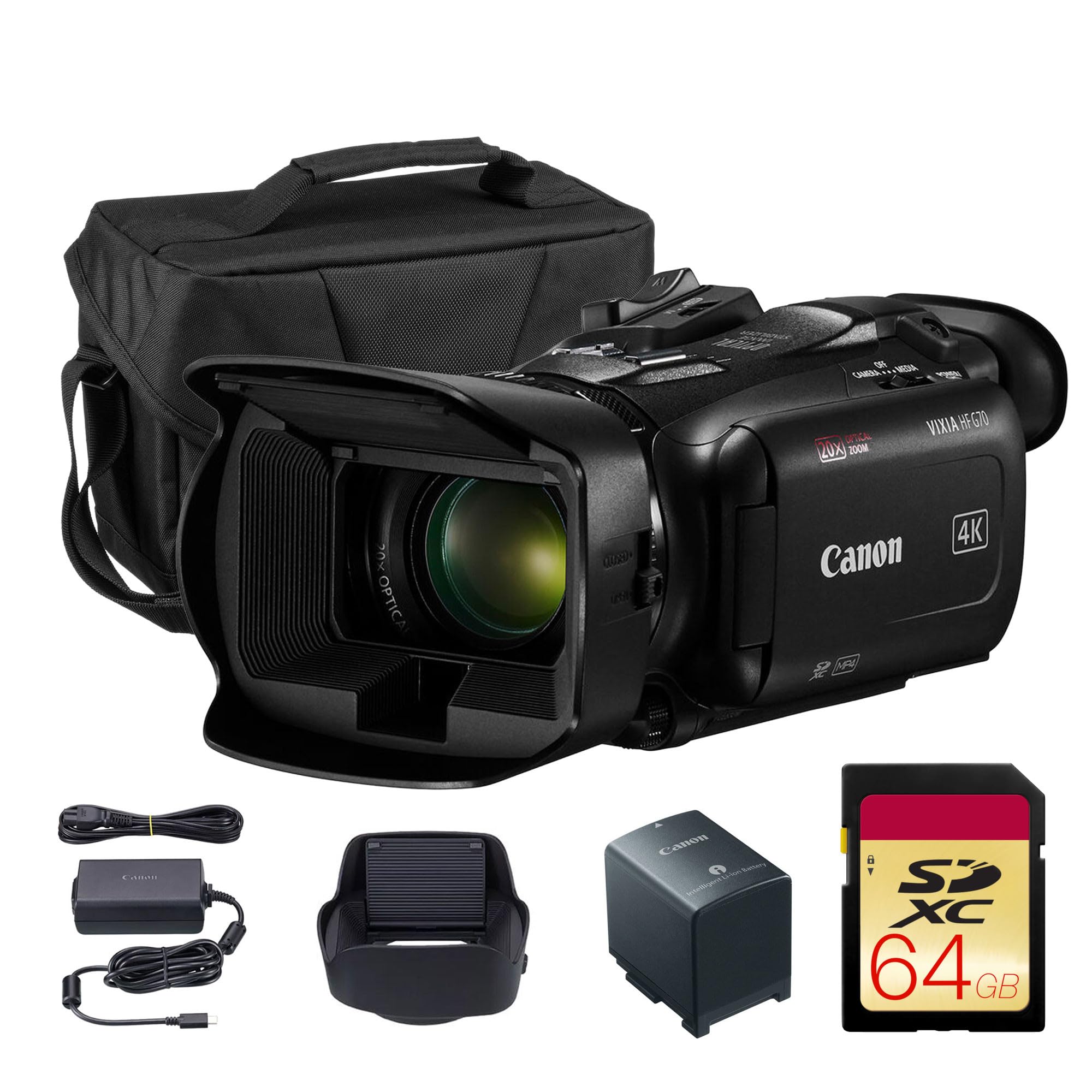
The Canon VIXIA HF G70 is the benchmark for serious event filming and sports coverage. Its 20x optical zoom lens lets you stay far from the action while maintaining crystal-clear 4K detail, and the 1/2.3-inch CMOS sensor combined with the DIGIC DV 6 processor delivers reliable autofocus with face detection. The dual SD card slots allow relay recording during long ceremonies or backup redundancy for critical shoots.
This specific bundle adds a shoulder bag and a 64GB memory card, making it a ready-to-go package for documentary, nature, or school sports filming. The touchscreen interface is intuitive, and the manual control ring gives experienced shooters precise focus and zoom adjustments without diving into menus. At this tier, you’re getting professional build quality and a lens that can zoom into a far sideline without losing sharpness.
The package version adds genuine value with included accessories, but the base camera is the same pro-level 4K camcorder. One reviewer noted a significant startup delay of seven to eight seconds, which can cause missed shots in fast-moving scenarios. It is also a larger camcorder compared to pocket options, so it requires a proper bag or strap for transport.
Why it’s great
- 20x optical zoom delivers sharp, loss-free magnification
- Dual SD card slots for relay or backup recording
- UVC livestreaming for direct HD streaming to a computer
Good to know
- Up to 8-second startup delay can cause missed shots
- Image stabilization is decent but not gimbal-smooth
- Larger form factor requires a bag for travel
2. Canon VIXIA HF G70 (Body Only)

This is the same core Canon VIXIA HF G70 camcorder as the bundle version, sold without the bag and extra SD card. The camera’s standout feature for content creators and live streamers is the UVC livestreaming capability, which lets you connect directly to a PC or Mac via USB for high-definition streaming without a capture card. The 20x optical zoom and DIGIC DV 6 processor remain identical, providing the same sharp 4K capture and responsive autofocus with face detection.
The 3.5-inch touchscreen is bright and responsive, making menu navigation fast even in direct sunlight. An 8-blade aperture produces pleasing out-of-focus highlights for a more cinematic look. For interview setups, classroom recordings, or house-of-worship streams, this camcorder offers plug-and-play simplicity combined with Canon’s reliable lens ecosystem.
The key limitation is that livestreaming output through both HDMI and USB is capped at 1080p, not 4K. One reviewer also reported that low-light performance degrades noticeably above 4 dB of gain, producing soft footage at higher ISO equivalents. If you primarily shoot in well-lit controlled environments, this is a non-issue, but for dim weddings or evening events, consider a model with a larger sensor.
Why it’s great
- Built-in UVC livestreaming eliminates need for a capture card
- 20x optical zoom with reliable face-detection autofocus
- 8-blade aperture for smoother background blur
Good to know
- Livestream output is 1080p, not 4K
- Low-light quality suffers past moderate gain
- No standby mode means a few seconds to start recording
3. Xtra Muse Vlogging Camera

The Xtra Muse packs a 1-inch CMOS sensor into a pocket-sized body with a built-in 3-axis gimbal stabilizer, making it a direct alternative to premium action cameras and gimbal setups. The 4K/120fps capture allows silky slow-motion playback, and the fast autofocus with face and object tracking keeps moving subjects sharp without manual intervention. For a vlogger filming while walking, this is the smoothest handheld footage you can get without post-production stabilization.
The 2-inch touchscreen is compact but responsive, and the camera supports true 10-bit X-Log color for advanced color grading. Switching between horizontal and vertical orientation is straightforward, making it suitable for both YouTube and TikTok creators who shoot in both formats. The included carrying bag, wrist strap, and handle with a standard 1/4-inch thread mean you can mount it on a tripod or mini stand immediately.
Battery life runs around two hours of continuous recording, which is typical for such a compact device but may be short for all-day event coverage. Users report that DJI Pocket 3 accessories often fit the Xtra Muse, but official wireless microphones may not auto-connect. The small screen can be tricky for precise framing in bright sunlight, but for active, run-and-gun shooting, its portability and stabilization are unmatched at this tier.
Why it’s great
- 1-inch CMOS sensor delivers excellent low-light performance
- Built-in 3-axis gimbal produces gimbal-smooth handheld footage
- 4K/120fps allows meaningful slow-motion capture
Good to know
- Battery lasts about 2 hours of continuous recording
- Small screen can be hard to see in direct sunlight
- Wireless mic compatibility varies
4. ORDRO M5 Handheld Camera
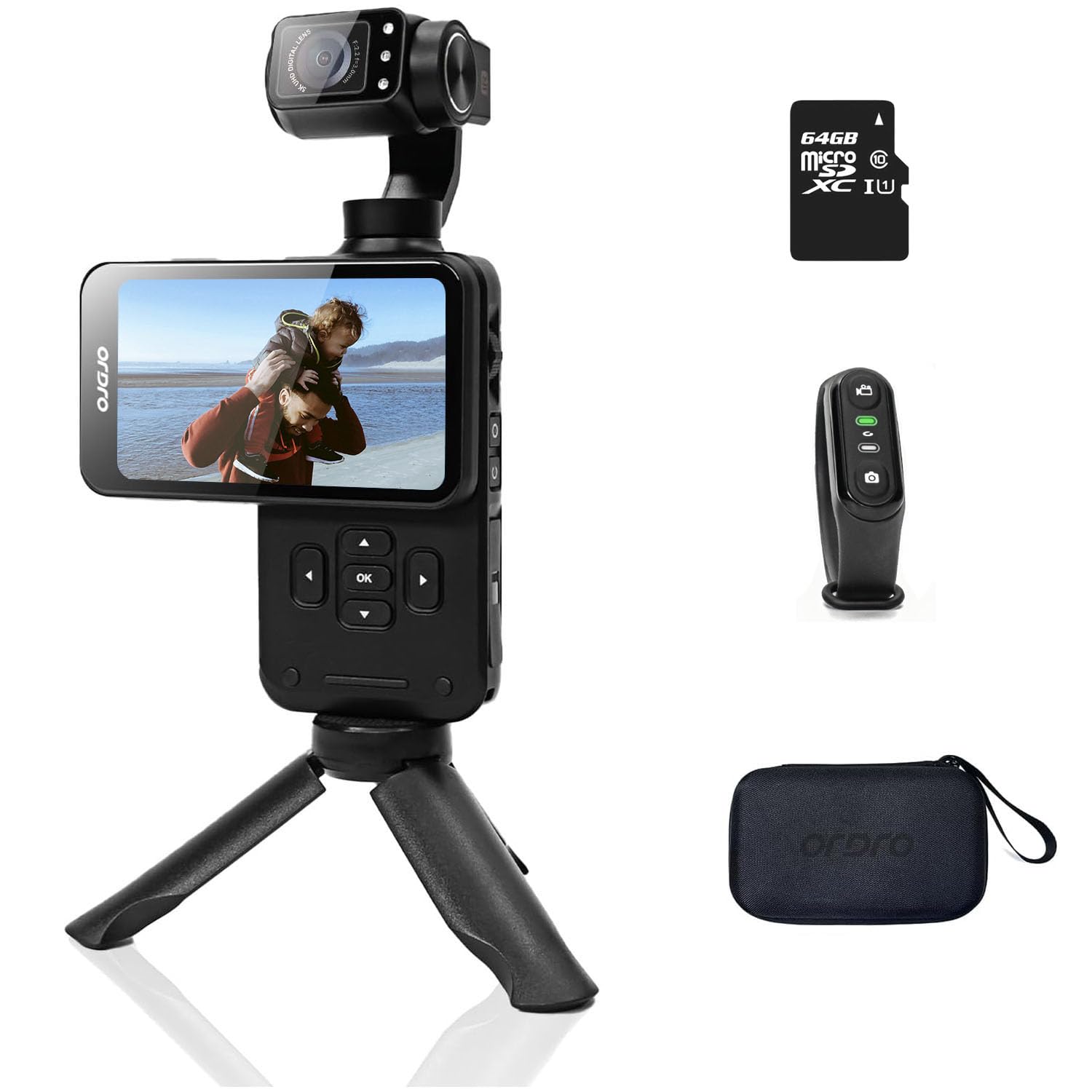
The ORDRO M5 is a compact 5K camcorder with a built-in 3-axis gimbal, designed for travelers and hikers who want gimbal-smooth video without the bulk of a full-sized rig. Its 1/2.5-inch CMOS sensor captures 5K at 30fps and 4K at 60fps, with a 120-degree wide viewing angle that is ideal for landscape shots and group vlogs. The 180-degree rotating lens allows seamless switching between forward-facing and selfie mode without moving the camera body.
The 3.5-inch HD IPS touchscreen is larger than most pocket camcorders, making menu navigation and live preview comfortable even for people with larger hands. The included remote control, mini stand, 64GB memory card, and camera bag mean you can start shooting right away. Face tracking and WDR (wide dynamic range) help maintain exposure balance in high-contrast scenes, like filming a person standing in front of a bright window.
The gimbal stabilization works well for smooth walking shots, though one reviewer noted it is not perfectly smooth during rapid movement. The built-in microphone picks up handling noise, so the external mic slot becomes essential for clean audio. Its small form factor means it can slip into a jacket pocket, but battery life is modest for a full day of shooting, so carrying a portable USB charger is advisable.
Why it’s great
- Built-in 3-axis gimbal for smooth handheld footage
- 120-degree wide-angle lens great for group vlogs
- Compact size fits in a jacket pocket
Good to know
- Internal microphone picks up handling noise
- Gimbal performance degrades with rapid motion
- Battery life is limited for all-day trips
5. OPRKQEE 6K Camcorder

The OPRKQEE 6K Camcorder targets beginners who want a feature-packed starter camera without a high entry barrier. It records at advertised 6K (5760x3240p) at 30fps, and the 64MP photo mode provides high-resolution stills. The 4.0-inch touchscreen is large and responsive, making it easy to navigate settings even for users unfamiliar with camcorder menus. The IR night vision mode captures black-and-white video in almost complete darkness, which is useful for wildlife or home security monitoring.
The included 4500mAh battery is a standout feature in this tier, providing up to 4.5 hours of recording time in 6K mode. This means you can shoot an entire school play or family gathering on a single charge. The package also includes a handheld stabilizer, an external microphone, a 2.4G remote control, and a 64GB SD card, giving you everything needed for a basic vlogging kit. The WiFi connectivity via the “Hello Cam” app allows remote control and file transfer to your phone.
The 18X digital zoom is the primary quality compromise — it degrades image sharpness significantly at maximum reach, as is typical for digital rather than optical zoom. The fixed-focus design means no true autofocus tracking, so moving subjects require you to stay within the depth-of-field zone. This camcorder is best suited for static interviews, desk tutorials, or tripod-based event recording where zoom is used sparingly.
Why it’s great
- 4500mAh battery delivers up to 4.5 hours of recording
- Large 4.0-inch touchscreen for easy navigation
- Full accessory kit includes mic, stabilizer, and remote
Good to know
- 18X digital zoom loses sharpness at full reach
- Fixed focus limits tracking of moving subjects
- Advertised 6K resolution is interpolated, not native
6. ABJURNJ 6K Camcorder

The ABJURNJ 6K Camcorder shares a similar feature set to the OPRKQEE model but distinguishes itself with a 270-degree rotatable HD screen, which gives you more flexibility for overhead or low-angle shots. It also records at 6K (5760x3240p) at 30fps and 4K at 60fps, delivering usable video for social media and classroom projects. The 18X digital zoom is identical in quality to the OPRKQEE, meaning it is best used sparingly and within the moderate range.
The included handheld stabilizer and external microphone address the two most common complaints about budget camcorders: shaky footage and muffled audio. The 4500mAh battery provides similar all-day endurance, and the WiFi app control via the same “Hello Cam” ecosystem allows wireless file transfers. The 2.4G remote works from up to 65 feet away, which is helpful for group shots or solo creators who want to start and stop recording without walking back to the camera.
Like the OPRKQEE, this camcorder lacks optical image stabilization, so the handheld stabilizer is your primary tool for smooth footage. The webcam mode works via USB, making it a dual-purpose device for remote meetings and online teaching. Users report that the video quality is sharp in good light, but grain appears quickly as lighting drops, especially above ISO 800. This is a solid entry-level choice for bright, controlled environments.
Why it’s great
- 270-degree rotatable screen for creative angles
- Full accessory kit with stabilizer and external mic
- Long battery life supports extended recording sessions
Good to know
- Digital zoom degrades image quality at high magnification
- Low-light performance is limited without good ambient light
- No optical image stabilization relies on the included stabilizer
7. Canon VIXIA HF R600 (Renewed)

The Canon VIXIA HF R600 is a renewed (refurbished) camcorder that focuses on one thing that budget camcorders typically lack: genuine 57x advanced zoom. This is an optical zoom, meaning you can zoom in on a stage performer from the back row of an auditorium and still get sharp 1080p footage. The 3-inch touchscreen is responsive, and the camera includes both a microphone jack and a headphone jack, which are rare in this price tier and essential for audio monitoring.
For a student enrolled in a video production class or a parent filming school plays, the HF R600 provides the zoom reach and manual control that phone cameras simply cannot match. The image stabilization helps reduce shake at full zoom, though it is not gimbal-smooth. The HD 1080p resolution is adequate for most viewing platforms, and the file sizes are manageable for editing on older computers.
This is a renewed unit, so cosmetic condition varies — some buyers report scratches or signs of use. It does not include a battery or memory card, so factor those into your total cost. The screen can be hard to see in bright outdoor conditions, and the build is lightweight plastic that will not survive a drop. If you need long optical zoom and professional audio ports on a tight budget, the HF R600 is a functional choice, but treat it as a used tool with typical wear.
Why it’s great
- 57x optical zoom is unmatched at this tier
- Includes microphone and headphone jacks for audio control
- 1080p HD recording with manageable file sizes
Good to know
- Renewed unit may show cosmetic wear
- Screen is dim in direct sunlight
- Battery and memory card are not included
FAQ
Can I use a digital camcorder as a webcam for streaming?
Why does my camcorder footage look grainy indoors?
What is the advantage of optical zoom over digital zoom?
Final Thoughts: The Verdict
For most users, the best digital camcorder winner is the Canon VIXIA HF G70 package because it combines 20x optical zoom, dual SD card slots, and professional autofocus in a bundle that is ready for events and sports. If you want a pocket-sized gimbal camera for active vlogging, grab the Xtra Muse. And for budget-conscious beginners who need an all-day battery and a full accessory kit, the OPRKQEE 6K Camcorder is the best entry-level value.

Mo Maruf
I created WellFizz to bridge the gap between vague wellness advice and actionable solutions. My mission is simple: to decode the research and give you practical tools you can actually use.
Beyond the data, I am a passionate traveler. I believe that stepping away from the screen to explore new environments is essential for mental clarity and physical vitality.