Our readers keep the lights on and my smoothie glass nicely filled. As an Amazon Associate, I earn from qualifying purchases.
Nothing kills a campfire evening faster than a TV screen frozen on a loading wheel the moment your favorite show starts. RV park coaxial hookups are unreliable at best, and many boondocking spots offer zero infrastructure for live television. The fix involves swapping that cracked dome or flimsy indoor leaf for an antenna engineered to pull over-the-air broadcasts while rolling down the highway.
I’m Mohammad Maruf — the founder and writer behind WellFizz. I’ve spent hundreds of hours combing through signal-range claims, amplifier specs, mounting hardware, and user reception reports to separate the antennas that deliver real HD channels on the road from those that promise the world but deliver static.
Whether you camp full-time or take weekend trips, choosing the right signal-grabber matters. This guide breaks down five proven models to help you find the best digital antenna for rv use — from budget-friendly refreshes to premium omnidirectional rigs.
How To Choose The Best Digital Antenna For RV
Your RV moves between different signal environments — open desert, dense forests, mountain valleys — so an antenna that works in one spot may fail ten miles down the road. Focus on the design factors that affect real-world reception rather than bold range numbers printed on the box.
Omnidirectional vs. Directional vs. Motorized
A fixed omnidirectional antenna picks up signals from all directions without adjustment. That convenience matters when you park in a new spot each night and don’t want to climb onto the roof. Directional antennas (like traditional outdoor Yagis) concentrate on one tower direction, pulling weaker stations but requiring manual aiming after every move. Motorized rotators combine the best of both — you aim remotely while staying inside. For RVs that rarely stay put, an omnidirectional or motorized model saves the most frustration.
Amplifier Quality and 4G LTE Filtering
A good amplifier boosts weak signals without adding noise, but a cheap one can amplify interference from cell towers, causing pixelation or dropped channels. Models with a dedicated 4G LTE filter clean out that mobile-band noise, which is critical when you camp near urban areas or highway corridors with heavy phone traffic. Check whether the amplifier is powered by USB or a wall plug — USB-powered units are easier to integrate into an RV’s 12V system.
Mounting Type and Roof Compatibility
RV roofs are not standard house roofs. Some antennas bolt into an existing hole left by an old dome unit, while others require a flat surface with clearance for a mast or wing. Wing-style antennas (low-profile, aerodynamic) reduce wind drag and fit under storage covers better than traditional dishes. If your RV already has a coax outlet on the roof, look for a replacement that uses the same footprint to avoid drilling new holes.
Cable Length and Signal Loss
Long cable runs from the roof to your TV bleed signal strength, especially with RG59 coax. A quality RG6 cable with pre-attached connectors minimizes loss. Many antennas include 30-40 feet of coax in the box, but check whether that length is enough to reach your RV’s entertainment center without a splice. Extension cables introduce another potential point of signal degradation.
Quick Comparison
On smaller screens, swipe sideways to see the full table.
| Model | Category | Best For | Key Spec | Amazon |
|---|---|---|---|---|
| Magnadyne TV-1W | Premium Wing | Full-time RV living | 24-inch wing style | Amazon |
| PBD WA-2608 | Motorized | Remote aiming from inside | 360° remote rotation | Amazon |
| 1byone 6-501NA004 | Omnidirectional | Minimal setup, no aiming | 360° omni-reception | Amazon |
| GE 29884 | Mid-Range | Budget-minded RVers | 70-mile range | Amazon |
| Yirkais Indoor/Outdoor | Entry-Level | Quick no-tool setup | Compact flat design | Amazon |
In‑Depth Reviews
1. Magnadyne TV-1W

The Magnadyne TV-1W uses a low-profile wing design that replaces old dome antennas on almost any RV roof without drilling new holes. At 24 inches wide, the aerodynamic shape creates less wind resistance than a dome, and the pre-assembled connectors (Motorola for AM/FM and F-connector for TV) cut installation time significantly. The integrated 4G LTE filter keeps cell tower interference from washing out your local broadcast channels, a common problem when camped near highways or towns.
Real-world reception tests from owners show strong pulls between 30 and 40 miles from transmitters, even in wooded surroundings. The built-in distribution plate offers dual TV outputs plus a selectable shore cable input, so you can toggle between over-the-air and campground cable without swapping cables. That flexibility is a genuine time-saver when you roll into a new park each evening.
Users who damaged their original roof antenna on a low-hanging branch reported this as an exact replacement that restored full channel counts without any extra parts. The white color blends well with most RV roofs, and the included wall plate gives a finished look inside. If you want one antenna that handles TV, AM, and FM while staying low enough to fit under a storage cover, this is the unit.
Why it’s great
- Exact replacement for many OEM RV antennas — no new holes needed
- Built-in 4G LTE filter prevents cell signal interference
- Dual TV outputs plus AM/FM in one compact wing
Good to know
- Not a screw-on upgrade if your RV has no existing roof plate
- Range is solid but not the longest among premium outdoor antennas
2. PBD WA-2608

The PBD WA-2608 is a motorized directional antenna with a wireless remote that rotates the head 360 degrees. This is ideal for RVers who park in spots where the strongest broadcast tower is behind the rig or blocked by a hill. Instead of climbing onto the roof to reposition a manual antenna, you simply press a button on the remote until the picture clears. The built-in amplifier supports a claimed range of about 150 miles, and the 40-foot RG6 cable is long enough to reach a mid-coach entertainment center without a splice.
Owners who installed this in attics and on RV roofs report channel counts jumping from under 30 to over 80 in suburban zones. The weatherproof housing handles rain and wind well, though the mounting bolts are steel and may snap if over-tightened — pre-drilling the mounting holes is a smart precaution. The dual TV outputs let you feed a bedroom screen and the main living area simultaneously without a separate splitter.
User feedback highlights the responsive customer support team, which provides detailed channel maps for your specific coordinates. The antenna is also ATSC 3.0 (NextGen TV) ready, meaning it can decode the newer broadcast standard when it arrives in your area. If you park in varied terrain and don’t want to guess the tower direction, the motorized aiming solves that problem elegantly.
Why it’s great
- Motorized rotation lets you aim from inside the RV
- 40-foot RG6 cable included with dual TV outputs
- ATSC 3.0 compatible for future broadcast upgrades
Good to know
- Mounting bolts can snap if over-tightened — pre-drill to be safe
- Added mechanical complexity vs. a fixed omni antenna
3. 1byone 6-501NA004

The 1byone 6-501NA004 delivers true omnidirectional reception, pulling UHF and VHF signals from all directions without any remote control or manual aiming. This makes it a strong candidate for RVers who move daily and don’t want to adjust anything after parking. The built-in Smart Pass pre-amplifier boosts signal right at the antenna, compensating for losses through the 32-foot RG6 coax cable, and the 4G LTE filter removes interference from nearby cell towers.
Users report pulling between 50 and 60 channels in metropolitan areas when mounted on a window or exterior wall. The compact white body measures just under 12 inches square with a low height, so it fits neatly on an RV roof without looking oversized. The moisture-proof and flame-retardant construction holds up well in rain, though a few owners noted that the seam can let water in over extended outdoor exposure — attic mounting is a workaround that preserves performance.
Installation is genuinely tool-free: the antenna mounts with included hardware, and the single TV output connects directly to your set-top box or RV TV. Because there is no rotator or motor, there are fewer mechanical failure points, which matters when you’re bouncing down washboard gravel roads. If you prefer a plug-and-play solution that works the moment you park, this 360-degree model removes the guesswork.
Why it’s great
- Truly omnidirectional — no aiming needed after each move
- Pre-amplifier with 4G filter boosts weak signals cleanly
- Tool-free setup with weather-resistant materials
Good to know
- Seam may require sealing if mounted fully exposed outdoors long-term
- Output is one TV only — add a splitter for a second screen
4. GE 29884
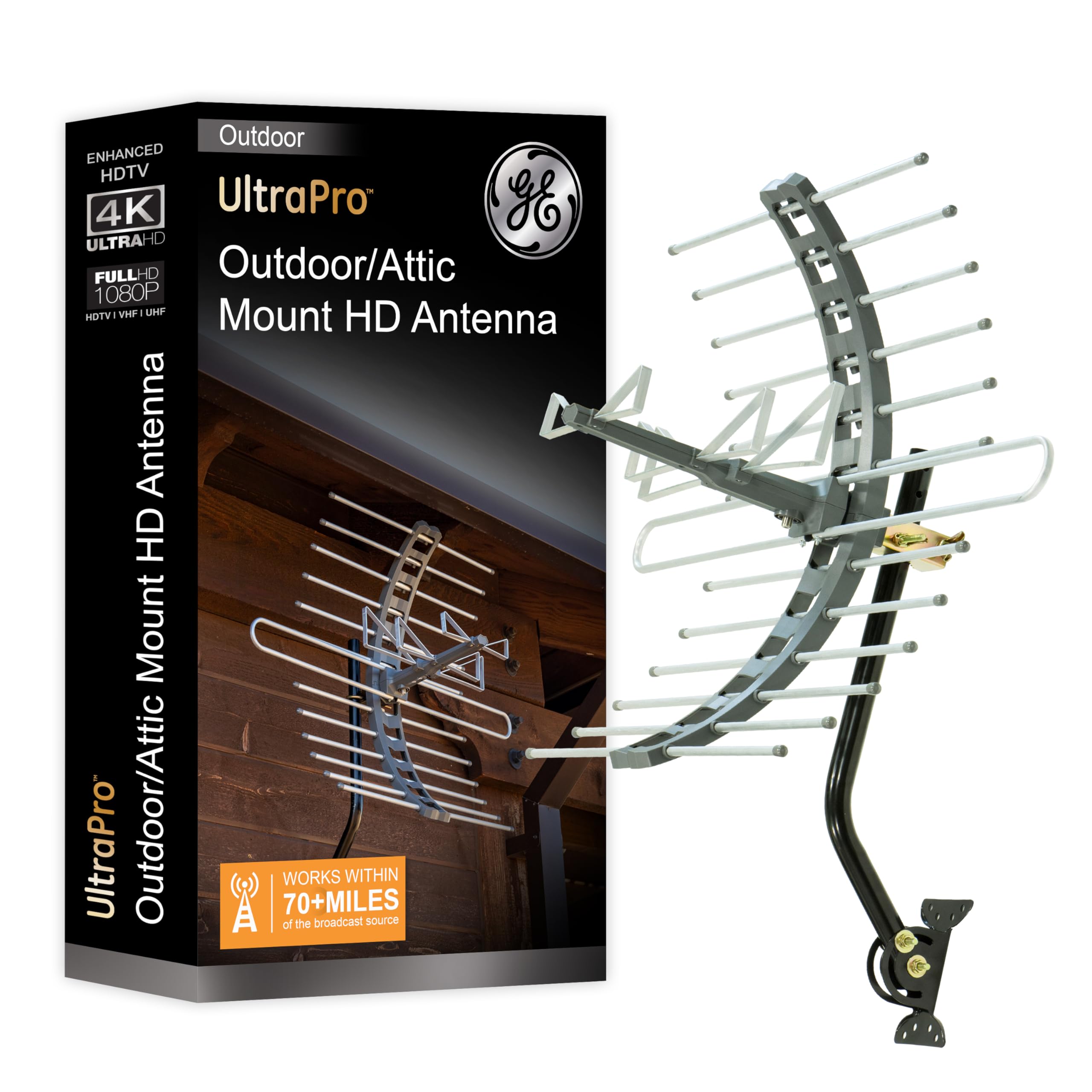
The GE 29884 is a traditional Yagi-style outdoor antenna with a 70-mile range rating and a J-mount included in the box. At a budget-friendly price, it delivers reliable reception for RVers who don’t mind installing a directional antenna once they reach their campsite. The aluminum elements lock together with a quarter-turn mechanism, so assembly takes about 15 minutes, though the printed instructions are sparse — most users turn to YouTube for mounting guidance.
Real-world performance is strong: owners report picking up 38 to 106 channels depending on terrain, with clear HD signals even 60 miles from the broadcast towers. The antenna weighs only three pounds, making it light enough to mount on a temporary tripod or a roof bracket without overloading the RV structure. Using RG6 cable instead of RG59 is critical for maintaining signal quality over longer runs, and the antenna’s 75-ohm impedance matches standard coaxial equipment.
Some users note that the plastic housing feels less durable than metal alternatives for permanent outdoor exposure, especially in high winds or hail. Attic or under-eave mounting solves the durability concern while preserving reception quality. If you park in a single location for extended stays and want maximum channel count without spending on a motorized system, this traditional Yagi delivers exceptional value per channel.
Why it’s great
- Excellent price-to-channel-count ratio for stationary camping
- Light three-pound build with included J-mount
- Works well with an amplifier for fringe reception past 60 miles
Good to know
- Directional — must be re-aimed after every move
- Plastic housing more prone to UV and wind wear than metal
5. Yirkais Indoor/Outdoor

The Yirkais indoor/outdoor digital antenna packs a 2026-upgraded amplifier chip into a flat, unobtrusive panel that fits on a window, wall, or desk. For RVers who want a quick way to grab local channels without any roof work, this is the simplest route. The 360-degree reception pattern means you don’t need to point it at a specific tower, and the USB-powered amplifier keeps the setup compatible with your RV’s 12V outlets.
User reviews highlight the five-minute setup: plug the coaxial cable into your TV’s ANT IN port, power the amplifier via USB, and run a channel scan. Owners in wooded or rural areas report clear HD pictures with no lag, pulling dozens of free local channels including ABC, CBS, NBC, PBS, and Fox. The thin profile makes it easy to store when not in use, and the black color blends into most RV interiors without looking intrusive.
While the flat panel cannot match the raw gain of a large outdoor Yagi or a wing-style roof antenna, it performs surprisingly well for its size when placed near a window. The claimed 5000+ mile range is unrealistic marketing (no terrestrial TV antenna can pull that), but within 30-40 miles of a broadcast tower, the signal stability is impressive for the price. If you need a backup antenna or want to test OTA reception without committing to a roof install, this is a low-commitment option.
Why it’s great
- Ultra-simple USB-powered setup with no roof work
- Compact flat design easy to pack and store
- Decent channel count in suburban and wooded zones
Good to know
- Claimed range is exaggerated — real-world best within 40 miles
- Flat panel cannot match the gain of a large directional antenna
FAQ
Can I use a regular house TV antenna on my RV?
Do I need an amplifier for my RV antenna?
How do I know which broadcast channels are available at my campsite?
Will a digital antenna work while I am driving?
Final Thoughts: The Verdict
For most users, the best digital antenna for rv is the Magnadyne TV-1W because it combines a low-profile wing design, integrated 4G LTE filtering, and AM/FM support in a package that replaces your OEM antenna without drilling new holes. If you want motorized aiming to chase distant towers from inside the rig, grab the PBD WA-2608. And for a truly tool-free no-aim setup, nothing beats the 1byone 6-501NA004.

Mo Maruf
I created WellFizz to bridge the gap between vague wellness advice and actionable solutions. My mission is simple: to decode the research and give you practical tools you can actually use.
Beyond the data, I am a passionate traveler. I believe that stepping away from the screen to explore new environments is essential for mental clarity and physical vitality.