Our readers keep the lights on and my smoothie glass nicely filled. As an Amazon Associate, I earn from qualifying purchases.
Living in a rural area shouldn’t mean accepting grainy TV or a monthly cable ransom. The right antenna transforms distant broadcast towers into a steady stream of free HD channels, but the key is finding a unit that can punch through miles of open terrain, tree lines, and weather. Most consumer antennas advertise city-friendly ranges; the real test happens when your nearest transmitter is 50 miles away over a ridge.
I’m Mohammad Maruf — the founder and writer behind WellFizz. I’ve spent hundreds of hours analyzing signal reception specs, amplifier gain ratings, and customer range reports to find the antennas that actually deliver where the grid thins out.
This guide cuts through the marketing to help you find the true best digital antenna for rural areas that will keep your household connected to local news, sports, and prime time without a single pixelated frame.
How To Choose The Best Digital Antenna For Rural Areas
Picking the right antenna for a low-density environment is different from a suburban purchase. You need to prioritize raw signal capture over cosmetic features, and understand the physics of terrestrial broadcast reception. The wrong choice means hours of fiddling with rotation and still missing your local NBC affiliate.
Range vs. Real-World Terrain
Manufacturer mile ratings are measured in perfect line-of-sight conditions. In rural settings, trees, hills, and buildings eat into that number fast. Look for antennas with at least a 65-mile advertised range, and add a quality preamplifier if you live in a valley or behind heavy foliage. The spec to watch is the antenna’s gain in dBi — higher gain means better focus on distant towers.
Directional vs. Multi-Directional Design
Directional Yagi antennas concentrate on one direction, maximizing range and signal strength from towers in that path. If all your broadcast towers lie in the same general direction, this is the superior choice for rural use. Multi-directional or motorized antennas offer flexibility if towers surround your property, but they typically sacrifice some gain and are more prone to interference. For deep rural, a strong directional antenna often outperforms a weaker multi-directional one.
Amplification and Filters
A built-in or external amplifier boosts weak signals, but it can also overload your tuner if a signal is already strong. More importantly, integrated LTE/4G/5G filtering prevents cell tower interference from overwhelming the UHF band — a common problem in areas with spotty cell coverage. Premium antennas like the Televes line include automatic gain control that adjusts amplification dynamically, which is a game-changer in fluctuating conditions.
Quick Comparison
On smaller screens, swipe sideways to see the full table.
| Model | Category | Best For | Key Spec | Amazon |
|---|---|---|---|---|
| Winegard HD8200A | Premium | Extreme rural & deep fringe | 65+ mile range, Full VHF & UHF | Amazon |
| Televes DiNova Boss Mix | Premium | Smart filtering & attic mount | 60 mile range, Auto gain control | Amazon |
| Five Star 200 Mile (Directional) | Mid-Range | High gain on a single tower cluster | 200 mile range, 11dB VHF gain | Amazon |
| Five Star 200 Mile (Rotating) | Mid-Range | Multiple directions, budget conscious | 200 mile range, 360° rotation | Amazon |
| PBD Motorized 150 Mile | Value | Motorized rotation on a budget | 150 mile range, Dual TV outputs | Amazon |
| GE 80 Mile Yagi | Entry-Level | Short-to-mid rural with clear line-of-sight | 80 mile range, ATSC 3.0 ready | Amazon |
In‑Depth Reviews
1. Winegard HD8200A
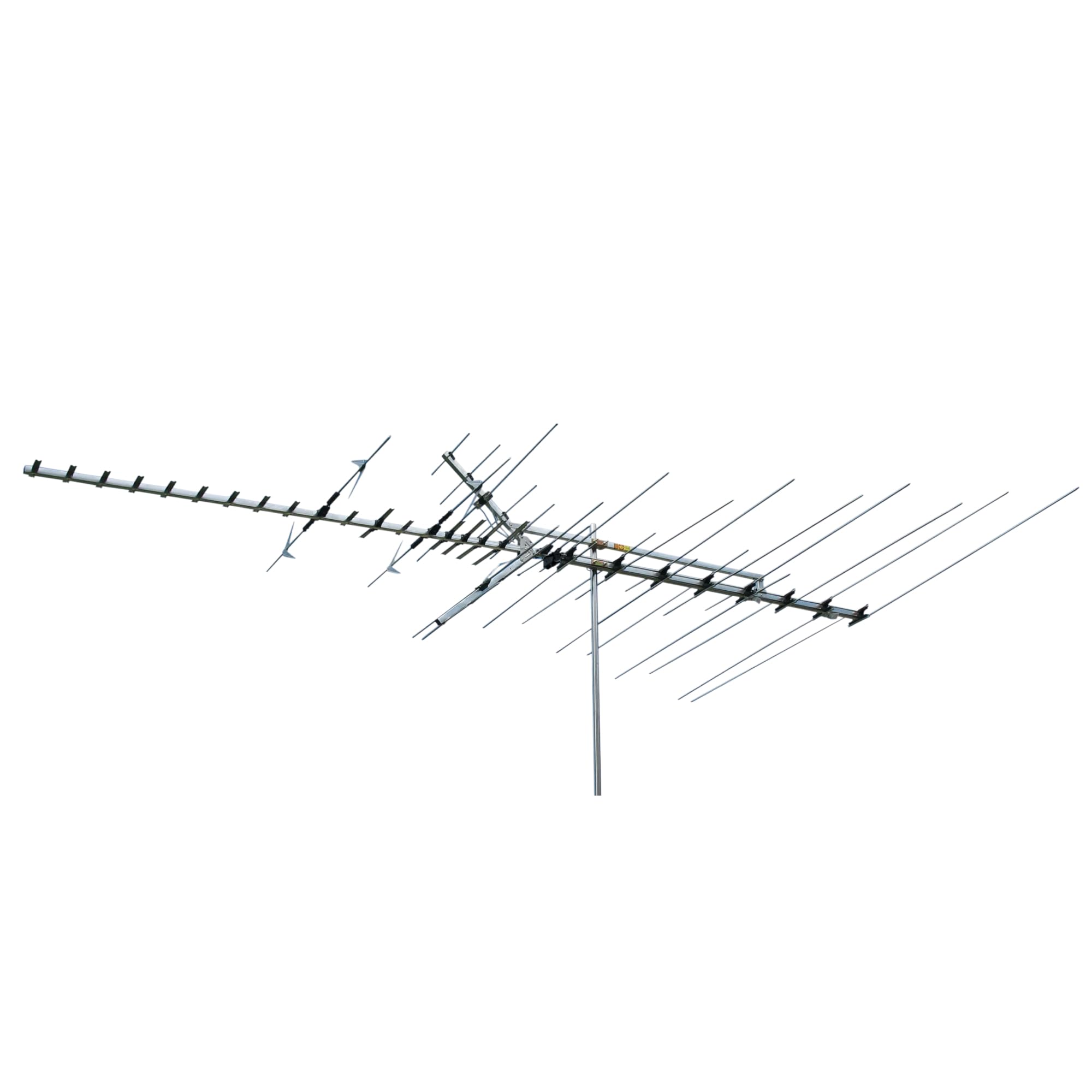
The Winegard HD8200A is built like a piece of broadcast infrastructure. Its zinc-plated steel frame, paired with a full VHF-High, VHF-Low, and UHF element array, makes it the most capable antenna here for deep fringe reception. Buyers in wooded rural settings report pulling 30+ channels where budget antennas managed only three to fourteen, and its robust construction survives harsh winters without signal degradation from moisture ingress. The Yagi design is directional, so precise aiming is required, but the reward is a clean signal lock on distant towers.
Setup requires two people due to the antenna’s size and weight, but the assembly is straightforward for anyone comfortable on a roof. The 65-mile rating is conservative — real-world reports show solid performance out to 60 miles with 50+ channels, and even 80 miles on some VHF stations with a clear line-of-sight. The limited 90-day warranty is short for this price tier, but the build quality suggests it will outlast that period many times over.
This antenna’s lack of built-in amplification is actually a strength: it allows you to pair it with a high-quality preamplifier tuned to your specific conditions, avoiding the overload issues common with integrated amps. It is ATSC 3.0 ready, so it handles NextGen TV broadcasts as they roll out. For the rural buyer who wants a single, permanent install with no compromises, the Winegard HD8200A is the undisputed workhorse.
Why it’s great
- Full VHF-Low coverage alongside UHF, rare in this category
- Zinc-plated steel resists rust and weather damage better than aluminum
- Real-world 60+ mile reception with excellent signal stability
Good to know
- Large and heavy, requires two-person installation
- No preamplifier included, must purchase separately
- Short 90-day warranty period
2. Televes DiNova Boss Mix 144286

The Televes DiNova Boss Mix represents a different philosophy: intelligent signal processing instead of brute-force element count. Its TForce intelligent gain control automatically adjusts amplification per band (29 dBi on High VHF, 34 dBi on UHF) to prevent both weak reception and overload. This is particularly valuable in rural areas where signals fluctuate due to weather or seasonal foliage changes. The integrated FM, LTE, 4G, and 5G filtering keeps cell tower interference from corrupting your UHF channels — a real headache in areas with spotty but present cellular infrastructure.
At roughly 31 inches long with a sleek white radome, this antenna is far less obtrusive than the Winegard and requires no assembly beyond mounting. It’s equally at home in an attic or outdoors, and the passive failover mode means it still passes signals if the power to the amplifier is cut. Users in hilly rural locations report gaining 20 additional channels compared to lesser antennas, and the low profile meets HOA aesthetic requirements without sacrificing performance. Its 60-mile range is realistic with the built-in amp, and it can push farther with an external booster in fringe zones.
One minor limitation is its focus on High VHF and UHF; it does not cover Low VHF channels (channels 2-6), which are rarely used today but still present in some areas. The price is a step up from many consumer amps, but the build quality — made in Spain with a robust ABS housing — justifies it. For the rural buyer who wants a maintenance-free, self-regulating antenna with superior interference rejection, the Televes DiNova is the smartest pick.
Why it’s great
- Automatic gain control prevents signal overload or dropout
- Integrated LTE/4G/5G filter cleans up UHF reception near cell towers
- No assembly required, compact and weather-resistant design
Good to know
- Does not receive low VHF (channels 2-6)
- Premium price point compared to simpler Yagi antennas
- Mounting fasteners not included
3. Five Star Outdoor HDTV Antenna (Directional)

The Five Star directional model is a classic large-aperture Yagi that prioritizes raw signal capture over convenience. Its extended element length and 11 dB VHF gain make it particularly effective for VHF-High channels, which are common in rural areas and often the hardest to lock. Real-world reports from users 45+ miles from transmitters show 60 to 128 channels, even with mountain obstructions or buildings in the path. The included 40-foot RG6 coax and J-mount make installation turnkey, though the assembly instructions miss some fine-tuning details like element alignment.
This antenna thrives when your broadcast towers are concentrated in one direction. Its directional pattern means less multipath interference and a stronger signal per channel compared to multi-directional antennas. It supports up to four TVs with the included splitter, and the ATSC 3.0 readiness ensures compatibility with future NextGen TV broadcasts. The 200-mile rating is aspirational, but the unit consistently outperforms cheaper flat antennas at distances over 40 miles, especially when mounted high on a roof or mast.
The trade-offs are its bulk — at 46 inches long it demands solid mounting — and its lack of built-in amplification. For deep fringe locations beyond 50 miles, pairing it with an external preamplifier is strongly recommended. The price is reasonable for the performance level, making it a strong mid-range contender for rural setups with a clear, unobstructed line-of-sight in one direction.
Why it’s great
- High VHF gain (11 dB) excels at grabbing difficult distant VHF channels
- Large element array provides excellent UHF directivity and rejection of ghosts
- Supports up to 4 TVs with included splitter and long coax cable
Good to know
- No built-in amplifier; external amp may be needed for extreme distances
- Assembly instructions lack some crucial alignment details
- Large physical size requires sturdy mounting and two-person install
4. Five Star Outdoor Digital Amplified HDTV Antenna (Rotating)
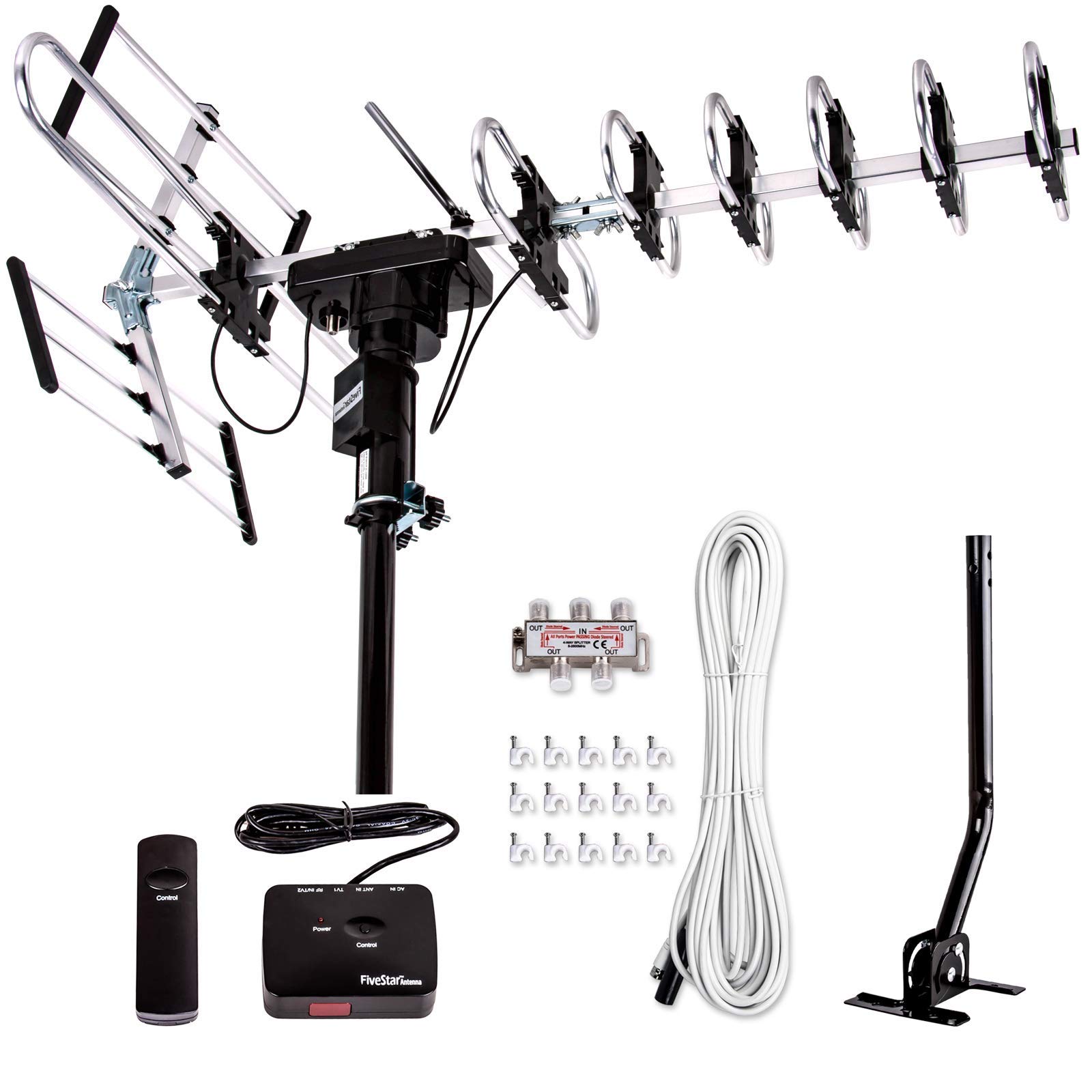
The Five Star rotating model solves the problem of broadcast towers scattered in different directions — a common rural scenario. Its 360-degree motorized rotation, controlled by remote, lets you switch between tower clusters without manually repositioning the entire antenna. The 6 reflector elements improve UHF image quality by roughly 25% compared to 4-element designs, and the built-in auto gain control chip adjusts amplification from 15 to 35 dB to maintain a steady output. The package includes a 40-foot coax cable, a 4-way splitter, and a J-pole, making it a complete kit for multi-TV households.
Real-world performance is solid for the price: users 25 miles from towers report 40+ clear channels including ABC, CBS, NBC, and FOX, even when towers are 65 degrees apart. The rotating function is genuinely useful in areas with terrain blocking one broadcast direction. However, the build quality feels less robust than the directional Five Star or the Winegard. Multiple reviews mention the motor can be jerky, and some units arrive with a dead motor or a remote that lights up but does not rotate. The aluminum construction is light and prone to wind-induced movement if not securely bracketed.
For the budget-conscious rural buyer who needs to pull signals from multiple azimuths, this antenna offers the best feature-to-price ratio in the rotating category. Just be aware that the motorized mechanism adds a potential failure point, and the 200-mile range claim is highly optimistic. With realistic expectations and secure mounting, it delivers reliable multi-directional reception at a fair price.
Why it’s great
- Motorized 360° rotation lets you aim at multiple tower clusters
- Auto gain control (15-35 dB) adapts to signal fluctuations
- Complete kit with J-pole, 40ft coax, and 4-way splitter
Good to know
- Motor reliability is inconsistent; some units fail quickly
- Light aluminum construction feels less durable than steel alternatives
- 200-mile range claim is unrealistic for most real-world conditions
5. PBD Amplified Outdoor TV Antenna with 360° Motorized Rotation

The PBD amplified antenna brings motorized rotation and dual TV outputs at a price point that undercuts most competitors. It claims a 150-mile range, though real-world users at 35-50 miles report it outperforms some indoor models and even older Winegard RV antennas in the same roof location. The built-in high-gain and low-noise amplifier helps stabilize signals in moderate rural conditions, and the included 40-foot RG6 coax covers most standard installations. The remote control makes it easy to reorient the antenna when switching between tower groups without climbing onto the roof.
Assembly is straightforward, and the weatherproof housing is adequate for outdoor mounting. The customer support team gets high marks for responsiveness, with one user noting they received a detailed local channel map and immediate help troubleshooting reception. However, the antenna’s UHF extenders are worth adding for better high-frequency capture, and the standard UHF array may underwhelm in deep fringe locations compared to more premium Yagi designs. Some users report needing to swap the default coax for a higher-grade RG-6 to avoid signal loss over longer cable runs.
The PBD is a genuine value proposition when the motorized function works reliably. But like the Five Star rotating model, the motor mechanism adds a failure risk, and the 150-mile range is best viewed as a marketing number rather than a guarantee. For a rural home 20-40 miles from towers that need the flexibility of rotation without spending triple the price, it is a sensible pick.
Why it’s great
- Motorized remote rotation for easy multi-directional aiming
- Dual TV outputs eliminate the need for an external splitter
- Responsive customer support with personalized channel maps
Good to know
- UHF array is not as strong as dedicated Yagi designs
- 150-mile range claim is not realistic for most users
- Motor reliability can be inconsistent over time
6. GE Outdoor HD Digital TV Antenna 33685

GE’s 33685 Yagi antenna is the most affordable option on this list that can still deliver meaningful results in rural settings. With an 80-mile maximum range and support for 4K and ATSC 3.0, it punches above its weight class when installed correctly. Buyers at 20-35 miles report solid reception with no pixelation, especially when mounted on a garage or eave in a clear direction. The weather-resistant bracket and included J-mount make rooftop or attic installation simple, and the antenna’s rugged construction handles moderate outdoor conditions without issue.
The limitations become apparent past 40 miles. Users at 65 miles from transmitters note channel dropouts on NBC and FOX, with inconsistency depending on weather and foliage. Assembly is required, and some find the instructions vague, but the process is manageable. The antenna lacks built-in amplification, so an external preamp is advisable for fringe locations. Its Yagi design is directional, meaning it pulls best from a single tower cluster; don’t expect multi-directional performance without manual repositioning.
For the budget-focused rural user who lives within 30 miles of broadcast towers and has a clear line-of-sight, the GE 33685 is a steal. It won’t match the deep-fringe performance of the Winegard or Televes, but it will cut the cable cord reliably at a fraction of the cost. GE backs it with a limited-lifetime replacement pledge and U.S.-based technical support, adding peace of mind to the low entry price.
Why it’s great
- Very affordable entry point for rural cord-cutters
- ATSC 3.0 and 4K ready for future broadcasts
- Weather-resistant design with lifetime replacement support
Good to know
- Performance drops off significantly beyond 40 miles
- No built-in amplifier; needs external amp for fringe use
- Lacks VHF-Low channel support
FAQ
Do I need an amplifier for a rural digital antenna?
What does LTE/4G/5G filtering do for rural reception?
Is a directional or multi-directional antenna better for the countryside?
Final Thoughts: The Verdict
For most users, the best digital antenna for rural areas winner is the Winegard HD8200A because it combines full VHF-Low and UHF coverage with rugged zinc-plated steel construction and real-world 60+ mile performance without reliance on finicky electronics. If you want intelligent signal processing and superior interference rejection in a compact package, grab the Televes DiNova Boss Mix. And for a budget-friendly but capable entry point under 40 miles, nothing beats the GE 33685.

Mo Maruf
I created WellFizz to bridge the gap between vague wellness advice and actionable solutions. My mission is simple: to decode the research and give you practical tools you can actually use.
Beyond the data, I am a passionate traveler. I believe that stepping away from the screen to explore new environments is essential for mental clarity and physical vitality.