Our readers keep the lights on and my smoothie glass nicely filled. As an Amazon Associate, I earn from qualifying purchases.
A dull knife is not just a nuisance — it is a hazard, forcing you to apply more pressure, increasing the chance of slips and uneven cuts. The right diamond sharpener transforms a neglected blade into a precision instrument, restoring the factory edge with controlled abrasion and consistent geometry. Whether you maintain a set of German chef’s knives or a single EDC folder, the abrasive platform you choose determines how much metal you remove and how fine a finish you achieve.
I’m Mohammad Maruf — the founder and writer behind WellFizz. To build this guide, I analyzed over 150 hours of customer feedback, cross-referenced grit specifications, motor wattage, and angle control mechanisms across seven leading models to find the sharpest results for every skill level.
After comparing guided systems, electric sharpeners, and manual rods, I have curated the definitive list of the best diamond knife sharpener for restoring razor edges quickly and consistently.
How To Choose The Best Diamond Knife Sharpener
Diamond is the hardest natural substance, making it the most aggressive and longest-lasting abrasive for sharpening. The key decision points come down to how much control you want over the angle, how fast you need the edge, and whether you are maintaining a fine edge or repairing a chipped blade. Below are the three most important factors to weigh before buying.
Abrasive Bonding: Plated vs. Monocrystalline Diamond
Plated diamond surfaces have a single layer of diamond grit electrochemically bonded to a metal substrate. They cut aggressively when new but wear out once the exposed crystals break free. Monocrystalline diamond plates embed the diamond particles into a resin or metal matrix, exposing fresh crystals as the surface wears. For heavy reprofiling or frequent use, monocrystalline stones maintain consistent cutting speed far longer than plated alternatives.
Angle Control: Guided Systems vs. Freehand
The sharpening angle determines the blade’s edge durability and slicing aggression. Guided systems like rod-based clamp rigs lock the knife at a fixed angle — typically between 10 and 35 degrees — eliminating the guesswork that leads to uneven bevels. Manual rods and steels require you to hold the blade at a consistent angle by feel, which demands practice but allows faster touch-ups between full sharpenings. For beginners or those sharpening multiple knife types, a guided system delivers repeatable results every time.
Grit Progression: Coarse Start, Fine Finish
A full sharpening cycle moves from a low grit (200–400) for edge repair, through a medium grit (600–1000) for refining the bevel, to a high grit (3000+) and a leather strop for polishing. Diamond abrasives excel at the coarse and medium stages because they cut fast without loading the stone. If your sharpener only has a single grit, you will either remove too much metal for routine maintenance or fail to cut through a damaged edge. Look for a system that offers at least two diamond grit stages — one for shaping, one for honing.
Quick Comparison
On smaller screens, swipe sideways to see the full table.
| Model | Category | Best For | Key Spec | Amazon |
|---|---|---|---|---|
| SHARPAL 202H | Guided System | Precision angle control from repair to mirror polish | 7 abrasives (220–6000 grit) + strop | Amazon |
| Chef’sChoice 15XV | Electric | Fast, consistent 15-degree edges on kitchen knives | 3-stage motor with 100% diamond abrasives | Amazon |
| VIDOME Professional | Electric | Versatile sharpening of steel, ceramic, and serrated blades | 3-stage diamond with magnetic chip collection | Amazon |
| HORL 3 Cruise | Rolling | Easy cleanup and travel with magnetic block | Diamond + steel disc, 15°/20° angles | Amazon |
| Wusthof Diamond Steel | Honing Rod | Quick daily touch-ups for neglected German knives | 10″ oval diamond-coated steel shaft | Amazon |
| Smith’s 3001 | Honing Rod | Aggressive realignment of very dull blades | 10″ oval diamond rod, medium grit | Amazon |
| EZE-LAP Brass Handle | Field Hone | Portable sharpening for outdoor and yard tools | 3.25″ retractable round diamond rod | Amazon |
In‑Depth Reviews
1. SHARPAL 202H Precision Knife Sharpening System
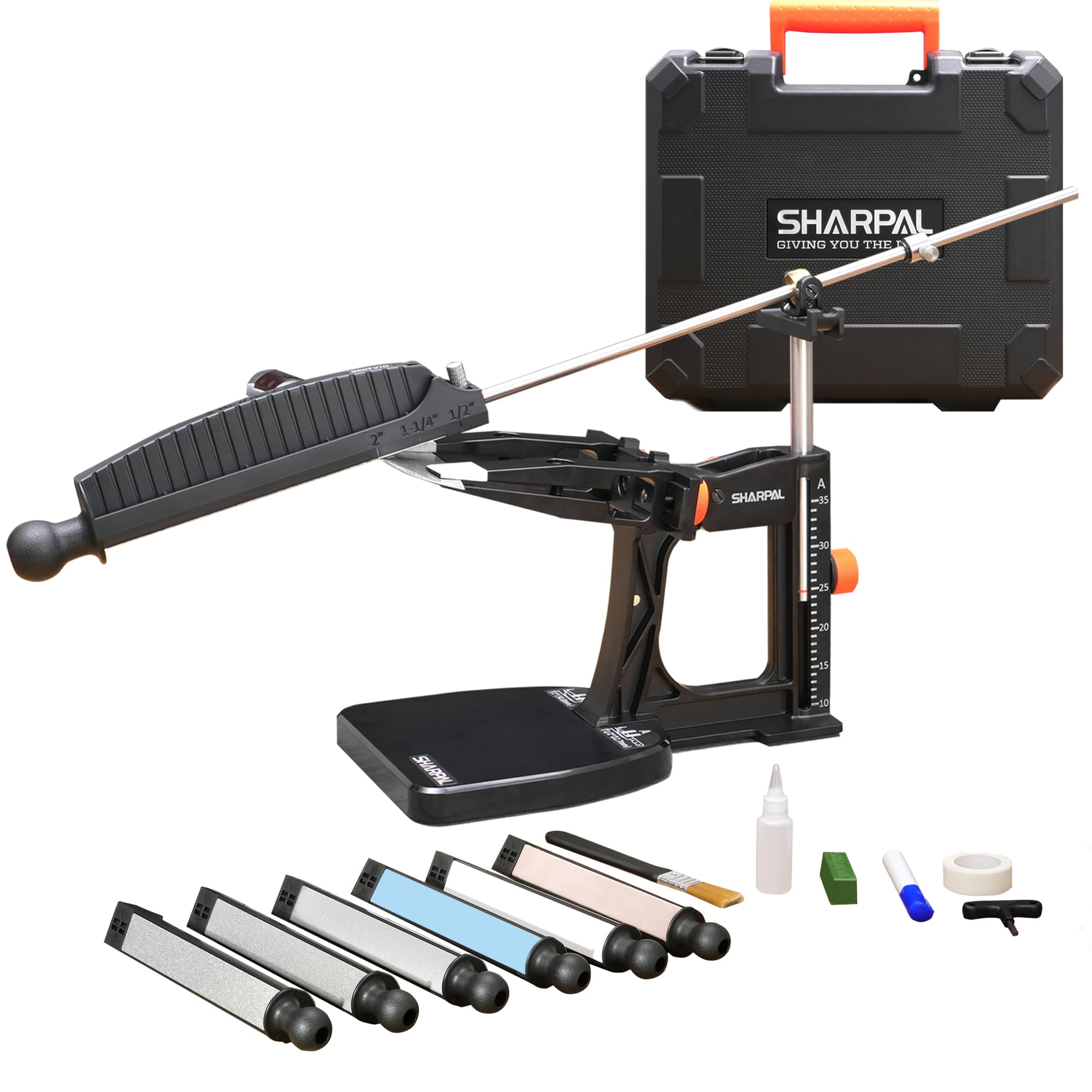
The SHARPAL 202H is a complete guided sharpening system that covers the entire grit spectrum — from 220 monocrystalline diamond for reprofiling damaged edges up to 6000 whetstone and a leather strop for a mirror polish. The distance-based angle setting compensates for blade width automatically, so you do not need to recalculate the angle when switching from a narrow pocket knife to a wide cleaver. The dual sliding clamps lock any blade length securely, and the flip mechanism ensures both sides receive the same bevel angle without dismounting the knife.
Users consistently report forming a burr in seconds with the 220 diamond stone, and the ability to dial in angles between 10 and 35 degrees makes it suitable for kitchen knives, hunting blades, and EDC folders. The monocrystalline diamond plates cut aggressively without loading, and the included strop with green compound delivers a shaving-sharp finish. The heavy-duty metal base and anti-slip feet keep the unit stable during extended sharpening sessions.
The rigid carry case holds all 7 abrasive plates, the strop, and the clamp assembly in organized cutouts, making it a strong candidate for frequent transport or gifting. The 220 grit stone is particularly effective for repairing chips or thinning blades behind the edge, while the 1000 grit diamond plate bridges the gap between coarse shaping and fine polishing.
Why it’s great
- Seven abrasives deliver a complete progression from edge repair to mirror polish
- Patented distance-based angle setting eliminates inaccuracies from blade width variation
- Robust metal construction with anti-slip base stays planted during heavy use
Good to know
- The included strop is functional but some users prefer upgrading to a dedicated strop for finer results
- Thicker knives with spines over 0.375 inches may require a modified clamp jaw
2. Chef’sChoice 15XV EdgeSelect Professional

The Chef’sChoice 15XV is the go-to electric sharpener for home cooks who want restaurant-quality 15-degree edges without learning freehand technique. Its three motor-driven stages use 100 percent diamond abrasives: stage one sets the bevel, stage two hones the edge, and stage three polishes with a patented flexible abrasive system. The flexible spring guides self-adjust to the blade shape, so you can run a 5-inch paring knife through the same slots as an 8-inch chef’s knife.
First-time sharpening takes roughly one minute per blade, while subsequent touch-ups require only about ten seconds. The motor is powerful enough to convert a factory 20-degree edge down to a 15-degree angle, which dramatically improves cutting performance on hard vegetables and boneless proteins. The unit weighs 4.19 pounds and measures 10 inches wide, providing enough mass to stay on the counter during use without sliding.
Customers who have used restaurant-grade equipment for decades consistently rank this as the best electric sharpener they own. The 15-degree angle is ideal for Japanese-style knives and high-carbon German steel, but it also works well on serrated blades when used with light pressure. The only caveat is that the plastic guide slots can develop nicks over time, though this does not affect sharpening geometry.
Why it’s great
- Converts traditional 20-degree edges to sharper 15-degree bevels with a factory-like finish
- Three-stage diamond system delivers a consistent razor edge in under 60 seconds
- Heavy-duty build stays planted on the counter for safe, repeatable passes
Good to know
- The polishing slot is less effective on deeply scalloped serrated blades
- Blade exit area can accumulate small plastic shavings from the guide slots over time
3. VIDOME Professional Electric Knife Sharpener
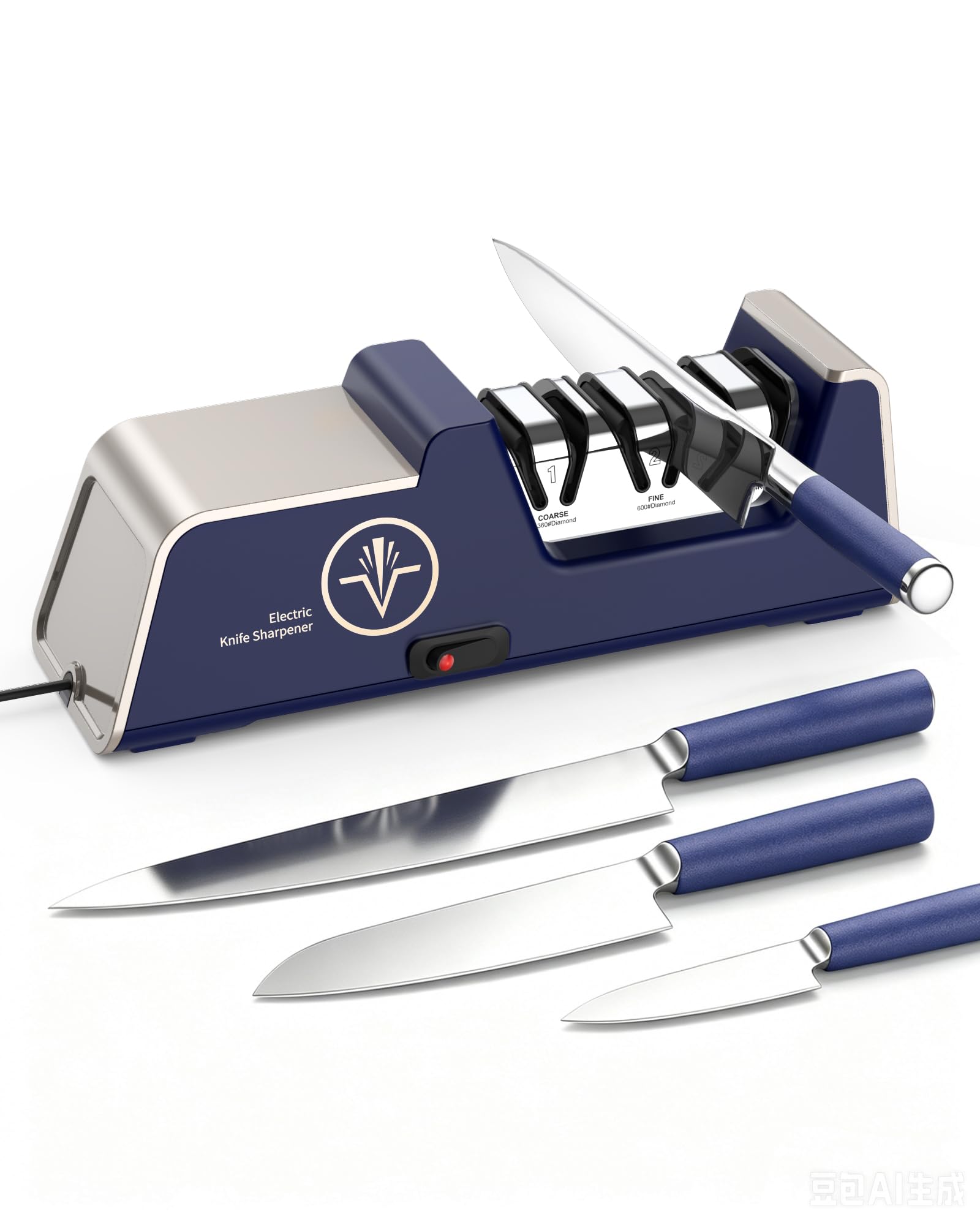
The VIDOME electric sharpener sets itself apart with 100 percent diamond abrasives across two stages and a third stropping stage for polishing, plus a magnetic chip collection tray that catches metal filings for easy disposal. It is one of the few electric models that explicitly handles ceramic knives and serrated blades in addition to straight-edge steel knives. The German-imported motor operates at 60 to 80 decibels and draws enough torque to reprofile a dull chef’s knife in about 30 seconds on the first pass.
The elastic constant force guides use spring-loaded tracks that hold the blade at the correct angle without requiring you to apply downward pressure. This design reduces the risk of scratching the blade surface and helps maintain a uniform edge along the full length of the blade. The 15-degree factory angle works well for fine slicing, and the machine is compact enough to store in a drawer or sit on a countertop without taking much space.
Customer feedback highlights its ability to revive severely neglected knives — one user noted it brought a ceramic chef’s knife back to sharpness that whetstones could not fix. The diamond abrasives cut fast enough that a single pass often restores a working edge, and the magnetic tray prevents loose grit from spreading across the kitchen counter. The champagne gold finish blends into most kitchen decor without looking like an industrial tool.
Why it’s great
- Compatible with both metal and ceramic knives, plus serrated blades
- Magnetic chip collection tray simplifies cleanup after each sharpening session
- Spring-loaded guide tracks hold the blade securely without user-applied pressure
Good to know
- The slot layout makes it difficult to slide the blade on the left side for stage three and right side for stage one
- Smaller ceramic paring knives may not contact the abrasive surface effectively
4. HORL 3 Cruise Rolling Knife Sharpener

The HORL 3 Cruise uses a rolling mechanism that pairs a diamond grinding disc with a stainless steel honing disc, allowing you to sharpen and hone in one motion without changing attachments. The neodymium magnet in the grip pad holds the knife firmly in place, even for small blades like a paring knife or large cleavers. You select either a 15-degree angle for fine slicing or a 20-degree angle for a more robust edge, and the rolling action ensures the entire blade length contacts the abrasive surface evenly.
Each dull knife takes roughly 12 to 18 rolls per side on the diamond disc, followed by roughly 20 rolls on the honing disc. The block-style diamond surface is embedded in a durable polypropylene housing that resists wear — users report minimal disc degradation after six months of regular use. The entire unit measures 5.31 inches high and sits in a compact footprint that fits on a crowded countertop.
The packaging and build quality are notable: the sharpener is made from ocean-bound plastic, and the sand-colored finish gives it a minimalist look. The magnetic block works well with both Western and Japanese blade geometries, and the rolling design makes it easy to maintain a consistent angle without clamping or aligning the knife on a guide rod. It is a strong choice for home cooks who want an elegant tool that delivers noticeably sharper edges than pull-through sharpeners.
Why it’s great
- Rolling design eliminates the angle-guessing of traditional manual sharpeners
- Strong neodymium magnets secure the knife through the full stroke
- Durable diamond disc shows minimal wear even after months of regular use
Good to know
- Sharpening a very dull knife from start to finish takes roughly 15 minutes per blade
- Only offers 15-degree and 20-degree angle options, with no finer or coarser settings
5. Wusthof 10-Inch Diamond Sharpening Steel

The Wusthof 10-inch diamond steel is a coarse-grit honing rod designed for knives that have been neglected or have developed small micro-chips. Unlike a standard smooth steel that only realigns the edge, this diamond-coated rod actually removes metal to restore a fresh bevel. The oval shaft provides slightly more surface contact than a round rod, and the slip-resistant plastic handle gives good control during stropping passes.
Users who own premium German knives — Wusthof, Zwilling, or similar 58 HRC blades — find that two to three light passes on this steel bring a dull edge back to slicing performance. It is deliberately aggressive: the diamond dust is coarser than typical honing steels, so it should be used as the first step in a two-step process, followed by a fine steel or ceramic rod for polishing. The rod weighs 0.28 kilograms and measures 10 inches, which is long enough to accommodate large chef’s knives.
The lifetime warranty reflects Wusthof’s confidence in the construction. The rod is made entirely of alloy steel with electroplated diamond coating, and the handle is designed to resist slipping even with wet or greasy hands. It is not a full sharpening solution by itself, but as a maintenance tool for keeping a working edge between sharpening sessions, it performs exactly as advertised.
Why it’s great
- Aggressive diamond coating removes metal fast, ideal for damaged or very dull blades
- Oval design increases contact area for more efficient honing per pass
- Lifetime warranty from a premium German manufacturer
Good to know
- Too coarse for routine daily honing — requires a finer steel or ceramic rod to finish
- Can remove excess metal if used with excessive pressure or incorrect technique
6. Smith’s 3001 10″ Oval Diamond Sharpening Steel

The Smith’s 3001 is a medium-grit diamond honing rod that balances aggressiveness and control, making it suitable for both quick edge restorations and occasional full resharpening. The oval shaft increases the sharpening surface area compared to round rods, and the interrupted surface pattern speeds up the cut by allowing debris to fall away during each pass. The rubber grip handle includes an oversized handguard for safety, and a metal hang-up ring lets you store it with your knife block or kitchen tools.
This rod hits a sweet spot for users who want more cutting power than a standard steel but do not need the extreme aggressiveness of the Wusthof diamond rod. The medium grit is aggressive enough to revive very dull stainless steel knives quickly — one customer noted it restored a set of decade-old kitchen knives to razor-sharp condition. The 10-inch length covers the full edge of any chef’s knife, and the rod is light enough at half a pound to handle with one hand.
The rod is also effective on outdoor tools such as axes and pruners, making it a versatile addition to a workshop or camping kit. The plastic sharpening tip on the end protects countertops from accidental contact, and the rod cleans easily with a damp cloth after each use. Some users note that the medium grit leaves a slightly toothy edge, which is actually beneficial for slicing soft tomatoes or meat but may need a ceramic finishing rod for push-cutting paper.
Why it’s great
- Oval design with interrupted surface speeds up cutting and prevents loading
- Versatile medium grit works on both kitchen knives and outdoor yard tools
- Soft rubber grip and large handguard provide comfortable, safe handling
Good to know
- Medium grit is too coarse for a razor-polished finish — needs a finer stone for final honing
- Requires correct technique and consistent angle to avoid uneven edge wear
7. EZE-LAP 3-1/4″ Diamond Round Sharpener in Brass Handle

The EZE-LAP brass-handled round sharpener is a portable field hone designed for backpacking, camping, and general yard tool maintenance. The 3.25-inch diamond rod retracts into a solid brass handle that doubles as a protective sheath, and a leather strop is sewn into the sheath for light honing after sharpening. The 600 grit is coarse enough to reshape a dull blade but fine enough to leave a working edge that can slice paper.
Users who have owned the same model for 30 or 40 years report that the current version is nearly identical in construction and performance, a testament to the durability of the brass casing and the diamond plating. The rod is particularly effective on single-bevel outdoor knives, axes, and pruning shears, and the compact size means it takes up almost no space in a pack or tool drawer. The retractable mechanism keeps the diamond surface protected when not in use.
The synthetic diamond coating cuts aggressively on high-carbon steel and stainless steel alike, and the round shape works well for sharpening serrated blades by following the curve of each scallop. It is not designed for fine kitchen work or mirror polishing, but as an emergency sharpener that lives in a glove box or hunting pack, it is nearly indestructible. The made-in-USA construction and simple design mean there are no moving parts to break.
Why it’s great
- Ultra-portable design fits in a pocket or pack for field sharpening
- Brass handle and retractable rod are built to last decades
- Integrated leather strop provides basic honing after the diamond pass
Good to know
- 600 grit is too coarse for fine kitchen knife polishing or razor-sharp edges
- Round rod lacks a flat side and groove for sharpening gut hooks or fish hooks
FAQ
Can a diamond knife sharpener damage my blade?
How often should I use a diamond rod versus a regular steel?
What grit sequence should I use for a razor-sharp edge?
Final Thoughts: The Verdict
For most users, the best diamond knife sharpener winner is the SHARPAL 202H because it combines a complete 7-abrasive progression with precise angle control, making it suitable for everything from repairing a chipped blade to achieving a mirror polish. If you want a fast, motorized solution for kitchen knives, grab the Chef’sChoice 15XV. And for portable field sharpening or backpacking, nothing beats the compact and durable EZE-LAP Brass Handle Sharpener.

Mo Maruf
I created WellFizz to bridge the gap between vague wellness advice and actionable solutions. My mission is simple: to decode the research and give you practical tools you can actually use.
Beyond the data, I am a passionate traveler. I believe that stepping away from the screen to explore new environments is essential for mental clarity and physical vitality.