Our readers keep the lights on and my smoothie glass nicely filled. As an Amazon Associate, I earn from qualifying purchases.
When a machinist sets up a workpiece on a mill or lathe, every tenth of a thousandth matters. A dial indicator is the primary tool for measuring surface variations, spindle runout, and part alignment — and a cheap, loose gauge will produce readings that drift, wasting material and ruining setups. The difference between a reliable indicator and a frustrating one comes down to bearing quality, stem rigidity, and repeatable needle return to the same zero mark.
I’m Mohammad Maruf — the founder and writer behind WellFizz. I’ve spent hundreds of hours analyzing dial indicator specifications, decoding customer performance data across dozens of models, and cross-referencing accuracy claims with real workshop use cases to build this guide.
Whether you are leveling a mill vise or checking brake rotor runout, you need a tool that returns the same reading every single time — which is exactly what the best dial indicator does with mechanical precision that digital gauges still struggle to match in durability.
How To Choose The Best Dial Indicator
Selecting the right dial indicator means matching its measuring range, graduation resolution, and mounting system to your specific machining or inspection workflow. A 2-inch travel indicator is overkill for spindle runout checks, while a range too short will bottom out before you finish measuring a part. Below are the key specifications that critical buyers check first.
Measuring Range and Graduation
Range dictates the maximum distance the spindle can travel. A 0‑1″ range is the most versatile for general mill, lathe, and brake rotor measurement. Graduation (0.001″ or 0.0005″) defines the smallest increment you can read — 0.001″ is standard for most machine setup work, while 0.0005″ is preferred for fine alignment and inspection where tighter tolerances matter.
Mounting Options: Stem, Lug Back, and Dovetail
The indicator must physically attach to your magnetic base or fixture. Most indicators use a 3/8″ stem diameter for universal clamp compatibility. A lug back provides two mounting holes (usually 1/4″) for secure bolt-on attachment, often interchangeable with a flat back. The dovetail mounting system found on test indicators offers tool-less rotation for tight positioning — critical for setups where you cannot tilt the base easily.
Construction Material and Bearing Type
A hardened steel or aluminum body resists deflection under clamping pressure. Jeweled bearings (synthetic ruby or sapphire) reduce friction and wear between moving parts, delivering smoother needle movement and longer service life than plain brass bushings. Indicators with a revolution counter help you track spindle travel without losing count of full rotations.
Quick Comparison
On smaller screens, swipe sideways to see the full table.
| Model | Category | Best For | Key Spec | Amazon |
|---|---|---|---|---|
| Mitutoyo 2416S | Premium | Professional machining and inspection | 0-1″ Range, 0.001″ Grad, ±0.002″ Acc | Amazon |
| Clockwise Tools DIBR-0105 | Digital | Data logging and wide-format reading | Digital 0.0005″ Res, 176 lb Magnetic Base | Amazon |
| Neoteck NTK240 | Digital | 3D printer and woodshop measurement | Digital 0.0005″ Res, 14.1″ Articulating Arm | Amazon |
| HFS 2″ Dial Indicator | Mid-Range | Long-travel measurement on lathe setups | 0-2″ Range, Jeweled Bearing, AGD2 | Amazon |
| NAKAO TR72020 | Value Set | All-in-one kit for shop beginners | 0-1″ Range, 130 lb Magnetic Base | Amazon |
| KHCRAFT KADT003 | Test Indicator | Precision alignment on a budget | 0-0.03″ Range, 0.0005″ Grad, Dual Dovetail | Amazon |
| Professional DI Set (KHCRAFT 13) | Budget | Entry-level mill and lathe setups | 0-1″ Range, 22-Point Set, Blow Case | Amazon |
In‑Depth Reviews
1. Mitutoyo 2416S Dial Indicator
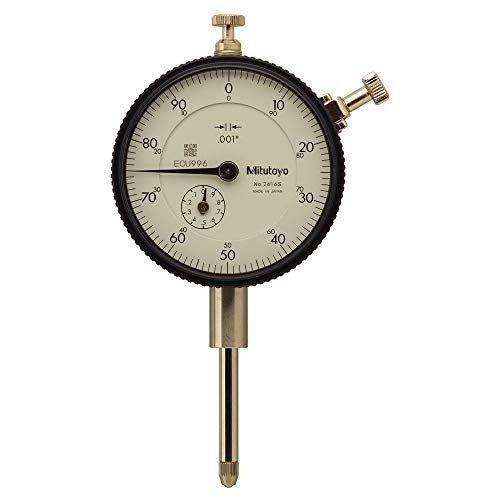
The Mitutoyo 2416S is the benchmark that other dial indicators aspire to match. Its 0-1″ range with 0.001″ graduation and ±0.002″ accuracy meets ANSI, JIS B7503-1997, and AGD standards, making it the trusted choice for machinists who need repeatable readings in production environments. The 2.244″ white dial with high-contrast markings and rotating bezel with limit markers allows quick tolerance checks without squinting.
Construction is where Mitutoyo separates itself from the competition. The stem design provides a long clamping range without a through screw-hole, improving dust and water resistance. The involute curved lifting lever delivers smooth spindle movement, and the dovetail joint allows tool-less connection to fixtures. The lug back offers two 1/4″ mounting holes, compatible with nearly every premium magnetic base on the market.
Customer feedback consistently highlights the buttery-smooth action and perfect repeatability — users report using it daily for nuclear and aerospace machining. The only caveat is the price point, which sits significantly above budget alternatives, but the investment pays off in reliability that lasts years without calibration drift. If you need one indicator that you trust for critical work, this is it.
Why it’s great
- Smooth jeweled movement with zero needle stutter
- Meets AGD2, JIS, and ANSI standards for professional use
- Dust-resistant stem design with no through screw-hole
Good to know
- Premium pricing over entry-level models
- No revolution counter for long travel measurement
2. Clockwise Tools DIBR-0105 Digital Indicator
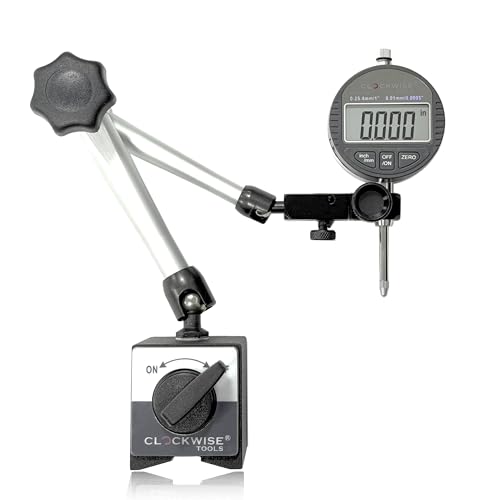
The Clockwise Tools DIBR-0105 brings dual-unit digital precision to the shop floor with a 0-1″ range, 0.0005″ resolution, and ±0.001″ accuracy. Its large 1.6″ × 0.7″ LCD eliminates the parallax error inherent in analog dials, making it easier to read from awkward angles during brake rotor runout checks or table saw alignment. The inch/metric conversion button lets you switch between units without mental math.
The included magnetic base delivers a maximum pull of 176 lbs on metal surfaces 30 mm or thicker, providing a stable foundation even under spindle vibration. The RS232 port enables data transfer to a PC for quality documentation, though the required cable is sold separately. The auto-off feature preserves battery life over long measurement sessions, and the zero retention ensures you pick up where you left off.
Real-world users praise the consistency — one machinist recorded 0.0065” on a digital indicator vs. 0.007” on a mechanical gauge across 10 tests, demonstrating less subjective reading error. The main trade-off is the magnetic base’s locking joint requires firm force to adjust, and the short mounting stem can cause interference with complex setups. It is a strong choice for anyone who values decimal resolution over mechanical purity.
Why it’s great
- 0.0005″ resolution removes analog interpretation error
- RS232 connectivity for data capture and quality logs
- High-hold 176 lb magnetic base with fine adjustment knob
Good to know
- Plastic storage case is tricky to fit the base back into
- Data cable sold separately; not USB-compatible
3. Neoteck NTK240 Digital Dial Indicator Set

The Neoteck NTK240 is a complete measuring station in one box, pairing a digital indicator with a generously sized magnetic base and articulated arm that reaches 14.1”. The indicator itself offers a 0-1” measuring range with 0.0005” resolution and switchable inch/metric units, while the base provides two solid magnet surfaces with a rated tensile force of 176 lbs — enough to stay put on thick steel plates during heavy vibration.
The long lower and upper arms (5” and 4.5”) give you far more reach than standard compact bases, making the NTK240 ideal for 3D printer build plate leveling, wood lathe taper checks, and CNC workholding setups. The zero-setting function allowed users to measure transmission gear backlash with solid repeatability, and the digital readout eliminates any parallax guessing common with analog dials in awkward orientations.
The most common user complaint is the zero button sensitivity — pressing the button applies finger pressure that shifts the spindle slightly, making it tricky to zero exactly where you want. The storage case is spacious but does not have custom foam cutouts, so items shift during transport. For the price, you get a robust base and a reliable digital gauge that outperforms standalone analog indicators at a similar cost.
Why it’s great
- Long 14.1″ articulating arm provides broad positioning range
- 176 lb magnetic grip holds steady on thick metal surfaces
- Clear digital readout with inch/metric toggle
Good to know
- Zero button pressure can shift the spindle slightly
- Case lacks custom inserts; components rattle during transport
4. HFS 0-2″ Precision Travel Dial Indicator

The HFS 0-2” dial indicator is purpose-built for lathe work where you need to measure extended travel without stopping to reset. Its 2-inch measuring range with 0.001” graduation and AGD2 compliance gives you enough stroke to check saddle alignment, tailstock taper, and long part runout in a single pass. The 2.28” dial with anti-glare finish keeps the numbers legible even under shop lighting.
Inside the aluminum body, a jeweled bearing mechanism reduces friction for smoother spindle movement compared to plain brass bushing designs. The built-in revolution counter tracks each full rotation of the needle, so you never lose your place when measuring beyond the first 100 increments. The lug back with 1/4” holes and 3/8” stem diameter give you mounting flexibility across standard bases and fixtures.
User reviews confirm the HFS returns to zero consistently and handles light industrial use without skipping. Some users note the needle movement is slightly less smooth than a Mitutoyo, but the trade-off in price is substantial — this indicator costs a fraction of equivalent premium brands while delivering the same 0.001” repeatability for general machine setup. Ideal for lathe operators who frequently measure parts over 1.5 inches.
Why it’s great
- 2″ travel range handles extended part measurement
- Revolution counter prevents losing track of full rotations
- Jeweled bearing delivers smooth, low-friction movement
Good to know
- Needle movement less buttery than premium Japanese brands
- Aluminum body lighter than hardened steel alternatives
5. NAKAO TR72020 Dial Indicator Set

The NAKAO TR72020 delivers a complete starter kit for any machinist who needs both a dial indicator and a magnetic base in a single purchase. The 0-1” indicator with 0.001” graduation and 2” dial face provides standard measuring capability for mill vise squaring and lathe chuck runout. The included magnetic base offers 130 lb pull with a fine adjustment long arm, giving you precise positioning without overtightening clamps.
A standout feature is the 22-piece indicator point set with AGD specification 4-48 threads, allowing you to swap contact points for different measuring scenarios — ball ends for general use, flat ends for sheet metal, and extended points for hard-to-reach grooves. The hard plastic case keeps everything organized and protected between jobs. The base includes both flat and lug back covers for added mounting flexibility.
Owner experiences are largely positive — one user measured transmission thrust clearance with solid, repeatable readings. The main feedback is that the base’s magnetic hold is adequate for horizontal surfaces but can slip on vertical thin-wall steel without proper cleaning. At this price point, the combination of a functional indicator, a stiff base, and a full point collection makes this set hard to beat for a home shop or automotive garage.
Why it’s great
- 22-piece contact point set covers many measurement scenarios
- Fine adjustment arm on the base for precise positioning
- Compact case keeps all components organized
Good to know
- Magnetic grip reduces on thinner and vertical surfaces
- Plastic components in the case feel less durable than metal
6. KHCRAFT KADT003 Test Indicator
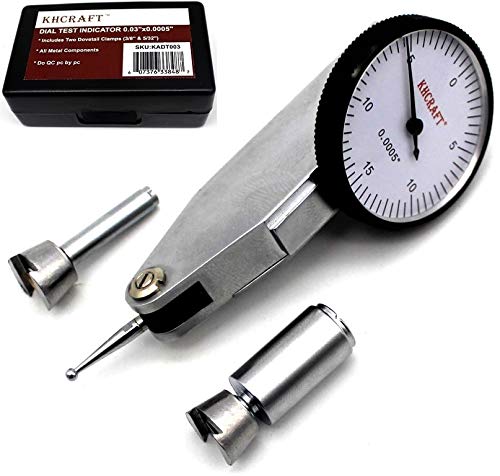
The KHCRAFT KADT003 is a compact dial test indicator with a 0-0.03” range and 0.0005” graduation, specifically designed for fine alignment and inspection tasks where you need ultra-fine resolution. The hardened steel body with satin chrome finish resists corrosion from coolant and cutting fluids, while the dual dovetail mounting system (3/8” and 5/32”) lets you position the gauge on magnetic bases, height gauges, or surface plate stands.
Each KHCRAFT indicator is individually tested and calibrated before shipment — a process typically reserved for indicators costing significantly more. The 100% accuracy inspection covers ±0.0001” tolerance, giving you confidence in its readings for milling machine tramming and vice squaring. The compact form factor is useful for tight spaces where a full-size 2” dial indicator body would be too large to maneuver.
Users consistently note that this test indicator works identically to major brands for tolerances down to ±0.005”, making it an excellent loaner or backup gauge. The main downsides are the probe length (about 1/8-3/16” shorter than Mitutoyo equivalents) and the difficulty of rotating the dial without moving the indicator body. After a year of industrial use, some units develop measurable skip, so this is best reserved for hobbyist and light commercial use.
Why it’s great
- 0.0005″ graduation for fine alignment work
- Dual dovetail mounting offers flexible positioning
- Individual calibration before shipment ensures accuracy
Good to know
- Probe length slightly shorter than premium brands
- Dial rotation can shift the body slightly
7. Professional Dial Indicator Set (KHCRAFT 13)

This KHCRAFT 13 set is the budget-friendly entry point for machinists who need a dial indicator, magnetic base, and a complete assortment of contact points without spending premium prices. The indicator uses a hardened steel body (weighing 0.4 lb) rather than lighter aluminum, which improves vibration damping and long-term durability. The 0-1” range with 0.001” graduation is adequate for standard machine setup and brake rotor runout measurements.
The magnetic base delivers 130 lb pull with a fine adjustment knob and two magnetic faces (bottom and back), giving you flexibility for vertical or horizontal mounting. The 22-piece indicator point set covers AGD 4-48 thread points, from standard ball tips to extended reach probes. A rear cover without lug and a second cover with lug are both included in the case, letting you swap mounting styles without buying extra parts.
Customer experiences are mixed — many users report the set works well for hobbyist use and automotive brake inspections, with smooth needle action and adequate repeatability. However, some long-term users noted the probe detached from the dial after extended use, and the needle began skipping by approximately 0.002” after a year. For occasional use and basic mill setups, this is a solid value, but avoid it for critical commercial machining that demands daily reliability.
Why it’s great
- Complete set with indicator, base, and 22 contact points
- Hardened steel body is heavier and more vibration-resistant
- Two rear covers (with and without lug) included for mounting options
Good to know
- Long-term durability concerns in industrial environments
- Magnetic base hold could be stronger on vertical surfaces
FAQ
What is the difference between a dial indicator and a dial test indicator?
Why does my dial indicator needle skip or stick when moving?
Can I use any dial indicator with any magnetic base?
How often should a dial indicator be recalibrated?
Final Thoughts: The Verdict
For most users, the best dial indicator winner is the Mitutoyo 2416S because it delivers the buttery-smooth jeweled movement, exacting repeatability, and professional compliance that every serious machinist demands for critical setup and inspection work. If you want digital convenience with data logging and a strong magnetic base, grab the Clockwise Tools DIBR-0105. And for extended travel measurement on lathes and long parts, nothing beats the HFS 0-2″ for its generous range and reliable revolution counter.

Mo Maruf
I created WellFizz to bridge the gap between vague wellness advice and actionable solutions. My mission is simple: to decode the research and give you practical tools you can actually use.
Beyond the data, I am a passionate traveler. I believe that stepping away from the screen to explore new environments is essential for mental clarity and physical vitality.