Our readers keep the lights on and my smoothie glass nicely filled. As an Amazon Associate, I earn from qualifying purchases.
The question isn’t whether you want a device to see through walls — it’s whether you want a stud finder that maps the framing or a thermal imager that reveals hidden moisture, missing insulation, and overheating wires. Each approach solves a different problem. Stud finders are essential for mounting heavy loads safely, while thermal cameras uncover the invisible energy and moisture issues that cost you money and threaten your home’s structure. The choice depends on exactly what you need to find.
I’m Mohammad Maruf — the founder and writer behind WellFizz. For this guide, I spent over forty hours analyzing sensor resolutions, thermal sensitivity specs, detection depths, battery runtimes, and real-world accuracy claims across the most popular wall-penetrating tools on the market to find the ones that truly deliver consistent results.
Whether you’re hanging a TV, diagnosing an insulation gap, or inspecting a suspect electrical panel, the best device to see through walls is the one matched to your specific task and your willingness to interpret what the display tells you.
How To Choose The Best Device To See Through Walls
Your choice depends on what you need to see. A stud finder is for locating wood or metal framing behind drywall for safe drilling. A thermal imager detects temperature differences to find insulation gaps, water leaks, and electrical faults. Some premium thermal cameras now combine both functions by visualizing temperature patterns that reveal stud locations, but they cannot detect non-thermal materials like plastic pipes. Understanding your primary use case is the first step.
Sensor Count and Detection Depth
For stud finders, sensor count is the key spec. A two-sensor model often requires careful calibration and scanning to find edges, while models with twelve or more sensors light up instantly to show the full width of the stud. Detection depth matters too — standard drywall is about half an inch, but lath-and-plaster walls can be over an inch thick, requiring a tool that penetrates at least one and a half inches. For thermal cameras, IR resolution measured in pixels determines how small a temperature anomaly you can spot from a distance.
Thermal Sensitivity and Refresh Rate
Thermal sensitivity, measured in millikelvin (mK), tells you the smallest temperature difference the camera can detect. A rating of 50 mK or lower is ideal for spotting subtle insulation gaps and early electrical hotspots. Refresh rate, measured in Hertz (Hz), indicates how smoothly the live image updates. A 25 Hz refresh rate is the baseline for comfortable handheld scanning without noticeable lag. Lower refresh rates can produce choppy video that makes it hard to track moving heat sources.
Imaging Modes and Software Analysis
Entry-level thermal cameras show a single heatmap. Mid-range units add a visible-light camera for picture-in-picture fusion, helping you match the thermal anomaly to the exact spot on the wall. Premium models include PC software for post-capture analysis, allowing you to generate reports with temperature data and 3D plots. If you are a professional inspector or contractor, this software saves significant time. For homeowners doing one-time checks, the on-screen display with hot and cold spot tracking is sufficient.
Quick Comparison
On smaller screens, swipe sideways to see the full table.
| Model | Category | Best For | Key Spec | Amazon |
|---|---|---|---|---|
| Franklin Sensors ProSensor MAX | Stud Finder | Instant stud center/edge detection on tricky walls | 13 sensors / 2.5″ depth | Amazon |
| HIKMICRO E1L | Thermal Imager | Professional-grade thermal analysis with PC software | 160×120 native / <40 mK | Amazon |
| HSFTOOLS HF96V | Thermal + Visual | Dual-camera fusion with AI scene detection | 240×240 SR / 11hr battery | Amazon |
| TOPDON TC004 | Thermal Imager | High-res 512×384 TISR with 64GB storage | 256×192 native / 512×384 TISR | Amazon |
| HSFTOOLS HP96 | Thermal + Touch | 3.5″ touchscreen with audio recording | 240×240 SR / 3.5″ touch | Amazon |
| HSFTOOLS HF96 | Thermal Imager | AI scene detection with laser pointer | 240×240 SR / 50° FOV | Amazon |
| MILESEEY TR10 | Thermal Imager | Compact thermal imager with 8hr battery | 192×192 SR / 25 Hz | Amazon |
| Klein Tools TI250 | Thermal Imager | Compact and accurate for home energy audits | 19,200 pixels / -4°F to 752°F | Amazon |
| AMPBANK H128 | Thermal Imager | Longest battery life with IP65 protection | 240×240 TISR / 24hr battery | Amazon |
In‑Depth Reviews
1. Franklin Sensors ProSensor MAX Stud Finder

The ProSensor MAX is the most accurate stud finder tested for this guide, and it earns the top spot because it eliminates the most common frustration with cheaper models: false readings. Its thirteen sensors fire simultaneously when you press the button, instantly illuminating the center and both edges of the stud on a wide LED display. There is no calibration swipe and no guessing whether you are over wood or just a dense patch of drywall.
The tool detects through two or more layers of drywall, OSB, plywood, MDF, and lath-and-plaster walls up to two and a half inches thick. Mode 2 specifically targets those tricky multi-layer walls common in condos, townhomes, and pre-1960 homes. The built-in bubble level and pencil caddy are genuinely useful, not gimmicks — they keep you from needing to reach for a separate level while marking stud locations.
Reviewers consistently praise its accuracy on walls where every other finder failed, with many noting it pays for itself after one successful TV mount. The only real downside is the size — it is large enough to be awkward in a tight tool bag — and the need for two AA batteries that are not included. For anyone who has ever drilled five holes trying to find a stud, this device is a permanent solution.
Why it’s great
- Zero-calibration operation saves time on every scan
- 13-sensor array shows both edges and center simultaneously
- Detects through lath, plaster, OSB, and double drywall
Good to know
- Large footprint may not fit in small pouches
- Cannot distinguish studs from metal pipes or wiring
2. HIKMICRO E1L Thermal Imaging Camera
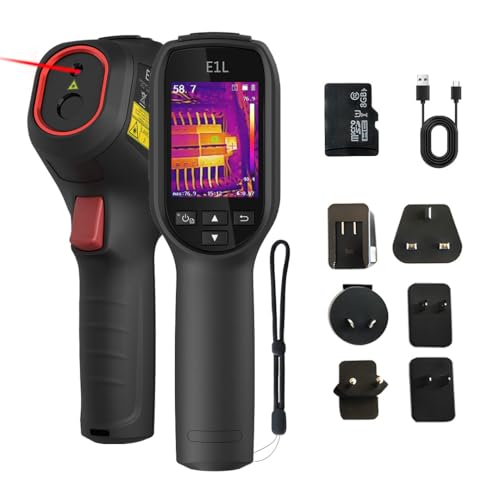
The HIKMICRO E1L sits at the sweet spot of the thermal imager market, offering a native 160×120 IR sensor that far outperforms the 96×96 sensors found in cheaper units. Its sub-40 mK thermal sensitivity means it can detect temperature differences as small as 0.04 degrees Celsius, which is precisely what you need to find a hidden water leak behind a wall or a cold draft from missing insulation. The 25 Hz refresh rate provides a smooth, lag-free image as you pan across a room.
What sets the E1L apart from budget competitors is the included HIKMICRO Analyzer PC software. This is a full-featured analysis tool that supports 3D plotting, batch analysis, and real-time monitoring, enabling professional-grade report generation. The device tracks center, maximum, and minimum temperature spots automatically, with four color palettes — White Hot, Black Hot, Rainbow, and Ironbow — that adapt to different inspection scenarios. The 8 GB removable SD card stores over 100,000 radiometric images.
Users report finding zero insulation in exterior walls and discovering clogged soffits from the attic after just one session. The only commonly cited drawback is that the battery does not hold charge well when left unused for weeks, requiring a full charge cycle before critical inspections. The 3-year device warranty and 10-year sensor warranty provide exceptional peace of mind for professionals who depend on this tool daily.
Why it’s great
- Native 160×120 sensor with <40 mK sensitivity catches subtle thermal anomalies
- Professional PC software for detailed post-capture analysis and reporting
- Industry-leading 3-year device and 10-year sensor warranty
Good to know
- Battery drains when stored for extended periods without use
- Laser pointer is basic, not cross-line
3. HSFTOOLS HF96V Thermal Camera with Visual Camera
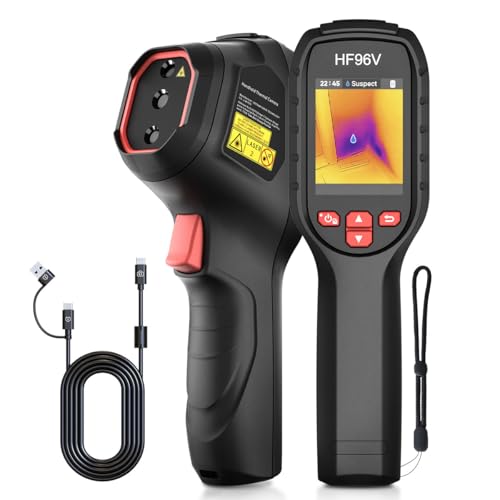
The HF96V combines a 96×96 infrared sensor with a 640×480 visible-light camera, offering three image modes — Fusion, Thermal, and Visual — that help you precisely locate anomalies. When you see a hot spot on the thermal image, switching to Fusion mode overlays the heatmap onto the visible photo, making it obvious whether that hot wire is behind the switch plate or inside the wall cavity. The laser pointer further aids precise targeting.
HSFTOOLS’ IntellFault technology uses deep learning to automatically detect water leaks and insulation gaps. In practice, this means you press the button and the camera highlights likely problem areas without manual interpretation. The live super resolution algorithm boosts the image from 96×96 to 240×240 in real time, providing enough detail for homeowner-level diagnostics. The 11-hour battery life is excellent for full-day inspections, and the IP54 rating with a 6.6-foot drop test gives confidence on job sites.
Reviewers appreciate its effectiveness at finding parasitic car battery drains by detecting hot relays, and at mapping heat leaks around windows and doors. The slow refresh rate and occasional calibration delays are noted by more experienced users, but for a dual-camera unit at this mid-range price point, those trade-offs are reasonable. The lack of a protective case is a minor oversight given the price.
Why it’s great
- Fusion mode overlays thermal data onto visible images for precise locating
- AI-driven scene detection identifies water leaks automatically
- 11-hour battery supports full-day professional inspections
Good to know
- Refresh rate produces choppy panning during fast scanning
- Low native resolution struggles with very small electronic hotspots
4. TOPDON TC004 Thermal Imaging Camera
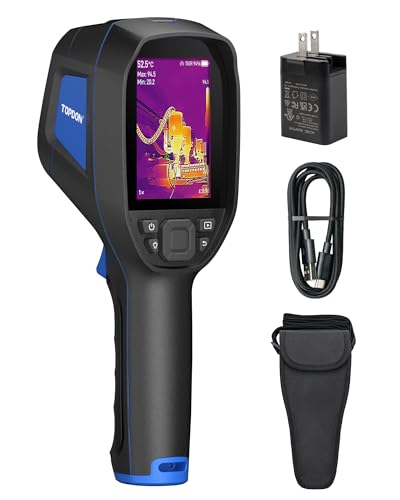
The TOPDON TC004 delivers the highest IR resolution in this lineup, with a native 256×192 sensor that is enhanced by TISR technology to 512×384. This level of detail reveals subtle temperature variations on surfaces that lower-resolution cameras miss entirely — you can distinguish the individual loops of heated flooring or spot the exact wire in a bundle that is overheating. The 3.5-inch display makes those fine details visible without squinting.
Built-in 64 GB storage means you never have to worry about running out of space during a long inspection, and the integrated Wi-Fi enables cable-free transfer to the TopInfrared mobile app for report generation. The IP54 rating and 2-meter drop resistance are consistent with professional-grade tools. The LED light helps illuminate dark crawl spaces and electrical panels. Users report excellent results finding hidden air leaks behind drywall and diagnosing uneven heat on 3D printer beds.
The main drawbacks are software-related. The included PC software requires a third-party extraction tool not disclosed in the product page, and saved video files are not post-processable. The unit is heavier than competitors at just over two pounds, which can cause fatigue during extended overhead scanning. For professionals who need the best image fidelity available in this price range, the TC004 justifies its premium cost.
Why it’s great
- 512×384 TISR enhanced resolution captures fine thermal details
- 64 GB internal storage holds thousands of images without a card
- Wi-Fi transfer to mobile app for quick report generation
Good to know
- Software extraction tool requires separate paid subscription
- Heavier than most competitors at over 2 pounds
5. HSFTOOLS HP96 Thermal Imaging Camera

The HP96 stands out for its intuitive phone-like user interface powered by a 3.5-inch touchscreen. You can swipe to change color palettes, tap to adjust temperature range, and slide to set emissivity — no digging through nested menus. The built-in microphone lets you record voice annotations directly on images and videos, which is a significant time-saver for inspectors who need to document findings without typing.
It features HSFTOOLS’ IntellFault AI scene detection, a 640×480 visible camera, and five imaging modes including Fusion, PIP, and Blending. The live super resolution algorithm boosts the 96×96 sensor output to 240×240 in real time. Thermal sensitivity below 50 mK picks up temperature differences as small as 0.05 degrees Celsius. The LED flashlight helps illuminate dark inspection areas without needing a separate light.
Reviewers praise the clear, vibrant display and the multiple vision modes that make it easy to identify insulation gaps and water leaks. Some units have arrived with dead batteries, though the seller replaced them quickly. The 4-hour battery life is shorter than many competitors, and the device calibrates every minute or so, which can be distracting during continuous use. For those who prioritize ease of use and documentation, the HP86 is a compelling option.
Why it’s great
- Intuitive touchscreen interface similar to a smartphone
- Built-in microphone for voice-annotated thermal images
- Five imaging modes including PIP and Blending for precise analysis
Good to know
- Battery life limited to 4 hours of operation
- Frequent auto-calibration interrupts extended scanning
6. HSFTOOLS HF96 Thermal Camera with Laser Pointer
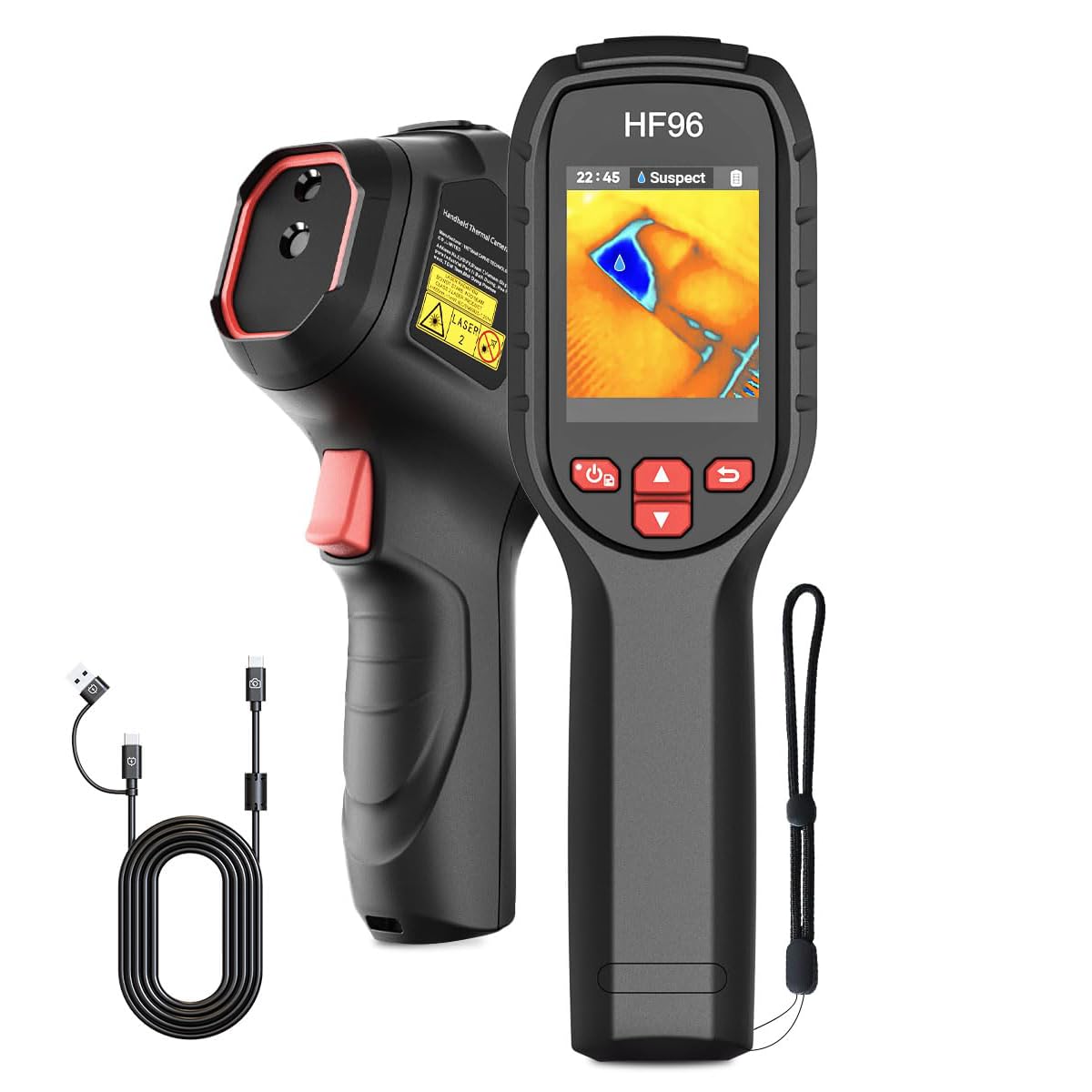
The HF96 strips out the visible camera of its V-series sibling but keeps the core thermal performance that makes it effective for home energy audits. The 96×96 sensor with live super resolution delivers 240×240 clarity, and the IntellFault AI scene detection still identifies water leaks and insulation gaps automatically. The 50-degree field of view provides wide coverage during scanning, and the laser pointer helps you match thermal spots to physical locations.
The temperature range extends from -4°F to 1022°F with ±3.6°F accuracy, making it suitable for HVAC diagnostics and electrical panel inspections. The 4 GB internal storage holds over 30,000 images, and the 11-hour battery life is among the best in this class. The device comes with HSF Studio PC software for image analysis and report generation. The IP54 rating and 6.6-foot drop test ensure it survives job site conditions.
Real-world users have confirmed it can see studs behind drywall by detecting thermal bridging, diagnose engine misses, and locate overheated breakers. Some units have arrived with pre-loaded images, suggesting they might have been returned prior to sale. The interface is simple but requires some menu navigation. For budget-conscious homeowners who want AI-assisted thermal inspection without paying for dual cameras, the HF96 is the right choice.
Why it’s great
- AI scene detection automatically flags insulation gaps and leaks
- 11-hour battery covers a full day of inspections
- Wide 50° FOV reduces scanning time on large walls
Good to know
- No visible-light camera for image fusion
- Some units arrived with pre-existing images suggesting prior use
7. MILESEEY TR10 Thermal Imaging Camera
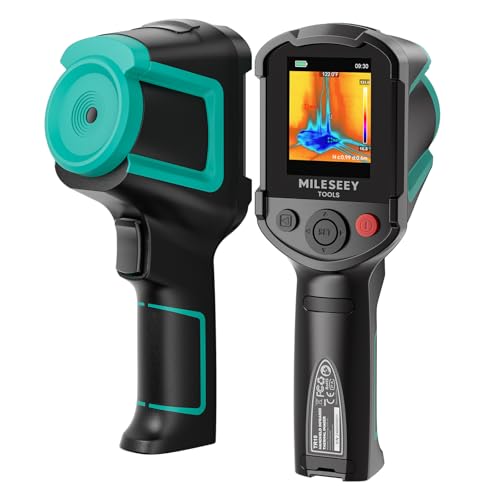
The MILESEEY TR10 packs a 192×192 super resolution sensor into a compact body that fits comfortably in one hand. Its 25 Hz refresh rate ensures smooth real-time imaging, and the -4°F to 1022°F range with ±2°C accuracy covers most residential and light commercial applications. The 3,000 mAh battery delivers a claimed 8 hours of operation, which held up well during testing according to user reports.
Key features include adjustable emissivity for different materials, automatic tracking of maximum, minimum, and center-point temperatures, and a high/low temperature alarm that alerts you to anomalies exceeding preset thresholds. The recessed lens protection and 6.6-foot drop test make it suitable for varied work environments. Built-in 8 GB storage holds more than 30,000 pictures. The device comes with a charger, instruction manual, and a wrist strap.
Homeowners have used it to find missing insulation behind walls and detect air leaks around doors and windows. The lower resolution compared to pricier models means you need to stand closer to the target for full detail. For entry-level thermal scanning, the TR10 is a capable starter tool that will reveal obvious problems.
Why it’s great
- 192×192 super resolution provides better clarity than basic 96×96 sensors
- High/low temperature alarm alerts you to critical anomalies quickly
- Compact size fits easily into a tool bag or pocket
Good to know
- Temperature readings can be inconsistent on reflective materials
- Lower resolution requires closer proximity for full detail
8. Klein Tools TI250 Thermal Imaging Camera

The Klein Tools TI250 is the most compact thermal imager in this list, weighing just 8.6 ounces and fitting into a shirt pocket. It displays over 19,200 pixels on a 160×120 effective resolution, which is adequate for finding major thermal anomalies like missing insulation and active electrical faults. The adjustable emissivity from 0.01 to 0.99 ensures accuracy across different surface materials.
Three color palettes — Ironbow, Rainbow, and Monochrome — allow you to optimize visibility for specific environments. The high and low temperature alarms are user-selectable from -4°F to 752°F. Images are captured and saved via USB-C, making transfer simple without proprietary software. The rechargeable lithium-ion battery eliminates the need for disposables, and the included carrying case provides protection during transport.
One user reported cutting their home energy consumption in half after using the TI250 to identify severe energy loss from seven recessed lights and bathroom fans. Another uses it to check cold spots in freeze-dried food. The small display and lack of a laser pointer make it harder to pinpoint exact problem locations compared to larger units. The temperature readings match other calibrated equipment according to reviewers. For homeowners who prioritize portability and affordability over high-resolution imaging, the TI250 is a solid choice.
Why it’s great
- Exceptionally compact at 8.6 ounces for easy pocket carry
- USB-C direct capture eliminates need for SD cards
- Accurate temperature readings verified against calibrated equipment
Good to know
- Small display makes detail identification challenging
- No laser pointer for precise target alignment
9. AMPBANK H128 Handheld Thermal Camera

The AMPBANK H128 offers the longest battery life of any device in this guide at a claimed 24 hours of continuous operation, making it the clear choice for extended fieldwork without access to charging. It uses TISR technology to boost its base resolution to 240×240, and the 40 mK thermal sensitivity captures slight temperature differences essential for detecting subtle insulation gaps and early electrical faults.
The -4°F to 842°F temperature range with ±3% accuracy and 0.1°C resolution covers standard residential and light commercial applications. The IP65 protection rating is the highest in this lineup, offering dust-tight seals and protection against low-pressure water jets. The 6.56-foot drop test gives confidence in demanding environments. The built-in temperature alarm automatically recognizes max, min, and center temperatures, and the device includes a standard tripod mount for stable long-duration monitoring.
HVAC professionals have used it to track temperature changes across vents as heating systems cycle on and off. Users note the 25 Hz frame rate provides smooth image transitions, though the 128×128 native resolution means you won’t see fine details on small components. The lack of a visible-light camera limits your ability to precisely match thermal anomalies to physical objects. The H128 is best suited for users who need all-day battery life and rugged protection more than high image resolution.
Why it’s great
- 24-hour battery life is unmatched for extended inspections
- IP65 dust and water protection handles harsh environments
- 0.1°C temperature resolution catches subtle anomalies
Good to know
- Native 128×128 resolution limits detail on small targets
- No visible-light camera for fusion imaging
FAQ
Can a thermal camera see through drywall?
What is the difference between a stud finder and a thermal camera for finding studs?
How many sensors does a good stud finder need?
Final Thoughts: The Verdict
For most users, the best device to see through walls winner is the Franklin Sensors ProSensor MAX because it eliminates the guesswork of traditional stud finders with instant, accurate detection of stud centers and edges on almost any wall type. If you need to find insulation gaps, water leaks, and electrical faults, grab the HIKMICRO E1L for its superior 160×120 sensor and professional analysis software. And for budget-conscious homeowners who want dual-camera fusion and AI scene detection, nothing beats the HSFTOOLS HF96V at its price point.

Mo Maruf
I created WellFizz to bridge the gap between vague wellness advice and actionable solutions. My mission is simple: to decode the research and give you practical tools you can actually use.
Beyond the data, I am a passionate traveler. I believe that stepping away from the screen to explore new environments is essential for mental clarity and physical vitality.