Our readers keep the lights on and my smoothie glass nicely filled. As an Amazon Associate, I earn from qualifying purchases.
Your glucose meter sits beside a dozen half-used test strip vials from three different brands — none of which work with the same device. That is the hidden friction that makes daily blood sugar checks feel harder than they need to be. A truly reliable monitor eliminates that confusion, giving you consistent, lab-accurate readings without forcing you to learn a new interface every time you test.
I’m Mohammad Maruf — the founder and writer behind WellFizz. This guide is built from hundreds of hours analyzing blood glucose monitor engineering, examining user feedback across thousands of verified reviews, and cross-referencing FDA clearance data to separate marketing noise from clinical reliability.
Whether you are managing type 1, type 2, or gestational diabetes, knowing which features actually matter can save you time, money, and daily frustration. That is exactly what this guide to the best device to check blood sugar delivers — clear, evidence-based recommendations for every budget and lifestyle.
How To Choose The Best Device To Check Blood Sugar
Not all glucose monitors deliver the same accuracy, ease of use, or long-term value. Focus on three core factors — certification standards, sample size, and data management — to find the right match for your daily routine.
Accuracy Certification: ISO 15197:2013 vs. ISO 15197:2015
ISO 15197 is the international benchmark for blood glucose monitoring system accuracy. Monitors certified to the 2013 or 2015 standard must produce readings within ±15% of laboratory reference values 99% of the time. Devices that exceed this — such as those promising results within ±10% — offer a clinically meaningful edge for insulin dosing decisions. Always check whether the manufacturer explicitly states compliance.
Blood Sample Size: The 0.5µL vs. 1.0µL Difference
Smaller sample requirements (0.5 µL to 0.8 µL) mean you draw less blood per test, which reduces pain and the risk of failed readings due to an insufficient drop. Monitors requiring 1.0 µL or more often cause more finger-stick discomfort, especially for users with poor circulation or calloused fingertips. Pair the sample size with an adjustable-depth lancing device for the gentlest experience.
Data Tracking and Connectivity: Memory vs. App Sync
Onboard memory (250–1000+ readings) lets you review trends directly on the meter. Bluetooth-enabled models sync automatically to companion apps, generating trend graphs and shareable reports for your healthcare provider. If you prefer simplicity, larger onboard storage with date-and-time stamps works fine. If you want pattern recognition and remote sharing, app connectivity becomes essential.
Quick Comparison
On smaller screens, swipe sideways to see the full table.
| Model | Category | Best For | Key Spec | Amazon |
|---|---|---|---|---|
| iHealth Gluco+ | Bluetooth Smart | App-driven tracking and sharing | 0.7 µL sample, 5‑second result | Amazon |
| CareSens N Starter Kit | Complete Bundle | All-in-one value with control solution | 0.5 µL sample, 5‑second result | Amazon |
| VivaGuard Bluetooth (VGM04) | Rechargeable Bluetooth | Eco-friendly with app sync | Rechargeable battery, 500 uses | Amazon |
| VivaGuard Talking (VGM26) | Voice Guidance | Visually impaired or elderly users | Voice broadcast, 1,000‑record memory | Amazon |
| ARKRAY GLUCOCARD Vital | Entry‑Level | Budget-friendly, simple operation | 0.5 µL sample, 7‑second result | Amazon |
In‑Depth Reviews
1. iHealth Gluco+ Wireless Smart Blood Glucose Monitor Kit
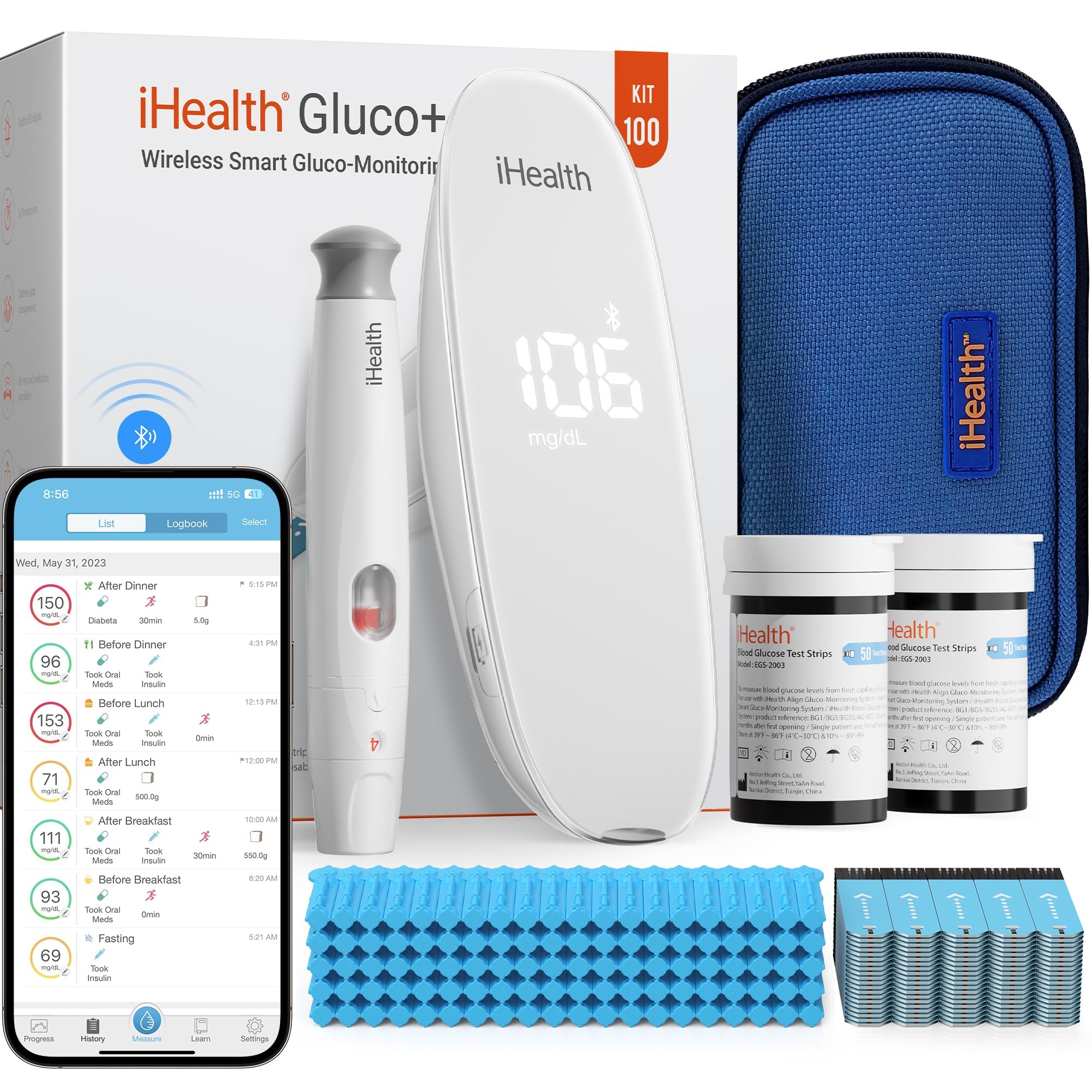
The iHealth Gluco+ sets the standard for modern glucose monitoring by pairing a compact, 510(k)-cleared meter with a free companion app that stores unlimited readings. Its 0.7 µL blood sample requirement keeps finger sticks quick and low-pain, while the adjustable 9-depth lancing device lets you dial in the right penetration for your skin. Results appear in just five seconds on a bright, backlit display that stays readable even in dim conditions.
What separates this kit from simpler meters is the wireless sync: every reading automatically transfers to the iHealth Gluco-Smart app, where you can view trend charts, set high/low glucose alerts, and share reports directly with your doctor. The rechargeable lithium-polymer battery eliminates the hassle of hunting for replacement batteries — a single four-hour charge lasts for dozens of tests. The kit includes 100 test strips, 100 lancets, a lancing device, and a travel case, making it ready for daily use straight out of the box.
Some users report a minor variance (1–8 mg/dL) compared to lab draws, which falls well within the ±15% ISO tolerance. The initial Bluetooth pairing can take a couple of tries, but once connected, the sync is seamless. If you value data-driven diabetes management and dislike fiddling with coin-cell batteries, the Gluco+ is the most future-proof option here.
Why it’s great
- Automatic Bluetooth sync with unlimited app storage
- Rechargeable battery — no coin-cell replacements needed
- Compact, lightweight form factor for travel
Good to know
- App pairing can require a few attempts initially
- Carrying case is somewhat minimalist for strip organization
2. CareSens N Blood Glucose Monitor Starter Kit

The CareSens N Starter Kit delivers the most complete unboxing experience among mid-range monitors: alongside the meter and 100 strips, it includes a control solution for validating accuracy, 100 lancets, a lancing device, and a sturdy travel case. Requiring only 0.5 µL of blood, the test strips use auto-coding — meaning the meter reads the code on the strip automatically, eliminating manual entry errors. Results appear in five seconds, consistent with the fastest options in this category.
Users consistently praise the CareSens N for its clinical consistency. Verified reviews note that readings tend to fall within a tight range when compared side-by-side with lab draws, and the 250-test memory with 7/14/30-day averages helps track trends without needing a smartphone. The battery compartment uses standard lithium manganese dioxide cells rated for 1,000 tests, so you will replace batteries infrequently. The display is clear and uncluttered, making it especially practical for older adults who may find app-connected meters confusing.
The main trade-off is the lack of Bluetooth or any wireless connectivity — this is strictly a standalone meter. If you prefer manual logbooks or don’t need digital sharing, that is an advantage. Some users mention that strips must be stored in the original vial to avoid moisture damage, a common requirement for all strip-based monitors. For a budget-friendly kit that includes everything to start testing immediately, the CareSens N is hard to beat.
Why it’s great
- Includes control solution for accuracy verification
- Auto-coding strips — no manual code entry needed
- Very small 0.5 µL blood sample reduces discomfort
Good to know
- No Bluetooth or app connectivity
- Strips sensitive to humidity; keep vial sealed
3. VivaGuard Blood Glucose Monitor (VGM04) with Bluetooth
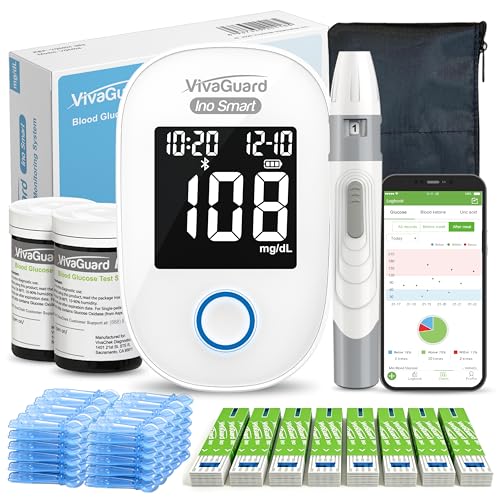
The VivaGuard VGM04 stands out for its rechargeable lithium-polymer battery — rated for up to 500 tests per charge — which eliminates both battery waste and the annoyance of dead coin cells mid-week. It meets ISO 15197:2013 standards with a claimed ±10% accuracy margin, exceeding the regulatory minimum. The meter accepts a tiny 0.8 µL sample and produces a result in five seconds, matching the speed of premium competitors. A backlit, high-contrast display makes readings legible in bright sunlight or low-light bedrooms.
Bluetooth connectivity pairs with the free VivaGuard app, enabling automatic sync of readings and trend analysis. The app stores historical data and can generate reports for healthcare providers. The five-depth adjustable lancing device combined with 30G lancets minimizes pain, and the included travel case holds the entire kit neatly. For users who want modern features without paying top-tier prices, the VGM04 delivers strong value.
A few reviewers note that the companion app has room for improvement — occasional sync hiccups and a somewhat clunky interface. If app reliability is your top priority, the iHealth Gluco+ has a more polished software experience. The kit does not include a control solution, so you will need to purchase one separately if you want to verify accuracy periodically. Still, for an eco-friendly, Bluetooth-enabled monitor at this price point, the VGM04 is a compelling choice.
Why it’s great
- Rechargeable battery — no disposable cells
- Clear backlit display readable in any light
- Exceeds ISO accuracy standards (±10%)
Good to know
- App connectivity can be inconsistent for some users
- No control solution included in the kit
4. VivaGuard Talking Blood Glucose Monitor Kit (VGM26)
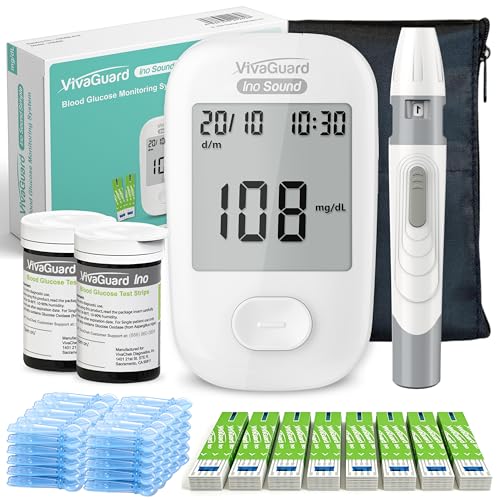
The VivaGuard VGM26 is the only monitor in this lineup with a full voice guidance system — it announces each step of the testing process and speaks the final reading aloud. This feature is invaluable for users with vision impairments, elderly family members who struggle with small screens, or anyone who wants an audible confirmation of their result. The voice volume can be adjusted or muted, giving you flexibility in quiet environments. Results arrive in five seconds from a 0.8 µL sample.
Beyond the talking function, the VGM26 stores up to 1,000 readings with date and time stamps — double what most competitors offer — and computes 7-, 14-, and 30-day averages for trend tracking. The no-coding design means you simply insert a strip and test, with no manual calibration. The kit includes 100 test strips, 100 30G lancets, an adjustable lancing device, two AAA batteries, and a carrying case, making it a complete package for home or travel use. ISO 15197:2015 compliance ensures clinical-grade accuracy.
The main drawback is the instruction manual: some users find the single folded page insufficient, particularly for setting the date and time. A few units have reportedly had issues with the voice repeating old results, though this appears to be an isolated quality-control concern. If you or a loved one benefits from spoken guidance and appreciates generous memory capacity, the VGM26 is uniquely suited to fill that need.
Why it’s great
- Voice guidance announces steps and results aloud
- Huge 1,000-record memory with averaging
- Meets ISO 15197:2015 accuracy standards
Good to know
- Instruction manual is minimal and hard to follow
- Some units may have voice-replay glitches
5. ARKRAY GLUCOCARD Vital Blood Glucose Monitor Kit
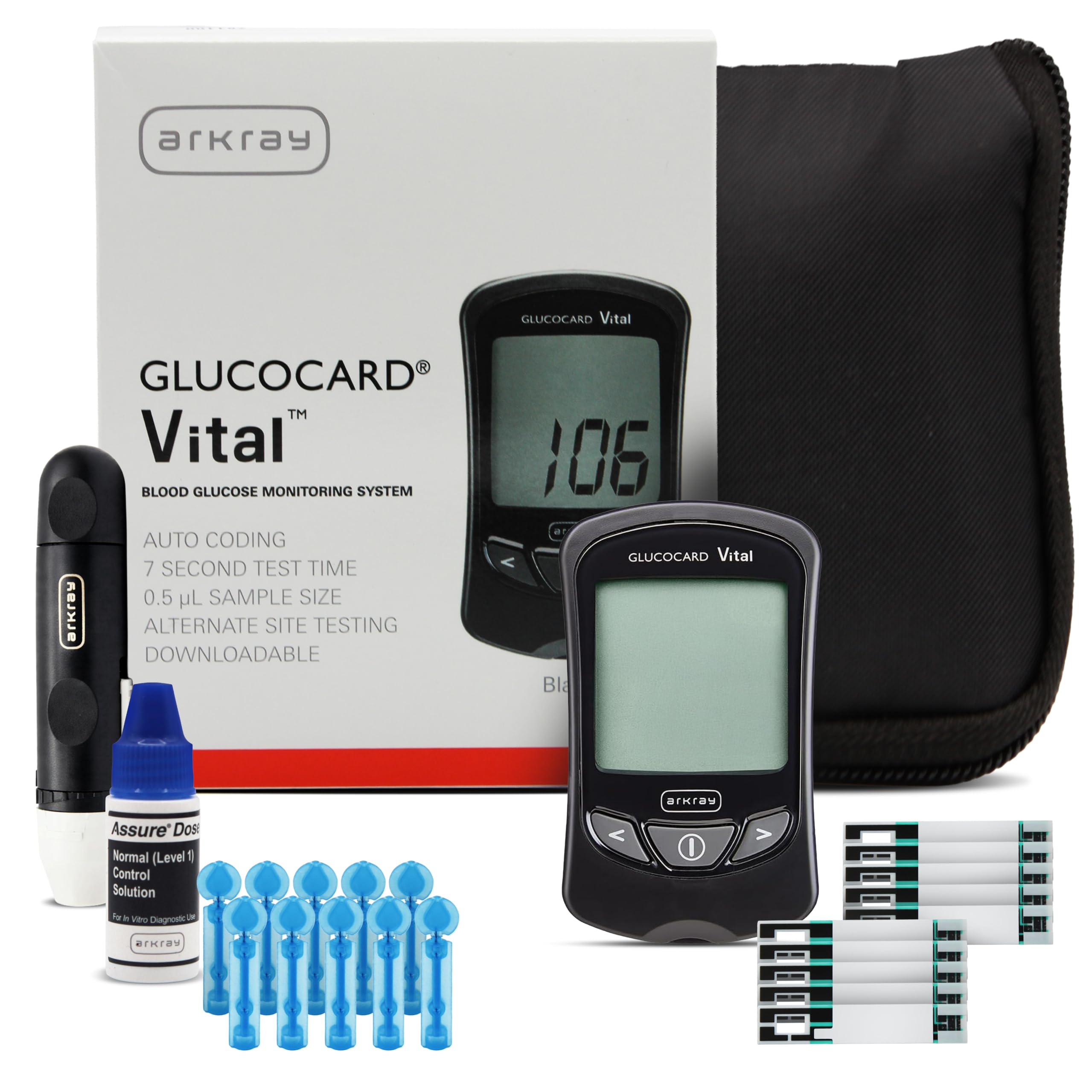
The ARKRAY GLUCOCARD Vital is a straightforward, no-frills meter built for users who want reliable results without Bluetooth, apps, or complex menus. Requiring only 0.5 µL of blood, it produces a reading in seven seconds — slightly slower than the five-second monitors above, but still fast enough for comfortable daily use. Auto-coding means the meter reads the strip batch code automatically, removing the risk of manual coding errors.
The kit comes with 10 test strips, 10 lancets, a lancing device, a small bottle of control solution, and a carrying case. That is enough to start testing immediately, but the 10-strip count means you will need to buy a larger supply quickly. Onboard memory holds 250 readings with 14- and 30-day averaging, and the automatic shut-off extends battery life. The display is clear and the interface uses just two buttons, making operation intuitive for first-time users.
The most common criticism is that the included strip count is minimal — this is truly a starter kit meant to get you familiar with the system rather than sustain long-term use. Replacement strips are widely available, but the per-strip cost is average. If you need the absolute lowest upfront investment to begin testing and prefer a simple, proven design from a established medical device manufacturer, the GLUCOCARD Vital fits the bill.
Why it’s great
- Very small 0.5 µL blood sample minimizes pain
- Auto-coding eliminates manual strip calibration
- Control solution included for accuracy checks
Good to know
- Only 10 test strips included — need to buy more
- 7-second read time is slightly slower than rivals
FAQ
Can I use any brand of test strip with my glucose meter?
Why do my home meter readings differ from lab results?
How often should I use the control solution to check accuracy?
Is a Bluetooth glucose monitor worth the extra cost?
Final Thoughts: The Verdict
For most users, the best device to check blood sugar winner is the iHealth Gluco+ because it combines clinical accuracy, automatic Bluetooth data sync, and a rechargeable battery in a compact kit — removing the two biggest annoyances of daily monitoring: manual logging and dead batteries. If you want a complete bundle with control solution and a proven track record, grab the CareSens N Starter Kit. And for elderly family members or users with vision challenges, nothing beats the VivaGuard Talking Monitor with its spoken guidance and 1,000-record memory.

Mo Maruf
I created WellFizz to bridge the gap between vague wellness advice and actionable solutions. My mission is simple: to decode the research and give you practical tools you can actually use.
Beyond the data, I am a passionate traveler. I believe that stepping away from the screen to explore new environments is essential for mental clarity and physical vitality.