Our readers keep the lights on and my smoothie glass nicely filled. As an Amazon Associate, I earn from qualifying purchases.
Losing thousands of family photos, irreplaceable travel memories, or critical business shots due to a failed phone or laptop isn’t a hypothetical risk—it’s a ticking clock for anyone who hasn’t invested in a dedicated storage solution. The best device for storing photos does more than just copy files; it acts as a secure, portable vault that organizes and protects your digital archive from accidental deletion, hardware failure, and even physical damage.
I’m Mohammad Maruf — the founder and writer behind WellFizz. My research into drive reliability, transfer protocols, and real-world recovery scenarios helps you cut through the marketing noise and find the storage device that will actually keep your photos safe for the long haul.
From ultra-fast solid-state drives for professional editors to massive hard drives for family archives and even network-attached storage for a private cloud, choosing the right device for storing photos means matching capacity, speed, and connectivity to your specific workflow.
How To Choose The Best Device For Storing Photos
Photo storage isn’t one-size-fits-all. A professional photographer transferring 50MB RAW files needs a completely different drive than a parent backing up a phone gallery. Here are the three core specifications that separate a good photo storage device from a regretful purchase.
Drive Type: HDD Capacity vs. SSD Speed
Hard disk drives (HDDs) offer the most storage per dollar, with 2TB and 6TB options ideal for large, static archives. Solid-state drives (SSDs) cost more per gigabyte but deliver transfer speeds of 1,000 MB/s or higher, making them essential for anyone who edits photos directly from the drive or moves large folders of high-resolution images frequently. For pure backup, an HDD suffices; for active work, an SSD is non-negotiable.
Connectivity and Transfer Protocol
USB 3.2 Gen 1 (5 Gbps) is the baseline for modern external drives, while USB 3.2 Gen 2 (10 Gbps) doubles the throughput and can saturate an SSD’s read speed. For iPhone users, look for MFi-certified drives with a Lightning or USB-C connector that bypass the need for cloud uploads. A drive that ships with both USB-C and USB-A cables guarantees compatibility with the widest range of laptops, desktops, and mobile devices.
Durability and Encryption
Photo libraries often travel in camera bags or backpacks. An IP65 water and dust resistance rating and 3-meter drop protection are real safeguards, not marketing fluff, for an SSD you will actually carry. Hardware-based 256-bit AES encryption adds a crucial privacy layer — if the drive is lost or stolen, your personal photos remain unreadable without the password. No amount of backup software helps if the physical drive is compromised.
Quick Comparison
On smaller screens, swipe sideways to see the full table.
| Model | Category | Best For | Key Spec | Amazon |
|---|---|---|---|---|
| Samsung T7 Portable SSD | External SSD | Fast photo editing & daily backup | 1,050 MB/s read, 1TB | Amazon |
| Synology DS223j | NAS Enclosure | Private cloud & automated family backups | 2-bay RAID 1, diskless | Amazon |
| SanDisk Extreme Portable SSD | Rugged SSD | Travel & outdoor photo storage | IP65, 3m drop, 1,050 MB/s | Amazon |
| iDiskk MFi Certified 2TB HDD | iPhone HDD | iPhone/iPad photo offload without cloud | MFi certified, auto backup app | Amazon |
| WD 2TB Elements Portable HDD | External HDD | Reliable budget-friendly archives | 2TB, USB 3.2 Gen 1, 5Gbps | Amazon |
| Maxone 1TB Ultra Slim HDD | Slim HDD | Lightweight 1TB for students/entry users | 0.4 inch thick, aluminum | Amazon |
| WD 6TB Elements Portable HDD | High-Capacity HDD | Massive photo archives (multiple libraries) | 6TB, 2.5-inch portable | Amazon |
In‑Depth Reviews
1. Samsung T7 Portable SSD

The Samsung T7 is the gold standard for photo storage because it marries NVMe-level read speeds of 1,050 MB/s with a compact, unibody aluminum design that dissipates heat effectively during long transfers. For a photographer or creative professional, this means importing a memory card full of RAW files or editing 4K video directly from the drive without waiting on buffering, and the drive rarely exceeds 42°C even under sustained load — well below the thermal throttle point.
Its PCIe NVMe technology is nearly twice as fast as the earlier T5, and the included USB-C and USB-A cables make it immediately compatible with modern laptops, older desktops, and even an iPhone 15 Pro for direct 4K 60fps video recording. The drive also includes 256-bit AES hardware encryption via a password setting, which is essential for anyone who carries their full photo library outside a home office.
Some users note that the factory default is MBR format; reformatting to GPT for modern Windows systems unlocks the full performance potential. The 1TB capacity hits the sweet spot for an active working drive, though heavy shooters may want to pair it with a larger HDD for cold storage. This is the drive you edit from and trust not to fail mid-project.
Why it’s great
- Extremely fast 1,050 MB/s read speed eliminates waiting time for RAW imports
- Rugged aluminum unibody with shock resistance up to 6 feet
- Hardware encryption keeps personal photo collections secure if lost
Good to know
- 1.5ft included USB-C cable may be too short; a longer Gen2 cable upgrade is recommended
- Requires reformatting to GPT for peak performance on modern systems
- 1TB fills quickly for users with multiple large photo and video libraries
2. Synology 2-Bay DiskStation DS223j
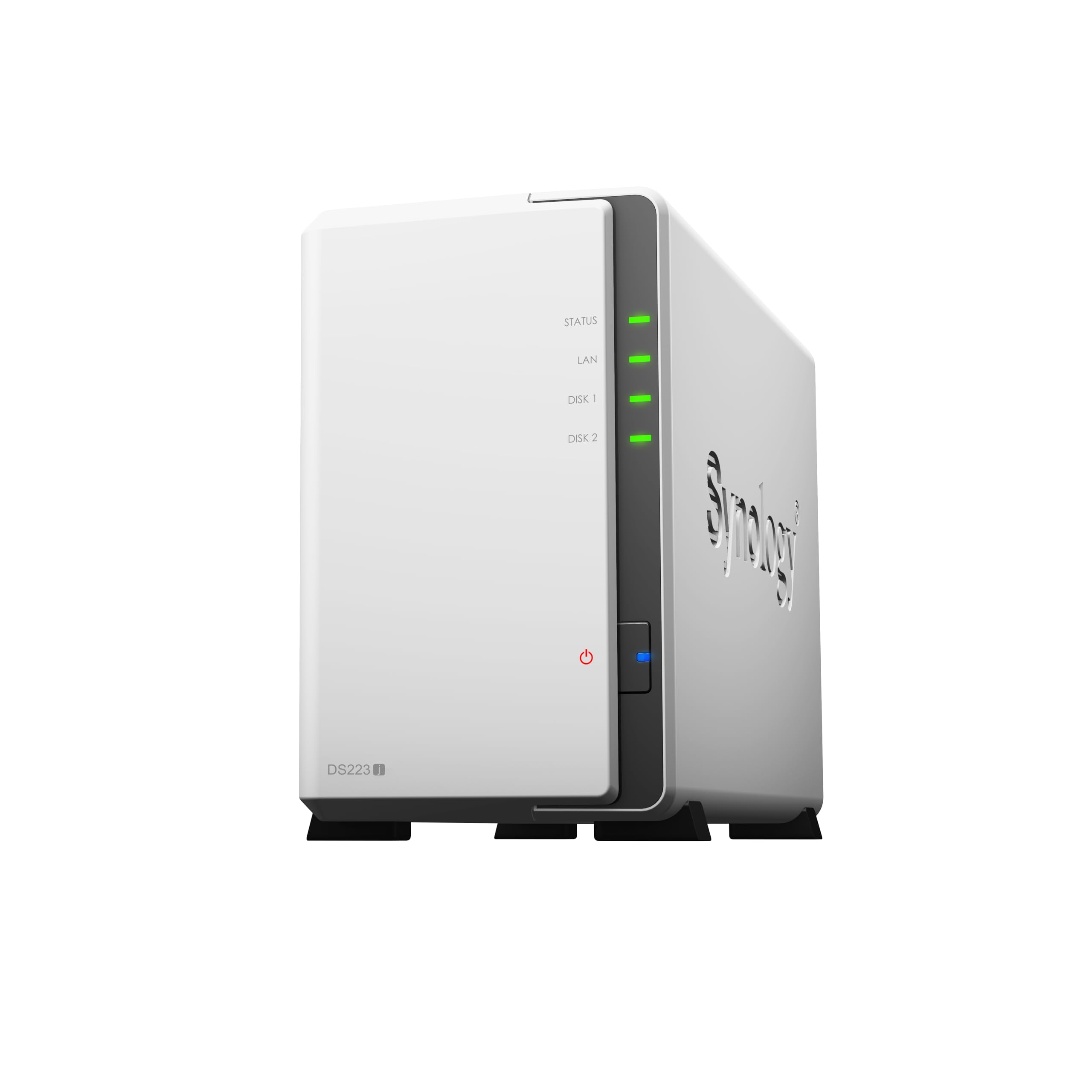
If your photo storage needs extend beyond a single external drive into a fully automated, always-on backup solution for the whole family, the Synology DS223j transforms any two NAS-rated drives into a private cloud that your phone, laptop, and tablet can all access from anywhere. The 2-bay chassis lets you configure RAID 1 mirroring, so if one hard drive fails, your entire photo library remains intact on the second drive — no cloud subscription fees, no recurring costs.
Setup is surprisingly painless for a network device: insert the drives, boot it up, and use the Synology assistant to create a storage pool. The included Synology Photos app then automatically backs up every photo from everyone’s iPhone or Android the moment they join the home WiFi network. Scheduled power on and off keeps power draw minimal, and the USB port allows for one-button backups to an external drive for an extra off-site copy.
The main trade-off is that this enclosure ships without drives, so you will need to purchase two separate hard drives (like WD Red or Seagate IronWolf) to get started. The software interface, while powerful, has a steeper learning curve than a simple plug-and-play USB drive, and the DS223j can slow down when running multiple apps like Surveillance Station or file sync simultaneously. For a dedicated photo vault, it is the most reliable option long-term.
Why it’s great
- RAID 1 mirroring protects photos from a single drive failure automatically
- Synology Photos app provides private, cloud-like access from any device
- Set-and-forget scheduled backups for every phone in the household
Good to know
- Diskless unit requires separate purchase of NAS-rated drives
- Software interface has a learning curve beyond simple external drive use
- Performance slows under heavy multi-application load
3. SanDisk Extreme Portable SSD

The SanDisk Extreme Portable SSD matches the Samsung T7 in raw transfer speed — up to 1,050 MB/s read and 1,000 MB/s write — but adds an extra layer of physical resilience with an IP65 water and dust resistance rating and 3-meter drop protection. For outdoor photographers, wedding shooters, or anyone who packs their drive into a camera bag that gets tossed around, this rating means a splash from a rainstorm or a tumble off a table won’t result in a lost gallery.
The built-in carabiner loop lets you clip the drive to a backpack strap or belt loop, keeping it accessible without occupying a pocket. It comes with both a USB-C cable and a USB-A adapter, so it works out of the box with everything from a MacBook to an older desktop. The included 256-bit AES hardware encryption also mirrors the T7, meaning your private photo collections stay locked behind a password even if the drive falls into the wrong hands.
User reports after a year of heavy use confirm the drive shows no slowdown and no connection dropouts, and it runs only slightly warm during sustained writes. The 1TB capacity is generous for most photo workflows, though videographers editing 4K directly from the drive may prefer the 2TB version. The only minor downside is that the drive is physically smaller than expected — which is actually a strength for portability once you get used to it.
Why it’s great
- IP65 water and dust resistance protects against real outdoor conditions
- 3-meter drop protection adds peace of mind for travel-heavy users
- NVMe performance matches other top-tier portable SSDs
Good to know
- Older model with updated firmware; check for latest revision
- Some users buy a hard shell cover for extra scratch protection
- 1TB fills quickly if used for both photos and 4K video work
4. iDiskk MFi Certified 2TB External Hard Drive

The iDiskk drive is purpose-built for iPhone and iPad users who want to free up device storage without paying for a monthly iCloud subscription. Its MFi certification guarantees stable data transfer with iOS devices, and the companion iDiskk Player app enables one-tap and future backups that only save newly added photos, avoiding duplicate file clutter. The drive packs a built-in 5000mAh battery, allowing it to function as both external storage and a power bank during travel.
Connection is straightforward: download the app, plug the drive into your iPhone’s Lightning or USB-C port, and tap “Backup.” The drive supports multitasking, so you can continue using your phone while the backup runs in the background. Data encryption with password protection is available, and the drive works with Android devices, PCs, and Macs after switching modes via the included manual — making it one of the most cross-platform photo storage solutions for mobile-first users.
The main drawbacks are bulk and occasional app instability. The drive is noticeably thicker than a standard portable HDD or SSD, and some users report the app crashes when transferring large video files, requiring a restart. The included PDF manual is also difficult to locate; Amazon’s Rufus feature provides better step-by-step guidance. For pure iPhone photo offloading, though, it bypasses the need for any cloud upload and keeps your originals in your hands.
Why it’s great
- MFi certified ensures stable, reliable data transfer with iPhones and iPads
- One-tap backup feature saves only new files to avoid duplicates
- Built-in 5000mAh battery doubles as a power bank for travel
Good to know
- App can crash during large video transfers; requires app restart
- Bulkier than typical portable drives due to internal battery
- Setup instructions are confusing; Amazon support via Rufus helpful but not ideal
5. WD 2TB Elements Portable External Hard Drive

The WD 2TB Elements is the quintessential balance of price and capacity for anyone who needs a dedicated home for their photo archive without paying a premium for SSD speed. It connects via USB 3.2 Gen 1 (5 Gbps) and is plug-and-play on Windows — no driver installations or reformatting required. For family photo libraries, scanned documents, and music collections that consume 1–2TB, this drive offers plenty of room without feeling wasteful.
Its 2.5-inch form factor is small enough to slip into a laptop bag pocket, and the drive runs whisper-quiet during operation. Users consistently report months or years of flawless performance for backups and file storage, making it a standard recommendation for home offices and students. It works with Mac out of the box as well, though Mac users running Time Machine on Monterey should note the OS may reformat to APFS, locking the drive for backups only.
The plastic enclosure, while lightweight and functional, does not offer the same impact protection as an SSD or a ruggedized drive. Care should be taken during transport. Some users also report that the included USB cable can be fragile and recommend replacing it with a sturdier third-party cable to avoid connection issues. For the price, this drive is the most straightforward way to back up 2TB of photos without any extra software or hardware.
Why it’s great
- 2TB capacity provides ample space for most family photo libraries
- Plug-and-play on Windows with no software installation needed
- Compact and lightweight design for easy portability
Good to know
- Included USB cable is prone to failure; plan to replace it
- Plastic enclosure lacks drop or water protection
- Not suitable for active photo editing due to slower HDD speeds
6. Maxone 1TB Ultra Slim Portable External Hard Drive

At just 0.4 inches thick with an all-aluminum anti-scratch chassis, the Maxone 1TB is the most portable budget-friendly HDD for students or casual users who need a simple, single-drive solution for their photo collection. The aluminum body acts as a heat sink, keeping the drive running cool during extended file transfers, and the metal construction feels noticeably more durable than the plastic shells found on similarly priced drives.
USB 3.0 technology provides transfer speeds up to 5 Gbit/s, which is sufficient for daily backups of JPEG and HEIC photos from a laptop. Plug-and-play operation means no external power supply or software is needed — just plug it into a USB-A port on a PC, laptop, or game console. The drive works with Xbox One and PlayStation 4, making it a decent option for storing game captures alongside personal photos.
Customer feedback over several years indicates consistent reliability, though the drive can occasionally make random sounds and trigger drive-fix notifications on Windows — a common behavior in budget HDDs. The 18-inch USB cable is noticeably short, limiting placement options on a desk. Users who drop the drive frequently report connection issues; this is not a ruggedized device. For a lightweight extra drive in a desk drawer, it gets the job done affordably.
Why it’s great
- Ultra-slim 0.4 inch aluminum design is highly portable and cool-running
- Plug-and-play setup works with PC, laptop, and gaming consoles
- 3-year manufacturer warranty provides basic peace of mind
Good to know
- Short 18-inch USB cable limits desk placement options
- Not shock-resistant; drops can cause connection failure
- Occasional random sounds and drive-fix notifications reported
7. WD 6TB Elements Portable External Hard Drive

For users with truly massive photo libraries — think decades of family archives, multiple DSLR collections, or a professional backlog of event shoots — the WD 6TB Elements is a breakthrough in portable HDD capacity. It is the world’s first 6TB 2.5-inch portable hard drive, squeezing an enormous amount of storage into a form factor that still fits in a laptop bag pocket. This is the drive you buy when you want to consolidate three older external drives into a single device without adding bulk.
The drive connects via USB 3.2 Gen 1 (5 Gbps), and while transfer speeds are standard for a 5400 RPM HDD, the real value is the raw capacity. Plug-and-play on Windows means you can start moving folders immediately. For Mac users, the same Time Machine formatting note applies as with the 2TB version — you may need to create a separate volume to avoid APFS lock. The drive runs slightly warm under load but remains whisper-quiet, making it suitable for a shelf or desk corner.
Given the high capacity, this drive should be used for cold storage and periodic backups rather than daily active editing. The plastic and metal enclosure provides basic protection, but dropping a 6TB drive can be catastrophic, so a padded case is recommended. As with many WD Elements models, replacing the included USB cable with a higher-quality one can prevent future disconnection issues. This is the most cost-effective way to store over 1.5 million photos in a single portable package.
Why it’s great
- Massive 6TB capacity in a slim 2.5-inch portable form factor
- Consolidates multiple older drives into one portable device
- Plug-and-play on Windows with no extra software needed
Good to know
- Included USB cable is known to fail over time; replacement recommended
- Not shock-resistant; risk of data loss if dropped
- 5400 RPM speed is slow for active photo editing workflows
FAQ
Should I use an SSD or HDD for long-term photo archiving?
Can I connect an external photo drive directly to my iPhone?
How do I recover photos if my external drive fails?
What does IP65 mean for a portable photo drive?
Final Thoughts: The Verdict
For most users, the device for storing photos winner is the Samsung T7 Portable SSD because it delivers professional-grade read speeds of 1,050 MB/s, a durable aluminum unibody, and hardware encryption — making it the ultimate daily driver for photo editing and backup. If you want automated redundancy for your entire family’s photo library without cloud fees, grab the Synology DS223j. And for a rugged SSD that survives drops and splashes during outdoor shoots, nothing beats the SanDisk Extreme Portable SSD.

Mo Maruf
I created WellFizz to bridge the gap between vague wellness advice and actionable solutions. My mission is simple: to decode the research and give you practical tools you can actually use.
Beyond the data, I am a passionate traveler. I believe that stepping away from the screen to explore new environments is essential for mental clarity and physical vitality.