Our readers keep the lights on and my smoothie glass nicely filled. As an Amazon Associate, I earn from qualifying purchases.
At six months, your baby is transitioning from passive observation to active exploration—grasping, rolling, reaching, and testing cause and effect for the first time. The right toy at this stage doesn’t just entertain; it builds the neural pathways for fine motor control, spatial reasoning, and sensory integration during a narrow developmental window that closes faster than most parents realize.
I’m Mohammad Maruf — the founder and writer behind WellFizz. I’ve spent hundreds of hours analyzing the engineering, material safety certifications, and age-specific developmental triggers behind infant toys to help parents make informed purchases that truly support their child’s growth.
After evaluating construction quality, sensory complexity, and safety compliance across dozens of options, I’ve compiled the most reliable selection of the best developmental toys for 6 month old babies that target real milestones without overwhelming your little one.
How To Choose The Best Developmental Toys For 6 Month Old
At six months, babies enter a phase of rapid motor and cognitive change—rolling both ways, sitting with support, reaching with precision, and beginning to understand object permanence. The best toys for this stage offer multi-sensory feedback, are safe for mouthing, and challenge specific emerging skills without causing frustration or overstimulation.
Material Safety and Choking Hazard Compliance
A 6-month-old explores primarily through mouthing. Every component must pass the choke tube test—meaning no piece is small enough to fit inside a toilet paper roll. Look for explicit CPSIA and ASTM F963 certification. Food-grade silicone is ideal for teething toys, while BPA-free ABS plastic is acceptable for structural pieces. Avoid toys with glued-on parts, loose button eyes, or paints that flake under chewing.
Developmental Targeting: Tummy Time, Grasping, and Cause-Effect
The 6-month milestone demands toys that serve multiple stages. For tummy time, look for rollers and drums that encourage weight shifting and visual tracking. For seated play, stacking rings, shape sorters, and pull-string toys build pincer grasp and wrist rotation. Toys with contrasting colors, mirrors, and hidden movements (like a ball reappearing after rolling away) teach object permanence and spatial reasoning long before the baby can name them.
Quick Comparison
On smaller screens, swipe sideways to see the full table.
| Model | Category | Best For | Key Spec | Amazon |
|---|---|---|---|---|
| Plunack 6-in-1 | All-in-One Kit | Comprehensive milestone progression | 28 pieces, food-grade silicone | Amazon |
| Qirptey 4-in-1 | Multi-Activity Set | Teething + shape sorting | Food-grade silicone & ABS, 18+ pieces | Amazon |
| Adena Montessori Kit | Montessori Set | Tummy time & spinning action | Spinning drum, mirror, fabric ball | Amazon |
| Youuys Tissue Box | Sensory Cube | Pull-and-play fine motor skills | 12 scarves + 3 crinkle tissues | Amazon |
| Thremhoo Jumbo Roller | Inflatable Roller | Crawling encouragement | 16-inch inflatable, glowing sequins | Amazon |
In‑Depth Reviews
1. Plunack 6 in 1 Montessori Baby Toys
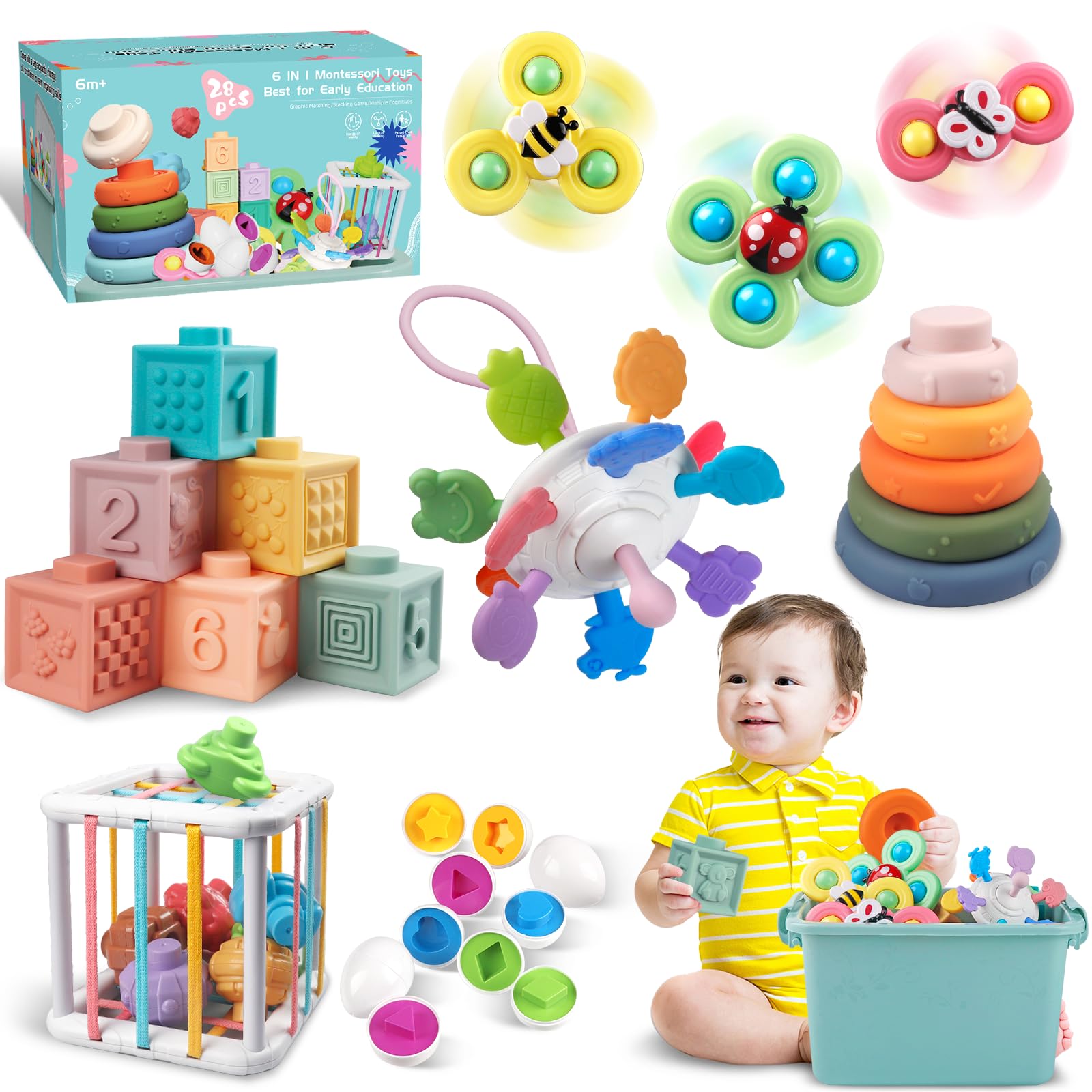
This is the most comprehensive single-box solution for the 6-12 month window. The set includes 6 soft stacking blocks, 5 stacking rings, 6 matching eggs, 3 suction cup spinners, a pull-string sensory toy, and a sensory bin with 6 shape blocks—all 28 pieces designed around specific developmental milestones rather than random play. Each component is crafted from food-grade silicone and BPA-free ABS plastic, tested to CPSIA and ASTM F963 standards, with the silicone blocks being dishwasher-safe and tolerant up to 200°C.
The suction cup spinners are particularly well-engineered for this age—they stick firmly to highchair trays and bathtub walls, keeping a baby engaged during meals and bath time without sliding off. Pediatric occupational therapists recommend the textured pull-string activity specifically for developing the pincer grasp that typically emerges around 7-8 months. The stacking rings teach size sequencing and color recognition, while the shape sorter eggs (12 colors paired with 6 shapes) build spatial reasoning through a satisfying push-and-click mechanism that babies quickly learn to anticipate.
The included storage bin doubles as a sensory bin during play and keeps all pieces organized for travel or daycare transport. The eggs are hollow and lightweight, making them easy for small hands to grasp but challenging enough to encourage rotational wrist movement. The only minor friction reported is that the teething ball has flat ends that some babies find less interesting to mouth than rounder alternatives—but with 27 other pieces in rotation, this rarely matters.
Why it’s great
- Covers 6 distinct skill areas in one purchase without overlap or filler
- Food-grade silicone is safe for teething and survives dishwasher sterilizing
- Suction spinners work on multiple surfaces—highchair, bath, car window
Good to know
- Some babies find the teething ball’s flat ends less engaging
- Larger set means more pieces to track during travel
2. Qirptey 4-in-1 Montessori Baby Toys
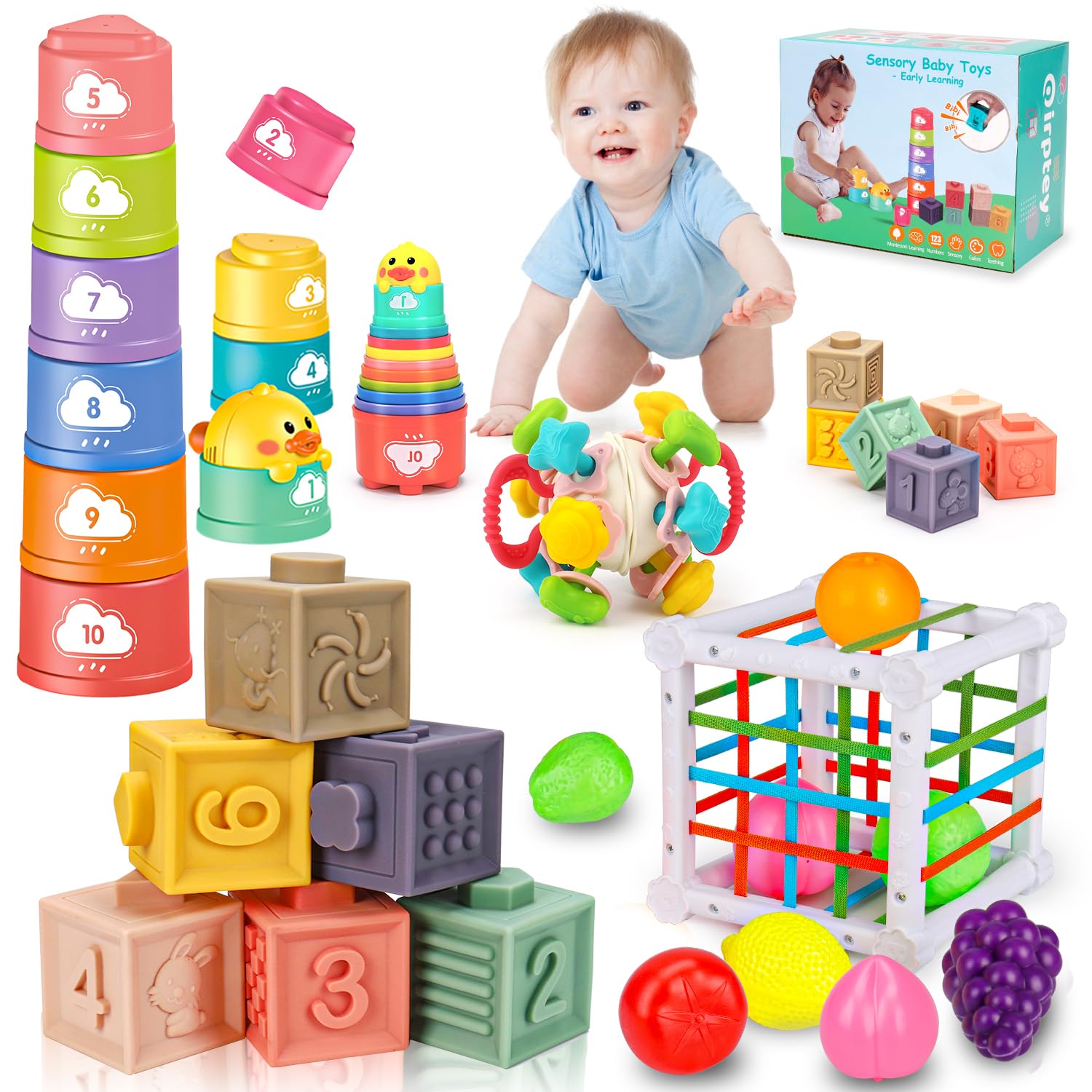
This 4-in-1 set leans hard into teething relief while still delivering genuine developmental value. The centerpiece is the fruit-shaped shape sorter bin—six soft silicone fruits (guava, orange, peach, tomato, lemon, grape) that are impact-sized for small hands and made from food-grade silicone that soothes inflamed gums during the typical 6-month teething spike. The stacking blocks are also soft silicone, designed to be squeezed, chewed, and tossed without causing injury or damage.
The stacking cups add a numerical and textural layer: each cup has a different color, shape number, and surface texture, allowing the toy to remain relevant as the baby grows from simple grasping (6 months) to intentional stacking and sorting (12+ months). The shape sorter bin’s fruit pieces are hollow and lightweight, making them easy to extract but slightly more difficult to reinsert—a deliberate design that encourages problem-solving and spatial reasoning without causing frustration. Early walkers will enjoy carrying the fruit pieces around the house, extending the toy’s lifespan well past the first birthday.
The material choice here is the standout feature. The silicone is premium-grade, non-toxic, and free of BPA, phthalates, and lead—third-party tested to meet CPSC requirements for infants 6+ months. The ABS structural pieces (the bin and cup bases) are durable enough to survive drops onto hard floors without cracking. The only durability concern reported is that the bin’s lid hinge can stress over time if a particularly determined baby pries it open aggressively, but this is an edge case rather than a common failure point.
Why it’s great
- Food-grade silicone pieces double as effective teething relief
- Fruit-shaped sorter is intuitive and visually engaging for this age
- Grows with baby from 6 months through 18+ months
Good to know
- Bin hinge may loosen under very aggressive play
- Set is smaller overall than some all-in-one kits
3. Adena Montessori Baby Toys Play Kit

This is a focused Montessori kit rather than a grab-bag of activities, which is exactly the right approach for parents who want quality over quantity. The set includes a wooden-and-fabric spinning rainbow drum, a wooden knob puzzle with a baby-safe mirror, and a rainbow fabric ball—three items that each target a specific developmental function without visual or sensory overload. The spinning drum is the standout: when a baby bats or kicks it during tummy time, the colors blend into a moving pattern and the drum produces a soft, soothing noise that rewards effort without startling.
The mirror element is particularly valuable at 6 months—babies at this age are just beginning to recognize their own reflection, and the knob puzzle encourages reaching, grasping, and the early concept of “fitting” a shape into a space. The fabric ball is lightweight and easy to grab, roll, and mouth, with a textured surface that provides tactile variety. The entire set is made from non-toxic, organic cotton and unfinished wood—no paints, glues, or synthetic coatings that could leach during mouthing.
The spinning drum works best on soft surfaces like carpet or play mats. On hard floors, the drum may tip or slide rather than spin cleanly, which can frustrate a baby who hasn’t yet mastered cause-effect logic. Some babies need initial parental demonstration to understand that batting the drum makes it spin—once they connect the action to the reaction, the toy becomes deeply engaging for extended periods. The drum is lightweight enough for a baby to push it around during early crawling attempts, transitioning from tummy time tool to mobility motivator.
Why it’s great
- Montessori-aligned design encourages self-directed discovery
- Mirror and spinning drum uniquely target 6-month visual milestones
- Non-toxic, organic materials with zero synthetic coatings
Good to know
- Drum spins best on soft surfaces—hard floors reduce effectiveness
- Baby may need initial demonstration to connect action with reaction
4. Youuys Baby Tissue Box Toy

This toy directly addresses a universal 6-month-old behavior: the obsessive need to pull things out of containers. Instead of letting your baby destroy a real tissue box, this sensory cube provides 12 colorful scarves and 3 crinkle-texture tissues that satisfy the pull-and-play instinct while building fine motor control. The repetitive grasping, pulling, and eventual stuffing-back-in motion is a powerful workout for the pincer grasp and wrist rotation—skills that directly translate to later writing and self-feeding.
Beyond the tissue-pulling function, the cube itself is a multi-sensory activity center. Each of the six sides features a different texture or feature: a baby-safe discovery mirror, a high-contrast crinkling duck, textured bear “hands,” a tactile lion face, and other sensory elements. The crinkle sound is particularly effective at this age—babies are neurologically wired to respond to novel auditory feedback, and the crinkle provides a satisfying reward without being loud or jarring. The mirror supports self-recognition development, which typically emerges between 6 and 12 months.
The safety engineering here is thorough. The entire set passed US-based CPC (Children’s Product Certificate) certification independently. The cube is made from soft, non-toxic woven cloth with reinforced stitching—no sharp edges, no hard parts, and the mirror is a soft, shatter-proof film rather than glass. The scarves are sheer and lightweight, making them easy for small hands to grasp but too large to pose a choking hazard. The only constructive feedback from long-term users is that the fabric scarves could be slightly thicker for durability over months of pulling, and the box structure could be firmer to maintain its shape during enthusiastic play.
Why it’s great
- Directly satisfies the 6-month pull-and-play instinct in a safe way
- Six-sided sensory cube adds variety beyond tissue pulling
- Soft mirror supports early self-recognition development
Good to know
- Fabric scarves could be thicker for long-term durability
- Box structure may lose shape with aggressive play over weeks
5. Thremhoo Crawling & Walking Baby Toy
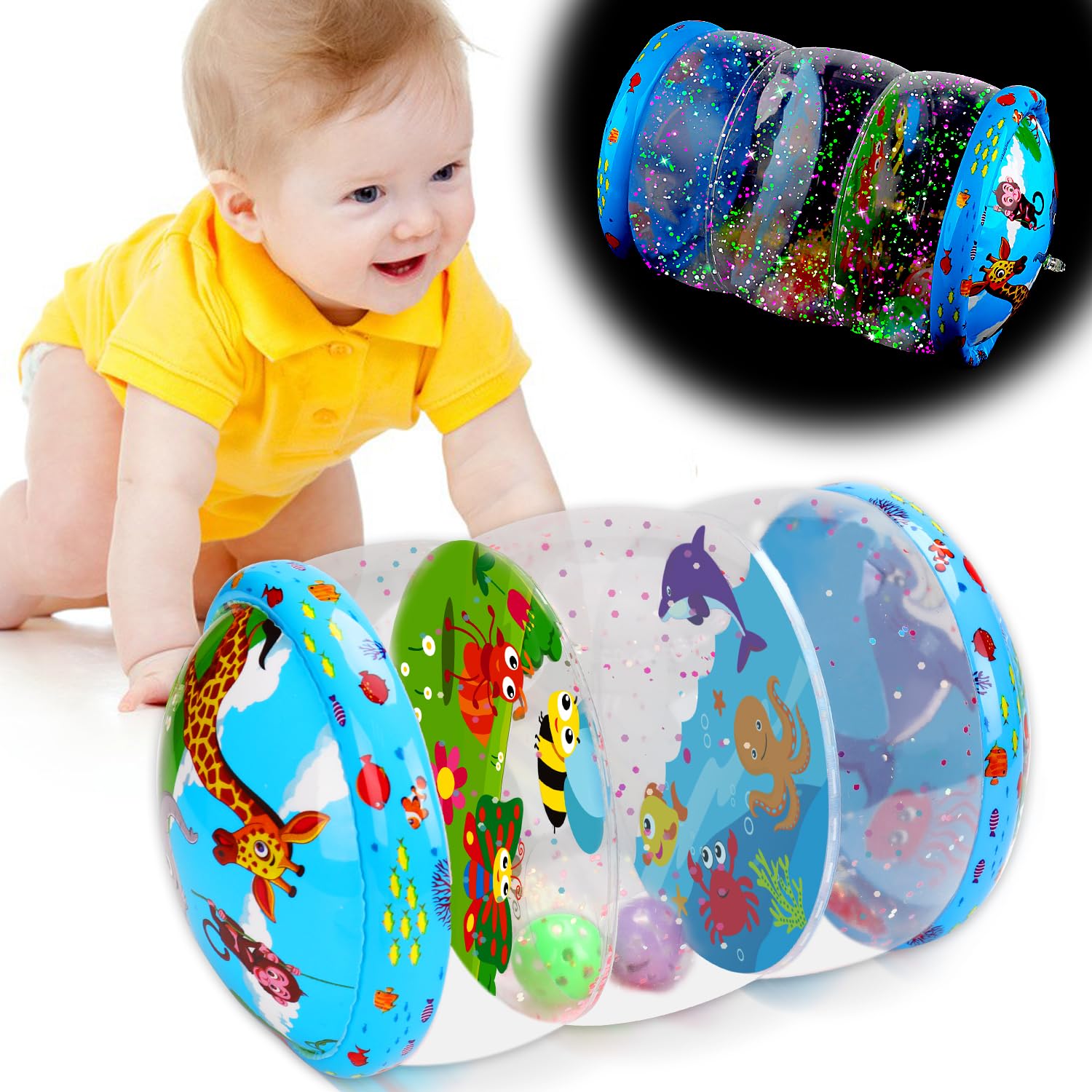
This inflatable roller serves one primary function—motivating a baby to crawl—and it performs that function exceptionally well. The 16-inch jumbo roller is light enough for a 6-month-old to push, bat, or roll, but substantial enough to provide gentle resistance that builds core and arm strength. Inside the transparent tube, two rattling balls move with the roller, creating an auditory lure that babies instinctively want to chase. The outer surface is covered in glowing sequins that shift and shimmer as the roller turns, adding visual reinforcement to the crawling effort.
The design is intentionally simple—no batteries, no switches, no electronic components. This is a manual cause-and-effect toy: the baby pushes the roller, the roller moves, the sequins shift, the balls rattle. That direct feedback loop is exactly what a 6-month-old’s developing brain needs to understand that their actions have predictable consequences. The inflatable construction makes it easy to deflate for travel or storage—it folds flat and weighs only 0.18 kilograms, making it a practical option for grandparents’ houses or daycare environments.
The PVC material is thick and durable—multiple reviews confirm it holds air for weeks without needing reinflation, even with daily play and occasional chewing. The sequins are embedded in the plastic rather than glued on, so they don’t flake or detach during mouthing. The glow-in-the-dark effect requires direct light exposure (sunlight or strong lamplight) to charge—it will not glow in low ambient light without prior charging, which is a subtle effect rather than a bright LED. The roller is best for babies who are already showing signs of crawling readiness (pushing up on arms, rocking on hands and knees) rather than newborns, as it requires intentional interaction to produce the reward.
Why it’s great
- Directly motivates crawling through visual, auditory, and physical lure
- Lightweight and inflatable—easy to store, travel, or deflate
- No batteries, no electronics—pure cause-and-effect feedback
Good to know
- Glow effect requires direct light charging and is subtle, not bright
- Best for babies already showing crawling readiness, not newborns
FAQ
How many toys does a 6-month-old actually need in rotation?
Is it safe to buy used developmental toys for my 6-month-old?
Final Thoughts: The Verdict
For most parents, the best developmental toys for 6 month old is the Plunack 6-in-1 Montessori Set because it covers fine motor, teething, object permanence, and sensory stimulation in one well-built kit that grows with your baby through 12+ months. If you want a dedicated tummy-time tool that specifically motivates crawling, grab the Thremhoo Inflatable Roller. And for a compact, mess-free solution to the universal pull-and-play phase, the Youuys Tissue Box Toy is a fantastic value that saves real tissue boxes from destruction while building crucial fine motor skills.

Mo Maruf
I created WellFizz to bridge the gap between vague wellness advice and actionable solutions. My mission is simple: to decode the research and give you practical tools you can actually use.
Beyond the data, I am a passionate traveler. I believe that stepping away from the screen to explore new environments is essential for mental clarity and physical vitality.