Our readers keep the lights on and my smoothie glass nicely filled. As an Amazon Associate, I earn from qualifying purchases.
The leap from wobbly first steps to confident toddlerhood is fueled by curiosity, and the right toys turn every stumble into a lesson. Between 12 and 18 months, your child’s brain is forming connections at a staggering rate, making every rattle, stack, and pull a tiny neurological breakthrough.
I’m Mohammad Maruf — the founder and writer behind WellFizz. I’ve spent hundreds of hours combing through safety certifications, material compositions, and age-graded design philosophies to separate developmental gems from mere distractions.
Whether you are shopping for your own little one or hunting for a memorable gift, this guide cuts through the noise to spotlight the very best developmental toys for 12 to 18 months that truly earn their place on the nursery shelf.
How To Choose The Best Developmental Toys For 12 To 18 Months
At this stage, the baby is transitioning from reflexive grasping to purposeful manipulation. The toy must survive drops, withstand chewing, and present a challenge that is just out of reach — not so hard that it frustrates, not so easy that it bores. Three factors dominate the decision.
Material Safety and Surface Finish
Babies between 12 and 18 months explore primarily with their mouths. A toy destined for this age group must be made from non-toxic, water-based paints on solid wood, or from food-grade silicone free of BPA and phthalates. Polished edges and splinter-proof construction are non-negotiable.
Multi-Modal Play Value
The best developmental toys engage more than one sense. A block that stacks, makes a sound when shaken, and features a different texture on each side builds cross-wiring in the brain. Look for sets that combine sorting, pounding, music, and spatial nesting into a single product — these stretch attention spans longer than single-action items.
Grip Geometry and Piece Size
Pieces must be large enough to prevent swallowing but small enough for a 12-month-old palm to encircle. Chunky knobs, thick handles, and lightweight components (under 8 oz) let toddlers practice the pincer grip without strain. Avoid toys with long cords or detachable magnets.
Quick Comparison
On smaller screens, swipe sideways to see the full table.
| Model | Category | Best For | Key Spec | Amazon |
|---|---|---|---|---|
| KMTJT Wooden Activity Cube | Premium | All-in-one exploration | 7 games in 1 cube | Amazon |
| Joyreal Hammering Pounding Toy | Mid-Range | Motor skill refinement | 4 activities + xylophone | Amazon |
| Qirptey 4-in-1 Sensory Set | Mid-Range | Teething + stacking | Silicone & ABS materials | Amazon |
| KMTJT Wooden Farm Toy | Budget | First puzzle play | 8 carrots + 10 animal blocks | Amazon |
| JoyCat Mystery Soft Box | Budget | Sensory discovery | 10 textured objects | Amazon |
In‑Depth Reviews
1. KMTJT Wooden Activity Cube

This activity cube packs seven distinct play surfaces into a compact 7.08-inch footprint: a bead maze on top, a baby xylophone, a learning clock, shape sorter, spinning gears, animal matching panels, and word cards. The bead maze flips over to reveal a shape sorter cavity, and all loose blocks store inside the cube — a clever space-saving detail that keeps the playroom floor clear. The rubber-wood construction passes the splinter test, and the water-based paint retains its color after repeated wipe-downs.
What makes this a standout for the 12–18 month window is the variety of grip demands. The spinning gears require a twisting wrist motion, the xylophone mallet encourages an overhead swing, and the shape sorter forces precise angle alignment. Parents report that 18-month-old twins gravitate toward the spinning gears first, then graduate to the bead maze as their pincer grip strengthens. The included word cards stretch the toy’s relevance into the second birthday.
The xylophone bars produce a clean tone, though the mallet is tethered by a short string that some toddlers find frustrating. The clock hands are stiff enough to stay in place but require adult help to rotate. Still, the sheer density of learning modes — counting, color naming, animal sounds, pattern recognition — makes this the single highest-value wooden toy in this price tier for a toddler who is ready to explore.
Why it’s great
- Seven distinct play modes in one compact unit
- Flip-top bead maze doubles as shape sorter storage
- Smooth, non-toxic finish passes rigorous mouthing tests
Good to know
- Xylophone mallet tether is short and may annoy some toddlers
- Clock hands require adult assistance to rotate
2. Joyreal Hammering Pounding Toy with Xylophone & Fishing Game
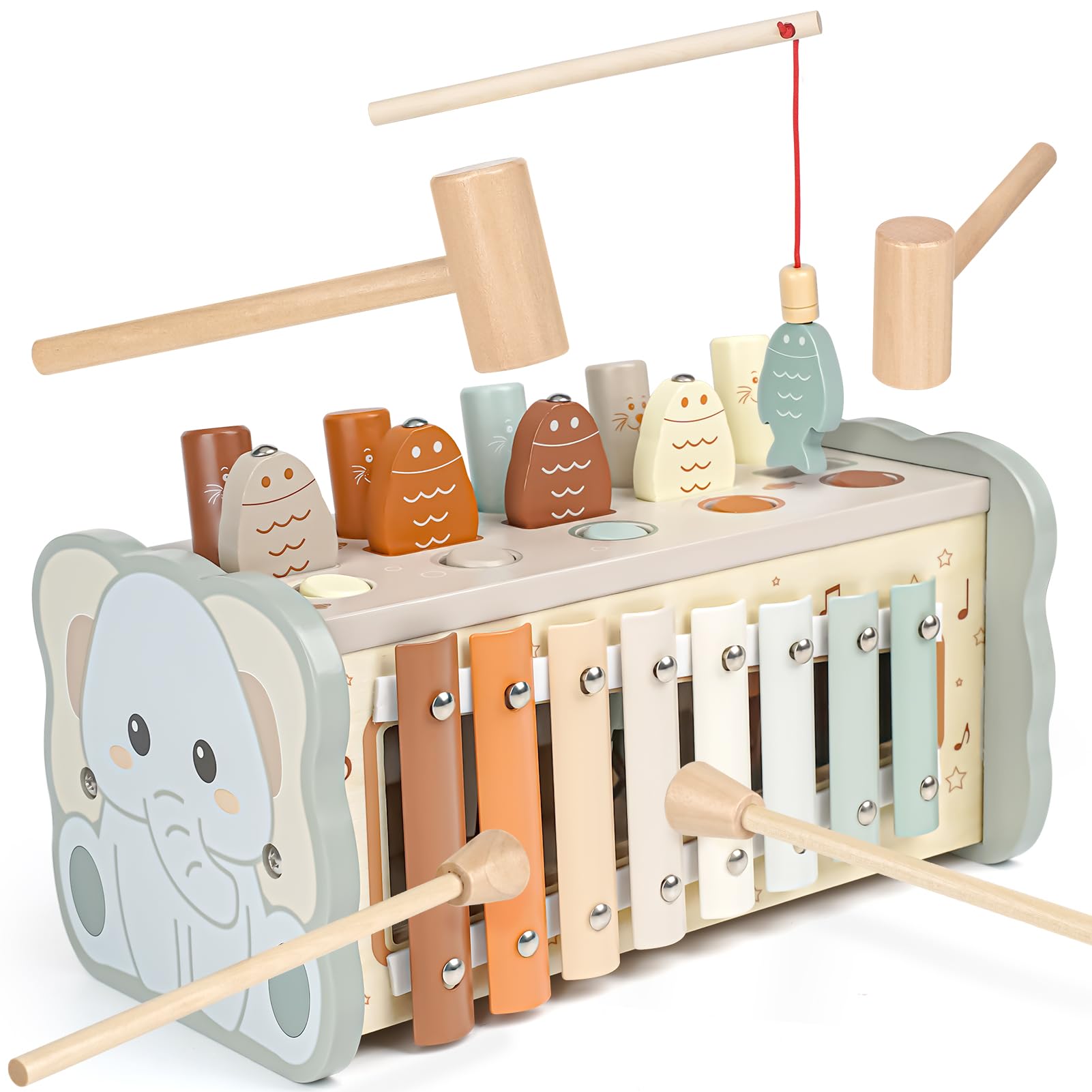
Joyreal’s set bundles a pounding bench with pop-up hamsters, a detachable xylophone, a magnetic fishing game, and a gear-spinning panel into one neutral-toned wooden base. Unlike the garish primary colors that dominate most toddler toys, this calming palette — soft beige, muted green, warm wood grain — reduces visual overstimulation while keeping the child focused on the task. Two hammers and two mallets are included, which means siblings or a parent can play alongside without waiting for a turn.
The pounding bench is the star: the hamsters bounce with each tap, providing immediate kinetic feedback that reinforces cause-and-effect logic. The xylophone sits on top and can be removed for lap play, and the fishing game uses a magnetic worm on a string — a challenge that demands steady hand-eye coordination from a 12-month-old. The gear panel requires both hands working together, one to hold the base and one to spin, which builds bilateral coordination critical for later skills like cutting and writing.
The neutral color scheme makes this toy blend into a modern living room aesthetic, but it also means the parts are less visually contrasty than a traditional primary-color toy. Some 12-month-olds may need an adult to demonstrate the fishing magnet a few times before they understand the motion. The wood is smoothly polished with no rough edges, and the sound of the xylophone is pleasant rather than jarring — important for parents who will hear it dozens of times a day.
Why it’s great
- Four discrete activities extend play sessions beyond five minutes
- Neutral color palette reduces visual clutter and overstimulation
- Two hammers/mallets support parallel play with siblings
Good to know
- Fishing magnet motion takes repeated demonstrations for younger toddlers
- Low-contrast colors may not hold attention as long as bright primaries
3. Qirptey 4-in-1 Montessori Sensory Set
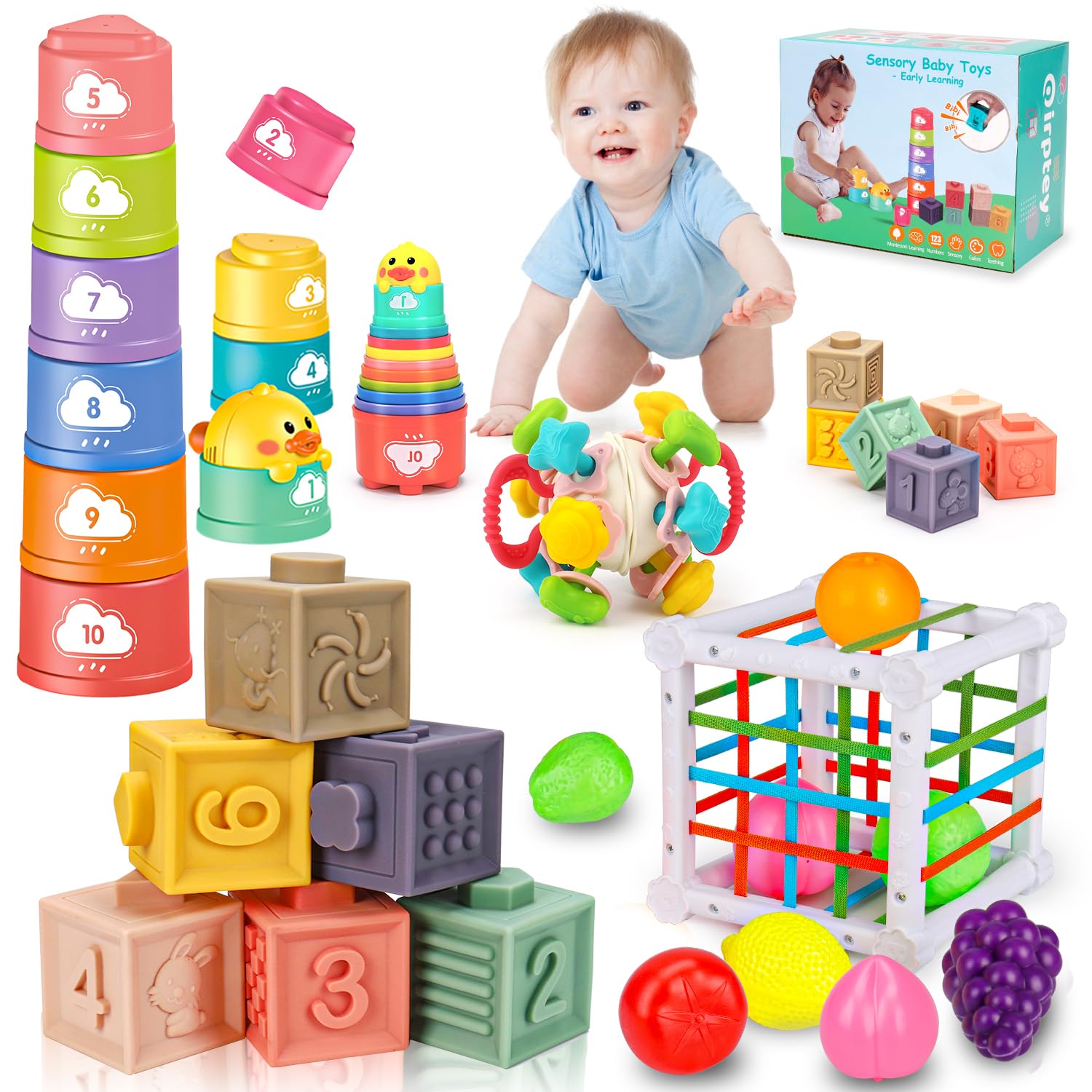
This set breaks the wooden monopoly by using food-grade silicone and high-quality ABS plastic — a deliberate choice for the teething phase that peaks between 12 and 15 months. The stacking blocks are soft enough to chew without damaging gums, yet firm enough to stack three high before toppling. The stacking cups feature raised numbers and textured bands that provide tactile variety, and the shape sorter bin uses fruit-shaped blocks (guava, orange, peach, tomato) that are large enough to prevent swallowing but small enough for a 10-month-old palm to grip.
The shape sorter is the standout feature: the fruit blocks have a satisfying weight and a slight silicone flexibility that makes them easy to insert into the bin’s openings. Toddlers develop spatial reasoning by rotating each block to fit the corresponding hole, and the bin’s lid is removable, allowing for open-ended dumping and filling — a favorite repetitive activity at this age. Reviewers note that the silicone blocks double as teethers, which means this toy earns its keep even when the baby is not in a stacking mood.
The ABS plastic components are impact-resistant but not indestructible — the bin’s lid hinge can crack if a toddler stands on it. The set is smaller than the product photos suggest, with the stacking cups measuring roughly two inches in diameter. However, the portability makes it a strong travel companion for restaurant outings or airplane trays. The absence of wood also means no splinter risk and easier dishwasher-safe cleaning for the silicone parts.
Why it’s great
- Food-grade silicone doubles as a safe teether for sore gums
- Fruit-shaped blocks make shape sorting intuitive and fun
- Lightweight and portable for diaper-bag carry
Good to know
- Bin lid hinge may crack under rough handling
- Overall size is smaller than promotional images suggest
4. KMTJT Wooden Farm Toy

This farm-themed set anchors itself in the Montessori tradition of open-ended, nature-inspired play. The wooden base acts as a garden plot where toddlers “plant” eight brightly painted carrots into holes, while the ten animal blocks (cow, pig, sheep, duck, etc.) slot into corresponding shaped indentations on the farm map. The map itself features road lines and fields that encourage narrative play — the kind of self-directed storytelling that language development experts prize at 18 months.
The carrot-pulling motion specifically targets the pincer grasp: the stems are wide enough for a 12-month-old to wrap her whole hand around, but the resistance when pulling encourages her to transition to a three-finger pinch over time. The animal blocks require shape matching, and parents can name animals and colors during play to build vocabulary. The rubberwood construction is dense enough to survive drops from a high chair tray without chipping, and the water-based paint shows no flaking after weeks of use.
The toy is smaller than the packaging suggests — the base measures 8.15 inches long — which means two toddlers cannot play simultaneously without crowding. The worm pieces on the carrot stems are glued in place, so they do not come off, which is a safety win but disappoints children who want to remove them. Some side puzzle pieces are too difficult for one-year-olds and only become solvable closer to 24 months. Despite these caveats, the open-ended farm narrative and the pure wood construction give this toy a long shelf life in the playroom.
Why it’s great
- Carrot-pulling motion builds pincer grip strength naturally
- Rubberwood construction survives high-chair drops without damage
- Farm map encourages narrative language development
Good to know
- Side puzzle elements are too advanced for most 12-month-olds
- Worm pieces are permanently glued and cannot be removed
5. JoyCat Mystery Soft Box
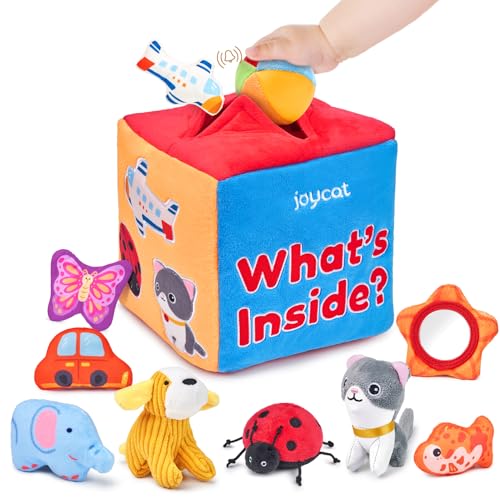
The JoyCat Mystery Soft Box is a fabric-based alternative to wooden toys, designed specifically for the sensory-seeking toddler. The box itself is made from ultra-soft, machine-washable material with no rigid supports — safe for a baby who tumbles onto it mid-play. Inside, ten objects each deliver a distinct sensory signature: the elephant and car produce a “bibi” squeak when squeezed, the airplane and ball rattle, and the butterfly crinkles. The variety means a 16-month-old can spend ten minutes just pulling items out and exploring each sound before moving on to the next.
The mystery element — reaching into the box without seeing the object — builds spatial reasoning and tactile discrimination. A 12-month-old may initially dump all items out at once, but by 14–16 months, they begin reaching in purposefully, feeling for a specific texture. The objects are sized for small hands; the largest piece (the cat) measures four inches and is made of corduroy that provides grip. All items are free of small parts, so there is no choking hazard even during unsupervised play.
The fabric construction means this toy is quieter than wooden alternatives, making it a strong choice for car rides and waiting rooms. However, the inconsistency of fabric quality across objects is noticeable: the cat is well-stuffed and durable, while the fish is made from thin material that may tear if pulled aggressively. The box collapses slightly when empty and needs to be held down for younger toddlers to insert items. Still, for sensory exploration and portability, this soft set fills a gap that wood cannot reach.
Why it’s great
- Ten distinct textures and sounds in one travel-friendly box
- Machine-washable fabric survives spit-up and juice spills
- No rigid parts means zero injury risk during tumbles
Good to know
- Fish piece uses thin fabric prone to tearing under heavy use
- Box collapses when empty and must be held steady for insertion
FAQ
How many toys does a 12-month-old actually need in one play session?
Should I avoid plastic toys for this age group entirely?
What is the difference between Montessori toys and regular toys at this stage?
Final Thoughts: The Verdict
For most families, the best developmental toys for 12 to 18 months winner is the KMTJT Wooden Activity Cube because its seven-in-one design evolves with the child from simple gear spinning to complex shape sorting without taking over the living room. If you want a calming, collaborative play session that strengthens bilateral coordination, grab the Joyreal Hammering Pounding Toy. And for a teething-safe, travel-friendly sensory experience that fits in a diaper bag, nothing beats the Qirptey 4-in-1 Sensory Set.

Mo Maruf
I created WellFizz to bridge the gap between vague wellness advice and actionable solutions. My mission is simple: to decode the research and give you practical tools you can actually use.
Beyond the data, I am a passionate traveler. I believe that stepping away from the screen to explore new environments is essential for mental clarity and physical vitality.