Our readers keep the lights on and my smoothie glass nicely filled. As an Amazon Associate, I earn from qualifying purchases.
High interference zones — mineralized soil, iron-laced ghost towns, black sand beaches, and power-line corridors — punish standard metal detectors with false signals and deafening chatter. A unit tuned for these conditions uses aggressive ground balancing, specific operating frequencies, and iron discrimination to isolate valuable non-ferrous targets from the noise.
I’m Mohammad Maruf — the founder and writer behind WellFizz. I spent months dissecting operating frequencies from 13.6 kHz to 71 kHz, comparing ground balance systems, and analyzing real-world user reports across mineralized, saltwater, and iron-infested terrain to find the detectors that actually perform when the ground fights back.
The goal was to cut through marketing hype and identify the detectors for high interference zones that deliver stable target ID, reliable depth, and clear audio in conditions that cripple lesser machines.
How To Choose The Best Detectors For High Interference Zones
Selecting a detector for high-interference ground is not about picking the most expensive model — it is about matching specific technical features to the type of interference you face. Mineralized soil, iron debris, saltwater, and electrical interference each require a different combination of frequency, coil, and ground balance.
Operating Frequency: The Goldilocks Principle
Lower frequencies (around 5–15 kHz) penetrate deeper and handle larger targets better but struggle in mineralized ground. Higher frequencies (18–71 kHz) are more sensitive to small gold and respond better to mineralized soil, but lose depth on large silver or copper. The best detectors for high interference zones often operate at 18 kHz or higher, or use multi-frequency technology to cover multiple ranges simultaneously.
Ground Balance: Manual vs. Automatic vs. Tracking
Manual ground balance gives you precise control to cancel out specific soil mineralization, but requires adjustment as conditions change. Automatic ground balance (one-touch) is faster and preferred for beginners, but may not handle rapid soil shifts. Ground tracking continuously adjusts as you sweep — ideal for areas where mineralization varies every few feet, such as creek beds or beach shorelines.
Coil Design: DD vs. Concentric
Concentric coils are cheaper and offer better pinpointing, but their cone-shaped detection field makes them prone to ground interference in mineralized soil. DD coils (double-D) produce a flat, blade-shaped field that cuts through mineralized ground and excels at separating targets in iron trash. For high interference zones, a DD coil is not optional — it is a requirement.
Quick Comparison
On smaller screens, swipe sideways to see the full table.
| Model | Category | Best For | Key Spec | Amazon |
|---|---|---|---|---|
| XP Deus II | Premium Multi-Frequency | Deep targets in variable ground | Fast Multi-Freq (4–45 kHz) | Amazon |
| Garrett AT Max Bundle | Mid-Range Wireless | All-terrain with wireless gear | 13.6 kHz, Z-Lynk Wireless | Amazon |
| Garrett AT Gold | Mid-Range Gold | Small gold in mineralized soil | 18 kHz, Iron Audio | Amazon |
| Fisher Gold Bug 2 | Premium High-Frequency | Tiny gold nugget detection | 71 kHz ultra-high frequency | Amazon |
| Teknetics G2+ | Budget-Friendly | Lightweight iron trash separation | 19 kHz, 2.5 lbs weight | Amazon |
In‑Depth Reviews
1. XP Metal Detectors Deus II Fast Multi Frequency

The XP Deus II is the only unit on this list that uses true fast multi-frequency technology, sweeping from 4 to 45 kHz in a single pass. This allows it to simultaneously detect high-conductivity silver and low-conductivity gold while automatically rejecting ground mineralization that causes single-frequency detectors to chatter. The 11-inch FMF search coil combined with 20 meters of waterproof depth makes it equally effective on wet salt beaches, iron-infested cellar holes, and mineralized gold country.
At under 5 pounds fully wireless — remote, headphones, and coil all communicate via radio — the Deus II eliminates cable noise and tangling. It ships with 12 factory programs and 12 user slots, covering everything from deep relic hunting to tiny gold prospecting. Reviewers note it finds targets previously missed by the Garrett AT Pro, which confirms its advantage in variable ground conditions.
The MI-6 pinpointer included in this bundle is waterproof and pairs wirelessly with the remote, making target recovery seamless. Battery life is 19 hours on the remote and up to 25 hours on the headphones depending on volume. The Deus II is complex to master but rewards time spent with unmatched stability in high-interference zones.
Why it’s great
- Fast multi-frequency covers all target types and ground conditions
- Fully wireless design reduces failure points and cable interference
- Waterproof to 66 ft for beach and river use
Good to know
- Learning curve is steeper than single-frequency detectors
- Premium price tier — not an entry-level budget choice
- Some reported durability concerns with plastic components
2. Garrett AT MAX Metal Detector Bundle

The Garrett AT MAX is an evolution of the legendary AT series, adding Z-Lynk wireless audio and a wireless Pro-Pointer to the proven all-terrain platform. Its 13.6 kHz operating frequency is a compromise — lower than pure gold detectors but deeper-reaching on coins and relics, while still capable of handling moderate mineralization. The True All Metal Mode delivers maximum depth by eliminating filtering, which can be necessary when targets are deeply buried in iron trash.
The Z-Lynk wireless system transmits audio with near-zero delay to the included MS-3 headphones, and the Pro-Pointer AT Z-Lynk communicates target proximity directly to the detector. This bundle also includes a hat, making it a complete package. The Iron Audio feature lets you hear discriminated iron targets, so you can decide whether to dig a potentially masked good target.
Reviewers love the backlit screen, AA battery convenience, and waterproof rating to 10 feet. One limitation is that the depth indicator can freeze during pinpointing. The AT MAX handles sandy beach and park conditions well, but static interference near other detectors or power lines may require a frequency shift.
Why it’s great
- Wireless headphones and pinpointer included for cleaner detecting
- True All Metal Mode for maximum depth in tough ground
- Waterproof to 10 ft for shallow water and rain use
Good to know
- 13.6 kHz may miss very small gold in high mineralization
- Depth indicator can freeze during pinpoint mode
- Requires YouTube study to unlock advanced features
3. Garrett AT Gold Metal Detector with Pinpointer and Headphones

The Garrett AT Gold is purpose-built for gold prospecting in mineralized soil, operating at 18 kHz to maximize sensitivity to small nuggets. It includes a 5-inch search coil for excellent target separation in dense trash, though many users upgrade to an 8.5 x 11-inch DD coil for deeper coverage. The Ground Balance Window provides both manual and automatic options, letting you fine-tune for specific soil conditions.
Iron Audio is the standout feature here — it audibly identifies iron targets so you can avoid digging rusty nails and bottle caps, which in gold country often mimic the conductivity of small gold. The True All Metal Mode delivers maximum depth, and the unit is waterproof to 10 feet. The bundle includes a Pro-Pointer AT and headphones, making it ready out of the box.
Reviewers consistently report finding coins at 8–10 inches and appreciate the ease of use for beginners. The main trade-off is the small stock coil, which limits coverage in open areas. The AT Gold is heavier than some dedicated gold detectors but offers better build quality and Garrett’s reliable warranty.
Why it’s great
- 18 kHz frequency is optimal for small gold in mineralized soil
- Iron Audio helps avoid digging iron trash in gold country
- Waterproof design and bundled accessories add value
Good to know
- 5-inch stock coil limits ground coverage per sweep
- Heavier than ultra-lightweight gold-specific detectors
- Missing headphones in some packaging — verify bundle contents
4. Fisher Gold Bug 2 Metal Detector
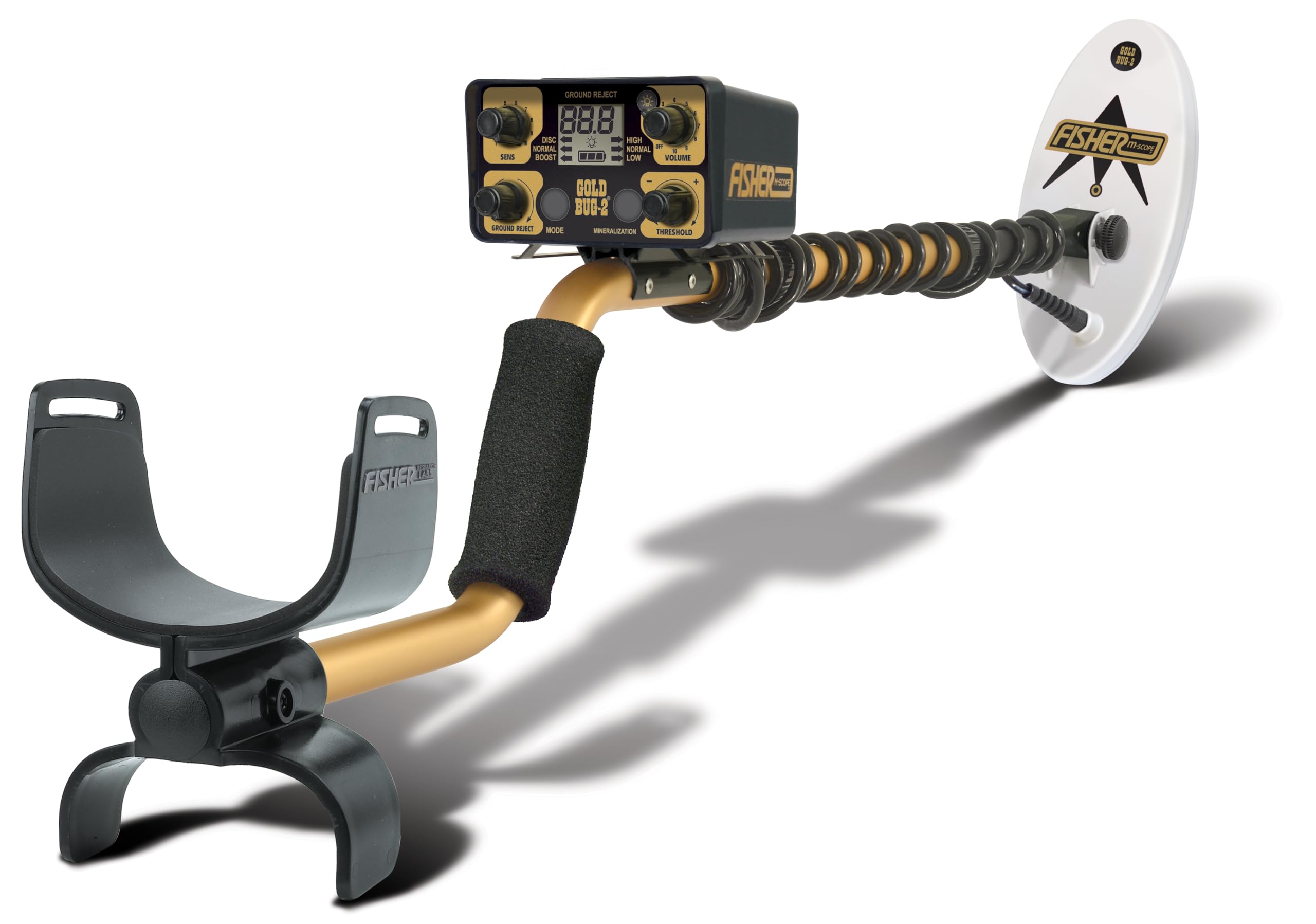
The Fisher Gold Bug 2 operates at a staggering 71 kHz, making it the highest-frequency detector in this roundup and arguably the most sensitive to tiny gold nuggets. At this frequency, even a 1-grain nugget buried in hot rocks or black sand produces a strong signal. The 10.5-inch elliptical DD coil is waterproof and includes 100% ESI shielding to reject electrical interference from power lines and other detectors.
Ground balance is manual via a 16-turn control, plus a three-position mineralization switch for high, normal, or low conditions. This level of control is necessary because 71 kHz is extremely sensitive to ground minerals — the wrong setting causes constant false signals. The audio boost mode amplifies faint deep targets without increasing shallow trash noise, a critical feature in high-interference zones.
At 2.9 pounds with a hip-mountable control housing, the Gold Bug 2 is comfortable for all-day use. Reviewers note it works well straight out of the box and finds gold in areas where other detectors fail. The downside is the missing armrest strap and the lack of a Double-D coil in the base package — many users upgrade to an 11-inch DETECH coil for better coverage.
Why it’s great
- 71 kHz is the gold standard for detecting sub-gram nuggets
- ESI shielding rejects electrical interference effectively
- Lightweight design with hip-mount option reduces arm fatigue
Good to know
- Manual ground balance requires learning and adjustment
- Base package missing armrest strap and headphones
- High frequency limits depth on large silver and copper targets
5. Teknetics G2+ Metal Detector with 11in DD Coil

The Teknetics G2+ offers a mid-frequency 19 kHz operating range that strikes a balance between gold sensitivity and coin/relic depth. Its 11-inch DD open elliptical coil provides excellent ground coverage and target separation in cluttered environments. The Ground Grab computerized ground balancing automatically adjusts to soil changes, while V-Break technology lets you set custom audio tone breakpoints for specific target ID ranges.
FeTone Adjustable Iron Audio is a standout — it reduces the volume of iron targets while maintaining full volume for non-ferrous targets, helping you isolate good targets in iron-infested ground. At just 2.5 pounds, the G2+ is the lightest detector on this list, making it ideal for users with physical limitations or long hunts. The ergonomic handle and adjustable stem accommodate various heights.
Reviewers consistently praise the G2+ for its performance in iron-rich environments, with one user calling it “excellent in the iron.” The 5-year warranty from Teknetics adds confidence. The main limitation is the lack of waterproof coil — you cannot submerge it — and the visual display could be better. For dry-land high-interference zones, however, the G2+ delivers remarkable value.
Why it’s great
- 19 kHz frequency works well for gold and relics in mineralized soil
- Ultra-lightweight design at 2.5 pounds for fatigue-free hunting
- FeTone iron audio reduces iron trash noise without losing depth
Good to know
- Not waterproof — cannot be used in rain or shallow water
- Display is basic compared to premium models
- Coil lacks ESI shielding found on higher-end detectors
FAQ
What does “high interference zone” mean for metal detecting?
Is a higher frequency always better for mineralized soil?
Can I use a standard coin detector in high interference zones?
How important is the coil type for high interference zones?
Do waterproof detectors handle high interference better than non-waterproof ones?
Final Thoughts: The Verdict
For most users tackling high interference zones head-on, the detectors for high interference zones winner is the XP Deus II because its fast multi-frequency technology adapts to any ground condition in real time, eliminating the need to choose between gold sensitivity and coin depth. If you want dedicated small-gold detection in extreme mineralization, grab the Fisher Gold Bug 2. And for a lightweight, budget-friendly entry into iron-rich terrain with excellent target separation, nothing beats the Teknetics G2+.

Mo Maruf
I created WellFizz to bridge the gap between vague wellness advice and actionable solutions. My mission is simple: to decode the research and give you practical tools you can actually use.
Beyond the data, I am a passionate traveler. I believe that stepping away from the screen to explore new environments is essential for mental clarity and physical vitality.