Our readers keep the lights on and my smoothie glass nicely filled. As an Amazon Associate, I earn from qualifying purchases.
The thrill of cracking a case without leaving your table is what sets detective board games apart from every other genre. Unlike games of luck or simple strategy, these titles demand logical thinking, observation, and the ability to connect disparate clues into a single, satisfying conclusion.
I’m Mohammad Maruf — the founder and writer behind WellFizz. I’ve spent countless hours researching the mechanics, component quality, and real-player feedback behind the most immersive mystery-solving experiences available today.
Whether you prefer cooperative campaigns or competitive clue-gathering, this guide breaks down the top contenders to help you find the best detective board games for your next game night.
How To Choose The Best Detective Board Games
Not every mystery game works the same way. Some rely on pure logic and observation, while others weave complex narratives across multiple play sessions. Understanding the core mechanics and format will help you pick a game that matches your group’s attention span and preferred style of sleuthing.
Cooperative vs. Competitive Investigation
Many detective games are fully cooperative — everyone wins or loses together by solving the case. Others allow competitive scoring, where players race to identify the culprit first. If your group argues easily, cooperative investigation games keep the focus on the puzzle rather than who gets the right answer fastest.
One-Shot Cases vs. Campaign Storytelling
Some games offer standalone cases that wrap up in under an hour, making them easy to replay with different groups. Others, like campaign-style detective games, tie multiple cases into an overarching narrative that builds across several sessions. A campaign format demands commitment from the same players week after week.
Realism vs. Creative Mechanics
Games like those using an online database or real-world research tools aim for a grounded, procedural feel. Others embrace supernatural elements, allowing communication with ghosts or solving puzzles using tarot cards and string. Choose the level of realism that fits your group’s suspension of disbelief.
Quick Comparison
On smaller screens, swipe sideways to see the full table.
| Model | Category | Best For | Key Spec | Amazon |
|---|---|---|---|---|
| Portal Games Detective | Campaign | Deep narrative immersion | 5 cases / 120-180 min each | Amazon |
| MicroMacro Crime City Full House | Observation | Visual puzzle fans | 16 cases / 75×110 cm map | Amazon |
| Paranormal Detectives | Party | Creative clue-giving | 28 scenarios / 30-150 min | Amazon |
| The Night Cage | Horror Strategy | Atmospheric cooperative play | Tile-based labyrinth / 40 min | Amazon |
| Unsolved Case Files (Ivey, Sandra) | Cold Case | Realistic evidence analysis | 4-5 hours / online answer keys | Amazon |
| 221B Baker Street Deluxe | Classic Deduction | Traditional clue-gathering | 200 cases / 30 min each | Amazon |
| So Clover! | Word Association | Light family fun | 220 cards / 30 min playtime | Amazon |
In‑Depth Reviews
1. Portal Games Detective
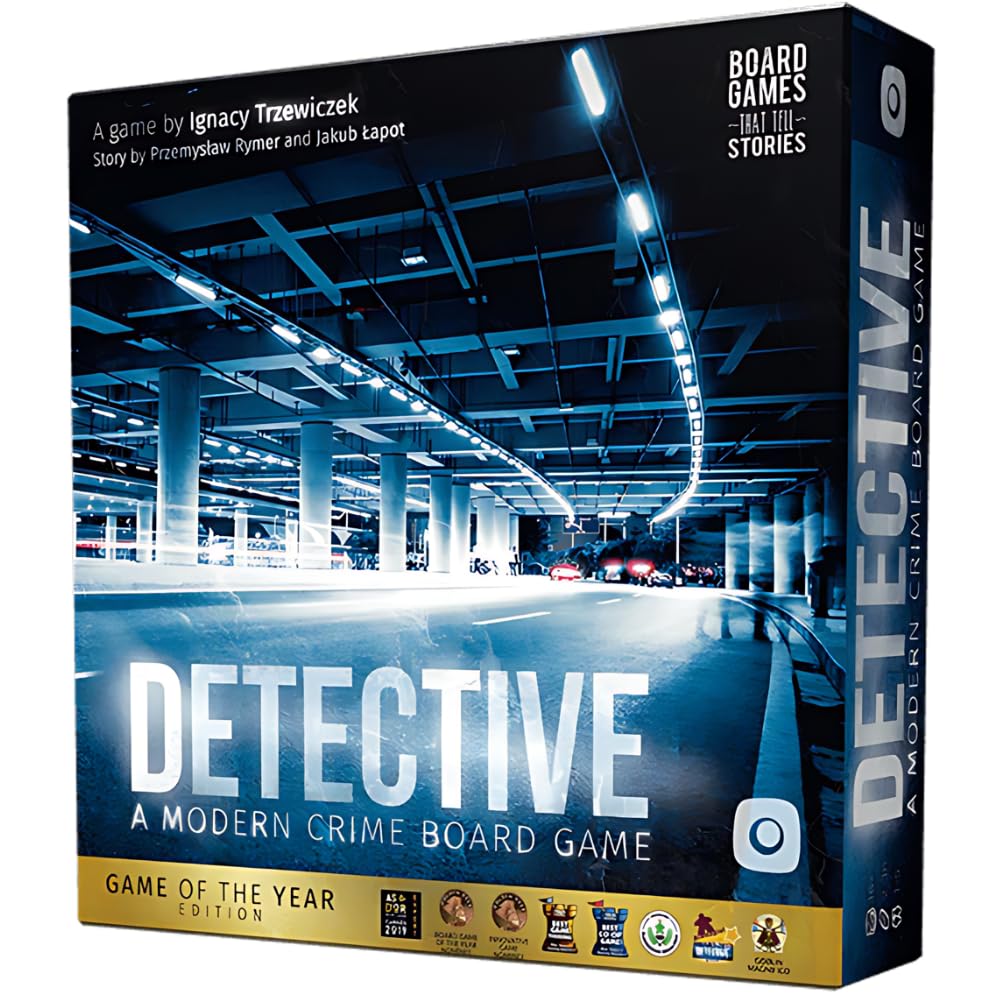
This is the gold standard for players who want a serious, campaign-driven detective experience. Portal Games Detective integrates a fictional online database called Antares, where you look up biometric data, match fingerprints, and cross-reference evidence — it transforms the tabletop into a procedural crime lab. Each of the five interconnected cases requires 120 to 180 minutes of focused play, and the overarching storyline ties every investigation together with sharp, deliberate writing.
The game demands more than casual attention. You will need to take detailed notes, build mind maps, and occasionally use external resources like real maps or Wikipedia to follow leads based on real-world events. The time pressure mechanic forces you to prioritize leads and accept that you cannot solve everything — a design choice that adds genuine tension. Two players seems to be the sweet spot for maintaining a coherent chain of reasoning without too many conflicting theories.
Critically, the game relies on an internet connection for its database, and the digital interface has a learning curve that can slow early sessions. The physical components are solid but the true star is the narrative design. Players consistently rank it among the most immersive cooperative investigation games available, with several expansions adding additional cases beyond the base box.
Why it’s great
- Exceptional narrative integration of physical and digital evidence
- Time pressure creates authentic investigative stress
- High replayability through branching leads and online expansions
Good to know
- Requires internet access for the Antares database
- Not suitable for casual or distracted groups
- Rulebook is dense; a tutorial video helps significantly
2. MicroMacro Crime City Full House

MicroMacro: Crime City delivers a completely different kind of detective work — one that relies purely on observation and logic rather than reading documents or interrogating suspects. The centerpiece is a single massive black-and-white map measuring 75 x 110 centimeters, depicting an entire city teeming with dozens of miniature scenes happening simultaneously. Your task is to follow numbered clues on case cards, locate the corresponding events on the map, and reconstruct what happened step by step.
The Full House edition contains 16 cases of varying complexity, marked with symbols so parents can filter out darker content for younger players. The game works well with 2 to 4 players, and the map is large enough that multiple people can search for details without crowding.
Component quality is strong — the map is printed on sturdy paper, and the included magnifying glass helps spot tiny but crucial details. Players often laminate the map or hang it on a wall for easier access. There is no reading required once the game begins, which makes it an excellent cross-generational choice for family game night. The main limitation is that each case can only be solved once, though the sheer density of the map encourages repeat visits to find hidden easter eggs.
Why it’s great
- Zero reading required — pure visual deduction
- Giant map provides hours of searching and discovery
- Star ratings on cases let you choose difficulty
Good to know
- Cases are one-time only once you know the solutions
- Map can be awkward to store flat without rolling
- Some tiny details are hard to spot without good lighting
3. Paranormal Detectives

Paranormal Detectives flips the traditional investigation formula on its head by making one player the ghost of the victim who can only communicate through cryptic actions. The ghost uses interaction cards — pantomime, tarot cards, a string on a talking board, or a word puzzle — to answer yes-or-no questions from the detectives. This mechanic creates laugh-out-loud moments as the ghost struggles to convey precise information about who killed them, in what room, and with what weapon.
The game includes 28 scenarios built into the box, each with a different victim, location, and killer combination. Individual rounds typically run 30 to 45 minutes, making it easy to play multiple rounds in a single sitting. The game supports cooperative, competitive, and team-versus-team modes, which gives it unusual flexibility for a detective board game. Cards are marked with content warnings for sensitive themes, allowing groups to skip topics they are uncomfortable with.
Component quality is a mixed bag — the artwork is fantastic and the variety of interaction tools is impressive, but the main board and box feel somewhat flimsy compared to other games at the same price tier. The board’s fold direction can be confusing and repeated folding risks splitting. Despite these build concerns, the gameplay loop is so engaging that most players overlook the physical flaws. It is a strong alternative to games like Mysterium for groups who want more active participation from every player.
Why it’s great
- Unique ghost-communication mechanic creates hilarious moments
- Multiple game modes increase replay value
- Quick rounds suit party environments well
Good to know
- Board and box are less durable than competitors
- Ambiguous clues can sometimes frustrate detectives
- Best with 3 or more players
4. The Night Cage

The Night Cage reimagines detective board games as a cooperative survival horror experience. You and your team are trapped in a pitch-black labyrinth, and your only light source is a candle that illuminates the tile you currently occupy. As you move, tiles behind you vanish into darkness, forcing you to memorize the layout and communicate every path to your teammates. The objective is to collect keys, locate the gate, and escape together before the maze collapses completely.
The game relies on a tile-laying system that randomizes the labyrinth every time, giving it exceptional replayability — no two games unfold the same way. Wax Eaters stalk the unlit corridors, and their movements are dictated by dice rolls that introduce an element of tension without overwhelming the strategic core. A single play session lasts about 40 minutes for up to 5 players, with adjustable difficulty settings and an advanced mode that adds new monsters and obstacles.
The component design leans heavily into the theme: the candle pieces and black tiles with subtle white line art create a genuinely eerie table presence when the room lights are turned off. Players often pair the game with ambient horror playlists to deepen the immersion. The rulebook could be clearer — particularly around monster movement and tile removal — but the core loop is intuitive enough that most groups figure it out within the first round. It is an excellent choice for groups who want a detective-adjacent experience that prioritizes tactile tension over paperwork.
Why it’s great
- Endless replayability through randomized tile layouts
- Genuine tension from limited vision and vanishing tiles
- Advanced mode adds depth for returning players
Good to know
- Rulebook could use clearer examples for special abilities
- Requires strong verbal communication to coordinate effectively
- Best with 2 to 4 players for balanced difficulty
5. Unsolved Case Files (Ivey, Sandra)

Unsolved Case Files treats itself like a genuine cold case folder, complete with witness statements, crime scene photographs, newspaper clippings, and suspect profiles. The Sandra Ivey case places you in a near-future setting involving sabotage aboard a commercial space station, but the investigative process feels very grounded. You must first prove the fire was arson, then confirm Sandra Ivey was murdered, and finally identify the killer to bring them to justice.
The game requires 4 to 5 hours of concentrated effort for a single case, making it more of an evening event than a casual after-dinner game. The evidence pack is dense with material, and the online answer key system ensures you cannot accidentally flip to a solution page. You input your deductions into a website that only confirms whether you are correct — if you are wrong, you dig deeper without being spoiled. This design preserves the mystery much better than a printed solution card.
Physical components include high-quality suspect photos, a space station poster, and documents that feel appropriately worn and official. The Sandra Ivey case has a difficulty rating of 9/10 from community reviewers, meaning it demands careful note-taking and logical cross-referencing. One player described the endgame puzzle as making them feel like a real hacker. The single-case format means it has zero replay value after solving, but the experience is dense enough to justify the purchase for one unforgettable game night.
Why it’s great
- Immersive cold-case format with authentic materials
- Online answer system prevents accidental spoilers
- Extremely satisfying deduction arc
Good to know
- Single-use case — no replayability after solving
- Requires internet access for the answer check
- Expect 4 to 5 hours of focused play time
6. Deluxe 221B Baker Street Board Game
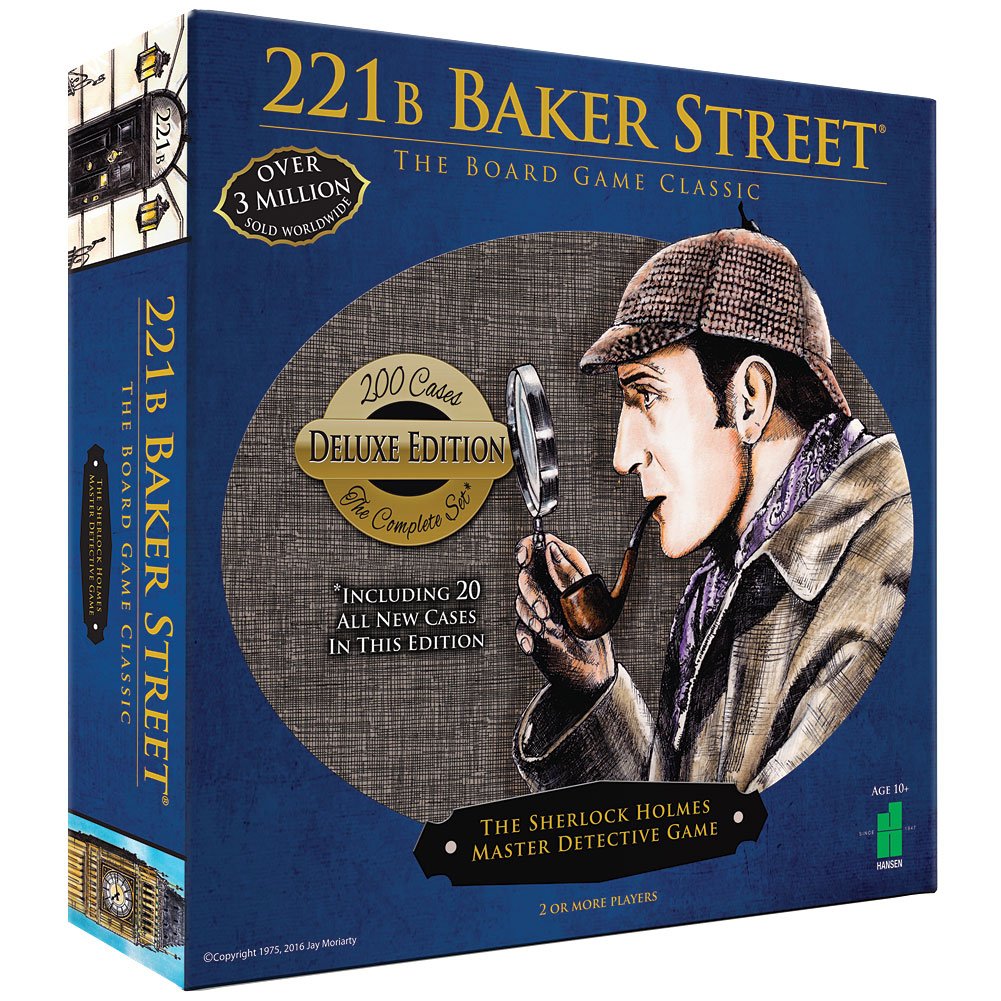
221B Baker Street is a long-running classic that predates most modern detective board games, and this Deluxe edition bundles 200 cases into a single box. Gameplay revolves around moving your token around a board of Victorian London locations, collecting clues by solving ciphers, riddles, and logic puzzles. Each case requires you to answer who committed the crime, what they did, where it happened, when, and why — a more demanding solution than Clue’s simple three-part answer.
The 200-case count gives this game extraordinary longevity, especially for groups that rotate through scenarios without memorizing solutions. Case difficulty varies widely — some are quick word puzzles that resolve in 15 minutes, while others demand careful reasoning and red-herring management. The game works cooperatively or competitively, and many families report playing the same cases across generations. The board includes metal player pieces and Scotland Yard cards that add small strategic choices to the movement phase.
The reliance on a movement die introduces an element of randomness that can feel at odds with the deduction theme — sometimes you waste turns circling a location for the clue you need. Some cases lean heavily on wordplay that can feel dated in language and cultural references. Despite these quirks, the sheer volume of content and the satisfaction of cracking a well-written mystery make it a reliable choice for families who want a large library of bite-sized investigations.
Why it’s great
- 200 cases provide massive content value
- Suitable for both cooperative and competitive play
- Classic Sherlockian atmosphere with beautiful board
Good to know
- Movement die adds luck to a deduction game
- Some word puzzles feel dated
- Playing competitively can feel random with clue collection
7. So Clover!

So Clover! shifts the detective genre from solving crimes to decoding word associations — think of it as a cooperative party game where creative thinking replaces evidence analysis. Each player writes one clue that connects two keywords on their clover board, and the team must guess which keywords belong to each clue. The more clever and unexpected your word links, the higher your team scores.
This is by far the most accessible game in the list, with a playtime of 30 minutes and rules that can be explained in under a minute. The box includes 220 password cards, six clover boards, and dry-erase markers for reusable play. It works best with 3 to 6 players, but larger groups can form teams without breaking the experience. Feedback consistently notes that the game generates laughter as players discover how their friends think — or fail to think — about word connections.
While So Clover! does not involve clue-gathering, interrogations, or case files, it exercises the same cognitive muscles of association and inference that make detective games satisfying. The cooperative structure means no one feels singled out for a bad guess, and the game can be played repeatedly without losing freshness because the card combinations change every round. It is an ideal warm-up or palate cleanser before diving into a heavier investigation game.
Why it’s great
- Extremely easy to teach and play
- Cooperative format prevents player elimination
- High replayability through randomized word pairings
Good to know
- Not a traditional detective investigation experience
- Soft player cap of 6; larger groups need to team up
- Relies heavily on vocabulary and abstract thinking
FAQ
Can you replay a detective board game after solving all the cases?
What is the ideal number of players for a detective board game?
Do detective board games require an internet connection to play?
Final Thoughts: The Verdict
For most users, the best detective board games winner is the Portal Games Detective because it combines deep narrative immersion with procedural realism that no other game in this list matches. If you want a visual puzzle that the whole family can enjoy without reading a single page of text, grab the MicroMacro Crime City Full House. And for a single unforgettable evening of cold-case drama, nothing beats the Unsolved Case Files (Ivey, Sandra).

Mo Maruf
I created WellFizz to bridge the gap between vague wellness advice and actionable solutions. My mission is simple: to decode the research and give you practical tools you can actually use.
Beyond the data, I am a passionate traveler. I believe that stepping away from the screen to explore new environments is essential for mental clarity and physical vitality.