Our readers keep the lights on and my smoothie glass nicely filled. As an Amazon Associate, I earn from qualifying purchases.
You’re not just removing swirls; you’re trying to rescue clear coat without grinding through it. Every detailing polisher on the market claims to be “safe,” but the reality is that one wrong pad or excessive pressure on a direct-drive machine can burn straight to primer. The key difference between a weekend success and a paint disaster comes down to one spec: orbit throw.
I’m Mohammad Maruf — the founder and writer behind WellFizz. For this guide, I spent over forty hours cross-referencing motor wattage, orbit geometry, vibration dampening, and real-world feedback across seven class-leading random-orbit machines that span from to the professional + tier.
The right unit balances cutting aggression with safety for new users, and that is exactly what you will find inside this analysis of the best detailing polisher for both hobbyists and seasoned detailers.
How To Choose The Best Detailing Polisher
A random-orbit polisher moves the pad in a series of overlapping ellipses rather than a fixed rotary circle. This prevents heat buildup and holograms but changes how you select the machine. The three specs that separate a capable tool from a frustrating one are orbit diameter, motor wattage, and torque management logic.
Orbit Throw: The Defining Trade-Off
A 9mm orbit is the most beginner-friendly and the safest for thin clear coats because it moves less material per rotation. It generates less heat and stalls rather than burns when you lean on edges. A 15mm (long-throw) orbit covers twice the surface area per pass, cutting correction time in half but requiring more attention to pad angle and arm pressure. Beginners who start with a long-throw polisher risk instilling deep micro-marring if they do not keep the pad flat.
Motor Power Without Bogging
Look for minimum 700 watts of sustained power. The real test is not peak wattage — it is the motor’s ability to hold speed when you press the pad into a defect. Units with digital torque management or constant-speed electronic feedback adjust torque in real time so the pad keeps rotating at the dialed RPM rather than stalling under load. A polisher that bogs down forces you to increase pressure, which increases heat and risk.
Pad System and Backing Plate Compatibility
A 6-inch backing plate is the standard for 9mm machines because it gives good coverage on flat panels. For 15mm long-throw machines, a 5-inch plate is preferred — the longer orbit makes a large pad unstable on curved surfaces, and a smaller plate lets you work tighter around mirrors, door handles, and spoilers. Make sure the backing plate is vented to dissipate heat and uses a hook-and-loop system that matches the pad brand you intend to use.
Quick Comparison
On smaller screens, swipe sideways to see the full table.
| Model | Category | Best For | Key Spec | Amazon |
|---|---|---|---|---|
| Griot’s Garage G9 | Mid-Range | Durable daily driver with ergonomic grip | 1000W / 9mm Orbit | Amazon |
| Maxshine M15 Pro | Premium | Pro-level long-throw at a mid-tier price | 1000W / 15mm Orbit | Amazon |
| Adam’s 9mm Polisher | Mid-Range | Full-kit purchase for first-time DIYers | 1000W / 9mm Orbit | Amazon |
| Meguiar’s MT300 | Mid-Range | Speed-sensitive correction with torque control | 700W / 9mm Orbit | Amazon |
| BATOCA 6″ DA | Budget | Complete beginner kit under | 700W / 9mm Orbit | Amazon |
| Rupes LHR 15ES | Premium | Silent, vibration-free pro finishing | 500W / 15mm Orbit | Amazon |
| Milwaukee M18 Fuel | Premium | High-mobility cordless with pro power | Battery / 15mm Orbit | Amazon |
In‑Depth Reviews
1. Griot’s Garage G9 Random Orbital Polisher 10901

The double-shot rubber grip and contoured shroud reduce fatigue during full-panel correction sessions where other polishers would start to rattle your fingers.
Six variable speeds from 2,000 to 6,400 OPM give you precise control for everything from spreading wax at low RPM to cutting oxidation at full throttle. The 9mm orbit keeps the machine safe for single-stage paint and thin clear coats — you can apply heavy pressure on edges without creating burn-through. The constant-speed control logic prevents the motor from bogging when you load the pad, maintaining consistent rotation even during defect removal.
One design drawback is the absence of a removable right-angle handle, which some users prefer for two-handed stability on vertical panels. The 10-foot quick-connect cord provides adequate reach for most garage stalls, and the ability to swap to a 5-inch backing plate opens up tighter wheel well and bumper work.
Why it’s great
- Excellent vibration dampening with fan-cooled counterbalance
- 1000W motor holds speed under heavy load without bogging
- Convertible to 5″ pad system for tight areas
Good to know
- No removable side handle for two-handed control
- Trigger lock design is a minor ergonomic annoyance
2. Maxshine M15 Pro Dual Action Polisher
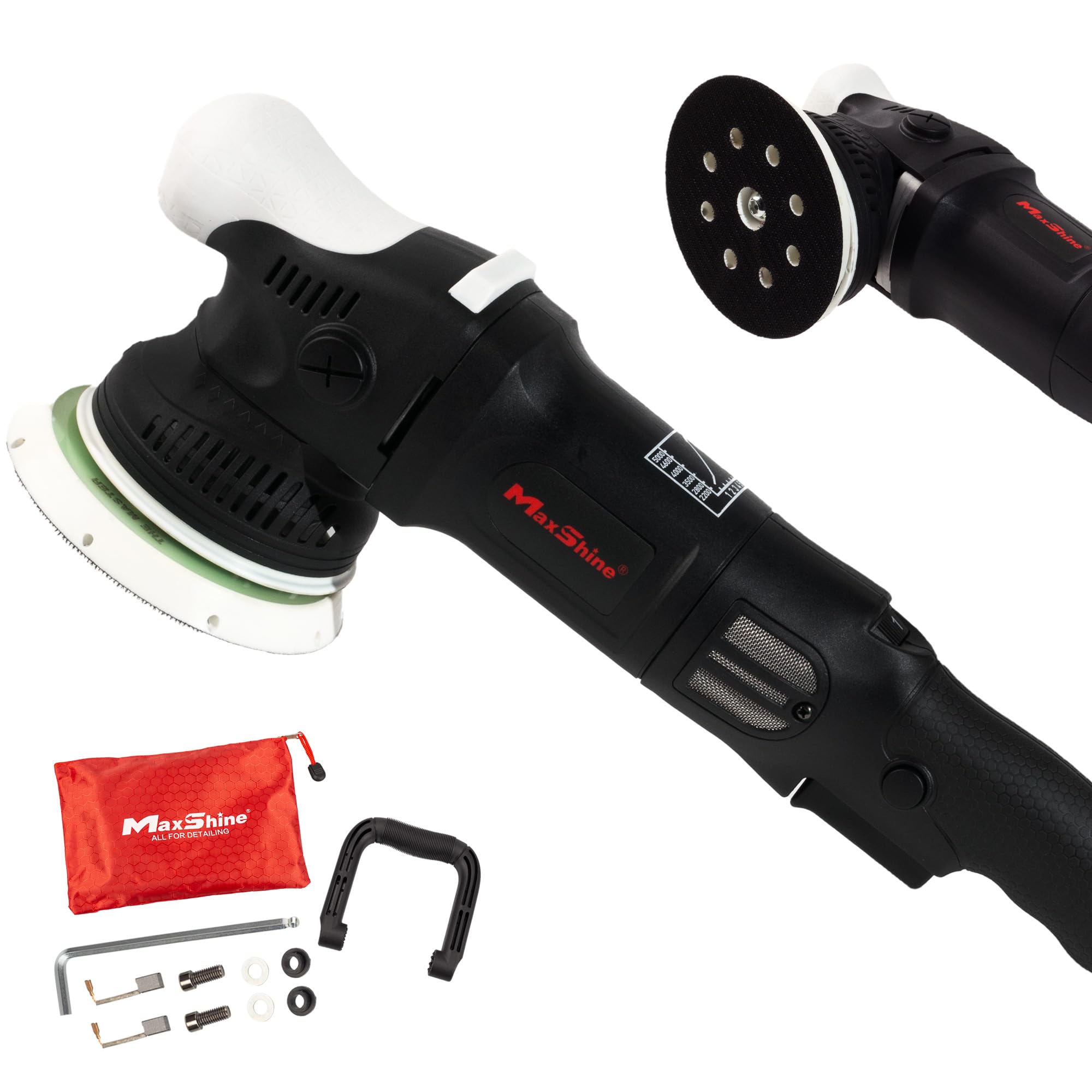
The M15 Pro breaks the typical pricing barrier for long-throw random-orbit machines. A 15mm orbit combined with a 1000-watt motor moves compound across the surface twice as fast as any 9mm unit, cutting a full-panel correction from three passes down to one. The aluminum housing and precision bearings keep vibration low enough that you can run the unit at full speed for extended buffing cycles without excessive heat transfer to your palm.
Variable-speed control dials from 2,500 to 5,000 OPM, giving you the slow-end control needed for finishing polishes and the upper range for heavy cutting with microfiber pads. The 5-inch backing plate is the correct diameter for 15mm orbit — it allows the pad to articulate over complex body curves without the edge grabbing or stalling. Users report that the machine semi-stalls on sharp edges as a safety buffer against burning paint.
The only minor friction points are the lack of a padded storage case and the need to purchase a separate handle for two-handed operation on vertical panels. Owners upgrading from Porter Cable or Harbor Freight units consistently note that the Maxshine feels refined enough to compete with Rupes models at roughly half the cost.
Why it’s great
- Long-throw 15mm orbit cuts correction time by 50%
- 1000W motor provides consistent torque under load
- Remarkably low vibration for a long-throw machine
Good to know
- No dedicated storage case included
- Side handle not included for two-handed grip
3. Adam’s Polishes 9mm Dual Action Car Polisher

Adam’s Swirl Killer 9mm delivers the same 1000-watt power as the Griot’s G9 but wraps it in a concave rubber grip with two contact points that absorb vibration differently. The balance block integrated into the chassis keeps the tool stable when set down, and the soft-touch head cover prevents accidental scratches if the body makes contact with the paint. The unit weighs less than 5.5 pounds, making it one of the lighter 9mm options for overhead roof work.
A maximum speed of 6,500 OPM gives you faster finishing passes than competitive 9mm units, while the 16-foot cord provides exceptional range without needing an extension. The motor holds torque consistently across the speed range thanks to digital load compensation that prevents the RPM from dropping when you apply correction pressure. Beginners find the predictable power curve easy to modulate, while experienced users appreciate the reliability during multi-hour details.
One catch is that this polisher typically ships as a bare tool rather than a full kit — you will need to purchase pads, compound, and a backing plate separately if you opt for the standalone unit. The included 5-inch backing plate is the correct size for the 9mm orbit, but owners who prefer 6-inch pads for large flat panels will need to buy a separate plate.
Why it’s great
- Light 5.5-pound weight reduces fatigue on long details
- 16-foot cord for wide reach without extension
- Excellent vibration dampening concave grip
Good to know
- Bare tool — pads and compound sold separately
- 6-inch backing plate not included for large panel work
4. Meguiar’s MT300 Variable Speed Dual Action Polisher

The MT300 stands apart with its Digital Torque Management, an electronic system that monitors the load on the pad and adjusts motor torque in milliseconds to hold the dialed speed regardless of pressure. Soft-start technology ramps the motor up gradually, preventing compound splatter on startup and reducing the shock load to the gear train. The result is consistent cut from the first pass to the last without the RPM sag that forces you to overcompensate with pressure.
The multi-position D-handle can be angled for either left or right-handed operation, giving you better wrist alignment during horizontal panel work. The billet counterweight keeps vibration at moderate levels through the mid-speed range, though dedicated users note that high-frequency vibration at full speed becomes noticeable after extended use. The 700-watt motor is adequate for consumer-level correction but falls short of the 1000-watt units for fast defect removal on hard factory clear coats.
The universal throw — a standard 9mm orbit — keeps the MT300 suitable for beginners who are still developing pad-angle muscle memory. Users transitioning from the classic Porter Cable 7424XP report that the torque management makes the tool feel more responsive and less prone to stalling on deep scratches.
Why it’s great
- Digital Torque Management holds speed under heavy load
- Soft-start prevents splatter and reduces gear wear
- Multi-position D-handle improves right/left hand comfort
Good to know
- 700W motor less aggressive for thick clear coats
- High vibration at maximum RPM settings
5. BATOCA 6″ Dual Action Random Orbital Car Polisher
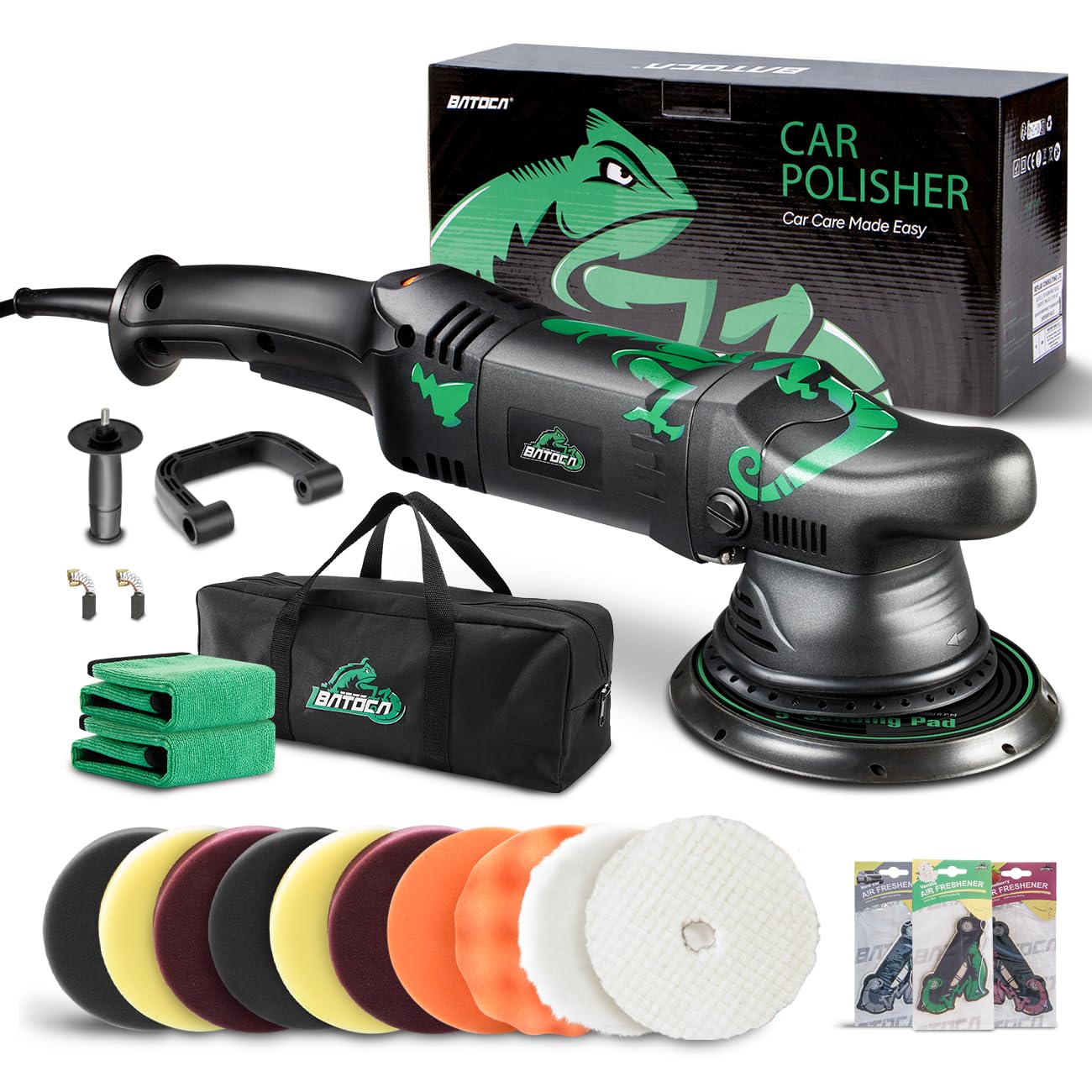
The BATOCA is the only unit in this lineup that ships with everything needed for a first detail out of the box: six-inch flat foam pads, wool pads, polishing bonnets, sandpaper discs, a microfiber towel, disposable gloves, and both a straight handle and a D-handle. The eccentric shaft design uses low-amplitude vibration to work wax into the paint surface without heavy arm pressure, making it forgiving for first-time users who have not yet developed consistent pad technique.
The 700-watt pure copper motor runs at six speeds from 1,000 to 3,800 OPM — a slower top end than the Griot’s or Adam’s machines, but the reduced RPM prevents novices from burning paint by running at excessive speed. The green chameleon body design is purely cosmetic but the ergonomic front grip and curved body keep the tool balanced during overhead work. The kit includes a pair of replacement carbon brushes for periodic maintenance every six months.
Initial pad stiffness is a noted characteristic — the included foam pads require a short break-in period before they soften and conform to body contours. Experienced users may find the 3,800 OPM cap insufficient for aggressive cutting with microfiber pads, but for the price point that includes a full accessory set, the BATOCA delivers immediate value for a weekend detailer.
Why it’s great
- Complete kit includes pads, towels, and replacement brushes
- Low 1,000-3,800 OPM range is safe for beginners
- Includes both D-handle and straight handle options
Good to know
- Foam pads are stiff initially and need break-in
- Maximum OPM lower than competition for heavy cutting
6. Rupes LHR 15ES Big Foot Random Orbital Polisher

Rupes engineered the LHR 15ES with a 500-watt motor that prioritizes smoothness over raw torque. The proprietary anti-spinning feature prevents the pad from rotating at high speed when off the paint — this eliminates the risk of flinging compound across the garage and reduces the chance of buffer swirls during the lift-off phase. The soft-start acceleration ramp means the pad does not jerk on startup, giving you a clean, predictable engagement with the surface.
The 15mm long-throw orbit covers large panels quickly while the low-vibration chassis makes the tool feel balanced even during one-handed operation on horizontal surfaces. The variable speed dial is positioned so you can adjust it mid-stroke without removing your hand from the main grip. The 5-inch backing plate matches the long-throw geometry, keeping pad edge grab minimal on fender curves and mirror caps.
At 500 watts, the motor is less aggressive than 1000-watt alternatives when cutting hard clear coats — you may need additional passes with a heavy-cut compound to remove deep sanding marks. The ergonomics and lack of vibration, however, make this the easiest long-throw machine to use for eight-hour shifts. The cord is also the longest of any unit tested, reducing the need for extension cables.
Why it’s great
- Exceptional vibration control for fatigue-free long sessions
- Anti-spin feature prevents pad rotation off the paint
- Longest power cord of any polisher in this guide
Good to know
- 500W motor less effective on hard OEM clear coats
- Requires separate purchase of pads and compounds
7. Milwaukee M18 Fuel 15mm Random Orbital Polisher

The M18 Fuel is the only cordless option in this roundup, and it delivers legitimate 15mm long-throw correction power thanks to a brushless motor that produces consistent torque from 2,650 to 5,100 RPM. The variable-speed trigger gives you on-the-fly speed modulation — squeeze harder for cutting passes, ease off for finishing — without needing to touch the dial. Users report that a 6.0Ah battery can complete an entire track car correction on a single charge.
The 8-speed dial combined with the variable trigger provides fine-grained control from 2,650 RPM (ideal for spreading sealant) up to 5,100 RPM (defect removal). The premium electronic feedback maintains speed and power under load, so the pad does not stall when you press into a deep scratch. The lock-on switch reduces thumb fatigue during extended buffing, and the overall ergonomics are designed for users who already own Milwaukee M18 batteries.
Purchase price is bare-tool only — you must supply your own M18 battery and charger, which adds significant cost if you are not already invested in the Milwaukee ecosystem. The 15mm orbit also demands careful pad-angle discipline, as the longer throw can induce micro-marring if the pad is held at an aggressive tilt. For anyone who values mobility over corded power, however, this is the most capable cordless random-orbit machine available.
Why it’s great
- Full cordless freedom with pro-level 15mm orbit power
- Variable-speed trigger for instant speed adjustment
- Impressive battery life on a single 6.0Ah charge
Good to know
- Bare tool — battery and charger sold separately
- 15mm orbit requires careful pad angle control
FAQ
Can a beginner use a 15mm long-throw polisher safely?
What size backing plate should I use with a 9mm polisher?
How often should I replace the carbon brushes in my detailing polisher?
Why does my dual-action polisher stall when I press down on scratches?
Final Thoughts: The Verdict
For most users, the best detailing polisher winner is the Griot’s Garage G9 because the 1000-watt motor, excellent vibration dampening, and safe 9mm orbit deliver professional results without requiring a professional budget or a steep learning curve. If you want the raw speed of long-throw correction at a mid-tier price, grab the Maxshine M15 Pro — it matches Rupes-level performance at half the cost. And for cordless mobility without compromising on 15mm correction power, nothing beats the Milwaukee M18 Fuel, provided you already own M18 batteries.

Mo Maruf
I created WellFizz to bridge the gap between vague wellness advice and actionable solutions. My mission is simple: to decode the research and give you practical tools you can actually use.
Beyond the data, I am a passionate traveler. I believe that stepping away from the screen to explore new environments is essential for mental clarity and physical vitality.