Our readers keep the lights on and my smoothie glass nicely filled. As an Amazon Associate, I earn from qualifying purchases.
That showroom shine you chase after hours of buffing often gets ruined by hazy residue, stubborn micro-marring, or a polish that dusts out mid-cycle. A high-quality finishing polish is the single variable that separates a decent wax job from a defect-free, glass-like reflection — especially on dark or sensitive paint.
I’m Mohammad Maruf — the founder and writer behind WellFizz. My research process for this guide involved analyzing abrasive technology, particle size consistency, and lubricity data across dozens of formulations to identify which actually eliminate swirls and holograms without filling them.
This guide evaluates five dedicated finishing polishes designed for paint correction. Each was examined for dusting tendency, working time, gloss depth, and compatibility with dark paint. The goal is to help you select the best detailing polish for a flawless, defect-free final finish tailored to your paint type and skill level.
How To Choose The Best Detailing Polish
Selecting a finishing polish requires more than grabbing the most popular bottle. The abrasive particle type, cut level, and chemical composition all determine whether you get a pure optical finish or introduce new defects. Below are the critical factors that should drive your decision.
Abrasive Grade and Particle Technology
Finishing polishes typically use aluminum oxide or ceramic abrasives with a grit rating equivalent to 2500 to 3000 or finer. A uniform particle shape — often described as “optical grade” — ensures that the abrasive breaks down consistently, leaving no micro-scratches. Products with irregular or poorly graded particles can create haze on dark paint that requires a second polishing step to remove.
Working Time and Lubricity
A polish that dries out too quickly forces you to buff a dried layer, which risks burning the clear coat and leaves stubborn dust in panel gaps. High-lubricity formulas offer extended buff cycles, allowing the abrasive to fully break down before you wipe off. This is especially important in warmer conditions or when using a dual-action polisher on larger panels.
Silicone and Oil Content
Silicone-free polishes are essential if you plan to apply a ceramic coating, PPF, or a high-end sealant afterward. Silicone-based fillers can bond to the paint surface, preventing proper adhesion of protective layers and causing premature failure. Pure finishing polishes that rely on abrasives rather than fillers deliver permanent correction without compromising later steps.
Quick Comparison
On smaller screens, swipe sideways to see the full table.
| Model | Category | Best For | Key Spec | Amazon |
|---|---|---|---|---|
| Meguiar’s M21032 Ultra Pro | Finishing Polish | Highest gloss on dark and sensitive paints | 32 oz, 240 grit fine abrasive | Amazon |
| Griot’s Garage BOSS Correcting Cream | Medium-Cut Polish | Moderate defect removal plus gloss | 16 oz, 120 grit medium abrasive | Amazon |
| KOCHCHEMIE Fine Cut Compound | Fine-Cut Compound | Medium defects on weathered paint | 8.45 oz, medium/fine aluminum oxide | Amazon |
| Chemical Guys V38 Optical Grade | Finishing Polish | Light defect removal by hand or machine | 16 oz, 2500 grit ceramic abrasive | Amazon |
| Menzerna Super Finish Plus 3800 | Finishing Polish | Mirror shine on dark-colored coats | 8 oz, medium aluminum oxide grit | Amazon |
In‑Depth Reviews
1. Meguiar’s Professional Ultra Pro Finishing Polish M21032
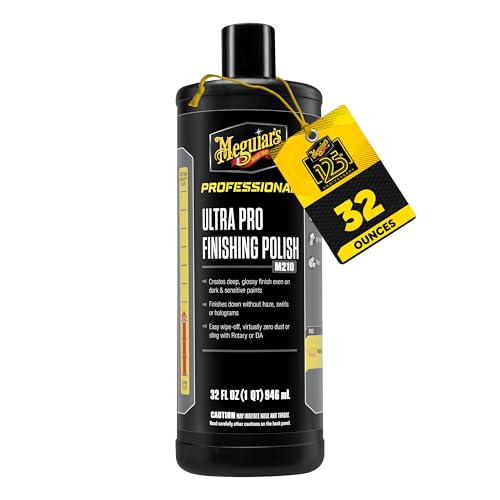
Meguiar’s M21032 represents the brand’s highest gloss finishing polish, formulated with a 240-grit fine abrasive designed to remove swirls and rotary holograms without leaving micro-marring on dark or sensitive paints. The polish applies smoothly with minimal dusting, and its extended working time allows the abrasives to break down fully before wipe-off — a critical advantage on large panels like hoods and roofs where heat can accelerate drying.
Real-world testing on black Tesla paint and 30-year-old single-stage finishes confirms that the polish delivers a mirror-like finish without requiring a follow-up step. Users pairing it with a firm white polishing pad achieved defect-free results on soft paint that had previously swirled with gentler pads. The 32-ounce bottle provides substantial volume for multiple correction jobs or for use in a professional shop setting.
Because it is a pure abrasive polish without silicone fillers, the M21032 is safe to use before applying ceramic coatings or sealants. The formula leaves no oily residue that could compromise bonding, making it suitable for detailers who want a one-step finishing polish that both fixes haze and preps the surface for protection. The only trade-off is that its fine cut requires a separate compounding step for deeper scratches.
Why it’s great
- Highest gloss production from a single finishing step on dark paint
- No silicone or fillers, so it’s coating- and sealant-safe
- Extended working time with minimal dusting on rotary or DA polishers
Good to know
- Requires a firm foam pad for best results on soft paint
- Fine cut only; needs a separate heavy compound for deep scratches
2. Griot’s Garage BOSS Correcting Cream

Griot’s Garage BOSS Correcting Cream occupies a unique position in the finishing polish category — it uses a 120-grit medium aluminum oxide abrasive that removes moderate swirls and light scratches while still refining the surface to a deep, clear gloss. The high-lubricity formula extends the buff cycle, preventing the cream from drying out and dusting, which makes it forgiving for both novice and experienced detailers.
Users report that the cream restored 12-year-old black Acura MDX paint to a mirror finish after four to five passes per panel with a microfiber cutting pad. The product also showed surprising versatility outside automotive use — one detailer used it to restore 40-year-old acrylic turntable covers, removing water stains and cloudiness without leaving a pink tint that some polishes impart. The lack of heavy dusting, even when the pad was slightly overloaded, reduced cleanup time significantly.
Because the BOSS system allows you to pair the correcting cream with different pad firmness levels, you can dial in aggressiveness — use a stiffer pad for deeper defects or a softer pad for light polishing. The 16-ounce bottle is a practical size for a full-car correction, and the cream works equally well with dual-action and rotary machines. The main limitation is that it is not a pure finishing polish; if you only need haze removal without any cut, a finer polish may be more appropriate.
Why it’s great
- Removes moderate swirls and scratches while producing a high-gloss finish
- Extended buff cycle with minimal dusting, even in warmer conditions
- Pad-system compatible — adjust aggressiveness with pad choice
Good to know
- Medium cut means it is not a pure finishing polish for final gloss only
- Best results require a pad with moderate cutting ability
3. KOCHCHEMIE Fine Cut Polishing Compound

KOCHCHEMIE’s Fine Cut Polishing Compound uses intelligent grain-size aluminum oxide technology that removes medium to heavy defects, including sanding marks from 2500-grade sandpaper, while leaving a deep, long-lasting sheen. The silicone-oil-free formula is designed for all paint types and is particularly effective on heavily weathered paintwork that needs both correction and refinement in one step.
Users report that the compound removed transport marks from a new BMW hood using only a Rupes fine polishing pad, leaving an excellent shine with very little haze and minimal dusting. Another detailer used it with an orange pad followed by Rupes ultra-fine polish on truck paint, removing deep scratches and cover marks in a few hours. The 8.45-ounce bottle is smaller than most competitors, but the compound’s cutting efficiency means you use less product per panel.
Because it sits between a cutting compound and a finishing polish, the Fine Cut Compound is ideal for detailers who want to consolidate steps. It corrects deeper imperfections than a pure finishing polish but still refines the surface enough that you can move directly to a sealant or coating. The trade-off is that its slightly higher cut means it may leave micro-haze on extremely soft paint if not followed by an ultra-fine polish.
Why it’s great
- Removes medium defects and sanding marks up to 2500 grit in one pass
- Silicone-oil-free, safe for coating and sealant application
- High cutting efficiency reduces product usage per panel
Good to know
- Small 8.45-ounce bottle may not cover a full large vehicle
- May require an ultra-fine finishing polish on very soft clear coats
4. Chemical Guys V38 Optical Grade Final Polish

Chemical Guys V38 Optical Grade Final Polish is built around a 2500-grit ceramic abrasive that removes light paint defects such as fine swirls, holograms, and 2500-3000 grit sanding scratches without filling or covering them. The ceramic abrasive provides a uniform breakdown that leaves a true, permanent correction rather than a temporary wax-based hide.
Users report that the polish corrected hazy scratches on a Volvo hood after aggressive sap removal, applied by hand with periodic water misting over 20 minutes. Another detailer used it after a dealer buffing incident that burned clear coat on a new car, restoring the door to undetectable condition. The polish applies well with both rotary and dual-action machines, though hand application is also viable for small touch-up areas.
Because the V38 is a pure optical-grade polish, it contains no waxes or sealants, making it a true finishing step that must be followed by protection. The 16-ounce bottle is a generous size for home use, and the ceramic abrasive resists clogging pads as quickly as some aluminum oxide polishes. The main limitation is that it offers very little cut — it will not remove moderate scratches or oxidation without a preceding compounding step.
Why it’s great
- Optical-grade ceramic abrasive leaves a permanent, non-filled finish
- Removes holograms and light sanding marks effectively
- Works well by hand or machine, even for non-professionals
Good to know
- Very light cut; requires a separate heavy compound for deeper defects
- Needs damp application; dry pads can cause the polish to skip
5. Menzerna Super Finish Plus 3800
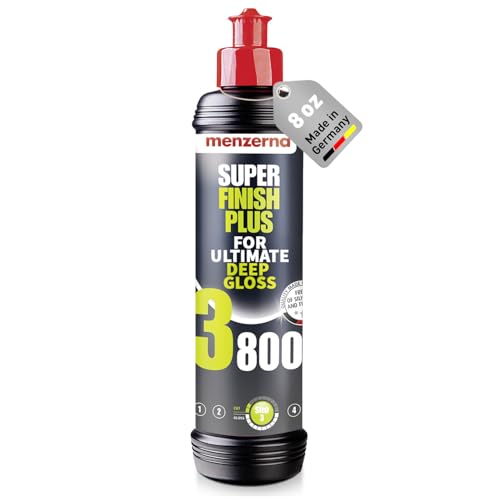
Menzerna Super Finish Plus 3800 is a dedicated finishing polish designed to remove micro-scratches and holograms while producing a mirror-like shine, with particular strength on darker paint colors. The medium aluminum oxide abrasive provides a balanced cut that removes light defects without risk of burning through thin clear coats, and the silicone-free formula ensures compatibility with any follow-up sealant or wax.
Users report that the polish removed micro-abrasions and holograms from black paint when used with a rotary at low speed and a red jeweling pad, leaving the paint crystal clear. Another user described it as a cross between a polishing compound and a polish — it provides deep gloss enhancement without abrasive cutting ability, meaning it is best used after a heavier compound. The working time is long enough for careful machine work, and the polish does not dry out prematurely, reducing dust buildup.
The 8-ounce bottle is a compact size that is ideal for spot correction and touch-up work, though it may not be enough for a full-vehicle finishing pass. The product requires thorough paint decontamination beforehand to achieve the best gloss depth, and because it offers no paint protection, you must follow with a wax, sealant, or coating. Beginners will appreciate the forgiving working time and easy wipe-off.
Why it’s great
- Produces a deep, mirror-like shine on dark and black paint
- Long working time with minimal dusting for beginner-friendly use
- Silicone-free, safe for use before coatings and sealants
Good to know
- 8-ounce bottle size is small; may not suffice for a full vehicle
- No abrasive cutting ability; requires prior compounding for defects
FAQ
Can I use a finishing polish by hand instead of with a machine?
How do I know if a polish is silicone-free?
What pad should I use with a finishing polish on dark paint?
Final Thoughts: The Verdict
For most users, the best detailing polish winner is the Meguiar’s M21032 Ultra Pro because it delivers the highest gloss on dark and sensitive paints with zero silicone interference and minimal dusting during extended buffing. If you want a versatile cream that removes moderate defects alongside gloss enhancement, grab the Griot’s Garage BOSS Correcting Cream. And for a premium fine-cut compound that handles medium defects on weathered paint, nothing beats the KOCHCHEMIE Fine Cut Polishing Compound.

Mo Maruf
I created WellFizz to bridge the gap between vague wellness advice and actionable solutions. My mission is simple: to decode the research and give you practical tools you can actually use.
Beyond the data, I am a passionate traveler. I believe that stepping away from the screen to explore new environments is essential for mental clarity and physical vitality.